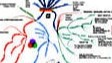
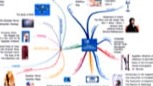
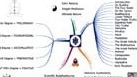
The project began in 1981, when, at the age of twenty, I wrote the Dutch monograph Sketches of an Absurd World View. Its dark and nihilistic tone belonged to an early phase. In 1982, the practice of yoga opened another horizon and initiated my sustained interest in transpersonal experience.
In 1987, I wrote the Proto-Tractatus Logico-Comicus, a short English text that made the first attempt to systematically organize my thoughts. This was a map of questions and directions that would occupy the following decades. One orientation remained constant : matter, information, and consciousness are understood as irreducible yet interdependent operators. None can be reduced to either of the other two without generating problems.
This threefold framework opposes ontological materialism and ontological mentalism while allowing scientific, philosophical, and transpersonal inquiry to retain their distinct methods and objects.
On April 9, 1996, the project first appeared online as Report on Studies in Philosophy. The Internet made it possible to publish the studies freely, interact with others, and to revise them as the work developed.
Criticism remains crucial. This normative branch of philosophy supplies the normative controls governing conceptual inquiry. Epistemology, aesthetics, and ethics establish the conditions under which claims to truth, beauty, and good action can be judged. They thereby regulate immanent metaphysical speculation without themselves depending on metaphysical foundations.
Ancient Egyptian Studies, the Buddhadharma, mysticology, neurophilosophy, and other auxiliary inquiries gradually enlarged the project. Philosophy remained central.
The work developed independently of institutions, doctrinal allegiances, and academic pressures. Its governing attitude was what Multatuli called 'free study’ : inquiry answerable to its subject and critical controls rather than to any imposed authority.
In 2006, the study and practice of the Buddhadharma became a decisive part. Its contemplative and philosophical resources made possible a more coherent articulation of the cognitive and existential aspects of mystical and holotropic experience.
The website and the books published from it preserve successive stages of this continuing inquiry.
Three Ways to Explore the Project :
Web Studies
The web studies form the first and most provisional layer of SOFIATOPIA. They preserve successive stages of the project and remain freely accessible for consultation.
Print-on-Demand Books (POD)
The print-on-demand books offer the most developed and sustained formulations of the principal philosophical, Buddhist, and Ancient Egyptian studies.
PDF EBOOKS
The PDF EBOOKS provide digital access to many of the same works in a portable format.