| |

Studies
in
Buddhadharma
On
Buddhist Tantra
Contents
SiteMap

"This space within the heart -
therein is the person, consisting of mind, immortal, resplendent." -Taittirîya Upaniśad, 1.6
"There are those whose
capacity of the Mahâyâna lineage is not meagre, whose minds are strongly
moved by great compassion through having trained in the common path
sustained by a spiritual guide, and excellent protector. They are in great
haste to free from cyclic existence the kind mothers wandering there. They
should enter the short path, the profound Vajra Vehicle that quickly
bestows the state of a Blessed Buddha, the sole refuge of all sentient
beings."
Tsongkhapa : The Great Exposition of Secret Mantra, part one,
Reasons for Faith.
"But in the first place, it is the one method of producing Heruka, and it
is by such production that men are relased, O Vajragarbha of Great
Compassion."
The Hevajra Tantra, chapter 1:10.
"Seeing this excellent yoga supreme, the others are like worm-infested
straw."
The Cakrasamvara Tantra, chapter IV.
Hindu
Tantra : An Appraisal
The Rise of Buddhist Tantra
Requisites for Mahâyâna Tantra & General Principles
The Four
Tantra Sets : Levels of Desire
Guru Yoga : Outer, Inner & Secret
Generation Stage Yoga and Deity Yoga
Completion Stage Yoga
and
Inner
Fire Yoga
Critique of Tibetan Buddhist
Tantra
The
Mandala of the Navayâna
The
Subtle Body
& the Harmony of Li & Kan
Towards A Pan-Erotic Tantra
|
|

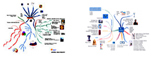
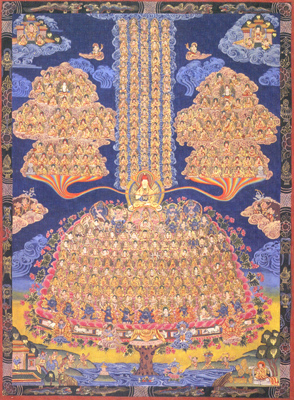
Left : Tangkha of Medicine
Yoga
with the Seven Wheels used in Completion Stage Tantra
Right : Buddhist
Channels, Wheels & Drops.
|
|
OM EVAM EKA TANTRA SIDDHI
HUM !
|
Referring to the idea of one active underlying principle
("eka"), the
Sanskrit word "tantra" means "weft, loom, warp, context, continuum". In
Tibetan, "tantra" is known as "ju" ("rgyud"), meaning "thread,
string", or "that which joins things together".
In this case, the "joining" intended is the "melting" of the "white drops"
(in the crown-wheel) under the influence of the "inner fire" produced by
the "red drops" (in the sacral wheel), allowing the six knots of the
heart-wheel to loosen, enabling consciousness to recognize the Clear Mind
of the "indestructible drop", placing the "great seal" (mahâmudrâ) on
every phenomenon. This is the joining of "heaven" and "earth", resulting
in the enlightened mind.
In Tantra, the underlying principle is the quality of oneness ("eka"). Hinduism, contrary to the three Abrahamic faiths, remained
more
henotheist than
monotheist. Moreover, for Tantra, the
underlying principle is not passive, remote or uninterested in mundane,
nominal, conventional existence. On the contrary, all possible activity is
its actual display or play ("lila"). There is no "mundane" existence. Nor is there a
"transcendent" existence. There is one pan-sacral reality (the One Thing).
To call it "Brahman", "Dharmakâya" or "Tao" does not eclipse the underlying
nameless principle itself.
Historically, Buddhist Tantra was introduced by
Mahâyâna Buddhism by the 2nd
century CE. Some insist the Tantras are not actual teachings of the
Buddha. Others, for good reasons, assert they originate from the Hindu tradition.
There are even those who claim Hindu Tantra was derived from Buddhist
Tantra ! Traditionally,
the origin of Buddhist Tantra is supposed to be rooted in the Fourth
Turning of the Wheel by
Buddha Śâkyamuni and meant for
superior practioners. Namely those who integrated the First, Second &
Third Turnings and realized the nondual "seeing" of emptiness (on the
first "bhûmi" & higher).
With the rise of the Pâla dynasty of Bihar & Bengal (760 - 1142 CE),
Buddhist Tantra became a systematic body of teachings from the 8th century
onwards, entering Buddhist universities. At that point, Buddhist Tantra was "purged"
from explicit sexual acts
(internalized) and formalized. Antinomian (and a-social, transgressive) elements were deemed part of a
"logic of reversal" -steeped in doublespeak & a "twilight language"-
necessary for speeding up spiritual evolution. Invoking, in a monastic
context, afflictive &
non-afflictive emotions (like anger, hatred, cruelty, arrogance, pride
etc) was possible (albeit highly ritualized & mostly visualized). But explicit sexuals acts
were replaced by an erotic symbolism expounding the unity of compassion (the
ultimate
method to accumulate vast
merit) and
emptiness,
realized by wisdom-mind.
In Tibetan Tantra, this is called "yab-yum", or "father-mother" unity,
i.e. a male Buddha with his female consort. Monks vowing to
be celibate, mostly replaced this wisdom-consort (the woman with whom the
tantric has sex) with internal processes (sensualisations). However, in
the Highest Yoga Tantra, actual erotic contact is crucial and thus
deemed necessary !
The fact Tantra integrates desire into the path remained. Indeed,
instead of denying one the nature of the fire of the desire realm, wherein
"all dharmas are on fire", the tantric makes desire appear together with
emptiness. Desire becomes the highest "method" denied self-subsisting,
self-powered substance by a ever-present wisdom realizing the ultimate
nature of all possible phenomena : lack of substance but presence of
process. This said, without compassion (revealing this process) and a
generic image (concept) of emptiness (the culmination of the Path of
Preparation), Tantra is dangerous, leading to a hellish rebirth. This is
why Tsongkhapa stressed prelonged emptiness meditations before entering
the tantric path.
In Tibet, Buddhist Tantra became strongly interlinked with specific yogic
techniques, in particular Inner Fire Yoga,
making the "winds" enter, abide and cease in the central channel of the
subtle body (the so-called "Vajra Body"), and the preparation of this
crucial event in Deity Yoga. The importance of fire and
the "flame of Agni" goes back to the Vedic seers (cf. the Keśin Hymn from
the Rig Veda), while the Yogas for "moving the winds" may go back
to Chinese (Taoist) sources.
Indeed, the importance & influence of the latter must be taken into
account. Indeed, using Chinese information (from Inner Alchemy and Ch'i
Kung, especially the harmony between Wei Dan & Nei Dan manifest in the
enlightened ones as the energetic balance between Li -Fire- and Kan
-Water-), enables the Navayâna (new vehicles) to develop novel tantric
techniques and better understand the traditional accounts (in particular
those related to the "white" and "red" drops). This may revolutionize
Buddhist Tantra, making it more operational & less symbolic (restoring the
original intent, ripping away cultural overlay & monastic impoverishment).
"Tantrayâna" or "Vajrayâna" did not introduce a new view on reality and
is based on the same
wisdom realizing
emptiness as the
Great Perfection Vehicle.
The crucial difference is one of method only.
By filling the two "baskets" of merit (compassion) &
wisdom (insight into reality) simultaneously (not sequentially), a crucial treshold, after which
final enlightenment is attained speedily, can be reached with greater ease.
This technique it at the heart ("om") of all tantras ("tantra"), and is
represented by the union ("eka") of wisdom ("e") and method ("-vam"),
leading to the highest powers ("siddhi") & Buddhahood (bodhi), never
leaving the mind prehending emptiness ("hum").
Calling,
in the Great Perfection Vehicle, for three countless aeons of hardship,
according to Tibetan sources, the goal of Tantra, Buddhahood, can be attained in
one lifetime or less (three months ?) of relatively comfortable practice.
In Chinese Inner Alchemy & Ch'an Ch'i Kung (Da Mo), the foundational
practices took hundred days and the method could be completed in at least
three years, if not longer (depending on money, partner, techniques &
place).
Let it be clear the Fourth Turning is exceptional. To give his tantras,
Lord Buddha appeared as Vajradhara in the minds of Superior Bodhisattvas.
In the tantric method, the conditions are set for swift, irreversible &
radical transformation of impure body, speech & mind into pure
(enlightened) body, speech & mind (this is called "producing Heruka" and
is considered the supreme yoga). The more this production-process, method
or exceptional skillful means is perfected, the more powerful the
"tântrika" becomes, i.e. is able to liberate others by the Four
Divine Deeds of pacification, increase (decreace), control & wrath
(destruction). Turned into one with magical feats ("siddhis"), this
Superior Bodhisattva only seeks to benefit all sentient beings.
Buddhist Tantra survived in Tibet and in the Shingon school of Japan.
It never grew well on Chinese soil.
Tibetan Buddhism integrated the complete
Buddhayâna or Buddha's path to
enlightenment (including. Secret Mantra Vehicle). With the 1959 exodus of the XIVth Dalai Lama to India and
the arrival in the West of lots of senior Tantric Lamas (ofter formely part of the ruling 5% of Old Tibet), Buddhist Tantra came to be practiced by Western
practitioners. This allows one to study, reflect & meditate on the
effectiveness of these Tibetan-styled tantras for the Western mind.
It is hoped this work results in a Western-style Buddhist Tantra to emerge and
grow. This Tantra, part of the Navayâna", would integrate Western science
(physics, cosmology, neurology, anthropology, philosophy), Chinese Ch'i
Kung (both Inner as Outer), Taoist Inner Alchemy and of course traditional
Buddhist Tantras (the Tibetan Kangyur contains translations of
almost 500 tantras) ... |
Hindu Tantra :
an Appraisal
On the one hand, there are those who consider Hindu Tantra to be the "fifth
Veda", i.e. a continuation of the four
Vedas and the subsequent Brahmanical religious texts based on them, the Brâhmanas,
the Âranyakas, the Upaniśads, the Purânas and the
Bhagavad-Gitâ. In this view, Tantra is one of the corner-stones of the "eternal
religion" ("sanâtana-dharma") of
Hinduism. The continuity between the
Vedic revelation and Tantra is deemed undeniable, and this despite the
fact both are like mighty companions, each with a distinct tradition.
On the other hand, as the
Rig Veda, the Brâhmanas & the Âranyakas hold no
systematic view on Yoga & Tantra, other scholars, collating iconographical,
archeological, anthropological and textual evidence, conjecture the
earliest practices, defined as specific techniques for operating body & mind
(cf. as "technologies of the self" - Foucault),
were developed by the renegade ascetics of the early Śramana
Movement (ca. 6th & 5th century BCE), i.e. a few centuries before the
Buddha.
Although the Keśin Hymn (Rig
Veda, X.136) mentions "breath" and the "fire & poison"
endured by the extraordinary figure of the "long-haired one", called the
"wind's steed", and the Rig Veda as a whole offers little textual evidence for an early Vedic system of Yoga or Tantra,
let us assume both disciplines were not yet distinct & differentiated, as
it were resonating waves in the continuum of the trance-consciousness of
the Vedic shaman-seer. Early Vedic techniques focused on visionary
revelation of sacred knowledge (as hymns & statements), used in ritual
contexts. Possibly Soma-induced, this Shamanism was
eventually lost.
The (re)emergence in the late Vedic period, around the 6th century BCE, of an ascetic movement inspired by
the Vedas, coincided with the redaction of the
Upaniśads. In fact, the latter may have been composed by these
new groups of ascetics. In these texts, union with "the One",
hylic pluralism and the subtle anatomy
with its sheets, channels, wheels and breaths are mentioned. These authors
return to the imagined life of the Vedic seers, and experience the visions
for themselves, i.e. directly, without intermediaries. As ritualists, they
offered fire and sought rebirth in (the Vedic) heaven.
In the early Upaniśads,
perhaps as early as the 6th century BCE, Yoga (as a way to change
the mind) as well as Tantra (as the way to use the powers resulting from this
change) are present. These texts are very important, for
they show a century-old interest in direct spiritual experience. While
Yoga appears as a system to attain enlightenment, Tantra seems more
occupied with the powers ("siddhis"). Yoga leads to the goal, while Tantra
manifests realization.
At the time of Siddhârtha Gautama (ca. 563 - 483 BCE), various groups practiced
renunciation (recently, scholars date the "parinirvâna" of the Buddha ca.
400 BCE !). Some of these "wandering" non-Vedic, heterodox ascetics were
in the process of becoming more integrated (with resulting discussions and
conflicts between various views). Gautama followed their ways (austerities
& the meditative "jhânas"), but found these unsatisfactory. His disciples
did not keep a Vedic fire and wanted release from
rebirth as such. They dropped the whole theo-ontology of Brahmanism and
the Vedas.
The Hindu Tantras were
foremost associated with Śiva, a deity who always retained a transgressive
side. We may conjecture the first Śaivite ascetics (leaving the "vrâtyas", the Vedic
"fighting men" aside) were the "Pâśupatas", first
mentioned in the Mahâbhârata. They were held to achieve the magical
powers of a "siddha" (an "accomplished one"). Their legendary founder,
Lakulîśa or Nakulîśa, is placed ca. 100 CE, but these ascetics might as
well have existed earlier.
In a general way, the history of early Hindu Tantra is at present
impossible to trace. Rooted in a variety of techniques, some of which are
clearly transgressive, and in ritual magic, it acquired
its typical Śaivite form by the fourth century CE. By contrast, the
earliest, unsystematic Buddhist Tantra saw the light in the early 2nd century CE,
while the first systematic versions, increasingly integrating
transgressive elements, emerged in the 6th & 7th
centuries. These dates made some authors (like Govinda) speculate Buddhist
Tantra brought Hindu Tantra into being ! This seems farfetched ...
Apparently, Buddhist & Hindu Tantras were more or less co-emergent. The
Hindu Tantrics formed centres for highly cultivated experts in various
branches of the "inner science" ("adhyâtmavidyâ"). The
(later) Buddhist Tantrics
belonged to the great Buddhist monastic "universities" ("vidyâlaya").
Hindu Tantra has three major components :
-
the identification with a fierce, transgressive male
resident deity such as Śiva (placed in a residence "mandala") ;
-
the cult of the fierce goddess ("Śakti") burning the
knots in the subtle channel connecting her with her spouse and
-
a "subtle body" Yoga, involving the conscious
manipulation of "prâna" or the subtle energy (wind) upon which the mind
"rides", causing accomplishments - a "siddha" has paranormal powers and
can perform the Four Divine Actions of pacification, increase, control &
destruction.
The art of circulating life-force may have been derived
from Chinese Taoism ("chi'"),
although the underlying "subtle anatomy" can be found in the earliest
Upaniśads (like the Taittiriya Upaniśad, dated to the
fourth or fifth century BCE). The interaction between China & India is
however unmistaken.
The transgressive, antinomian spirit implied rituals involving cremation
grounds, polluting substances associated with sex & death, fierce gods &
goddesses and initiations involving the consumption of the "essences" of
the male Guru and his female consort. The central theme was the union of "Śiva" with "Śakti", of the
masculine (Solar) transcendence with feminine, immanent (Lunar) energy.
Hindu Tantra allowed the Kundalinî-Śakti or "serpent power" (at the base
of the spine) to rise and unite with Śiva at the crown of the head (cf.
Kundalinî Tantra).
In Hindu Tantra, the negative effects of the overall
spiritual degeneration taking place in the dark age ("kali-yuga") must be
countered with powerful, radical methods to break through the attachment
to conventional relationships and worldly concerns. For the "tântrikas",
the Vedas were seen as an earlier revelation which had lost
efficacy ! This notion bordered on "heresy", for the Vedic heritage was
deemed a revelation of the
Divine. But Tantra avoided any direct conflict
by claiming its tradition originated from the same source. The methods
were adapted to the present age in which desire, craving, grasping and
hatred run amok. Confronting afflictive emotions instead of renouncing them, the
tantrics integrated practices unacceptable to the Brahmins.
Antinomianism is the basic feature of Hindu Tantra, i.e. it goes against the law
or accepted norm. These texts refer to going against the grain,
inversion or reversal. This may lead to excentric, extravagant or
extremist behaviors. The contrast with the sober & clean way of life of the
Brahmin could not be more pronounced. Hence, Hindu Tantra developed two
schools : the perilous "left-hand path" of Vâmâchâra, a "kâpâlika-style"
practitioner associated with the skull he wore, devoted to transgressive
practices involving fear, danger, pain & sexuality, and the "right-hand
path" ("dakśinâchâra"), featuring purification rituals and a total
surrender to the Divine Mother ("Śakti" in all her forms).
Although antinomianism runs agains the consolidation of power in outer
architectures (rulers, kings, states), Tantra got associated with the
art & science of dominating the forces of Nature. Identifying the "residence" of the king
as the "mandala" of the resident deity, and amply using military
symbols in their rituals, both point to the importance of these magicians in the affairs of
power, sexuality (marriage, children, etc.), wealth & longevity. Even in Buddhism
(in view of the invading Muslims), Tantra was used to control and if
necessary destroy the enemies of the Dharma (cf. the
Kâlachakra Tantra, covering the whole spectrum of esoteric Buddhism, and
aimed to destroy these barbarians).
Hindu Tantra aims at a vast & profound understanding arising from the
direct experience of higher states of consciousness during meditation &
ecstasy. But the distinction between "vaidika" (Vedic) & "tântrika"
(Tantra) always remained pertinent. Both poles of Hindu spirituality
continued to interact, giving Brahmin worship ("pûjâ") Tantric features,
or explaining Tantric processes in terms of Vedic theology (cf. the pair
"Śiva / Śakti").
The Rise of
Buddhist Tantra
Within the context of Mahâyâna, Buddhist
Tantra gave rise to again a completely new body of texts. The
emergence of this first phase of "Vajrayâna" or "Adamantine Vehicle", the
third phase of Indian Buddhism, dates from the early 2nd century CE
(other names for it are "Tantrayâna" & "Mantrayâna"). Its earliest tantras
are from the "kriyâ" tantra class (Action Tantra) and were translated into
Chinese from the 3rd century. This expansion of the Mahâyâna consists in the adoption of additional techniques ("upâya",
or "skillful means") rather than in wisdom ("prajñâ").
In particular, rituals, specific Yoga techniques & the use of Deity Yoga are outstanding.
Although Buddhists had strong commitments to avoid an inclusive, supreme
deity (introduced in the Kâlacakra Tantra as the "Âdi-Buddha" as late as
the 11th century), they developed a wide range of visualizations of the
Buddhas, intended to bring about their presence. This "buddhânusmriti" or
"recollection of the Buddha", seen in one of the first few Mahâyâna sûtras
to be translated into Chinese in the first century CE, probably a century
after its redaction, evidences the practice of meditation in front of
images or paintings. This visionary procedure may have provided the
mechanism by with Mahâyâna texts were held to be the authentic words of
the Buddhas. But there are no sexual practices, nor transgressive symbols.
Neither does the meditator identify with the visualized Buddha. The first
classes of Buddhist Tantras (Action Tantra & Performance Tantra) can be
understood as later monastic formalization of these early practices.
This "esoteric" Buddhism remained Indian, secretive, not
systematic & a private minority interest until the 8th
century, when, with the arising of the Pâla dynasty of Bihar & Bengal (760
- 1142 CE), the Vajrayâna entered the great universities, and Tantra was
"purged" (internalized) and formalized. This called for the elimination of
Śaivite components, a redefinition of "Śakti" as "prajñâ",
wisdom, and a reduction of sexual practices, arrived at by symbolizing &
internalizing the union between
compassion (the male
method-deity) &
wisdom-mind (the female wisdom-consort). Indeed, the male was
systematically identified with method and the female with wisdom ! However, sexual practices and transgressive
symbolism were never completely eliminated, in fact, sexuality reemerged
as an important factor in the Kâlachakra Tantra, the culmination of the
Buddhist tantric tradition.
Buddhist Tantra
became international. This second phase
marks the origin of the Vajrayâna proper, including its symbolism,
terminology & ritual. The latter is adaptive to circumstance, uses the
"standard" subtle apparatus of Hindu Yoga (the Vajra-body of
winds, channels, wheels & drops), but adds the wisdom of seeing
reality as it is, i.e. without "own-being" ("svabhâva"). It was largely
from the Indian universities at Vikramaśîla and Odantapurî that Buddhism
was then taken to Tibet. There, it was integrated in the
Buddhayâna, to become the pinnacle of the
path to enlightenment (cf. "outwardly Hînayâna, inwardly Mahâyâna, and
secretly Vajrayâna"). This happened in several stages, integrating magical
Tantra (Padmasambhava), Siddha-based Yogas (the Six Yogas of Naropa), and
the Tantras introduced by Atiśa (982 - 1054), Virupa (9th century) and
others.
When Tibetan Buddhism was completely reorganized by Tsongkhapa the Great (1357 -
1419), the monastic vow of celibacy and the Highest Yoga Tantra technique
of attaining Buddhahood by way of sexual union with a wisdom consort, were
harmonized by allowing the monk to become a Superior Bodhisattva, but
only a Buddha immediately after death (hence not needing a wisdom consort
and so not breaking the vow of celibacy !).
Applying Buddhist philosophy to Tantra involved a radical departure
from the realist & idealist Hindu ontologies, rooting the whole
experience in great compassion & the wisdom-mind realizing
emptiness, the
unique features of Buddhism, in particular
Mahâyâna.
Requisites for Mahâyâna Tantra
& General Principles
In terms of understanding reality, Buddhist Tantra does not differ from
the wisdom of the
Great Perfection Vehicle, but introduces, to
realize Buddhahood (the Mahâyâna "nirvâna"),
two powerful new methods, or ways to carry out an action, namely (a) Deity Yoga (generation) and (b) Inner Fire Yoga (completion). These Yogas cause
the two baskets of
merit &
emptiness to be
simultaneously filled (as one result of one technique), and not
separately (as two results of various techniques). Compassion (merit) &
wisdom (emptiness) are gathered together. This quick collection serves as the basis for
a
this-life transformation of impure body, speech & mind of an
ordinary person into the pure body, speech & mind of a Buddha.
Bodhicitta is the necessary condition to practice Buddhist Tantra. To
attempt it without this mind of enlightenment for the sake of all sentient
beings is sheer folly and usually leads to an increase in suffering due to
increased self-grasping & self-cherishing (ego-inflation). Without great
compassion, the quintessence of relative Bodhicitta, it is
impossible for wisdom to arise. The "energy" of merit makes the mind
supple enough to conceptualize emptiness distinctly & clearly. Then
one understands why the Consequentialism of the Middle Way ("Prâsangika-Mâdhyamaka") is
the philosophical viewpoint of the Four Tantra Sets. Inherent existence
("svabhâva") is the target of this view, designating emptiness or
absolute Bodhicitta by way of a non-affirming negation. This theoretical
view on emptiness is "objective" (emptiness is an object of
knowledge) and epistemic (emptiness is the end of substantial instatiation
or reification), identifying "samsâra"
as a state of mind, affirming the functional existence of interconnected
phenomena.
The Tantric Bodhisattva wants to attain Buddhahood for the sake of all sentient
beings as soon as possible. There is no time to waste. To really
help these countless suffering beings, nothing less than Buddhahood will do.
Achieving this in this life, will allow this Buddha-to-be to manifest
countless forms to help & bless others until the whole of "samsâra"
ceases. So all Tantric Bodhisattvas are Sutric Bodhisattvas, while not all
Sutric Bodhisattvas are "tântrikas". Sutric Bodhisattvas possess
Bodhicitta and so are allowed to enter the Vajrayâna.
The Sûtras are called "causal" because they shape the conditions for the
effect, namely Buddhahood. The Tantras as called "resultant" because they
take the result (Buddhahood) into the path (Deity Yoga) before it has been
attained, but anticipate it. Imagining having the abilities of Buddhahood
to be gained in the
future in the present, creates the causes to attain these more quickly.
As long as Bodhicitta is fabricated (i.e. not spontaneous), it needs to be
"generated" and consolidated (by mind training). At some point though,
Bodhicitta comes as natural as breathing. Then the Path of Accumulation is
entered and the Bodhisattva is truly established (ready to take the
Bodhisattva Vow). To perfect the practice of the Six Perfections, further
Insight Meditations into emptiness are required. Bodhisattvas who attain
"superior seeing" (begin the Path of Preparation) are able to establish
emptiness by way of conceptual thought. This enables them to enter the
Tantic path (of generation) and practice Deity Yoga, preparing them for the next stage,
completion. The latter is however impossible to finish without having
entered the Path of Seeing and established, during meditative equipoise, a direct experience of
emptiness devoid of conceptualization.
In the completion stage of Highest Yoga Tantra, Inner Fire Yoga makes use
of the subtle anatomy of the body (cf.
hylic pluralism), consisting of subtle
winds ("prâna"), channels ("nâdîs"), energy wheels ("chakras") and seminal
drops ("bindu"). To produce bliss, this Yoga aims to bring the winds into the
"central" channel and make (by means of vase breathing) the
"drops melt", while Deity Yoga, the core technique of
generation stage Tantra, prepares for this crucial event. To achieve
Buddhahood with Action Tantra, Performance Tantra or Yoga Tantra, Deity
Yoga is coupled with other Yogas than Inner Fire Yoga. In these lower
Tantras, the process of transformation can however not be completed in one
lifetime. Only Highest Yoga Tantra offers this !
As the subtle body is the
energy-matrix underpining all physical processes, wrong techniques may
damage this fine network, causing reduced immunity, disease, shortened
lifespan, insanity or sudden death (cf. "wind" disease). By contrast, a successfull tantric,
besides being very compassionate,
has strong health, feels & behaves youthful, has a prolonged lifespan,
extraordinary mental capacities
and is able to choose where he or she will be reborn.
The Four Tantra
Sets : Levels of Desire
The Gelugpa explanation of the Four Tantra Sets, constituting systems of
analogy, involves the intensity with which desire is satisfied. Desire is
the overruling quality of
cyclic existence as
experienced by the six
classes of sentient beings of the Desire Realm in general, but manifests
in the human world as strong attachment, the exaggerated desire for what pleases
and the exaggerated desire to avoid was displeases. Therefore, in Tantra,
desire is the "prima materia" to be transformed into wisdom.
In accord with the late Indian Buddhist
classification of philosophical trends in four views (analytical,
traditional, experiental & centrist), the Tantras are usually divided in
four classes : Action ("kriyâ"), Performance ("caryâ"), Yoga ("yoga")
&
Highest Yoga ("anuttarayoga"). The first three are also called "lower
Tantras", the last set "higher tantra". In the Tibetan Old Translation School (the Nyingmapas), Highest
Yoga Tantra is further subdivided in Father Tantra, Mother Tantra &
Non-Dual Tantra.
Each level of intensity of desire is associated with a level of
interiority (note how higher levels of desire-satisfaction call for higher
levels of interiority, causing sexual union to correspond with complete
interiority) :
-
Action Tantra :
practitioners delight in external ritual over yogic concentration =
partners in love laughing at each other ;
-
Performance Tantra
:
practitioners delight in external ritual & internal yogic concentration
equally = partners in love mutually gazing at each other ;
-
Yoga Tantra :
practitioners delight inner yogic concentration over
external ritual = partners in love holding hands ;
-
Highest Yoga Tantra
:
practitioners delight in internal yogic concentration = partners in love
sexually unite.
There are many unorthodox analogical schemes. In his Ngagrim Chenmo
(Great Discourse on Secret Mantra), Tsongkhapa argues against the idea
Action and Performance Tantras curtail Deity Yoga by eliminating
Self-generation. For him, all Tantras involve Deity Yoga, and Deity
Yoga implies Self-generation. The threefold correspondence prevalent in
Buddhist Tantras (body, speech, mind) suit the Four Tantra Sets well :
-
Action Tantra
:
practitioners primarily purify the body by way of external ritual
realizing its emptiness (external washing) - the Deity is a superior, not
an equal ;
-
Performance Tantra
:
practitioners primarily purify speech by way of the interaction between
external ritual and internal concentration realizing its emptiness (inner
washing) - the Deity is not yet an equal, but more like a senior family
member ;
-
Yoga Tantra :
practitioners primarily purify mind by way of internal concentration
realizing emptiness (secret washing) - the Deity is treated as an equal,
a peer ;
-
Highest Yoga Tantra
:
practitioners purify & unite body, speech & mind by way supreme internal
concentration realizing their emptiness (ultimate washing) - the Deity and
the tantric are one being.
ACTION TANTRA primarily focuses on ritual activity :
outer conduct, ablution, offerings, cleanliness, eating & drinking codes,
clothing etc. To overcome the separation between ordinary
(conventional) life and the Divine (in the form of the Deity), one
conforms to a way of purity in attire & conduct, visualizing the Deity and
recollecting the emptiness of one's own ego. Traditionally, some Action
Tantras position the Deity only outside of oneself, and foster the notion
of inferiority to the Deity. As Tsongkhapa wrote, this is not the case for
all Action Tantras. Eventually, a vivid experience of oneself as
indivisible from the Deity arises.
There are three families of Action Tantra Deities :
-
the Buddha or Vairochana family
(manifesting the Vajra Body of the Buddhas) : Mañjuśrî, Vajrasattva,
Mairichi ;
-
the Lotus or Amitabha family
(manifesting the Vajra Speech of the Buddhas) : Amitayus, Avalokiteśvara,
White Tara, Green Tara ;
-
the Vajra or Akśobya family
(manifesting the Vajra Mind of the Buddhas) : Buddha Unmoving, Vajrapani.
PERFORMANCE TANTRA focuses both on outer rituals and
inner Yoga, training in a vast number of actions while entering the inner,
empty reality presenting itself in visual and audible Divine
representations. Here one is deemed close to the state of the Deity, but
not yet fused with it. In Conduct Tantra one visualizes oneself as the Deity
and visualizes the Deity outside of oneself. One trains to experience all
form as the appearance of emptiness. The practices of this Tantra (Four
Concentrations & the Yogas with and without Signs) are very similar to
those of Action Tantra.
YOGA TANTRA primarily focuses on the contemplation of the inner reality,
placing the yogi in the center of it and establishing a network of
subjective relationships with it, appearing in a variety of Divine
features. Both are viewed as equal. Method and wisdom are applied
inseparably in contemplations on the indivisibility of one's body, speech,
mind & activities (the Four Seals) and those of the Deity.
HIGHEST YOGA TANTRA completely focuses on the contemplation of the inner
reality, and this in two stages : generation & completion. In Generation
Stage Yoga, the three bodies of a Buddha are brought into the path (the
Three Bringings) and associated with the process of death, intermediate
state and rebirth. Death is brought into the path of the Truth Body.
Intermediate state is brought into the Path of the Enjoyment Body and
rebirth is brought into the path of the Emanation Body. An imagined Deity
body is created or generated, which will become an actual Deity body (the
continuously residing body or very subtle wind abiding in the heart-wheel). In Completion Stage Yoga, the winds are made to enter, abide and
cease within the central channel and, through the force of Inner Fire Yoga
(vase breathing), the subtle drops are made to "melt" producing four
levels of increasing bliss.
Completion is subdivided in the Yogas of Isolated Speech, Isolated Mind,
Illusory Body, Clear Light and Union. Completion Stage Yoga holds the
promise of Buddhahood in a single lifetime.
Guru Yoga :
Outer, Inner & Secret
Without empowerment ("abhiśeka"), also translated as
"anointing", "consecration", or "initiation", Tantra cannot be
practiced. This is the rule. Empowerment differs from inspiration ("adhiśtana"), often
translated as "blessing", "elevation" or "uplifting", like waves bringing
magnificence. Empowerments are
given by the Tantric Guru or Vajra Master. Entry into Tantra presuppose
the Bodhisattva Vow, for without spontaneous Bodhicitta Tantra is vain.
Tsongkhapa reminds us Tantra, although the most expedient way to
Buddhahood, is not for everybody.
Action Tantra calls for a water empowerment & a crown empowerment.
Performance Tantra adds to this the four vases empowerment (lower rebirth,
all goodness, dispelling obstructions and love). Yoga Tantra, similar to a
Highest Yoga Tantra empowerment, adds the empowerment of the Five Buddha
Families & the empowerment of the Vajra Master. The latter gives one permission to teach
the Tantra and to continue the lineage. Yoga Tantra and Highest Yoga
Tantra demand the commitments of the Five Buddha Families and the
Tantric Vows. Keeping these Vows is said to guarantee a swift & easy
movement towards enlightenment.
For Tsongkhapa, the Tantric guru is the root of the path, the source of
realization, and a living Buddha ! Only through skillful
devotion to such a being will blessings be received. Especially in Tibetan
Buddhism, emphasis on the virtues of the (usually male) Tantric guru is
pertinent. Guru Yoga, a ritualized devotional practice
dedicated to the Vajra Master, is conceived as the most profound way
to cultivate results. The Tantric guru is the source of empowerment or
initiation into the tantric Deity the disciple experiences as his or her
Inner Guru. Vows are taken, and if broken, then, after death, a special
"Vajra hell" awaits the renegade !
In Zen, a spiritual mentor or spiritual teacher is present, but he or she
is not venerated as a living Buddha. In the Theravadin tradition, the
teacher is a valued and honored mentor worthy of respect. Only in Tibetan
Tantra is the Vajra Master viewed as the very root of spiritual
realization. What to think of these differences ? What to think of the
Tibetan view ?
In the Sûtra approach, the spiritual teacher, Dharma instructor,
meditation trainer, ritual coach, Buddhism professor etc. are there to
help us power up our spiritual journey. Because of their good
qualities, acting as cherished examples, they give oral transmissions and
inspire.
These spiritual teachers address the gross levels of mind, based on
self-cherishing and conceptual thought (acquired self-grasping).
In the context of Sûtra, Guru Yoga is a ritual way to acknowledge the good
qualities of our teachers, so we may relate to them and be uplifted. We
may assist them and help them, but we never offer to them. We always try
to very generous with them. While we develop devotion and feelings of deep
friendship, we do not need to see our teachers as living Buddhas. We do
request to be blessed by their presence and inspiration, and this we
visualize as entering our heart-wheel in the form of brilliant light. In
the Sûtras, our Inner Guru is
Bodhicitta itself, i.e. the mind of
enlightenment for the sake of all sentient beings. Thanks to our Sutric
Guru Yoga, Bodhicitta will be generated by knowing & communicating with
our Outer Guru. Just as this teacher before us, acting as the Outer Guru,
our Inner Guru is replete with good qualities, inspiring us to attain them
by ourselves in excellent and sublime ways. After years (or lives) of
practice, we slowly transfer the spiritual authority away from the Outer
Guru to the Inner Guru, one's acquired compassion & wisdom.
In Tantra, the Vajra Master is the Outer Guru who empowers us to come in
touch with the deepest (absolute) level of Bodhicitta, one touching the
very subtle mind of Clear Light, a mind beyond the conceptualizations of
the gross and subtle minds, a mind "recognizing its own face",
its own empty nature. In the
Great Perfection Vehicle teachings, gross & subtle minds were center
stage. In Tantra, the Inner Guru is the "mind-bound" Tantric Deity
("iśta-deva", "chosen Deity" or
Tib.
"Yidam") who ferries us to this enlightened mind (enlightened speech,
enlightened body). This Inner Guru is the dynamical factor enabling us to
reach the Clear Light. It is the "Sambhogakâya" or "Enjoyment Body" in
which the Clear Light can manifest and communicate the ineffable bliss of
the "Dharmakâya" or "Truth Body", its own absolute absoluteness,
the nondual
datum of Buddhahood. This process of alchemical transformation has to be
ignited by the "Vajra Master", fully realizing his or her own Inner Guru.
His role is to connect the disciple with his own Inner Guru and help the
disciple to stabilize & root the link with his own "Higher Self".
During the ritual, the Outer Guru must, at least at an intellectual level,
be understood to be a living Buddha, although this does not mean the Outer
Guru has necessarily attained enlightenment. The Outer Guru confers the
"causal" empowerment that ripens. Calling for an accomplished ritualist, a
ritual and an instruction, this links the disciple with his or her Yidam
and explains how to invoke the Deity (Generation Stage). These planted
seeds give rise to "pathway" empowerment from the Inner Guru, the Yidam.
Eventually, this leads to "resultant" empowerment from the Clear Light
mind of a Buddha (Completion Stage).
The ripening process occurs because
the "pathway" empowerment is also a "foundational" empowerment, resulting
in all attainments and qualities ripening into Buddhahood. For the Inner
Guru is but a manifestation, actualization, luminous solidification of the
mind of Clear Light, the sole natural light of the mind, the Secret Guru
or "Truth Body" of absolute wisdom.
So in Tantra, initiation has three levels :
-
Outer Guru
: the Vajra
Guru, approached as if he or she is a living Buddha, plants seeds in the
mindstream of the disciple (causal empowerment). These seeds ripen and
bring the disciple in direct contact with his or her Inner Guru, the
Tantric Deity ;
-
Inner Guru
: this is the
Yidam with which the disciple will identify in Deity Yoga. This Yidam is
the "Sambhogakâya" (or
"Enjoyment Body") manifestation of the Clear Light
mind or "Dharmakâya" (or "Truth Body") of the disciple (his or her own
Buddha-potential or ultimate nature of mind). It grants "pathway empowerment", acting as the foundation
for Buddhahood ;
-
Secret Guru
: the Clear
Mind of each and every sentient being is his or her true Guru. As the very
subtle mind, it is beyond all gross and subtle minds. This Truth Body,
"Dharmakâya" or "âlaya-jñâna" manifests as the luminous Enjoyment Body of
the Yidam. It is the Clear Mind encompassing all excellent qualities.
Traditional Tantric Guru Yoga views the Vajra Guru as
a living Buddha. The ceremony for honoring the guru is very extended (cf.
Lama Chöpa) and presupposes asymmetry between the Master and his disciple.
Veneration, devotion and offerings are common practices. When necessary,
the Outer Guru may use his miracle-powers of pacification, increase,
control & wrath. This goes well beyond the mere inspiration of Sutric Guru
Yoga, for without the "special" blessings of the Vajra Guru, the path
cannot be finished. The Outer Guru must aim to connect an aspirant with
his or her Inner Guru swiftly, with ease and permanently.
Although Tantra involves the primordial wholeness and completeness of
being, represented by the union of the male method-Deities with their
female wisdom-consorts, the deeply entrenched domination of woman by the
male elite (using sexual intercourse with woman exclusively to charge
one's spiritual batteries), gave rise to tantric teachings in which the
mother goddess emanated from the masculine god, and the androgyny
(male-female forces possessed by a man) remained uncompensated by gynandry
(female-male forces possessed by a woman), building in disparity. Then,
bi-sexual eroticism is reduced to heterosexual machoism. As a
result, and not solely because of this feminist critique, some
practitioners try to develop a Navayânic Buddhist Tantra for the West, i.e. in
harmony with Western science, secular thought & basic human rights. This
goes against the paternalism, the dogmatism and the authoritarian approach
of some and calls for rethinking many teachings, rituals and regulations,
in particular in the context of Tibetan Buddhism training Western minds !
To close, let me focus on a few salient points :
1. While it may be difficult (but not impossible) for a novice Westerner
to walk the spiritual path without a spiritual guide acting as their
source of oral transmission, insight & inspiration, the process of
relating to Eastern teachers has its own hazards. They seem to lack a deep
understanding as to the nature of the Western psyche, in particular our
childhood woundings. In the East, the tradition of relating to a spiritual
teacher is millennia old. In the West, this is hardly the case and so a
certain "naïvité" is often at work. The patriarchal nature of the Eastern
Guru-system cannot be transported to the West. Fortunately, in the last
decennia, more Western spiritual teachers are at work and so these
cultural problems can, in principle, be eliminated.
2. In Buddhism, the crucial divide lies between Sutric teachers and
Tantric Gurus. The former are spiritual guides & mentors worthy of
respect, who assist us while we study, reflect & meditate. They are
"special" in the sense of being accomplished and able to transmit their
knowledge & insights. They do not enter our mindstream, nor receive
offerings. They are skillful teachers, with extraordinary empathy, capable
of being wise friends. Their wisdom protects, creating the "open space"
their students need to evolve. As teachers, they may encounter complex and
demanding situations, and although their method & wisdom is vaster than
that of their students, they try to maintain symmetry and work to allow
the student to accomplish certain set goals (like meditative equipose in
Calm Abiding, or conceptual insight into emptiness in Insight Meditation).
Whilst such cases cannot be excluded (from the side of the student),
demanding veneration does not exist from the side of the teacher, who may
choose to undermine the very tendency to disrupt symmetry and deify the
teacher (the teacher and anti-teacher).
3. In Tantra, only embarked upon after years of Sutric activity, the Vajra
Guru or Outer Guru is crucial. He or she is an accomplished meditation
master who has finished or is finishing the Bodhisattva training and who
is willing to infuse the mindstream of their disciple, so he or she opens
up and is linked with his or her own Inner Guru. When this empowerment is
conveyed, this yogi has manifests as his own Yidam, and so is a "living
Deity" ! This situation can be
compared with Western initiation, as in alchemy, Freemasonry or Western
mystery traditions. In the West, we lack the culture of viewing our
teachers as "special beings", but in spiritual orders this attitude is
amply cultivated. Asymmetry is part of the equation. If this is done for
the sake of the relationship between the Outer Guru and the disciple, and
not to link the disciple with his or her own Inner Guru, then
abuse cannot be excluded. In fact, when the disciple confuses his or her
Inner Guru with the Outer Guru (because the latter has not imposed the
distinction), the Outer Guru is defunct. Indeed, the main task of the
Outer Guru is to connect the disciple with this Inner Guru. All techniques
able to produce this effect are welcome and necessary. So the Tantric Guru
is more than a wise friend, he or she may also be a dangerous friend !
Generation
Stage Yoga and Deity Yoga
The technology of Highest Yoga Tantra involves (a) preparing the ground in the so-called
"Generation Stage" and (b) manipulating the subtle anatomy of the various
invisible entities constituting the "Vajra
body" (cf.
hylic pluralism), making the "winds"
("prâna") enter, abide and cease in the "central channel" of this
"Vajra body" and allowing the subtle "drops" to melt under the
influence of
Inner Fire Yoga.
These & other procedures make up the "Completion Stage". In
the Lower Tantras, of which Action Tantra is the most common, the approach
is somewhat different, while Completion Stage Yoga is absent.
Although Buddhahood is only achieved at the end, Generation Stage Yoga includes the
simultaneous gathering of merit (the substantial cause of the "Form Body") and wisdom
(the substantial cause of the "Truth Body") by way of Deity Yoga. It is not causal, but
resultant, taking the fruit (Buddhahood) into the path. This is done by letting the
"form" of a fully enlightened being or Deity
spontaneously rise as a result of interdependent conditions, being of the
same empty nature as the yogi. As this form rises after the inherent
existence of the conventional "I" and its context have been cancelled, it is
the result of wisdom.
Although no-self ("anâtman") is one of the
seals of Buddhism, Tantra
personifies our potential for enlightenment or wholeness in the symbolic
form of the Deity, embodying our Buddha-nature, generated out of the
ultimate nature of our mind. This Deity bridges the two
aspects of reality, namely conventional (relative) truth & ultimate
(absolute) truth. The Deity is an interface or ferry, carrying
consciousness to the "other shore of wisdom", i.e. from the Emanation Body
of conventional truth to the Truth Body or ultimate truth.
Dharmakâya
Body of Truth |
ultimate truth |
emptiness :
permanent
Secret Guru |
Sambhogakâya
Enjoyment Body |
Buddhist
Deity |
wisdom +
compassion : dynamic
Inner Guru = guru yidam |
Nirmânakâya
Emanation Body |
conventional
truth |
interdependence
: impermanent
Outer Guru |
The Deities are the countless
inspirational Enjoyment Bodies of the supreme virtuous minds of absolute Bodhicitta,
the infinite masks of ultimate truth or manifestation of emptiness. No longer a mere conventional truth,
a Deity is a pure, luminous & dynamic, rainbow-like manifestation rising
out from the ultimate nature of all phenomena :
emptiness. The latter is
not a positive state, nor a negative state, nor any logical operation
between these two states. Utterly ineffable, only the un-saying of the "Via
Negativa" remains.
Of this emptiness or ultimate truth, the Deity is a threshold-phenomenon,
and isthmus, i.e. a relatively narrow strip connecting the
Two
Truths, touching both simultaneously and dynamically, i.e. with a
definitive movement away from conventional truth to the right view
understanding its objects thoroughly, i.e. wisdom. This shift is the work
of the Deity, emerging out and remaining in emptiness and thus radically
unlike the "Gods & Goddesses" of Western Paganism (Ancient
Egypt,
Hermetism,
Greco-Roman religion,
Hermeticism) as well as
Hinduism, who are examples of
theo-ontologies, i.e. Supreme Beings conceived as inherently existing "out
there".
The function of the Buddist Deity is to allow the Truth Body of a Buddha
to manifest and benefit others (which cannot be the case on the level of
ultimate truth). This luminous body with its very subtle mind is however
without any trace of substantiality, and functions to cross the divide
between the ultimate reality of the Buddhas ("Dharmakâya") and the
relative reality of our conventional world ("Nirmânakâya"). Hence, the
Deity in Buddhism is exceptional. Without being God or a God, the Buddhist
Deity is
Divine !
Like unproduced space (lacking obstructive contact), emptiness is
a permanent phenomenon. While space negates obstructive contact, emptiness
negates inherent existence, a "reality" on its own ("svabhâva"). The
Deity appears as a luminous form in unproduced space and is, at the same
moment, cognized by a mind realizing emptiness.
The appearance of and identification with the Deity is "entering the
vessel" of alchemy, the "furnace" or "athanor" in which the transformation takes place.
The Deity is the "Higher Self" emerging out of emptiness.
In Deity Yoga, the Deity can be generated outside or within. In the former
case, the Deity is visualized outside and in front (or above) us, in the
latter, the Deity is made to rise from within and coincides with our own
subtle body & subtle mind. This Self-generation is the mental generation
of the "tântrika" as enlightened being. Both cases establish the Deity in
six stages known as the "Six Deities". Establishment means a shift has
taken place from the Deity as a cognitive object to the Deity as a cognizing
subject.
|
SPACE |
Dharmakâya
death |
1.
Deity of
Emptiness |
all is dissolved in
emptiness, the true absence of inherent existence |
death |
|
2.
Deity of Sound |
spontaneously the
seed-letter is heard as from outside, with the mind as a disk
at the heart-wheel |
bardo |
| AIR |
Sambhogakâya
bardo |
3.
Deity of Letter |
the seed-letter is visualized on a disk at the heart-wheel,
with the mantra set around the edge, emitting rays of
enlightening light |
conception |
| FIRE |
4.
Deity
of Form |
withdrawn back into the letter & wheel, this transforms into
the form of the Deity |
gestation |
| WATER |
5.
Deity of
Mudra |
blessing parts of the body of the Deity provides the seals and
finalizes the pledge-being |
birth |
| EARTH |
Nirmânakâya
rebirth |
6. Deity
of
Signs |
next, this
clearly appearing pledge-being invites the actual wisdom-being to
merge with it, completing the Deity of Signs, establishing the
presence of the Deity at hand. |
adulthood |
Deity Yoga establishes the reality of the Deity (the
Resident Mandala) and its environment (the Residence Mandala),
transforming the impure "I" & its world in the subtle reality of the
Deity-in-its-Mandala (the Resident in the Residence). The Deity making the mind firm is not
designated on the basis of "my" physical body and "my" casual mind or
conventional "I". This would identify it with the conventional
truth of myself only and stop the needed dynamic away from the deluded
understanding of reality, one appearing as inherently existing while
ultimate analysis shows otherwise.
The Deity is designated on the basis of (a) a body of light rising out of
the wisdom realizing emptiness like a fish jumps out of water (implying a
direct conscious awareness of emptiness, like in "superior seeing"), and (b)
a wisdom-mind fused with a seed syllable and the mantra of the Deity, as
in meditative equipoise during Calm Abiding.
The aim of Deity Yoga is a perfect visualization of the generic image of the
Deity with a mind in meditative equipoise on its empty seed or mantra and
this while generating the Divine Pride of identifying with these subtle bases
of designation (the luminous body and the enlightened mind). The measure
of firmness in Deity Yoga is indicated, according to Tsongkhapa, by
"whether going, standing, or sitting is always immovable though moving
about". Once this is realized, the yogi enters and exits the Deity
(switches from gross to subtle bases of designation) as one would put on
and off a garment.
This signals the readiness for completion.
Completion
Stage Yoga and Inner Fire Yoga
In Completion Stage
Yoga, only available in Highest Yoga Tantra, the "tântrika", while assuming the Deity, makes the subtle winds
enter, abide and cease in the central channel of the Vajra-body, allowing
the very subtle mind carried by the very subtle wind (in the heart-wheel) to manifest as the "Truth Body" ("Dharmakâya") & the "Form
Body" ("rûpakâya" or "Nirmânakâya" + "Sambhogakâya") of a Buddha,
actualizing the ultimate nature of mind, its Clear Light.
The subtle & very subtle techniques of Completion Stage Yoga make, once
the winds enter, abide & cease in the central channel, the seminal drops
to
communicate. The "white drop", Lunar, of the nature of bliss and received
from the father (crown-wheel), and the "red drop", Solar, of the nature of emptiness and
received from the mother (navel-wheel), define the vitality, strength and power of the
subtle energy-body, directly linked with the "Enjoyment Body" to come (the
very subtle wind is the substantial cause of the "Sambhogakâya"). Using
"vase breathing", the red drop, abiding in the navel energy-wheel, is
ignited and this "inner fire" unbinds the "knots" of the heart-wheel & the
throat-wheel, making the white drop, abiding in the crown-wheel,
to "melt", causing levels of bliss (known as the Four Joys). This great bliss
is then mixed with the wisdom realizing emptiness, destroying very subtle
delusion, making the Clear Light shine forth, entering Buddhahood.
The Form Body is generated to help
others, to actually perform enlightened actions and engage Dharma. It is
of no other use. There is no better reason to cease the singular focus on
the ineffable bliss of the "Dharmakâya" than the sublime thought
generating compassion for those who are still suffering. How can there be
true peace when there are still beings contaminated and in pain ?
This mind of enlightenment for all sentient beings or Bodhicitta
the great treasure of the Mahâyâna. Dedication of all merit to the benefit
of all others, projects the vast scope of working for every single sentient
being.
Although a Buddha has vast miracle-powers, s/he is not omnipotent (cannot
take away ripening "karma", but merely deflects it) and does not
interfere
in the free will of human beings, except if the survival of the Dharma is
at stake (cf. the "Dharmapâlas"). Final enlightenment bestows omnipresence
& omniscience. Sentient beings open to receive the blessings of a Buddha
instantaneously do so, benefiting countless others.
A Critique of
Tibetan Buddhist Tantra
The dynamic
structure of the Vajra-body was no discovery of Vajrayâna, rather it was
adopted from pre-Buddhist times (cf. the
Upaniśads) and
possibly from Chinese medical thinking. Although
the Kâlachakra Tantra displays many parallels with Hindu
Kundalinî Yoga, with regard to the subtle bodily techniques needed to
arouse the female "kundalinî", important differences between these
cultural traditions pertain.
Traditional Buddhist Tantra, as it was preserved and developed in Tibet,
unleashes the "inner fire" in the navel and do not focus on the
point between the anus and the
root of the penis like the Hindus & the Chinese. The "candali" flares up in the belly of
the Vajra Master and her heat, kindled by vase breathing, rises to "melt"
the "cool" white drops abiding in the crown wheel. This melting takes
places in four stages (the Four Joys). Once she has vaporized the wheels
up to the roof of the skull and melts, on account of its "watery"
character, the white male drops stored there, the "fire woman" is
extinguished.
Why is the feminine, linked with the passive element in India,
China & the West, here equated with the activity of destructive fire ? Is the hostile
attitude of Sutric Buddhism towards the world of appearances, form &
womanhood at
hand ? As the feminine and the act of birth were deemed responsible for the
"terrible burden of life", are "world" & "womanhood" made synonymous ?
In Early Buddhism, women could not reach "nirvâna". They had to work hard
to "earn" a male incarnation ! At first, even the Buddha doubted whether
an order of nuns was appropriate ... By
kindling the feminine "drops" within himself, the male symbolically casts
the "world-woman" upon the pyre ! All form becomes victim of the flames.
Is traditional Buddhist Tantra, as preserved in Tibet, based on a
patriarchic male ideology ? The role of the female is made subservient
to the salvic goal of the male. As a "wisdom-consort", she merely
served the male to establish the supreme goal : the union of bliss
and emptiness. How, given this subtle physiology, a woman may attain
enlightenment is unclear (are her red drops situated in her crown-wheel ?).
Moreover, why associate wisdom with the Lunar and the ritual Bell ? Wisdom-mind, being the
realization of the Clear Light, cannot be consistently identified with the
derivative "cool" light of the Moon (visible at night), but only with the
self-kindling, hot fire of the Sun (making the day), the power of the
Vajra ... Indeed, the "Sun of wisdom" stands for
awakening,
while the Moon refers to the
method leading up
to it (cf. Yesod and the Grade of Theoreticus in the Qabalah). In Tibetan
Tantra, this has been reversed.
Contemporary Navayâna Tantra should therefore work out a system leading
to a blissfull union of polarities and not to one "males only". On the one
hand, the Vajra-male "takes" the feminine, Lunar form-energy of the woman
to reach androgyny, on the other hand, the Lotus-woman "assimilates" the
masculine, Solar force-energy of the man to reach gynandry. The ideal
being sacred omni-eroticism through the union of Lunar bliss & Solar
wisdom. In the spirit of the Highest Yoga Tantra, androgynous guru-god and
gynandric mistress-goddess are one. This Tantric scheme is far more
balanced. It can already be found in Taoist Inner Alchemy, were both male
and female bodies are able to achieve enlightenment by means of their
respective omni-erotic energies.
To arrive at such a new Buddhist Tantra, prevailing correspondences are no
longer valid. As in Hindu Yoga, Taoist Inner Alchemy, Traditional Chinese
Medicine & the Western Tradition, the feminine is equated with the
Lunar, with Form (Left Pillar) & the passive, i.e. with Yin. This is consistent with the
association of the "kundalinî" ("Śakti") with the bottom of the spine (cf.
the Gate of Life & Death or Hui-Yin at the perineum & the passive Earth Field or Tan-Tien at the navel in Taoism,
or Malkuth/Yesod in Qabalah). The masculine
is then Solar, active, Force (Right Pillar), i.e. Yang, situated at the top of the spine
("Śiva", and the active Heaven Field or Pui-Hui at the crown,
or Kether in Qabalah).
The traditional Tibetan Buddhist correspondences, based on an exclusive
masculine model, mostly do no more than foster Guru-Yoga to "enhance" and
"develop" the process ignited by initiation. Instead of giving the
disciples the tools to grow up by themselves well assisted, they
often result in an increased dependence upon the male Vajra Guru,
at times leading to grotesque, abasing & potentially abusive forms of
Guru-worship, whereby the Guru needs to be "deified" as a Living Buddha
... Projected collectively as spirito-communal phenomena, such strategies
bring to life the doctrine of "lineages", "tulkus" & other
Buddhocratic & Buddhomanic inventions,
as Tibetan Buddhism evidences.
The question before us : what is the structure of such a Navayânic Tantra
?
The
Mandala of the Navayâna
The specificity of Buddhist Tantra lies in
(a) the negation of the inherent existence of the deities, and hence of
Śiva & Śakti and their immortalizing & liberating union and (b) building
all tantric technology on the Three Doors of "karma" : body, speech &
mind. Because "karma" is a "dependent-arising", it is part of the
"method-side" of the tantric equation (together with compassion & bliss),
whereas emptiness or the lack of inherent existence is the "wisdom-side"
(together with space). The Tantras offer only a new method (Deity Yoga) to
manipulate "karma", and has nothing to add concerning wisdom. Indeed,
without at least the conceptual realization of the latter, Tantra may be
dangerous (for a relapse into reification remains possible and this time
on subtle mental levels). Without compassion, integrating desire leads to
increased self-cherishing. This is why Tsongkhapa places so much emphasis
on meditations on emptiness. Being able to negate reification is (one of
the two) essential preliminaries to Tantra.
Buddhist Tantra wants to transform the samsaric, "karmic" (bound) state
into the nirvanic, unbound state. It assumes the unbound state to be the
fundamental, original nature or situation of things, and the suffering
state merely a reduction, veiling or clouding this original nature. They
are not "causal" but "resultant", taking the fruit (Buddhahood) into the
path (as the ever-present ultimate nature of the mind itself).
Tantra tries to integrate all afflictive &
non-afflictive elements of "samsâra" into one "Gestalt" or visualized
whole. This is the "mandala", composed of Residence (the actual matrix
representing the world as a whole) and Resident (the consciousness
prehending this matrix, positioned in its center) ; this is the notion of
"two-in-one" upon which all Tantras are based. The idea is to transform
the world and its prehension, starting from gross (deluded) to very subtle
(enlightened). Very akin to inner alchemy, Tantra seeks the path to
experience the world and ourselves as pure. In the context of the
Buddhadharma, "purity" or "perfection" is not entering some perfected,
refined or highly "polished" higher or "Divine" ontological plane, but the
direct experience of oneself & the world as lacking substance or
own-form, i.e. an existence possessing its properties inherently, from its
own side, self-powered & self-settled. This experience is automatically
complemented by the direct witnessing of the interconnectedness between
all phenomena, i.e. oneself (and other selves) and the world at large.
This experience of emptiness is what the Buddhadharma identifies as
"Divine" and this is not the same as the goal of Hindu Tantra, namely
union with a self-settled Deity. There are no self-powered Deities. To
think there are, is the pinnacle of delusion ! A Buddha is not
self-powered, not a "substance of substances", but displays an ongoing
symmetry-transformation, a unique & perfect kinetography.
Let us first discuss a few schemes introduced to organize the core view of
the Buddhadharma. Indeed, to classify the structures organizing it, various analogical scheme exist. These correspondences accommodate ritual activity as
well as visualization. The fundamental structure is the "key in three",
the Triple Gem.
Three
Jewels |
Three
Gates |
Three
Poisons |
Three
Functions |
| Buddha |
mind |
Ignorance |
MAYBE
indifference
not knowing reality as it is |
| Dharma |
energy
speech |
Craving |
YES
affirmation
grasping, attracting, lust |
| Sangha |
body |
Hatred |
NO
negation, denial, rejection, repulsion, unlust |
This can be expanded :
|
Psychological |
Cosmological |
|
mind |
meditate |
fruit |
Formless |
Dharmakâya |
Mother |
|
speech/wind |
reflect |
path |
Form |
Sambhogakâya |
Son |
|
body |
study |
view |
Desire |
Nirmânakâya |
Energy |
And even assist organizing the Buddhadharma
as a whole :
|
Three Vehicles |
Three Methods |
Three Gates |
Three Ways |
| Dzogchen |
self-liberation |
mind |
Wisdom |
| Tantra |
transformation |
energy/speech |
Compassion |
| Sutra |
renunciation |
body |
Renunciation |
These correspondences are universal and pose
no problems. Another important classification is the "key in five". It
organizes the five aggregates ("skandhas").
Indeed, tantrics study themselves (or look for objective information about
their psychological constitution) to discover their
predominant desire and work on it by way of the corresponding Buddha
Family (cf. the so-called "meditational" or "Dhyâni" Buddhas).
In the Tibetan tradition, the following correspondences are proposed :
|
Aggregates
& Cardinal Directions in
Tibetan
Vajrayâna |
"vijñâna"
consciousness |
Absolute
Wisdom |
Vairochana
Space |
White / Center |
"rûpa"
body, sensation |
Mirrorlike
Wisdom |
Akśobhya
Water - Vajra |
Blue / East |
"vedanâ"
feeling |
Wisdom of
Equanimity |
Ratnasambhava
Earth - Ratna |
Yellow / South |
"samjñâ"
cognition |
Wisdom of
Discrimination |
Amitabha
Fire - Padma |
Red / West |
"samskâra"
will |
All-accomplishing
Wisdom |
Amoghasiddhi
Air - Karma |
Green / North |
Cardinal correspondences are not absolute,
but are largely due to
cultural conditioning. For example, in the
Western Mystery Tradition, based on the Qabalah & Ancient Egyptian
religion, "Earth" is green
(vegetation, nature, etc.), not yellow. "Air" is yellow (dawn, Sun-rise,
etc.), not green. "Water" is associated with feeling, "Air" with thought
and "Earth" with form etc, while in the East "Water" is
form,
"Air" will and "Earth" feeling ! Hence, Buddha Amitabha is associated with the aggregate of
thinking, not feeling. He is deemed Fire, not Water. Moreover, within the
Tibetan tradition, variations pertain between the sects & lineages. This
shows these correspondences are not to be taken as absolutes.
The record here result from a
Western understanding of the
five elements (Space, Air, Fire, Water,
Earth) and their corresponding seasons, colors, cardinal directions, etc.
hand in hand with tantric practices.
Although the elements represent a universal experience, the way they are
perceived depends on conditioning. Someone who first used to train
in the Qabalah,
finds the Tibetan correspondences impossible to work with, while a newcomer will have
less difficulty associating "Earth" with the color yellow and the
aggregate of feeling. Once the correspondences are "locked", they "work".
They do not possess inherent, substantial value, but express particular
associative networks of interdependent phenomena. The mandala can be
constructed in various ways and "works" as long as it symbolizes all
possible phenomena in a stable set. Of course, greater understanding
unfolds more complex mandalas.
To arrive at a
comprehensive view, the Navayâna tries to combine Eastern &
Western systems of correspondences. It should also be remarked the
"elements" as used in Tantra represent stable states (orientations)
and not dynamical ones (as in Chinese medical theory, where they represent
the 5 phases of one circulating energy : Wood, Fire, Earth, Metal,
Water).
|
Aggregates
& Cardinal Directions in Navayâna |
|
mind |
"vijñâna"
consciousness |
Absolute
Wisdom |
White Vairochana
Space - Center - White
Eightspoke Wheel |
"samjñâ"
cognition |
Mirrorlike
Wisdom |
Blue Akśobhya
East -
Air - Yellow
Vajra |
"samskâra"
will |
All-accomplishing
Wisdom |
Green Amoghasiddhi
South -
Fire - Red
Karma |
"vedanâ"
feeling |
Wisdom of
Discrimination |
Red Amitabha
West - Water - Blue
Padma |
|
body |
"rûpa"
body
sensation |
Wisdom of
Equanimity |
Yellow Ratnasambhava
North -
Earth - Green
Ratna |
The Five Aggregates with their Afflictions :
|
Aggregates (Navayâna) |
Functions |
Afflictions |
Space / Buddha
consciousness |
clarity &
awareness
luminosity &
movement |
stupidity
dullness
ignorance |
Air / Vajra
discrimination |
thoughts |
anger
aggression |
Fire / Karma
volitional
factors |
will |
jealousy |
Water / Padma
feeling |
affects/feelings |
passion
attachment |
Earth / Ratna
form |
sensation |
pride |
The Six Worlds with their Delusions &
Perfections :
|
Realm |
Colors (all dull) |
Delusion |
Perfection |
| Gods |
white |
pride |
concentration |
| Demigods |
green |
jealousy |
ethics |
| Humans |
yellow |
attachment |
joyous effort |
| Animals |
blue |
stupidity |
wisdom |
| Hungry Ghosts |
red |
greed |
generosity |
| Hell-beings |
black |
hatred |
patience |
The Subtle
Body
& the Harmony of Li & Kan
In the Tibetan Tantric
system, the "Vajra-body" is the subtle body surrounding the gross physical
structure (cf.
hylic pluralism). This is an energy-body, acting as an interfase
between the physical & mental planes of existence. Working directly with
this energy-field, Tantra quickens the process of liberation, prompting
awakening. Of course, the better the structure & function of this
energy-field is understood, the more efficient & thorough this "work with
energy" ("ch'i kung") will be. The dangers involved with directly working
with this vital field demand deep understanding & long (slow) practice.
This said, the Vajra body consists of subtle winds ("prâna" or "ch'i"),
channels ("nâdîs"), energy wheels ("chakras") and seminal drops ("bindu").
Of the millions of channels, the Tibetan tantrics only incorporated three
: "lalanâ" (left, the Hindu "idâ"), "rasanâ" (right, the Hindu "pingâla")
and "avadhûti" (central, the Hindu "suśumnâ"). How to visualize these
three main channels ?
The central channel is thin as a drinking straw, supple,
transparent, blue-grey on the outside, oily red on the inside. Visualize the central channel exactly midway between the left and
right halves of the body, to the back. The central channel runs in the spine,
beginning at the brow-wheel, ascending in an arch to the crown-wheel
(connecting with it) and then
descending in a straight line to the perineum. Bringing all
left & right winds into the central channel purifies the minds mounting
them.
Visualize how, starting at the
nostrils, the left (white - Lunar) and right (red - Solar) channels arch and descend left
and right of the central channel. They come together in the sacred wheel
where they enter the central channel. The red Solar channel is the wisdom
channel, the white Lunar channel is the method channel.
Visualize three drops.
I the crown-wheel is a white drop and in the sacred wheel a red drop. At the level of the heart-wheel and inside the central channel is the sacred
drop, the size of a small pea, top half white and bottom half red. It is like a tiny ball of crystal
simultaneously radiating coloured
rays of light.
The Tibetans visualize these channels differently than the Hindus, and
crucial variations in correspondences are also the case. Comparing these
views on the Varja body with the Chinese system of 12 meridians
(channels), 10 organs, 8 wonder meridians and 3 elixir fields (main
wheels), the simplicity of the former becomes clear. Could it be the
Indians & Tibetans derived their model from the Chinese and also highly
simplified it ? Or did India provide the basic architecture for China to
add complexity & sophistication ? The Tibetan system clearly simplifies
the Indian one.
The Chinese view on the subtle (energy) body is very complex and takes
into account the whole body, gross & subtle. The system of medicine based
on this is sophisticated and has been operational for thousands of years.
Its merits are without discussion. As it would take a separate book to
outline this and compare it with the Hindu & Buddhist accounts (both
Indian & Tibetan), only a broad sketch can be offered here.
In terms of sexual polarity, the first traditional (written) tantras
represent a "canonical" discourse made ready for a monastic & academic
audience. Mind that before the emergence of these texts in the 7th century
CE, Buddhist Tantra was already half a millennium old ! It remains unknown
how, in the early days, sexuality (as part of "samsâra") was made part of
Tantra. And indeed, a questionable reversal of polarities is present in
the first historical tantras.
In most (if not all) symbolic systems of correspondences, the Chinese
included, the masculine is associated with the Sun and the
feminine with the Moon. Even in Vedic times this had been
acknowledged. Indeed, "Yang" is masculine and associated with the Sun
(day, light, heaven) and "Yin" is feminine, associated with the Moon
(night, darkness, earth). Now in traditional Buddhist Tantra this polarity
is reversed, causing an incomprehensible conflict of energies. The
masculine is associated with the Moon (the feminine with the Sun) !
On top of this, the reversal is associated with the pair "wisdom/method"
in a way conflicting with the actual contents of these terms. Indeed, the
"Sun of Wisdom", the final clearing of delusion (the advent of "bodi-mind"
itself), is associated with the Moon, i.e. a satellite of the Earth !
Mutatis mutandis, the mere method (secundary causes & conditions) to
achieve enlightenement is then related to the Sun. This is moving against
the wisdom of the Buddhadharma, the highest of its perfections. The end of
reification clears the ignorance realizing the deluded state of
consciousness and only the wisdom realizing the lack of own-power
(affirming other-power) is able to thoroughly do this. Hence, the Sun is
associated with the wisdom clearing away ignorance and the Moon with the
methodology we earthstriken deluded minds may use to liberate ourselves &
awaken (for the benefit of all sentient beings).
Why did this odd reversal happen ? In Hindu Tantra, the "feminine" consort
("śakti") of the male Deity ("śhiva") seeks to reunity with him. She is
"fiery" and dances on delusions to achieve union. In traditional Buddhist
Tantra, this fiery woman becomes the "wisdom-consort" of the male Vajra
Heruka awakening to Buddhahood. Hence, wisdom ("prajñâ") = feminine and
hence Lunar !
These correspondences are clearly wrong, as evidenced by the Chinese
account. Heaven is "the great Yang", masculine, Earth is "the great Yin",
feminine. The one is above, the other below. Humanity stands in-between,
able to achieve the harmony of enlightenment.
Navayâna Tantra is
based on the following correspondences :
|
Polarity |
Area |
Gender |
Side |
Luminary |
Wings |
| YANG |
heaven |
masculine |
right |
Sun |
wisdom |
| YIN |
earth |
feminine |
left |
Moon |
method |
Now the actual "yoga"
introduced by traditional Buddhist Tantra (namely the "melting" of the
drops leading to the Four Joys) must be realigned with the above
correspondences. To do so, an important issue needs to be addressed. The
Crown wheel is regarded as masculine (both in India & China), and thus in
touch with "heaven". The Root wheel is regarded as feminine, and in touch
with "earth".
The drops represent the two vital elements of the body, namely "semen"
(the white drops, "amrita") and "blood" (the red drops, "rakta"). The
connection between semen (received from the father) and longevity connects
the white drops with the long-life vase (of method), whereas the purity of
the blood (received from the mother) and the power of the brain allows one
to identify the red drops with the skull-cup (of wisdom).
|
Drops |
Vital Fluid |
Power |
Symbol |
Luminary |
Wings |
| Red |
blood
(mother) |
health |
skull-cup |
Sun |
wisdom |
| White |
semen
(father) |
longevity |
long-life vase |
Moon |
method |
If these correspondences
are applied to the wheels (vital in the yoga of "melting the white drops")
then inconsistencies seem to appear. Indeed, the white drops are mainly
situated in the Crown wheel, whereas the red drops are located in the
Sacral wheel ("svâdhiśthâna")
or the Navel wheel ("manipûra"). How can the "Lunar" component be
associated with the Crown wheel, deemed "heavenly" and so Yang (masculine)
? How can the "Solar" component be associated with the Sacral wheel,
deemed "Earthly" and so Yin (feminine) ? This problem can however be
solved by integrating the central key of Internal Taoist Alchemy into
traditional Buddhist Tantra, thereby transforming it.
This central key implies "Li" and "Kan", two trigrams representing Fire
and Water respectively. These two trigams are the more interactive,
transformative aspect of Heaven -Yang-Yang-Yang- and Earth -Yin-Yin-Yin-
respectively. "Li" is "Fire" and written as Yang-YIN-Yang. It
represents the state of consciousness associated with the Crown wheel &
the Brow wheel. "Kan" is "Water" and written "Yin-YANG-Yin" and
represents the "gut feelings" of the lower abdomen (the Navel, Sacral &
Root wheels). So when the tantras state the white (Lunar, Yin) drops are
situated in the Crown wheel, they refer to the YIN component of Fire,
which -as a whole- is Yang. When they associate the red (Solar, Yang)
drops with the Sacral wheel, they refer to the YANG component of Water,
which -as a whole- is Yin. This balances the structure, for the polarities
of the wheels (Solar Crown wheel versus Lunar Sacral wheel) and the
distribution of the drops (Lunar White at Crown versus Solar Red at
Sacral) are no longer in conflict ! Nor is the core meaning of wisdom in
the Buddhadharma harmed.
|
Navayâna Tantra |
|
Wheel |
Polarity Wheel |
Wings |
Drops |
LI/KAN Polarity |
| Crown |
Solar
(Sun)
Fire (Li) |
wisdom |
mainly
White
(Lunar) |
YIN of
FIRE (LI)
Yang-YIN-Yang |
Sacral
Navel
Root |
Lunar
(Moon)
Water (Kan) |
method |
mainly
Red
(Solar) |
YANG of
WATER (KAN)
Yin-YANG-Yin |
A last standing issue is
the ritual use of Vajra & Bell. In the Tibetan tradition the Vajra
(outstanding symbol of wisdom, a weapon of the Solar Indra) is associated
with male method, whereas the Bell (outstanding symbol of method)
is associated with female wisdom ! Again an incomprehensible
polarity-reversal. How can wisdom be feminine, Lunar & dark ? How can
method be masculine, Solar and light ? Why this ambiguity regarding the
core concept of the Diamond Vehicle, "Vajra" ? Clearly wisdom is the Sun
of Awakening arrived at thanks to the method of Lunar practice
accummulating merit (compassion) ? Vajra is the power of this Sun to
clarify there are no substances, whereas the Bell is the sound gathering
the countless dependent arisings, making them emerge and stand out in
concert. One cannot reverse the symbol of the Vajra. But one can easily
work out a wrong method (like holding the Bell upside down).
Holding the Vajra in the Solar right hand associates it with the Solar
right channel, connected to wisdom. Holding the Bell in the Lunar left
hand associates it with the Lunar left channel, or method. This activity
reflects the conditions of the energies of the subtle (Vajra) body.
On the altar however (passive), the Solar Vajra is placed left and the
Lunar Bell right. Indeed, this cross-over represents the physical
situation, for the right hand is associated with the left hemisphere of
the brain and the left hand with the right hemisphere. When actively using
Vajra & Bell, the subtle body is addressed. When passively positioned on
an altar, they represent the physical body.
Towards A Pan-Erotic Tantra
Consistent with
Eastern and Western Alchemy, after having identified the putrified
components ("negrido"), the basis or root is the "albedo"
or "white
phase", to be identified with the Lower Elixir Field, the three lower
wheels, the "red drops" (the fire of Water, KAN)
and with Lunar "method". Mutatis mutandis, the "rubedo" or "red phase"
refers to the Upper Elixir Field, the Brow & Crown wheels, the "white drops" (the
water of Fire, LI) and with Solar "wisdom".
|
Navâyana Tantra |
|
Energy Wheels |
Polarity |
Drops |
Goal |
| Crown |
Masculine/Yang
Solar/Right/Vajra |
foremost
white drops |
wisdom/emptiness
rubedo |
| Heart |
Harmony
Yin/Yang |
indestructible
drop |
nonduality |
Root/Navel
Sacral |
Feminine/Yin
Lunar/Left/Bell |
foremost
red drops |
method/bliss
albedo |
The
"operators" are Vajrayogini-Heruka, and so omni-erotical, implying the
partners assume the role they prefer. In case of opposite sexes, it may be
common for the female to assume Vajrayogini and the male Heruka. In the
case of two woman or two males, the complementary polarity is sought, for
Heruka has Vajrayogini as His wisdom-consort and Vajrayogini has Heruka as
Her wisdom-consort. The goal being to allow all possible operators to
experience all types of bliss and empty it. However, in this Tantra both
partners assume Buddhahood (Generation) and fully realize it (Completion).
Then, instead of exclusively building the completion technology on fierce Inner Fire through vase breathing
(the fire-goddess "Candâlî" burning at the navel),
the gentle circulation & harmonization of the life force ("prâna", "c'hi", "ka",
"pneuma" or "ruach") may offer alternate methods to
make the winds enter the central channel, realizing the
nondual union of bliss & emptiness by building the "illusionary body"
slowly & with great care. The ultimate state is clearly associated with the
Heart wheel,
the indestructible drop therein,
the HeartMind Elixir of Taoism (or Middle Elixir Field), or Tiphareth in Qabalah.
In Hindu Yoga, this is like slowly untying & dissolving the knots
("bandhas"), not burning them up violently !

|
|