The Instruction of Amenemhat
early XIIth Dynasty - ca.1909 BCE
the revelation of
truth beyond the tomb
the assassination of the king and his solitude
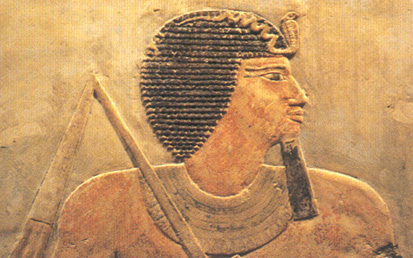
Pharaoh Amenemhat I -
XIIth Dynasty
lintel from el-Lisht - Metropolitan Museum
by Wim van den Dungen
 |
The translation of
The Instruction of Amenemhat is part of my
Ancient Egyptian Readings (2016), a POD publication in paperback
format of all translations available at maat.sofiatopia.org.
These readings span a period of thirteen centuries, covering all
important stages of Ancient Egyptian literature. Translated from
Egyptian originals, they are ordered chronologically and were
considered by the Egyptians as part of the core of their vast
literature.
The study of the sources, hieroglyphs, commentaries and pictures
situating the text itself remain on the website at no cost. |
1. The
source : the lost papyrus Millingen.
2. Pharaoh Amenemhat I and his son.
3. The text of the Instruction of Amenemhat.
4. Notes.
5. Egyptian sacred literature.
6. Egyptian wisdom literature.
1. The source : the lost Papyrus Millingen
►
discovery
The text of the Instruction of Amememhat was
preserved on the so-called Papyrus Millingen of the XVIIIth
Dynasty, of which an integral copy was made by Peyron in 1843.
The papyrus was subsequently lost !
It must have been a good manuscript, that turns fragmentary in its final
portion. Parts of the work are preserved on three wooden tablets of the
XVIIIth Dynasty, papyrus fragments, leather fragments and numerous ostraca
of the New Kingdom.
Griffith (1896)
published Papyrus Millingen and
Maspero (1914) all known extant fragments. An English translation was
made by Erman (1927). A new comparative study of all available sources
(including new fragments and numerous ostraca) was
done by Volten (1945). In 1963,
Lopez reexamined Papyrus Millingen.
In 1969, a German translation was made by
Helck (1969).
Lichtheim (1976) and
Brunner (1991) made the most recent
translations. Papyrus Millingen is deemed "a good manuscript, but fragmentary in the
final portion" (Lichtheim, p.136).
"I think, the Millingen Papyrus may perhaps fairly
be excepted from Professor Erman's statement that all our materials are
corrupt school copies of the New Kingdom."
Griffith,
1896, p.36.
The following
temporal layers may be discerned :
-
Papyrus
Millingen : in the XVIIIth Dynasty, an unknown scribe made a copy from earlier sources
- Gardiner (1934, p.481), dates the
papyrus in the reign of Pharaoh Amenhotep II (ca. 1426 - 1400 BCE) or
Tuthmosis IV (ca. 1400 - 1390 BCE) ;
-
the actual
literary composition : the instruction was written shortly after
the murder of Amenemhat, namely at the beginning of the reign of Pharaoh Senusret I, ca.
1909 BCE ;
-
the person of
Amenemhat : reigned between ca. 1938 - 1909 BCE.
►
literary features
Our literary-political instruction was composed for Pharaoh Senusret I by
one of his scribes. A Ramesside scribe seems to have considered that this
was the sage Khety, who also wrote the popular, standard text of the
scribal schools called The Teaching of Khety (or The Satire of
the
Trades - cf. Papyrus Chester Beatty IV). So this New Kingdom
scribe was aware of its pseudo-epigraphic nature, although it is likely
that in the Middle Kingdom it was believed to be the work of the men whose
name it bore, Amenemhat and his son Senusret. Our instruction was
widely read down into the Late Period, and has been seen by scholars as the
"inaugural address" of Pharaoh Senusret I.
Because of the divine nature of kingship, regicide was a theme that could
not be treated openly (the same reticence is felt regarding the murder of
Osiris). Hence, the assassination is described in veiled terms. The work
is the only one of its kind. Together with the Instruction to Merikare
of the reign of Pharaoh Merikare (IXth & Xth Dynasties, ca. 2160 - 1980
BCE),
this teaching is a royal instruction.
This work is a "powerful and imaginative composition" (Lichtheim,
p.135). Three elements are important :
-
the literary
form : the orational style is used, except for the description of
the assassination, which is in prose ;
-
the literary
setting : the speaker is the murdered Amenemhat who communicates to
his son Senusret in a "revelation of truth" : this device reminds us of
Hamlet ;
-
the
existential tone : as would later be said of the office of the
vizier, kingship is not sweet but bitter, and the instruction involves the
castigation of the traitors as well as warnings to his son not to trust
anybody.
2
Pharaoh Amenemhat I and his son
►
the beginning of the Middle Kingdom
The last Pharaoh of the XIth Dynasty was Nebtawyre Mentuhotpe (ca. 1945 -
1938 BCE). He probably usurped the throne, for he is missing from the
king-lists. His mother was a commoner. It is possible that he was not a
member of the royal family. Of his seven year reign, little is known. He
undertook building projects and dispatched his vizier Amenemhat to head an
army of workers at the quarries of the Wadi Hammamat for his intended
royal tomb. There is a consensus that this is the same Amenemhat who
founded the XIIth Dynasty, although there is no reliable information
available.
"There is considerable reason to think that in
reality the succession did not take place by force, and the way might even
have been paved by a period of coregency." -
Hornung,
1999, p.50.
Pharaoh Amenemhat I Sehetepibra (ca. 1938 - 1909 BCE), "Amun is at the
head" was the son of a "god's father"
(a priest) named Senusret and a member of the house of Elephantine called
Nofret. His was an
illustrious Dynasty, which restored the functional & unified state to the
point of it being able to begin its second period of cultural blossoming :
the Middle Kingdom (the XIIth Dynasty). For the Horus name of his titulary, he chose the
expression "wehem-mesut" or "he who repeats births" (i.e. of creation),
characterizing his reign as the beginning of a new era. At el-Lisht, he
reintroduced the Old Kingdom pyramid-style royal tomb.
The royal residence was moved from Thebes to the old center of the land,
in the vicinity of Memphis (Ptah) and within
eyesight of the Great Pyramid (Re). Old form were invested with new
meaning, although Thebes remained the center of
Amun
worship. But it lost its political power. In the New Kingdom, this
constellation of leading deities (Re, Ptah, Amun) would become a trinity
of trinities (cf. the
Leiden Hymns).
In ca.1919, Pharaoh Amenemhat I elevated his son Senusret
(Senwosret, Senusert, Sesostris) to the
coregency. They conducted the affairs of state together (a custom adopted
by the remaining kings of the Dynasty). While his coregent was on an
expedition to Libya, a harem conspiracy broke out (the instruction hints
at a dispute over the succession). The elderly king was at the lowest
point of his effective powers, and had planned a Sed festival of renewal
to replenish himself. Apparently, the assassination attempt succeeded,
although the legitimate successor thwarted the other plans of the
conspirators and was crowned Pharaoh Senusret I in ca. 1909 BCE.
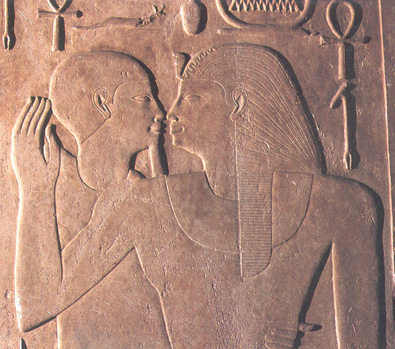
relief of Pharaoh
Senusret I embracing Ptah
Pharaoh is also embraced by Amun, Atum and Horus,
each god placed at the cardinal points of the Earth
XIIth Dynasty - White Chapel at Karnak
►
regicide and the
changed perspective on kingship
Though the thirty-year rule of Pharaoh Amenemhat I ended with his murder,
his reign was successful. Near its beginning it had been glorified in the
Prophecies of Neferti, a series of prophecies after the event in a
fictional disguise. In it, he depicts civil war and distress, turning into
happiness with the accession of Pharaoh Amenemhat I.
That a successful reign may end in assassination, underlined the changed
perspective on kingship. Although Pharaoh was still a divine king, the
burden of responsibility weighed heavily on the king, who, except for the
deities, could trust nobody. The breakdown of the Old Kingdom had
ended the "natural trust" on the part of the common people. Patriarchy was
over, and distrust, vigilance and self-preservation were deemed essential.
Alone, Pharaoh had to prove his divinity by works of superhuman
proportion. Hence, heroic qualities were invoked and these characterize
the monarchs of the Middle Kingdom, who decided in solitude.
The "democratization" of the afterlife evidenced in the Coffin Texts
(every individual having a "soul" and the ability to become an "Osiris NN"
- cf. The Discourse of a Man with his Ba) runs
parallel with the "humanization" of kingship. Indeed, the divine rule of
Pharaoh is viewed in terms of an "intensified
instance of the human condition" (Hornung, 1999, p.55). In the
Loyalist Instruction (early XIIth Dynasty) one demands of those around the king to
"Worship the king inside yourselves, be close to his
Majesty in your hearts." (section 2).
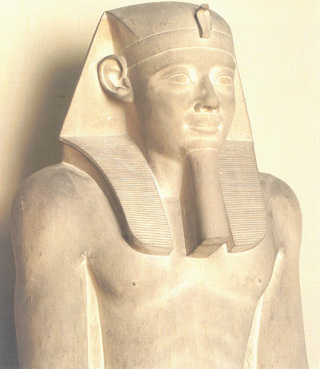
seating statue of Pharaoh
Senusret I
XIIth Dynasty - el-Lisht - Cairo Museum
Pharaoh Senusret I resided at
el-Lisht and like his father, he built complexes emulating Old Kingdom models (he used the
causeway of Unis as the model for the
decoration of the walls of his burial place). We are told that it was in el-Lisht that he
received Sinuhe when he returned from exile (cf. The Story of Sinuhe,
in the form of an autobiography). This political work was probably
commissioned by the ruling Dynasty.