Amun, the Great God :
Hidden, One and Millions.
AMUN
: unbegotten preexistence
double-concealed in transcendence and immanence
and the unity of Ancient Egyptian theologies
by Wim van den Dungen

"O You, the
Great God, whose name is unknown."
Pharaoh Unis (PT 276c -
ca. 2350 BCE)
 |
The translation of The
Hymns to Amun is part of my
Ancient Egyptian Readings (2016), a POD publication in paperback format
of all translations available at maat.sofiatopia.org. These readings
span a period of thirteen centuries, covering all important stages of
Ancient Egyptian literature. Translated from Egyptian originals, they are
ordered chronologically and were considered by the Egyptians as part of the
core of their vast literature.
The study of the sources, hieroglyphs, commentaries and pictures situating
the text itself remain on the website at no cost. |
"None
of the gods knows
His true form,
His image is not unfolded in the papyrus
rolls,
nothing certain is testified about Him."
Hymns to Amun, Papyrus Leiden I
350, chapter 200, lines 22- 24.
ca.1213 BCE (end of the reign of Ramesses II)
Table of Contents
Introduction
1 Amun
in the Old and Middle Kingdoms.
1.1 Amun as
hidden, primordial god in the Pyramid Texts.
1.2 Amun, hidden of name in the Coffin
Texts.
2 The
crisis of polytheism in the New Kingdom.
2.1
The New Solar Theology and early Amun-Re theology.
2.2 Amarna, the Restoration & late Amun-Re theology.
FIVE
HYMNS TO
AMUN-RE
I Philological remarks.
II Text in English with Commentary.
III Text in French
IV Hieroglyphic Text.
Epilogue
Bibliography
INTRODUCTION
The importance of the
state cult of Amun
(later Amun-Re), initiated in the Middle Kingdom, is undisputed.
The cult of Amun-Re, the "king of the gods", was outstanding, as archaeological, monumental, textual, ritual & funerary evidence
shows. So powerful was the
name : "Amun", that Akhenaten tried to erase it from the records (scriptoral as well as
monumental). This outrage was immediately restored by Tutankhamun after the heretical king
died. In the Ramesside era, after the Amarna episode, Amun rose to even more formidable resplendance. In the Third
Intermediate Period which followed the New Kingdom, civil
stife occured & a double monarchy ruled : a military dictatorship of
the high priests
of Thebes (with Amun-Re as Pharaoh) versus the Kings of Tanis in the Delta.
But, Amun's cult remain active as far as Upper Nubia ...
"A papyrus furnished the number of persons in the
service of Amun during the reign of Ramesses III (ca.1198 - 1166 BCE) -priests,
peasants in the fields, hunters, boatmen, administrators, and workers of all
sorts- a total of 81.322 persons ! We also learn from this papyrus that this
fortunate god owned 433 gardens, 591.320 acres of fields, 83 boats, 46
construction sites, and 65 towns, all dedicated to the sole purpose of
maintaining his sacred domains. Seeing these figures, we can easily imagine the
astonishing number of priests and other staff who could be employed in the cult
and the management of such an organism : we can count as many as one hundred
twenty-five different posts among the personnel employed in the service of this
all-powerful god." -
Sauneron, 2000, pp.52-53 (translated by
David Lorton).
The importance of the cultic, ritual and intellectual activities offered to Amun-Re,
answered theological and philosophical answers posed by the
confrontation between the monotheist, solitary & Pharaonic solution of
Akhenaten and the undisputed adherence of the people to a plurality of deities, acting in
constellations (Assmann) and listening (during the festivals) to the voice-offerings of the commoners.
These discussions and ideas were "secret", implying a limited access.
The "inner" aspect of the Egyptian Sun-cult was only for an elite. The
Books of the Netherworld are royal guides, i.e. the best of the best knowledge
for the afterlife.
"The 'inner aspect' of
the Egyptian sun-cult, its mysteries, is constituted by a tradition that
specifies what must be known, said and done during the enactment of it. The
representatives of this tradition are a small circle of professional priests and
scholars. They are in no sense identical nor should they be confused with the
larger circle of sun-worshippers, which in the New Kingdom almost took on the
character of a 'movement'." -
Assmann, 1995, p.17.
|
ATHEISM :
no supreme,
creative, supernatural principle or being (God) exists ;
AGNOSTICISM :
it is unknown and/or remains unknown whether a supreme,
creative, supernatural principle or being exists or not ;
THEISM :
a supreme being exists (God) or supreme beings exist (gods
and/or goddesses) ;
POLYTHEISM :
a collection of such gods &
goddesses exists ;
HENOTHEISM :
one supreme principle or being
(God) exists and is at the head of (abides in) a pantheon, or family of
deities ;
MONOTHEISM :
one and only one supreme
principle or being (God) exists ;
PANTHEISM :
there is only one supreme being
and that is creation itself ;
PAN-EN-THEISM :
all happens in one supreme
being (God) who transcends creation but who nevertheless is creation itself
(with or without other supreme beings). |
Following themes run accross our philosophical study of Amenism :
-
the
synthesis of the main theologies : It became
necessary to invoke Amun-Re as an all-comprehensive deity, who united the
principle of creation (Re), verbality (Thoth), materiality (Ptah) and
tenacity (Osiris-Pharaoh). How to realize this, without harming the
integrity and uniqueness of each individual deity ? How to give form to such
all-comprehensiveness and maintain the countless gods and goddesses of the
constellational pantheon (rooted in mythical & pre-rational thought -
cf. Verb) ?
-
the
replacement of Pharaonic rule : In the Ramesside experience, the
world had become unstable. The presence of (a heretic) Pharaoh could lead to
the exodus of the deities ! Pharaoh no longer guaranteed order, but he lived
by it because he followed the will of the god. The just follow Pharaoh,
because Pharaoh follows the god. The notion of Pharaoh as source of order
"sui generis" (as in the Old Kingdom - cf.
Wenis)
was discarded (although in the New Kingdom exceptions occur : Amenophis III,
Akhenaten, Ramesses II).
-
the
democratization of mediation : From the Middle Kingdom onwards,
deceased non-royals could assume the title "Osiris-NN" and, if
justified by Maat (i.e. truth-speaking), enter the Osirian Field of Reeds.
Although during festivals and in the open courts of the temple, common
Egyptians made offerings, danced & prayed, and hence participated in the
cultic acts, they did not hope that the god would hear their
voice-offerings directly and personally.
This was reserved to Pharaoh and his priests. Akhenaten had been the last
Pharaoh to have implemented this idea "de manu militari" with
unbelievable tenacity & zeal. This had taught the commoner to pray in
silence, hidden from the social eye. Hence, in the Ramesside theology of
Amun-Re, such a direct experience (called by Assmann "personal
piety") was deemed possible, for Amun-Re (with large ears), heared the
prayers of the poor and everything was in his omnipotent hands &
onmiscient heart. By placing Amun-Re in one's mind (a divine person rather
than a divine energy, intimate rather than cosmic), one's voice-offering
would be returned if he willed, and nothing in-between was longer necessary
to mediate the divine communication.
-
the
exodus of monotheism : The founding story of Judaism, the Exodus,
probably took place under Ramesses II (Modrzejewski, 1995). If we accept
that Moses was initiated in the Egyptian mysteries, we may put into evidence
the resemblance between the Mosaic heritage (of memory) and Amarna theology
(of history). By introducing an aniconic religion, Moses only took
Akhenaten's Aten-theology to its final step. Take away the "icon"
of the Aten (and with it the realm of heliomorph proto-rationality and its
contextual focus on light), reduce the role of Akhenaten to that of a
"prophet" (one to whom the god reveals himself), and a more or
less "rational" monotheism ensues. Furthermore, the ineffable,
hidden & unsaying aspect of "YHVH" is an aniconic
transposition of the name "Amun", the "hidden", whereas
the "ALHYM" or Divine presence (the "shekinah") refers
to Re and the deities ("Elohim" is a plural word - cf.
theonomy).
Israel, "a people come out of Egypt" (Numeri, xxii, 5 -11)
indeed drank deeply at the wells of Egypt (Williams, 1981), as would the
Greeks later ...
Following table broadly sketches
the different phases to be noted in Ancient Egyptian theology. It also
summarizes the ideas proposed in this paper. The elements of philosophy
prevailing in each phase have been put in italics.
1 Amun
in the Old and Middle Kingdoms.
►
the Predynastic
roots of the sacred
Evidence suggests that the
domestication of cattle and the cultivation of cereals appeared in the Western
Desert ca. 5000 BCE. Mid-Holocene aridity probably encouraged desert herders and
farmers to settle along the banks of the Nile.
The Neolithic period is the interval between the emergence of farming
villages on the banks of the Nile and the initiation of the Egyptian
nation-state (ca. 3000 BCE). The earliest evidence of Neolithic communities in the Nile
Vally dates between 5000 and 4100 BCE (cf. Merimda Beni Salama).
-
The Badarians
(cf. Badari, Upper Egypt, about 4000 BCE) were a farming and herding community. These settlers raised
cattle, sheep/goats and pigs. They cultivated barley and wheat and
agriculture was supplemented by fishing and fowling. Pottery, glass, copper
and glazed staetite were found at some sites. They provided their
dead with food and placed female figurines in the graves. Funerary
orientation was not yet fixed.
-
Middle
Predynastic Period (ca. 4000 - 3600 BCE) : with Amratian
culture (cf. site of el-Amra, Sohag - Naqada I) agriculture inceased, hunting
deceased and a marked techological change took place. Pottery not yet
diffused from Mesopotamia was created, with geometrical and naturalistic
designs, unstructured in layout. Concentration and centralization of power
in its incipient stages with the formation of a managerial class.
Transportation of goods along the Nile. Social status evident in funerary
cults. Clear proof of religious activity involving female deities such as Hathor. Graven
images in tombs. Corpse on its left side, head of deceased pointing South, looking
West.
-
Late Predynastic
Period (ca. 3600 - 3300 BCE) : in Gerzean
culture (cf. site of el-Gerza, Fayum - Naqada II), fundamental
changes happen and techniques were improved. Contacts with Mesopotamia. Cult centers and urban
centers emerged, associated with chiefdoms, principalities,
provincial states and village corporations united into regional kingdoms.
Trade continued to flourish and wealth distinctions became more salient. Whole burial treasures.
Sky & cow goddess Hathor is very prominent ;
-
Terminal
Predynastic Period (ca. 3300 - 3000 BCE - Naqada III) : The rise of the Egyptian
state was the result of wars and alliances. Over at least 250 years,
fragmentation and reunification had occurred. In Upper Egypt, there had been the
kingdoms of Naqada and Hierakonpolis, and in the Delta the petty kingdoms of
Buto, Sais, Tell el-Balamoun, etc. The first major power emerged when the
two Southern kingdoms of Hierakonpolis (Nekhen) and Naqada united. These kings from
Hierakonpolis, later known as the "Followers of Horus"
conquered and annexed the kingdom of Naqada (Seth) and later the Delta. FInally, Pharaoh
Aha founded Memphis (or "Mennefer" in the North), to serve as a link
between Upper and Lower Egypt (ca.3000 BCE) and initiated the Dynastic Period.
Although polytheism is attested, it is likely that the tendency towards
one divine principle was present from the start of
the Dynastic Period (ca. 3000 BCE). I speak of a "tendency" rather than
of a basic monotheism with polytheism as a façade. Nevertheless, an
overarching, mythical & pre-rational view was clearly present (cf. the
figure of the Horus Falcon) and had formidable growth-potential, although the
use of the word "monotheism" (cf. Otto's "Monotheistische
Tendenzen in der ägyptischen Religion" of 1955) should be considered misleading
in the context of the Early Dynastic Period (the Archaic Period, Dynasties I
& II) and the early Old Kingdom (Dynasties III & IV).
►
a divine dual monarchy
In the Archaic Period, this tendency to unite was clearly manifested in the figure of
Pharaoh (Hebrew pronunciation of "pr Aa", "great house"), the divine king, who was
a "Follower of Horus". He had come from the South and was an embodiment of the divine, celestial and
supreme principle. By his sheer presence, he guaranteed the unity of the Two
Lands and represented Egypt as a whole (with his Residence in northern Memphis).
The Horus names of these kings suggest the use of pairings, possibly
reflecting the binary structure of Egypt (with its Two Lands, the South -Upper
Egypt- and the North -Lower Egypt-).
"The institution of
kingship was projected as the sole force which held the country together, and
the dual nature of the monarchy was expressed in the king's regalia, in his
titulary, and in royal rituals and festivals. This concept -the harmony of
opposites, a totality embracing pared contrasts- chimed so effectively with the
Egyptian world-view that the institution of kingship acquired what has been
called a 'transcendent significance'. This helps to explain the centrality of
the institution to Egyptian culture, and its longevity."
-
Wilkinson, 2001, p.185, quoting Frankfort, 1948).
These early figurations of unity are mythical (Pharaoh assimilating
the sacred power of the "Great Goddess" of Predynastic times) and pre-rational
(Pharaoh overseeing everything as does the falcon, a bird of prey that glides high up in the sky on
the hot air and with a watchfull eye overlooks its large
territory, soaring down on its prey at a 100 miles per hour, combining speed
with endurance). On the
ivory comb of Pharaoh Djet of the First Dynasty, Horus is represented in three
forms :
-
as the celestial falcon,
whose outspread wings are the vault of the sky ;
-
as a falcon traversing the
sky in a celestial, solar bark and
-
as a falcon atop Pharaoh's
"serekh".
It is clear that Pharaoh was seen
as Horus incarnate. Horus was the "great(est) god, lord of the sky",
"he who is above", "face of heaven" (i.e. Horsemsu,
"Hr-smsw" or Horus the elder and Heru-ur or "Horus the
Great").
"The
identification of the ruler with Horus, represented by a falcon, is apparent
from late Predynastic times, and is given expression on royal monuments and in
the serekhs of the kings from the period of state formation. It is
possible that the worship of a celestial falcon god was widespread in
Predynastic Egypt since there is evidence for the existence of several falcon
cults. As a universal deity, Horus would have been a natural choice to associate
with the kingship, since the connection would necessarily have had greater
resonance and significance." -
Wilkinson,
2001, p.184.
Besides one passing occurrence in
the IIth Dynasty (Pharaoh Reneb), Re played no role in royal names (the titulary
was not yet completed). But we do have IIIth Dynasty evidence of a single Solar creator
god (cf. the Step Pyramid complex of Djoser by Imhotep).
"The religious idea
driving this new construction is not recorded, but it seems that the Step
Pyramid may be the first great monument equating the single earthly king with a
single power in heaven, the sun. There are two supporting, if circumstantial
pieces of evidence. In the reign of
Netjerkhet (Djoser), for the first time Ra appears as not just the word for sun,
but unequivocally as the name of a great god : one of the officials of the king
bore the name Hesyra 'he whom Ra favours', with Ra written first as befits a
deity. The second piece of evidence we have seen at Iunu itself, the fragments
of stone shrine inscribed with the name of Netjerkhet and images of the king and
of gods associated with Iunu." -
Quirke,
2001, pp.119-120, Netjerkhet (Djoser) reigned
between ca. 2654 - 2635 BCE.
In the IVth Dynasty, Solar
theology got further developed and was explicitly linked with Pharaoh. The conflict between
Horus and Seth was harmonized by Re and became a smaller part within the new general scheme of
this single
all-powerful Solar creator, who throned in the sky, ruling together with his official
and unique son, Pharaoh, the "son of
Re", who throned on Earth and who, in the afterlife, returned to his father (in the Northern,
imperishable, circumpolar sky). Pharaoh Khephren completed the titulary.
"Perhaps the most powerful and pervasive ideology in
Ancient Egyptian culture was the ideology of divine kingship : the belief that
the king was the earthly incarnation of the supreme deity, a channel of
communication between the divine and human spheres, and the unifying force that
held Egypt together, without whom chaos would ensue." -
Wilkinson,
2001, p.xiv, my italics
|
The
Dynastic Titulary : a
theo-political constitution ...
the example used
is the original titulary of Amenhetep IV, followed by that of the later
"Akhenaten", meaning :
"He who is useful to
Aten", "Radiance of Aten" or "Glory of Aten" |
|
NAME
|
MEANING
|
|
Horus |
The Horus-name (a falcon
perched on a rendering of an archaic palace or "serekh" within
which is Pharaoh's name) is the oldest of the five names of the
titulary. It designates Pharaoh as the incarnation of the divine power
of kingship (Horus), residing in the palace (i.e. the "great
house", Pharaoh). This is Horus, the "Lord of the sky". The earliest
Pharoah's were only named with this Horus name. In the New Kingdom,
"Mighty (or strong) Bull" was added at the beginning, but it was usually
quite variable.
"Strong Bull of the Double Plumes"
"Strong Bull, Beloved (or lover) of Aten"
Clearly the Horus-name refers to the Predynastic
and Early Dynastic Period and the original mythical link between
kingship (as enduring unificator) and the falcon of the sky. This name
shows that the unity of the Two Lands is guaranteed by a divine
embodiment, Pharaoh. The latter exclusively embodied the overseeing
qualities of the sky god Horus. He was the only "incarnation"
of the celestial principle (the sky) on Earth (the Two Lands). He
"embodied" the divine spirit ("akhu") of the sky god
Horus, i.e. the power of the divine spirit "in the flesh".
|
Two
Ladies |
This name appears in the
First Dynasty. Nekhbet and Wadjet were the protective goddesses (cf. the
"Two Ladies" - "nebty") of Upper and Lower
Egypt respectively (a vulture & a cobra, each atop a basket).
These two refer to the duality of Pharaoh's realm, as does "Lord
of the Two Lands". The "Two Ladies" correspond to the
"Two Lords", the royal gods Seth and Horus.
"Great of Kingship in Karnak"
"Great of Kingship in
Khut-Aten"
The Two Ladies metaphorize the dual monarchy, as
well as the duality that characterized creation as a whole. In the
Ancient Egyptian mind, duality was the fundamental condition of every
state of being, whether it be that of a deity or any other being.
Creation and existence were constantly moving, or part of a process,
fluctuating in cycles and rhythms. This fact is fully acknowledged in
the myths and even made part of the Dynastic Titulary. The Horus-name
underlined the divine presence of Pharaoh. The Nebty name makes that
divine presence result in the tenacious continuity of unity of the Two
Lands, and by extension, the harmony of the elemental opposites that
characterize creation.
|
Falcon
of Gold |
The name of gold or
Falcon of Gold name (first attested in the IVth Dynasty) is
represented by a Horus falcon atop a beaded collar (gold). The name might
refer to the wealth and splendour of Pharaoh, as well as to his
enduring qualities (gold was considered to
be the untarnished "flesh" of the deities). In the Papyrus of Ani
(chapter 77), the Falcon of Gold refers to the Sekhet
Hetep, the field of peace and nourishment.
"Crowned in Heliopolis of the South"
"Exalter of the Name of Aten"
The ancient name of Naqada, the cult centre of
Seth, was "Nubt" or "golden (city)". Seth was
described as "nbwty" or "the golden one". The
image of Horus mounting gold, may have expressed the rule of order over chaos,
and with it, the idea of Pharaoh as the champion of Maat. |
Throne
Name |
This prenomen name is the
youngest of the five names, first appearing in the Vth Dynasty. It is
preceded by the title "King of Upper and Lower Egypt"
("he of the sedge and bee") and enclosed by a cartouche (a long oval,
protective ring of rope, a cycle suggestive of eternity). More recent scholarship conjectures
this name to be a statement regarding Pharaoh and his policies (instead of a theological
statement concerning the god). It was compounded with the name of the
Sun god Re (i.e. it included the hieroglyph of the disk of the Sun -
N5). Eventually this name became the most important of the titulary,
being (after the Middle Kingdom) often the only name by which Pharaoh is
mentioned in texts.
"Nefer-kheperu-Re, Waen-Re" "
or : perfect are the
manifestations of Re, Sole one of Re" -
"Nefer-kheperu-Re, Waen-Re,
Living by Maat"
The title preceding the throne name apparently
stressed Pharaoh was the embodiment of the dualities which made
up Egypt and creation. This formal affirmation of dual kingship is then
followed by the motto of the king, declaring the major theme of
his reign and the tenacious powers with which he planned to guarantee
the continuation of the order of creation (the unity of the Two
Lands). |
Son
of Re |
Pharaoh's personal, nomen name
is
always preceded by : "son of Re" (first attested with a
cartouche in the IVth Dynasty). This is the name given to the
prince at birth. After coronation is was enclosed in a
cartouche. It affirmed that Pharaoh is by birthright a
god.
"His beloved
Amenhetep, god-ruler of Thebes"
"Living by Maat, Lord of Crowns, Khut-en-Aten, Great in his Lifetime"
The fact that the epithet "son of god"
precedes the name of the royal prince at birth, points to the intimate
relationship between this human person and his divinity. Divine birthright, due to the exclusive filial relationship between
Pharaoh and his father Re, the celestial principle of creation, is not
based on a bloodline (the texts never mention "father of the
king" or "brother of the king"). Kingship was a single
line of individual manifestations of Re. This divine Solar king had
contact with human women. The outcome, if male, was ipso facto divine
too. Before his coronation, the prince could already use lofty titles, but never "son of Re". |
|
Egyptian texts usually
refer to Pharaoh, during his life and after his death, by his throne
name. By convention, egyptologists use the nomen name instead. Since a Dynasty often
had several kings with the same nomen name, they are numbered, a
convention not used by the Egyptians themselves.
|
Atum-Re, Aten,
Amun-Re : seeking to solarize the deities and initiation
By the Vth Dynasty, the supreme and divine
Solar father of Pharaoh, namely Re, had surpassed Horus (god of the sky & the kingship). Re became the active power in the
world, a position previously exclusively held by Pharaoh (Hornung, 1999).
Pharaoh was the sole mediator, who offered truth and justice to his father Re (who
returned what belonged to the sky-god, namely order). By doing so, the divine
king maintained creation (the divine gift of a "good Nile") and conquered the forces of darkness, destruction, corruption and
chaos inside and outside Egypt. In the afterlife, Pharaoh ascended to the sky to be with his father Re
(cf. Pyramid Texts). The impact of
Heliopolitan
theology was immense. Atum, the "ba" of Nun, was the Sole Creator, and this
"autogennetos". Atum creates Atum. Re and Atum are the same deity.
Hornung (1982) showed that the idea of oneness may be understood as
"uniqueness", applicable to every deity as such and inherent in the
concept of "netjer" ("nTr"), "god". The divine
world, which was the spiritual expression of reality, was conceived as a
multiplicity. According to Hornung, the only place were the Egyptians found the
absolute unity of Divinity, was outside creation and existence, namely during
the fugal transition between non-existence and existence (called "zep
tepy", the "first occasion, or "first time").
For Assmann (1995), and rightly so, Hornung goes too far. For there are many textual
examples dedicated to the "aloneness" of the supreme god, especially
in the New Solar Theology, Atenism and
the Ramesside theology of Amun-Re. Indeed,
top level
theologians & scholars produced a henotheist concept
of Amun-Re, embracing both the unsaying (apophatic - "one") and symbolical
(katapathic - "millions") side of the fundamental bi-polarity of the Divine (cf.
theonomy).
We may conjecture a tiny minority of specialists of the "mysteries" or
"secrets" of
Amun-Re had an abstract (decontextualized) concept of the unique, solitary &
supreme God. This grew hand in hand with the pantheon, understood as a theophany of the various aspects,
forms, images, manifestations & transformations of the One & Great God (mature,
rational henotheism instead
of monotheism). Moreover, this theology expressed its views in an iconical,
pictoral & contextual language and God remained accessible to commoners
(personal piety) and popular polytheistic practices. It allowed
"images" and "divinities" next to God to explain His Will.
The praise of God's Will was the law.
Using words like "mystery" and "initiation"
should remind us of the difference between their meaning in Ancient Egypt and
their role in the Greek
mysteries or in Egypto-Alexandrian Hermetism. Greeks started to
settle in Egypt under Pharaoh Amasis (570 - 526 BCE).
"Greek immigrants, and
the more urban and educated among their descendants, often persevered in Greek
ways of thought and behaviour. They spoke their own language, keeping it free
of loan-words, and exploiting its flexibility, consciously or not, to disguise
the uniqueness of their adopted land, bequeathing us in the process
'pyramids', 'obelisks', 'sphinxes' and 'labyrinths'. They read their own
literature, and stuck to the company and customs of their own kith and
kin." -
Fowden, 1993, p.17.
Under the Ptolemies (304 - 30 BCE), Graeco-Egyptian religion was asymmetrical and stressed the autochthonous. This
also shows how Greek culture got assimilated by upperclass Egyptians. A
minority of them could write books on the Egyptian religion in Greek
and
translate sacred priestly books for those unable to read Egyptian. But there
was no shortage of priests who were called "unlettered", i.e.
ignorant of Greek. True cultic
syncretism came from the heavily Hellenized parts of the country, such as
Alexandria and the Fayum.
The essence of the Greek (Hellenistic) mysteries (imported in Egypt) dealt with
the distinction between "psuchè" (breath of life, spirit,
soul, state of mind) and "phusis" (nature, physical body, elements). "Initiation"
consisted in the liberation (emancipation) of the psyche out of its physical
entrapment here and now. Moreover, physical extremes were not avoided to
generate "katharsis" and to allow the psyche to enter altered state of
consciousness (cf. Orpheus, Dionysius, the role of the choir in the tragedies,
etc.). Being a "young people" (cf. Plato's view on the Egyptians ideas
about the Greeks), the Greek mysteries involved renewal and rejuvenation during
one's lifetime. If spirituality had any meaning at all, it had to refer to
one's actual physical life on Earth.
Much later, this view would be developed at the most abstract level of
(conceptual) rationality : in the Neoplatonism of Plotinus (who studied in
Alexandria under Ammonius Sacca), the body is called the jail (cave) of the soul
(Enneads, IV 8,3). The latter was able to realize illumination by
itself during one's lifetime. The whole notion of "morality"
became linked with the preparatory purifications necessary to achieve this (see
also the Golden Verses of Pythagoras). So Greece and Egypt viewed
initiation from a radically different perspective :
"(...) in ancient Egypt,
this was a matter of a constantly renewed regeneration ; in Hellenism, however,
it was a release from the forces of fate and mortality, freedom from
imprisonment in this world." -
Hornung, 2001, p.14.
1.1 Amun as hidden, primordial god in the Pyramid Texts.
Two alternative views on the principle of creation are attested :
-
the creator is understood
as immanent in the forces and elements of the created world, i.e.
a supreme being, in whom all of creation is inherent. This notion was
associated with Atum-Re, who as "Khepri" self-created on
the first occassion and split into Shu and Tefnut ("I am Re who
issued from the Nun in this my name of Khepri." - CT 307) ;
-
the creative principle is
viewed as transcending creation, being independent of it (as
Atum-Re self-creating in the Nun), creating (in the Middle Kingdom)
the world by means of magic (cf. the "Lord of All" and
"Sole Lord" in CT 261,
To Become a
Magician) or crafting the universe and its order by the design of his mind (cf. the
logos-philosophy of the
creative verb in the XXth Dynasty
Memphis
Theology on the Shabaka Stone, and the Hymn
to Ptah, Berlin Papyrus 3048 of the XXIIth Dynasty). However, the greatest
development of this transcendent notion of the creator, is found in the
Ramesside era. In late Amun-Re theology,
transcendence is no longer exclusively realized by positioning the One before
creation (in pre-creation), but (also) as a "hidden unity" in
creation.
The name "Amun"
("imnw") suggests imperceptibility in and of itself and derives
from the verb "imn", meaning both "to conceal" and
"be hidden". Its vocalization is said to belong to the same
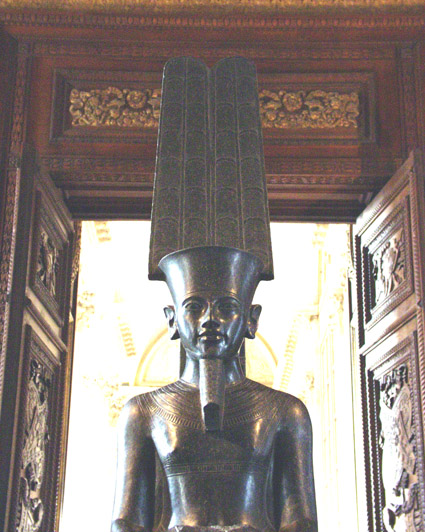
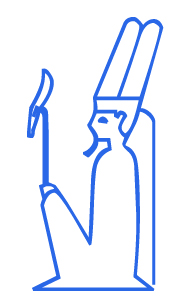
noun-class as the name "Atum" (Osing, 1976). Amun is depicted
anthropomorphically and wears his typical crown, consisting of a modius
surmounted by two high feathers, divided vertically into two sections (the
Two Lands), each plume having horizontal segments adding up to seven. His
flesh is coloured blue, suggestive of lapis lazuli, an imported,
highly-prized stone dedicated to Amun. He is a god of Air, as the two
feathers suggest. As the wind, Amun can be felt but not be seen, except in
its
effects, just as the blowing wind moves through feathers ...
In the New Kingdom, the epithet "he whose name is hidden"
("imn-rn.f" or "imn-rn") was commonly used as an
etymology of "Amun". Several of these New Kingdom
"etymologies", as well as our
Hymns to Amun
from Papyrus Leiden (I 350), speak of Amun as "concealing Himself".
This epithet can be found in the Pyramid Texts :
-
PT 399a : in this
Cannibal
Hymn, Pharaoh (Unis) is said to "sit together with Him whose
name is hidden" ;
-
PT 1778a : Pharaoh
Neferkare is a great falcon upon the "enclosure of Him whose name is
hidden" ;
-
PT 276c : in
Pharaoh Unis the
phrase is : "O You, the great god whose name is unknown".
The role of Amun in the passage
from the Cannibal Hymn is not insignificant ! He is not eaten by
Pharaoh and sits together with him when he judges himself without having need
of the pantheon, for Pharaoh is the "power of powers" and the "image of
images". The great falcon sitting upon an enclosure calls the "serekh" to
mind. In this image, Pharaoh is identified with a falcon who sits upon the
"palace" of the hidden god, suggestive of the special relationship between
Pharaoh and the hidden god. In Unas again, we are told the unknown god is a great god.
"O You, the
Great God, whose name is unknown."
Pharaoh Unis (PT 276c -
ca. 2350 BCE)
In the Pyramid Texts, the actual name "Amun"
appears in three passages :
►
PT 446c
First attested in the tomb of Pharaoh Unis, Amun appears together with a
feminine counterpart called "Amunet" in a short litany of pre-creational
deities, said to protect the gods (of creation) with their
shadow.
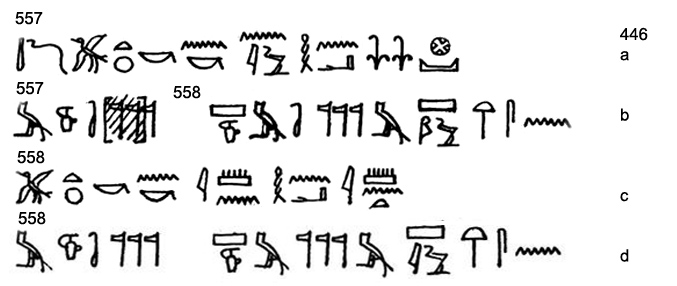
Pyramid Texts, Utterance 301,
§§ 446 a-d, tomb of Unis
These hieroglyphs have been digitally enhanced using the standard notation of
Sethe.
His major work is partly made availabe by the
Library of the University of
Chicago.
 To say the words : To say the words :
You have your bread-loaf,
O Nun and Naunet !
You pair of the gods,
who joined the gods with their shadow.
You have your bread-loaf, O Amun and Amaunet !
You pair of the gods,
who joined the gods with their shadow.
You have your bread-loaf, O Atum and Double-Lion !
Who yourselves created your two gods and their bodies,
that is Shu and Tefenet, who made the gods,
who begot the gods and established the gods.
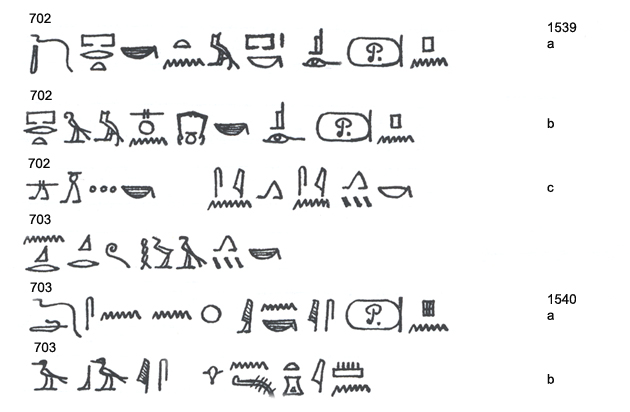
Pyramid Texts, Utterance
579,
§§ 1539 a-c - 1540a, tomb of Pepi II.
To say the words :
"This going forth from your house, O Osiris, this Pharaoh Pepi,
is the going forth of Horus seeking You, O Osiris, this Pharaoh Pepi.
Your porters hasten, your couriers run, your heralds hurry ...
They announce to Re that You have come, O this Pharaoh Pepi,
as the son of Geb upon the throne of Amun."
The phrase : "son of Geb upon the
throne of Amun" prefigurates Amun's Middle Kingdom epithet : "Lord
of the Thrones of the Two Lands".
In another text in the tomb of Pepi II (Neferkare), the name "Amun"
is mentioned without further information. But the earlier copy of Merenre of
the same text has the name of
the god Min instead. From the XIIth Dynasty onwards (Middle Kingdom), Amun is often represented in the same
form as Min ("the bull of his mother"), a god worshipped in the
Theban area, assimilated by Amun, and with Predynastic associations.
"Dès l'Ancient
Empire, très probablement, il est une des divinités adorées dans la région
de Karnak. Des scarabées 'trigrammes', attribués à une époque qui va de la
VIIIe à la XIe dynastie, portent son nom." -
Barucq &
Daumas, 1980, p.181.
In the Old Kingdom record, Amun was conceptualized as a hidden,
primordial deity, a great one, who existed before creation came into being and
who was associated with the throne of Egypt. Let us take the mentioned
sparseness of (written) information about Amun seriously (it is a recurrent
theme). This would mean that the nature of Amun was indeed largely unknown.
Moreover, the little known had to be considered a
"mystery", i.e. something to be kept secret and exclusively revealed
to the "higher" initiates (royality, high priests, viziers, high
administrators & learned men). Although not of national importance,
Amun was already a "great god". Of all the primordial deities, Amun
was the only one (together with "Nun", the primordial ocean itself)
who remained important. This was apparently already the case in the Old
Kingdom.
Although Hornung confirms the preexisting world of "Nun" implied the
absolute absence of existence (i.e. is non-existence), to the Egyptian mind, "absence of existence" meant a
"negative" existence unlike created existence, which is
"positive". The fact alone the Egyptians introduced
primordial, pre-creational gods in this preexisting world (the chaos-gods of
the Pyramid Texts and the Hermopolitan Ogdoad),
shows they did not conceptualize this pre-creation as a passive
nothingness (a mere zero), although it was inimical to the conditions of
creation and life as we know it (i.e. not spatial, not temporal and not
differentiated). This mythical "negative existence" (the
"Nun", the "father of the gods" without a cult of his
own) is an absolute, unlimited, pre-creational, preexistent inertness in which the dramatical self-creative
activity takes shape in the first time, namely the first occasion of the
god of creation himself (Atum, the "father of the gods" rising from the Nun).
Pre-creation is thus a passive nothingness (the Nun, zero) in which
the active potential or principle of creation (Atum, the empty set of
all possibilities), creates itself "ex nihilo". Hence, in
"negative existence", the principle of creation -by creating
itself- established a permanent "first occurence", out of which
"positive existence" (the primordial hill) emerged due to the
split of the creator into Shu (sky) and Tefnut (moist), and through them,
into a multiplicity
(of deities), out of which the life & the order of the pantheon, nature and people sprang.
1.2 Amun in the Coffin
Texts.
The First Intermediate Period was a turning point in the history of
Thebes, the fourth nome of Upper Egypt (opposite Karnak),
"she of the sceptre". In the Old Kingdom, Thebes
offers no clear evidence for royal activity. Substantial
evidence for statuary data of this type does not exist outside
of the Memphite region.
Around ca. 1980 BCE, after a century of disunity (the First Intermediate
Period), Herakleopolis ("Nekhen") fell and all of Egypt was again
under the rule of a single Theban Pharaoh, namely Mentuhotpe III (ca. 1945 -
1938 BCE). The apprenticeship period of Egyptian literature lay behind. The
Middle Kingdom produced a vast number of works in a variety of genres and with
full control over a vast number of forms. Hence, it is called the
"Classical Age" of Egyptian literature, which saw the consolidation
of Middle Egyptian.
Amenemhet I ("Amun is pre-eminent" - ca. 1938 - 1909),
who initiated the XIIth Dynasty and with it the Middle Kingdom,
moved the Residence away from Thebes to the North, thus removing
the centre of activity (Pharaoh) elsewhere. Thebes lost much of
its political power. Simultaneously, however, one of the local
gods worshipped in the region, namely Amun, was promoted to be
the pre-eminent dynastic and national deity. Thebes became the
city of Amun. Pharaoh donated statues and a granite altar to the
temple of Amun. However, he attended Ptah of Memphis too. Ptah,
the patron of Memphis,
had not been very prominent in the Old Kingdom. Amun-Re, Ptah
and Osiris (who received special attention as an enduring focus
of belief touching the afterlife) formed a constellation of
leading deities.
"La suprématie d'Amon s'affirmera à
Thèbes de la XIe à la XXVIe dynastie,
malgré l'intermède d'Hyksos et surtout son effacement
temporaire lors de la crise armanienne. En
son honneur s'élèveront dans une splendeur sans cesse accrue les immenses
édifices de Karnak et de Louqsor. Tous les grands souverains, y compris les
princes macédoniens, voudront pouvoir revendiquer l'honneur d'avoir réparé,
agrandi, embelli son palais toujours plus complexe." -
Barucq &
Daumas, 1980, p.182.
The Coffin Texts superceded the Pyramid Texts as early as the
VIIIth Dynasty, but their principal sources are the later cemeteries of the
nomarchs of Middle Egypt in the XIIth Dynasty. The largest number of spells of
this textual tradition was found in Deir el-Bersha, the cemetery of
Hermopolis, the city of the god of writing, Thoth. These spells (1.185 of
them) appear mainly on coffins of officials and their subordinates, but also
on tomb walls, stelæ, canoptic chests, mummy masks and papyri. Important spells were entirely in red.
The Coffin Texts eliminated the royal exclusivity of ascension.
Every deceased was an "Osiris NN", although the principal group of
people to make use of them were the nomarchs and their families of the Middle
Kingdom. The tradition of these Coffin Texts came to an end at the end
of the Middle Kingdom. They were transformed into the new Book of the Dead
in the XVIIth Dynasty. Some important spells survived and were used in the New
Kingdom (cf. burial chamber of Minnakhte TT87).
The epithet "Him whose name is hidden" is also to be found in the Coffin
Texts :
-
CT 132 / II 154 :
"I have sat with my back to Geb, for I am he who will judge in
company with Him whose name is hidden ..." ;
-
CT 147 / II 207 :
"Have judgement with Him whose name is hidden ..."
;
-
CT 148 / II 220 :
"... for you have reached the horizon, having passed by the
enclosure of Him whose name is
hidden." ;
-
CT 148 / II 221 :
"O Falcon, my son Horus, dwell in this land of your father Osiris
in this your name of Falcon who is on the enclosure of Him whose name is
hidden." ;
-
CT 148 / II 223 :
"See Horus, you gods, I am Horus, the Falcon, who is on the
enclosure of Him whose name is hidden."
-
CT 682 / VI 310 :
"He has flown and soared as that great falcon which is on the
enclosure of Him whose name is hidden, who takes what belongs to those
who are yonder to Him who separated the sky from the earth and the Nun."
The recurring association of
Amun with the falcon is what strikes here. It shows the house of Amun
is envisaged as the place to be for Pharaoh in his form of Horus, the
falcon. The power of the magician NN is made formidable by situating him before
creation too. Indeed, in the famous spell,
Becoming a
Magician (CT 261 / III 382 - 389), the "Lord of All"
and the "Sole Lord" are invoked. The latter made the deceased
"before there came into being the two meals on Earth". The
magician is the son of the goddess who bore Atum and caused the Ennead to
live ! He took the authoritative command in his mouth and speaks as the
august god.
In the Coffin Texts, the actual name "Amun"
appears in only one major spell, entitled : "Words spoken by him whose
names are secret, the Lord of All" and combined with the above
mentioned epithet. After a long description of the excellent powers of the
Lord of All, the text says :
"I am he in this name. Make way for me, that I
may see Nun and Amun ! I am that equipped spirit who passes by the
(guards). They do not speak for fear of him whose name is hidden, who is in
my body. I know him, I do not ignore him ! I am equipped and effective in
opening his portal."
Coffin Texts, VII, 469 -
470.
In the Story of Sinuhe (Middle Kingdom), we read :
"It is your ka, o
good god, lord of the Two Lands, which Re loves and which Mont, Lord of
Thebes, favors, and Amun, Lord of Thrones-of-the-Two-Lands, and ... "
Story of Sinuhe
- translated by
Lichtheim, 1975, vol I, p.230.
At the beginning of the XIIIth Dynasty, Egypt withdrew from Nubia and entered a
period of great confusion (the Second Intermediate Period). Kush (founded on Kerma,
Upper Nubia) becames the most important
state in Nubia. The Kushite expansion into Lower Nubia & beyond (i.e. Upper
Egypt) could begin. They
managed to penetrate the outer defences of Buhen and capture & burn the
inner fort. Extensive destruction followed. Those in command gave the Kushite kings access to both the
desert roads and the river route to Upper Egypt. They traded directly with the
new rulers of the Delta, the Hyksos kings of Avaris (Lower Egypt). The presence
of Egyptians at Buhen and other forts points to a considerable egyptianization
of Kerma culture.
Even during the occupation of
the North by the Hyksos ("rulers of foreign lands"), Amun remained
known at Thebes as :
-
the "great god whose
name is unknown" (Old Kingdom - Pyramid Texts) ;
-
the "throne of
Amun" (Old Kingdom - Pyramid
Texts) ;
-
"him whose name is
hidden" (Old Kingdom - when part of Heliopolitan system and Middle
Kingdom - Coffin Texts) ;
-
the "Lord of the
Thrones of the Two Lands" (Middle Kingdom - Story of Sinuhe) ;
-
the "divine
judge" (since Middle Kingdom, when Amun assimilated Re - Thebes
becomes "Memphis of the South") ;
-
the "king of the
gods" (since Middle Kingdom state deity - Pharaoh Amenemhat).
The Theban princes, trapped between the Hyksos and the Kushite -who saught alliances against Thebes- moved to reunite Egypt under their own
rule. Kamose
(Wadjkheperre), with whom the Second Intermediate Period ends (ca.1539 BC),
regained control over the 2th cataract and reoccupied the fortress at Buhen. His
brother Pharaoh Ahmose (Nebpehtire, ca.1539 - 1514 BC) was victorious against both the
Hyksos and the Kushites and initiated the XVIIIth Dynasty and with it the
"imperial age" of Egypt, the New Kingdom ...
2 The
crisis of polytheism in the New Kingdom.
2.1 The New Solar Theology and early Amun-Re theology.
►
the New Solar Theology
In the course of the XVIIIth Dynasty, the Sun god Re was turned into an
all-embracing creator-god,
manifesting himself under various names & forms. The Books of
What is in the Duat ("Amduat", the netherworld, "Unterwelt",
"monde inférieur" or Rilke's "Weltinnenraum") were
the new guides to the hereafter (Amduat, the Book of Gates,
the Book of Caverns, the Book of Earth).
Contrary to the Book of the Dead, which was a development of the Coffin
Texts, it was a new, foremost royal literary genre (even
absent from the tombs of the queens). The Book
of the Dead continued to be an ever-changing collections of spells
(cf. the different papyri), but these new religious books had a permanent content.
A precursor of this literature is the Book of the Two Ways (part of the
Coffin Texts).
Their focus was nocturnal,
otherworldly forms of the Sun god Re, and their effect in the netherworld.
As Hornung, in his The Ancient Egyptian Books of the Afterlife (1999,
p.27)
claimed, they furnished : "the
ordering and creative principles for the spaces in the hereafter"
and
dealt with the nocturnal regeneration of the Sun. Hence, on the far side of death, renewal is at work and
the netherworld is
the "interior of the sky", or "lower sky" (of Osiris). The
Amduat arranges the nightly
course of the Sun in twelve hours, with the Solar Bark in the center of
each hour. Later, this Bark disappears, and Re was indicated by a red Sun
disk, which remained absent from the damned.
In the eleventh nocturnal hour of the Book of Gates, the deceased views
the Sun god.
"As the face of Re is
pulled through the underworld it turn toward the observer - a rare occurrence
in Egyptian two-dimensional art. The frontal position helps emphasize the
directness of the visual contact. The deceased sees the god and knows his
secret. He becomes an initiate, as in the later mystery cults that derive many
of their notion from ancient Egyptian concepts of death and the hereafter. But
while in the later period a few select individuals become initiates by
undergoing a symbolic death, in the Pharaonic Period each person enters the
realm of the gods and learns the secrets of the afterlife through his or her
actual death." -
Hornung,
1992, p.112.
►
early Amun-Re
theology
Again, the victorious Theban dynasty of the
early New Kingdom choose Amun as their national god. Its thinkers tried to formulate a theology of Amun-Re which would be
comprehensive enough to include the traditions of both Amun and Re.
By accumulation and juxtaposition, their various features were combined,
and Amun was worshipped in the same way as the Heliopolitan Re. The Theban theology of the XVIIIth Dynasty
may be called a continuation of the search
for a more unified articulation of the divine, which had been initiated in the Middle
Kingdom. It is also the starting point of the quest for a brand new concept of the
divine, for the Sun god existed outside the constellations of the
pantheon, he was "alone".
In his Egyptian Solar Religion in the New Kingdom (1995) and The
Search for God in Ancient Egypt (2001)
Assmann defined the "New
Solar Theology" as :
"... the explication and representation of the
course of the sun in the non-constellative categories of explicit theology.
(...) The New Solar Theology arose as a cognitive iconoclasm that rejected
the entire mythic, pictoral world of polytheistic thought. All its basic
principles can be understood as theological explications of cosmic
phenomena, specifically the sun, its light, and its movement." -
Assmann,
2001, p.201.
According to Assmann, the
phraseology of Middle Kingdom biographies revealed the emergence of a new
concept of man, i.e. the invention of an inner universe of virtues. Likewise,
the phraseology of the "eulogies", (predications in the nominal
style of the specific nature of Amun-Re), which were added as extensions of
the Offering Formula, reveal the emergence of a new concept of god,
and also :
"... a conscious
conceptual elaboration of certains semantic complexes and problems, such as
the 'oneness' of the divine, the relationship of the 'one' and the 'many', the
relationship between mythical and historical, celestial and terrestial
kingdom, between creation and preservation and between cosmic and local
rule." -
Assmann,
1995, p.108.
These eulogies were classified according to contents.
Three categories
ensue :
-
Amun
as primordial, unique, & self-created creator :
"primeval one" - "primeval one of the beginning" -
"without his equal" - "unique in his kind" -
"unique god" - "unique one" - "unique one in the
beginning" - "divine
god" - "greatest of the
great" - "ruler of rulers" - "self-created" -
"who created humankind and gods" - "who made the gods"
- "who made what is and created what exists" - "who raised
high the sky" - "builder who made every eye"
-
Amun-Re
as preserver or source of light (Sun) :
"living flame who came forth from Nun" - "sharp/noble
power" - "who makes light/gives free passage" - "lord
of breathe who leads it to the nose"
-
Amun-Re
as ruler :
"lord of the double plumes" - "beautiful of face with the
double plumes" - "beautiful of face with the diademe and
plumes" - "perfect of form, high with diademe" -
"great god on the great throne"- "ruler of all gods" -
"ruler" - "chief of the gods" - "king of
eternity, lord of everlastingness" - "king of heaven, ruler of
the two lands" - "king of the two lands" - "ruler of
Heliopolis" - "universal lord" - "who speaks and what
is to happen happens" - "a good burial of his command" -
"to enter the earth according to his command"
"The
Amun-Re eulogies appear in the early period of the Theban solar hymns in such
profusion that one can describe the worship of Amun-Re as not simply in its
infancy, but in the prime of life. The great interrelationships of texts,
their use of the same phraseology and text structure, enables one to conclude
that they reflect a theological discourse that was fully developed at the time
and was being disseminated by means of hymns." -
Assmann,
1995, p.128.
2.2 Amarna, the Restoration &
late Amun-Re theology.
►
the Amarna crisis
Let us, by way of introduction, consider the tomb stela of the architects Suti and Hor from the reign of
Amenhotep III, the father of Akhenaten. In these two hymns to Amun-Re,
these twin brothers gave a prominent place to the Aten, the physical disk
of the Sun. The major themes of Amarna
religion are to be found : the Sun, its light and its movement.
"Self-made you fashioned your body,
Creator uncreated.
Sole one, unique one, who traverses eternity.
Remote one, with millions under his care ;
Your splendor is like heaven's splendor,
Your color brighter than its hues.
When you cross the sky all faces see you,
When you set you are hidden from their sight ;
Daily you give yourself at dawn,
Safe is your sailing under your Majesty.
In a brief day you race a course,
Hundred thousands, millions of miles.
A moment is each day to you,
It has passed when you go down.
You also completed the hours of night,
You order it without pause in your labor.
Through you do all eyes see,
They lack aim when your Majesty sets.
When you stir to rise at dawn,
Your brightness opens the eyes of the herds ;
When you set in the western mountain,
They sleep as in the state of death."
Suti & Hor : Hymn to the Sun
god, first hymn.
Stela British Museum 826, translated by :
Lichtheim, 1976, vol II, p.87.
Most of the elements becoming prominent in Amarna
religion were present before
Akhenaten implemented the final
consequences of his reflections on the Divine. The notion that besides the Sun
god no other divinities could be tolerated is the original step
taken by Akhenaten. The New Solar Theology was not an early form of Amarna
religion, for early Amun theology (after Akhenaten's ban was lifed), picked up
:
"... after the Amarna Period at exactely the point at which this new
development had been interrupted by Akhenaten's upheaval and continued down
until nearly the end of the history of Egyptian religion, side by side with
texts expressing the rehabilitated constellative theology of the course of
the sun."
Assmann,
1995, p.201.
The reasons for this are clear :
"The New Solar Theology stood, and
understood itself, in the context of the other deities. By way of an
example, the frame of the stela of the two architects contains offering
prayers to, among others, Hathor, Khons, Mut, Amun-Re, Anubis and the
God's Wife Ahmes-Nefertari. Though other deities no longer participated in
the course of the sun, they were nevertheless there, and their mere
existence stood in the way of a total demythologizing and disenchantment
of the world." -
Assmann,
1995, p.208,
my italics.
Hence, not so much the contents of
Akhenaten's message was
original and heretic, but rather the politico-religious form in which he poured
it (exclusive monotheism) and the radical way he implemented them
(cf. the abrupt closure of most cults and the
eradication of the name of Amun - cf. the
Great Hymn to
the Aten).
►
the Restoration under Tutankhamun
In a Hymn to Amun from the reign of Pharaoh Haremhab (ca. 1319 -
1292 BCE), we read :
"Thou findest him who
transgresses agains thee ;
Woe to him who assails thee !
Thy city endures ;
But he who assails thee falls.
Fie upon him who transgresses against thee in every land (...).
The sun of him who knows thee not goes down, O Amun !
But as for him who knows thee, he shines.
The forecourt of him who assails thee is in darkness,
But the whole earth is in light.
Whosoever puts thee in his heart, O Amun !
Lo, his sun dawns."
Ostrakon 5656a, British Museum.
Translated by
Breasted, 1972,
p.345-346.
The so-called "Amonite Papacy" recovered all it had lost and much
more, but although Akhenaten was forgotten, certain aspects of his revolution
remained.
"Indeed,
notwithstanding the restoration of Amon, the ideas and the tendencies which
had given birth to the revolution of Ikhnaton were far from disappearing. It
was not possible to carry them on, under a monotheistic form, involving the
annihilation of the old gods ; but the human and beneficent aspects of Aton,
in his care for all men, had taken hold upon the imagination of the thinking
class, and we find the same qualities now attributed to Amon." -
Breasted,
1972, p.346.
►
late (Rammeside) Amun-Re theology
The rise of "personal piety" is evidenced by the prayers from Deir
el-Medina, a workmen's village laid out in a narrow valley on the fringe of
the western desert. Numerous workmen, artisans, scribes and others provided an
immensely rich documentation of the life and thoughts of this New Kingdom
community of average people, from simple laborers to skilled, moderately
wealthy artists. The prayers on the votive stelæ are penitential hymns, and
hymn and prayer merge, for the deity is praised in the traditional manner
(hymn) but also prayed to in personal terms.
"Praisegiving to Amun !
I make hymns in his name.
I give to him praise :
to the height of heaven,
and the breadth of the earth.
I tell his might to him who sails down-stream,
and to him who sails up-stream.
Beware of him !
Repeat it to son and daughter,
to great and small.
Herald him to the generations not yet born.
Herald him to the fishes in the deep,
and to the birds in the sky.
Repeat it to him who knows it not,
and to him who knows.
Beware of him !
You are Amun, the Lord of the silent.
Who comes at the cry of the poor.
When I call to you in my distress,
You come to rescue me.
Give breath to him who is wretched.
Rescue me from bondage.
You are Amun-Re, Lord of Thebes,
Who rescues him who is in the netherworld ;
For you are he who is [merciful],
When one appeals to you.
You are he who comes from afar."
Votive Stela of Nebre
translation based on :
Breasted,
1972, pp.350-351.
Lichtheim, 1976, vol II, p.105-106.
As Assmann correctly pointed out, we are dealing with a
"structural
change of the old religion" which left the traditional forms of
expression intact. Early Amun-Re theology had not yet faced the major
conceptual problem of henotheism (the relationship between the supreme and the
pantheon), for the "Great One" had always been associated with
pre-creation and its first occurence. As in Anaximander's "apeiron"
much later (cf. the
boundless & indefinite), the "One" had been spatiotemporally divided
(separated) from the "enantia" (elements). This points to a spatial,
architectonic perspective at work in the pre-rational mode of thought of the
Old Kingdom : Shu is
the "space" necessary to divide Earth and sky, allowing for
creation, whereas Tefnut (appearing simultaneously) is the "moist"
that conditions the emergence of life and the flow of time (cf. the flow of
the Nile from South to North).
The "nugget of gold" of the Amarna experience had been its emphasis on
movement, intimacy, personal devotion, artistic expression and
a "protestant" use of the popular tongue (Late Egyptian) to express sublime statements
of natural mysticism (Amarna art, architecture & cult dealt with direct
movement). In Rammeside
theology, these appropriated qualities implied the spatiotemporalization of
the One, and raised the question of the direct, immediate interference of the
creator in the state of affairs in the world (and of course also, in the
life of each and every Egyptian). For had Amun not decided to
eradicate his own name ? If such an extreme and unprecedented destruction had
been possible, then surely Amun was absolutely free to decide whatever Amun
desired. He saved whom he willed ! Amun became personally involved in the
welfare of all (which -without taking action agains the pantheon- reduced the
importance of all other mediators).
From the start of Egyptian religion until early Amun-Re theology, the
transcendence of the creator had been affirmed by saying he preexisted
before creation. Hence, as the falcon, the divine was remote. Only
exclusive mediators could operate the connection
(Pharaoh & the pantheon). Amarna theology wanted to eradicate the
nocturnal, invisible, hidden pole of the divine (cf.
Divine
bi-polarity), summarized by the name "Amun". The Aten was
direct, physical and alight. No trace of mystery or magic surrounded the Aten.
Amarna proposed a universal Solar monotheism with no shadows, veils, clouds or
curtains.
This absence of mediators (the light of the Aten was the only divine
presence), the failed project of Akhenaten (the frail -mad ?- sole mediator)
and the "exodus" of the gods & goddesses (who no longer dwelled
in their temples because they lacked the offerings to their doubles) must have provoked
a deep cognitive crisis (followed by the extreme repression of its memory),
which apparently triggered (at least) three insights :
-
the divine is not only
before (creation) or after (life), but also a hidden unity (a soul) in
creation & in life, enduring in all things ;
-
the divine is not
exclusively outward (and remote) but also inward (and near) ;
-
lastly, the divine will is the
final ethical authority : nothing happens outside the divine will.
Assmann's
preliminary summary of the motifs and characteristics by which the
post-Amarna, Amun-Re theology may be recognized most clearly has following
points :
"1. the emphasis on the oneness and hiddenness of
the god ;
2. the predication of the god as 'i.ba' in connection with the concept of
hiddenness ;
3. the formula of the 'one who makes himself into millions', with all its
variants ;
4. the concept of the god dwelling in the world as 'ba', image and body, who
has created the world as earth, heaven and underworld for these three
constituent elements of his self ;
5. the theory of the 'life-giving elements', i.e. the concept that god
sustains and gives life to the world not only by, but also as light, air and
water ;
6. the idea of all-prevasiveness in the form of air, as is expressed in the
formula (Jmn) mnw m jht nbt [(Amun) enduring in all things] ;
7. the role of this god as god of time and fate in connection with
8. his personal aspect as 'ethical authority'." -
Assmann,
1995,
p.133.
Following themes spring to the fore :
-
the emphasis one the
oneness of Amun-Re ;
-
the
one-and-millions-formula ;
-
the omnipotence of
Amun-Re's will ;
-
the all-prevasive, hidden
unity of Amun-Re in the world ;
-
the transcendent &
immanent transcendence of Amun-Re.
►
the
emphasis on the oneness of Amun-Re
"Oneness" is the overarching concept here. Despite multiplicity
and variety (which are not denied), the divine is One.
Hence, oneness characterized all possible transformations of Amun-Re :
-
before creation :
Amun (here "Re" should not be added, because there was no Sun
god in existence yet) is a primordial god, "existing" before
existence (like Atum in Nun) ;
-
during creation as
sole creator : Amun-Re is the creator, transforming the primeval word
into the cosmos (as Atum hatched out the primordia egg by himself) ;
-
after creation as
pantheon : Amun-Re is "hidden" behind all other deities who
are his images, forms, manifestations, transformations and names.
The distinction between
:
-
an absolute unity, or ultimate,
primordial cause, which remains identical with itself and unopposed to
anything (but out of which "sui generis" creation unfolds)
and
-
a (self-created) creator,
the first cause or first number, is explicit in
the difference between pre-creation (with its Ogdoadic inertness
rooted in Nun) and
the "first time" of Atum-Re, who creates himself out of himself
and all the rest of existence out of his own body. Atum splits as soon
as he emerges, and so his creativity is always tangential (mythical,
fugal), for it was the Ennead -sprang out of him-, which ruled the affairs of the
world. Hence, the first cause is Re, the final manifestation of Atum,
self-creating himself in eternity-in-everlastingness.
Hence, the oneness of Amun-Re
covers pre-creation, the creator and creation. It is an all-encompassing
oneness, also to be found in the
Memphite theology
of the period.
►
the one-and-millions-formula
The "canonical" form of this concept is : "the one god who
made himself into millions".
In Papyrus Louvre (3292) we also read : "Hail to you, who
brought himself forth as one and who created millions in their
abundance." In Papyrus Leiden (I 344), we find :
"The one
alone, whose body are millions." etc. These various expressions
of the same idea have been discussed by
Sethe,
Hornung,
Zandee and
Assmann. All passages of this formula come from Thebes and almost always
refer to Amun-Re.
The most obvious interpretation of this formula was given by Hornung, who
understands it in a temporal sense. So "oneness" is the condition
of Amun before creation and "millions" is the polytheistic
divine world of reality after creation. Amun-Re is
therefore one and all. Assmann adds that the late Amun-Re
theology aims at a concept of the god as expressed in the formula "unus
qui est omnia" ("the one who is all"). In his interpretation, Amun-Re is also a "hidden
power" or "hidden soul" in creation who is the source of the million-fold
plurality in which he unfolds into the boundless. Not the world is
"boundless", but Amun-Re himself, and this by virtue of the fact
that Amun-Re transformed himself into the millions and the millions did not
exhaust him nor did he cease to be One.
"He is the many in
that mysterious way, hidden and present at the same time, which this
theology is trying to grasp by means of the ba-concept. A common text even
goes so far as to describe god as the ba of gods and humans, i.e. 'the
millions'. (...) By linking the ba concept and the theology of the hidden,
it becomes clear in what respect this formula goes beyond the traditional
creation theology of the opposition between unity and plurality. (...) In
the context of this hymn, the concept of 'all that is' ntj nb / wnnt nbt
is then explained as the totality of living creation, from gods and humans
to worms, fleas and mice."
Assmann,
1995, p.153.
Amun-Re, by creating the world, transforms himself
into a totality of gods and goddesses (divine powers), which operate
creation and maintain the world. The complete pantheon is thus comprised in
the One !
Interestingly enough, the one-and-millions-formula became the credo of
Hermetism,
which proves its success and continuity throughout the Late Period. In the
teachings of Hermes to his son Tat, the fifth treatise of the Corpus
Hermeticum (cf. the
Tabula Smaragdina), we
read :
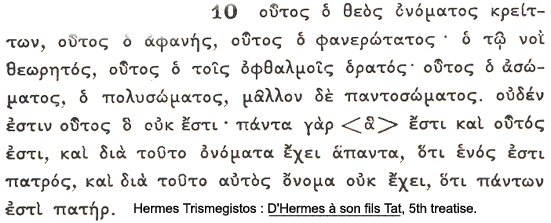
"Il est,
lui, le Dieu trop grand pour avoir un nom, il est l'inapparent et il est le
très apparent ; lui que contemple l'intellect, il est aussi celui que
voient les yeux ; il est l'incorporel, le multiforme, mieux encore,
l'omniforme. Rien n'existe qu'il ne soit aussi : car tout ce qui est, tout
est Lui. Et de là vient qu'il a tous les noms parce qui toutes choses sont
issues de cet unique père ; et de là vient qu'il n'a point de nom, parce
qu'il est le père de toutes choses."
Hermes Trismegistos : Corpus
Hermeticum, V.10, between 100 and 300 BCE, translated by : Festugière,
A.J. & Nock, A.D. : Corpus Hermeticum, Les Belles Lettres -
Paris, 1983, p.64 (with a critical rendering of the Greek text), translated
into English as :
"He, He is the God
too great to have a name ! He is the inapparent and He is the very apparent.
He who the intellect contemplates ! He is also the one seen by the eyes. He
is the incorporeal, the multiform, better still, the omniform. Nothing
exists which He is not, for everything that exist, everything is Him. From
that comes that He has all names, for all things come forth from this unique
father. From that comes that He has no name at all, for He is the father of
all things."
►
the omnipotence of Amun-Re's will
The Old Kingdom had produced the (mythical, pre-rational and early
proto-rational) ideology of a divine, cosmic order ("Maat")
realized and tenaciously maintained by Pharaoh, who offered order to his
father, the creator and source of order. Indeed, before the cosmos (i.e. an
inherently ordered creation) came into being, only the undifferentiated
"Nun" and its darkness, nothingness and oblivion prevailed
("existence" would be a bad choice of words). In it Atum lay
dormant as the mere possibility to self-create, the "soul" of Nun.
The
"humanist" Middle Kingdom recovered from the collapse of this
ideal and the conceptual crisis it involved, by discovering the value of
persoonhood, selfhood, individuality and personality. Its literature also
questioned the afterlife (scepticism) and described the worse traits of
humankind (pessimism) in a way which is "for millions of years",
i.e. "for all times". Hence, this elaborated religious humanism
(cf. Discourse of a man with his Ba) introduced
-besides the institutional rule of Pharaoh, who still embodied the unity of the Two
Lands- "personal conscience" and the "inner values" of
what was thought, said and willed (i.e. the "heart" -
"ib"). This lightness of the heart (cf. the Judgement Scene) was a
subjective affair, for having been near to Pharaoh while serving him and
being approved by him, no longer guaranteed a happy afterlife (as had
been the case in the Old Kingdom).
However, both in the Old Kingdom and Middle Kingdom, the permanence of
existence had been the underlining principle : a long life (here and
now), filled with happiness, prosperity & health ("ankh, uda,
seneb"), a good burial and in the afterlife, being justified,
venerable. Shu (life) and Tefnut (Maat) evidence the close connection
between order and life, continuous life. This was achieved by the constant
restoration and rejuvenation of creation and the daily victory of good over
evil. This repeated triumph (the battles are won but the war is never won)
is what made "permanent existence" possible. The success of this
operation have been differently appreciated. In the Old Kingdom, Pharaoh was
the sole guarantee. In the Middle Kingdom, the lightness of each person's
heart was the "via Regia" to the god's blessing ("hesu"
- "Hzw" : "one to whom grace and favour have been
given"). But in both cases, there was the concept of an unchangeable
order which had to be followed (public and/or personal). Personal conscience
was weighed in the afterlife, magic opened the doors and gave the deceased a
safe passage.
Amarna provoked a crisis precisely because personal conscience was
considered of no importance. The netherworld and magic were eliminated. The
identity of the supreme netherworld deity (the "hidden" in
essence), Amun, was eradicated. Akhenaten moved back to the archaism of the
deified Pharaohs of the late Old Kingdom. Re had incarnated again in Egypt
and had removed the pantheon "de manu militari" ! He had subjected
his people to his views and tolerated no opposition. This anachronism could
not shoot root. Meanwhile, those who adhered to the netherworld and its
magic (surely not a few), went underground and the pantheon left the
"public" domain (cf. the deities "leaving Egypt"). For
the first time in Egyptian religious history, the netherworld had become
intimate, secret and exclusively of the "private" domain.
"After Amarna all
the topoi of 'ethical authority' (good sheperd, asylum of the oppressed,
ferryman of the boatless, pilot, vizier of the poor, etc.) are related to
god. God is now praised precisely in those aspects of his nature which it is
not only possible, but indeed obligatory for human beings to 'imitate'. The
spiritual change expressed in these shifts can now be understood as follows
: god now appears directly and no longer through a representative in
institutions created by himself and courts appointed by himself."
Assmann,
1995, p.207.
The importance attributed in Amarna theology to Akhenaten (its inventor),
was also the reason for its eventual downfall. With no other mediators
present,
nobody understood the essence of the Aten. Who would present the offerings ?
Akhenaten's death coincided with the end of Amarna religion. But during this
incredible experience (although forgotten as such in less than a century
thereafter), the netherworld had been a private affair.
Shortly after his death
(or even before ?), Akhenaten's display of "free will" (i.e. the
Aten moving against the divine order deemed unchangeable) was
projected upon Amun-Re. Following Akhenaten was swiftly replaced by following
Amun-Re. Only Amun-Re disposed of free will. Nothing happened without
him willing it. And Akhenaten ? His memory could be forgotten, his frail
talatat-constructions demolished and reused as in-betweens, reinforcing the
new & enduring monuments praising Amun ...
►
the all-prevasive, hidden unity of Amun-Re in the
world
Although Amun-Re was direct and intimate, he was so in a hidden, concealed
and mysterious way. His interventions are permanent, but unseen. In Egyptian
we find words as secret, inaccessible, difficult ("StA"), secluded
("Dsr"), august, noble ("HAp"), hidden
("imn"). They refer to the concept of the holy, the sacred, the
put aside.
"It is expressed
through the secrecy surrounding the ritual, through the regulations for the
initiation and purification of priests and in temple architecture, the
development of which down to the Late Period makes it clear how much
importance was attributed to this aspect of holy throughout Egyptian
religious history." -
Assmann,
1995, p.137.
It is said of the deity that it is "secluded" or
"segregated" (as was its image).
"We have seen this
segregation in the concealment of the image in a dark and remote sanctuary,
where it may be handled only by a high priest who has undergone special
initiation ; it may have been kept in a closed shrine even when carried
about in procession." -
Morenz,
1992, p.99.
In Ramesside theology, the one deity was also concealed from its own
creation, even though he acted in it (or rather, it in Amun-Re). Nobody knew
the identity of Amun-Re. The crown was not even revealed to the best of the
best of creation. No revelation was possible. Amun-Re was part of the
world but remained an invisible, hidden part. But the world was also a part
of Amun-Re, but it knew it not. The best of what was known regarding this
god were his perfect transformations, i.e. the pantheon. Humans could take
Amun-Re "in their hearts" and he could become their personal
saviour. To follow the will of Amun-Re is all what is necessary in religion.
►
the spatiotemporal & sacred transcendence of
Amun-Re
In mythical thought, pre-creation was segregated from creation. The only
route from creation to pre-creation (which did not stop to "be
chaos" after creation) was the netherworld, deep down in the darkness
lurking beneath the Solar Bark, trying to destroy Re as does Apepi. For
kings, the route was an ascension to the sky. In the
traditional descriptions of divine transcendence, the primeval world was the
mythical anchor : by making the god (Pharaoh or magician) stand before
the spacetime of creation, creation itself is superceded
and made dependent of the creative command which initiates a new creation.
In Ramesside theology, the sacredness of Amun is no longer realized by this
spatiotemporal segregation (his essence being pre-creational), this
"temporal Beyond" (Assmann, 1995). Instead, Amun-Re as creator is
"summum bonum" and "summum ens" (first cause), dwelling
everywhere in his creation "behind" the screen of an infinite
number of forms. Amun-Re is ontologically segregated from all other
deities and none of them knows his name. Like the subtle "logos" of
the Stoics much later, Amun-Re is present in the invisible domains of
creation.
So regarding the transcendence of Amun-Re, two aspects are distinguished :
-
pre-creational
transcendence : Amun is primordial and so he spatiotemporally
transcends the order or creation (this is the traditional line of
thought, starting with Atum) ;
-
sacred
transcendence : Amun-Re is the self-created "soul"
("Ba") of creation, the "summum ens", the supreme
being. He is present in his creation as a sacred, hidden god, a
supreme being, that transcends all other beings, because Amun is the
all-prevasive, sacred unity in all beings that remains hidden for his
transformations (late Amun-Re theology or Amenism).
Ramesses II allowed the oracle of Amun-Re to guide him in the appointment of the
god's high priest, which made the step to a hereditary priesthood simple. At
the end of the New Kingdom, Egypt had become a sacerdotal state ruled by
Amun-Re of Thebes. Pharaoh
had yielded his power to the head of the state church, whose high priest knew
the will of Amun-Re ...
FIVE HYMNS TO
AMUN-RE
Leiden Papyrus I
350
I Philological
remarks
Although in many New Kingdom
texts, the three major aspects of Amun-Re (primordial god, creative
principle and ruler of the creation) are developed in detail, the Papyrus Leiden I
350 contains the most elaborate statement of Ramesside Amun theology,
with a clear attempt to integrate Heliopolitan and Memphite cosmological
schools of thought in a new comprehensive theology. Amun is described in three stages, namely :
-
as a hidden hypostasis of
the unity of the primodial deities ;
-
as the primodial hill
("ta-tenen") emerging out of Nun, a place of which Amun-Re
can set foot and begin to create ;
-
as the alone and
separated from those who came forth from him.
A cosmological scheme of
succession unfolds : Amun, "ta-tenen" and Re.
Hence, for an eloquent exposition of Amun's role in creation, none is better
than the series of songs or hymns dedicated to the glorification of Amun
contained in Papyrus Leiden (I 350). This document was probably originally
divided in 28 "enclosures" ("Hwt") or
"chapters", of which only 22 have survived in whole or in part (1
through 4 and the last 2 are lost).
The cursive handwriting is difficult to read and allows for different
translations. In each enclosure, a red dot divides the verses of the
manuscript, which facilitates the discovery of the intended poetical
structure. However, punctuation abruptly ends at line 11 of page 5. Scribal errors
are probable.
The manuscript was transcribed, edited and discussed by Gardiner, A.H. :
"Hymns to Amon from a Leiden Papyrus.", in : Zeitschrift für
ägyptische Sprache und Altertumskunde, Berlin, n°42, 1906, pp.12-60.
An elaborate and authoritative study was published by Zandee, J. : De Hymnen aan Amon van
Papyrus Leiden I-350, Oudheidkundige Mededelingen uit het Rijksmuseum
van Oudheden te Leiden - Leiden, 28, 1947 and Ermann, A. : "Der
Leidener Amonshymnus.", in Sitzungsberichte der Preussischen Akademie der
Wissenschaften - Leipzig, 1923. A complete French
translation was made by Barucq, A. & Daumas,
F. : Hymnes et Prières de L'Égypte Ancienne, Du Cerf -
Paris, 1980, pp.208 - 229. The most interesting enclosures were
translated into English by Allen, P.J. : Genesis in Egypt : The
Philosophy of Ancient Egyptian Creation Accounts, Hew Haven -
Connecticut, 1988, pp.49 - 55 as well as by Assmann, J. : Egyptian Solar
Religion in the New Kingdom, Kegan - London, 1995, chapter 5 - see also
: Assmann, J. : Ägyptische Hymnen unde Gebete, Zurich, 1975.
In this paper, five pivotal hymns (so
called because they praise & honour Amun - cf. "Hset") of the 22
(whole and partial) chapters have
been translated. They back the philosophical exercise at hand. The
central song, in the form of a sonnet (Assmann,
1995), was transliterated according to the standard
system for the computer-encoding of hieroglyphs.
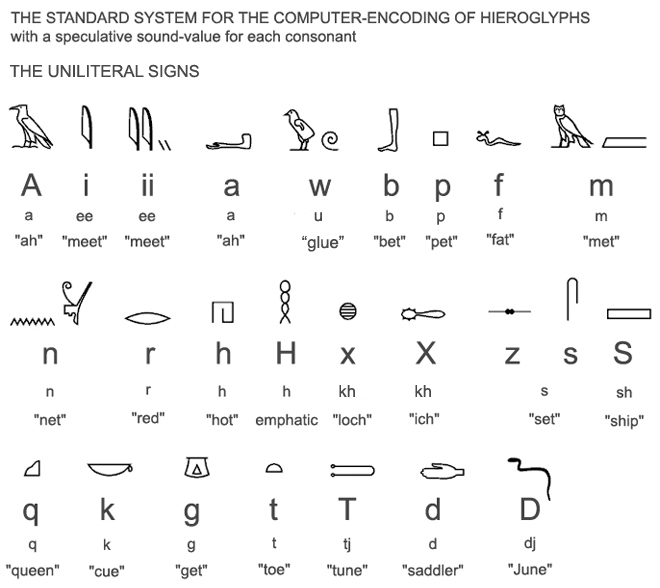
The "enclosures" were artificially numbered from 1 to 10 (1
through the beginning of 5 is lost), then by tens from 10 through 100, and
by hundreds from 100 through 800 (the last extant in the manuscript),
probably up to 1000, i.e. a total of 28 enclosures (2 + 8 = 10 = 1).
"L'usage constant de
jeux de mote entre la numérotation du chapitre et le premier et dernier mot
du texte (souvent des mots-clés pour l'intelligence du chant) est aussi à
mettre au compte d'une signification théologique. (...) Les Égyptiens
pensaient bien que sous les mots se cachait l'essence des choses et des
idées transmises. La combinaison chiffres-mots ajoutait encore à la
puissance significative de l'ensemble. D'où le choix de chiffres simples,
comme ceux des unités, dizaines et centaines. La symbolique des nombres est
chose utilisée dans toutes les spéculations religieuses et dans les
compositions théologico-mystiques ..."
Barucq &
Daumas, 1980, p.207, my italics.
A tentative Ancient Egyptian "number" symbolism could be :
{0} = the set of all possibilities of Amun being
Single, Alone, with no second (Atum ba of Nun) ;
{00} = the self-creation of Atum, hatching out of the primordial egg, the
first time, the pantheon ;
{000} = the undifferentiated primordial ground of everything - the Ogdoad ;
1 = unity, the monad, Atum-Re, Amun-Re ;
2 = division, the Two Lands, the tension between the elements of
creation, Shu and Tefnut ;
3 = harmonization, one-as-three, the divine family-trinities : god and goddess
with child ;
4 = the 4 pillars, the cardinal points, the sons
of Horus ;
5 = tenacity, Pharaoh, the continuous rule of law governing the Two Lands, Horus
;
6 = flow of life, Re, eternal life, the diurnal and nocturnal cycle
of the Sun ;
7 = resurrection, fertility, Osiris & the 42
Assessors, Djed pillar, fate, judgement, soul ;
8 = healing, regeneration, thought, the
heart, magic of the manifested, Ogdoad, Thoth ;
9 = perfection, completion, the Ennead, the whole pantheon, Isis as
"una quæ es omnia" ;
10 = solidification, the double, physical manifestation of order, Ptah and
Pharaoh.
In the following English translation, I
capitalized "God, He, His, Him and Himself" (pointing to Amun), for the
mode of theological thought is deemed abstract enough to be classified as a
discourse in the archaic stage of the rational mode of thought,
written in a highly sophisticated literary style, using a carefully planned
compositional structure. The discourse succeeds in positioning
"Amun" as a concept devoid of contextual connotations, such
as the "neteru" or creation (the effect of His creative act). The
"neteru"
("nTrw", pronounced : "netjeru" and usually translated as
"gods") are Amun's perfect
manifestations. The songlike quality of the verses
bring the Psalms and the Koran to mind, although their
semantics is henotheist (the Godhead being explicit and all-comprehensive despite
but not against the "neteru", cf.
Sufism).
For our authors and their environments, presumably XIXth Dynasty Theban
"initiates" of the "mysteries" of Amun (cf. remark
supra), the "neteru" receive new meaning. In their theology, the
"neteru" are no longer unique, one and great, but attributes of
Amun insofar as His creative activity goes (compare this with the role
of the "Elohim" -a plural- in
qabalah or
the "Beautiful Names" of Allah in
Sufism).
The "neteru" are Amun's transformations, and as such, they
loose their autonomy and are not opposed by Amun (as in radical monotheism,
moving against the plurality of Divinity - cf.
Islam). These authors were well
aware of the cultural disasters caused by the radical monotheistic tenets of
Atenism and did not wish
to oppose the house of the "neteru". But neither did they wish to
remain confused about the precise relationship between Amun and the
"neteru" (cf. infra).
|
|
The translation of
The Hymns to Amun is part of my
Ancient Egyptian Readings (2016), a POD publication in paperback
format of all translations available at maat.sofiatopia.org.
These readings span a period of thirteen centuries, covering all
important stages of Ancient Egyptian literature. Translated from
Egyptian originals, they are ordered chronologically and were considered
by the Egyptians as part of the core of their vast literature.
The study of the sources, hieroglyphs, commentaries and pictures
situating the text itself remain on the website at no cost. |
Hymns
to AMUN
a selection
Leiden Papyrus I 350 - ca.1213 BCE
II Text in English
|
Chapter 80
1 80th Chapter.
The Eight
(1)
were
Your first
manifestation (2),
until You completed these, You being
Single
(3).
Secret was Your body among the elders,
5 and You kept Yourself hidden as Amun,
at the head of the gods.
You made Your manifestations in Tatenen
(4),
to accompany the primeval ones in Your first primeval time.
Your beauty arose as the Bull of
His Mother (5)
.
You withdrew as the one in the sky, enduring as Re.
10 You returned in fathers, maker of their sons,
to make an excellent heritage for Your children.
You began manifestation with nothing,
without the world being empty of You on the first occasion
(6).
All gods came into existence after You ... [remainder lost]
|
(1) The pre-creational,
primordial Ogdoad or "chaos-gods" (Faulkner), worshipped at
Hermopolis, city of Thoth ("Khemenu" or "xmnw"), also :
"the Hermopolitans".
(2) "Kheperu" ("xprw") also means "form, shape,
similitude, image, change, transformation".
(3) The word here is "watii", which also means "sole, lone,
alone".
(4) The primordial hill emerging out of Nun, solid ground for the creator to
step on.
(5) Amun (Min) Kamutef is the ithyphallic form. As Amun has no father, He
impregnates His mother himself. The bull is a metaphor for strength,
fertility and sexual athletism. The epithet also refers to the god Min
("mnw"), worshipped in the 9th nome of Upper Egypt (the Greek city
Panopolis), with secundary sanctuaries at Memphis, Thebes and Esna. In
Coptos, as well as in Thebes, the epithet was a metaphor for the idea that
Min was born out of his own semen.
(6) The "first time" or the mythical realm "in the
beginning", when the primordial hill rises, Atum self-creates and Atum
splits, initiating creation through Shu and Tefnut.
COMMENTS
THE OGDOAD
In the traditional (Old Kingdom
based) mythical & pre-rational Heliopolitan theology of Re, a
confrontation between, on the one hand, Atum-Re, self-created and alone in his
creation (cf. Coffin Texts, spell 80 - II, 39) and, on the other hand, Nun, the inert primordial ocean is avoided, for the undifferentiated
inertness of the latter is overcome in an by the self-creative act of
Atum. By declaring Atum "causa sui", one may visualize him as spontaneously
emerging "ex nihilo" (like the "primeval hill" Tatenen)
out of the Nun (a vast, limitless, infinite, black ocean of oblivion). Atum is
the "Ba" of Nun. The
myth of emergence (visualize the water of the Nile lit up by the division of
the horizon when light -Re- rises at dawn, heralded by the chanting baboons)
is coupled with the vastness of pre-creation
(and thus the uniqueness of life & order guaranteed by Pharaoh). In the
cultural forms of the Terminal Predynastic and Early Dynastic Periods (ca.
3300 - 2600 BCE) a movement away from the chaos of disharmonized
division towards the harmonized (organized, regulated, administrated) division
of the Pharaonic state is apparent, for the latter served as "harmony of
opposites" (cf. Chapter 200 and the Two Lands).
Ramesside and Memphite theologies go a step further : the Nun is a
manifestation of Amun (or Ptah).
The 8th Chapter (the beginning of which is lost) ends with these words about
Amun : "God with souls more powerful than those of the gods, because He
is the One who remains unique, Divine, whose Name is hidden among the
Ogdoad." Taken here a step higher (80), and more explicit, the present
enclosure reaffirms this, but starts with the affirmation that the Ogdoad is a
manifestation or transformation of Amun. What could this possibly mean ?
Consider this :
-
Amun precedes the primodial
ocean, the Waters (Nun, "father of the gods") and the rest of the Ogdoad.
Inertness, chaos and destruction, which characterize the Waters, do not
know His "secret body". Even to them, Amun is a stranger ... this
anteriority is explicit & absolute ;
-
Before creation, nothing
except Amun existed (He being Single). "Negative" existence is
an intrinsic part of the Divine, which comes down to say that before
creation only God existed ;
-
The first step in the
developmental process of creation is taken in "negative" existence,
namely as the typical characteristics of the Waters, described by the
Ogdoad : His first manifestation (in pre-creation) ;
-
The second step is
"Tatenen" : the material principle allowing for creation ;
-
The third step is His
perfection as the Creator of the gods, at the head of the pantheon but
again absolutely withdrawn from them. The apophatic condition works for
all possible deities (Ogdoad + Ennead).
The material principle
("Tatenen" or "primeval hill") offers the land, not the
seed, the creative principle ("Re", source of an eternity of everlasting life &
regeneration). So Amun creates a material pre-condition (a matrix or space,
field, realm of options). Primeval matter is made manifest by Amun out of
Himself in His primeval time, which is a liminal, mythical,
"cross-over" from the Single Amun (in non-ogdoadic pre-creation) to
the Amun as "head of the gods" (in ogdoadic pre-creation and in
enneadic creation).
non-
ogdoadic |
Amun is Single - there is
no Ogdoad, no primeval "chaos"-gods, no "negative" existence of any kind |
pre-
creation
|
| ogdoadic |
Amun
manifests the Ogdoad in His primeval time. He creates the material
principle or matrix of creation ("the risen land") to
accompany the Ogdoad. |
With the expression "beauty" or "perfection" of Amun, rising as "bull of His
mother", Re and the pantheon are invoked, but their multiplicity and
variety is coupled with the idea that Amun is hidden from them.
If anything, the Divine was deemed nameless. That is the revelation of
no-revelation in these Theban mysteries of Amun : the purified soul alights
because Amun Wills so !
Chapter 90
1 [90th
Chapter]
The Ennead
(1)
combined is Your body.
Every god joined in Your body, is Your image.
You emerged first, You inaugurated from the start.
5 Amun, whose name is hidden from the
gods.
Oldest elder, more distinguished than these,
Tatenen, who formed [Himself] by
Himself as
Ptah (2).
The toes of His body are the
Eight (3).
He appeared as Re, from Nun
(4), so that He might rejuvenate.
10 He sneezed, [as Atum, from] His [mouth and gave birth to]
Shu and Tefnut
(5),
combined in manifestation.
He appears on His throne as His heart prompts.
Who, through His [power], rules for
Himself all that is.
Who binds together for Himself the kingship for ever,
15 down to eternity, established as Sole
Lord (6).
Light was His coming into existence on the first occasion,
with all that exists in stillness for awe of Him.
He honked by voice, as the Great
Honker,
coming into a land that He created for Himself,
while He was Alone.
20 He began speaking in the midst of silence,
opening every eye and causing them to look.
He began crying out while the world was in stillness,
His yell circulated while He had no second,
so that He might give birth to what is and cause them to live,
25 and cause every man to know the way to walk.
Their hearts live when they see Him.
His are the effective forms of the Ennead. |
(1) The Heliopolitan Ennead is
the result of the split of Atum ("the Bull of the Ennead") in Shu
(air) & Tefnut (moist), engendering Geb (earth) and Nut (starlight). The
latter gave birth to Osiris, Isis, Seth and Nephthys. Together with Pharaoh,
the Ennead is the sacred Decad (10), the number of ultimate completion
(macro and microcosmos interpenetrating) and oneness (sky and earth united).
(2) Here the suggestion is made Amun and Amunet are not part of the Ogdoad,
confirmed by the idea the Ogdoad was Amun's first manifestation (hence
his 10 toes = Ogdoad + Amun and consort).
(3) The primordial, inert ocean of non-manifestation characterized by the Ogdoad.
(4) In the myths, Atum either sneezed or masturbated.
(5) Shu creates space (air, breath, enduring life), Tefnut the order of time
(cf. the flow of water, of the Nile, rejuvenating, "what is right"
- Maat).
(6) As "unique" Lord is also possible, but the context suggests
aloneness (the French has "uniqueness").
COMMENTS
THE ENNEAD
The Ennead (90 = 9) is the company of
the "neteru", the organs of the "body" of Amun. This
"body" is a metaphor for the principle and operations of
materialization (Ptah). The combination of the organs make up the unity of the
material vehicle. The "neteru" are Amun's means of direct action.
Each of them is an image of Amun, for He was first and initiated the
"start" of creation.
Amun's absolute anteriority, precedence and distinction are again emphasized
and then the theme of his preeminent causative role is developed. Is it a coincidence that in this "enclosure", dealing with the Ennead
(multiplicity in Divinity), the fundamental theme is Amun's singleness and
sole creative power ? The last verse ends with : "His are the effective
forms of the Ennead." Amun is One before creation, during creation and
abides as an "image" in every "neter". He is also the only
true king on Earth (theocracy). The entire company of "neteru" is
nothing more than the sum total of Divine transformations and the image of the
creator, whose existence precedes theirs. The "neteru" are Amun's
theophanies.
The occurence of both the Heliopolitan (mythical & pre-rational) and
Memphite (proto-rational) accounts of the creative act, points to the
underlying intention present in the songs to synthesize the two major
theologies of Egypt. The Atum-cycle is linked with the rule of Amun as king
(cf. Pharaoh, son of Re, replaced by Amun, "King of the Throne of the Two
Lands"). The Ptah-cycle is replaced by the "Great Honker" who
spoke "in the midst of silence" and opened every eye. The creation
of the "neteru" and the world through the
creative
verb is coupled with the personalizing thought that Amun is at work in
every person and can be "seen", rejuvenating the mind.
Chapter 100
1
100th Chapter.
The One who initiated existence on the first
occasion,
Amun, who developed in
the beginning,
whose origin is unknown.
5 No god came into being prior to Him.
No other god was with Him who could say what He looked like.
He had no mother who created His name.
He had no father to beget Him or to say : "This belongs to me."
Who formed His own egg.
Power of secret birth, who created His (own) beauty
(1).
10 Most Divine God
(2), who came into being
Alone.
Every god came into being since He began Himself.
|
(1) "Neferu"
("nfrw") can also mean "perfection".
(2) "Neter neteri" ("nTr nTri") is a superlative expression
like : "God of gods".
COMMENTS
THE ONE
In chapter
"100", Amun's preexistent unity is invoked (100 = 1).
His absolute transcendence is affirmed and approached with negatives : this
absolute unity of His being is unknown, unseen, uncreated, not generated and
of secret birth. What we do know is that Amun is prior to everything, that He
is "causa sui", also the cause of His own perfection and absolutely
Alone, Single and without a second. As the end of this chapter indicates, He
is the only "Divine" God, every "neter" coming into being
after He began Himself. Transcendence is thus linked with ontological
priority (anteriority) and Self-creation.
Chapter 200
1 200th
Chapter.
Secret of manifestations and sparkling of shape.
Marvellous God, rich in forms.
All gods boast of Him,
5 to magnify
(1)
themselves
in His beauty,
to the extent of His Divinity.
Re himself is united with His body.
He is the great one in Heliopolis.
He is called Tatenen.
Amun, who comes out of the Nun,
to guide the peoples
(2).
10 Another of His forms are the Eight,
primeval one of the primeval ones, begetter of Re.
He completed himself as Atum,
being of one body with him.
He is the Universal Lord,
who initiated that which exists.
His Soul
(3), they say, is the one who is in the sky.
15
He is the one who is in the netherworld,
foremost of the East.
His Soul is in the sky, His body in the West.
His statue is in southern Heliopolis,
elevating His body
(4).
One is Amun,
who keeps Himself concealed from them,
who hides Himself from the gods,
no one knowing His nature.
20 He is more remote than the sky,
He is deeper than the netherworld.
None of the gods knows His true form.
His image is not unfolded in the papyrus rolls.
Nothing certain is testified about Him.
25 He is too secretive
for His Majesty to be revealed,
He is too great to be enquired after,
too powerful to be known.
People immediately fall face to face into death
when His Name is uttered
knowingly or unknowingly.
There is no god able to invoke Him by it.
He is Soul-like, hidden of name, like His Secrecy. |
TRANSLITERATION
StA xprw THn irw
nTr biAiiti aSA xprw
nTr nb ab=sn im=f
r SaA-sn m nfrw=f mi nTri=f
Raw Ds=f zmAw m Dt=f
ntf pA wr imi Iwnw
iw Dd.tw TA-tn ir=f
Imn priw m Nnw sSm=f Hrw
kii xprw=f m xmnw
pAwti pAwtiw msiw Raw
tm=f sw m Itmw Haw wa Hna=f
ntf Nb-r-Dr SAa wnnt
bA=f pw xr.tw pA nti m Hrt
ntf pA nti m dAt xnti iAbtt
bA=f m pt Dt=f m imntt
Xnti=f m Iwnw Smaw Hr wTz
Haw=f
wa Imn imnw-sw ir=sn
sHApw-sw r nTrw
bw rH.tw iwn=f
wAiw-sw r Hrt
mDw-sw r dAt
bw rx nTrw nbw qi=f mAa
nn sSm=f prxw Hr zSw
nn mtr.tw ir=f Driiwt
sw StA r kfA Sfiit=f
sw aA r dDdD=f
wsr r rx=f
xr Hr-a m mwt n Hr-n-Hr
n wD rn=f StA xmw rxw
nn nTr rx nis sw im=f
bAii imn-rn=f mi StA=f
|
(1) Literally : "to make
themselves greater".
(2) "Hr" or "face" ("Hrw", "the faces")
is also possible. "Hr nb" is "everyone". The poetical
"the faces" refers to all human beings (all of those who have a
face), i.e. "the peoples".
(3) "Ba" ("bA"), represented by the Jabiru-bird (Ephippiorhynchus
senegalesis) to be distinguished from the "Akh"
("Ax"), represented by a crested Ibis (Ibis comata).
(4) "Elevating His appearances" is also possible.
COMMENTS
THE TWO LANDS
This form of this chapter has
been called a "magnificent hymn" comparable with that of a sonnet
(Assmann, 1995), and the
"clearest surviving expression of the Egyptian
concepts of immanent and transcendent divinity" (Allen, 1988). However,
to refer to its contents as "pantheist" -as does
Assmann (1997)-
is not in accord with the text.
Indeed, in this song, Amun is described in positive ("katapathic"
- lines 3 - 17) and negative ("apophatic" - lines 18 - 28) terms.
In the former, the immanence is affirmed and the "neteru" appear
as sparkling manifestations of Amun, so many of His forms, each form
becoming "greater" not through themselves, but in His beauty and
perfection. In the latter, His absolute transcendence is put to the fore in
terms of concealment, secrecy, hiddenness, un-saying and unknowing. In a
pantheism, God and His attributes are identical and transcendence is undone.
This is not the case here. Hence, our Amun theologians were pan-en-theists,
for Amun is transcendent (as preexisting essence) and immanent (as the
created existence of His forms, the "neteru" or Divine Names).
Everything happens "in" Amun, in other words, nothing falls
outside Him ("pan-en-theos", "all-in-God").
"Every being came
into being when His being began being.
There is nothing outside Him."
Praise of Amun in the Decree for
Nesikhonsu, 6, XXIth Dynasty (the "Credo of Amenism").
The division implied by the diad is applied to Amun Himself.
Hence, our title for this chapter ("the Two Lands") is a metaphor
for the
bi-polarity of the Divine. Amun, on the
one hand, equals created existence as a countless variety of
manifestations (perfect as the "neteru" and imperfect as the rest
of creation). On the other hand, Amun is
unknown to both the "neteru" of creation as well as to the Ogdoad.
Such a one-and-millions-theology was also at work in the Great Hymn to
the Aten :
"You created the sky far away in order to ascend
it,
to witness everything You created.
You are alone, shining in Your form of the
living Aten.
Risen, radiant, distant and
near.
You made millions of forms from Yourself alone
:
cities, towns, fields, the river's course."
Akhenaten :
Great
Hymn to the Aten, 72 - 75.
The "noble" and "base" Divine Names of Amun are the
ontological roots of everything in existence. Nearness and remoteness are
thus both applied to Amun. Much later, we witness the same theological
structure with regard to the all-comprehensive Name of God in the
Koran,
namely "Allah" and His Most Beautiful Names, which can also be
divided in "perfect" and "imperfect".
Bi-polarity makes the distinction between, on the one hand,
"uncreated and creating" and, on the other hand, "created and
creating" explicit (these categories were taken from the IXth
century Periphyseon of Johannes Scottus). Indeed, Amun is not created
by anything except Himself and creates the pre-creational Ogdoad as well as
(in the form of Atum) the Ennead. Amun is present in each and every Divine
Name He creates and these Names are responsible for the construction of the
whole of the created universe. Were it not for the explicit transcendence of
Atum before creation and His concealment after creation, a pantheism would
indeed be the case. However, the all-comprehensiveness of Amun coupled with
a clear division between pre-creation and creation, points to pan-en-theism
(a term created by Christian Krause in his System der Philosophie of
1828, also used by Jacobi). In Renouvier's Traité de Logique of
1854, we read :
"Ce cas, que l'on a
appelé de nos jours de panenthéisme, consiste à supposer entre
l'unité et la pluralité non pas une relation telle que celle-ci soit issue
de manière ou d'autre de celle-là, mais une relation de nécessité
réciproque, jointe à une subordination constante, éternelle, du Multiple
par rapport à l'Un." - Renouvier, Ch. : Traité de Logique,
1854, tome III, p.220.
The message of line 22-24 is interesting :
"None
of the gods knows His true form,
His image is not unfolded in the papyrus
rolls,
nothing certain is testified about Him."
Chapter 200, lines 22- 24.
Nothing certain is known about Amun,
although He is given names as "Atum", "Tatenen" and
"Re". People also say that He is a "Ba" or
"soul", but in fact the papyrus rolls do not unfold His image. He
can not be perceived, and so He cannot be known. His identity being
unknown, nobody has any power over Him. Not the gods, not the world, not the
people. This strong affirmation of un-saying, ineffable transcendence is
striking. The "neteru" conceal Amun. People may think that Amun is
this-or-that "neter", but in truth, only Amun knows Amun. He is
Alone, One and Single and hence His essence (or face) is only for Him to
know & behold. This radical articulation of transcendence is however no
monotheistic declaration of unity (like "there is no god, but the
Aten"). Quite on the contrary : Amun who is the God of gods does not
deny the "gods & goddesses" their existence, but their
manifestation can only be perfected (made greater) in and through Amun. He
does not move against the "neteru", but subjugates all of them to
His Will. The extent of His Divinity determines the grand power of these
"neteru". Without Amun, they are not. Hence, the
"neteru" are no longer "gods" but Divine Names or Divine
Attributes at work insofar Amun deals with creation (either in
pre-creation, in the creative act of creation and in creation itself).
The end of the song again focuses on the personal element : if anybody would
utter the true, hidden Name of Amun to invoke Him, they would find death instead. His
soul-like quality is an outer manifestation grasped by the
"neteru" and the people, but His true Name is secret. Hence, the
word "Amun" (the Hidden) points to the namelessness of the
Absolute God who abides as the All in All. Everything happens "in"
Him, and He has no second (nothing exists outside Him) ...
Chapter 300
1 300th
Chapter.
All the gods are three :
Amun, Re and Ptah, without their second.
His identity is hidden as Amun,
5 He is Re as face, His body is Ptah.
Their towns are on earth, fixed for the span of eternity :
Thebes, Heliopolis and Memphis are established perennially.
When a message is sent from the sky, it is heard in Heliopolis,
and repeated in Memphis for the
god-with-the-beautiful-face (1),
10 put in a report, in Thoth's
writing (2),
directed to the town of Amun, bearing their concerns,
and the matter is answered in Thebes,
by an oracle emerging, intended for the Ennead.
Everything that comes from His mouth,
15 the gods are bound by it, according to what has been decreed.
When a message is sent, it is for killing or for giving life.
Life and death depend on Him for everyone,
except for Him, Amun, together with Re, [and Ptah] : total, 3. |
(1) This is of course Ptah.
(2) Thoth is the god of writing and magic.
COMMENTS
THE TRINITY
The preceding chapters taught
us that the "neteru" are the sparkling theophanies of Amun. They
are no longer independent of Amun and called
"the one" (as usual), but "three". Indeed, only Amun is
One. This "3 = 1"-formula
is next coupled with the "divine" geography of Egypt, affirming
that the "neteru" evidently deal with the realm of creation, in
specific, the Two Lands :
|
AMUN |
Thebes |
the hidden identity |
principle
of
unity |
|
RE |
Heliopolis |
the outer
"face" |
principle
of
filiation |
|
PTAH |
Memphis |
the outer
"body" |
principle
of
manifestation |
All "neteru" are
"three", namely Amun, Re and Ptah, i.e. the hidden identity (Amun
Himself, the principle of unity), their "face" or
"presence" as Re (the principle of light & life, i.e. the
"son" of the "father of the neteru") and their
"body" or "solidity" as Ptah. This trinitarian solution
reminds us of the Christian dogma of the Holy Trinity, and indeed, one may
wonder whether an indirect influence is really to be excluded.
We know that Christianity arrived in Alexandria, at least, by the middle of
the first century and so encountered the learned Alexandrian tradition, with
its Hermetism and traditional Egyptian religion. If we realize that Paul was
influence by Philo of Alexandria ("Christ" as "second
God", "contrition of the heart" etc. - cf. history of
Early
Christianity and
Jewish Christianity), we may
suspect the presence of a broader context of cultural diffusion,
assimilation and integration of interesting theological concepts still
circulating in Memphis and Thebes at the time of the first heresies (second
century) and even later, when an independent Coptic Church was established
and affirmed against the authority of Rome ("Coptic" by the way,
is the last phase of Ancient Egyptian). When the conflict between Rome and
Constantinopel regarding the nature of Christ was sealed in the West by
Constantine the Great with the "Nicene Creed" (arrived at with a
minority of bishops present), the notion of a Divine Trinity was already
well established and in accord with Ramesside theology, for
"Father", "Son" and "Holy Spirit" can with
ease find links with the triune theology invoked by our Amun theologians
(see also my
Tabula Smaragdina) :
-
Amun (the hidden, secret
"father of the neteru") = the Heavenly Father
-
Re =
Christ ("pantokrator" and exclusive path to the Father) and
-
Ptah =
Holy Spirit (the principle of manifestation acting through Mary to engender
Christ).
However, note (and here Amun theology differs from its Christian
offshoot) that our authors do not say that Amun is three, but that all
"neteru" are three. Each and every sparkling manifestation of
the hidden God is triune : Amun, Re and Ptah, i.e. hidden
essence, luminous presence and physical solidity :
-
hidden
essence : the spirit of each "neter" withdraws to abide
in the sky. Moreover, although celestial, they do not know their
Creator, who hides from them. Their own essence thus remains concealed
from them.
-
luminous
presence : the doubles and souls of the "neteru" exist
on Earth. As in Atenism, their presence is extended everywhere, from
"stone to man", and global.
-
physical solidity : the
bodies of the "neteru" are in gold, precious stones, stone,
wood and clay . So they exist in the very elements constituting nature
and become solid as a culture of sustainable harmonization, the
interlocking of human culture with the cycles of nature. The
"neteru" are the "names" of the laws &
conditions of process and evolution, "schemata" of successful
schemes of creating harmony in and with the environments (inertia being
overwon through "heka"). Their
"quantum" involving continuous emergence, dissolution
(annihilation) and resurrection (rejuvenation). Each "neteru"
in its own unique and special way. Solid structures (such as carved
hieroglyphs) symbolized the power magic had over matter & inertia
(cf. amulets & talismans).
The true identity of
the "gods" is "hidden as Amun", implying that the Name
"Amun" is the best verbal approximation possible of the Nameless,
ineffable Supreme God. It invokes His Secrecy ! Hence, the
"essence" of each and every "neteru" is the same,
namely "hidden" as "Amun", the highest Name of the One
God Alone, the Single without a second, before, during and apparently in
creation too.
The presence of the "gods" is luminous as Re. They are all beings of
light, or excellent manifestations of the creative principle. They are the
multiple rays emanating from the One, Limitless Source.
The body of the "gods" is their extension in space (the towns where
they act) and time (when they act). It is also a principle of outer
organisation (government) which keeps the Two Lands solidly together (Dynastic
rule). What is "heard" in Iunu is "repeated" in Men-nefer,
"put in a report" by Thoth and "directed" to Thebes, where
it is "answered" by the oracle of Amun, who has the last say on
everything.
Moreover, this trinity is linked with the major cult-areas in
the "body" of Egypt, the city of Amun (Ta-Apet, Thebes), the city
of Re (Iunu, Heliopolis) and the royal Dynastic city (Men-nefer, Memphis).
These also represent two traditional theologies (verbal,
in the case of Ptah of Memphis and
self-creational,
in the case of Re of Heliopolis) and the synthesis proposed by our Theban
authors. They were confident to have realized a superior scheme, although it
is not likely to have had popular following. These hymns reflect the canonical
discourse of a small elite, and focus on the theological superstructure of the
"initiate" mystery-cult of Amun after Amarna.
The "hearing" of Heliopolis, is more than just processing air. The
high priest of Re is a visionary and interacts "face to face" with
the creative principle. This "hearing" hence points to
inspiration, insight, revelation and the direct experience of Re, all rooted
in the presence of Pharaoh. Heliopolitan theology is fundamentally
celestial, Solar and Pharaonic. The "repetition" done in Memphis,
is more than verbosity. The contents of the "hearing" is made
conceptual (Sia), is given an authoritative form (Hu) and is simultaneously
spoken aloud by means of the tongue, giving what was "heard" its
first "sheet" or "layer" of solidity, for the
"magical" word is spoken by Ptah, the principle of continuous
craftmanship and enduring defiance of the inertia of matter (associated with
the act of eternalizing hieroglyphs). The recording of Thoth is a short
reminder of Hermopolitan theology (with Thoth at the head of the
pre-creational Ogdoad) and is suggestive of the tremendous importance of
writing. This truthfull report is "answered" in Thebes by the
oracle of Amun, who has the last word in all things. As "King of the
Throne of the Two Lands", Amun was Pharaoh and hence nothing He said
could be countered, His decrees were final.
The Great God Alone is Nameless. His Name "Amun" is His Secrecy,
His Ineffable Essence. Re is His outer manifestation as Light, Life and
Love. Ptah is His solidity in the elements of the Earth as the Unique Master
of His Temple. His Great Work is constantly being accomplished.
III Text in French
|
|
The French
translation of The Hymns to Amun is part of my
Ancient Egyptian Readings (2016), a POD publication in
paperback format of all translations available at
maat.sofiatopia.org. These readings span a period of
thirteen centuries, covering all important stages of Ancient
Egyptian literature. Translated from Egyptian originals,
they are ordered chronologically and were considered by the
Egyptians as part of the core of their vast literature.
The study of the sources, hieroglyphs, commentaries and
pictures situating the text itself remain on the website at
no cost. |
IV
Hieroglyphic text
The
hieroglyphs were published by
Jan Zandee in 1948 in his
doctoral thesis at Leiden University, Zandee, J. : De Hymnen aan Amon
van Papyrus Leiden I 350, Brill - Leiden, 1948, plates I - VI.
Epilogue
At its best, philosophy is an
answer to the question : What makes beings be ? This answer
surpasses their existence (cf. "ex" + "histanai"), their Whatness ? and Whoness ? Philosophy proper (not
to be confused with philosophistics, the logistics of philosophy,
studied at most of our universities) stands in the limitations or
isthmus of all possible
entities, and by remaining there, it transcends the existence of these entities by
entering into their being-there, i.e. into the essence of what these things are, given
they are some thing besides being something (what) and/or somebody
(who). In the case of human beings, the question is : is there a someone
instead of only something ?
As an independent discipline
of abstracts, philosophy was non-existent in Ancient Egypt. But as a discourse
on wisdom, it had a distinctive historical record as old as the Early Dynastic Period (namely as the
"transcendent significant", Pharaoh, the eternal witness). One can not assert a
"system" of human thought (as
Allen,
1988 does), for the mature proto-rational
mode of cognition (producing a concrete, practical and contextual system)
was only attained as late as the New Kingdom. Moreover, the
pictoral, contextual imagery of the Egyptian language itself was never left behind
and, in
the religious context, Classical Middle Egyptian became the standard language
(cf. the Shabaka Stone).
"The biological
imagery provided the ancient Egyptian with a means of visualizing and
communicating basic concepts that are more familiar to us as abstracts
principles or the terms of an equation. To appreciate the true intellectual
content of ancient thought, we have to look behind the images for the concepts
those images are meant to convey." -
Allen,
1988, p.ix.
Extant texts underline the Egyptian interest in the origin and constitution
of the cosmos. They provide us with a variety of cosmogonical and cosmological
considerations. The latter were an intrinsic part of the religious corpus.
Alongside this,
the Egyptians were fascinated with the good afterlife, and developed a specific
anthropology to discuss these matters. The two main objects of "natural
philosophy" (the cosmos and humanity) were important themes, and this from
the start of Heliopolitan theology in the Old Kingdom.
►
between sky and Earth :
Pharaoh and the deities
The
theology of Pharaoh called for transcendent and harmonizing qualities and
the specifics of the ascension-texts reveal something of the phenomenology of
Pharaonic (self)consciousness, the embodiment of a witnessing awareness. In the Old Kingdom, no other individual
received comparable attention, and common Egyptians "hid", whereas
Pharaoh "flew" to the sky. Classical literature (Middle Kingdom) introduced the expression
(verbalization) of personality within the provincial and urban family-context,
flanked by the articulation of (funerary) scepticism and a pessimistic
literature. Internationalization came with the New Kingdom, born out of the
collapse of the Hyksos, who -as other peoples- had introduced new cultural
forms (subsequently assimilated). Natural philosophy was at the core of the New
Solar Theology, and its
monotheistic extension briefly became state theology. After Amarna, Pharaoh
lost his power to the advantage of Amun, who's representative he was.
Atenite monotheism made it clear what happens when
religious and political authority coincide : destructive action is
undertaken against the plurality of deities. Amun was targetted by
Akhenaten because He represented the "hidden", ineffable side of
the Divine, as it were expelled into the desert (as was Amun's high priest)
by the fundamentalism of light, direct (intimate) presence and movement,
essential to Atenism. The light of the Aten did not allow for
shadows. No rival "cosmic god" could be allowed. The
"plural" for "gods" was eliminated. This eradication was
systematic with regard to Amun, but did not touch minor deities, nor Thoth,
indicating Amarna's "monotheism" was clearly tailored for the
Egyptian mind.
"We also see no
indication that the existing temples of the gods were converted into
sanctuaries of the Aten ; the worship of the god had its unequivocal center
in the new capital. At the same time, only fifteen miles away in Neferusi,
Knum, Thoth, and Osiris were still being worshipped ! (...) We must imagine
that the supression of the old cults was not altogether consistent in the
distant provinces, and that Thebes surely was a special case."
Hornung,
1999, p.86.
Moreover, Akhenaten had good political reasons to move against Thebes, which
had risen to considerable political and economical might. With his
"renaissance", Akhenaten wanted to return to the old system,
centralizing all political, economical and theological power in Pharaoh.
Although the temples were closed, the Thebans did not loose their money, and
so they waited for better times.
It is not unlikely this unacceptable violence is akin to all
forms of monotheism ?! This could well be another interesting aspect of the
Amarna episode : the first theo-political sectarian disaster in recorded
history ! A whole state run by an artistic madman & his wife. A "god" who
left foreign messengers waiting outside until they died in the burning Sun.
The sole mediator who crushed the salvic hopes of the poor, outlawing their
religion, and closing down their age-old religious points of reference (the
various temple cults and their festivals), impoverishing their religious
& social life. Akhenaten brought a new creation, a new cult, a new
afterlife and abolished the netherworld ! This frenzy led to the
interiorization of religious life and a shock-wave which would revise the
notion of kingship fundamentally (and this despite the gigantism of the
Ramesses). After the death of Akhenaten (apparently not caused by a fall
from power by a violent end), the sole worship of the Aten was immediately
given up. The experience was so traumatic, it was repressed (and, as
Assmann suggested, reappeared transformed in -Jewish- literature, like Psalm
104 and popular legends). In Egypt, the name of Akhenaten was erased and
slowly but surely the Egyptians transferred Pharaonic power & status
from the king to Amun, who became Pharaoh, and the king His masterservant.
The same lack of respect for Divine pluralism witnessed in Amenhotep IV, can
be found in Judaism, Christianity and Islam, although each of these
religions "of the book" have assimilated plurality and immanence
implicitly (i.e. under the control of their dogmatic theologies) and have
acted against heresy with more radical zeal.
-
in
Judaism
there is the "Shekinah", the "Messiah" & the
"chosen people" ;
-
in
Christianity
the "Christ-Divinity" of Jesus & the theology of the Paraclete ;
-
in
Islam
the "Most Beautiful Names" or attributes of Allah with which
the Sufi is adorned.
In Amenism, an abstract comprehension of the Divine was realized and the
division between the various theologies harmonized (as evident in the
one-and-millions-formula). Moreover, the necessity of "outer" cultic
ramifications was superceded, and replaced by the "Will of Amun",
who even "heard" the poor who were unable to offer ! Religious
tolerance, personal conscience and the proximity of God walked hand in
hand.
These complex religious, political and
theological issues imply philosophical activities like epistemology, natural
philosophy, metafysics, ethics, esthetics and philosophical anthropology. There is however no text which records the results of such speculative
activity for its own sake, i.e. for that reason alone. Ulterior purposes,
mostly relgious and theological, supercede the concerns of a speculative
approach, which is intransitive. The abstractor necessary for this operation was not
present or functioned at the tangent of the excellence of proto-rationality
(as in the authors of Papyrus Leiden I 350).
This unity of religion and philosophy does not mean that in thousands of texts,
such as hymns, prayers, songs, funerary and temple liturgies, spells,
narratives, dialogues, etc., subjects of philosophical interest can not
be isolated "post hoc", although they are always part of and refer
to a larger context.
In the Old Kingdom, wisdom and its discourse, emerge as a synthesis of cosmic
& social justice (Pharaoh being the moral center) and its verbal power
(Memphis). Pharaoh's power of exclusive constellational mediation is
omnipresent : Pharaoh is a god among the gods who mediates between Egypt and
Re by offering justice and truth, i.e. Maat, to his father Re. After
the collapse of the Old Kingdom, wisdom is democratized (we see provincial constellational participations and
early henotheism rising). A justified (virtues) & deified (Osiris NN)
individuality are wisdom's domains. The New Kingdom implied another
considerable leap forwards. The assimilation of foreign forms (under the
Hyksos), reunification (by Thebes) and the strong power of Pharaoh,
transformed Egypt into an international nation. Changes in theology and
philosophy were impending. The Books of the Afterlife are the research manuals
of the hereafter, to be known and used by Pharaoh alone !
Given the cognitive limitations of
proto-rationality,
it is suprising to witness the extent of what was still possible in philosophy. This
because a refined and mature proto-rationality is the
outcome (apex or flower) of a difficult process of differentiation, and hence is
characterized by a relative stability in the concrete & practical realm, whereas with
the next step, rationality, the whole process is to be repeated, to realize the operation of
abstraction, on a higher
level of cognitive performance.
In the general development of the cognitive
growth of humans and their cultures, the treshold between proto-rationality and
rationality is therefore pivotal. Ancient Egyptian
civilization never anchored in the rational mode, although its most exceptional
individuals inspired the admiration of philosophers like Pythagoras and Plato,
who did.
The Egyptian elite, discoursed in the way of conceptual rationality, but with the
door left wide open to mythical, pre-rational and proto-rational influences
(i.e. with no systematic abstraction or "theoria") and using a
refined, literary language steeped in metaphor, allegory, analogy & poetry.
Egyptologists are wrong when they say the attempt to
communicate abstract thought to others is universal, making
pre-Hellenistic peoples no exception (Allen, 1988). The importance of Greek
thought is unmistaken, although not exclusive. But with the introduction of the
categorial concept, Egypt's practical wisdom could be reformulated, and it was. The Greeks
provided the syllogism and its "major", the Egyptians the
"minor". The result, Egypto-Alexandrian Hellenism (and
Hermetism), was
most influential ... The abstract core of most ancient practical procedures
could now be established as well as the logical language underlying them (cf.
Euclid, Hipparchus).
"Read" the word "neter" and its derivations as expressions,
transformations, modifications or permutations of the hidden, secret "Deus
absconditus" (Atum, Amun). "Decode" the specific literary style
of Ancient Egyptian, with its specific associations, epithets, references to the
vast traditional mythical storehouse of imaginal representations (with Re, the
principle of light & creation, at its head) and its early, pre-rational,
pre-conceptualization of collective experiences in loose, plastic and flexible
(somewhat confused) "pre-concept-sets". Due to crisis this
requilibrates and an integrated (not underlying)
philosophical stratum may be discerned. It is often interrupted by theological,
religious and funerary considerations or spiced with epithets or series of words
(spells) intending a physical result (magic or "actio-in-distans").
This is a proto-rational system at work, a model with closure enabling a
specific ante-rational mode of thought to be developed. Three distinct modes of
thought engender three distinct views on creation and mankind, canonized in
three pivotal realizations : Heliopolitan theology and wisdom-teachings (Old
Kingdom), "humanistic" literature and individualized magic (Middle Kingdom) and
the New Solar Theology and its conceptualizations (New Kingdom).
Regarding recurring patterns of interest for philosophy, Ancient Egyptian philosophy brought
the origin (creation) and working (life & death) of the cosmos and humankind
to the fore. Material (Men-nefer), self-emergent (Iunu) and verbal (Khemenu)
pre-systems of philosophy emerged. The former, macrocosmic intellectual
interest, prevailed in theology, temple-liturgy and festivals. The latter, microcosmic
aim, was foremost realized in the funerary context and in the obligation of a good
life in accord with the practical wisdom in which order is truth and justice
(cf. "maâti", "Maat", "Judgement", Osiris, etc.).
During the "second" blossoming of Egypt (XIIth Dynasty, Middle
Kingdom), it was acknowledged that every human being had a "Ba" (soul)
and a conscience ("Ib", heart). The latter would be judged in the
afterlife and had to be as light as the Feather of Maat, the metaphor of being "true of
voice". The weight (burden) of the mind determines bliss or perdition.
The
dialectical (here : conflictual) nature of existence, both cosmical and
anthropological (returning in Greek pre-Socratic philosophy - cf. the tension of
war between the "enantia", the "elements" from Thales to
Empedocles and later in Plato's model of psyche's "two horses"), i.e.
the division of the "Two Lands" and their unity as "Egypt"
is acknowledged as early as the Terminal Predynastic Period (ca. 3300 - 3000
BCE). The harmonization of division ("coincidence of opposite") being
the final aim.
In the foundational myths of Ancient Egyptian theology & religion, the following
philosophical elements
return and give rise to pre-rational and proto-rational patterns of speculative
thought :
-
the
existence of an ontology of pre-creation : an undifferentiated and inert ocean
of potential energy exists - it is before, during and after creation
ends : a limitless, spaceless and timeless implicate order,
characterized by the possibility of creation (Atum, the Ba of Nun) ;
-
the
self-creation of the creator : "ex nihilo", the creator
of everything emerges as his own cause and simultaneously splits into
space, time and the elements ;
-
the
verbal factor in creation : through "great speech",
"authoritative utterance", "generative command" and
"divine words" in the mind and on the tongue of the
creator, everything ensues ;
-
the
fundamental importance of light : if darkness is a metaphor for
pre-creation, then dawn represents creation in its material, physical
aspect. The light of the disk of the Sun is the cause of photosynthesis
and all forms of life on the surface of the Earth ;
-
the transcendent element
: the dialectical divisions are always superceded and harmonized
(unified) by a central power (of powers). This "image of
images" is first projected on the king and kingship, later
attributed to Amun, the "King of the Throne of the Two Lands".
►
from natural
order to Divine morality and the king as protocol
Amun hears everybody, His
Will abides and He is the Saviour and Helper of the oppressed. So can one still perform votive offerings which bestow a particular favour (blessing)
"ex opere operato" (out of the nature of the things themselves) ?
The constellational discourse of the old theology had always been
cosmological and the (meta)physics of the magic of the proper
"name" omnipotent. But in mature Amun theology, as well as in that
of Ptah (cf. Papyrus Harris I,44), God was also conceptualized as being a Personal Saviour, and the righteous order of things was identified
with His Will. Hence, the "natural" order was broken down to the
advantage of the "Divine Will" able to curtail the cosmological order
of things.
"Amun-Re, I love You
!
My heart has been filled by You.
I have placed You in my heart,
for I know Your Name."
Prayer to Amun, Ostracon
British Museum (5656a), XIXth Dynasty.
From the point of view of natural philosophy this was a drawback. Also
morally this development was rejectable, for the acquired conscience and its
"lawful justification" was replaced by the oracular randomness (or
secrecy and mystery) of Amun (c.q. the power of the clergy).
"You are Amun, Lord
of the Silent,
who answers the cry of the humble.
I cry unto You because I am afflicted,
and already You come and save me.
You who gives breath to he who lacks it !
Save me, I, who am in distress.
You are Amun-Re, Lord of Thebes,
who even saves the one who is in the netherworld."
Prayer of Nebre, Stela 23.077
of the Berlin Museum, XIXth Dynasty.
After Amarna, the power of Thebes rose again. This had been the last
confrontation between Pharaoh and the Theban clergy, and the latter had won.
Pharaoh remained an important figure, but he could no longer do anything without
the approval of the oracle of Amun. The end of the ideology of the Pharaonic
Period was at hand, and after the New Kingdom, Pharaoh became an institution
which reflected the unity of the Two Lands.
In the Third Intermediate Period (ca. 1075 - 664 BCE), the Asiatic regions
were lost, and Nubia and its gold slipped from Egyptian authority.
"In practice, the
Thebaid was a military dictatorship ruled by the high priest, but in theory
it was a theocracy in which the all-powerful divine ruler Amun guided all
that happened, down to the solving of crimes and the appointement of
officials, through his oracular decisions."
Hornung,
1999, p.125.
In the Ptolemaic Empire (replacing Amun with Ptah), this would become his most
important, charismatic function. With the formula "Amun is King", all major
decisions in Egypt were (in principle) taken by the Hidden One.
"The principal
quality of the Ptolemaic kingship, inspired as it was by Hellenistic
ideology, consisted of a charismatic invincibility which was upheld by the
gods and which had to be proven if recognition by the kingdom's subjects was
to be secured. This was essentially different from the sovereignity of the
ancient Egyptian pharaoh, since the latter's invincibility, affirmed in his
role as the victorious Horus, was principally understood in cultic and
mythic terms." -
Hölbl,
2001, p.91.
►
the strong argument of monotheism
"ALLAH has no son, nor is there any divinity next to ALLAH. For otherwise,
each
god would make creation his and some of them would risen up above the others.
Far
from the glory of ALLAH is what they describe."
Koran, 23:92
In most chapters of the Koran, Divine unicity is emphasized. Although
Allah has attributes (His Most Beautiful Names), He is Alone. He created the
world but has no divine son and no fellow Divine beings.
Christianity, which largely incorporated the Egyptian Pharaonic model in its
Christology (Jesus being the unique "son of God", i.e. a God-man), is
rejected as a milder form of incarnationism (i.e. the notion that God
incarnates in a human being or may dwell in parts of creation). In
Sufism,
only creation as a whole and the Perfect Man are images revealing something about God, but He
has no need of creation. What argument did the Koran provide for this
radical monotheism ? Is this not the only form of theology which is logically
consistent with the idea claiming the supreme must be One, i.e. with the
fundamental
condition of the Divine ? Or is a postmodern
henotheism possible
?
Islamic law (drawn from the Koran and the so-called
"traditions", the hadith) refutes Egyptian religion
on the grounds that it is idolatrous, i.e. based on the worship of idols.
Historically, this interpretation holds true for Egypt's polytheistic phase,
situated before the emergence of the Dynasties. However, these authors do
associate idolatery with the theology of Dynastic Egypt, and this is somewhat
off the mark. We know of the
fugal monotheism of Atum
of Heliopolis, of the pan-en-theistic verbal creation of
the world by Ptah of Memphis, of the solitary Re in the
New
Solar Theology and Amarna and of the present, strict henotheist
interpretation of Amun in Rammeside theology. In all these theologies, the
One is not an idol but incarnates in whatever material object He desires and the
pantheon in particular is but a manifestation of His fundamental, hidden unity.
Hence, idolatery is not the strongest argument against Egyptian religion. It was
probably proposed as a result of a focalization on Pharaoh and his claim to be a
god (cf. the many instances in the Koran describing the confrontation
between Moses and Pharaoh (Ramesses II?)).
The Koran proposes another, stronger argument. Suppose, says the author
of the Koran, we accept the existence of Gods and Goddesses. Then
each Deity would claim creation for itself and try to compete with the others.
Indeed exactely what happened in Ancient Egypt ! In the Old
Kingdom, Osiris competed with Re. In the Middle Kingdom, Osiris and Amun-Re
confronted each other. Amarna theology tried to eradicate Amun by destroying his
name & temple-service. And although in the late New Kingdom, the Thebans claimed
the "millions" to be the many outer faces of Amun, each
"face" (in its own nome & temple) continued to be praised for
its own "greatness" and "oneness" without relating its
founding myth to the fundamental unity of which it was deemed to be but an expression (as do
the Divine Names of Allah). Indeed, in the Late Period, the formula
"one and millions" was also attributed to ... Isis !
So in his or her own temple, each god & goddess remained omnipotent, and the fact
Amun was the hidden origin of them all, may well have been part of the
hymns sung at Thebes, but was clearly not generalized on the walls of the
temples of the other deities. The exclusivity of the local deity was stressed as
much as the overall divine kingship of Amun. Just as Osiris and Re were left to
exist side by side, Amun-Re and the pantheon co-habitated. Even in a strict
henotheism, onflicts between deities cannot be excluded. Ancient
Egyptian proto-rationality was unable to operate consistently, and so the
fundamental confusion eroding Ancient Egyptian theologies was never taken away.
Is this the confusion the Koran rejected ? There is only one Great
God, and everything else is far removed from His Glory. Introduce more than one
god and we do not know who is really in charge. The whole rational effort of theology
becomes futile. But is theology served with this exclusive focus on reason and
rational completion (cf.
neurotheology)
? Is religion rational ?
"Have you considered El-Lat and El-'Uzza ?
And that other, Manat, the third idol ? What ? Do you have sons and He daughters ?
Indeed an unjust division. They are nothing but names. You and your fathers named them as such.
ALLAH
has not sent down any authority touching them. You only follow surmise, and
what
your souls desire, and yet guidance has come to you from your Lord. Shall the human have whatever he fancies ?"
Koran, 53:19-24
"Is your Lord not the final end of everything ?
It is He who makes you laugh and weep. It is He who makes you die and live. He Himself created the two kinds, male and female,
of a sperm-drop, when it was emitted. Upon Him rests one second of growth. It is He who gives wealth and riches.
It is He who is the Lord of Sirius."
Koran, 53:43-50
Against the idolatery of pre-Islam Arabia (plunged in the so-called "era of
ignorance"), the Koran states that people give names to
divinities of their own fancy which are not endorsed by Allah, nor exist
without Allah. The epithet "Lord of Sirius" in the context of growth,
wealth and riches, is suggestive of Osiris & Isis. Allah is the All. If He
has All Names, then clearly the worship of any individual Name as such is vane
and useless, for in each Name all other Names manifest. This logically
terminates the henotheist project and opens the way for a radical &
consequent monotheism (indeed, even in strict Egyptian henotheism, Osiris and
Seth remain two operational entities, whereas in monotheism only God is
operational).
Whenever free individual expression in writing and art is coupled with the
fundamental question : Why is there something rather than nothing ?,
philosophy is at work. Although philosophical inquiry is a
rational process, and criticism, dialogue and the limitations of
thought come to the fore in the
rules
of the game of "true" knowing, we should not replace our philosophical task
(being) with the instrument (thought).
Philosophy can be unsystematic, poetical and literary, as evidenced by
Ancient Egyptian civilization, both in its Pharaonic as well as in its
Hellenistic phase. Perhaps this is the wisdom of the ancients : the
tread of Ariadne is thin and interwoven with the "great story" of
life itself ; it is not a "rational" Tower of Babel to reach the heavens, but,
like the scales of Maat, a
bridge for passers-by, a channel harmonizing the flow of the waters, a
mediator between above and below, a pathway, landmark and waymark for
a good and happy life here, but also hereafter.
|