|
Introduction
This famous work is preserved in a single manuscript from the
XIIth Dynasty. In 1843, the egyptologist Lepsius puchased this
nameless hieratic papyrus and brought it to Berlin were it
became "Berlin Papyrus 3024". In 1859, he published the text
without translation. The first transcription & translation was
by Adolf Erman in 1896, under the title : Das Gespräch eines
Lebensmüden mit seiner Seele. The Egyptian text can also
(partly) be found in Sethe's Aegyptische Lesestücke
(1928). Faulkner published his translation as : "The Man who was
tired of Life" (in JEA, n°42, 1956, pp.21 - 40). His work was
based on more recent philological insights. In 1969, Wilfrid
Barta studied the work. He took 37 translations into account. He
stressed the difficulties posed by the text, understood by him
as unparalleled among the texts of Ancient Egypt. In 1970,
Goedicke published his translation in The Report about the
Dispute of a Man with his Ba. In 1973, Miriam Lichtheim (who
described this text as exceedingly difficult and intriguing)
proposed a new translation, but she acknowledged that a great
variety of interpretations are possible. In 1978, Bika Reed
translated the text from the perspective of the initiatic
experience. Another translation in French was done by Claire
Lalouette in 1984. The present translation owes much to the
translations of Faulkner, Lichtheim, Reed, Lalouette and made
also use of the Egyptian texts published by Faulkner, Sethe &
Reed.
According to Assmann in his Maat (1999), this highly
remarkable work belongs to what he calls "discourses on Maat"
or
"sapiental literature", consisting of teachings & complaints. In
the Old Kingdom, the
Maxims of Ptahhotep
and the shorter instructions of Prince Hordedef and those
addressed to Kagemni and in the Middle Kingdom the Eloquent
Peasant, the Prophecies of Neferti and the
Complaints of Khakheperre-sonb also dealt with
Maat. According to Hornung in his Idea and Image (1992),
the text is from the First Intermediate Period (while the
manuscript is from the XIIth Dynasty).
It is clear that in the Discourse of a Man with his Ba,
Maat is spoken of "a contrario", namely as auto-destruction,
dispute, rebelion, ungratefulness, egoism etc. Here death
instead of life is glorified.
►
What is the plot of the text ?
Section 1 : the Ba speaks
We know the dialogue is already going on for some time. The
broken sentences of the first section indicate that between the
man and his Ba an advanced state of argument prevails. The man
wants to end his life. His Ba tries to dissuade him. The Ba
threatens to leave the man and probably cries out the man
will have to answer for the offense of taking his own life.
Payment will be asked for by those who are unpartial, namely the
42 judges of Osiris. In fact, at the beginning of the extant
text, the Ba seems, from the perspective of the man, to have
left him ...
Section 2 : the man speaks
His Ba does not talk anymore, which is like deserting the
man. This is a crime. In fact, it is the reflection of the man's
confused and split state of being. The Ba seems to have left the
physical body while the man is still alive on earth ! The man
knows his Ba will be there on the day of judgment. Leaving
him now would only hasten what the Ba wants to avoid : the
unnatural death of the man. On the other hand, when it is
around, the Ba nurses the pain of life for the man and tries to
bring him to other thoughts.
Apparently, the man does not wish to end his life without the
approval of his Ba. He realizes that without his Ba he will be
lost in the afterlife (total annihilation) and so he tries to
persuade his Ba to participate in his auto-destructive
sacrificial act, for he does envisage immortal bliss & resurrection
! So this is a man who knows about the afterlife and the deities
and who nevertheless wants to end his life himself but not
without the help of his own Ba ! Because his Ba does not want to
cooperate, he reminds it that it is obliged to assist him.
Moreover, he knows his Ba will witness the weighing of the
man's heart on the day of judgment. Instead of stilling the pain
of life, he asks to sweeten the West (i.e. to make death easy
for him). But it will not be sweetened and even if the Ba could
do it (for it has incredible powers) it will not. This state of
affairs triggers desperate reactions in the man. He is totally
carried away and pleads his case before the deities. He ends by
saying life is too painful for him and invites the gods to
begin with their work (the funerary rituals allowing the "sah"
to be released from the body).
Section 3 : the Ba speaks
The Ba succinctly replies that the man should be ashamed of
himself and stop complaining. Who is he to utter these words and
think these thoughts ? Is he not of modest origins ?
Section 4 : the man speaks
This admonition was of no help at all. But the man is reluctant
to die if his Ba is left behind. For if left on earth, his Ba
would die too and this would imply total annihilation (physical
as well as spiritual). This the man does not seek. He needs his
Ba to rise so as to become a god in the afterlife. He wants his Ba to
assist him and pleads to it by saying he will make a
splendid mortuary temple and his children will present
offerings. He turns the argument around, and tries to reason his
Ba by saying it will not find peace if it accepts the
man should die without it being around ... He is very aware
all his efforts are in vain, for his Ba will never help him with
anything else than the just course of events. To die before
death comes is rejected by the Ba.
Section 5 : the Ba speaks
The Ba again questions the attitude of the man. The tombs &
monuments become, after their owners have ascended, as desolate
as those who die abandoned. The Ba urges the man to listen and
to follow the day of his jubilee (namely his birth, the
beginning of life) instead of worry. The Ba strikes two
simulitudes to offer comfort to the man but with no avail.
Section 6 : the man speaks (poetically)
The man denies his name, the others & life. He glorifies death
and reverses the highest values !
Section 7 : the Ba speaks
The Ba is not impressed at all and suggests the man to throw
away his complaints and to set aside his longing for death. As
long as he is alife, the natural course of events will not be
hampered with and his Ba will surely enlighten him after the
appropriate moment arrives for the physical body to die and
nothing should change that. It is unknown whether the man
decides in favor for his Ba ...
1 From
patriarchy to the individualism of the "classical age"
1.1
the centralized power of Pharaoh
The thinkers of the "age of the pyramids" envisaged the order of
society as a mirror-image of the order that supposedly governed
the cosmos. In this picture, the Sun-god Re and his son on
earth, i.e. Pharaoh, the "great house", were the two fundamental
points of reference. The never failing circuit of the Sun (as
well as the annual flooding of the Nile) ruled the world in the
same way as Pharaoh & the royal dynasties guaranteed the human
order. This harmony between "macro" and "micro" (between "above"
and "below") was conceived as a cosmic order of universal value,
a "justice" imbeded in the nature of being which encompassed
both the realms of "being" and "obligation" ("sein und sollen").
These ideas were brought together in the concept of Maat, which
was the great creation of the Old Kingdom.
"The sky is at peace, the earth is in joy,
for they have heard that Pharaoh Neferkare will set Maat in the
place of Isefet."
Pyramid Texts,
utterance 627 (§ 1775).
To realize a centralized sovereignty with supralocal dimensions,
i.e. to erect a state, was the great achievement of the Old
Kingdom. Pharaoh, the son of Re, "said Maat", "realized Maat" or
replaced "Isefet" (sins, faults, transgressions, i.e. the
negation by an act of free will of what is necessary by nature)
by "Maat". In the Old Kingdom, the pharaonic institution was the
center of gravity of the country. In fact, one could say that
"Maat" was the will of Pharaoh. Every initiative emanated
from him.
"... c'est d'abord le dieu qui veut
que la Maat soit réalisée, et que la Maat soit accomplie. Et, en
dernière instance, c'est la Maat qui veut ou plutôt exige
que l'homme parle et agisse de façon solidaire. Cela implique
naturellement que le roi soit obéi, que sa volonté
s'accomplisse. Mais c'est la Maat qui détermine la volonté du
roi, le roi ne peut vouloir autre chose que la Maat."
Assmann, 1999, p.127.
So, in a way Pharaoh incarnated cosmic harmony and order. Never
did these two notions conflict. Pharaoh was the divine
institution par excellence and he guaranteed the continuity of
both the cosmic as well as the social, political realm.
1.2
literature in the Old Kingdom
At the very beginning of the Dynastic Age, writing, considered
to be a gift of the gods, and hence sacred, was limited to
brief notations, identifying Pharaoh, an important event or
a crucial possession (like a tomb). A distinction should be made
between, on the one hand, texts on vessels and monuments and on
the other hand, short notices carved on tablets of wood or ivory
that accompanied jars of oil, to indicate their vintage year,
like : "Smiting the Land of Nubia." or "fashioning" a divine
statue, "visiting" a sanctuary of the goddess Neith.
At this early date (although cursive script and papyrus were
attested in the Predynastic period), there were no continuous
texts or arrangements of hieroglyphs into rows, no sentences.
The hieroglyphs were used to record short information, like
names of persons, places and products. Here are some examples :
-
from a
fragment of a large, globular, green faience vessel or vase
inlaid with the name of Pharaoh Aha in brown-coloured
faience (Ith Dynasty, ca. 3000 - 2800 BCE, in British
Museum) we learn about the sophistication of the combination
of faience technology and artistic talent in the Early
Dynastic period ;
-
the
Palette of Narmer (Dynasty 0, ca. 3050, in Cairo Museum JE
32169) commemorates a victory, probably the final one,
ending the struggle for the unification of the entire Nile
Valley (or Delta of Lower Egypt), for by this time
Hierakonpolis was a powerful political and religious center
in Upper Egypt. Narmer or Menes was the legendary or
historical Pharaoh who united the Two Lands, initiating the
end of the Predynastic era (ca. 3050 BCE). The Palette has
his name on it ;
-
the tomb
stela of Pharaoh Djet (Djer, Wadj, Uenephes, "serpent" - Ith
Dynasty, ca. 2920 BCE - Louvre E 11007) has his Horus name
inscribed on it ;
-
the tomb
stela of Pharaoh Reneb (Saqqara, IIth Dynasty, in
Metropolitan Museum of Art of New York) was also the focal
point of the royal mortuary cult (it represents the falcon
Horus surmounting a paneled facade, the "serekh", with the
hieroglyphs "Ra" and "neb", meaning "Ra is my Lord.") ;
-
the statuette
of Pharaoh Ninetjer in festival Sed-garb (IIth Dynasty, ca.
2760 - 2715 BCE, little over 5 inches in height) has his
royal name on it ;
-
the gods Geb
and Seth have been identified on a fragmentary relief of
Pharaoh Djoser (IIIth Dynasty, ca. 2654 - 2635 BCE, in Turin
Museum) ; the mortuary temples at Maidum & Dahshur of Snofru
(IVth Dynasty, ca. 2600 - 2571 BCE) were simple (an altar
with two tall stelæ bearing the royal titulary) but the
valley temple of the Bent Pyramid was provided with statues
& relief decorations (processions of the royal estates in
the various nomes) and columns (with ceremonies like
foundation rituals, scenes of the Sed festival, scenes of
Pharaoh being kissed by the deity) ...
The first major
literary application was the so-called Offering List
which contained a list of foods, ointments & fabrics. It
probably already existed in the IIIth & IVth Dynasties. It was
carved on the walls of the private tombs of high officials. The
written word gave special identity to the pictoral
representations, and named the tomb-owner, his family, his ranks
& titles and the offerings the deceased was about to receive. We
have to wait for
Pharoah Wenis or Unas (end of the Vth Dynasty, ca. 2378 -
2348 BCE) to read what had probably been recited for at least
since the beginning of the Dynastic Age, i.e. the spells of the
Pyramid Texts.
"(...) one cannot help suspecting that a
fundamental revision of the ritual coincided with the decision
to immortalize these spells, previously handed down on
perishable papyrus, by carving them in stone and thereby also
endowing them with greater magical power." -
Hornung, 1999, p.36.
So in this early period, the priests drew up an Offering List
which contained that which was thought right to offer to the
dead, together with formulæ repeated when the offerings were
made (and possessing a sacred force "sui generis"). This list,
together with the rituals, was handed down from generation to
generation, and was extant in the Roman Period. So we see that
the Old Kingdom list of offerings made to Unas or Wenis (5th
Dynasty), is repeated without too many variations in the Late
Period tomb of Peta-Amenapt (XXVIth Dynasty), i.e. 27 centuries
later !
"It must also be remembered that the
nature of the material offerings presented to the dead was
changed during the act of offering by the sacred formulæ which
the Kerh heb recited over them. The bread and meat, and wine and
beer, were transmuted into the essence and substance of Horus,
the great god of heaven." -
Budge, 1994, p.99.
For example, to cleanse & purify the statue so that it might
become a suitable and permanent dwelling-place for the "ka", the
"Sem" priest (who performed the ceremonies) took up a vessel
filled with clean water, in which salt or soda had been
dissolved, and poured it into a bowl held by his assistant. He
walked around the statue four times, sprinkling the salted water
on it from all sides. Meanwhile, the "Kher heb" priest (who held
a roll of papyrus in his hands and directed the assistant)
recited (after Budge, E.A.W., Ibidem, p.43) :
"O Osiris, take away all those who hate
Pharaoh Unis and who speak evilly against his name. O Thoth,
hasten, take away him who is harmful to Osiris, and carry off
him who speak evilly against Pharaoh Unis ; put him in your hand
! (Recite four times) 'Do not let go of him ! Beware lest you
let go of him !' (Pour water)."
Pyramid Texts,
utterance 23 (§ 16).
This ritual was performed in the
Tuat-chamber of the tomb.
Before it began, the altar (table of offerings) was purified for
the "ka" of the deceased. The "sa" ("sA") was a protective
energy existing in the gods, represented by rolled up papyrus
(V17), also used as an amulet with the same meaning. As "sA n
anx" it was the magical fluid of life, which could be
transferred by "magnetic passes" along the back, over the nape
of the neck or the spinal column. In the context of this ritual,
we may suppose that the transfer of the Sa was properly executed
by the purification of the statue by salted water by the "Sem"
priest and the invocation of Osiris by the "Kher heb".
However, the divinity of Pharaoah defined the distinction
between royal and private burials. Although there was common
ground between them (interchange & adaptation of certain
scriptoral practices) the difference was very important and
placed its stamp on writing.
In the Pyramid Texts, exclusively used to adorn the tombs
of the kings, the divinity of Pharaoh is clearly attested. Many
ascension-texts clarify that after he had died, he travelled to
the sky and (being a god) returned to the realm of the gods.
Only Pharaoh had that privilege. The pyramids themselves were
magificent monuments evidencing the divine status of the king
who utilized this mortuary house of fire to return to the
heavenly world of the stars where the gods abided. Osiris (in
the constellation of Orion), the god of resurrection, was the
prototype of the dead Pharaoh, son of Re.
Other royal inscriptions
appeared in rudimentary form :
(1) record of a single event ;
(2) the annalistic record ;
(3) the royal decree.
The inscriptions made in private tombs became the
stepping-stone to literature, for in their "house of
eternity", the high officials of Pharaoh used the written word
to identify pictoral representations and to name the tomb-owner
and his family, listing his ranks, titles and offerings. These
first texts focus on the tomb (especially its protection) and
not on the deceased. The status of tomb-owner implied :
(1) a function allowing one to use artisans to make and to adorn
the tomb (this was a state monopoly) ;
(2) a family organizing the funerary cult &
(3) a place in the collective memory of society (public
approbation).
"The elder Judge of the Hall,
Hetep-her-akhet, says : 'I made this tomb on the west side of a
pure place, in which there was no tomb of anyone, in order to
protect the possession of one who has gone to his ka. As for any
people who would enter this tomb unclean and do something evil
to it, there will be judgement against them by the great god. I
made this tomb because I was honored by the king, who brought me
a sarcophagus."
Inscription of
Hetep-Her-Akhet (Lichtheim,
1975, vol.1, p.16. The inscription of Hetep-Her-Akhet is in the
Leiden Museum and was carved in vertical columns on the two
sides of the entrance leading into the tomb-chapel. It dates
from the Vth Dynasty).
The long offering list became a short Prayer for Offerings
and to the ever lenghthening lists of ranks and titles,
narration was added, giving birth to the Autobiography
(cf. the autobiographies of Weni & Harkhuf, both of the VIth
Dynasty). Hence, the Egyptian autobiography was derived from the
epitaph.
Three fundamental components of the Egyptian autobiography
appeared side by side in prominent non-royal tombs :
-
a commentary
on the tomb-owner, sketching an impersonal portait of the
deceased in an ideal biography. This aimed at showing
that the deceased had been integrated in the cosmos &
society (the pharaonic state) and thus that s/he had
accomplished & spoken as Maat. It did this in general terms
;
-
a catalogue of virtues, implying a
serious commitment to ethical values which were also helpful
in the afterlife (namely in the "Hall of Maat" on the Day of
Judgment) ;
-
the
distinguishing marks of the individual, in flamboyant and
particular wording, i.e. a personal description of the
individual career (the professional biography) of the
departed.
These two
elements, Maat & career, determined who one was in the Old
Kingdom, both from the perspectives of cosmic (divine)
justice and of social status (defined as a function of Pharaoh's
goodwill towards the individual, directly -the court- or
indirectly -the local temples-).
"The quest for immortality had a magical
as well as a moral side. Statues, food offerings, and other
rituals would magically ensure revivification and eternal life.
But a good character, a life lived in harmony with the divine
order (maat) was equally essential." -
Lichtheim, 1975, vol.1, p.4.
During the Vth Dynasty, prayer and autobiography acquired their
fundamental shape. The prayers focused on the request for
offerings and a good reception in the West. The Prayer for
Offerings became a standardized formula, invoking Anubis and
the power from whom the desired goods would come. The rise of a
noble class of administrators was the result of an increasingly
complex system of government. Through their wealth and the
beneficence of Pharoah, they fashioned for themselves more
elaborate tombs to provide for the afterlife. At the end of the
Vth Dynasty, the first Pyramid Texts were carved on the
walls of the pyramids of Pharaoh Wenis (Unis or Unas).
In the VIth Dynasty, the autobiography (unfettered by the cult)
became prominent & attained its full length. Its aim being to
sum up the features of the person in terms of positive worth in
the face of eternity and in terms of what s/he had done or
received by Pharaoh. However, as the person was supposed to live
eternally in a transfigured body of the resurrected dead, so
that his or her name would live on forever, personal
shortcomings and the details of his or her life were unsuitable
for the autobiography. Hence it remained a blend of the real
with the ideal (as does a portrait sculpture).
The self-laudatory traits of the autobiography have to be viewed
in the context of the epitaph and the quest for immortality. The
epitaph is not a confession, and the faulty & ephemeral features
of the deceased were stripped off. In these Old Kingdom
autobiographies, Pharaoh always comes first (cf. the
Autobiography of Weni of the VIth Dynasty).
Along with the autobiography, the catalogue of virtues expanded.
It was written in a strict formalized, symmetrically structured
sentences (midway between prose and poetry). This catalogue
contrasted with the free proze of the narrative components of
the autobiography but provided the monumental, official proof
that life had been lived consistent with the precepts demanded
by the sapiental instructions. These
wisdom
discourses or didactic literature were literary works on
papyrus, calling for a life in accordance with Maat, universal
justice & truth (symbolized by a feather).
In the middle of the VIth Dynasty, royal power diminished
progressively to the advantage of the provincial governors, the
nomarchs. Maat had been identified with the will of Pharaoh (the
ultimate divine source of the unity of the Two Lands). By
serving society one had served the state and its core, Pharaoh.
The decay of the unity of the land triggered questions about
Maat, for the equation had been disrupted. Were was the
general standard to be found if the gods had forsaken Egypt ?
1.3
the patriarchy of the Old Kingdom and the First Intermediate
Period
At the end of the Old Kingdom, the stable pharaonic system
slowly broke down. During the nine decades of the reign of the
last Pharaoh of the VIth Dynasty, Pepi II (ca.2246 - 2152) -the
longest reign in history- the way was paved for the collapse of
the Old Kingdom under the pressure of internal weakening. A folk
tale of the New Kingdom depicts Pepi II as a weak personality
with abnormal tendencies ... No serious dangers threatened Egypt
from western Asia or Nubia, although attacks on Egyptian
expeditions seems to have been more frequent. One important
factor was the increase in the number of cults freed by royal
decree from taxes and other obligations, placing a burden on the
royal treasury, diminishing is power and majesty (cf. the number
of buildings built). Low Nile floods are also to be noted, as
well as a climate change ca. 2200 BCE (probably a world-wide
small ice age).
"But the decisive factor was that the
archaic, patriarchal structure of the adminstration was no
longer adequate to meet the more specialized demands of the era
and thus not suited in all respects to the tenor of the times."
Hornung, 1999, p.41.
The weak administration was no longer able to run the country as
a whole and the consequences were economical difficulties,
famine and struggle for life itself (while Pharaoh made enormous
gifts to the temples). Economic need occupied the center of
attention in biographical inscriptions which emerged in this
period. This situation triggered two important phenomena :
-
(objective)
local potentates acquired the necessary goods for themselves
and their subjects. Raids on neighboring regions and the
peasants were common. The latter therefore formed armed
bands. Safety was lost. Art sank to a provincial level. In
the walled homes of the rulers of the nomes (the nomarchs)
an urban middle class was formed, focused on the
accumulation of
private property. These "nedjes" (a pejorative word for
"small") designated these new "bourgeois" who made the
cities into political centers.
-
(inter-subjective)
the struggle against the terrible experience of returning to
the banished chaos triggered a flowering of literature
such as Egypt had never produced before. With the decline of
the monarchy, the identification of Maat with the will
of Pharaoh broke up. So the questions : What is good ?
What is evil ? became all important. For the intellectual
elite of the First Intermediate, the divine shepherd had
forsaken his human flock. Even the blessed afterlife was
questioned. New ways of formulating their thoughts were
sought, especially to break away from the formulaic &
archaic literary style of the mortuary cults. The power of
the individual was found ...
After Pepi II,
the construction of pyramids stopped and in rapid successions at
least a dozen Pharaoahs resided in Memphis and nominally ruled
the entire land. What exactely happened is unknown (for this
period is obscure), but at the end
Egypt was divided between the "kings" of two major nomes
: Heracleopolis (IXth & Xth Dynasty) & Thebes (XIth Dynasty).
The unity broke up and no great monuments were erected to
consolidate the power of the state. The Theban ruling family
assumed the royal titulary at about the same time as the
nomarchs of Herakleopolis. This fact initiates the First
Intermediate Period, which would last for about a century.
"Statues of the Theban rulers were set up
in the temple of Heqaib on the island of Elephantine, and we
must assume that because of this tie with the south, the Thebans
had at their disposal, from the very beginning, seasoned Nubian
soldiers who would lend considerable combat strength to the
Theban army in the warfare that ensued to reunite the land."
-
Hornung, 1999, p.45.
Hornung situates the Discourse of a Man with his Ba in
this First Intermediate Period. The vivid images used by the man
to describe the incurable degeneration of solidarity, justice
and goodwill in society, could thus be suggestive of a disrupted
and divided Egypt, returning to geosentimental barbarism (from
the unity of the Two Lands to the war between the
nomes). However, although unity was lost and conflicts did
happen, no general anarchy prevailed during the First
Intermediate Period.
So the poetical enunciations of the man are proof of the
author's refined literary abilities, combining "real" events
with subjective imagination & fiction to describe what
happens in the heart (the mind) of the man. In the
narrative, as well as in the poetry, the method "a contrario" is
used. The negation of these negative statements produces a
remarkably refined subjective reflection of Maat and the ways of
the just life. It also allows us to understand the relationship
between a
living human being and his soul.
In our text, kingship is mentioned only once, an this in the
context of nome-politics ("the town of a king") and treason. It
is interesting to note that although his moral depravity is
complete, the man has not relinquished the deities nor
eternal life. In fact, the discourse oscillates between a
dispute and a reconciliation. The outcome remains unknown.
The Ba-soul or guardian of the man remains focused on justice
and life. The man (his heart) is split between a total rejection
of this life on Earth (because of its chaos) and his knowledge
that he will be judged (although the Two Lands had no Pharaoh,
the celestial Pantheon remained). His higher, true
individuality is called in to act against its own laws.
The reply is a radical refusal : life on Earth must be lived in
happy and enjoyable ways whatever happens. When physical death
arrives, the Ba will assist the man to attain immortality.
Meanwhile, he should stop worrying, for his soul will nurse his
pains anyway ...
1.4
the salvation of the non-royals
The inscriptions of the First
Intermediate provide us with ample proof of the fact that
individualism was on the rise. Although the society remained
organized in a hierarchical fashion, the leaders were not divine
kings but local chiefs, ruling the country's ancient districts
(the nomes), called "nomarchs". These nobles (princes) and high
officials displayed a proud individualism which was taken over
by the commoners.
"An offering which the king gives and
Anubis, who is upon his mountain and in the place of embalming,
the Lord of the necropolis : an offering for the Count, Royal
Seal-bearer, Sole Companion, Lector-priest, the revered Indi,
who says :
I was a citizen excellent in combat, a companion of excitement.
I was one loved by his father, praised by his mother,
Loved by his brothers, liked by his relations.
Raised from the back of his father's house by the might of
Onuris ; ruler of This with a will to excell, with a will to act
for the best. One who spoke with his mouth, one who acted with
his arm. No man will be found who would speak against the
revered Indi.
A thousand of bread, a thousand of beer, a thousand of oxen, a
thousand of fowl, a thousand of ointment jars, a thousand of
clothing, a thousand of everything good, for the revered Indi.
His beloved wife, Sole Royal Ornament, Priestess of Hathor,
honored by the gods of This, Mut-muti."
Stela of Count Indi of
This (Lichtheim, 1975,
pp.84-85. The inscription was found on a rectangular, painted
limestone, carved in sunk relief. Metropolitan Museum 25.2.3,
VIIIth Dynasty).
Hence, the two families of nomarchs (at Heracleopolis and at
Thebes) amassed sufficient power to claim the kingship. Again :
although these inner conflicts are clear, the First Intermediate
Period is not decadent or anarchic.
"An
offering which the king gives and Osiris : an offering of a
thousand of bread and beer, a thousand of ointment jars and
clothing, a thousand of everything good, to one honored by
Re-Atum in his evenings, honored by Hathor who nurses the dawn.
He says :
Will you depart, father Re, before you commend me ?
Will sky conceal you before you commend me ?
Commend me to night and those dwelling in it.
So as to find me among your adorers, O Re !
Who worships you at your risings.
Who lament at your settings.
May night embrace me, midnight shelter me.
By your command, O Re !
I am your deputy, you made me lord of life, undying.
Commend me to night's early hours.
May they place their guard upon me.
Commend me to early dawn.
May he put his guard about me.
I am the nursling of early dawn.
I am the nursling of night's early hours.
Born at night, whose life is made in darkness.
Whose fear besets the herds with back-turned horns.
With your eye's red glow as my protection.
You find me hailing your approach !"
A Stela
of Pharaoh Intef II (Lichtheim,
1975, pp.94-95. The inscription was found on a finely carved
limestone stela in his Theban tomb. Metropolitan Museum
13.182.3, XIth Dynasty).
The crude artwork found evidences that quite ordinary people
made funerary monuments for themselves, which beforehand had
been the privilege of the wealthy high officials only. It was
not court art but work done by local craftsmen or perhaps even
by their owners themselves. Mostly the stelæ survived.
At the end of the Old Kingdom, the two main components of the
autobiography (ideal biography & professional biography) which
had never merged will do so and form a new genre which has been
called the "apogee" of Ancient Egyptian autobiography, namely
that of the First Intermediate Period. In this period and
thereafter the stela became the carrier of a short
autobiography. In the autobiography of the period, no royal
service (career) is mentioned.
"The Prince, Count, Royal Seal-bearer,
Sole Companion, Lector-priest, General, Chief of scouts, Chief
of foreign regions, Great Chief of the nomes of Edfu and
Hieraconpolis, Ankhtifi, says :
Horus brought me to the nome of Edfu for life, prosperity,
health, to reestablish it, and I did it. For Horus wished it to
be reestablished, because he brought me to it to reestablish it.
I found the House of Khuu inundated like a marsh, abandoned by
him who belonged to it, in the grip of a rebel, under the
control of a wretch. I made a man embrace the slayer of his
father, the slayer of his brother, so as to reestablish the nome
of Edfu. Now happy was the day on which I found well-being in
this nome ! No power in whom there is the heat of strife will be
accepted, now that all forms of evil which people hate have been
suppressed.
I am the vanguard of men and the rearguard of men. One who finds
the solution where it is lacking. A leader of the land through
active conduct. Strong in speech, collected in thought, on the
day of joining the three nomes. For I am a champion without
peer, who spoke out when the people were silent, on the day of
fear when Upper Egypt was silent.
As to everyone on whom I placed my hand, no misfortune ever
befell him, because my heart was sealed and my counsel
excellent. But as to any fool, any wretch, who stands up in
opposition I shall give according as he gives. 'O woe !' will be
said of one who is accused by me. His w'r will take water
like a boat. For I am a champion without peer !"
Autobiography of
Ankhtifi (Lichtheim,
1975, pp.85-86. From his tomb at Hefat (Mo'alla) - last decades
of the 22th century B.C).
Two other facts reflect this important change of attitude : the
Instruction to Pharaoh Merikare (the first treatise on
kingship) and, what Assmann (1999) called, "the advent of
virtue". The instruction proves the changed attitude towards
kingship : textualization of the royal tradition (the testament
of a departing king to his son & successor) in the context of
the division of the land and the absence of a unifying political
power.
The fact that in the autobiography excellence in royal service
is no longer mentioned, indicates that Maat alone is needed to
attain immortality. The accomplishment of a supra-individual
rule or norm coupled with individual merits became the two
determining elements of who one was in the First Intermediate
Period and in the Middle Kingdom. With the "invention of virtue"
(beauty, goodness, good nature, quality, character, grace,
kindness, patience, etc.) a new view on justice and truth
emerged. Moral behavior and professional activity merged. In the
First Intermediate Period, the autobiographies make no
mention of Maat as such. This because Maat had been
associated with the pharaonic state which had collapsed. Hence,
only individual merit remained :
"Kindness is a man's memorial for the years after the function."
Maximes of Ptahhotep, maxim 34.
"Good nature is a man's heaven."
Instruction to Pharaoh
Merikare (Lichtheim, 1975,
p.99. Three fragmented papyri of the XVIIIth Dynasty - the work
is dated Xth Dynasty or perhaps XIIth Dynasty)
"The monument of man is his virtue."
Stela of Mentuhotpe
(Schenkel, 1964, p.11. - dated
XIth Dynasty)
In the Middle Kingdom
this new view was again directly associated with Maat :
"Speak
Maat, do Maat.
For she is mighty.
She is great, she endures.
Her worth is tried,
She leads one to the state of reveredness."
The Eloquent Peasant
(Lichtheim, 1975, p.181. Four
copies on papyrus dating Middle Kingdom, also Assmann, J. : Op.cit., 1999, p.70 - dated XIIth Dynasty).
Around ca.1980 BCE, after a century of disunity, Herakleopolis
fell and all of Egypt was again under the rule of a single
Theban Pharaoh, namely Mentuhotpe III (ca. 1945 - 1938 BCE). The
apprenticeship period of Egyptian literature lay behind. The
Middle Kingdom produced a vast number of works in a variety of
genres and with full control over a vast number of forms.
Hence, it is called the "classical age" of Egyptian literature,
which saw the consolidation of Middle Egyptian.
The Coffin Texts superseded the Pyramid Texts as
early as the VIIIth Dynasty, but their principal sources are the
later cemeteries of the nomarchs of Middle Egypt in the XIIth
Dynasty. The largest number of spells of this textual tradition
was found in Deir el-Bersha, the cemetery of Hermopolis, the
city of the god of writing, Thoth. These spells (1.185 of them)
appear mainly on coffins of officials and their subordinates,
but also on tomb walls, stelæ, canoptic chests, mummy masks and
papyri. However, they are attested in only one place.
This local element distinguishes the Coffin Texts
from other corpora. The deceased was almost always spoken of in
the first person singular. Red ink was used for emphasis and to
indicate divisions. Important spells were entirely in red.
The Coffin Texts eliminated the royal exclusivity of
ascension. Every deceased was an "Osiris NN", although the
principal group of people to make use of them were the nomarchs
and their families of the Middle Kingdom. The tradition of these
Coffin Texts came to an end at the end of the Middle
Kingdom. They were transformed into the new Book of the Dead
in the XVIIth Dynasty. Some important spells survived and were
used in the New Kingdom (cf. burial chamber of Minnakhte TT87).
"Going out from the tomb in the
necropolis. The cavern of those who are in the Abyss is opened,
the movements of those who are in the sunshine are extensive,
the tomb of the Sole One is opened. When he went out, I went out
from the tomb, I went forth from the Great Lake, I descended
into the lustral basins. My foot is on the (...), my hand is
raised aloft, I have laid hold of his lashing which belongs to
(...), I row in my seat which is in the Bark of God, I do go
down into my seat which is in the Bark of God, I have taken
control without neglect of my seat which is in the Bark of the
Controller, my seat which is in the Bark of God did not leave me
stranded."
Coffin Texts, spell 151,
popular in the New Kingdom.
Besides these Coffin Texts, major works were the private
autobiographies of officials, artists as well. They combined
narration, the catalogue of virtues & elaborate prayers and
also contained hymns to the gods and praises to Pharaoh.
Royal monumental inscriptions, erected as a result of historical
circumstances (like war, peace, new temples, to set boundaries,
to mark festivals or special occurences) developed and came into
their own. Pharaoh was described as leader of the state in war
and in the service of the gods. His divinity was given ornate
expression.
2 Personal
piety in Ancient Egypt before the New Kingdom
2.1
the indwelling of the deities
For the Egyptians of the Old Kingdom, the deities withdrew to
the sky and were separated from humanity. The cohabitation had
been a primordial state which was lost. The withdrawal of the
deities to the sky went hand in hand with the founding of the
pharaonic state (ca. 3000 BCE). Direct contact between humanity
and the gods did no longer exist, except for the mediation
between the state and the divine Pharaoh (the heart of the
state). Between the human and the divine a sacred
signification, a "transcendent function" bridged the gap.
This was provided for by the temples, the state agencies, who
represented Pharaoh. The gods were resident on earth as lords of
a particular temple. Although their essences (or spirit or
"akh") existed in the sky, their "kingdom" was "of this world"
(through their "doubles", the "Ka's").
The temples of the nomes owned the land of Egypt and the local
deity of the temple embodied the concept of "city", which was
always the city of a particular deity. To belong to a city meant
to be under the rule of the god of that city. A city was thus a
temple situated on the primordial hill, home and domain of an
independent deity. The temple was the center of municipal
administration and those who lived in the city were
automatically "hour-priests" serving in the temples in a monthly
rotation under the authority of full-time priests (under the
charge of a royal official representing Pharaoh). Hence, the
Residence of Pharaoh determined which nome was dominant.
Sedentariness was a principle and those who fleed were severely
punished for desertion. In the "intermediate periods",
wanderlust and internal migration happened as a result of famine
and civil war.
The deities did not "dwell" on earth but they installed
themselves "in their images". The "installation" of Pharoah
during coronation (and his jubilees, the Sed-festivals) may have
served as a model. The deities of the old pantheon were in the
sky as "spirits" and "souls" ("ba's"), but their physical images
existed on earth. This physical double or "Ka" could embrace or
fraternize with the world if and only if the proper rituals of
"installation" were daily performed by the priests who were
functionaries of Pharaoh, for he was the state and the state was
the unity of the temples of the Two Lands. In the cult, the
divine brought itself near the realm of human activity. Through
the rituals, the deity "installed" itself in its earthly
image & function and in the mystery play, the divine drama was
executed (the priests did not act as mediators but interacted as
players in the ongoing divine plot). Without these rituals, only
the inanimate, physical image would remain, emptied of its power
of presence in this world (as if the gods had stopped living in
Egypt and only graves remained). So the priest never responded
to the occurring process of "indwelling" (cf. Junker's
"Einwohnung") but rather accompanied and confirmed it. He never
"spoke" to the deity, but narrated (assuming a particular
god-form) his alloted part of the divine drama.
2.2
the paradox of Pharaoh in the Old Kingdom
This ongoing personal service to the lord of the temple was
modeled on the daily morning ceremony of clothing Pharaoh,
for he was (as son of Re) a direct divine source and hence he
alone had a soul ("ba") and was the ultimate high priest.
Pharaoh was a god and also the only god who was actually
physically present in Egypt (he was not in the same way in
need of ceremonial installation as the images & statues). This
exclusivity of the divine king, who united & sustained the
Two Lands, was absolute.
All of this points to his paradoxical nature, for although being
a god he was the only god to dwell on earth, i.e. his
"divine ba" was on earth ... He alone ascended to the sky, and
for this he used a special door ("rhy.t"), translated as "the
door which keep out the plebs" (cf. Pyramid Text §§ 655,
876, 1726, 1934). These commoners continued their existence too,
but not vertically by ascending but by means of a
horizontal passage toward the sacred, isolated and
terrestial afterlife ("ta djsr"), put aside as the "Beautiful
West", enlightened by the Sun of the night ...
There is a correspondence to be found between, on the one hand,
the notion that the gods abided as "ba's" in the sky while
installing themselves in their statues & images through magical
means, and on the other hand, the idea that the "ba" was
gratified by the offerings made to the double (cf. the "ka"),
even if the latter were only representations of these offerings
in the "sacred" language of the gods (hieroglyphs).
2.3
the rise of Amun in Thebes in the First Intermediate Period
This First Intermediate Period was a turning point in the
history of Thebes, the fourth nome of Upper Egypt (opposite
Karnak), "she of the sceptre". In the Old Kingdom, Thebes offers
no clear evidence for royal activity. Substantial evidence for
statuary data of this type does not exist outside of the
Memphite region.
When the Old Kingdom had collapsed, the rulers of Herakleopolis
(IXth & Xth Dynasties) may at first have ruled Egypt nominally,
but it was not for long before many of the Southern nomarchs
started to build their provincial empires. Military campaigns to
conquer their neighbors were frequent, and at the end of the
story, Thebes triumphed ! Pharaoh Inyotef I, initiating the
Theban XIth Dynasty (ca. 2081 - 2065 BCE), assumed pharaonic
titles and wrote his name in a cartouche, as did his successors.
Pharaoh Amenemhet I ("Amun is pre-eminent" - ca. 1938 - 1909
BCE), who initiated the XIIth Dynasty and with it the Middle
Kingdom, moved the Residence away from Thebes to the North, thus
removing the centre of activity (Pharaoh) elsewhere. Thebes lost
much of its political power. Simultaneously, however, one of the
local gods worshipped in the region, namely Amun, was promoted
to be
the pre-eminent dynastic and national deity. Thebes became
the city of Amun. Pharaoh donated statues and a granite altar to
the temple of Amun. However, he attended Ptah of Memphis too.
Ptah had not been very prominent in the Old Kingdom. Re, Amun,
Ptah and Osiris (who received special attention as an enduring
focus of belief touching the afterlife) now formed a
constellation of leading deities.
"La suprématie d'Amon s'affirmera à Thèbes
de la XIe à la XXVIe
dynastie, malgré l'intermède d'Hyksos et surtout son effacement
temporaire lors de la crise armanienne." -
Barucq & Daumas, 1980, p.182.
2.4
the afterlife of the commoners in the Middle Kingdom & Osiris
In the Old Kingdom, only Pharaoh had a "ba", i.e. a "soul". He
alone would operate the transition from earthly existence to
divine immortality. While on earth he had been a living god,
after death he would ascend into the sky to return to the abode
of the deities. The "ba" is represented by the hieroglyph of
a bird that flies away, suggestive of the rise towards
another world, considered to be fully part of the created order
but transcending the gross plane of physical existence of
life on earth. The commoners were supposed to "hide" in
their tombs of the Beautiful West (the abode of the dead).
Ascension was not for them, but
exclusively for Pharaoh. The common people might survive
death as "revered ones", but they could not ascend.
"To say : 'Nu has commened Pharaoh Teti to
Atum. The Open-armed has commended the Pharaoh Teti to Shu, (so)
that he may cause yonder doors of the sky to be opened for
Phraoh Teti, barring ordinary folk who have no name. Grasp
Pharaoh Teti by his hand and take Pharaoh Teti to the sky, that
he may not die on earth among men.'"
Pyramid Texts, utterance
361 (§ 604).
Festivals were, besides the service payed in the temples to the
local deity, the way to express the might of Pharaoh and the
gods in a public way (the holy parts of the temples were
forbidden to commoners). These festivals organized personal
piety, for during a procession everybody could worship the deity
"face to face" and present their offerings & prayers.
The inscriptions on the mastaba tombs and other monuments of the
Old Kingdom give us the names of these festivals. On the
sarcophagus of Khufu-ankh (IVth Dynasty) the following festivals
are mentioned : Festival of the New Year, Festival of Thoth,
Festival of the beginning of the year, Festival of Uak, Great
Festival, Heat Festival, Appearance of Menu Festival, Festival
of Uah-akh, Festival of Satch, Festival of the beginning of the
month, Festival of the beginning of the half month, Every
festival on every day for ever ... In later Middle Kingdom tombs
(like that of Khnemu-hetep of the XII Dynasty) the list is
longer, including Festivals of the 1th, 6th, 15th and one other
day in each month, Festivals of the Five Epagomenal Days, ... in
total 73 festivals, allowing for the conclusion that on average
every fifth day was a day of festival ! In later periods
several other festivals were mentioned, and in the most
flourishing periods the sepulchral offerings in the tombs of
Pharaoh and the wealthy people were renewed daily.
The collapse of the pharaonic Old Kingdom of the pyramids (from
Djoser to Pepi II, i.e. ca. 450 years) and the subsequent
decentralization which eventuated, put Egyptian culture in a
state of crisis which triggered the re-equilibration of the
nation & the state by the formation of an internal "prise de
conscience" touching good, evil and the importance of the
individual in the state. The Old Kingdom had been construed
around Pharaoh and his temples. From the First Intermediate
Period onwards and especially in the Classical Age, this new
awareness moved the intellectual & spiritual forces of the Two
Lands to understand that Pharaoh was no longer an absolute
justification, for it was not one's service to Pharaoh which
was weighed at the judgment, but the very heart of the
deceased. And a heavy heart only invited the remainder to be
eaten after the judgment by the monster, the Devouress (emerging
as an iconographical element after the Amarna period) ...
After the fall of the Old Kingdom, the whole constellation of
interrelated concepts about survival and immortality were
democratized, although the distinction between survival and
immortality remained. Although a human longed for immortality he
would never attain it as a human being. A
revered person ("imakhou") was a moral being surviving in the
tomb in the Beautiful West. A living god was an immortal
being. In the case of Pharaoh, this had only implied a
transition, not a change in essence, for he was already a god on
earth and he alone would ascend to reach the abode of his soul
and the souls of all the other deities of the old pantheon.
After the collapse of the Old kingdom, the commoners also
aspired immortality and could attain it, not as a human being,
but as a living god too ! Hence, a change of essence had to
happen, for a mortal human had to be changed into an immortal
god ! This deification called for new ideas.
The transition was conceptualized in the funerary literature (Coffin
Texts in the Middle Kingdom & Book of the Dead from
the New Kingdom onward) in the form of a series of initiatoric
events post mortem, starting with purification, then
judgment and finally admission as a god. In this "scala
perfectionis" (cf. the Christian "purificatio, illuminatio &
deificatio"), purification (called "the baptisal of Pharaoh")
implied that the deceased separated him or herself from all
sins. It called for the recital of the "declaration of
innocense" which is precisely the fact that the deceased had
said and accomplished Maat. What one had not done was
deemed more important than what one had done ! Not to eat the
forbiden fruit was considered far more closer to doing the right
thing than a series of obligatory actions. The list shows that a
lot of sins were directly related to what one had said or
to how one had listened. The cognitive element
predominated, suggestive of the association of Maat with
mental states and the notion of "logos" (also found in the
Memphis Theology and the teachings on the
accomplished discourse).
No other god in Ancient Egypt was more intimately related with
the afterlife than Osiris. The original home of Osiris was the
temple city Per-Asar-neb-Tetu (the Greek Busiris), situated in
the 9th nome of Lower Egypt. Here was preserved the backbone of
Osiris, the "tet", and grew the sacred acacia etc. As his
cult extended, Osiris assumed & assimilated the forms of the
gods of the dead of other nomes and cities like Memphis
(Ptah-Seker) and Abydos (Khenti-Amenti). Before Osiris had
arrived at Abydos from the North, Khenti-Amenti ("Foremost of
those of the West") had been one of the oldest gods of Abydos
...
The Pyramid Texts evidence the assimilation of the
Khenti-Amenti by Osiris. The oldest form of the name of Osiris
had two hieroglyphs : a seat, throne, place and an eye, i.e. the
seat maker, he who takes his throne. His important role in the
funerary rituals is testified by the ceremony of "Opening the
Mouth" found in the Pyramid Texts, intended to "balance
the mouth", enabling the deceased to speak etc. in the
afterlife.
In the Old Kingdom, Osiris was intimately related with the
individual spiritual process of transformation happening after
Pharaoh's physical body had died. For Osiris was the proto-type
of a godman who had lived on the earth, had been dismembered but
who nevertheless remained everlasting in a fine condition, alife
after natural death ... immortal. Later, Osiris was called "Lord
of the Living" (i.e. of those living their afterlife). Osiris
was the god of the dead because he gave eternal life to the
dead as a result of his own permanent state of divine
existence in the afterlife.
In the classical account on Osiris, namely in Plutarch's De
Iside et Osiride, we are not told whether Osiris
returned from the Other World in his natural body or in a subtle
body. The latter had power of speech, thought and an posture
recognizable by his son Horus. The core of the message being
that his natural body was only a sheet put on by the divine
part of Osiris, able to take on all forms (at first of all
the Kings of Egypt and eventually of all justified humans).
"A ladder is knotted together by Re before
Osiris, a ladder is knotted together by Horus before his father
Osiris when he goes to his spirit, one of them being on this
side and one of them being on that side, while I am between
them."
Pyramid Texts,
utterance 305 (§ 472).
Hence, the nexus of paramount
importance between the monarchy and Osiris consisted in the fact
that once the king of Egypt had died, he became Osiris, king of
the netherworld. At death, the divinity of Pharaoh, embodied in
the forms of (a) Horus the elder sky god and (b) the son of Re,
took on a new divine manifestation. Pharaoh became the monarch
of the underworld & the afterlife : Osiris. Consequently, in the
Pyramid Texts, the dead Pharaoh is sometimes referred to
under the name of Osiris (cf. Osiris Wenis or Osiris Pepi).
However, this was done with some reluctance and dread of the
ruler of the dead. Osiris also reigned over the hidden, unknown
& forbidden regions of the Duat (namely those touching the
primordial chaos of pre-creation), associated with evil & the
demonical. Osiris also gloried in slaughter and in the Coffin
Texts he utters malignant spells against a dead person and
is the head of "Osiris's Butcherers Painful of Fingers" ...
It seems that there is only one Great Hymn to Osiris
which mentions the "top secret" regarding this unique and sole
god of the dead, namely the narrative concerning his
dismemberment by his evil brother Seth when he was king of
Egypt. At no time in Ancient Egypt is this murder of Osiris at
the hands of Seth pictorally represented ! According to
Plutarch, the story of Osiris' death was a "mystery" veiled by
silence. Indeed, the story as such is not mentioned in the
Pyramid Texts, Coffin Texts or in the Book of the
Dead, whereas the story of Horus (his posthumous son) as the
defender & avenger of his father are oft repeated themes.
Indeed, to write down the most terrible event in history would
cause it to happen again ...
"We have delivered to the son of Isis his
enemy, who succumbed to his force. We have done evil to the
adversary. He who attacks the strong will see his misfortune
reach him. The son of Isis has defended his father. His name
becomes sacred and beneficial. Respect rests in its place and
reveredness is established according to its own laws. The road
is free, the paths are open. How joyous have the Double Banks
become ! Evil dissipates and the accusor moves away. The land is
pacified under the authority of its Lord. Justice is established
for its Lord. Backs are turned towards injustice !"
Great Hymn to
Osiris (translated to the French by
Barucq & Daumas, 1980, pp.96-97. Preserved on Stela C
286 of the Louvre, dating from the early New Kingdom, XVIIIth
Dynasty).
Seth is in many ways the outsider of the pantheon. He
killed his brother Osiris and dismembered him. After the
unfoldment of the complete drama (including Isis, Thoth, Re and
Horus), Osiris returned from the abode of the dead
(resurrection) to encourage Horus to battle Seth, who looses. At
the end of this story, told in many versions, Osiris is the sole
judge & king of the dead, the ruler of the underworld, he who
could bestow immortal life on the dead ... but also cast the
unfit into oblivion.
"Seth is one of the gods composing the
Ennead of Heliopolos : Atum, Shu and Tefnut, Geb and Nut, Osiris
and Isis, Seth and Nephthys. Primaeval time may be described as
the time before duality had arisen in the land. The one
primaeval god Atum, the lord of all, as the first act of
creation brought forth a male-female twin by self-fecundation :
the god Shu and the goddess Tefnut. This twin brought forth
another twin : the earth god Geb and the sky goddess Nut, who in
turn produced Osiris and Isis. The duality so far is that of man
and woman and is complementary. However, Geb and Nut dit not
bring forth only one male-female twin, but also Seth and
Nephthys. This disturbs the harmonious development of creation,
wherein each pair only produced on other pair. Thus the birthday
of Seth is the beginning of confusion. Seth is the one who
caused disorder before his name existed." -
Te Velde, 1977, p.27.
Seth is one of the gods of the Ennead who actively embodies the
force of chaos. The primordial Ogdoad was completely inert and
represented the potential of evil present in pre-creation. It
must be assumed that some part of this latent, hidden evil
manifests when Atum differentiates and creation unfolds. Seth
being the deification of the most powerful part of these
disruptive, destructive, corrosive, dark & deadly power of
chaos, emerging out of the inert matrix of dark pre-creation
itself and actively engaged in moral & natural evil. Fratricide
(of Osiris), anal intercourse (with Horus) and the destruction
of Re (by Apophis, ruled by Seth helping Re) being particularly
symbolic of the sinful states of mind of Seth, anthropologically
as well as cosmically.
But the assassination of Osiris (evil par excellence) was of
no avail ! In order to obtain his resurrection, Isis and
Horus performed ceremonies on the body of his father, helped by
Anubis, the embalmer, while Thoth recited sacred words. Thus was
Osiris
raised from the dead to life immortal in a new body.
If Pharaoh was a living paradox (a god abiding on earth), then
Osiris was a dead paradox (a man alive after death). In both
worlds, they represented the exceptions :
The divine Ba of Pharaoh lives in his body and may
return to the sky when the king dies.
Osiris natural body is mummified but he was raised from
the dead to eternal life in the afterlife.
Osiris became the great prototype of all dead men, to start with
Pharaoh in the Old Kingdom. From the Middle Kingdom onward,
everybody who was just and able to pay for the rituals could
find a set of spells which would be helpful to him or her in the
afterlife ...
3 Didactical Literature
3.1 the didactical
literature of the Old Kingdom : Hordedef, Kagemni &
Ptahhotep
The wisdom teachings (or, as the
Egyptians called them, "instructions") were the second major
literary genre in the Old Kingdom. The great order (Maat)
combined with speculative thought gave rise to brief teachings
or maxims. The narrative frame of a
father instructing his son were the literary device used to put
these teachings together. These instructions teach how humans
can be made perfect and summarize the deposit of wisdom
of Ancient Egypt. Whereas all other works are anonymous, the
wisdom instructions are attributed to a famous sage (genuine or
pseudo-epigraphic).
The instruction was primarily aristocratic. It became "middle
class" in the New Kingdom. The Old Kingdom instructions have the
ambiance of the Old Kingdom and reflect a state which is
unified, serene, orderly & optimistic. The state (Pharaoh & the
temple services) is in harmony with itself, and the instructions
embody the pragmatical wisdom of the upper-class Egyptian. They
promote the code of the Old Kingdom nobleman, belonging to the
wealthy class, (partly) initiated in the rituals of the temple
service payed to the deities, able to read & write
hieroglyphics, and a member of the administration of Pharaoh,
like local governors, high priests, members of court or members
of the family of the king.
Of the Instructions of Kagemni (serving under Huni &
Snefru, IIIth to IVth Dynasty, but dated VIth Dynasty) only a
final portion is preserved and the name of the sage is lost. The
text is part of the Papyrus Prisse of the Bibliothèque
Nationale and (after a blank stretch) it is followed by the
Maxims of Ptahhotep. The latter is also written in the VIth
Dynasty and both are stylistically resemblant.
"If a good
example is set by him who leads,
he will be beneficient for ever,
(and) his wisdom will be for all time.
He who knows, feeds his Ba with what endures,
so that it is happy with him on earth.
He who knows is known by his wisdom,
(and) the great by his good actions.
(That) his heart twines his tongue,
(and) his lips (be) precise when he speaks.
That his eyes see !
That his ears be pleased to hear what profits his son.
(For) acting with Maat, he is free of falsehood."
Maxims of Ptahhotep, epilogue.
In fact, both instructions embody teachings on justice & truth
(Maat) which must have existed long before the VIth Dynasty. On
the walls of the pyramids of
Pharaoh
Unis (Vth Dynasty, the first one to cover the walls of his
tombs with hieroglyphs) and the rulers of the VIth, we also find
:
"To say : 'May you shine as Re, repress
wrongdoing, cause Maat to stand behind Re, shine every day for
him who is in the horizon of the sky. Open the gates which are
in the Abyss.'"
Pyramid Texts,
utterance 586 (§ 1582).
"Collect what belongs
to Maat, for Maat is what the King says."
Pyramid Texts,
utterance 758 (§ 2290), translated by
Faulkner, 1969, p.318.
It is difficult to say how far these wisdom teachings go back.
For example, in the early days of research, egyptologists dated
the Pyramid Texts as early as possible. For Sethe they
were Predynastic. Contemporary egyptologists mostly go to the
other extreme, and generally date the origin of texts close to
the time of their textualization. Personally, I reject both
positions. The advent of a unified, pharaonic, dynastic Egypt
(cf. Palette of Narmer - ca. 3050 BCE) was the starting-point of
a particular Egyptian culture, the foundations of which would
scarcely change.
Moreover, the invention of writing
(phonogram + ideogram) immediately preceded the Ith Dynasty.
From the very beginning the Egyptians developed cursive signs
for use in everyday life, to record data which could not be
expressed by means of a picture, suggestive of symbolized
cognitive activity. Predynastic and Early Dynastic evidence does
not make it likely that the first Dynasties were devoid of
religious ceremony, ritual, sacred texts and oral wisdom
teachings. Hence, from a hermeneutical perspective, exemplaric
textualization like the Prayer for Offerings, the
Pyramid Texts or the wisdom teachings must very probably
have been part of the cultural tradition of the dynastic
Egyptians since Djoser (ca. 2654 - 2635 BCE, IIIth Dynasty), if
not earlier (Aha ? - ca. 3000 BCE, Ith Dynasty), i.e. ca. 750
years earlier than the reign of Pepi I (ca. 2316 - 2284 BCE,
middle of Vth Dynasty), when Pharaoh had to start dealing with
the growing importance of the provinces.
The wisdom teachings offer the "summum bonum" of the Old Kingdom
: to be a man of peace & justice, to speak and to do Maat,
i.e. the will of Pharaoh. Did these
magisterial textualizations, by teaching what the wise
considered to be the best, intent to avoid the progressive
decline of the unity of the Two Lands, apparent from the middle
of the VIth Dynasty ?
The collapse of the Old Kingdom brought about the disruption of
the identity between the unified pharaonic state and the just
and true state of affairs (Maat). Maat could not be the same
anymore as what Pharaoh said ... the "sollen" required the heart
(mind) of the individual.
"While art sank to a provincial level for
lack of support from a central Residence, the intellectual elite
of the land took pen in hand and even held the creator and
sustainer of the world, now called 'God' responsible for the
collapse." -
Hornung, 1999, p.42.
3.2
the didactical literature of the Middle Kingdom : Neferti,
Ipuwer & the
Eloquent Peasant
After the collapse of the Old Kingdom, three major changes were
taking place :
-
climate
changes & low Nile floods : the equatorial African
climate, hot and humid with abundant rainfalls, which down
through the Neolithic Period had never changed, became the
dry, desert climate of today. This must have had a
tremendous impact on the naturalistic religiosity of the
Egyptians and may well be one of the factors explaining why
the Age of Pyramids was over (cf. the reduction of the size
of the tomb and the influence of moisture on the
conservation of the mummy) ;
-
the
disruption of the state of union : the Two Lands were
ruled by two kings ! The divine order was broken. Pharaoh,
Lord of the Two Lands, was no longer and so justice, truth &
the good could no longer be projected outwardly upon
the institutions (a central "great house" and the temple
services of the nomes, the functionaries of Pharaoh). Social
unrest, famine, provincial anarchy, internal division,
strife & the downfall of a central economy ensued ;
-
the rise
of the urban class : at first local potentates, the
former rulers of the nomes, go for self-help. Raids on
neighboring nomes are common. The law of the strongest
prevailed. Over time, the residences of the nomarchs were
walled and an urban middle class was formed, focused on the
accumulation of private wealth. Two major nomes ruled, in
Upper Egypt, Thebes, and in the Delta, Heracleopolis.
These physical,
political, economical & sociological changes affected Egyptian
society deeply. Instead of disappearing altogether, the
collective consciousness of Egyptian civilization was able to
interiorize itself to deal with this crisis. New mental
operators emerged (cf. Piaget). This proves the creative
flexibility of the Egyptian way of life, always coupled with an
incredible inner, hidden strength. Is it a coincidence that the
reunification of Egypt was realized by the nomarchs of the
Theban nome, the city of
Amun : One, Millions
and Hidden ?
How to characterize the novelty ? The explosion of intellectual
activity in the Classical Age, as well as the finalization of
the language itself, may be explained by the "Renaissance"
brought about by the need of every individual to consolidate
him or herself as a source of truth & justice. The
individual had to make his or her free choices and these would
be weighed against the feather of truth. Nobody escaped judgment
and the importance of a good place in the West was no longer
a royal privilege. The wisdom teachings evidence this change
too.
The instructions appear in three forms : the didactical speech
of a father to his son (like the Instruction of King
Amenemhet I for His Son Sesostris I), prophetic & other
speeches (containing lamentations and insights regarding the
problematic nature of human life, like the Complaints of
Khakheperre-sonb) and dialogue, with contrasting points of
view (like in the present Discourse). This didactical
literature still understood Pharaoh as the guardian of order,
but then mostly in circumstances when kingship is weak and chaos
("isefet") had overtaken the land to the disadvantage of justice
& truth ("maât").
Indeed, the main topic of the wisdom teachings was order
versus chaos. The latter appeared -not in a cosmological
-Nu- or theological sense -Seth-, but in a moral one, formulated
as a general disruption of the Two Lands because of an extreme
loss of solidarity and humanity between its people, fratricide,
regicide & suicide. In fact, this topic was also literary, for
-at the time of their composition- no "national distress" was at
hand. Except for civil disorders that broke out periodically,
peace & prosperity were the rule between the XIth and XIIIth
Dynasties. It is clear that the foundation of the new sense of
individuality (hand in hand with the democratization of
ascension or deification) had also called for a more
individualized, well-composed, deliberate, thematical approach
of the fundamental opposition between "isefet" and "maât". A
common rhetorical device often used was the reversal of
something into its opposite : the poor becomes wealthy, the
master a slave and a slave a master ...
"I show you the land in turmoil : the
weak-armed is strong-armed, one salutes him who saluted. I show
you the undermost uppermost : what was turned on the back turns
the belly, man will live in the graveyard, the beggar will gain
riches, the great will rob to live, the poor will eat bread, the
slaves will be exalted. Gone from the earth is the nome of On,
the birthplace of every god."
The Prophecies of
Neferti (Lichtheim, 1975,
p.143. Preserved in a single manuscript, the Papyrus
Leningrad 1116B, from the VIIIth Dynasty - dated two decades
after the Instruction of Amenemhet I, i.e. early XIIth
Dynasty).
According to Lichtheim and others, neither the "long past" First
Intermediate Period nor any other historical situation has
influenced the contents of this literature.
"... the Admonitions of Ipuwer is
inherently contradictory, hence historically impossible : on the
one hand the land is said to suffer from total want ; on the
other hand the poor are described as having become rich, of
wearing fine clothes, and generally of disposing of all that
once belonged to their masters." -
Lichtheim, 1975, p.150.
Others, including myself, conjecture that the author's memory of
the historical events of the First Intermediate Period (the loss
of unity and the subsequent collapse of the state), which were
less than two centuries old, was used as a literary background.
The "new rich" mentioned, may well be the nomarchs who, being
proud individualists, displayed the titles, customs & wealth
which previously had exclusively belonged to Pharaoh and his
court. The general loss of harmony, order & truth described, may
express the lost paradise of the serene Old Kingdom. Moreover,
our author adds that because of the evil impulses within certain
individuals, things are not well in Egypt. Indeed, with
individualism came egoism and also the lack of respect for
others, leading to the downfall of the fundamental feeling of
justice, intimately related with how one heard, listened, spoke
and acted. So our authors use past horrors to make a point when
reflecting on "la condition humaine" in the context of the
Middle Kingdom.
"Each man's heart is for himself. (...)
One gives only with hatred to silence the mouth that speaks. To
answer a speech, the arms thrusts a stick, one speaks by killing
him. Speech falls on the heart like fire, one cannot endure the
word of mouth."
The Prophecies of
Neferti (Lichtheim, 1975,
p.142)
The order of the state was no longer, the land was shrunk and
the rulers were many. In this situation, chaos rules and order
is not. Re withdraws from humanity and no face will be dazzled
by seeing him in Pharaoh. At the end of his prophecy, the
political intentions of Neferti become clear. He writes that a
king (called "son of man") will come, who will make order return
to its seat while chaos is driven away and make those who attend
him rejoice again ...
On the theme of loss of justice and this time without any
political motives, we read in the Complaints of
Khakheperre-sonb (closely related to the Prophecies of
Neferti and the Admonitions of Ipuwer) :
"It is pain to be silent to what one
hears, it is futile to answer the ignorant. To reject a speech
makes enmity ; the heart does not accept the truth, one cannot
bear a statement of fact. A man loves only his own words.
Everyone builds on crookedness, right-speaking is abandoned. I
spoke to you, my heart, answer you me. A heart addressed must
not be silent. Lo, servant and master fare alike, there is much
that weighs upon you."
Complaints of
Khakheperre-sonb (Lichtheim,
1975, p.148. Preserved on a writing board, British Museum 5645,
- dated to the reign of Sesostris II, i.e. XIIth Dynasty).
People's voices are crooked and even children dislike their
existence ! Joy has gone.
"Lo, merriment has ceased, is made no
more. Groaning is throughout the land, mingled with laments. Lo,
every have-not is one who has, those who were people are
strangers whom one shows the way. Lo, everyone's hair has fallen
out. One can't distinguish the son of man from the pauper. Lo,
one is numb from noise. No voice is straight in years of
shouting. No end of shouting ! Lo, great and small say : 'I wish
I were dead.'. Little children say : 'He should not have made me
live !' Lo, children of nobles are dashed against walls, infants
are put out on high ground. Lo, those who were entombed are cast
on high ground, embalmers' secrets are thrown away. (...) If
only this were the end of man, no more conceiving, no births !
Then the land would cease to shout, tumult would be no more !"
Admonitions of Ipuwer
(Lichtheim,
1975, pp.152-153 & 154. Papyrus Leiden 344recto, which dates
from the XIXth Dynasty although the work itself dates from the
XIIth Dynasty).
In the Eloquent Peasant, a long work consisting of a
narrative frame and nine poetical speeches, the need for justice
coupled with the utility of fine, acomplished speech are also
the dominant themes :
"When you go down to the sea of justice,
and sail on it with a fair wind, no squall shall strip away your
sail, nor will your boat be idle. (...)
Is it not wrong, a balance that tilts, a plummet that strays,
the straight becoming crooked ? (...)
Straighten your tongue, let it not stray, a serpent is this limb
of man. (...)
Earth's rightness lies in justice ! Speak not falsely - you are
great. Act not lightly - you are weighty. Speak not falsely -
you are the balance, do not swerve - you are the norm ! You are
one with the balance, if it tilts you may tilt. (...)
When the secret of truth is found, falsehood is thrown on its
back on the ground. (...)
None light of heart is weighty in conduct. Be patient so as to
learn justice. Restrain your anger for the good of the humble
seeker. No hasty man attains excellence, no impatient man is
leaned upon. (...)
Do justice for the Lord of Justice. The justice of whose justice
is real ! Pen, papyrus, palette of Thoth, keep away from
wrongdoing ! When goodness is good it is truly good, for justice
is for eternity. It enters the graveyard with its doer. When he
is buried and earth enfolds him, his name does not pass from the
earth ; he is remembered because of his goodness, that is the
rule of god's command. (...)
Speak justice, do justice. For it is mighty. It is great, it
endures. Its worth is tried, it leads to reveredness."
The Eloquent Peasant
(Lichtheim,
1975, pp.169-182. Preserved on four papyrus copies from the
Middle Kingdom).
The study of Egypt's
wisdom texts is dealt
with separately.
4
Components of Ancient Egyptian Funerary Anthropology
The Ancient Egyptians had a
complex anthropology, called in to explain the processes which
assured one's existence after the physical body had died.
Egyptologists have had a very difficult time explaining the
various components of this view on man, especially because it
seems the Ancient Egyptians themselves did not always
understand them, but also because most contemporary sciences
have embraced
the materialist and realist fallacies, and have hence
blinded themselves of seeing ... As a result, when the actual
meaning of the fundamental concepts of Egyptian (African)
anthropology, such as "ka" (double), "ba" (soul), "ab" (heart),
"khaibit" (shadow), "akh" (spirit), "khab" (spirit-body), "ren"
(name), "sah" (spiritual body), should be given, silence or a
muddled explanation ensues. This is not surprising. Today,
egyptology is still in the process of specializing, and a
generalist approach has not yet emerged, mostly because the
methodology of a multi-disciplinary approach is still lacking
and the academia have time nor money to persue
a free study, the mother of all scientific exploration and
advance.
"The ideas and beliefs which the Egyptian
held in reference to a future existence are not readily to be
defined, owing to the many difficulties in translating religious
texts and in harmonizing the statements made in different works
of different periods. Some confusion of details also seem to
have existed in the minds of the Egyptians themselves ..."
-
Budge, 1967, p.lv.
"Unlike ancient artists who concentrated
on a person's individuality or beauty, Egyptian artists wished
to present the enduring, suprapersonal part of the human being
that, removed from time, lives on in the hereafter. While not
ignoring the physical side of existence, the Egyptians realized
that the human being had a variety of spiritual or mental
components as well." -
Hornung, 1992, pp.174-175.
Evidence points to :
(a) subtle bodies and
(b) different foci of conscious identity existing in these
bodies.
In Neoplatonism, Christian Gnosticism, the Qabalah (Jewish
mysticism) as well as in
Eastern Yoga identical views are heard. Can a comparative
analysis provide us with enough hermeneutical keys to conjecture
the meaning of the different components of Egyptian funerary
anthropology ?
4.1 hylic pluralism
How to name the view that matter is subdivided in gross & subtle
strata, allowing for different aggregates on different material
layers or sheets ? In his Ochêma of 1954, Poortman
suggested the term "hylic pluralism" in order :
"(...) to give expression to the fact that
it is not in the first place a question of matter as a
philosophical point of view, as in 'materialism', but rather a
question of several forms or subdivisions of matter. (...) The
view that the soul does not possess one ochêma or vehicle, but
several ochêmata or vehicles of matter, of decreasing density,
is sometimes encountered, for example, in the case of the
neo-Platonist Proclus." -
Poortman, 1954, p.8.
Hylic pluralism can be found in many ancient cultures all around
the globe. It is also operative in Jewish qabalah, in Hindu yoga
as well as -more recently- in European theosophy (cf. Golden
Dawn). The following table of correspondences makes this quite
clear.
This model is used as the general (mathematical) guideline
regulating my comparative investigations, measuring the
operational levels of the
phenomenology of the infinite. By comparing the different
anthropologies of these traditions, one is able to contextualize
the diverse components of Egyptian funerary anthropology with
more ease.
It is limited to 7 dimensions because the additional 3
addessed to analyze pre-creation have no bearing on the subject
of the different components of man (they belong to
mystical theology and are studied in
Sufism).
So let me try to,
on the basis of the available Egyptian
sources, assess the meaning of these elusive Ancient Egyptian
words, which describe the various components of man. This is
speculative, but it is better for the advancement of knowledge
to speculate than to remain silent. At the end of this analysis
a comprehensive picture may emerge. Also, this tentative sketch
is made with the warning that these reconstructive distinctions
do not fit in the proto-rational approach of the Egyptians.
Their definitions and functional understanding was less
well-defined and always contextual. It is amazing to see what
humanity was still able to do without abstraction !
4.2
the physical body ("khat") & mummification
:
 or
or
The word "khat", written with hieroglyphs : "kh" (pronounced
"ch" as in the German "ich" - representing an animal's belly
showing treats & tail) and 't' (a loaf of bread) + the
determinative for "one" (a stroke), is translated as "body,
belly".
These glyphs summarize the function of the living physical
vehicle quite well ("belly" being a metaphor for all substances
taken in by the living body). Add to this the determinative of
the seated man, and "khat" means a "man". This can be expanded
again to include "body of people, generation, humanity".
Humanity abiding on earth and living there in a physical body
being part of the connotative field (or total semantic range) of
the word.
However, "khat" written with the ideograms of the oxyrhynchus
fish for "kh" (and "t") + the determinative of a gland in a
morbid conditions, is translated as a dead body, a corpse, which
decomposes rapidly and stinks as rotting fish. The determinative
also suggests (from the Vth Dynasty onward) bandages and
embalming, allowing funerary connotations. These become explicit
when the determinative of the recumbent mummy (or a mummy lying
on a bed) is used instead of the gland.
In wat follows, the word "khat" implies the physical body when
it is alive. When the mummy has been created, what was called
"khat" has been transformed into a magical instrument used
by the subtle conscious states and their co-relative bodies.
The living body is called to become a corpse but ends as a
mummy. The physical components which are left over as a rotting
corpse, end up being consecrated for the higher purposes of the
subtle components, hovering around corpse and eventually mummy
with four Canopic jars. These subtle components exist in the
"khat" untill its dies as a living, vital whole. This physical
body, when dead, is to be transformed into a subtle, magical
(symbolical) whole : a mummified landmark for the powerfull &
eternal beings of the afterlife, an anchor in the "physical
world", a "false door" enabling the transference from this side
to the other side (and vice versa).
At birth, the "khat" becomes the abode of a spiritual being.
This spiritual spark (the "akh") assumes vehicles of various
densities. The "khat" has the highest density. During life on
earth, the identities or foci of consciousness ("akh", "ba",
"ab") and their vehicles ("khab", "sah", "khaibit" and "ka")
all live in the "khat". This makes the "khat" more than just an
aggregate of matter, for both its vitality, creativity &
indwelling divinity, suggest the presence of "more", namely the
higher states of consciousness with their co-relative fine
material aggregates.
density
(dim) |
vehicles |
foci of awareness |
stages of
the initatic process |
parallels in comparative
mysticism |
lowest
(7)
very subtle |
khab |
(a)kh |
deification : thanks to Re ferried over the Lake to the Island of the Just |
station
of no station
cosmic : ego + self + creator |
low
(6)
subtle |
sah
khaibit |
ba |
illumination : by Osiris after the Hall of Judgment |
gatlut
(higher state)
elliptical : ego + Self |
highest
(5 ... 1)
coarse |
ka
khat |
ab |
purification : Sacred Lake & Judgment |
katnut
(lower state)
circular : ego |
There is no
indication the natural, physical body resurrected, neither
of reincarnation (the return of the same soul in a different
physical vehicle). After death, the essence of Pharaoh went to
heaven while his "khat" remained on Earth (as a mummy).
"The spirit is bound for the sky, the
corpse is bound for the earth, and what men receive when they
are buried is its thousand of bread and its thousand of beer
upon the altar of the Foremost of the Westeners. Poor is the
heir who has no document, so he writes with a big finger and
does not write with a little finger."
Pyramid Texts,
utterance 305 (§ 472).
As Pharaoh was a god, his conscious awareness embraced
all states and bodies. Contrary to the other deities,
Pharaoh's soul abided in his "khat" while he was alife on earth.
The other deities lived in the sky and were present on earth
through their "ka" in and through ritual speech and/or
hieroglyphic presence.
The process of mummification was a great mystery. In fact, what
we know about the procedure proves that the physical body was
conceived as a vehicle, for during mummification organs were
removed and prepared in a particular way. This process was
modelled on what had happened to Osiris, for his dismembered
body had been mummified.
In Chapter 152 of the Book of the Dead we read these
words about the body of Osiris :

" ... the great divine body which goes to rest in Heliopolis
..."
Egyptian text in Budge,
E.A.W. : Op.cit., p.lix. (refering to Lepsius : Todtenbuch)
The dead body
(the first three hieroglyphs) of Osiris is given the
determinative for "god". It is also qualified as "great". The
determinative shows the deity seated, as in the name of Ptah or
Mont. The divinity of the dead body of Osiris refers to the fact
that Osiris was seen after his physical death. Osiris
rose in an incorruptible, lasting soul-body which was powerful,
glorious & noble. This "Osirification" (or deification of
Osiris) became the proto-type of Egyptian salvation, i.e.
everlasting existence in an Osirified body. Dismemberment
(passion - Osiris Slain) and mummification (death - Isis
Mourning) of the god-man Osiris had released the mythical "sah"
out of the "net" of his physical body (resurrection - Osiris
Risen). The fact that this body "rests" in Heliopolis is
suggestive of the important link between this soul-body and the
mummy in the tomb (to which the "ka" and "ba" returned).
At the end of the process, a mummy with four jars remained. It
should not be forgotten that before, during and after these
procedures ritual ceremonies took place, containing prayers,
hymns, spells etc. and that the divine wrapping themselves
contained amulets, papyri and sometimes complete texts. So if
the deceased did not expect to be raised in his "khat", then why
take the trouble of mummification ?
In the process of mummification we see three magical techniques
simultaneously at work :
-
the
creation of a subtle link : as death implies the
departure of the subtle from the dense, the dense is used to
create subtle landmarks for the higher vehicles and states
of consciousness to return to. Physical procedures
symbolical of certain conscious intentions (rituals)
accompanied by magical words ("hekau") created the
passage-ways between the planes. In fact, as both the
"ka" and the "ba" are not immortal, the "khat" is given an
ultimate use : a place to abide in, move away from and
return to for the "ka" & the "ba". The mummy in its tomb
became a "door" between the dense and the subtle layers of
being of the deceased. The Ritual of the Opening of the
Mouth (the "aun-ra", used to animate statues - cf.
Book of the Statue) was used to activate the mummy (the
"khat" as statue), i.e. to establish the first link between
the mummy and the higher planes. It was primordial that the
"ka" and the "ba" could continue to visit the mummy, so that
offerings made by the heir of the deceased to the "ka" may
continue to gratify the "ba" ;
-
the making
of a talisman : the process of charging a physical
object with a particular conscious intent powerful enough to
affect its (possibly unconscious) wearer. A mummy has become
a magical object charged with a particular intent, namely a
means to guarantee the survival of the subtle bodies and
co-relative higher, more subtle foci of consciousness : the
"ka" and the "ba" through offerings, the first being the
"khat" itself (i.e. mummification itself) ;
-
the
liberation of the "sah" : the priests alone knew how to
raise from the "khat" by means of magical words & ceremonies
the "sah", the revivified soul-body which (as the body of
Osiris) obtained freedom from the "khat", incorruptible and
everlasting as the Restored (left, lunar) eye of Horus. It
had the power to appear on earth and to journey everywhere !
This soul-body was the final abode of the "ba" and could be
inhabited by the "akh" at pleasure. It was fully restituted
by the Ritual of Coming Forth by Day.
"Point capital : le sarcophage n'est pas un tombeau ni un lieu
clos. Il est considéré comme un navire et comme le ventre du
ciel. Au Moyen Empire, on peint sur ses parois extérieures de
fausses portes et deux yeux à la hauteur de ceux du visage de la
momie.
L'esprit du 'mort' entre dans la sarcophage et en sort.
La tombe, de même, est un lieu de passage. La fausse porte,
d'abord placée au mileu du côté est du mastaba, fait communiquer
l'ici-bas et l'au-delà. L'esprit passe à travers la matière."
-
Jacq, 1983, p.69, my italics.
4.3
the double ("ka") : vital force and vehicle of personified
desire :
One of the subtle bodies "in" the
"khat" is the "ka" (plural : "kau"). The deceased speaks of :
"you {the heart} are my Ka within my
body which joins and makes strong
my limbs."
The Papyrus of Ani (30B -
Plate 3 - Egyptian text in Budge,
1967, my italics).
The word "ka", written with a single hieroglyph representing two
human arms extending at right angles to the breast (to embrace)
+ the determinative for "one" (a stroke) means : image, vital
power, double, character, disposition, person, genius (cf. the
Coptic "ka", meaning "idol" or "statue" and the Greek
"eidolon"), sometimes even "name".
In the context of temple ritualism, as in : "the ka of Re", the
"ka" was said to dwell in and around the statues of the
deities, being invited to do so (not compelled) through
ritual offerings ("kaa" or "bringer of offerings") and mystery
plays between the gods themselves (not between priests and the
gods). The "ka" of a god left when these offerings
ended, for its "ba" and "akh" were essentially in the sky.
The "ka" could also function as an impersonal power, as in :
"the ka of all gods". Then it is associated with the general
pool of vitality in creation.
So functionally, the "ka" understood as a life-force corresponds
with the etheric double of theosophy (cf. "chi" in Taoism,
"prâna" in Hinduism, "entelechy" in Greek thought and "vital
force" in classical homeopathy). It was associated with vitality
(strong immunity), beauty (good looks at every age) & health (a
wholesome physical body). It could be moulded in certain forms
(like statues), by forcing it by magical words & proceedings
(the word for "magic" is "heka" + det).
In the context of funerary anthropology, as in : "the ka in my
body", the "ka" was a personified life-force shared by
all living beings, a subtle copy of the original as in : "the ka
of the King". So as a personified life-force, the "ka" was the
sum total of affects, which are rooted in the vitality of the
living being and, in the case of man, in animal & vegetal drives
(cf. the "nephesh" or "animal soul" in qabalah). It is the lunar
component : instinctual, imaginal, contextual, associative,
emotional, anticipational and prone to exaggerations (cf. "sôma
psychicon", the sidereal, astral body, the "kama" of Hinduism,
the imaginal world of Sufism). In this interpretation, the "ka"
-besides being a vital force which may be personified- is
also a subtle vehicle, in which emotions, passions,
desires and feelings are expressed. In that sense, the "ka"
works as a medium or bridge between the "khat" and the mind (or
"ab").
However, the functions of the "ka" reveal themselves "par
excellence" in the process of dying. This starts when the "ka"
starts to withdraw its vital force from the "khat" into
itself. The moment of death occurs when the "khat" becomes
separated from the "ka". This process is complete when the
connection with the "khat" is finally broken (in qabalah this
happens around the third day after physical death). Separated
and disconnected from the "khat", the "ka" hovers around the
dead "khat" or corpse, which decomposes back into its
original elements. In the climate of Egypt, decomposition sets
in immediately after death, affecting the internal organs first.
So any delay in beginning the embalming process could have
cancelled the possibility of succesful magical procedures
(consider also these other elements : price of the rituals,
availability of the priests, quality of the rituals). In
chapters 105 to 109 of the Book of the Dead, Osiris NN
presents offerings to his "ka" in order to assist him when he
will be judged by Osiris himself. It seems that feeding the "ka"
with everything it desired was the appropriate way to
keep it around and happy ...
The Egyptians did not wish the "ka" to die soon after the
"khat". They tried to prolong its subtle existence, so that the
personal feelings of the deceased would remain in the tomb with
its mummy. This consecrated corpse was the talisman representing
every important physical item of the deceased, composed of
physical, textual & symbolical physical evidence. It was also
the guarantee (through the funerary rituals) that the mummified
"khat" would be visited by the "ka" and the "ba".
If the "ka" is provided with a statue in which to dwell (in a
well protected ka-chapel in the tomb) and is regularly attended
by sufficient offerings, then the available "etheric power" (sum
of the "kau" in the tomb) is constant and the "ka" would never
perish. By means of magical prayers, food could be secured for
the "ka" of the deceased. This proves that the offerings could
also be purely symbolical. These continued throughout the
history of Ancient Egypt, till the Egyptians embraced
Christianity and the offerings to the dead stopped.
As the "ba" is gratified by the offerings made to the "ka", the
"ka" is also seen as the vital strength of the "ba". The
historical fact that tombs were destroyed by natural causes,
robbers or usurped by strangers (the last one being the tomb of
Tutankhamun in the 20th century CE) did not escape the
Egyptians.
"To say : 'If
you wish to live, O Horus in charge of your staff of justice,
then you shall not close the doors of the sky. You shall not
slam shut its door-leaves before you have taken Pharaoh
Pepi's double to the sky, to the nobles of the god, to those
whom the god loves, who lean on their staffs, the guardians of
Upper Egypt, clad in red linen, who live on figs, who drink
wine, who are anointed with unguent. He shall speak on behalf of
Pharaoh Pepi to the great god, he shall conduct Pharaoh Pepi to
the great god.'"
Pyramid Texts,
utterance 440 (§ 815), my italics.
Pharaoh was buried with the most elaborate rites and ceremonies
which conferred upon him the privileges of the gods who lived
for ever. He was more than an "imakhu", but a living god on
earth. This meant that the "ka" of Pharaoh ascended to heaven
with him. The same is said of the other vehicles and states.
Pharaoh embodied the perfect man on earth, and became
Osiris in the afterlife, the one raised from the dead after
being assassinated. His bodies are always aligned and his
awareness of himself and his states complete. Hence, the deities
and the kings of Egypt are truly and "sui generis" eternal.
For Pharaoh, this eternal life was guaranteed on all planes
of being in the afterlife. Nothing of Pharaoh perished.
His mummified "khat" and its glorious tomb became the magical
landmarks visited by his eternal "ka". However, even the
destruction of the mummy, the tomb or both did not affect the
vitality of his "ka". His "ka" (like the "sah", the "akh" and
the "khab") had no need for offerings. It could return to the
gross material plane as long as there remained something to
be visited. We know that from the very beginning writing was
sacralized. Was the name in a cartouche not a pictoral
expression of a sacred enclosure analogous with the mummy in its
magical boat crossing the celestial Nile ? As long as his name
somehow persisted, Pharaoh existed !
"À l'écriture est attribuée la capacité
d'abolir les limitations temporelles de la parole et de
l'étendre à l'infini."
Assmann, 2000, p.53.
From the Middle Kingdom onwards the "ka" of Pharaoh's family,
nobles and intimate friends could be deified too. Maybe because
Pharaoh's "ka" was not satisfied without having the "kau" of the
latter around in heaven ... Later, the rich, who could pay the
price and had pharaonic approval, could also become "Osiris NN".
The middle class and the poor would receive a different ritual
treatment and if their "kau" were unprovided, they could
altogether perish, threatening the life of the "ba", which could
also be lost, together with a person's "name".
4.4
the heart ("ab") : its thought ("kat") and "ka"
:

The "ab" is lodged in the
"khat" too. The word "ab", written with a single hieroglyph
representing a mammal heart + the determinative for "one" (a
stroke), means : middle,
interior, intelligence, thought, attentions, intentions,
disposition, will, wish, mind, ego. It occurs in
heart-expressions like : "heart of the soul", "the dictates
of the heart", "heart's desire", "heart of my heart", "to eat
the heart" (to be sorry), etc.
"O my heart which I had from my mother ! O
my heart which I had upon Earth ..."
The Papyrus of
Ani (30A - translated by Faulkner, R.O. in
Wasserman, 1998, p.103 - British Museum n° 10.470 - Thebes,
New Kingdom, XIXth Dynasty, around 1250 BC).
One could say that the "ab" is the state, quality or "mental"
condition which the Egyptians associated with the physical heart
(cf. "hâti"). This "ab" is a product of maternal education. The
word "hât" means a member, the flesh of the physical body, the
person in bodily form, a product of earth. See also the
expressions : "hâ", to rejoice, to be glad, glad ; "hââ", to
rejoice, exult, to be glad ;"hââut", rejoicing, gladness ;
"hâiu", those who rejoice and "hâa-t ha-t", the joy of heart ...
The "ab" is contrary to the "khat" and the "ka" more a
self-identical state of consciousness than a vehicle or
component of man. Its conservation is deemed necessary for the
general mastery & steering (of the bark of life) seated in the
heart. In this reading, the "ka" is the desire-vehicle of the
"ab". The latter covers the main characteristics of what today
is called "ego-consciousness", namely intention, mind, free will
& ego, associated with cognitive capacity, speech and the power
of the word directed towards "body & belly". Many centuries
later, depth-psychology described the coordinating influence of
this personal center of consciousness.
"Le coeur-conscience conçoit, pense, donne
des ordres aux nerfs, aux muscles, aux membres. C'est lui qui
permet aux sens de fonctionner correctement. Tout part du coeur
et dout lui revient, il émet et il reçoit." -
Jacq,
1983, p.16.
In the 26th chapter of the Book of the Dead is said that
:
"I will be in the sky, a command shall be made for my benefit in
Memphis, I shall be aware in my heart, I shall have power in my
heart, I shall have power in my arms, I shall have power in my
legs, I shall have power to do whatsever my ka pleases, and my
ba will not be fettered at the gates of the West when I go in or
out in peace."
The Papyrus of Ani
(26 - translated by Faulkner, R.O. in
Wasserman, 1998, Plate 15).
The "ab" appears as the place of awareness, coordination and
mental control. The "ab" is the mind. This cognitive feature is
explicit, as in : "thought of the heart", the "kat", meaning
thought or meditation (cf. "kai", to think, to think out, to
say).
The "ab" is the seat of free will and hence responsible for a
person's evil deeds, which cause the heart to become heavy and
dull (for everything said & done is recorded). In a good will,
the heart steers the concert of physical, vital and emotional
(imaginal) forces at work in the common human being well, and
remains ever as light as a plume : flexible, strong but of
nearly no weight. In a sick heart, coordination is lost and so
consciousness has no strong focal point. The will is weak and
one's expectations are spoiled by fear.
In the Book of the Dead, the heart appears in the context
of being without blame (i.e. in harmony with Maat). The deceased
did not wish to loose his or her heart after judgment, for the
"ab" was the seat of the "ba" (before it entered its "sah" ?).
Judgment came after the mummy had been reactivated and adapted
to its new environment and it was decisive in order to enter
heaven to have passed the trial of the balance. A heart found to
be heavier than the plume of truth was devoured and with it the
prospect of eternal life. Hence, the heart was also a "moral"
center (cf. "conscience" or "super-ego" in depth-psychology).
During life, the heart was closely related with the "ka" and
represented the cognitive aspect of personalized existence (i.e.
the mind).
In the chapters on the heart of the Book of the Dead, the
deceased addressed the "ab" and identified it with the "ka" :
"O my heart which I had from my mother ! O
my heart which I had from my mother ! O my heart of my different
ages ! Do not stand up as a witness against me, do not be
opposed to me in the tribunal, do not be hostile to me in the
presence of the Keeper of the Balance, for you are my Ka
which was in my body ..."
The Papyrus of Ani
(30B - translated by Faulkner, R.O. in
Wasserman, 1998, Plate 3, my italics).
The heart is receptive and receives its influences from two
sides : from the "ka" joined with the physical body and from the
"ba". When the physical body dies, the heart is weighed against
the Plume of Maat. The process of embalming has been completed
with success and Anubis checks the plummet while Thoth records
the outcome. A monster waits near the scales to eat the heart as
soon as the Plume is found to be lighter. In that case the whole
ritual proceedings were in vain ...
The heart had to be restituted so that the deceased received his
memory and personal identity back, for perpetual existence also
implied personal continuity :
"O my heart, raise yourself on your base
that you may recall what is in you."
Coffin Texts, spell 657.
"... my heart is not ignorant of its
place, and it is firm on its base. I know my name, I am not
ignorant of it, I will be among those that follow after Osiris
..."
Coffin Texts, spell 572.
4.5
the soul ("ba") : 
The "ba" (plural : "bau") too is somewhere in the "khat", the
living physical body. The word "ba", written with a single
hieroglyph representing the Jabiru stork, means "soul". Later,
this bird was given a human head with a ritual beard, pointing
to the fact that it belonged to the spiritual world and the
realm of pharaonic ceremonialism (Pharaoh and Osiris had
"postiche" beards). Two hieroglyphs were added : namely a bowl
with incense rising from it and the Horus falcon on the
standard, the latter being a determinative often used for gods
(like Amun) and of Pharoah ("nsw", "king").
"A further distinction is made between
ka and ba : the former embodies the causal principle
and the protective power behind a person, while the ba
signals one thing emerging from another." -
Hornung, 1992, p.183.
In the Old Kingdom, the "ba" was part of the funerary
ceremonialism set in place for the return of Pharaoh to heaven.
It had a rather higher, more subtle function than the double. In
this funerary context, it was Pharaoh as the luminous one,
after he had flown up as "ba" to the sky. Only Pharaoh had a
"ba". But the "bau" of the deities could live in the "khat" of
Pharaoh, who could have more than just one "ba". Pharaoh could
transfer this "higher" "ba"-force to his son, etc. The "ba" was
gratified by the offerings made to its "ka", so the latter acted
as its "vital force". It could enter and leave the tomb to
converse with the other souls of heaven. It descended the shaft
of the pit of the tomb leading to the mummy chamber and is seen
bearing water and air to give to the "ka" (cf. Papyrus of
Neb-qet). It must be repeated that this is an idealized
account. The texts are much more confusing, as if the writers
themselves did not clearly distinguished between "ka" and
"ba". Nevertheless, the "higher" function of the "ba" is
evidenced in the texts of the Vth Dynasty. Later, when the
non-royal middle classes emerged, and non-royals could also
become immortal, everybody had a "ba", but not everybody could
pay the priests ...
In the present Discourse of a Man with his Ba, we read
how intimate the living "man" and his "ba" were. The fact that
there is a dialogue between the "man" and his "ba" is in itself
interesting, for it implies a direct knowledge & communication
with the "ba" while the "man" is still living on earth (in a
morbid state of mind), which begs the question : who is the
"unnu", the living human being ? This brings us to the
fundamental distinction made in all major spiritual
anthropologies, namely that between "lower" and "higher" bodies
& co-relative states of consciousness. In contemporary
psychology, the latter are called "transpersonal" and associated
with peak-experiences (cf. Maslow) & altered states of
consciousness (cf. Tart) associated with telepathy, telekinesis,
psychometry and remote viewing (cf. the so-called "epiphenomena"
of mystical experience - cf. Woods, Underhill, Stace, Wilber,
etc.).
It would seem then that the ordinary, common, nominal, living
human being was understood as an organic unity with its
"motoric" conscious center of awareness, intention, will and
conscience in the heart, at work with and through the
double and existing in the physical body, as it were caught in
its "net". The "higher" transpersonal components were associated
with the "ba" (its body and the shadow of the latter) and the
"akh", or divine spark. This soul was the hidden dweller, caught
as a prey like fish in a net. The physical body is closely
connected with the double, and the "ba" was thought ethereal,
i.e. less gross than the lower bodies (the double, but
especially the physical body). In their proto-rational hylic
pluralism, the Egyptians saw body and co-relative state as an
organic whole (cf. infra).
|
caught in the net of the khat (the living physical body) : |
|
HIGHER HUMANITY
or INDIVIDUALITY
|
akh (spirit), khab
(star-body), ba (soul) |
|
LOWER HUMANITY
or PERSONALITY
|
ab (ego), ka (double) |
The task of the
"ba" (or true individuality) was to guide the person
(product of nature and nurture) during life and to fly with the
deceased to the sky, to the heaven of the stars. The "ba" dwelt
in the heart, indicating the "heart" was also the
receptacle of the higher components. I suppose the "ba"
dwelt only in the heart of those who spoke and did Maat.
Those who established themselves in their humanity would see
their heart to be the permanent abode of the soul. They are "in
their middle", have established themselves in their true nature
and master the passions that reach the heart by means of the
double. Those who have a sick heart carry their sins with them
as a load of heavy stones. The words of their soul does not
reach them. Hence, they lack rejuvenation and settle in grooves.
However, the soul is a trustworthy guide who remains at the side
of the greatest sinner. For only if the latter returns to the
middle in time, may judgment be mild and annihilation of the
heart (the coordinating center) avoided. Does such a destruction
inevitably imply the death of the "ba", which will never be a
"ba" living for all of eternity (on the power of the stars) ?
The sources evidence it does.
In the Discourse we learn about the freedom of the
personality (the ego), rebelling against its true nature (the
Self or individuality). Although the soul communicates with the
ego or personality of the man, the latter does not want to
hear what the soul has to say and persists in his wish to
end his existence in his physical body. Moreover, the person
explains to his soul that it is not allowed to leave him behind.
It is summoned to assist him in this matter ! If it would leave
him, it would call judgment upon itself ! In a sence, both this
man and his soul seem desperate being together, but they are so
interconnected that final separation would hurt both. And both
are aware of this.
For the soul does not wish to speak about suicide and does not
want to make a mistake, for it indeed knows that it will be a
present during the ritual of the balance, witnessing how Thoth
will record the true moral weight of the deceased. The man does
no longer care. His burden is so painful that he raises his
voice and invokes the deities to support his case ! Is he
hallucinating and having delusions of priestly status ? Short
episodes of psychotic collapse ?
At some point, the soul seems about to leave the man. How is
this possible, if the hidden dweller is caught in the net of the
physical body ? Could the soul be liberated out of this net
before physical death ensued ? Likely not.
4.6
the body of the soul ("sah") and its shadow ("khaibit")
:
►
the sah
The meaning of the word "sah" is not straightforward. Four
phonograms prevail : "s", "a" and "H", respectively a bolt (or a
folded cloth), a forearm and a wick of twisted flax. Usually one
of two determinatives are added : a goat with a collar carrying
a cylinder seal, indicating rank, dignity or a cylinder-seal
attached to bead-necklace, indicating a seal. "Sah + det." then
means : to be noble, a nobleman, worthy. Add to this the
determinative of "to lie" (a mummy lying on a bier) and the word
refers to the noble dead, the "form" of the human being that
exists in heaven after being released out of the "net" of the
physical vehicle during the latter's mummification and ritual
preparation.
"O Pharaoh Unis, you have not departed
dead, you have departed alive."
Pyramid Texts, utterance
213 (§ 134)
In the 89th Chapter of the Book of the Dead (plate 17 in
the Papyrus of Ani) we read :
"... O you gods who dragged in the bark of
the lord of millions of years, who bring the upper sky to the
netherworld and raise up the lower sky, who make approach the
souls toward their sahu."

"Hail gods (...) who make souls enter their sahu ..."
The Papyrus of Ani (89 -
Plate 17 - hieroglyphic text in Budge, E.A.W. : Op.cit.,
p.113).
In this text, the
determinative of king is added to the phonogram for "sah".
Faulkner (who systematically translates "sah" as "dignitiy",
"noble", etc.) translated the word as : "noble dead", although
the determinative does not suggest this. Instead, as is the case
with the determinatives for rank and seal, Pharaonic
connotations are indicated. Moreover, instead of the Jabiru bird
for soul, a human-headed bird with ritual beard to which incense
is offered, indicating the beatified soul. Hence, this approach
is of a beatified soul toward its own "sah".
The "sah" (the imperishable) is liberated through the
"Osirification" of the decaying corps. The highest is drawn out
(escapes from) the lowest (cf. the qabalah's "Kether in
Malkuth"). Without the proper rituals of mummification such
could not take place. In all Egyptian rituals,
verbalization was very important. By saying the "words of
power" in the proper way, the priest invited the deities to send
their doubles to participate and facilitate the effects of the
rituals. Hence, the better the priest performed the rituals, the
more effective the procedures were.

"
... You are adorned with this your sah which is among the
souls."
Pyramid Texts,
utterance 419 (§ 743c).
The "sah" was
"received" during the rituals (in the Theban edition of the
Book of the Dead by Osiris) and these alone granted the
deceased a vehicle which would last for ever, being
incorruptible. With this "sah", he was limited by nothing, and
could freely move in the heavens and on earth.
"
... Pharaoh Wenis' lifetime is eternity, his limit is
everlastingness in his sah."
Pyramid Texts,
utterance 273-4 (§ 412),
Cannibal Hymn.
The "sah" is the spiritual body of the soul. Released from the
net of the body, it can enter its spiritual body and abide
there. The spiritual body "germinates" as does living things. It
"exists" and "lives". The unity between the soul-body and its
soul is explicit, as in : "I am (...) a soul-body with his
soul." (Chapter 78).
In theosophy, the "causal body" has identical features :
"At its inception, the causal body, or
form-aspect of the true man, is described as a delicate film of
subtlest matter, just visible, marking where the individual
begins his separate life. (...) The causal body, as said, is the
receptacle of all that is enduring - i.e. only that which
is noble and harmonious, and in accordance with the law of the
spirit ; for every great and noble thought, every pure and lofty
emotion, is carried up, and its essence worked into the
substance of the causal body."
Powell, A.E. : The Causal Body,
The Theosophical Publishing House - London, 1978, p.90
The "form-aspect" refers to the material operator, co-relative
with lower and higher states of consciousness (nominal and
meta-nominal). The "sah" is the vehicle of the higher state, the
"true" Self, individuality or "soul" of man, guiding his heart
(while on earth), witnessing his judgment (when deceased),
gratified by the offerings to the double ("ka") and communing
with the spiritual essence ("akh").
►
the shadow
("khaibit") 
Besides the body of the soul, the Egyptians also reckoned with
its shadow, shade or "khaibit". It had the ability to separate
itself from the physical body when the latter died. Although the
shadow is mentioned in the Pyramid Texts, its function is
not at all clear. In the Book of the Dead, the shadow was
believed to be always near the soul, suggesting that this
shade is the "umbra" of the soul-body. In Chapter 92 of the
Book of the Dead, the deceased says :
"May I look upon my soul and my shadow."
hieroglyphic text in
Budge, E.A.W. :
Op.cit., p.lxvii. (refering to Naville : Todtenbuch)
It is certain
that the resurrection of the soul-body was not complete unless
the deceased was in possession of his shadow. It had the power
to move about and to go where it liked.
"Two main attributes characterize the
shadow : it is able to carry and transfer power, and to move
with uncanny agility and speed. In contrast to the equally
mobile ba, however, the shadow does not take to the sky ;
it remains closely attached to the earth and the physical
world." -
Hornung, 1992, p.179.
4.7
the spirit ("akh") : its body ("khabs"), power ("sekhem") and
name ("ren")
We now arrive at the "top" of the anthropological model. The
soul-body was the incorruptible result of the ceremonial
activities involved with and after mummification. It had to be
released from the corpse. Without the proper rituals, the soul
would not be able to enter its soul-body and become a "living
soul". The "akh" on the other hand, possessed a star-body which
sparkled like a star and shone forever.
►
the spirit in its
star-body : "akh"
 in "khab"
The crested Ibis stands for the blessed spirit of man, glorified
in heaven. The spirit is therefore the eternal state abiding in
every human being (cf. cosmic consciousness). This state is also
a "divine spark", a "shining one" abiding in a shining,
translucent and intangible casing or covering, namely the body
of a star. Hence, all men and women are essentially starlike.
The origin and goal of humanity is the stars, in particular the
circumpolar stars, which never set or rise. The highest state
and co-relative body were self-existent. Nothing could destroy
it and no activity could influence it. It was always "living"
and needed no offerings to sustain itself. It fed from the power
of the stars itself. Of course, the "akh" had to be liberated
from the corpse and from the tomb too. But as soon as this had
happened, it immediately ascended to heaven and was greeted by
the glorious spirits. The deified human abided in a glorified
soul-body visited by the spirit as it pleased.
►
the spirit : its
power and name : "sekhem" and "ren"
Two other parts of man also existed in heaven : the "power" and
the "name". The former is also mentioned in connection with the
soul and seems to indicate the super-natural powers associated
with the beatified soul and the glorified spirit. The "name" on
the other hand, proves that deification did not do away with all
personal & individual features (which was also the case on the
plane of the soul - cf. the restitution of the heart). Even in
the spiritual world, some part of the ideosyncratic make-up of
each deceased survived. That this part was the "name" is not
surprising if we realize that most ancient peoples believed that
to know the name of a human implied to touch his or her essence.
It also gave one the ability to have power over that individual
... The name was eternal as were the beings of light existing in
heaven. It was the "word of power" or "magical word" par
excellence ... Destroy the name and one annihilates the
existence of its bearer.
"Le plus grave, pour un être, est de voir
son nom détruit. Aussi la magie prend-elle toutes ses
précautions pour que le nom dure éternellement. Les éléments du
nom, les lettres qui le composent, sont des sons porteurs
d'énergie. Quand le magicien parle rituellement, il utilise ces
sons comme une matière animée, agit sur le monde extérieur, le
modifie si besoin est." -
Jacq,
1983, pp.69-70.
4.8
the bi-modality of living human beings and psychic topology
Egyptologists
have argued that according to the Egyptians, the living human
being ("unnu") had several souls. I would like to suggest
instead their anthropology was a proto-rational
understanding of human nature in which
a bi-modality between "higher" and "lower" states of
consciousness was given shape hand in hand with a hylic
pluralistic view on matter.
|
|
the living humans |
|
HIGHER PART OF MAN
|
the akh (spirit) in the
khab (star-body) is only operational in Pharaoh who as sole "god on
earth" is conscious of his spirit |
|
ba
(soul) is the guide of the living, directing word & action towards "maât",
assuring an enduring testimony of a good life
|
|
LOWER PART OF MAN
|
ab (ego) in ka (double)
represent the vital operations of actions, emotions and thoughtsl
|
|
caught in the net of the living physical body |
This understanding implied that
there was one focus for "nominal" (common) man (the heart) and
two for the initiated and/or deified individual (the soul and
the spirit). This psychic topology knows three levels (realms)
of existence :
-
common
existence : a physical body housing a vitality sheet
and a body of emotions which are all mastered by the mind or
the lower state of consciousness associated with the
empirical ego ;
-
initiated
existence : besides the nominal bodies ("khat" and "ka")
and their conscious focus ("ab"), the "khat" had a "hidden
dweller", namely the soul ("ba"). The latter guided the ego
of the spiritual commoner, able to realize its presence
(through knowledge & conversations). The task of the soul
was to assure that the ego was just. In that sense, it
represented the "ideal" of the "true" individuality of a
living person ;
-
deified
existence : besided the (ego) and its guide (ba), every
human was starlike, i.e. a glorified, immortal and a
perfectly pure being of light, spirit or essence. The
essence of man was beyond any possible decay and corruption
(as the body of the soul) but moreover was self-subsistent
(independent of offerings). The essence fed of the light of
the stars itself !
Physical death
changed this topology dramatically. The organic unity which
characterized the physical body was lost. The forces of decay
and corruption (associated with the primordial state of things -
cf. "Nun") set in and a new organic whole had to be realized.
This was done through the power of words. The most important
operation being the creation of a soul-body or "sah" for the Ba,
which, thanks to physical death, could escape the "net" of the
living physical body.
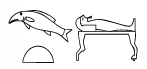 |
|
the mummified corpse : a place to return |
|
HIGHEST
SUBTLEST
ETERNAL
realm of Re &
the Ennead
|
akh
(spirit) |
the essence is luminous,
divine and abides in the soul-body as it pleases |
khab
(spirit-body) |
the light of the stars is
perpetual and house of the essence of man |
HIGHER
SUBTLE
TRANSITIONAL
realm of the beatified souls
and Osiris |
ba
(soul) |
witness at
judgement, beatified by Osiris, freely existing in its own body gratified by
the offerings to the double |
sah
(soul-body) |
liberated
as the result of funerary rituals and mummification |
|
LOWER
GROSS
TEMPORAL
the unity of the Two Lands
Pharaoh
|
ab
(ego) |
restored
and weighed - only the truth is light enough |
ka
(ego-body) |
free to
move the double remains near the mummy fed by offerings |
khat
(corpse) |
the mummy
does not decay - mummy and tomb are a magico-spiritual symbolization of
eternal existence |
|
primordial inertness : Nun and
the Chaos-gods (Ogdoad)
|
The importance of
the spoken word can not be stressed enough. The Egyptians
liberated the central component of their funerary anthropology
-the body of the soul- by means of mummification and grand
funerary ritualism. This had a result "ex opere operato". The
ceremony always idealized the deceased. There is no extant
funerary text in which the deceased admits a sin. So much
confidence was placed in the presence of exact words of power
that a correct articulation (and ritualization) of the good
"words of god" was deemed powerful enough to guarantee the
deceased a blessed afterlife. The words and the inscriptions
(even the representations of offerings) were all "charged" by
the rituals and hence "loci" for the deities to dwell in.
In the living physical body, the human being was focused in his
or her heart or mind. It was the mind that received influences
from above (higher mental, ideal-ego or soul) and from below
(emotional and lower mental or ego). The "good heart"
conceptualized the two sides of anything into a unity. In the
sick heart, this unity was lost and dissociated, so partial
substates of consciousness occur which tend to undermine one's
motoric cohesion and behavioral control, leading to dispersion,
despair and chaos.
When the soul had entered its soul-body (beatification),
ascension (glorification) was sure to follow. In its soul-body,
the soul represented the "middle" between the physical and the
divine. The plane of the soul is a transitional realm,
mediating between heaven and earth. The soul perished if the
heart (mind) of man was unjust and sick of sin. Hence, the
relationship between the divine realm (the sky) and humanity
(the earth) was a moral one (the "weight of the heart"
decided whether a soul survived).
The beatified soul was rejuvenated and replenished by the
spirit, entering the "sah" at pleasure and giving it the
imperishable protection ("sa") and power ("sekhem") of its
starlike body of most subtle luminous matter.
Discourse of a Man with his Ba
probably Middle Kingdom, i.e. the
XIIth Dynasty (ca.1938 - 1759 BCE)
the
hieroglyphic
text is also available
 |
The translation of
Discourse of a Man with his Ba is part of my
Ancient Egyptian Readings (2016), a POD publication in paperback
format of all translations available at maat.sofiatopia.org.
These readings span a period of thirteen centuries, covering all
important stages of Ancient Egyptian literature. Translated from
Egyptian originals, they are ordered chronologically and were
considered by the Egyptians as part of the core of their vast
literature.
The study of the sources, hieroglyphs, commentaries and pictures
situating the text itself remain on the website at no cost. |
|