The Maxims of Good
Discourse
or the Wisdom of Ptahhotep
ca.2200 BCE
the art of hearing, listening &
excellent discourse
the plumb-line of the scales & the state of veneration
by Wim
van den Dungen
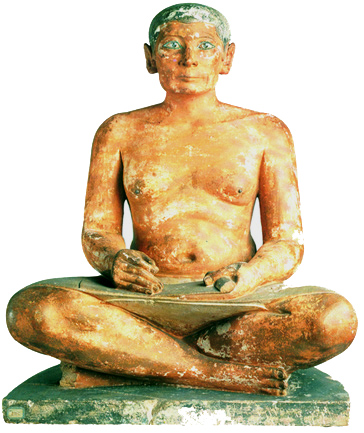
the Scribe of Saqqara
IVth or Vth Dynasty (ca.2600 - 2348 BCE)
Adjacent Pages :
plain text of the Maxims
notes on the translation
lexicon of special concepts
hieroglyphic text of the Maxims
 |
The translation of The
Maxims of Good Discourse is part of my
Ancient Egyptian Readings (2016), a POD publication in paperback format
of all translations available at maat.sofiatopia.org. These readings
span a period of thirteen centuries, covering all important stages of
Ancient Egyptian literature. Translated from Egyptian originals, they are
ordered chronologically and were considered by the Egyptians as part of the
core of their vast literature.
The study of the sources, hieroglyphs, commentaries and pictures situating
the text itself remain on the website at no cost. |
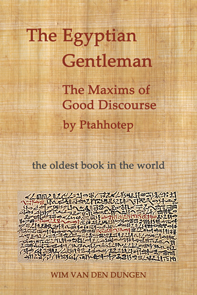 |
A new translation with
commentary. |
Introduction
1 Did the historical Ptahhotep write the Maxims of Good
Discourse ?
2 Philological
& Historical remarks and options.
2.1
Papyrus
Prisse, the British Museum Papyri and the Carnarvon Tablet.
lexicon of major
concepts, notes to the text, plain
text,
hieroglyphic
text
2.2 Hermeneutics of
Ancient Egyptian.
2.3 A few points of importance concerning the
Memphite Kingdom.
3 The
Memphite Philosophy of Order through Just Speech.
3.1
Various perspectives on Maat.
3.2
The hermeneutics of the Weighing Scene.
3.3
Hearing versus listening, ignorance versus wisdom.
Bibliography
INTRODUCTION
The Maxims of Good Discourse,
named after the 37 wisdom sayings which make out the bulk of this ancient text,
is indeed a literary composition, i.e. a text which shows deliberate
cognitive design beyond that of a record, list or collection of moral
ideas. This ancient text (ca. 4400 years old), written by a man called
"Ptahhotep" ("ptH-Htp"), has been labelled a
"moral" text which does not "amount to a comprehensive moral
code", nor are its precepts "strung together in any logical order"
(Lichtheim, 1975, vol 1, p.62) ...
Is the category "logical order" (in its Greek sense) applicable to the
context of Ancient Egyptian thought, writing and
verbalisation
? Besides morality, Ptahhotep also teaches, by example,
anthropology, politics and the emancipation of everyman. Indeed, he touches
"upon the most important aspects of human relations" (Lichtheim,
1975, vol 1, p.62). Moreover, the compositional backbone of this remarkable
text, written as early as the late VIth Dynasty (ca.2200 BCE), is "discourse" and
its dynamics, which is suggestive of the
verbal philosophy
of Memphis. Furthermore, an "ascetical" approach to divinity is
present, for none of the gods (except for his Majesty the Pharaoh, Osiris, Maat and the "Followers of
Horus") are mentioned by name. "Netjer" ("nTr",
"god") is mentioned as one flagpole without determinative. The
"netjeru" ("nTrw", the plural of "god" or
"the gods") are invoked by that word only once (line 24), and are next
referred to as "they".
This absence of constellational elements
contrasts with the contemporay royal texts, such as the Unis-Texts and
will remain typical for didactical literature as a whole.
There we read that "gods" (like Pharaoh) "fly" and ordinary
men "hide" (Sethe, 1908/1960,
Utterance 302, § 459a, vol.1, p.236).
Ptahhotep thus also offers the Old Kingdom solution to the soteriology of the non-royal
officials and commoners. The teaching itself however, can be recommended to
everybody, Pharaoh and non-royals alike.
In the expression "tjesu en medjet neferet" (line 33 - "Tsw n
md.t nfr.t"), usually translated as "the maxims of good
discourse", the word "tjes" ("Ts"), "maxim"
can also mean "speech, utterance" or "phrase, sentence" (Faulkner,
1999, p.308). The determinative of a papyrus roll (writing and thinking) is
added.
The word "nefer" ("nfr") has a complex field of semantical
connotations, being of use in more than one context. It shares this
characteristic with other important Egyptian words, such as "hearing",
"truth", "justice", "becoming" etc. These
"special" coordinated schemes, pre-concepts and concrete concepts
define the fundamental semantics of the edifice of Egyptian philosophy was
construed, i.e. notions & (pre-)concepts which elucidate the origin &
the continuity of
creation and humanity in it. Other meanings of "nefer" are
"beautiful of appearence, kind of face, good, fine of
quality, necessary, happy of condition" (Faulkner,
1999, p.131). So a broader context is suggested. The maxims describe a kind of
discourse which produces a happy life. Although actions are important, proper
speech is even more. An element of necessity is invoked, so that one may say that
if a "good" discourse is made, the enduring effects will be generated
"de opere operato". Morality (good or evil actions) is hence rooted in thought &
speech (good or bad speech), and this in accord with
the
theology of Memphis).
In the mythical, neolithic mind, stability and order were sacred. Natural cycles
manifested the enduring as part of creation. Cycles related to birth,
growth, death & rebirth became the domain of the "great goddess"
of the sacred (in Ancient Egypt, ca. 4000 BCE). The notion that the human
skeleton represents the enduring within man is (still) part of Shamanism, the
natural, unorganized, religious culture of the hunters & early settlers, so
prominent in the Neolithic. Mummification takes the conservation of the
ephemeral a step further, for here that which is meant to disappear (flesh
& blood), is sustained, to allow for an everlasting existence of the
personality ("Ka") and the soul ("Ba") with its mummy, i.e.
a "second birth" in the kingdom of Osiris. To challenge the process of
decay was one of the essential features of funerary preoccupations, indeed,
characteristic of the Ancient Egyptian mentality as a whole. The mummified
viscera prove the point.
The message of Ptahhotep seeks to transmit that which endures in the realm of
the heart, the abode of consciousness, free will, conscience, thought and
speech (in short, the "mind"). The maxims exemplify Maat. By truly
understanding each "example", the "son" (pupil, disciple),
who heard and listened, acquires rectitude of mind, affect and action, the
proper balance and steering capacities to navigate the heart in such a way that
efficient and luminous results ensue and evil, injustice and irrationality flee. As a true Memphite, Ptahhotep puts all his
trust in the cognitive capacities, especially in speech. The wise acquires just
speech. The hierarchy of justice typical for the Old Kingdom is of course
presupposed :
Order of
Creation
deities ONLY |
Re creates Maat |
the state of
the spirits
immortal & eternal |
Order of
Pharaoh
PHARAOH ONLY |
Pharaoh returns
Maat |
the divine soul
deified & immortal |
Order of
Society
EVERYBODY |
Egypt
circulates Maat |
the state of
veneration
justified & surviving |
Besides Pharaoh, nobody addressed
the spirits (of the gods & goddesses who abide in the sky) directly. He alone mediated between
heaven and earth because he was the only god on earth. In particular, his voice-offerings were the performance of
rectitude, so that through them Pharaoh returned Maat to its creator, his
father Re and by doing so guaranteed an order which could at any time be
disrupted. He (and his representatives) were the only one able to do so. Pharaoh
embodied Egypt and the Nile embodied Egypt. This grand river, flowing from South to North,
yearly fed Egypt by inundating the Two Lands. The
circulation of goods along it, had been essential in the process of unification of
the land, and the establishment in the "House of Ptah" at Memphis
("Men-nefer") of the
"Balance of the Two Lands", as the
Memphis
Theology claims :
"Then Heru stood over the land. He is the
uniter of this land, proclaimed in the great name : Tanen, South-of-his-Wall,
lord of eternity. Then sprouted (14c) the two Great in Magic upon his head. He
is Heru who arose as king of Upper and Lower Egypt, who united the Two Lands in
the Nome of the (White) Wall, the place in which the Two Lands were united.
(15c) Reed (heraldic plant for Upper Egypt) and papyrus (heraldic plant for
Lower Egypt) were placed on the double door of the House of Ptah. That means :
Heru and Seth, pacified and united. They fraternized so as to cease quarreling (16c)
wherever they may be, being united in the House of Ptah, the 'Balance of the Two
Lands' in which Upper and Lower Egypt had been weighed."
Memphis
Theology : lines 13c - 16c
Endurance was also the motivation behind inscribing the divine words in stone
(another activity ruled by Ptah). To writing was attributed the capacity to
abolish the temporal limitations of speech and to extend the latter infinitely.
The texts were inscribed on the walls of the tomb, the sarcophagus (coffin) and
the mummy (in the form of amulets & talismans). The deceased was not
supposed to "read" these words, but he or she remained in the
vincinity of their sacramental "sekhem" (power), eternalized through writing & ritual.
Old Kingdom religion envisaged two ways to explain the world. Either through
self-creation or as a product of divine cognition & speech.
The Heliopolitans (Heliopolis, "Iunu") taught that order (creation)
was self-caused ("kheper" - "xpr") in the midst of
undifferentiated chaos, darkness and oblivion (the "Nun", or
primordial water, a cultless deity). Chaos continued to lurk in the darkness of
the deep, and might be encountered during sleep (bad dreams) or in the
netherworld (when born again like Osiris). Its most horrible manifestation in
creation was the annihilation of a person's name ("ren"), which
might happen to the deceased if judgement was negative and the person was not
justified (its heart eaten by the monsterous devouress of the dead or "am
mwt", which had the head and the jaws of a crocodile, the hind quaters of a
hippopotamus and the middle part of a lion).
In the beginning, creation unfolded out of a point of absolute singularity.
This alternation-point ("Atum", "tm", suggestive of
completion, totality) was conceived by the Heliopolitans (the dominant royal
theology of the Old Kingdom) as "causa sui" and fugal. Atum created
himself by masturbating, taking his own seed into his mouth and spitting out
(sneezing) the constituents of creation (the nine basic elements of creation,
Atum -the monadic principle- included). Together with Pharaoh (the 10th element
or pyramideon), the sacred decad of order was realized, both in the sky (the
Ennead) as on earth (the Residence of Pharaoh).
This primordial creative activity was imagined to "happen" in a realm
which existed in-between pre-creation and creation, situated as the "first
time", the "beginning" ("zep tepy" - "zp
tpii"), absolute time (or no-time). Creation was the ejection (cf. Big
Bang) out of this point of singularity
(Atum and his mythical deed of self-impregnation). This Crown of creation
permanently oscillated between the order of creation and the mythical
"first time". This monad simultaneously split into two fundamental
creative principles (space -Shu- and time -Tefnut-), out of which the multitudes
orderly emerged.
The Memphites taught that Ptah was
the creator of the universe. He was the creator of chaos and of Atum. In their
theology, the whole Heliopolitan process happens in the "form" or
"image" of events in the heart and on the tongue of Ptah.
"Atum" is a creative verb, image, scheme or model. Its functionality
(and that of other important deities such as Horus and Thoth) is not denied, but
seen as an outward manifestation (theophany) of the all-encompassing cognitive
activity of the speaking Ptah (cf. the
creative verb).
This focus on manifestation through speech can also be found in the royal
funerary texts (largely Heliopolitan) and in "Khemenu" (Hermopolis,
the city of Thoth & magic), were the sacred Ibis
dropped the creative word in the primordial ocean, therewith creating the
universe.
These cosmogonic speculations, essential to understand the broader context of
any discourse on wisdom, belong to the order of creation (the deities) and to
the order of Egypt (Pharaoh). Ptahhotep's work, adhering to the Memphite accent
on discourse, aims to propose a "way of life" valid for everybody.
Although the base of the pyramid offers no panorama, its fundamental role is
unmistaken, for it carries everything above it. What can be said of the
situation of everybody ? Ptahhotep does not deny the existence of higher types
of rectitudes. The deities ("god" and "the gods") and
Pharaoh are mentioned by name, but are not aimed at in the maxims, although the
proper circulation of Maat depends on them. But what can be done by someone
with no divine soul ("Ba") ? How far does wisdom alone take such a
person ?
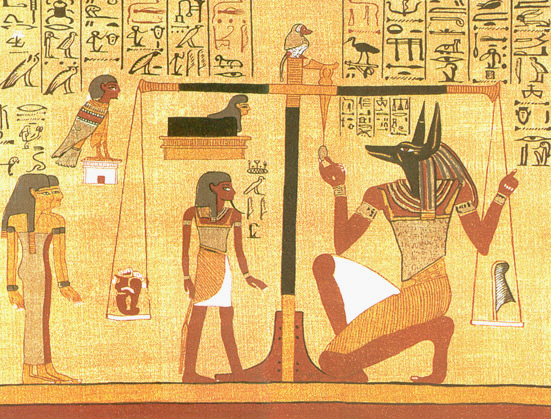
The Weighing Scene
Papyrus of Ani - XIXth Dynasty
One of the motivations behind these studies is the clarification of the distinction
between Egyptian and Greek philosophy, between ante-rationality (and its
irrational foundation in mythical thought) and rationality. Indeed, Greek
philosophy emerged as a culture of rational debate at the heart of the "polis",
the city-state. The conflicts between systems of thought were much like political
differences : they needed to be solved in public through argument &
dialogue, and logic and/or rhetorics were the means to realize this. By
realizing that pre-Greek, ante-rational speculation existed and by investigating
these philosophical strands, one may disentangle the polemic nature of Greek
philosophy from
general philosophy, which is the
persuit of wisdom by all possible means (i.e. it is not exclusively rational,
although never irrational, i.e. purely mythical).
In Egypt's Old Kingdom, the wisdom of the didactical texts dealt with the continuity of truth and justice.
These wisdom texts can and should be distinguished from schemata, pre-concepts
& concepts related to natural philosophy (the origin of the world -
cosmogony, which mainly flourished in the New Kingdom - cf.
Amun-Re
& the Aten) and
verbal
philosophy (the idea that words are creative). Although Marxist, atheist and
humanist philosophers claimed that Ancient Egypt only produced a
"cosmic" moral code unable to separate "is" from
"ought", the difference between the natural
(descriptive - how things are) and moral (normative - how thing should be) order
was indeed part of Ancient Egyptian philosophy (cf. infra). That their moral
theory was in accord with their cosmology, does not reduce the Ancient Egyptian
sense of justice to their ontological scheme of how things are. It is thanks to
the hard work of post-war egyptologists of all disciplines and nationalities
that philosophers today may try to understand the cognitive, philosophical,
spiritual, religious & theological implications of the Ancient Egyptian
heritage and its profound, complex influence on all cultures of the
Mediterranean.
Hence, the words "wisdom" and "philosophy", although
applicable in the general sense as a conceptualized, practical investigation
of
the being of creation and man, do not have dialogal & polemic
associations. And of course, pre-Greek philosophies never worked with the
"tabula rasa" principle, neither with the Razor of Ockham, but rather
with a multiplicity (complementarity) of approaches (as evidenced by the
different cosmogonies). Different answers were as it were put on top of each
other. Wisdom was tradition embedded in context. This absence of debate and lively discussions
does not
imply the absence of philosophy, i.e. the quest for a comprehensive understanding
(within the limitations of the given modes of cognition) of
the universe and the situation of humanity, as shown by the Maxims of Good Discourse.
That proto-rational thought is not a priori devoid of philosophical
inclinations, may well a discovery which balances the Hellenocentric approach of
wisdom, so fashionable in the West since the Renaissance.
In what follows, Ptahhotep and his text are highlighted. My translation was
inspired by the work of
Dévaud (1916),
Zába
(1956), Lichtheim (1975),
Lalouette
(1984), Brunner (1991) &
Jacq
(1993) and distances itself from an approach which deviates too much from the
original text, such as the questionable translation of
Laffont
(1979), or which limits itself to the translation of only a few maxims.
1 Did the historical Ptahhotep
write the Maxims of Good
Discourse ?
Ptahhotep (I) was the vizier of king
Djedkare Isesi of the Vth Dynasty. His son was Akhethotep, who was also a
vizier. He and his family were buried at Saqqara. His tomb is a mastaba located
in North Saqqara (D62), where he was to laid rest by himself. His grandson was
Ptahhotep Tshefi (or Ptahhotep II), who lived under king Unis and who was buried
in the mastaba of his father Akhethotep. Their double mastaba (D64) is famous
for its outstanding depictions. While the grandfather of Ptahhotep II is
credited with authoring the Maxims, Ptahhotep II is traditionally
credited to be the author.
At
the end of the corridor to the right of a pillard hall and then left is
Ptahhotep's burial chamber. The reliefs there are the best preserved of the Old
Kingdom. The ceilings are imitations of the trunks of palm trees.
|
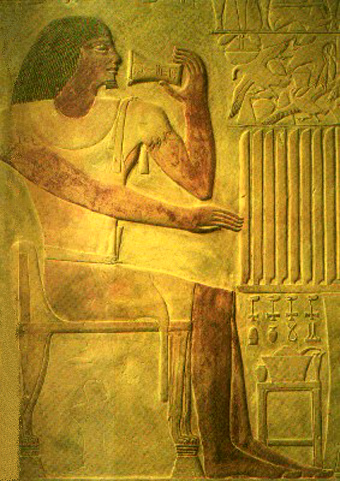 |
The mastaba of Ptahhotep
II is a
double mastaba which he shared with his father, Akhethotep. His room is quite similar to
Ptahhotep's, although less decorated.
The tomb suggests that Ptahhotep must have held a very important
position during the reign of Pharaoh Djedkare (ca. 2411 - 2378 BCE), the
predecessor of Unis (cf. the
Cannibal Hymn).
In his tomb, Ptahhotep describes himself as a priest of Maat. He was also
the vizier, the chief of the treasury and the granary, as well as a judge.
The reliefs found inside are not all completed.
The main corridor has
reliefs on both sides. On the left are what appear to be preliminary
drawings in red. Over the red are corrections in black made by the master
artist.
|
|
 |
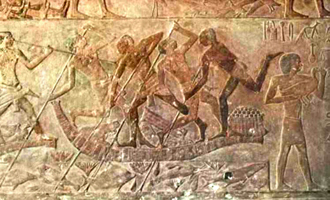 |
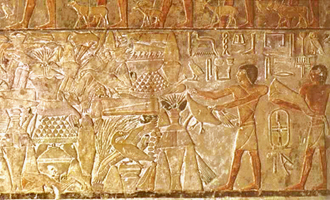
Other reliefs show
fowl being carried by servants to Ptahhotep.
Mastaba of Ptahhotep -
Saqqara |
Back into the pillard hall and to the left is the chamber of Akhethotep.
Through a passageway to the left is a chamber that contains a mummy that has not
been identified. The passageway leads to the pillard hall and the entrance
corridor.
|
Dyn. |
Pharaoh |
Vizier |
| 2 |
Ninetjer (?) |
Menka |
| 3 |
Djoser |
Imhotep |
| Huni |
Kagemni
Nefermaât |
| 4 |
Snefru |
|
DjeKhufu |
Hemiunu |
| Ankhkhaf |
| Khafre |
Menkhaf |
| 5 |
Nyuserre |
Ptahshepses |
| Isesi |
Ptahhotep |
| 6 |
Teti |
Mereruka |
| Pepi II |
Djau |
| 11 |
Mentuhotep IV |
Amenemhat |
| 12 |
Amenemhat I |
Iyotefoker |
| 18 |
Hatshepsut |
Senmut |
| Thutmose III |
Rekhmire |
| Amenhotep III |
Aper-el |
| Ptahmose |
| Ramose |
| Akhenaten |
Ramose |
| 20 |
Ramesses IX |
Khaemwaset |
| Ramesses XI |
Herihor |
| 26 |
Psamtik I |
Sisobek |
| 33 |
Cleopatra VII |
Yuya Amenhotep |
| WbnRaMPt Horemheb |
|
Within the courtiers ("Sniit") surrounding Pharaoh, the most favoured
persons were called "friends" ("smrw"). The most important
dignitary bore the title "tjati" ("TAti"), translated as
"vizier", who in the IVth Dynasty, was regularly one of the royal
princes. Later the office passed into the hands of some outstanding noble, and
then it tended to become hereditary.
In the titularies of the early viziers, we
find the title : "superintendent of all the works of the king"
("amii-r kAt nbt nt nsw"). He was also the supreme judge, and bore the
epithet "prophet of Maat".
The earliest attested reference to this highest administrative office was
written in ink on a stone vessel from the Step Pyramid of Netjerikhet at Saqqara
(the vizier Menka of the middle of the IIth Dynasty). In the beginning of the Early Dynastic period, the vizier bore the titles
"Tt". The fuller form : "tAitti zAb TAti" is of later
periods.
And official called "Tt" is depicted on the Narmer palette.
He walks in front of Pharaoh and carries his regalia. The tripartite title held
by the vizier may indicate his threefold nature (Wilkinson,
2001, p.138) :
-
"tAitti" or "he
of the curtain" is an epithet indicating the courtly aspect of
the office ;
-
"zAb" or
"noble" is a general designation for an official ;
-
"Tati", untranslatable
and suggestive of the administrative aspect.
|
The word "vizier" is
the French spelling of the Turkish "vezir", which was the title of the
Sultan's prime minister. This in turn comes from the Arabic "wazir",
or "porter". In Ancient Egypt, the vizier wore a special garment which
remained unchanged for thousands of years. It was a plain smock made of pure
white cotton which symbolized his impartiality.
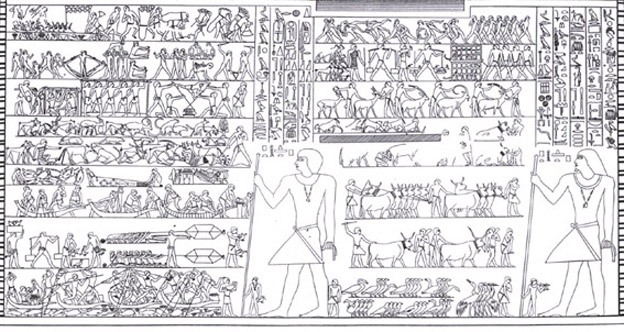
The mastaba of Ptahhotep, East Wall, drawing
Davies, N. de G.,
1900.
Notice above the young Ptahhotep the cartouche of Pharaoh Izezi (top of second
column),
whereas above the older Ptahhotep we read "in front of Maat" (third
column).
The vizier was the head of the administration, but at various times, and particularly at Thebes, the vizier might also be the chief priest.
In the Old Kingdom, the role of the Egyptian state was organizational : preventing
local famines by bringing in the surplus, lessening the effect of calamities
(irregular inundations), arbitration and security. Irrigation works were the
responsibility of the local responsible. Viziers heard all domestic territorial disputes, maintained a cattle and herd census, controlled the reservoirs and the food supply, supervised industries and conservation programs, and were
also required to repair all dikes. The bi-annual census of the population came under their
authority, as did the records of rainfall and the varying levels of the Nile during its inundation. All government documents used in
Ancient Egypt had to bear the seal of the vizier in order to be considered authentic and binding. Tax records, storehouse receipts, crop assessments and other necessary agricultural statistics were kept in the offices of the viziers. In addition, young members of the royal family often served under the vizier. In this capacity, they received training in government affairs.
It is probable that throughout Egyptian history, the viziers were some of
Pharaoh's most trusted allies. The vizier was usually in constant contact with
him, consulting him on many important matters. Family members, particularly those who might hold a claim to kingship, could often not be trusted. But viziers, even though at times did elevate themselves to kingship, were probably most often selected not only for their skills, but because
Pharaoh could trust them to carry out his will without the fear they might overthrow his rule.
In the tombs of viziers we see various crafts at work in different tasks. His
responsibility was not little. In the tomb of the vizier Rekhmire (XVIIIth
Dynasty), the latter is installed by Pharaoh Thutmose III with the words :
"His Majesty said to him : 'Look to the office of
vizier. Watch over all that is done in it. Lo, it is the pillar for the whole
land. Lo, being vizier, Lo, it is not sweet, Lo, it is bitter as gall. Lo, he is
the copper that shields the gold of his master's house, Lo, he is not one who
bends his face to magistrates and councillors, not one who makes of anyone his
client."
The Installation of Rekhmire,
his tomb at Thebes (N.de G.Davies, 1944,
pp.84-88 & plates xiv - xv).
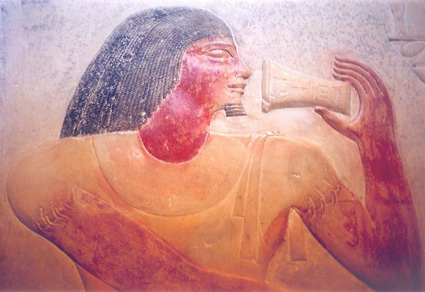
Was Ptahhotep, besides vizier,
also a teacher of wisdom ?
Papyrus Prisse, belonging
to
the Bibliothèque Nationale (Paris), contains the
only complete version of the Maxims we currently possess. It is in
Middle Egyptian, the language of the Middle Kingdom, and was probably
manifactured in the XIth Dynasty (in this First Intermediate Period, between ca.
2198 and 1938 BCE, another interesting work of literature saw the light : the
Discourse
of a Man with his Ba). The text itself situates the wisdom-teaching in the late
Vth Dynasty, when Old Egyptian was still in use. If the teachings were indeed
Ptahhotep's and he originally wrote them in Old Egyptian, then we are forced to assume
considerable
linguistic alterations to explain how the Old Egyptian text became a Middle Egyptian
one. For Miriam Lichtheim, this is one of the strong arguments in favour of the
idea that the Maxims are pseudo-epigraphic
(Lichtheim, 1975, vol.1, p.6).
Interestingly, these wisdom-teachings do not stand alone. The
"earliest" instruction is the Teaching of Prince Hordedef (son of Pharaoh Khufu, IVth Dynasty, ca.
2571 - 2548). Only a fragment of the text has survived (namely
the beginning - Lichtheim,
1975, pp.58-59). It has been pieced together using relatively late copies,
namely 9 ostraca of the New Kingdom and one wooden tablet of the Late Period (Brunner-Traut,
1940). The text is archaic enough to be (late) Old Egyptian, i.e. a text
supposedly transmitted (copied) without major alterations. If compared with the
language of the monumental record, scholars situate its composition in the Vth
Dynasty. The tomb of Hardjedef, as he is also known, has been located at
Giza, to the east of the pyramid of his father Khufu. Hardjedef also appears
later in stories compiled during the Middle Kingdom. A lot of wisdom-teachings
are attributed to him, but time has left us nothing but a few ostraca.
|
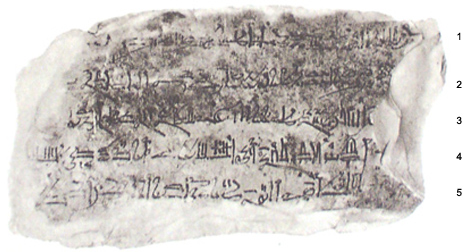
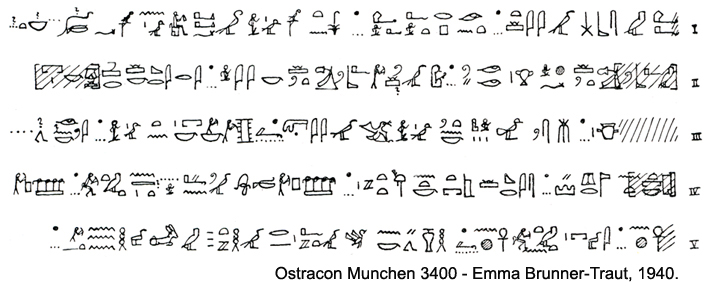
Ostracon
München 3400
The text of the Teaching of¨Prince Hordedef had to be
reconstructed out of nine ostraca of the New Kingdom and one wooden tablet
of the Late Period. The hieroglyphs of the Munich ostracon bought by Emma
Brunner-Traut in Thebes are given below. Parts of the translation based on
other sources are italized. |
The reconstructed fragment (Lichtheim,
1975, pp.58-59) reads :
Fragment
: The Instruction of Hordedef
(Vth Dynasty - reconstructed)
Beginning of the
written teaching made by
the hereditary prince, count, King's son, Hordedef
("Hrddf"), for his
son, his nursling, whose name is Au-ib-re.
He says :
"Cleanse
yourself before your own eyes, lest another cleanse you.(1)
When
you prosper, found your household, take a mistress of heart,(2)
a son
will be born to You. It is for the son that you build a house
when you make a place for yourself.(3)
Make a good dwelling in the
graveyard, make worthy your station in the West.(4)
Accept that
death humbles us, accept that life exalts us, the house of death
is for life.(5)
Seek for yourself well-watered fields.(6)
Choose
for him
(7)
a plot among your fields,
well-watered every year. He profits you more than your own
son,
(8)
prefer him even to your
(...)
--- " |
|
(1) also in
the Maxims, we find a warning at the start (line 43). But here,
the Hordedef instructs his son to purify himself, for otherwise someone
else will wash off the unnecessary before he does. It is better to
criticize oneself and do something about it, than to wait until another
points to the defect and starts taking it away ;
(2) a woman who is hearthy & jovial ;
(3) what a man erects is for posterity (the
"son") - what one does for oneself has only value if it also
benefits posterity - actions are always based on what has been
given by the ancestors ;
(4) this advice also recurs in the
Instruction of
Merikare - the "venerated place" (Maxims, line 537)
is this "station in the West", the "tomb" which the
greedy lacks (line 248)- this "place" was was also called the
"place of silence" ;
(5) the worthy station in the West is acquired by a
good tomb because the offerings presented to the Ka gratified the Ba. As
a result, the Ka (the energetical double of the personality) endured
(otherwise it perished) and the Ba (the soul) was gratified (vitalized by
the Ka) and beatified. The spiritual principle in touch with the Ba,
namely the "Khu" or "spirit", was considered
immortal and eternal. But it seems likely that the Ba could be depleted
(lacking its Ka by absence of offerings) ;
(6) yearly inundated by the Nile (both physical as
metaphorical) ;
(7) the funerary priest ;
(8) the son will continue the tradition and draw his
own vignettes of good examples. However, the (magical) power which will truly
benefit the father, is the continuity of the offerings made to his Ka
when his physical body has died and has been mummified & entombed.
So the priest(s) must be well provided.
|
The third Old Kingdom instruction
is that to Kagemni (serving under Huni &
Snefru, IIIth to IVth Dynasty). Of this Instructions of Kagemni
only the final portion is preserved and the name of the sage is lost. But, the
text is part also of Papyrus Prisse and (after a blank stretch) it is followed by the Maxims
of Ptahhotep. Clearly, the
fact that Papyrus Prisse contains both texts makes it the oldest
compendium of wisdom teachings extant on papyrus. Although the context of the
teaching (to Kagemni) claims to be late IIIth Dynasty, its language is
characterized by the schematics of Middle Egyptian encountered in the text of
the Maxims, which claims to be late Vth Dynasty. As the record makes the
point of the difference between late IIIth Dynasty and late Vth Dynasty
literature, the "tangibly fictional nature of this attribution"
(Lichtheim, 1975, vol 1, p.67) must be
acknowledged. As only the wisdom teachings were transmitted in the name of a
famous sage (all other literature being anonymous), we may presume
that this name is indicative of a school of thought initiated by a historical figure of
importance (another excellent example is Imhotep and later Amenhotep).
"Aus der in die Lehre genannten Zeit, den Regierungen
des Königs Snofru, ist ein Wesir mit Namen Kagemni nicht bekannt, dagegen
existiert in Saqqara das Grab eines solchen aus der frühen 6.Dynastie, und es
ist sehr wahrscheinlich, dass dieser Mann mit dem Empfänger der Lehre gemeint
ist, zumal sich am Grab Spuren seiner Verehrung gefunden haben. Die Lehre wäre
dann, wie mache ägyptischen Literaturwerke, in eine berühmde Vergangenheit
zurückdatiert worden. Dass sie noch im Alten Reich, wenn auch gegen dessen
Ende, verfasst worden ist, dürfen wir nach Inhalt und Sprache annehmen."
Brunner
(1991, p.133).
Because we know : (a) many of the forms characteristic of Middle Egyptian
can already be found in the
biographical inscriptions from VIth Dynasty tombs and (b) the Maxims (together with the Instructions
of Kagemni) fit
"into
the ambiance of the late Old Kingdom"
(Lichtheim, 1975, vol 1, p.7) and its monumental
inscriptions, the author of the Maxims
was most likely at work ca.150 years after vizier Ptahhotep,
who indeed worked at the court of Pharaoh Djedkare Izez or
Issa, died (namely after Pepi II). And as the period between the
probable first redaction in the late VIth Dynasty and the extant Middle Kingdom versions is
rather small (the end of the VIth and the
beginning of the XIth are only a century apart), only minor textual alterations
have to be conjectured to bridge the gap between the first redaction and the
extant copy. The other line of thought, which suggests a Vth Dynasty original
(composed before the Unis Texts !), has to cope with the difficulty of
explaining how an Old Egyptian text got copied and was altered to become the
early Middle Egyptian text of Papyrus Prisse ?
Fragment
: The Instructions of Kagemni
(VIth Dynasty - Papyrus Prisse I & II)
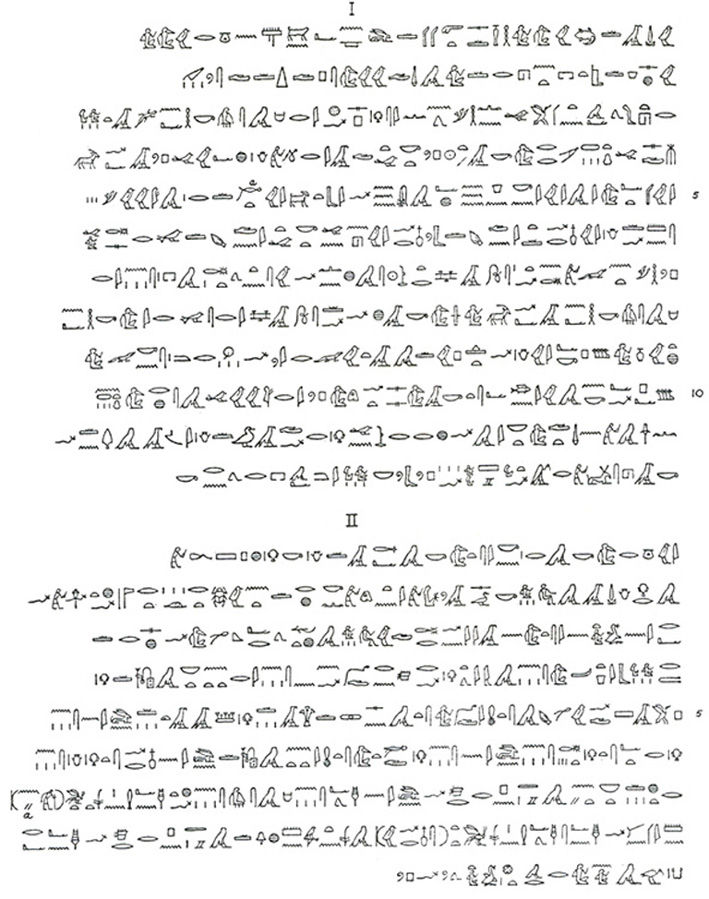
Papyrus Prisse I & II : The Instructions
of Kagemni -
Gardiner,
1946.
"(...) the timid man
prospers,
praised is the fitting,
open (is) the tent to the silent,
spacious is the seat of the satisfied.(1)
Speak not (too much) !
Sharp are the knives against he who transgresses the road,
(he is) without speedy advance, except when he faults.(2)
When you sit with company,
shun the food you like.
Restraint of heart is (only) a brief moment !(3)
Gluttony is base and one points the finger at it.
A cup of water quenches thirst,
a moutful of herbs strengthens the heart.(4)
A single good thing stands for goodness as a whole,
a little something stands for much.
Vile is he whose belly is voracious ;
time passes and he forgets
in whose house the belly strides.(5)
When you sit with a glutton,
eat when his appetite has passed.
When you drink with a drunkard,
partake when his heart is happy.(6)
Do not grab (your) meat by the side of a glutton,(7)
(but) take when he gives You, do not refuse it,
then it will soothe.
He who is blameless in matters of food,
no word can prevail against him.
The shy of face, even impassive of heart,(8)
the harsh is kinder to him than to his
(own) mother,
all people are his servants.
Let your name go forth,
while you are silent with your mouth.(9)
When you are summoned,
be not great of heart,
(10)
because of your strength
among those your age, lest you be opposed.
One knows not what may happen,
and what god does when he punishes.
The vizier had his children summoned, after he had gained a complete
knowledge of the ways of
men, their character having come upon him.(11)
In the end he said to them :
'All that is written in this book, heed it as I
said it. Do not go beyond what has been set down.'
Then they placed themselves on their bellies. They recited it
aloud as it was
written. It was good in their hearts beyond anything in this entire land. They
stood and sat accordingly.(12)
Then the Majesty of King Huni of Upper and Lower Egypt died. The Majesty of
King Snefru
of Upper and Lower Egypt was raised
up as beneficient King in this entire land. Kagemni was (then) made
overseer of
the city and vizier.
It is finished." |
|
(01)
these four sentences describe how to be among the "satisfied"
: the quiet, silent attitude is well received. In the Maxims we
read : "spacious the seat of him who has been called" (line
179). In the Pyramid Texts, Teti's seat is spacious with Geb
(Utterance 402, § 698a). Those who speak little are not likely to
reveal what they hear.
(02) "Nn Hn nn is Hr sp.f" is difficult. I
take "Hn" for "run, haste", and "sp" as
"fault".
(03) only a moment's effort is required ;
(04) makes one feel stronger, vitalized and envigorated
;
(05) the more one eats, the more one forgets that the
food was given - i.e. the voracious is ungrateful ;
(06) feast not with a bad-tempered drunk ;
(07) the crocodile snaps its meat voraciously and
without consideration - if one attacks one's meat in the vincinity of
the glutton, he will feel disadvantaged and spoil the meal ;
(08) "Hrr (amended to "Htr") n Hr r
dfA-ib" is difficult and probably corrupt - "dfA" is the
problem. Most scholars agree with "stolid", i.e. having or
expressing little or no emotions, unemotional, but I prefer impassive,
which has no pejorative connotations and fits better in the context of
the "silent" timid, whereas "stolid" retains negative
associations, as does "slow-wittedness", which is totally
inappropriate ;
(09) the actions which are sealed by your name are
better than your words in the wind ;
(10) an inflated sense of personhood - the same advise
is found in the Maxims ;
(11) having become apparent, clear, evident ;
(12) they conducted themselves, or lived, accordingly. |
Although at present no consensus
among scholars exists, I agree with Lichtheim that the texts of Kagemni &
Ptahhotep are pseudo-epigraphic.
This does not exclude the possibility of a line of transmission going back to
the historical author. In the case of Ptahhotep, this would be suggestive of a "Memphite school" or
a community of scribes working in the House of Life of the
temple of Ptah at Memphis. Of this however, we only have circumstancial evidence
and no direct proof.
The actual redaction of this age old wisdom at the end
of the Old Kingdom, could also point to an attempt to exorcise the
fortcoming collapse of the Memphite Kingdom under the pressure of the provinces
and their enriched nomarchs. Was it the aim of the unknown author to summarize the best of
what the past had given, because of the crisis of today, which needed to be
solved so that the generations of tomorrow might endure ? The same method would
be used, much later, by Pharaoh
Shabaka when he
rescued the "worm-eaten"
Memphite theology.
In the Maxims,
Pharaoh and pantheon play a passive part in the literary setting of the
teaching, whereas the discourse of the commoners was elucidated in
the context of the avoidance of the collapse of the natural order and its rectitude by doing
Maat for
Pharaoh (who offered it for creation).
We shall treat the Maxims of Good Discourse as a pseudo-epigraphic wisdom-text
written by an unknown author who, by means of a set of literary devices (such as
a pseudo-epigraphic attribution, a compositional context, a narrative structure,
a "count" of good examples, etc.), tried to impart the non-polemic, moral philosophy of the Old Kingdom. This author saw in the historical vizier Ptahhotep a recent, grand example of
Maat everybody still knew, would recognize and might adhere to.
These considerations point to the following redactional levels :
-
extant
text : to be found on the oldest papyrus extant, dating XIth
Dynasty (ca. 2081 - 1938 BCE) ;
-
original
text : probably written in early Middle Egyptian in the late VIth
Dynasty (ca. 2348 - 2198 BCE) ;
-
original
ideas : not later as the period proposed in the extant text ?
Pharaoh Djedkare of the late Vth Dynasty, reigned between ca. 2411 and
2378 BCE. The legend of wisdom-teachers goes back to Imhotep, the
architect of Pharaoh Djoser of the IIIth Dynasty, ca.2654 - 2635 BCE.
But is remains difficult to
establish how far these wisdom teachings really go back.
For example, in the early days of research, egyptologists dated
the Pyramid Texts as early as possible. For Sethe they
were Predynastic ! Most contemporary egyptologists go to the
other extreme, and date the origin of texts close to
the time of their extant textualization (even if the
assumption of earlier copies of the same text is not unreasonable or even
mentioned in the copy). The more we study the Predynastic Period (i.e. before 3000 BCE), the more it can be shown that important elements of the Egyptian
cultural form were already present before the Dynasties started. But the
introduction, in the Early Dynastic Period (Dynasty I and II, ca. 3000 - 2670
BCE), of Pharaoh (the "Followers of Horus") was essential to the
process of consolidating the elements of the unification of the Two Lands and
its various deities. The advancement of language ran parallel with Pharaoh's
outstanding achievements. By the IVth Dynasty, Old Egyptian was written down.
As the
language of the Maxims is indeed suggestive of the VIth Dynasty, the
most reasonable earliest date is the one proposed by the extant text itself,
namely de reign of Pharaoh Djedkare. Indeed, these instructions embody teachings on justice &
truth (Maat) which must have existed long before the VIth
Dynasty. On the walls of the tomb of the pyramid of Pharaoh Unis (Vth
Dynasty) and the rulers of the VIth, we read :
"To say : 'May you shine as Re, repress
wrongdoing, cause Maat to stand behind Re, shine every day for
him who is in the horizon of the sky. Open the gates which are
in the Abyss."
Pyramid Texts, utterance
586 (§ 1582), translated by
Faulkner
(1969, p.238).
"Collect what
belongs to Maat, for Maat is what the King says."
Pyramid Texts,
utterance 758 (§ 2290), translated by
Faulkner
(1969, p.318).
Wisdom as a literary genre is the fruit of a society which knows leisure, peace
& prosperity. When cultures are only surviving, no higher, less material and
more spiritual values concerning life and oneself are possible. That this
profound literary genre emerged more than 4000 years ago, is highly remarkable
and should mobilize more attention than it has. So the wisest sages of Ancient
Egypt were pre-philosophers ? True, they did not argue in abstract, discursive categories.
Their schemes, pre-concepts and concrete conceptualizations allow us to
understand thought from an unexpected, ante-rational perspective, so that the aim
of cognitive philosophy is realized : an integrated rationality in harmony with
ante-rationalist (and its instincts) & intellectual
perception (and its intuitions). This is a rationality with
a global perspective, working in the local context of everyday. It fosters sustainable
harmonization instead of sustainable development, for enduring growth is an
illusion. Only the balance itself endures, not what lies in its scales.
Wisdom-literature remained a genre in Ancient Egypt from its legendary start
(Imhotep of the IIIth Dynasty who allegedly wrote the first "wisdom-teaching")
untill the advent of the Christian era.
2 Philological
& Historical remarks and options.
2.1 Papyrus Prisse, the
British Museum Papyri and the Carnarvon Tablet.
It is impossible to say, how early the Egyptians
began to cut and press the stalks of the papyrus plant in
order to make a material for the use of the scribe. But
we know that papyrus was already employed for literary purposes in
the time of the IIIth Dynasty (ca. 2670 - 2600 BCE), whereas uninscribed papyrus
has been found in tombs of the first Dynasty (ca. 3000 BCE) ! We also know
that it was used for cursive hieroglyphs (reserving stone for the lasting
constructions of Pharaoh).
The Maxims have survived in four copies :
-
Papyrus
Prisse (P) : this is the most precious & oldest papyrus known
(XIth Dynasty - ca. 2081 - 1938 BCE). It has been well styled "the oldest book
in
the world" (Chabas, 1858). It was bought by
E.Prisse d'Avennes (1807 - 1879), a French engineer, painter and master
draughtsman who lived in Luxor. He was passionate about Arabic and
Egyptian Art (cf. Histoire
de l'Art Égyptien, 1878) and also a
distinguished scholar who, with the documentation collected during his
many travels in the Middle East, gave a decisive contribution to the
knowledge of Arabian Art.
On the
East side of the Nile (ancient Thebes - Drah Abou'l Negga), he acquired
the papyrus which would immortalize his name. It contained the end of the
"teaching" of Kagemni and a complete version of that of
Ptahhotep. It clearly appeared to be a Middle Kingdom copy of earlier
copies. For Jéquier (1911), this was
"le texte littéraire égyptien le plus difficule à traduire".
Breasted, Erman & Gardiner agreed ;
-
Papyri
BM (L1) : British Museum Papyri nos
10371 - 10435 (published by Jéquier, 1911) of the XIIth Dynasty - it
consists of two series of fragments and is incomplete (no beginning) ;
-
Papyrus
BM (L2) : British Museum Papyrus n°
10409 (Budge, 1910), bought at Thebes of
the XVIIIth Dynasty - New Kingdom, is incomplete (only the beginning), but
gives some clues as to punctuation ;
-
Carnarvon
Tablet (C) : found in 1908 by Lord Carnarvon (Cairo Museum N°
41790, published by Jéquier, 1911) is of the XVIIth or XVIIIth Dynasty -
New Kingdom and also incomplete (only the beginning).
In 1956,
Zába
realized a decisive translation and also reproduced the hieroglyphs of these
four sources in a comprehensive and clear way (which was absent in the work of
Dévaud, 1916). It is this publication which I
used and reproduced, i.e.
Zába's hieroglyphs published
more than 40 years ago by the "Academie
Tchécoslovatique des Sciences" of Prague (under the academician Lexa),
i.e. in former Czechoslovakia.
The translation of the American egyptologist Wilson, published by
Prichard
(1950 & 1958) made use of all extant copies and as a result he worked from
a text of his own. Recently,
Brunner (1991)
followed a comparative course. Other scholars like
Lichtheim
(1975) use Papyrus Prisse only, which is
logical, for it is the oldest as well as a complete version.
The present
translation follows Papyrus Prisse and takes Papyrus L1 in
account (for both are Middle Egyptian). L2
is used to understand punctuation, not contents. C
is helpful to analyze the linguistic evolution of the text (being the extant
terminus). My translation was directly influenced by the work of Zába (French), Lichtheim
(English), Brunner (German) & Jacq (French), but always returned to the
hieroglyphs.
plain text
lexicon of major
concepts
notes to the text
hieroglyphic text
2.2 Hermeneutics of
Ancient Egyptian.
Besides the general principles developed in the
context of my study of
Flemish mysticism (cf. the
Seven
Ways of Holy Love of Beatrice of Nazareth (1200 - 1268), and the last part
of the Spiritual Espousals by Jan of Ruusbroec (1293 – 1381), called
The
Third Life), Ancient Egyptian literature calls for special
considerations :
-
semantic
circumscription (Gardiner) : to those unaware of the semantical problem in
mythical, pre-rational and proto-rational thought and its literary products,
the differences between various
translations may be disconcerting.
Ancient Egyptian literature is a treasure-house of this ante-rational
cognitive activity, and its "logic" is entirely contextual,
pictoral, artistic and practical. The meaning or conception of the sense of
certain words, especially in sophisticated literary context, is prone to
large discrepancies. Gardiner spoke of "interpretative
preferences" (Gardiner, 1946).
Furthermore, despite major grammatical discoveries, Egyptian writing is
ambiguous qua grammatical form. Some of its defects can not be
overcome and so a "consensus omnium" among all sign interpreters is unlikely. The
notion of "semantic
circumscription" was derived from this quote by Gardiner : "If
the uncertainty involved in such tenuous distinctions awake despondency in
the minds of some students, to them I would reply that our translations,
though very liable to error in detail, nevertheless at the worst give a
roughly adequate idea of what the ancient author intended ; we may not grasp
his exact thought, indeed at times we may go seriously astray, but at least we
shall have circumscribed the area within which his meaning lay, and with
that achievement we must rest content." (Gardiner,
1946, pp.72-73, my italics). To the latter, more attention to lexicography
(a discussion of individual words) and the rule that at least one certain
example of the sense of a word must be given were considered as crucial.
Personally I would add the rule that one has to take into consideration all
hieroglyphs (also the determinatives) and try to circumscribe the meaning by
assessing the context in which words and sentences appears ;
-
the benefit of the doubt (Zába) :
amendments should be introduced with great caution and for very good
reasons. Indeed, some egyptologists change the original text with great
ease, and consider that Egyptian scribes were careless and prone to mistakes. This
is not correct.
Zába
(1956, p.11)) prompted us to respect the original text and made it his
principle. He wrote : "Pour ce qui est la traduction d'un texte
égyptien dans une langue moderne, l'étude de divers textes (...) m'a
amené au principe dont je me suis fait une règle, à savoir de considérer
a priori un texte égyptien comme correct et de m'en expliquer chaque
difficulté tout d'abord par l'aveu de ne pas connaître la grammaire ou le
vocabulaire égyptien aussi bien qu'un Egyptien. (...) et ce n'est donc
qu'après avoir longement, mais en vain, consulté d'autres textes et ne
pouvant expliquer la difficulté autrement, que je suis enclin à croire que
le texte est altéré."
-
multiple approaches (Frankfort)
: this
notion implies that one has to assimilate the Egyptian
way of thinking before engaging in explaining anything. Their
"method" being not linear, axiomatic (definitions & theorema)
or linea recta. Frankfort (1961, pp.16-20)
explains : "...
the coexistence of different correlation of problems and phenomena presents
no difficulties. It is in the concrete imagery of the Egyptian texts and
designs that they become disturbing to us ; there lies the main source of
the inconsistencies which have baffled and exasperated modern students of
Egyptian religion. (...) Here then we find an abrupt juxtaposition of views
which we should consider mutually exclusive. This is what I have called a
multiplicity of approaches : the avenue of preoccupation with life and death
leads to one imaginative conception, that with the origin of the existing
world to another. Each image, each concept was valid within its own context.
(...) And yet such quasi-conflicting images, whether encountered in
paintaings or in texts, should not be dismissed in the usual derogatory
manner. They display a meaningful inconsistency, and not poverty but
superabundance of imagination. (...) This discussion of the multiplicity of
approaches to a single cosmic god requires a complement ; we must consider
the converse situation in which one single problem is correlated with
several natural phenomena. We might call it a 'multiplicity of answers'."
-
integral acceptation
(Zimmer) : in his study of Eastern religions and exegesis of Hindu
thought, the German scholar Heinrich Zimmer introduced a principle which
implies that before one studies a culture one has to accept that it exists
or existed as it does and claims. One should approach and interprete its
cultural forms as little as possible using standards which does not fit in,
which focus on subjects which were of no interest to it (like the colour of
the hair of royal mummies) or which reduces it to what is already known.
This means that one, as does comparative cultural anthropology with its methodology of
participant observation, accepts the culture at hand without prejudices and
projections. Zimmer (1972, p.3) explains
himself : "La méthode -ou, plutôt, l'habitude-
qui consists à ramener ce qui n'est pas familier à ce que l'on connaît
bien, a de tout temps mené à la frustration intellectuelle. (....) Faute
d'avoir adopté une attitude d'acceptation, nous ne recevons rien ; nous
nous voyons refuser la faveur d'un entretien avec les dieux. Ce n'est point
notre sort d'être submergés, comme le sol d'Egypte, par les eaux divines
et fécondantes du Nil. C'est parce qu'elles sont vivantes, possédant le
pouvoir de faire revivre, capables d'exercer une influence effective,
toujours revouvelée, indéfinissable et pourtant logique avec elle-même,
sur le plan de la destinée humaine, que les images du folklore et du mythe
défient toute tentative de systématisation. Elles ne sont pas des
cadavres, mais bien des esprits possesseurs. Avec un rire soudain, et un
brusque saut de côté, elles se jouent du spécialiste qui s'imagine les
avoir épinglées sur son tableau synoptique. Ce qu'elles exigent de nous ce
n'est pas de monologue d'un officier de police judiciaire, mais le dialogue
d'une conversation vivante."
-
non-abstraction
: egyptologists are aware that the cognitive abilities of the Ancient
Egyptians were not the same as the Greeks. Thanks to Piaget's description of
the genesis of cognition, we can assess the Egyptian heritage with the
standards of ante-rational thought, to wit : the mythical, pre-rational and
proto-rational modes of thoughts, which each have their specific modus
operandi. Hence, when we try to interprete a text, the question before us is
: in what mode or modes of thought was this written (which kind of text is
this) ? Indeed, because of the multiplicity of approaches, the Ancient
Egyptians left old strands of thought intact, with an
amalgam of approaches placed next to each other without interference as a result
;
-
spatial
semantics : Ancient Egyptian hieroglyphic writing was more than a way
to convey well-formed meaning (i.e. language), but tried to invoke the magic
of the "numen praesens", involving the use of space (a
contemporary equivalent is the Zen garden) as a additional element in the
composition of meaning. The
Shabaka Stone,
discussed earlier, is only one (late) example of the principles of spatial
organization which governed Egyptian from the start (besides honorific or
graphic transpositions). Unsightly gaps and disharmonious distributions were
rejected. Groupings always involved the use of imaginary squares or
rectangles ensuring the proportioned arrangement. This allowed for slight
imperfections. Furthermore, important hieroglyphs were
given their architectonic, monumental or ornamental equivalent. Spatial
semantics was at work in large monumental constructions as well as in small
stela or tiny juwelery and important tools (for Maat is at work in both the
big and the small) ... Egyptologists have not given this aspect of Egyptian "sacred geometry" the attention it deserves (besides
Schwaller
de Lubicz), leaving the horizon wide opened to wild stellar, historical
& anthropological speculations.
-
metaphorical
inclination : Ancient Egyptians "spoke in images". This
holds true in a linguistic sense (namely their use of pictograms), but also
with regard to their literary inclinations. When somebody grabbed his meat
violently, the Egyptian thought of the voracious crocodile who has no tongue
and who has to grab his food with his teeth and swallow it in one piece.
When they saw the Sun rise and heared the baboons sing, they associated this
activity with praise and the glorification of light, etc. Some hymns speak in
images, poetical phrases, metaphors and other sophisticated literary
devices. Literary and metaphorical meaning overlapped and interpenetrated (for
example : "He who spits to heaven sees his spittle fall back on his
face.) ... The epithets of the deities too are full of visual elements. Some
egyptologists tend to rewrite this to comfort the contemporary readers. This
offends the fluid nature of the texts and makes them dry and gray. The
contrary (leaving these images intact) works confusing when Egyptian
literature is new. As a function of their intention to try to really grasp
the sense, translators make a compromize between literal and analogical
renderings. I myself tend towards the analogical (which was closer to the
Egyptian way of life), leaving room for explicative notes and comments.
It goes without saying, that
all the hermeneutical rules-of-tumb in the world will not guarantee a perfect
translation, which simply does not exist. The Italian dictum "traduttore
traditore" (the translator is a traitor), is especially true for
Egyptian. As with all texts of antiquity, large scale comparison is the best
option. Not only has the text to be contextualized, but one has to
acquire the habit of looking up the same word or expression in various
contexts across time (lexicography). But even then, one should be content with Gardiner's
view that to circumscribe sense is the best one can do. At times, my guess is
as good as any other ...
"Although we can approach its grammar in an orderly
fashion (...) we are often puzzled and even frustrated by the continual
appearance of exceptions to the rules. Middle Egyptian can be especially
difficult in this regard ..."
Allen
(2001, p.389).
So the best one can do, given these difficulties -which
can not be taken away- is to publish the original
hieroglyphic text along with new translations, influenced as they are by
consulting the original texts along with those of the most published specialists at
work in the field for the last century, i.e. people like
Breasted,
Sethe,
Gardiner,
Faulkner,
Lichtheim,
Allen,
Hornung,
Assmann,
Grimal
and other dedicated contemporary scholars. In
this way, alternative translations can be made by the competent sign
interpreter. This process is unending. I wholeheartedly admit to be an amateur
compared with professional linguists like Gardiner, Lichtheim or Allen. The
scope & intention of my work is however different. Genuine philosophical
hermeneutics tries to make use of authentic, historical texts, which makes
serious studies of the original languages at hand unavoidable (cf. my
Seven
Ways of Holy Love and
The Third Life, based on
Middle Dutch, the
Yoga-sûtra, based on Sanskrit,
and
Q1,
The Gospel of Thomas,
the
Didache and
The Mystical
Theology based on Greek & Latin sources). Next, the various ideas expressed in these
texts serve as references in a philosophical inquiry for its own sake.
The philosopher has to be able to read the original text to the point of a
good understanding of the signs present. This is not the same as to have
an overall, detailed view of all grammatical rules with their exceptions and
examples. But to gain a good understanding of the context and its problem
(the reason why the original text had to be invoked), the amateur has to
know all available linguistic tools well enough to identify a possible rule at
work, and he must have the time to think all possible solutions over many
times to "untie the knot" ...
2.3. A few points of importance concerning the
Memphite Kingdom.
|
Chronology
approximative,
all dates BCE
Predynastic
Period
- earliest communities - 5000
- Badarian culture - 4000
- Naqada I - 4000 - 3600 or Amratian
culture
- Naqada II - 3600 - 3300 or Gerzean
culture
- Terminal Predynastic Period : 3300 -
3000
Dynastic
Period
- Early Dynastic Period : 3000 - 2600
- Old Kingdom : 2600 - 2200
- First Intermediate Period : 2200 -
1940
- Middle Kingdom 1940 - 1760
- Second Intermediate Period : 1760 -
1500
- New Kingdom : 1500 - 1000
- Third Intermediate Period : 1000 - 650
- Late Period : 650 - 343
|
The following points should be kept in mind
regarding the Old Kingdom :
-
population
: Hassan (1993) estimated the
population about 1.2 million persons - the earlier semi-autonomous
villages lost their independence and all land was owned by royal estates ;
-
cultural
density : the great edifices of cultural life were all erected in
or near Memphis - the major centres of population became capitals of
administrative districs or provinces (nomes), with the capital of the
country at the vertex of the Delta ;
-
royal
residence : at the center of Egyptian civilization stood the
"great house", an expression which referred to the monumental
presence of the rule of the kings of Egypt, but which is also suggestive of
the "great household" which characterized the Old Kingdom, i.e.
the corporate organization & administration - the precise location of
the White Wall ("Ineb-hedj"), on the west bank of the Nile, south of
modern Cairo, the capital founded by Menes, has not yet been established
(scholars suggest Abusir in the Nile Valley, north-east of Djoser's
complex) - during the Old Kingdom, the royal residence did not move away
from Memphis ("Men-netjeret" was a stone building
south-west of Djoser's pyramid).
A culture (or a sustained meaningful form) consists of
social formations, an economy, common values, beliefs & practices,
art, philosophy and religion. To faithfully recreate the picture of any
culture of antiquity, we must know the shape of every layer. For
this, we depend on physical evidence, ranging from archaeological, monumental
& funerary evidence to linguistic, hermeneutical & philosophical studies
of the available texts.
Linguistically, several stages may be
discerned in Ancient Egyptian :
-
schematic
:
as economy changes from hunting and gathering to communal agriculture,
humans make a much deeper impact on their environments. They leave much more
artefacts (deliberate, because they are sedentary & as waste). Gerzean
ware-design revealed the activity of mythical schemata (Czerwinski,
1995). The "great cow-goddess" (Hathor) dominated (Hassan,
1992). We can consider this to be the
beginning of our understanding of Egypt's earliest myths. In Predynastic
Egypt, the first communities start between 5000 and 4100 BCE (cf. Merimda Beni
Salama) ;
-
archaic
: political unification & literacy
(a written script) are achieved 3000 BCE, although there are few
extant literary sources for the
first 4 or 5 centuries - the scarcity of texts from these earliest times seems to indicate that the
written language (the script) was not yet widely used ;
-
early Old
Egyptian : the
first statues of scribes appear during the IVth Dynasty, possibly indicating that the ability to write was
still something reserved to the very limited few. Hence, the vast stratum of scribes that later formed a
social class in Egyptian society did not yet exist - this early Old Egyptian
gives expression to the pre-rational mode of thought ;
-
Old
Egyptian : in a few generations time, the script evolved considerably
- extant since the end of the Vth Dynasty (Pyramid Texts, i.e.
ca. 650 years after the unification), it confronts pre-rationality with
early proto-rationality, leaving however the contradictions intact ;
-
Classical
Egyptian : manifesting on papyri of the XIth Dynasty (Prisse), but
probably emerging at the end of the Old Kingdom (ca. 2200 BCE), Middle
Egyptian develops and becomes the standard of literacy (Middle Kingdom) - it
continued to be the language of the monumental, funerary & priestly
record.
The long period of economical stability enjoyed
by Egypt in the Old Kingdom, unassailed and living in plenty, explains why a
considerable number of people could be taken out of the production of food,
housed, fed and -if necessary- healed to erect the pyramids. It is clear that
this must have pressured the slaveless and moneyless Egyptian economy.
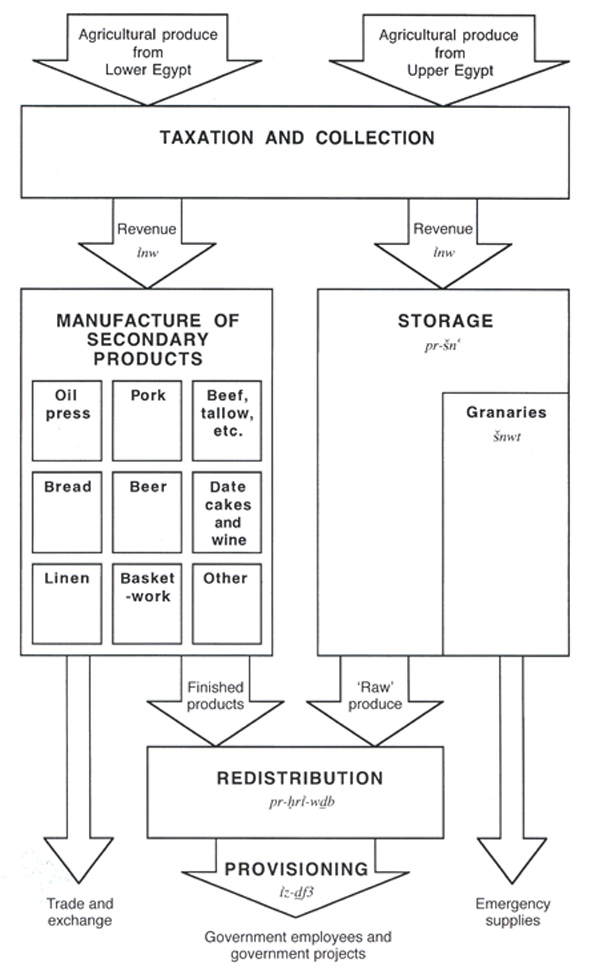
"The treasury
and its functions. The chart shows the principal operations carried out by the
treasury in the Early Dynastic period (based upon information from
contemporary sources : seal-impressions, inscribed stone vessels, and the
Third Dynasty tomb inscription of Pehernefer)."
Wilkinson, 2001, pp.126-127.
Three factors were of important in the
Memphite economy :
-
it was slaveless, so it had
to be workable (rotation-system, chain-labour, unit labour) ;
-
Pharaoh owned everything
and could give parts of his land away (and so loose its surplus) ;
-
there was no money :
economical transactions involved commerce "in natura".
The fact these formidable Old Kingdom constructions were built, can only be explained by a yearly overall surplus
large & varied enough to compensate for these "great works", and
this without emptying the reserves needed for eventual local shortages, protection and
administration (for production-techniques remained largely the same). These ongoing activities of Pharaoh and his court changed
Egypt profoundly. Finally, they heralded the end of the "old"
Memphite system, for as soon as the yearly overall surplus was smaller than
the actual losses (and/or not varied enough), local shortages & famines could cause
uprise and civil disorder ... As, by the end of the VIth Dynasty, Pharaoh had given away too much of his own
surplus (to his representatives, the temples and the nobles), direct means to
compensate
were lacking and the overall good distribution of goods was lost, as well as
Pharaoh's power to act as a "deus ex machina" (he was bound by his
own contracts). The end of the Old Kingdom would thus prove to be the outcome of a negative
economical balance-sheet hand in hand with a commanding bureaucracy dominating
an economically weakened Pharaoh. A falling apart caused by loosening the cords and avoiding the standard of the
plumb-line, spoiling the equilibrium of the scales ? Add to this a world-wide
climate change, causing drought and extremely low Nile floods for several
decades, and the collapse of the Old Kingdom was at hand.
The Maxims of Good
Discourse
by vizier Ptahhotep (ca. 2400
BCE)
after two Middle Kingdom copies
This
translation is based on the two oldest extant sources
(Middle Kingdom). Technical elements (in teal) have been added to the
text (in black)
:
-
sources
: the
sources of the text are given as : P, L1, L2
and C ;
-
general
composition : in 3 parts : I.Prologue, II.Teachings : 37 maxims and
III.Epilogue with Colophon ;
-
numbering
: numbers
of verses are new - the number of Dévaud (1916) is indicated as :
<bold>(D+number)</bold> ;
-
hieroglyphs
: the numbers of the 37 maxims are hyperlinked with the corresponding
section of the hieroglyphic text of
Zába
(1956) ;
-
notes :
the
hyperlinked notes refer to a
separate
webpage ;
-
special
words : the
word "heart" has been italized to indicate that the
passage in question figures in the
lexicon
of heart, wisdom & religious concepts ;
-
theological
concepts : all religious concepts (god, gods, etc.) are in bold ;
-
plain
text : to read
the text without most technical elements : click here
;
-
(...)
: words added to clarify the text and allow for more fluency ;
-
{...}
: explanatory remarks ;
I PROLOGUE
(P, L2 & C)
(01)
Written teachings of
(02)
the overseer of the city, the vizier
Ptahhotep,(1)
(03)
under the Majesty of Pharaoh Izezi,
(04)
King of Upper and Lower Egypt,
may he live for ever and ever !
(05)
The
overseer of the city, the vizier Ptahhotep, he says :
(06)
"Sovereign, my Lord !
(07)
Old age is here, old age
arrives !
(08)
Exhaustion comes, weakness is made new.
(09)
One lies down in discomfort all day,
(10)
eyes are dim, ears deaf,
(11)
strength wanes, the
heart is weary.
(12)
The mouth, silent, speaks not,
(13)
the
heart, ended, recalls not the past,
(14)
the bones ache throughout.
(15)
Good
becomes evil,
(16)
all taste is gone.
(17)
What age does to people
(18)
is evil in everything.
(19)
The nose clogged, breathes not,
(20)
difficult are standing and sitting.(2)
(21) May this servant be commanded to make a
'Staff of Old Age' !(3)
(22)
so as to
speak to him the words of the judges,(4)
(23)
the ways of
those before,
(24)
who listened to the
gods.(5)
(25)
May
the like be done for You,
(26)
so that strife may be removed from the people,
(27)
and
the Two Shores
(6) may serve You."
(28)
The Majesty of this
god said :
(29)
"As
for You, teach him then the sayings of the past,
(30)
so
that he may become a good example for the children of the great.(7)
(31)
May
hearing enter him and
(32)
the exactness of every heart that speaks to him.(8)
(33)
No one is
born wise."
II THE TEACHING
(34)
Beginning of the
maxims of good discourse,(9)
(35)
spoken by the prince, count, god's father, beloved of
god,
(36)
eldest son of the King, of his body,(10)
(37)
overseer of the
city, vizier Ptahhotep,
(38)
teaching the
ignorant in knowledge,
(39)
and
in the standard of good discourse,(11)
(40)
beneficial to him who hears,
(41)
but woe
to him who neglects it.
end of C
The Maxims of Good Discourse
(P and L2)
(42) So he spoke to his son :
1
(D51)
(43) "Don't let your
heart get big because of your
knowledge.
(44) Take
counsel with the ignorant as well as with the scholar.
(45) (For)
the limits of art are not brought,
(46) (and)
no artisan is equipped with perfection.(12)
(47) Good
discourse is more hidden than green stone,(13)
(48) yet
may be found among the maids at the grindstones.(14)
2
(D60)
(49) If
You meet a disputant in his moment (of action),(15)
(50) one
who directs his heart, superior to You,
(51) fold
your arms
(16) and bend your back.
(52) Do
not seize your heart against him,
(53) (for)
he will never agree with You.
(54) Belittle
the evil speech,
(55) by
not opposing him while he is in his moment.
(56) He
will be called a know-nothing,
(57) when
your control of heart will match his piles (of
words).
3
(D68)
(58) If
You meet a disputant in his moment (of action)
(59) who
is your equal, your peer,
(60) You
will make your excellence exceed his by silence,
(61) (even)
while he is speaking wrongly.
(62) Great
(then) is the discussion among the hearers, (and)
(63) the knowledge the magistrates have of
your name will be good.(17)
4 (D74)
(64) If
You meet a disputant in his moment (of action),
(65) a
man of little, not at all your equal,
(66) do
not be aggressive of heart because he is weak,
(67) give
him land (for) he refutes himself.(18)
(68) Do
not answer him to relieve your heart.
(69) Do
not wash the heart against your opponent.
(70) Wretched
is he who injures a man of little heart.
(71) One
will wish to do what your heart desires.
(72) You
will strike him with the reproof of the magistrates.
5
(D84)
(73) If
You are a man who leads,
(74) charged
to direct the affairs of a great number,
(75) seek
out every well adjusted deed,
(76) so
that your conduct may be blameless.
(77) Great
is Maat, lasting in effect.
(78) Undisturbed
since the time of Osiris.
(79) One
punishes the transgressor of laws,
(80) though
the heart that robs overlooks this.
(81) Baseness
may seize riches,
(82) yet
crime never lands its wares.(19)
(83)
He
(20)
says : 'I acquire for myself.'
(84) He
does not say : 'I acquire for my function.'
(85) In
the end, it is Maat that lasts, (and)
(86)
man
(21)
says : 'It is my father's domain.'
6 (D99)
(87) Do
not scheme against people,
(88) (for)
god punishes accordingly.
(89) If
a man (nevertheless) says : 'I shall live that way.',
(90) he
will lack bread for his mouth.
(91) If
a man says : 'I shall be rich.'
(92) He
will have to say : 'My cleverness has snared me.'
(22)
(93) If
a man says : 'I will rob someone.',
(94) he
will, in the end, make a gift to a stranger !(23)
(95) People's
schemes do not prevail.
(96) God's
command is what prevails.
(97) Live
then in the midst of peace (with what You have),
(98) (for)
what they give comes by itself.
7
(D119)
(99)
If You get to be among guests,
(100)
at the dining table of one greater than You,
(101)
accept what he gives, in the way it is set before your nose.
(102)
Look at what is before You,
(103) do
not pierce it with lots of glances.
(104) It
offends the Ka to be molested.(24)
(105) Do
not speak until he summons,
(106) (since)
one does not know whether he has evil on his heart.
(107) Speak
when he addresses You,
(108) and
may your words please the heart.
(109) The
nobleman, sitting behind the breads,
(110) behaves
as his Ka commands him.(25)
(111) He
will give to him whom he favors,
(112) (for)
that is the custom when the night has come.(26)
(113) It is
the Ka that makes his hands reach out.(27)
(114) The
great man gives to the lucky man.
(115) Thus
the breads are eaten under the plan of god,
(116) a fool
is who complains of it.
8
(D145)
(117) If
You are a man of trust,
(118) sent
by one great man to another,
(119) be
exact when he sends You.
(120) Give
his message as he said it.
(121) Guard
against slanderous speech,
(122) which
embroils one great with another.
(123) Keep
to Maat, do not exceed it.
(124) But
the washing of the heart should not be repeated.
(125) Do not
speak against anyone,
(126) great
or small, the Ka abhors it.
9
(D161)
(127) If
You plow and there is growth in the field,
(128) (because)
god lets it prosper in your hand,
(129) do
not boast about it at your neighbour's side,
(130) for
one has great respect for the silent man.
(131) If
a man of good character is a man of wealth,
(132) he
takes possession like a crocodile,(28) even in court.
(133) Do
not impose on one who is childless :
(134) neither
criticize, nor boast of it.(29)
(135) There
is many a father who has grief,
(136) and a
mother of children less content than another (without).
(137) It
is the lonely whom god fosters,
(138) while
the family man prays for a follower.(30)
10
(D175)
(139) If
You are a weakling, serve a man of quality, worthy of trust,
(140) (so) that
all your conduct may be well with god.
(141) Do
not recall if once he was of humble condition,
(142) do
not let your heart become big towards him,
(143) for
knowing his former state.
(144) Respect
him for what has accrued to him,
(145) for
surely goods do not come by themselves.
(146) They
are their laws for him whom they love.
(147) His
gain, he gathered it himself,
(148) (but)
it is god who makes him worthy,
(149) and
protects him while he sleeps.
11
(D186)
(150) Follow
your heart as long as You live.
(151) Do no
more than is required.
(152) Do
not shorten the time of 'follow-the-heart',
(153) (for)
trimming its moment offends the Ka.
(154) Do
not waste time on daily cares
(155) beyond
providing for your household.
(156) When
wealth has come, follow your heart !
(157) Wealth
does no good if one is annoyed !
12
(D197)
(158) If
You are a man of quality, worthy of trust,
(159) may You
produce a son, by the favour of god.
(160) If
he is straight, turns around your character,
(161) takes
care of your possessions in good order,
(162) (then)
accomplish for him all that is good.
(163) He is
your son, belonging to the seed of your Ka,(31)
(164) (so)
do not withdraw your heart from him.
(165) But
an offspring can make trouble :
(166) if he
goes into the wrong direction, neglects your counsel,
(167) with
insolence disobeys all that is said,
(168) if
his mouth sprouts evil speech,
(169) (then)
put him to work for the totality of his talk !
(170) They
disfavour him who crosses You,
(171) (for)
his obstacle was fated in the womb.
(172) He
whom they guide can not go astray,
(173) (but)
whom they make boatless can not cross.(32)
13
(D220)
(174) If
You are in a court of justice,
(175) stand
or sit as fits your rank,
(176) assigned to
You on the first day.(33)
(177) Do not
force your way in, (for) You will be turned back.
(178) Keen
is the face of him who enters announced,
(179) spacious
the seat of him who has been called.(34)
(180) The
court of justice has a correct method,
(181) all
behavior is by the plumb-line.(35)
(182) It is
god who gives the seat.
(183) He
who uses elbows
(36) is not helped.
14
(D232)
(184) If
You are among the people,
(185) gain
allies through being trustful of heart.
(186) The
trustful of heart does not vent his belly's speech.(37)
(187) He
will himself become a man who commands,
(188) a
man of means thanks to his behavior.
(189) May
your name be good without You talking about it.
(190) You
body is sleek, your face turns towards your people,
(191) and
one praises You without You knowing (it).
(192) (But) him whose
heart obeys his belly disappears ;
(38)
(193) he
raises contempt of himself in place of love.
(194) His
heart is denuded, his body unanointed.
(195) The
great of heart is a gift of god.
(196) He
who obeys his belly, obeys the enemy.(39)
15
(D249)
(197) Report
your commission without swallowing the heart,
(198) and
give your advise in your master's council.
(199) If he
is fluent in his speech,
(200) it
will not be hard for the envoy to report,
(201) nor
will he be answered : 'Who is he to know it ?'
(202) As to
the master, his affairs will fail,
(203) if
he plans to punish him for it.(40)
(204) He
should be silent and conclude : 'I have spoken.'
16
(D257)
(205) If
You are a man who leads,
(206) that
your way to govern may freely travel.(41)
(207) You
should do outstanding things.
(208) Remember
the day that comes after,(42)
(209) (so
that) no strife will occur in the midst of honors.(43)
(210) (Indeed),
where a hiding crocodile emerges, hatred arises.(44)
17
(D264)
(211) If
You are a man who leads,
(212) calmly
hear the speech of one who pleads,
(213) (and)
do not stop him from purging his body
(45)
(214) of
that which he planned to tell.
(215) A man
in distress wants to wash his heart
(216) more
than that his case be won.
(217) About
him who stops a plea,
(218) one
says : 'Why does he reject it ?'
(219) Not all one pleads for can be granted,
(220) but
a good hearing calms the heart.
18
(D277)
(221) If
You want friendship to endure
(222) in
the house You enter,
(223) as
master, brother, or friend,
(224) or in
whatever place You enter,
(225) beware
of approaching the women !
(226) Unhappy
is the place where it is done.
(227) (Their)
face is not keen on he who intrudes on them.
(228) A
thousand men are turned away from their good.
(229) A
short moment like a dream,
(230) then
death comes for having known them.(46)
(231) Poor
advice is 'shoot the opponent' !
(47)
(232) When
one goes to do it, the heart rejects it.
(233) (But)
as for him who fails through lust of them,
(234) no
affair of his can prosper.
19
(D298)
(P, L2 and beginning of L1)
(235) If
You want your conduct to be perfect,
(236) deliver
yourself from every evil,
(237) (and) combat
against the greed of the heart.
(238) It is
a grievous sickness without cure,
(239) impossible
to penetrate.
(240) It
causes disaster among fathers and mothers,
(241) among
the brothers of the mother,
(242) and
parts wife from husband.
(243) It is
an amalgam of all evils,
(244) a
bundle of all hateful things.
(245) That
man endures who correctly applies Maat,
(246) and
walks according to his stride.(48)
(247) He
will make a will by it.
(248) The greedy of heart has no tomb !(49)
20
(D316)
(249) Do
not be greedy of heart in the division (of goods).(50)
(250) Do
not covet more than your share.
(251) Do not
be greedy of heart toward your kin.
(252) The
kind has a greater claim than the rude.
(253) The
family of the latter reveals very little,(51)
(254) (for)
he is deprived of what speech brings.(52)
(255) Even
a little of what is craved,
(256) makes
conflict rise in a cool-bellied man.(53)
21
(D325)
(257) When
You prosper, found your house,
(258) love
your wife with ardor,
(259) fill
her belly, clothe her back,
(260) ointment
is a remedy for her body.
(261) Gladden
her heart as long as You live.
(262) She
is a fertile field, useful to her master.
(263) Do
not contend with her in a court of justice,
(264) (and)
keep her from power, restrain her.
(265) Her
eye is her storm when she gazes.(54)
(266) You
will make her stay in your house.
(267) If
You push her back, see the tears !
(268) Her
vagina is one of her forms of action.
(269) What
she enforces, is that a canal be made for her.(55)
22
(D339)
(270) Satisfy
those who enter, and in whom You trust,
with what You make,
(271) (for)
You make it by the favour of god.
(272) Of
him who fails to satisfy those who enter,
and in whom he trusts,
(273) one
says : 'A Ka too pleased with itself !'.(56)
(274) What
will come is unknown, even if one understands tomorrow.
(275) The
(proper) Ka is a correct Ka at peace with itself.(57)
(276) If
praiseworthy deeds are done,
(277) trustworthy
friends will say : 'Welcome !'
(278) One
does not bring supplies to town,
(279) one
brings friends when there is need.
23
(D350)
(280) Do
not repeat calumny,
(281) neither
hear it.
(282) It
is the way of expression of the hot-bellied.(58)
(283) Report
a thing observed, not heard.
(284) If
it is negligible, do not say anything,
(285) (and)
see : he who is before You recognizes (your) worth.
(286) Let
it be ordered to seize what it produces.(59)
(287) In accordance with the law,
(288) hatred
will arise against him who seizes it to use it.(60)
(289) Calumny
is like a vision against which one covers the face.(61)
24
(D362)
(290) If
You are a man of quality, worthy of trust,
(291) who
sits in his master's council,
(292) bring
your whole heart together towards excellence.
(293) Your
silence is more useful than chatter.
(294) Speak
when You know how to untie the knot.(62)
(295) It
is the skilled who speak in council.
(296) Speaking
is harder than all other work.
end of L2
(297) He who
unties it makes it serve.
25
(D370)
(P and L1)
(298) If
You are mighty, gain respect through knowledge
(299) and
gentleness of speech.
(300) Do
not command except as is fitting.
(301) He
who provokes gets into trouble.
(302) Do
not be high of heart, lest You be humbled.
(303) Do
not be mute, lest You be reprimanded.
(304) When
You answer one who is fuming,
(305) avert
your face, control yourself,
(306) (for)
the flames of the hot of heart sweep across.(63)
(307) He who
steps gently finds his path paved.
(308) All day long,
the
sad of heart has no happy moment.
(309) All day long,
the frivolous of heart can not keep house.
(310) The
archers complete the aim,
(311) as one who holds the
rudder untill (it) touches land.(64)
(312)
The opposant is imprisoned.
(313)
He who obeys his heart is equipped to
order.
26
(D388)
(314) Do
not oppose a great man's action.
(315) Do
not vex the heart of one who is burdened.
(316) His
anger manifests against him who combats him.
(317) The
Ka {of the great one} will part from him who loves him.(65)
(318) (Yet)
he who provides is together with god.
(319) What
he wishes will be done for him.
(320) When
he turns his face back to You after raging,
(321) (then) there
will be peace from his Ka,(66)
(322) (and)
hostility from the enemy.
(323) To
provide increases love.
27
(D399)
(324) Teach
the great what is useful to him,
(325) be
his aid before the people.
(326) Let
his knowledge fall back on his master,(67)
(327) (and)
your
sustenance will come from his Ka.(68)
(328) As
the favorite's belly is filled,
(329) so
your
back is clothed by it,
(330) and
his help will be there to sustain You.
(331) For
your superior whom You love,
(332) and
who lives by it,
(333) he
in turn will give You good support.
(334) Thus
will love of You endure,
(335) in
the belly of those who love You.(69)
(336) Behold
: it is the Ka that loves to listen.(70)
28
(D415)
(337) If
You are a magistrate of standing,
(338) commissioned
to appease the many,
(339) remove
stupidity from the record.(71)
(340) When
You speak, do not lean to one side,(72)
(341) beware
lest one complains :
(342) 'Judges,
he puts his speech on the side he likes !'
(343) In
court, your deeds will (then) turn against You.
29
(D422)
(344) If
You are angered by a misdeed,
(345) (then)
lean toward the man (only) on account of his rectitude.
(346) Pass
over the old error, do not recall it,
(347) since
he was silent to You on the first day.(73)
30
(D428)
(348) If
You are great after having been humble,
(349) have
gained wealth after having been poor in the past,
(350) in
a town which You know,
(351) (then)
knowing your former condition,
(352) do
not put the trust of your heart in your heaps,
(353) which
came to You as gifts of god,
(354) so
that You will not fall behind one like You,(74)
(355) to
whom the same has happened.
31
(D441)
(356) Bend
your back to your superior,
(357) your
overseer from the palace,
(358) then
your house will endure in its wealth,
(359) and
your rewards (will be) in their right place.(75)
(360) Wretched
is he who opposes a superior,
(361) (for)
one lives as long as he is mild ...
(362) Baring
the arm does not hurt it !(76)
(363) Do
not plunder a neighbour's house,
(364) (and)
do not steal the goods of one near You,
(365) so
that he does not denounce You,
(366) before
You are heard.(77)
(367) A
quarreler lacks in heart,
(368) so
if he is known as an aggressor,
(369) the
hostile will have trouble in the neighbourhood.
32
(D457)
(370) Do
not copulate with a woman-boy,(78)
(371)
for You know that one will fight
(372) against
the water upon her heart.
(373) What
is in her belly will not be refreshed.(79)
(374) That
during the night she does not do what is repelled,(80)
(375)
(but) be calmed after having ended the offence of her heart.(81)
33
(D463)
(376) If
You seek to probe the true nature of a friend,
(377) do
not inquire (after him), but approach him (yourself).
(378) (Then)
deal with him alone,
(379) until
You are no longer uncertain about his condition.
(380) After
a time, dispute with him.
(381) Test
his heart in dialogue.
(382) If
what he has seen (of himself) escapes him,(82)
(383) if
he does a thing that irritates You,
(384) be
yet friendly with him or be silent,
(385) but
do not turn away your face.(83)
(386)
Restrain yourself and open dialogue.
(387) Do
not answer with an act of hostility.
(388) Neither
counter him, nor humiliate him.
(389) His
time does not fail to come ...
(390) (for)
one does not escape what is fated.(84)
34
(D481)
(391) Be
bright-faced as long as You exist !(85)
(392) (But)
what leaves the storehouse does not return.
(393) It
is the food to be distributed which is coveted.
(394) (But)
one whose belly is empty is an accuser,
(395) (and)
one deprived becomes an opponent.
(396) Do
not have him for a neighbour.
(397) Kindness
is a man's memorial
(86)
(398) for
the years after the function.
35
(D495)
(399) Know
those at your side, then your goods endure.(87)
(400) Do
not be weak of character toward your friends,
(401) (they are) a
riverbank to be turned and filled,(88)
(402) more important than its riches ...
(403) For
what belongs to one (also) belongs to another !
(404) The
good deed profits the son-of-man.(89)
(405) An
accomplished nature is a memorial.
36 (D495)
(406) Punish
as a commander-in-chief,
(but) teach the complete form !(90)
(407) The
act of stopping crime is an enduring good example.
(408) Crime, except for misfortune,(91)
(409)
turns the complainer into an aggressor.
37
(D499)
(410) If
You take to wife a woman of good quality,
(411) who
is unbound of heart and known by her town,
(412) conform
her to the double law.
(413) Be
pleasant to her when the moment is right,
(414) do
not separate yourself from her and let her eat,
(415) (for)
the joyful of heart confer an exact balance."
(92)
III THE EPILOGUE
On Hearing & Listening
(D507)
(Ptahhotep continues ...)
(416)
"If
You hear my sayings,(93)
(417)
all your plans will go forward.
(418)
In their
act of Maat lies their value.
(419)
Their
memory lingers on in the speech of men,
(420)
because
of the accomplishment of their command !(94)
(421)
If
every word is carried on,
(422)
they
will not perish in this land.
(423)
That
an advice be given for the good,
(424)
(so
that) the
great will speak accordingly.
(425)
It
is teaching a man to speak to what comes after (him).
(426)
He
who hears this becomes a master-hearer.(95)
(427)
It
is good to speak to posterity,
(428)
it
will hear it.
(429)
If
a good example is set by him who leads,
(430)
he
will be beneficient for ever,
(431)
(and)
his
wisdom will be for all time.
(432)
He
who knows, feeds his Ba with what endures,
(433)
so
that it is happy with him on earth.
(434)
He
who knows is known by his wisdom,
(435)
(and)
the great by his good actions.
(436)
(That)
his heart twines his tongue,
(437)
(and)
his lips (be) precise when he speaks.
(438)
That
his eyes see !
(439)
That
his ears be pleased to hear what profits his son.
(440)
(For)
acting with Maat, he is free of falsehood.(96)
(441)
Useful
is listening to a son who hears !
(442)
If
hearing enters the hearer, the
hearer becomes a listener.
(443)
To
listen
well is to speak well.
(444)
He who listens is
a master of what is good.
(445) Splendid
is listening to one
who hears !
(446)
Listening
is better than all else.
(447)
It
manifests perfect love.
(448)
How
good it is for a son to grasp his father's words !
(449)
Underneath
them, he will reach old age.(97)
On the Listener and the Non-Listener
(D545)
(450)
He
who listens is beloved of god,
(451)
he
who does not listen is hated by god.
(452)
(It
is) the heart (which) makes of its owner
a listener or a non-listener.
(453)
Life, prosperity & health
are a man's heart.
(454) It is the hearer who listens
to what is said.
(455)
He
who loves to listen, is one who does what is said.
(456)
How
good for a son to obey his father !
(457)
How
happy is he (the son) to whom it is said :
(458) 'The
son pleases as a master of listening.'(98)
(459)
He (the son) who hears the one (the father) who said this,
(460)
is well adjusted in his inner being,(99)
(461)
and
honored by his father.
(462) His
remembrance is in the mouth of the living,
(463)
those
on earth and those who will be.
(464)
If
the son-of-man accepts his father's words,
(465)
no
plan of his will go wrong.
(466)
Teach
your son to be a hearer,
(467)
one
who will be valued by the heart of the nobles,
(468)
one
who guides his mouth by what he was told,(100)
(469)
one
regarded as a listener.
(470)
This
son excels, his deeds stand out,
(471)
while
failure enters him who listens not.
(472)
The
knower wakes early to his lasting form,
(473)
while
the fool is hard pressed.(101)
(474)
The
fool who does not listen,
(475)
can
accomplish nothing at all.
(476)
He
sees knowledge as ignorance,
(477)
usefulness
as harmfulness.
(478)
He does all that is detestable,
(479)
and
is blamed for it each day.
(480)
He
lives on that by which one dies,
(481)
he
feeds on damned speech.
(482)
His
sort is known to the officials,
(483) to wit
: 'A living death each day !'(102)
(484) One
passes over his doings,
(485) because
of his many daily troubles.
(486) A son
who listens, is a Follower of Horus.(103)
(487)
It
goes well with him when he listens.(104)
(488)
When
he is old and reaches veneration,(105)
(489) (may) he speak likewise to his children,
(490)
renewing
the teaching of his father.
(491)
Every man teaches as he
acts.(106)
(492)
He speaks to the children,
(493) so
that they speak to their children.
(494)
Set
an example, do not give offense.
(495)
If Maat stands firm, your children live !
(496)
As
to the first who comes as a carrier of evil,(107)
(497)
may
people say to what they see :
(498)
'That
is then just like him !'(108)
(499)
And
may they say to what they hear :
(500)
'That
is then just like him !'
(501)
Let
everyone see them
(109) to appease the multitudes.
(502)
Without
them, riches are useless.
On Speaking
(D608)
(503)
Do
not take a word and then bring it back.
(504)
Do
not put one thing in place of another.
(505)
Beware of loosening the cords in You,(110)
(506)
lest
a man of knowledge say :
(507)
'Hear ! If You want to endure in the mouth of the listeners,
(508)
speak
(only) after You have mastered the craft !'
(509)
If
You speak in a refined way,
(510)
all
your plans will be in place.
(511)
Immerge
your heart, control your mouth,
(512)
then
You are known among the officials.
(513)
Be
quite exact before your master,
(514)
act
so that he says : 'He is a son !'(111)
(515)
And
those who hear it will say :
(516) 'Blessed is he to whom he was born !'
(517)
Be
patient of heart the moment You speak,
(518)
so
as to say elevated things.
(519)
In this way, the nobles who hear it will
say :
(520)
'How
good is what comes from his mouth !'(112)
(521) Act so
that your master will say of You :
(522)
'How
accomplished is he whom his father taught.
(523)
When
he came forth from him, issued from his body,
(524)
he (the father( spoke to him
when he was in the belly (of his mother),
(525)
and
he (the son) accomplished even more than he was told.'
(526)
Lo,
the good son, the gift of god,
(527) exceeds what is told to him by his master,
(528)
he
does Maat and his heart matches his steps.
(529)
(O
my son) as You succeed me, with a sound body,
(530)
the King at peace with all what is done,
(531)
may
You obtain many years of life !
Concluding Remarks
(D640)
(532)
Not
small is what
I did on Earth ...
(533)
I
had hundred and ten years of life,
(534)
as
a gift of the King, (and)
(535)
honors
exceeding those of the ancestors.
(536)
For
by doing Maat for the King,
(537)
the
venerated place comes."
Colophon
(D645)
(538)
From its beginning to its end,
(539)
in accordance with (how it was) found in writing.
NOTES
LEXICON
HIEROGLYPHS
|
3 The
Memphite Philosophy of Order through Just Speach.
the biliteral Shu
("Sw")
the Feather of Maat
Thus said Atum
:
"Tefnut is my living daughter,
and she shall be with her brother Shu ;
'Living One' is his name, 'Righteousness' is her name.
I live with my two children, I live with my two twins,
for I am in the midst of them {Tefnut & Maat} :
the one near my back, the other near my belly.
Life lies down with Maat, my daughter,
the one within me and the other around me.
I stood up between them both, their arms being about me."
(...)
Nun said to Atum :
"Kiss your daughter, Maat, put her at your nose,
that your heart may live forever, for she will not be far from you.
Maat is your daughter and your son is Shu whose name lives.
Eat of your daughter Maat, it is your son Shu wo will raise you up."
Coffin Texts, spell 80 (De
Buck, 1935-1961)
3.1
Various perspectives on Maat.
Maat
in
religious history
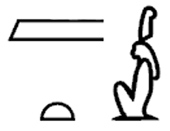
"mt" with
determinative of the goddess, also "mAat"
many other variations are extant
Great
is Maat, lasting in effect.
Undisturbed
since the time of Osiris.
Maxim 5, lines 77 - 78
The earliest evidence for the existence of
Maat can be found in the names of some kings. The oldest seems to
be the name of Pharoah Sekhem-Ib, from Dynasty II (ca. 2800 - 2670 BCE). Both his Horus name and
his Nebty name (cf. the royal
titulary) include the epithet "pr n mAat" or "house of
Maat".
Pharaoh Snefru (ca. 2600 - 2571 BCE), initiating Dynasty IV, calls himself "nb mAat" or : "Lord of
Maat" and in the late Vth Dynasty, Pharaoh Djedkara Izezi (ca. 2411 -
2378 BCE), used
"mAat ka Ra", "Maat, the double of Re". With this goddess
we touch upon direct evidence of the personalization of a stable concept, albeit
ante-rational & non-abstract (executed in the mythical, pre-rational and
proto-rational mode of thought).
"Choiser de parler de la Maat signifie également puiser dans une
plénitude de sources. Aucune notion égyptienne n'a suscité une telle
diversité de discours. Nous aurons à nous occuper de textes sapientiaux,
biographiques, funéraires, théologiques, cosmologiques, culturels,
historiques, c'est-à-dire pratiquement de toute la documentation
égyptienne."
Assmann, 1999, p.15.
In the Pyramid Texts, Osiris is also called "Lord of Maat"
and Maat is in the company of Re. He
appears with Maat's plinth as the base of the throne on which he sits to
judge the dead, meaning that everything depended on what happened in the Hall
of the Double Maat (the Two Truths). The deities of the Ennead, together as a
tribunal, were called the "council of Maat". The title "priest
of Maat" was given to those who administered justice (the magistrates).
The kings saw Maat as their authority to govern and continued to stress how
their reigns upheld the laws of the cosmos which she embodied, for they were
the "beloved of Maat". In Hermopolis, the
goddess was also thought to be the
wife of Thoth, moon god and god of wisdom.
Maat personified the supreme daily offerings brought by Pharaoh and his
representative to the pantheon in the various "places of truth"
(i.e. the temples with their necropolis). She had no festival of her own to be
celebrated. Ptah, Re, Thoth & Osiris, as well as Pharaoh, were called
"Lord of Maat", i.e. the national deities of the Old Kingdom were all united by
doing Maat. She had no myth of her own and could never be fused with
other deities.
In the Middle Kingdom, Maat was
disconnected from the pharaonic principle (which was not abolished, for
Pharaoh still was the "Lord of the Two Lands"). But, what one did for
Pharoah (and his people, undisconnected in the Old Kingdom) was no longer a
guaratee for justification. The "inner being" and state of one's
conscience became essential (everybody, not only Pharaoh, had a
"soul" or Ba). Maat endorsed the rectitude which one seriously and with
great effort had earned for oneself. The democratization of ascension
(commoners could also be deified as an "Osiris NN") as well as this reevaluation of individual
conscience (continuous judgement as a "balancing-out") was the great
cultural surplus acquired during the Middle Kingdom.
In the New
Kingdom (XVIIIth Dynasty), Maat wascalled "daughter of Re" and
Pharaoh wasrepresented offering an effigy of
the goddess in the palm of his hand before the major deities. But after Akhenaten,
"who lives by Maat", the will of the gods was equated with Maat, which
in fact stopped the concept from working (the principle of balancing scales
being abolished). Hence, The Instruction of
Amenemope (NK, XIX / XXth Dynasty, ca. 1292 - 1075 BCE) can be
seen as the last major work of Egypt's sapiental literature.
"Mais identifier la Maat à la volonté de Dieu,
c'est l'abolir. La volonté de Dieu se traduit en actes individuels, actes de
grâce, que l'Égyptien résume sous la notion de 'hzwt', 'faveur'. Maat s'absorbe dans 'hzwt' et il n'y a que la volonté divine qui reste. La
différence essentielle entre la volonté de Dieu et la Maat, c'est que cette
dernière est reconnaissable, saisissable, transmissible, évidente et
confortante, tandis que la volonté de Dieu est cachée."
Assmann, 1999,
p.143.
A small temple dedicated to Maat was found in the southern sector of
the precinct of Montu at Karnak.
Maat
as cosmic
& social order
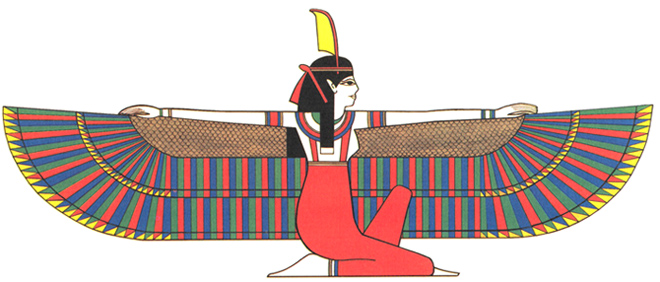
In
the end, it is Maat that lasts, (and)
man says : 'It is my father's domain.'
Maxim 5, lines 85 - 86
The hieroglyphs
associated with Maat is that of a plinth and a feather, representing the primeval mount
upon which the creator self-emerged, and the invisible, all-encompassing
nature of "air", which can be felt but never seen (cf. the word
"hidden" & the iconography of
Amun). She comes into being
together with the cosmos (the hieroglyph of the feather is also the biliteral
"Sw", the god of Air who was created together with Tefnut by the
creator Atum-Re).
Without Maat, the Nun (the primodial, chaotic waters) would reclaim
creation. Maat is shown as a Lady wearing an ostrich feather (of the Air-god
"Sw") which can stand on its own instead of the full representation
of the goddess. She usually wears the sign of life ("anx").
Maat was more a fundamental bridging concept rather than a deity to be
worshipped. Literally, "mAat" meant also : "truth, integrity,
uprightness, justice, the right, verity, social & cosmic order, balance,
equilibrium". The fact that "the proper measure" (in Dutch :
"de maat", also in words as "maatstaf, maatgevend,
matigen") was Ancient Egypt's fundamental concept, shows the
importance of balanced, exact & correct thought before
the advent of rational categories.
The cosmic function of Maat is the continuity, maintenance, stability and
permanence of creation (cf. "Weltordnung" -
Schmid,
1968) and so it is not surprising that, especially in the Old
Kingdom, she is ultimately linked with the presence of Pharaoh (the Follower
of Horus who is the sole god-on-earth who is Maat's brother).
Pharaoh is the tenacity principle par excellence, as the Pyramid Texts
make clear (cf. the Cannibal Hymn). Maat is born
when creation emerged. Likewise, Pharaoh established & maintained the
unity of the Two Lands, politically (Upper and Lower Egypt) as well as
theologically (divine and human worlds). The kingship which his institution
represented had "transcendent significance" (Frankfort,
1948).
More analogies may be found. At Philae, we see the Nile-god Hapy pouring water
from two vases. A serpent's body outlines a cave in some rock. According to
Plutarch, the Egyptians saw the Nile as an outflow of Osiris and the earth as
the body of Isis, whereas Seth represented the intensity of dryness which
evaporates the Nile's waters. The flood itself symbolized the annual
resurrection of the vegetation-god Osiris. Contrary to other rivers, the Nile
begins its annual swelling in the hottest time of the year, when Sirius (Isis)
rises at the same time as the Sun (heliacal rising), a date which during the
third millenium BCE coincided with the summer solstice. Orion (Osiris) appears
just before the Dog Star Sirius ... The inundation itself, was similar to an
inert, primordial ocean, for its expanse extended over a length of more than
1000 kilometers (over 600 miles), with, at some places, a width of 10 to 20
kilometers (up to 12 miles). Such a scenery must have been very impressive.
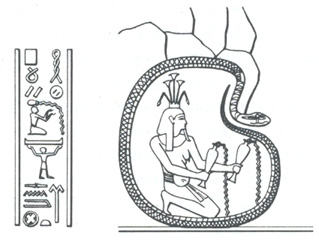
bas-relief in the temple
adjoining the Nilometer
on the island of Philae showing the sources of the Nile
It is true that the relapse into chaos which
Maat was supposed to avert and (if calamities happened) soothe & heal was
not a metaphor, but a historical fact. Indeed, read the chaotic, undifferentiated,
dark and endless "primordial waters" (of the "Nun", the
"father of the gods" who had no temple) as (a) the
"waters" of the river Nile, with its irregular and inpredictable
(strange, chaotic) flood-attractor moving in the phase-space of the various
parameters involved when observing the Nile (cf.
Chaos,
1996), (b) the amount of water brought by the flood,
ranging from too low to too high and (c) the natural and artificial
redistribution of this water in the canals and irrigation-systems (public
& local dikes). Nile water was the major source of wealth and poverty. The
continuum of this "flood-attractor", which the Ancient Egyptians did
not understand (for the process is too irregular and involves complex
mathematics), may be represented by the two extreme ends of the phase-space of
the inundation,
namely very low and very high annual floods ... like the two
extreme positions of the two scales of the balance.
In years when too little water and silt was brought, the annual harvest
surplus would be very small or non-existent, causing the reserves to be
depleted. If the latter were too small or absent (because this is happening a couple of years in a row), famine, plague, disorder, misery and
depopulation occurred as a function of the length of the absence of new,
balanced floods. Extreme flooding caused canals and field systems to be damaged or
destroyed, generating lower crops. Studies reveal that both long-term and
short-term cycles are at work, in addition to stochastic, unpredictable
changes in the height, timing, peak, duration and sequence of the annual
summer flood (Hassan, 1993). Hence, although
the Egyptians kept a record of the "chaotic waters" (probably to
discover some regularity), they never mastered its mathematics. So, if the
power of the "Nun" was a yearly recurring event, the whole notion
of Ancient Egypt as an example of static, eternalizing, enduring stability
should always be contrasted with the fact of the urgent & dangerous
presence of chaos (in the way the cosmos was believed to function, as well as
in the Egyptian mentality and economical organization). In fact, this makes Ancient
Egypt a good example for the problems the world faces today ...
The general
flood-curve has been established by
Bell
(1970) and Butzer (1984). The annual discharge
could be drastic (from, for example 129 billion cube meters per day in 1879 to
44 billion cube meters per day in 1913). Changes in the volume of the Nile floods occur on several scales (35 years,
150 years, 300 years, 500 years, 1000 to 1600 years and longer). So except for
changes at the shortest interval, Nile floods could not be recognized in any
orderly way and no predictions could be made.
-
Early
Dynastic Period : low floods, small population, adequate surplus ;
-
Old
Kingdom : good floods, larger population, start of effective
bureaucratic administration ;
-
end
of the Old Kingdom : low floods, collapse of central authority,
famine (end VIth Dynasty) ;
-
Middle
Kingdom : low floods, ambitious programs of flood control and land
reclamation ;
-
end
of the Middle Kingdom : aridity of the Egyptian Sahara, low floods
with occasional high floods, famine, disease ;
-
New
Kingdom : good floods, surplus & prosperity - Egypt's
"golden age" ;
-
end
New Kingdom : after Ramesses II low floods (drop in lake levels in
East Africa) and eight- to twenty-fourfold increase in grain prices in
1110 BCE.
This fundamental insecurity
(which could have drastic effects) was the riverine foundation (basis) of
Egyptian civilization. The "plinth of Maat" being an image of the
"primordial hill" which served as a stable throne for Atum-Re, who
as his own creator emerged out of chaos. Without Maat, chaos would reclaim
creation. As their existence was based on highly unpredictable events, which
returned every year, we may also understand Maat as Egypt's concrete
conceptualization of a practical solution when dealing with disorder. If
Re was the power of light, the dawn of creation, Maat, his daughter, was the immanent
formula of creation and order. To apply this, enabled every element of
creation to endure as part of creation. Because of Maat, ways were
found to counter all circumstances (all positions of the two scales).
Indeed, compare the immanent continuity personalized by Maat with the Balance
of Judgment (cf. 3.2 infra). The two scales and their various positions,
reflect the various dynamical dual states at work in the processes of nature
& society (cf. the Two Lands), especially in its astronomical cycles,
which measure "eternity", and its socio-econmical cycle, based on
riverine characteristics. On top of the middle point of the one beam, holding
the two scales, sits the Baboon of Thoth, who, as consort of Maat, records
the position of the plumb-line, which is telling us precisely how much the
balance is out of its state of equilibrium. It is the correct, precise and
faithful record of this unbalance which lies at the heart of doing Maat. He
who applies Maat, starts with recording the imbalance and next compensates,
and this permanently ...
The economical cycle of the Old Kingdom (a period of good floods) allowed for
excessive building-projects such as the large pyramids of the "Pyramid
Age" because the surplus was put in reserve. The administration of
the produce was considerable, and guaranteed that compensations could
always be made. As long as there was enough surplus in reserve, sudden large
imbalance could always be re-equilibrated. A strong central command was of
vital importance, and the large-scale collective building-projects pulled the
whole country together around its Pharaoh, a socio-religious trigger of
considerable importance. But when the floods turned bad for long periods of
time, calamity could strike nationwide (no surplus and no reserves).
A prudent, timid and gentle stride was considered to be in harmony with Maat.
Excesses were avoided. When they happen, they were compensated by putting in
reserves as well as by being reserved. By being aware of the plumb-line of the
balance (conscience), one may judge one's situation and act to (re)establish Maat
and let her endure (again). The straight path was the proper middle way
of accomplished equilibrium on the chaotic sea of non-equilibrium. As this law
of rectitude was immanent (part of the order of creation), its standard was at
work both in the macrocosmos (were it just "is") as well as in the
microcosmos (were it ought to be). To it, growth is not essential, but
increasing harmonization is (cf. the spiral-curve instead of the straight
line). The macrocosmic work of Maat got associated with the course of Re,
i.e. Solarized. In the microcosmos, as Ptahhotep showed, Maat operated in all
kinds of social situations, but excelled as the good discourse made by the
wise father to his son, who heard and listened, and did better than his own
father.
Maat
as justice
|
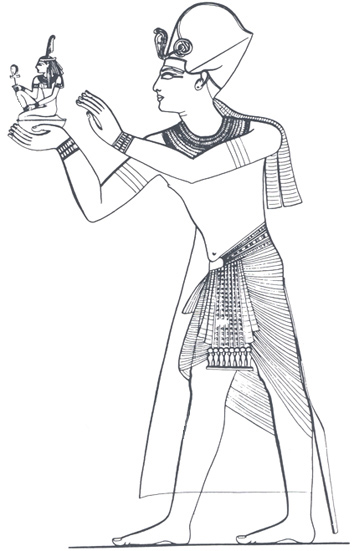
Seti I presenting Maat
XIXth Dynasty - his temple at Abydos
Keep Maat, do
not exceed it.
Maxim 8, line 123 |
During
life on earth, it
was Pharaoh's duty to uphold "maât". "I have done Maat." has been
spoken by several kings, as well as the affirmation that they were "beloved of
Maat".
Maat was also the justice meeted out
in Egypt's law courts. The title "priest of Maat" referred to people
who were involved in the justice system, as well as being
priests of the goddess herself.
In Ancient Egypt, Pharaoh prevented crime, judged & punished the
criminals. Justice and the immanent order of being were one and the
same thing. It was necessary that righteousness ruled (and greed
expelled), because by offering order to Re, Pharaoh returned to his
father what had been given by the latter, namely creation itself. By
circulating the goods, and not causing individuals to heap up their
wealth, equilibrium was maintained.
Pharaoh possessed everything and everybody else received
what they needed from him and the other gods directly (via the
offerings). Greed, lying & killing ran directly against Maat.
|
"And
the Setem shall cense Re-Heru-Khuti in all his names, and shall say : 'O Re,
living in Maat. O Re, who feedest upon Maat. O Re, who rejoicest in Maat. O
Re, who art united to Maat. (...) I have come and I have brought unto thee Maat, in which thou livest, in which thou rejoicest, in which thou art
perfect, in which thou art bound together, in which thou flourishest (...) Thy
heart is glad when thou seest those who are in thy shrine, who rejoice when
they see Maat, following thee, since evil beareth contentions and destroyeth
all the gods and the offerings.'"
Book of Opening the Mouth, the
Address to Re, translated by
Budge, 1972,
pp.103-107.
Maat as the double truth
in the "Beautiful West"
"Le jugement
des morts, si l'on en croit la forme que les Égyptiens ont donnée à cette
idée, est surtout un rite d'initiation d'après le modèle de l'initiation
sacerdotale. (...) Le rite purificateur/qualificateur comprend la récitation
et l'action. La récitation, c'est la déclaration d'innocence ou de la Maat codifiée ; l'action consiste dans l'acte de la 'psychostasie', ou mieux de la 'pesée du coeur'."
Assmann
(1999, p.82 & 84)
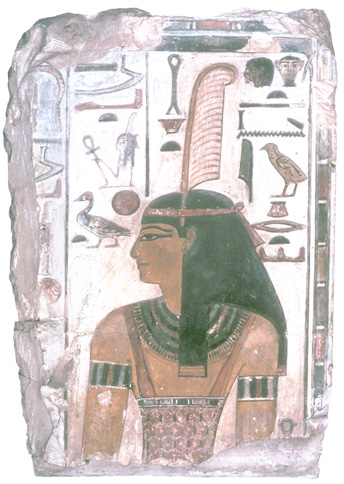
relief of Maat in
the tomb of Seti I
XIXth Dynasty - Thebes, the legend reads :
"Maat, daughter of Re, sovereign who presides over the land of
silence."
For by doing Maat
for the King,
the venerated place comes.
Epilogue, lines 536 - 537 |
We see the deceased
brought (sometimes by Maat herself) in the "Hall of Maat",
the "Hall of the Double Truth" or the "Hall of Judgment". His heart (i.e. the sum total of all conscious
processes) was placed on one scale and was balanced by
"truth" herself -the Feather of Maat- on the
other scale.
Which truth ? Maat herself and the negative affirmations or the
declaration of innocence made by the deceased. In
it, he confirmed before the 42 gods not to have offended Maat in various (essential) ways (cf. the Book of the Dead, chapter
125) but in this way also purged his possible sin. Anubis
(god of embalming and guide of the dead) weighed the heart, and Thoth (god of writing, scribes, magic and wisdom) recorded. Only
perfect equilibrium was acceptable. For only in that case had the
person not added weight to his own heart by acting against Maat without
compensating for the wrongdoing in some way. In that case, the heart was devoured by
a female demon called "Ammut", the Devouress of the Dead.
This was the second, final death. But if the heart weighed the same as
the Feather of Truth, the deceased was justified (venerated) and could meet Osiris
to be deified ...
|
Maat
as the Eye of
Horus
the left & the right eye of
Horus
That man
endures who correctly applies Maat
and walks according to his stride.
Maxim 19, lines 245 - 246
In the Pyramid Texts we
read :
"Take the two Eyes of Horus, the black and the
white. Take them to your forehead, (so) that they may illuminate your face."
Sethe, 1908/1960, § 33a
"Behold, Pharaoh Unis brings to you your great left Eye healed. Accept it from
Pharaoh Unis intact, with its water in it
intact, with its blood in it intact, and with its ducts in it
intact."
Ibidem, § 451a - c
"To say : 'Horus has cried out because of his Eye, Seth has cried out because
of his testicles. The Eye of Horus sprang up, as he fell on yonder
side of the Mer-en-Kha {a lake in the netherworld}, to protect itself from Seth. Thoth saw
it on yonder side of the Mer-en-Kha when the Eye of Horus sprang up on
yonder side of the Mer-en-Kha and fell on Thoth's wing on yonder side of
the Mer-en-Kha.' "
Ibidem, § 594a -f
"To say : 'May the sky make the sunlight strong for Pharaoh Pepi, may
Pharaoh Pepi rise up to the sky as the Eye of Re and may Pharaoh Pepi stand at that left Eye of Horus by means of which the speech of the gods is heard.'
"
Ibidem, § 1231a - d
"To say : 'O my father, Pharaoh Merenre, I have come and I bring to you green eye-paint. I bring to you the green eye-paint which Horus gave to
Osiris. I give you {the eye-paint is addressed} to my father, Pharaoh Merenre,
just as Horus gave you to his father
Osiris. Horus has filled his empty Eye with his full Eye.' "
Ibidem, § 1681 - 1682
In the fight with Seth, Horus lost his left eye (and Seth his testicles
- symbols of the causes of revolt, violence and turbulence). This left Eye of Horus, or Eye of Thoth, is the endangered
& injured Eye, also called "the black eye" (his "empty
Eye"), associated with the
cycle of the Moon (especially the Full Moon) and the winter. It was
miraculously filled and completed by Thoth and then given back to Horus (as it
is brought to Pharaoh) as a "full Eye". Because of this rejuvenation, it is called "the
green eye" (cf. the color of the resurrection of Osiris also associated
with vegetation), but also the strong, mighty, great, pure Eye. It was stronger
than men and mightier than gods ... Healed, it even had its own typical perfume.
The right Eye of Horus, or Eye of Re, is the original
"wedjat-eye", for "wTAt" means "well,
uninjured", also called "the white eye", associated with the
cycle of the Sun (especially its zenith) and the summer. It was this intact
eye which was used in the Egyptian notation of measures of capacity :
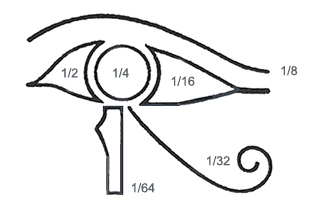
the Wedjat-eye or uninjured
Eye of Ra or right Eye of Horus
the sum of the fractions is 63/64 - 1/64th was left to magic
"Although
Maat may have been driven out, she could return thanks to the assiduous work
of the ruler or the individual. In that sense maat resembled the eye of
Horus, wounded time and time again and subsequentely healed. Both symbolized a
constantly endangered order that must repeatedly be established anew. The
presentation of the eye of Horus, or udjet eye, by the pharaoh or priest had
the same basic significance as the presentation of Maat. The gesture gave
visible proof that all disruptions and threats to order had been removed, and
that justice and harmony ruled once more. On two statues we find the symbols
explictly joined in the inscription : 'My arms carry the udjet eye, I present
maat.' The sacred eye is often shown in the hands of a baboon - an allusion to
Thoth, who healed the eye ..."
Hornung,
1992, p.142.
Again the two scales appear : uninjured (Eye of
Re, analogon of the Feather, daughter of Re) versus the endangered or injured (Eye of Thoth,
analogon of the heart, judged by speech).
The
white eye is incomplete (lacks 1/64th) and the black eye is restored to become
the greatest magic power possible, except the powers of life & vitality, of which
this green eye is a splendid example. The restored Eye is Maat, and the
restored energy is given back to its origin (to complete the cycle and
condition perpetual rejuvenation - the eternal return of the same).
Turbulence in the cycle is part of the equation (as Seth was part of the
pantheon), but the work (process) of restoration (from black to green, from
barren to fruitladen tree, from emptiness to fullness) is -as long as creation
lasts- everlasting & evergreen. Maat transcends the turmoil upon which
the very existence of the culture of the Two Lands was based, but her standard
is immanent in creation (the cosmic moral law was not in touch with the
"first time" of before creation). She is the goddess perceived by
Nun (the preexistent, passive "chaos" versus active
"chaos" as "isefet") as Atum's greatest asset ! He tells
him to kiss her and smell the excellence of her fragrance ! She is always near
him, i.e. present in every point of his creation. Maat can be
"eaten", for she is the "divine food" of the gods (the
offerings) which are redistributed as "gifts of the gods". She is
the ultimate food from heaven which is given back to heaven (as
voice-offerings).
Truth and justice are the backbone of every great civilization, and they can
always be restored, as the Eye of Horus teaches (are Mercy its flesh and
Compassion its spirit ?). To find oneself on the straight path again after
having gone astray from it for a long time may be difficult, but not
impossible. Indeed, "on the first day", there was no conflict (i.e.
the "original" state of affairs was just). So if someone makes up
later by doing great deeds for the people regardless his former lowliness, then
Maat automatically rebalances
between them and perfect peace ("hotep" - "Htp") returns as it was on the first day (when things just were what they were and not yet
how they turned out afterwards). The "balancing-out" proposed here
is not a final judgement (which comes later, after the process of judgment in
the Hall of Truth is concluded by the recording of the results by Thoth and
one is brought before Osiris), but a degree of mastership regarding the rudder
of the boat of life, enabling one to continue to do one's work whatever the
conditions, hinderances and/or the costs (here and in the afterlife).
|
NUN |
the preexistent, primordial,
precreational waters which lurk behind every excess of the floods ...
|
passive
chaos |
| SETH |
the arch-personalization of
divine evil - fundamental cause of the disruption of divine plenty and
(by extension) of the "breaks" between various
"states" of the heart - controls Apep the serpent
|
active
chaos
universal |
| ISEFET |
the negation of Maat by the
members of the pantheon (like Seth), and general concept for all
possible moral evil done by the person and his (her) heavy heart
|
active
chaos
personal |
With the Eye of Horus, we touch upon the core of the dramatical activities
unfolding between the gods & goddesses, as these are determined by the
presence of Seth, the personalized focus of the active chaos within creation :
divine, natural as well as moral (deicide, calamity & moral evil, i.e.
"isefet"). The scarcely mentioned murder of Osiris by Seth, was the
introduction of divine moral evil in the holy sanctuary of the pantheon itself
: chaos initiated as an intrinsic, irreducible and active part of the system
of nature (contrary to Nun, who remains passive and undifferentiated, Seth has
a form of expression of his own) ... The result was devastating, for the old
order (represented by Osiris) was over (he was slain). With the "mourning
of Isis" came the necessary purgation which enabled Isis to trick Re into
giving up his secret name. Together with Thoth she was able to resurrect
Osiris in a new, immortal body in the netherworld, were he reigned as supreme
king and judge. Together, Isis and Osiris conceived a son Horus, who avenged
his father by combatting Seth, and lost his left eye. He was justified (not
by winning the battle) but by the concert of the divine tribunal and so became the
Lord of the Two Lands. Seth was not destroyed, but had to retreat in the dry
deserts, with its storms and weird animals. As compensation for abandoning the
throne, Seth was given two goddesses as wives and he was also allowed to live
in the sky with Re. Every night, his magical strength was needed when Re, at
the end of the nightly caverns (reviving Osiris at the midpoint of the night),
was attacked by Apep, the great chaos serpent. Hence, Seth was fully
integrated although he remained the arch-fiend.
The restoration of the Eye (by Thoth) is reminiscent of the resurrection of
Osiris (cf. the "green" eye). The Eye of Horus represented the last,
final phase of the drama, one with which everybody could easily identify when
calamity, conflict, disease or some other evil occurred (Osiris, Isis &
Horus function as a family-unit). The restoration of the Eye reflected the
reequilibration of Maat on a personal, intimate, contextual level. To
present the Eye of Horus, was to offer one's efforts to turn away from the
Sethean towards the Osirian. This was doing Maat on a personal & social
level (for offerings were always redistributed).
The fact that the Eye was restored while Horus was alive, made it possible to
associate its "emptiness" with a sickness (a lack) of which one is
healed (completed, made full). Did the healer (another function of Thoth),
restored what was sick by applying "green" or "vitality" ?
When the Eye had been restored, it became more powerful than before (stronger
immunity). Restored, it became the magical Eye par excellence, tracing its
enemy with the "night-eye" of darkness (in dreams, visions) as well
as with the "day-eye" of inner vision (in controlled trance,
telepathy and clairvoyance). The eye of the high priests, the visionary
prophets ...
"To the Egyptians, the archetypal amulet was the wedjat
eye, from which one of the general words for amulet was derived. Rubrics often
mention that the wedjat eye should be drawn on linen or papyrus for use
as a temporary amulet. Thousands of examples in more permanent materials
survive."
Pinch
(1994, p.109)
I conjecture that to illiterate Egyptians, the restoration of the Eye of Horus
was the analogon of what the resurrection of Osiris meant for Pharaoh and
those deified with him. By adhering to the Eye, commoners realized a
continuous awareness (conscience) also implied in the image of the balance
with its plumb-line. Was the popular (amuletic & talismatic) image of the Eye,
besides being protective, also at work as a common reminder to be alert,
mindfull, aware, present & observant of what is happening (cf.
"ayin", the "eye" in qabalah), i.e. to avoid disease and
unbalance ? These attacks on Maat, cause breaks in the stream of
consciousness, or
Sethean gaps, which have to be restored afterwards, again by witnessing its
flow, measuring its disposition and rebalancing, assisted by rituals &
voice-offerings ...
Maat
as Logos
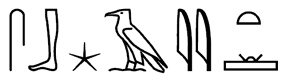
"sbAiit"
: written teachings
(For) acting with Maat
he {the wise} is free of falsehood.
Epilogue, line 440
The sign of the Star (N14) after
"sb" is the triliteral "sbA", the word for "star"
("seba"). This hieroglyph, which covered the ceilings of the tomb of
Pharaoh Unis and his successors, has "quintessential" associations (it
represents a pentagram) : the quaternio of the elemental division is transcended
by a "fifth element" embracing simultaneously the best of the
quaternio united. This was associated with the "imperishable"
circumpolar Northern stars, which did not rise or set, the light of which was
deemed, in the Old Kingdom, to be the final, celestial & spiritual abode of
Pharaoh. With different determinatives, the root "sbA" means
"door", "teach" or "teaching". As it appears here
("sbAiit"), "written teachings" is the usual translation.
Ptahhotep is clear : through "good discourse", the best of the best
(a teaching about life itself) is transmitted to a son or spiritual heir. That
the latter may be a spiritual heritage put down in writing (a cultural
memorial), is evident, and opens the avenue to understand why the
"written teachings" of Egypt's sapiental literature are "wisdom-teachings".
The fact that they are put in the narrative structure of a monologue spoken by
a father to his son (a characteristic returning in the Corpus Hermeticum),
points to the importance of the actual words spoken by the father. Not only is this a
"good" discourse because it concerns itself with what people ought
to do to live a balanced life (namely Maat), but what is said is said in an
accomplished, excellent way. The words spoken have instrinsic value
because truth & justice operate in them. Their command is accomplished
and so they (at least) linger on in the memory of those who heared them. It is
clear that this aspect of the wisdom-teaching is in accord with the
Memphite
theology as well as with the
verbal philosophy
found in all periods. In that sense, we may read the wisdom-teachings as the
concrete application of the "authoritative command" by non-royal
scribes, priests & aristocrats. Excellent speech creates.
Egyptian sapiental education was based on hearing this excellent discourse. To hear,
was to let the Ka of the words enter one's "inner
being", allowing one to make (if hearing was accomplished) a perfect copy of
what was heard and so to reproduce it. Indeed, if
excellent discourse is written down, the process of "hearing"
becomes that of "reading" or "reciting". This first step,
eventually made the hearer an artisan able to copy the masterplan and
comprehend it, but without a plan of
his own.
Moreover, hearing (reading) alone is of no avail. Only because of
the commanding excellence of what is said (written), will hearing
(reading) have a
lasting effect on the hearer (reader). The excellent discourse is not a passive activity.
It is the result of many long years of service (to other people, Pharaoh
foremost) and the long and perpetuated exercise of the good example in various
contexts of life (cf. the vignettes offered as "maxims"). The Good
Discourse offers a variety of such archetypal situations. They enable the
master-hearer & good listener to grasp the "act of Maat" which
they represent. They are excellent examples of ways to circulate vital energy
(Ka) in harmony with the plumb-line of the balance of truth & justice.
Eventually, this leads to the "silence" of the wise, the refusal to
engage in a contra-productive waste of vital energy, protecting oneself by
bouncing back Sethean ignorance and pretence, solidly anchored in doing Maat for life itself.
The "just speech" is "commanding", but not described as
"Hu", the "authoritative, great speech" of Pharaoh.
Indeed, the former is at the service of the latter. Nevertheless, insofar as
the uprightness of what is said (or written) is based on Maat, the extent of
the "command" offered to just speech is not small, and is described
in judicial and administrative terms (great ones, masters, judges,
magistrates).
According to Assmann (1999, p.27), it is
precisely in the discourses that the true structure of this "compact
concept" of justice & truth may be revealed. Is the image of the balance adequate to
ascertain how to "apply" Maat in everything, good discourse
included ? For is it not in court that truth must be spoken ? The judges must
listen and be
impartial, the witnesses must describe precisely everything as it has happened
and the
accused must defend himself using excellent speech, confessing that no crime
has been done and purging himself from all possible heaviness of heart.
Maat
as Sophia

"No
one is born wise."
Prologue, line 33
|
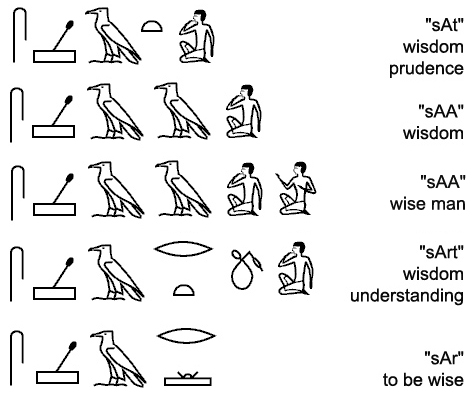 |
Words for wisdom like "sAt,
"sAA", "sArt" and "be wise"
("sAr") may help us find out what
kind of knowledge was given. Other Egyptian words suggest that the wise was viewed as competent,
able & sincere of heart, endowed with skilled knowledge, learned and
cunning.
Indeed, the wise in particular was able to circulate Maat and
assure the proper balance of creation and man in it.
The wise is
literally present in the Maxims, and we could see in him the
"ideal man" of the Old Kingdom, devoted to Pharaoh and peace,
lacking all martial "virtues". |
In the Old Kingdom, wisdom-teachings were primarily aristocratic, but non-royal. They became
"middle class" in the Middle Kingdom, when a new
"ideal man" was proposed, one with a soul. The Old Kingdom
instructions have the ambiance of the way of life of the Old Kingdom.
They reflect a
state which is unified, serene, orderly & optimistic. The
state (Pharaoh & the temple services) was in harmony with
itself. The instructions embody the pragmatical wisdom of
the upper-class Egyptian, and promote the code of the Old
Kingdom nobleman, belonging to the wealthy class, initiated in the temple service, able to read & write and part of the administration
of Pharoah, like local governors, high priests, members of court
or Pharaoh's family. The Maxims tell us a
great deal about this.
In the Epilogue, we read :
(429)
If
a good example is set by him who leads,
(430)
he
will be beneficient for ever,
(431)
(and)
his
wisdom will be for all time.
(432)
He
who knows, feeds his Ba with what endures,
(433)
so
that it is happy with him on earth.
(434)
He
who knows is known by his wisdom,
(435)
(and)
the great by his good actions.
(436)
(That)
his heart twines his tongue,
(437)
(and)
his lips (be) precise when he speaks.
(438)
That
his eyes see !
(439)
That
his ears be pleased to hear what profits his son.
(440)
(For)
acting with Maat, he is free of falsehood.
The context here, is the transmission of vital
information concerning Maat by means of the good example. This example is
also a discourse by those who "know", i.e. the wise. They are known
because they are able to observe, hear, listen, say & do the proper,
correct, right thing at the right time. They focus on their "son",
or spiritual heir (their "Magnum Opus") and try to see and hear that
which may help them in their transmission of their wisdom to posterity.
The wise transmit this most subtle of cultural forms and their heart
& tongue is entirely devoted to that cause. Because they act in accord
with Maat, no falsehood can enslave them.
Furthermore, although the wise is a master-hearer, he is foremost a listener.
He listened (as a son) to his father, and was taught how the teach his own son
to be a hearer. He spoke the excellend discourse. Eventually, his own son surpassed him as he surpassed his father. This structure will remain
typical for sapiental discourses and it will return in Alexandria, in Jewish teachings and
in nearly all Greek philosophical schools (also named after their founder).
3.2 The hermeneutics of the Weighing Scene.
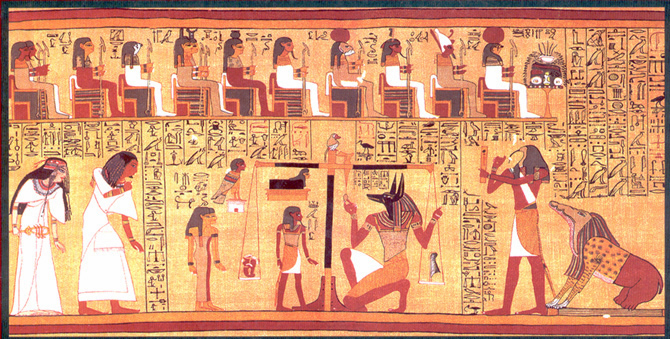
Papyrus of Ani, Plate 3 - XXVIIIth Dynasty
|
TRANSLATION
(the hieroglyphs start above the "meskhen" and face
right) :
"Osiris, the scribe Ani, said : 'O my heart which I had from my
mother ! O my
heart which I had from mother ! O my heart of my different ages ! May there be nothing
to resist me at the judgment. May there be no opposition to me from the
assessors. May there be no parting of You from me in the presence of
him who keeps the scales ! You are my Ka within my body, which
formed and strengthened my limbs. May You come forth to the place of
happiness whereto I advance. May the entourage not cause my name to
stink, and may no lies be spoken against me in the presence of the god
! It is indeed well that You should hear !'"
(Anubis watches a small text-line facing left) :
"Said he that is in the tomb : 'Pay attention to the decision of
truth and the plummet of the balance, according to its stance !'"
(the second part starts just above the right-hand beam of the balance,
faced by the Baboon", hieroglyphs facing left) :
"Said Thoth, the righteous judge, to the
Great Ennead, which is in the presence of Osiris : 'Hear ye, this
decision, in very truth ! The heart of Osiris has been weighed and his
Ba stands as a witness for him. His deeds are righteous in the Great
Balance, and no sin had been found in him. He did not diminish the
offerings in the temples, he did not destroy what had been made, he
did not go about with deceitful speech while he was on earth.'"
(the third large section starts in the far right corner, facing right)
:
"Said the Great Ennead of Thoth, who is in
Hermopolis : 'That which comes forth from your mouth is true. The
vindicated Osiris, the scribe Ani, is righteous. He has no sin, there
is no accusation against him before us. Amemet {the eater of the dead,
executing the second death} shall not be permitted to have power over
him. Let there be given to him the offerings which are issued in the
presence of Osiris, and may a grant of land be establised in the
Sekhet-Hetepu {the Field of Offerings} like for the followers of
Horus.'"
|
In this famous scene from the Papyrus of Ani, Ani and his wife enter the Hall of the Double Law or Double Truth
(divine versus human - good versus evil - eternal life versus second death,
etc.) to have Ani's heart, emblematic of conscience, weighed against the Feather of
Maat, emblematic of truth & justice.
On the left of the balance, facing Anubis, stands Ani's
"Shay" ("SAii") or "Destiny". Above Ani's Destiny is an object
called "meskhen" ("msxn"), a cubit with a human head
connected with Ani's place of birth. Behind Shay stand
"Meskhenet", presiding over the birth-chamber, and
"Renenet", guiding the rearing of children and called (in the Litany
of Re) "Lady of Justification". Above them (behind the
"meskhen") is the Ba of Ani in the form of a human-headed bird
standing on a pylon. This left side summarized the various elements which
together constituted Ani's life on earth :
-
where he was born (nature)
and how he was raised (nurture) ;
-
the destiny allotted to him
: "what is
fated" (Ptahhotep - Maxims 12 & 33 - Amenemope, chapter 7)
: Shay is also the god of the span of years and the prosperity that one
may expect to enjoy - note that the "meskhen" floats above Ani's
destiny (indeed, where one was born influenced one's destiny) ;
-
Ani's heart : the epicentre
of the whole scene, symbolizing Ani's thoughts, intentions and conscience
during his lifetime on earth ;
-
Ani's Ba : during his
lifetime, his soul was captured by the "net of the body" and it
made Ani happy if he invested in enduring thoughts & deeds - after the
mummification of the body, the Ba existed in a "spiritual body"
(the "sah") and witnessed the weighing, of which the final
direction of the lower constitutents of Ani depended (either a second
death or a vindication).
On the right of the balance, the left arm of Anubis is
above Maat's Feather (his tumb pointing to the words "the heart of
Osiris has been weighed") while his right hand touches the plumb bob or plummet
of the balance (at the end of the plumb-line).
On the centre of the beam of the balance sits a dog-headed ape (Baboon),
facing Thoth the recorder (who stands at Anubis' right side with the Monster of the
Netherworld behind him). Beneath the
right beam we find these words (spoken by Anubis, watching the
pumb-line) :
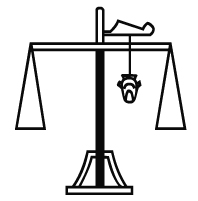
Said he that is in the tomb :
'Pay attention to the decision of
truth
and the plummet of the balance, according to its stance !'
I conjecture that this exhortation
summarizes the practice of wisdom found in Ancient Egypt,
as well as their philosophy of well-being and art of living happily &
light-heartedly (for the outcome of the weighing is determined by the
condition of the heart alone). In this short sentence, the "practical
method" of the Ancient Egyptians springs to the fore : concentration,
observation, quantification (analysis, spatiotemporal flow, measurements)
& recording (fixating) with the sole purpose of rebalancing,
reequilibrating & correcting concrete states of affairs, using the
plumb-line of the various equilibria in which these actual aggregates of
events are dynamically -scale-wise- involved, causing Maat to be done for
them and their environments and the proper Ka, at peace with itself, to flow
between all vital parts of creation. The "logic" behind this
operation involves four rules :
-
inversion
: when a concept is introduced, its opposite is also invoked (the
two scale of the balance) ;
-
asymmetry
: flow is the outcome of inequality (the feather-scale of the
balance is a priori correct) ;
-
reciprocity
: the two sides of everything interact and are interdependent (the
beam of the balance) ;
-
multiplicity-in-oneness
: the possibilities between every pair are measured by one standard
(the plummet).
Above, in another register, are twelve gods, upon thrones before a table of
offerings of fruit, flowers, etc. Their names : Harmachis ("the great one
within his boat"), Atum, Shu, Tefnut ("lady of the sky"), Geb,
Nut, Isis, Nephthys, Horus ("the great god"), Hathor ("lady of
Amenta"), Hu and Sia. In a way, they represent the heavenly bliss
awaiting the justified. Whether this final goal will be attained, will be
decided in this Hall of Truth.
Other visual dispositions of the same concept may be found, but the vignette of the Papyrus of Ani
outweighs them all qua beauty & excellence :
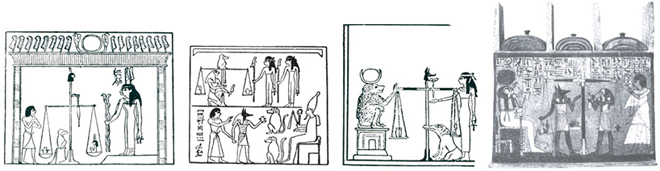
Papyrus BM 9901, Papyrus BM 10.472, Papyrus of
Qenna ,
Wooden Ushabti Box
The central emblem is Maat's
Feather. It represents the standard of truth & justice immanent in
creation, but also the truth of the declaration of innocence made by the
deceased (Plate 31) before the tribunal of assessors (the hieroglyph for
"not" is in red), and thus by virtue of the rule of
"reversal", a "purging" of possible past crimes. Three
offences are repeated in the Judgment Scene :
-
never to diminish the
offerings made to the temples (against the pantheon & the people) ;
-
never to destroy what had
been made (against the memorial of the ancestors) ;
-
never to speak deceitfully
(against truth & righteousness).
Wat does the text give us ? It
starts with Ani invoking his own conscience but also his mother, from whom he
received his heart (cf. the major role of woman in nurture, but also as
representing the sacred "matrix" of life). We also learn that his
heart was linked with the Ka "within the body", the vital power that
made and sustained one's stride. Next, Anubis weighs Ani's heart against the
divine standard (the Feather) and Thoth confirms that no sin is found and that
the equilibrium of the Great Balance is established. Finally, the Ogdoad of
Hermopolis (headed by Thoth), confirms the sentence spoken and recorded by
Thoth and it is they -the chaos-gods- who lift the curse of the Monster or
Ani's "second death". Instead of being annihilated, Ani will be
allowed to enter the kingdom of Osiris because he is "maa-cheru"
("mAa - xrw"), i.e. vindicated, justified, triumphant !
What was the meaning of this afterlife scene to those still alive ? The
importance given to the heart could not be missed : it is a person's
conscience, determined by what he said (wrote) and did (how he lived), which
was deemed crucial. As Ptahhotep taught, just speech is the heart of a wise
transference of the best of the past to the best of today for the sake of the
future (so that the memorial of the ancestors remains), as well as of the
continuous progress made over the generations. If we study Egypt's sapiental
literature, we do not encounter the notion that a person may be
vindicated during his or her lifetime on earth. On the contrary, in the Old
Kingdom, a non-royal could only hope to endure without being immortalized. The
sage was always in the process of attaining the state of veneration,
except when his vital force left his physical vehicle. Then and only then
could veneration be a final station (a terminus). Although since the Middle Kingdom,
deceased commoners could be immortalized and deified as "Osiris-NN",
nobody attained this state during his or her lifetime. Only Pharaoh was a
living god on earth. Hence, even during his lifetime, Pharaoh was
"justified", for he "lived in Maat".
The weighing procedure invoked in this scene, is -ex hypothesi- not restricted
to the afterlife (were it appears as the final "balance-sheet" of
the deceased). The sapiental discourses make it clear that in
every situation, the Egyptian wise seeks to do Maat, and does it by
"measuring" the scale of the imbalance in order to restore
the Eye and bring it to the forehead (i.e. realize a "tertium
comparationis"). This to harmonize life and end strife in Pharaoh's name,
he who guaranteed the unity of the Two Lands by returning Maat as
voice-offering to his father Re. First comes a careful, concrete investigation of what is at hand,
in order to discover its "balance", i.e. the two factors
which allow the "Ka" to flow (from high to low) and animate the given
context. Next there is the restoration by striking the "nil", the true balancing-point of the beam, arrived
at when the difference between the two weights is naught. Indeed, the sinuous
waters go up and down and when this flood equilibrates (not too much and not
too little), the inundation is perfect and the surplus large. The wise
has always enough reserves to compensate for any imbalance ... At the
balancing-point, Maat is brought to the nose of Atum ...
The wise of Ancient Egypt made the poise of the balance of truth & justice
rest upon the vastness of the non-equilibrium (chaos) which constantly
treatened the survival of the cosmos. He knew that this reclaiming of life by
death is of no avail if at every movement of the rudder, the boatman knows how
to balance the bark and master the waters, whether he be travelling on
earth or on the Nile of the netherworld. His commanding excellence made his
bark float upon the chaotic ocean. His just word was the primodial hill, or the
emergence of order out of chaos and the making of the beam of the balance
that kept the two scales together and separated, allowing one to
"walk upon the waters", using the surface-tensions of their chaos itself ...
3.3 Hearing versus listening, ignorance versus wisdom.
The fundamental categories of Memphite philosophy
were "heart/tongue/heart" insofar as
theo-cosmology,
logoism and
magic were at hand
and "hearing/listening/hearing" in moral, anthropological,
didactical and political matters. The first category reflected the excellence
of the active and outer (the father), the second the perfection of the passive
and inner (the son). The active polarity was linked with Pharaoh's "great
speech", which was an "authoritative utterance" and a
"creative command", which no counter-force could stop. The passive
polarity was nursed by the intimacy of the teacher/pupil relationship, based
on the subtle and far-reaching encounters of excellent discourse with a
perfected hearing, i.e. true listening.
The "locus" of Egyptian
wisdom was this intimacy. Although Pharaoh was also called "wise", the
sapiental discourses alone name their (possible) author. Wisdom was always
linked with a "niche" defined by the vignettes of life the sage
wished to use as good examples to confer his wisdom to posterity, to
understand how he balanced Maat in all circumstances and made the social
order endure by serving "the great house", being at peace with himself.
Maat
as Cosmic Logos |
|
Tongue |
Heart
|
|
words as physical
manifestations of what is conceived by the heart - the material cause
of creation and excellent discourse |
thought as the efficient cause of words - the
immaterial cause of creation and excellent discourse - seat of personality
and free will
|
|
Maat
as Social Order |
|
Hearing |
Listening
|
|
the material entrance of
sound in the healthy ear - the comprehension of the meaning of what is
said - the ability to reproduce what has been said without
"inner" understanding |
to grasp the intent, possible hidden implications and
"Ka" of what was perfectly heard - to listen with the heart is
to truly understand the message with one's "inner being"
|
In the Maxims, there are
no grammatical criteria to establish whether the author uses the verb
"sedjem" ("sDm") as "to hear" or as "to
listen". Although is some cases, variations occur which could indicate
"listen", in other cases "sDm" appears when the context
suggest "listening". Hence, only the context may reveal the
distinction.
Let us enumerate them (following the order of the text were they occur) :
(024) the judge is an archetype of listening;
(031) A speaks to B and B hears A ;
(040) as the Epilogue makes clear, hearing
the good discourse is already beneficial ;
(062) those who heard what happened will be
talking about it ;
(212) the one who is pleading speaks to the one
who hears ;
(220) to hear what a person in distress has to
say helps that person to calm down ;
(281) one should not let what the hot-bellied has
to say enter one's ear ;
(283) direct observation is preferred over
testimonial evidence ;
(336) the Ka is the subtle vehicle of vital
energy linked with the heart and listening ;
(366) before the ear is touched by what You have
to say ;
It is in his Epilogue, called a "fugue" on "sDm" (Assmann,
1999), that Ptahhotep makes use of both meanings in identical contexts,
allowing one to discern between the receptive (hearing) and reflective
(listening) modes of the passive side of the polarity. I must add, that Zába,
Lichtheim, Assmann, Brunner & Jacq give different solutions :
(416) - (440) "hearing" alone
Ptahhotep describes how hearing these wisdom-sayings makes every plan go
forward. The act of making these teachings available is beneficial. It is the
best memorial possible as well as a tribute to the ancestors of truth &
justice, who's words, in the end, will always prevail. The words of the
sayings accomplish Maat "de opere operato", i.e. as would
"Hw", authoritative speech (cf.
magic). One
only needs to "hear" (read) to already experience their rebalancing
effect ... So, that the ears "be pleased" for what enters them, i.e.
what they "hear".
(441 - 449) introducing the difference between
"hearing" and "listening"
Useful (luminous) & splendid is listening to one who hears. By entering
the ears, words are heard. After hearing is perfected (a master-hearer who is an
artisan of reception & reproduction), the hearer may "listen
with his heart" or "inner being" and do more than only hear. Only listeners are able to surpass the limits of what they heard
and hence move beyond the mere recitation of what they heard. The good
discourse is a creative one, for speaking well adds something to the
traditions one heard. Listening focusses on what is good, excellent &
accomplished. To one who hears, it is splendid because it adds a new dimension
: the manifestation of what is good, namely perfect love. So, when the good
son "grasps" his father's words, he did more than just hear spoken
words and comprehend them, he "read" them as living good examples
of doing Maat. Then the sayings of the ancestors become so many memorial
sign-posts pointing to Maat and the ongoing process of balancing-out
according to the "Great Balance". Hearing is beneficial but
listening is a good old age. The latter only depends on the condition of
one's heart ... (greedy materialists have no tomb).
(450 - 502) the difference between "a
listener" and a "non-listener" : the wise versus the fool
The distinction between "listener" and "non-listener" is
pertinent : the former is loved by god, the latter hated. As we already know,
it is the "heart" which decides what will be the case, not the
"ears". Human freedom is made explicit. The fool decided not
to listen. He who knows, i.e. the wise, always listens. Ptahhotep points out
that the natural state of man's heart is positive and constructive : life,
prosperity & health ! So, the fool is a product of his own choice.
Death, poverty and sickness (the injured Eye), which are his every day, are
the outcome of neglecting the plummet. These defects ought not to be
(normative) but just are because people made & continue to make wrong
choices, causing the scale to flip to one extreme of the spectrum of possible
balancing states. They do not restore the Eye, and so never acquire the
"third Eye" that always watches the plumb-line.
Of course, there is no listening without hearing (it is the hearer who listens
to what is said). Moreover, the listener speaks well (is master of what is
good) and does what is said (the hearer benefits too, but this does not
necessarily mean that he will change his mind or way of life).
The ultimate realization for a son is to hear his father say that he is a master
of listening. Note that Ptahhotep points out that one may teach one's son to
be a hearer, but never to be a listener. The latter depends on the heart of
the son and can only be affirmed by those nobles who listened to the words of
the son and observed his excellent deeds.
If hearing these wisdom-teachings is beneficial, then refusing to listen to
them (the way of the insane) is like inviting failure & error. Those who
listen not, go astray and are left with a Ka turned to itself, leading to
frustration, loneliness and the depletion of one's vitality (death). Such a
person is a fool and will accomplish nothing, exist as a "living
dead" with many daily troubles ... The fool, the carrier of evil, is
easily recognized, and so people who see and hear such an erratic occupied,
immediately say : "Evil as we expected from him !". Because they
understand his way, nothing of that foolishness can undermine their stability,
equipoise, serenity and detachment.
Indeed, he who listens, is a Follower of Horus and because he listens all goes
well. He was a son, but today he is a father who teaches his own son.
(507) Behold ! Be aware ! Focus attention ! Open your ears ! Hear !
(507) in the mouth of the judges, nobles, magistrates and other great ones who
listen ;
(515) those who heard the words "He is a son !"
(519) those who heard the elevated things spoken.
The following "order" may be derived :
-
hearer
: one who opens his ears to invite the meaning of the words spoken
- the ears are pleased to hear what profits the didactical purpose of the
good discourse, the accomplished transmission of the commanding words of
wisdom - the hearer directs his attention consciously and so
"hearing" is clearly a level higher than registering without the effort
to comprehend ;
-
master-hearer
: the one who immediately comprehends the meaning and can reproduce
it - this leads to listening if the heart desires so ;
-
listener
: one who opened his heart to invite the "inner" meaning
of the totality of what he heard - one able to recognize the excellence of
the good discourse in the words & deeds of those who heard &
listened to them (i.e. a perfect son) - note that he who listens is loved
by god ;
-
master-listener
: one who listened so well that he surpassed the teachings of his
own father and is able to do great, excellent deeds and speak the
accomplished discourse ;
-
venerable
: when old age has arrived, the master-listener (while alive)
enjoys constantly doing Maat and his inner state contrasts with the
defects described in the Prologue. Indeed, our author wants to make us
believe that -although lacking memory- Ptahhotep was 110 when he spoke
this accomplished discourse !
|