| |

Studies
in
Buddhadharma
Introduction
 Contents
  SiteMap

"As the wise test gold by
burning, cutting and rubbing it (on a piece of touchstone), so are You to
accept my words after examining them and not merely out of regard for me."
-
Jñânasara-samuccaya, 31.
The First Turning the
Wheel of Dharma
The Second Turning the
Wheel of Dharma
The Third Turning the
Wheel of Dharma
The Fourth Turning the
Wheel of Dharma
The Unique Buddhadharma
The Necessity to Accumulate
Merit
The Illusion of Inherent
Existence
Western
Criticism
& Process Philosophy
|
|
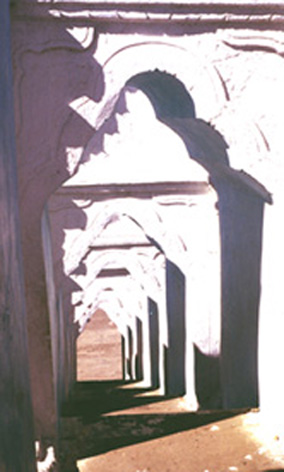
Mandalay -
Myanmar (Burma). |
|
|
As
wisdom is the primary concern of
the
Buddhadharma,
the teachings of
Buddha
Śâkyamuni, these studies aim to point out the
concept (theory) & yoga (praxis) of "śûnyatâ",
translated as "emptiness". The latter is not "voidness" or sheer
nothingness (the empty set), as in nihilism, but the mere indication of an absence,
of something not being there, namely a truly established or
inherently existing object. This absence does not imply something
does not exist, it merely points out substantial entities do not. The yoga of emptiness of the Śûnyavâda is always preceded
by generating a pliant mind, i.e. a compassionate mind able to rest
in equipoise on its object.
Each view on emptiness yields accepted
conclusions (or tenets). Those prevalent in Tibetan
scholasticism form a ladder of greater & greater denial of "true
establishment", another word for self-powered substances (essences),
objects with properties as it were inhering in them. The lowest
tenets accept inherent existence. The higher deny it in varying
degrees. Study of & reflection on these tenets assist the progressive stages of meditation on
emptiness. Each stage, when fully integrated, prepares the mind for the
next.
• Great Exposition : all phenomena,
both compounded (conventional) & uncompounded (ultimate), exist
inherently ;
• Sûtra School : present minute
particles & moments of consciousness have self-nature or are
self-powered ;
• Mind-Only : consciousness lacking
apprehended-object & apprehended-subject is a self, has nature ;
• Middle Way : in the Autonomy School
(Svâtantrika), conventional phenomena exist inherently, while in the
Consequence School (Prâsangika), all phenomena lack true
establishment, and so no object has self-nature or is truly
(absolutely) established. Logically, the Prâsangika is the highest view.
The idea a higher tenet exists, namely other-emptiness, is rejected
on logical grounds, but cannot be denied its place in terms of the
direct experience of emptiness. Philosophically, self-emptiness is
supreme, but in terms of experience other-emptiness is to be
preferred.
This ladder designates an increasingly
vaster perspective on the subject. In each, the core question answered
is : What is truly established ? Or : What exists by way of its own
character ? What is independent from everything else ? |
The Mahâyâna
Mind-Only School introduced the pedagogic scheme of the
"Three Turnings". When
Buddhist Tantra became academic (in the 7th century
CE), a "Fourth Turning" was added ... These Turnings organized the various
teachings, some of which were considered "definitive" (directly
revealing the Moon) and others
"provisional" (a finger indirectly pointing at the Moon).
The different "turnings" are said to
represent various levels of the teachings, and therefore call for
different audiences. Together, they constitute the "84.000 Dharma Doors".
For all schools, the First Turning is provisional. In the Middle Way
Consequence School, the Second Turning is definitive and the Third Turning
provisional. For the Nyingmapas, Kagyus & Jonangpas (Other-Emptiness),
both Second & Third Turnings are definitive.
The First Turning of the Wheel of Dharma
In the traditional accounts, Śâkyamuni
was welcomed in the royal deer park near Vârânasî by the group of five
ascetics who earlier had turned their backs on him for having rejected the
path of austerities. He proclaimed himself a "Tathâgata", a
word etymologically meaning "a speaker of the Truth", but also "one who
has attained what is really so" or "one who is thus gone" etc. He gave his
First Sermon, called "Setting in Motion the Wheel of the Dharma".
This First Turning of the Wheel of Dharma contained his core teachings : the
Four Noble Truths, the
Eightfold Path
& the Two Truths.
These are the
foundation of the entire Buddhadharma, the
Hînayâna (Tripitaka),
as well as the
Mâhayâna, both
Sûtras &
Tantras.
The Second Turning of the Wheel of Dharma
In his Second Turning of the Wheel of Dharma, Buddha
introduced his famous "anâtman" or "no-self" as well
as the importance of compassion.
Selflessness is empty
of "self", absence of "own-form" ("svabhâva").
It negates the idea objects possess
a core essence or "nature" from their
own side, inherently, substantially. It affirms process and by doing so
brings the absence of substance to bare. The true self is therefore the
non-self. The core of the self is selflessness.
To understand these teaching on "śûnyatâ",
emptiness, the ultimate reality, numerous tenet-systems developed,
differing on the definition of emptiness, the ultimate truth.
Emptiness has two sides
: philosophical & yogic :
-
philosophy affirms reason, uses concepts to eliminate
reified concepts, and finally tries to nullify the cognitive act of designating or
labeling inherent existence itself. This is like approaching enlightenment from "the outside",
objectively and in accord with epistemology. It is preparing the vision
without spoiling it by trying to describe it. The philosophers gave rise to
"Sûtra Mâdhyamaka" and its two branches : the Autonomy School & the
Consequence School
;
-
yoga transcends reason, develops direct, non-conceptual experience
of emptiness from
"the inside" and so manifests the transcendent or
supramundane. Middle Way yogis are "Yogâcâra Mâdhayamikas", accepting
self-emptiness, except for a consciousness lacking
apprehended-object & apprehended-subject. They come close to "Tantra
Mâdhyamaka", stressing primordial wisdom as the union of clarity-emptiness
& bliss-emptiness. They are also found in the Other-Emptiness School
and in Mahâsandhi (Dzogchen).
The conceptual (logical, reasonable) and the non-conceptual
(para-logical, experiential) are the two fundamental answers to the
questions addressed by the emptiness-teachings of the Second Turning : What is the ultimate nature of reality ?
What is truly establised ? How to think the
Two Truths ? However, before engaging
the poetry of direct experience, the ways of reason first need to be exhausted.
"Emptiness" is understood in terms of the Middle
Way Consequence School, the Prâsangika-Mâdhyamaka, in casu :
-
Nâgârjuna (2th CE) in
Mûlamadhyamakakârikâ (A Fundamental Treatise on the Middle Way) &
Shûnyatâsaptatikârikânâma (Seventy Stanzas on Emptiness)
;
-
Chandrakîrti (ca. 600 – 650) in his Mâdhyamakâvatâra
(Entering the Middle Way) &
-
Śântideva (8th CE) in his Bodhicharyâvatâra (A
Guide to the Bodhisattva's Way of Life) ;
-
Atiśa (ca. 982 - 1054) in
his Bodhipathapradîpa ;
-
Tsongkhapa (1357 - 1419)
in his The Great
Treatise on the Stages of the Path to Enlightenment, The Ocean of Reasoning
and The Essence of Eloquence.
To characterize scientific knowledge,
Western Criticism will also be taken into account, in casu Kant (1724 - 1804)
of
the Critique of Pure Reason as well as
process metaphysics.
My studies set off by endorsing the view on emptiness of
the Prâsangika-Mâdhyamika or "Rangtong" Mâdhyamikas, the rationalists & strict
nominalists found in the Sakya & Gelug schools of Tibetan
Buddhism. They back the philosophical approach, stressing study &
reflection based on logic & debate. Here, emptiness, the ultimate nature of phenomena, is
defined as
absence of inherent existence. This is the exclusion negation, or
non-affirmative negation.
For Rangtong, ultimate analysis affirms
all phenomena, including the "noumenon" of Buddhahood, or
wisdom-mind apprehending its object, to be
"empty of self", i.e. empty of inherent existence. Hence,
Buddhas do not exist "from their own side", nor does their Truth Body or
"Dharmakâya" ! As all phenomena (the ultimate included) are of
the same ultimate
nature, there is nowhere any ontological "split". To clarify
its view, the
Rangtong often debates with the Mind-Only School, the so-called
"Yogâcârin School", "the practice of yoga school",
with idealist Mâdhyamikas like Gorampa and at times with
Dzogchen
& Jonang masters (cf. other-emptiness). These operate on the
basis of a choice negation, eliminating the defilements of the mind
to bring inherent Buddha-qualities to the fore.
In ultimate analysis, the moment of consciousness following the last
ultimate nullification of false ideations cannot be conceptually or
linguistically characterized. The difficulty of appreciating the
mind of Clear Light is related to the structure of our language, not
permitting a transitive verb without a subject and a predicate.
There is no "knowing" without a knower and a known. But this is
merely grammatical convention. In the expression "the Sun rose" on
may realize that it is the Sun that is rising ...
When concepts have cleared all reified concepts, silenced the mind
and brought awareness to what is at hand,
nothing
remains to be said. What happens next is sheer un-saying, ineffable for
ever. This can only be approached with poetry. The transcendent state of enlightenment (awakening) can be personally
experienced, but not conceptually known or linguistically described
from the outside, while the person actually experiencing it from
the inside cannot describe it in empirico-formal propositions, but only
point to it. He or she can transform this inner experience into
living compassion. As art, this knowledge is excellent, exemplaric &
sublime.
Because of this critical
barrier, strict nominalism affirms nothing about the absolute,
except it too lacks inherent existence, own-form ("svabhâva") or
"self" ("âtman"). Buddhahood too is a dependent-arising, albeit one
continuing for ever, a permanent dynamic or "perpetuum
mobile" !
The
Third Turning of the Wheel of Dharma
Once the compassionate mind conceptually understands the
logic, rationality & philosophy of emptiness, the Third Turning of the Wheel of Dharma
presents the yogic generation
of the qualities of the Buddha-potential or Buddha-nature ("tathâgatagarbha") of sentient beings. For the philosophers,
bound to the Second Turning, the potential cannot be a full-blown nature,
while for yogis, all enlightened qualities are found to be already present but merely
covered by adventitious, accidental material. The fact this Fourth Turning
comes after the Second Turning, indicates the failure of a mere conceptual
analysis at this level.
Several yogic traditions emerged as a result of the Third Turning : Yogâcâra Mâdhayamikas
posit a consciousness lacking apprehended-object as well as
apprehended-subject. Tantric Mâdhyamikas affirm the unity of clarity(bliss)-emptiness.
Shentong or other-emptiness, affirms primordial, ever existing
Buddha-qualities of enlightened mind, speech, mind & action. In Dzogchen, the inseparability of clarity & the
empty primordial base is affirmed.
In the yogic tradition of
"Mahâ-Mâdhyamaka", "Great Mâdhyamaka", "Shentong"
(actually "Zhentong") Mâdhyamaka
or "other-emptiness",
found in the Nyingma,
Kagyu & Jonang schools of Tibetan Buddhism, meditative experience or "yogic
perceivers" are central. Shentong is explained in the Mountain Doctrine of Dolpopa (1292
- 1391), in the The Essence of Other-Emptiness &
Twenty-one Differences Regarding the Profound Meaning of Târanâtha
(1576 - 1634).
In Shentong, teaching extrinsic emptiness,
emptiness is affirmed as the
non-conceptual, primordially existent wisdom-mind, empty of contingent
stains, endowed with the full spectrum of Buddhahood, i.e. non-empty of
the vast Buddha qualities of enlightened body, speech, mind & actions.
This is a choice negation, nullifying the accidents and affirming
enlightened qualities. Shentong posits the power, energy & wisdom of our Buddha-nature,
ever-discovering the full array of the natural, fundamental (most subtle)
qualities of mind ; the Clear Light shining forth unobstructedly after the
temporary defilements and obscurations have been removed through practice.
Our Buddha-nature or "matrix-of-One-Gone-Thus" is naturally &
inherently radiant
& pure. It possesses the thirty-two marks of a Buddha and abides in all sentient beings. "Empty of others" ("zhentong"), it
just
exists ! Shentong seems to take position from the side of Buddhahood,
defining all the rest as sheer illusion. This existence is a continuous symmetry-transformation or
unique & perfect enlightened wisdom-stream, dance or kinetography.
According to Dolpopa, the view of other-emptiness is the
ultimate tenet, surpassing all others, including the self-emptiness of the
Consequence School. The latter is
deemed the "Ordinary Middle Way". But for Rangtong, this
other-emptiness is the worse kind of heresy, causing a fundamental
hierarchy to arise between conventional and ultimate truth (akin to the
Platonic divide between the true word of being and the illusionary world
of becoming). For Rangtong, there is no tenet higher than the Consequence
School, in particular Tsongkhapa's Critical Mâdhyamaka. They invite
all arguments to the contrary. They claim Shentong affirms
Buddha-nature to be substantial.
Rangtong, Shentong & Dzogchen entertain different views on the
Two Truths.
For Tsongkhapa, duality is not seen as a problem, for to
realize Buddhahood there must be a cognitive act directly
knowing emptiness. Buddha-qualities are deemed generated by a such a
mind. The target here is reification, not the distinction between a
subject & an object of experience. In
Dzogchen,
ultimate truth is non-conceptual and duality is done away with.
For Tsongkhapa, the mind of a Buddha has knowledge of both
relative & ultimate objects simultaneously, while in the Great
Perfection all virtuous qualities & powers of Buddhahood
are contained within the One Truth from the very beginning.
As Dzogchen does not, as in other-emptiness, deny self-emptiness, nor conceptually
designates anything to
be inherently existent, it should not be equated with Shentong with
which it nevertheless can be confused. Once the idea of emptiness as
absence of inherent existence is firmly established, these subtle distinctions
will become clearer.
Can it be shown how these Second (Negating) & Third (Affirming)
Turnings can be made of "one taste", i.e. compatible & harmonious
?
The differences between Rangtong & Shentong will assist in doing so.
What is primordially & spontaneously established
(our Buddha-potential) lacks inherent existence, is "empty" of "self"
("own-form") and so is ultimately self-void (as the Prâsangika-Mâdhyamaka
rightly claims).
This is its ultimate base, its "body of truth" or "Dharmakâya".
Attributing Buddha-qualities to a mere potential is like trying to
eat an appel by swallowing the seed of the tree. Clearing the mind
from substantial instantiation generates Buddha-qualities. A mere
potential needs effort to actualize. Emptiness yoga is the spiritual
exercise doing so. What is primordial (Buddha-potential) is devoid
of existing truly and inherently (as a substance), but at the same time is devoid of
what is coarse and fleeting and devoid of being itself coarse and fleeting
(as Shentong affirms). This is combining self-void and other-void. This
combines the best of both views.
Absence of inherent existence is indeed "all the way up" !
In Shentong, Buddha-nature, like anything else, does not exist from its
own side. But lacking stains, this ultimate truth and absolute reality
is "empty"
of "other" fleeting, evanescent phenomena or other-void. When,
thanks to yoga, the
contaminations are voided, nullified or annihilated, the stainless Clear Light, the natural light
of the mind shines forth. Although in strict Mâdhyamaka logic, this cannot
be conceptually affirmed (for only a non-affirming nullification of
"own-form" will do), Shentong designates, contrary to consequent
rational thinking, the radiant, inherent qualities or "own-form" of our Buddha-nature,
overriding the classical logic of the Prâsangika-Mâdhyamaka with the
testimony of direct yogic
perceivers ! This reminds me of the difference between rational knowledge
and intuitive knowledge in the system of Spinoza (1632 - 1677). The former
works with logic (syllogism and/or the reductio ad absurdum), while
the latter is its own standard (cf. "veritas index sui").
Rangtong, being a spiritual discipline, should not negate the data from
direct yogic experience. Shentong has to accept there is no way around
classical logic.
The
Fourth Turning of the Wheel of Dharma
According to Tantra, the Buddha appeared to a great
assembly of superior Bodhisattvas (those able to "see" emptiness,
perfecting themselves in ten stages) as Vajradhara, the Holder of the
Vajra, the thunderbold or diamond. As a diamond, it cuts any substance,
but cannot be cut itself. As a thunderbolt the Vajra has irresistible
force. Both were deemed necessary in the Dark Age of Kâlî, when evil
rules. Kâlî is the black, horrible tongue of Agni, the god of fire, but
also the grim consort of Śiva. This "Śakti" represents the radical
dissolution & destruction of ignorance, underlining the clear, pristine,
pure Divine awareness of her consort, the god of Hindu Tantras.
Appearing in this collective vision as the Holder of the Vajra, Buddha
Śâkyamuni projected his final teachings directly in the minds of his most
devoted disciples. These superior Bodhisattvas had already realized a
pliant, compassionate mind, exclusively devoted to the benefit of all
sentient beings. If they engaged in this "secret" and "hidden" practice,
they did so because they needed a special technology or skillful means to
realize Buddhahood faster than what the Sûtras offered (i.e. the first
three Turnings) and this despite the vast presence of evil in the world
(and therefore massive hinderances to spiritual emancipation). Indeed,
only as Buddhas do they truly benefit all sentient beings.
To be able to realize these goals, these Bodhisattvas were taught to
incorporate desire into the path and place the fruit (Buddhahood) in the
present moment. This involves a radical change in the coarse, subtle &
very subtle layers of the energy-system defined by the physical body. With
this notion of the "Vajra-body" and its refinement, complex systems of
tantric meditations emerge, emphasizing the unity ("eka") of emptiness
("e-") and bliss ("vam").
The Fourth Turning has been denied any historical significance and viewed
as a buddhological recuperation or superstructuration (effectuated by
early Mahayanists). Buddhist Tantra has been understood as the origin of
Hindu Tantra, and vice versa, which is a more likely account. These
studies want to make clear Indian Tantra (Hindu as well as Buddhist) has
most likely been influenced by Taoism, in particular its Inner Alchemy.
Can these traditions be merged into a coherent ensemble ? Is an
operational system, a new, powerful method the outcome ?
The Unique
Buddhadharma
"Shambhu, Meghavahana, Hiranyagarbha
Anangapati, Damodara, and the other (gods),
All puffed up with self-infatuation,
They roar their Lordship o'er the worlds ;
And yet, before the vision of His Body,
They pale like fireflies in the Sun !
Then down they bow their sparkling diadems,
In reverence to the lotuses of His feet !
I pay homage to that Lord of Sages,
The God of all the gods !"
Tsongkhapa :
The Essence of True Eloquence, prologue
(Shambhu = Śiva, Meghavahana = Indra, Hiranyagarbha = Brahmâ).
With
emptiness, the Buddha introduced a unique
teaching. Without
it, the Buddhadharma would not differ from the traditional six
schools of Indian philosophy, based on the Vedas and Upaniśads, nor from the Abrahamic
faiths, based on revealed texts like the Torah, the New
Testament or the Koran, all unveiling a substantialist
theo-ontology absent in the Buddhayâna. Because of its introduction, the Buddha was able to develop a unique philosophy, drawing a radical
distinction between substantialism & nominalism. This
crucial divide, together with impermanence, suffering & its
cessation, make up the
Four Seals, authenticating any doctrine as part of the Buddhadharma.
The Vedic religion, the
Ancient Egyptian tradition, the Abrahamic monotheisms, the Greco-Romans and,
with only a few exceptions, most of Western
philosophy, are
substantialist (essentialist) to the core, accepting the
objective and independent existence of extra-mental or intra-mental
reality,
either in terms of the world "out there", adding a creational
dimension (the
One God being the cause or Creator of the world), or positing a
subjective ground "in here" (like an immortal soul or "âtman"). By
introducing emptiness, the Buddha thoroughly rejected this ontological approach,
conjecturing radical nominalism long before William of Ockam (ca. 1288 -
1347), Kant (1724 - 1804), neo-Kantianism or contemporary
Criticism
or, more recently,
Process Philosophy.
The substantialist preferences of the West live out the Alexandrian
dream empowering sensate & mental objects with an existence "of
their own", becoming thereby "independent" & "secure", making the
thus
"liberated" own-powered entities part of a mosaic of other self-powered
entities, ruled by a "supreme overlord", eventually an emperor of
the world of sorts, or, in a religious sense, a Supreme Being, an All
Seeing Eye (cf. "ayin").
The more subtle philosophies and mystical teachings of
Judaism (Qabalah),
Christianity (apophatic theology) &
Islam (Sufism) agree nothing can be
said about the essence of the Divine (God is for God Alone). Indeed, in
the face of this Divine Darkness, even the most holy names must be denied.
The Divine is Nameless, but revealing itself as the "infinite light" (cf. "Ain
Soph Aur" in Qabalah), the "hidden light" (cf. ps.-Dionysius the Areopagite in
the Mystical Theology), the "excellent FarNear" (cf. Marguerite
Porete) etc., giving rise to the wonder of
perplexity (cf. Ibn'Arabî on the "station-of-no-station").
The mystics of the West also arrive at nondual truth, and realize
why their most cherished substance of substances (namely "God") cannot be
found as an ultimate as such. So at this point, the genuine,
theist mystic and the non-theist Buddhist yogi "seeing" emptiness can no longer be
neatly distinguished, for both acquire the "Body of Truth" ("Dharmakâya"), the
ultimate truth concerning
phenomena, a completely nondual, direct experience of suchness, of
things as they are. Of course, the Buddhadharma goes all the way,
while in the West, the path remains "katapathic", empowering "God" with
substance insofar as the organization of religion goes. This explains why
the West has never treated its mystics properly.
In the graduated path, leading to enlightenment step-by-step, emptiness
has to be conceptually understood before it can be directly perceived. The
path is a temporary, contrived solution, an
elaborate, efficient, ongoing & powerful auto-suggestion introduced,
maintained and adjusted, until emptiness is understood & directly
recognized.
"He must so to speak throw away the ladder, after he
has climbed up it."
Wittgenstein, L. : Tractatus Logico-Philosophicus,
6.54.
The Necessity to
Accumulate Merit
Although the vehicles, schools & subschools (sects) of the
Buddhayâna often propose different
views & paths (methods), they all agree emptiness (attended by wisdom-mind) is the
key perfecting all phenomena, while wisdom-mind itself is deemed the most exhalted
& virtuous of minds.
But the Buddha did not introduce emptiness without compassion. The
Second Turning encompasses both, and for good reasons. Renunciation,
compassion &
wisdom
characterize the graduated path of the
Buddhayâna.
Renunciation & compassion are
necessary preparations to realize
emptiness and enter "nirvâna".
By practicing these,
merit is accumulated. This makes the mind calm enough to understand
emptiness.
To organize the
Great Perfection Vehicle, Kamalaśîla (ca.
700 - 750 CE) introduced emptiness in terms of the "Five Paths to
Enlightenment", called : Accumulation, Preparation, Seeing, Meditation &
No-More-Learning. In this scheme, the rational, conceptual realization of
emptiness is part of the Path of Preparation, beginning with "superior
seeing" and ending with "supreme Dharma". This is followed by various
meditative realizations of emptiness on the Paths of Seeing, Meditation &
No-More-Learning.
But in no way is one's analytical insight into emptiness, established on the
Path of Preparation, divorced from the Path of Accumulation preceding it.
Accumulation calls for mindfullness dealing with sensate
& mental objects (renunciation), as well as the end of
self-cherishing, as in equanimity, joy, love & compassion (the
"brahmaviharâs"). These Four Immeasurables
make the mind supple enough to
effectively
investigate emptiness (Insight Meditation). Without this accumulation
of merit, emptiness
yoga cannot establish
"superior seeing". Without this, emptiness cannot be
conceptually understood.
When human beings only care for their own petty circles of trust and act accordingly, their minds miss the
pliancy to grasp, assimilate & integrate the truth concerning the
ultimate nature
of phenomena. They cannot understand emptiness and discover the true state
of affairs. They need to realize this slowly. If
ignorance is like mistaking a rope for a snake in a dark room, one may
either turn on the light or carry the "snake" outside the room. Suddenly
dangling the rope in the light before those panicstricken by the imagined "snake" may cause harm, while accepting the other is deluded by the
"snake" and taking it outside the room, will cause relaxation and enable a
gradual appreciation of how deluded one is and how powerful delusions can
be. Accumulation is like taking the "snake" out. Teaching
emptiness in a wrong way is like dangling the rope taken to be a snake.
Only through compassion, the action of actually causing all
possible others to be happy, does the mind slowly open up to take in the
wisdom realizing the ultimate nature of things. Conventional truth, and
in particular functional interdependence, the bedrock of
method &
compassion,
must be grasped before the
wisdom witnessing phenomena
as they are can be
entered.
In that sense, generosity, morality, patience, diligence & spiritual
practice (concentration) are prerequisites for the ultimate success of
realizing emptiness.
These qualities calm the mind. A calm mind is able to manage the crucial,
restructuring insight, bringing it to "the other shore" of absolute truth, to
wisdom-mind. Without
compassion, wisdom cannot be found. Without wisdom, compassion cannot be
perfected and remains inefficient, i.e. does not liberate from suffering
(cf. the difference between "good" karma and
merit).
Of course, without compassion, absolute truth can be grasped at (not
realized or thoroughly established) by way
of the logic of ultimate analysis, but the resultant view, lacking
the functionality of mere existence, will be nihilist. Then, ultimate
nature, the "noumenon" is deemed a mere limit-concept. This
"dark" emptiness is a
mere "dead" void, a
nothingness, an "empty set". This wrong view undermines all other-centered
activities, making the mind even more gross & egocentric.
So to realize emptiness, a whole series of conditions must be
present. By accumulating
merit, the secundary causes leading to
enlightenment will actually manifest. Non-Buddhists may understand
emptiness, but, lacking a skillful
method to greatly increase their merit, they cannot
thoroughly understand it, nor directly perceive it. To
succeed in this, one needs (a) the vast merit collected by the exceedingly
skillful means of
compassion, (b) prolonged & recurrent
Insight Meditations and (c) the non-conceptual, nondual direct experience
of emptiness.
When, in every cognitive act,
compassion & the
wisdom realizing
emptiness are simultaneous,
awakening is a fact.
The Illusion of
Inherent Existence
"Śûnyatâ"
is the most important, original, complex & far-reaching of
Buddha's discoveries, identifying wisdom as a
consciousness directly realizing emptiness, i.e. a mind understanding its
object as it is, perceiving things as they truly are, devoid of
delusions, distortions, hallucinations, superstitions, etc. caused by afflictive emotions and/or gross
& subtle
mental obscurations designating, positing, imputing, attributing,
labeling, etc. objects as unchanging substances
existing independently "out there" or "in here". The
enlightened mind is non-conceptual and nondual, while being
extraordinarily functional & effective, directly & simultaneously
perceiving how all events are (a) non-substantial, but process-like, as
well as (b) merely appearing as functional, conventional objects.
Conventional reality is an appearance concealing the
truth of emptiness (and process) on two levels : subjectively, by positing
a permanent self, ego, "I", "person", "soul" ("âtman"),
etc. and/or objectively, by
establishing a
permanent "other", world or "God" ("Brahman").
Although everything appears to be inherently existent ("svabhâva"),
no independent, substantial phenomena can be found. The mere appearance of
the contrary is caused by a cognitive superimposition of "existence-by-way-of-its-own-entity" ("svarûpa"). This is an ingrained, innate misconception
or false ideation
operating from the side of the every sentient being within "samsâra".
Take that away, and enlightenment ensues.
Not the appearance is binding,
but the attachment to it is.
In truth, all conventional phenomena :
-
are produced by determining factors like causes &
conditions ;
-
depend on another positor ;
-
have a status changing into something else.
Suppose an entity, event or phenomenon
named "A". A is posited by way of identity (A = A) & contradiction (A ≠
B). Here, B is not necessarily another entity, but everything A is not.
This is the logical characterization of A. Next, we connect A to another
entity, say C as follows : C = f(A) or C is a function of A. Given A, then
C is possible (for example, if A is a cup, then C, pouring liquid into A,
is possible). The last step is ontological. Turning A into a hypostasis or
substance is attributing own-power to A, designating to A a
"substantial", "essential", "eidetic" nature. This core remains
self-identical and is deemed to represent the "true nature" or "ultimate
existence" of A. The "essence" of A must always remain the "essence" of A,
for otherwise A could not substantially remain A, but become A', while A'
≠ A. This crucial requisite of substantialism actually undermines the
consistency of substantialist ontology. This reified A is an independent
"monad" without "parts" and "openings" (cf. Leibniz in his Monadology). Hence, there is no interaction
possible, for nothing can "come in or go out". So if A is
functional, A cannot be a substance. If A is a substance, A cannot
function ! Being ignorant, we think something
functional must permanently exist. This is the fundamental error and cause
of all our dissatisfactions.
-
formal-logical
designation :
every object A is self-identical and object of an affirming negation
(everything B which is not A) ;
-
functional designation
:
every object A relates to other objects, say C, by performing functions or
C = f(A) ;
-
substantialist
designation :
every object A, because it functions, is self-identical, i.e. exists by way
of its own characteristics. This last designation is false as shown by
ultimate analysis, pointing out the absurd consequences of this
substantialism, clarifying objects are other-powered and so cannot exist
from their own side.
As soon as A is reified or grasped as possessing an
essence "of its own", absurdities arise and our ideation of A is
scattered. For example, if we accept an inherently existent A can cease to
exist, then we must accept it to inherently exist (remain stable) and not
exist (unstable). But if existing, A cannot cease. If not existing, there
is nothing to cease. Likewise, if we say A exists from its "own
side", then "in the core" A always remains A, i.e. unchanging. Hence, as
activity is always a kind of change, A cannot act. Accepting an inherently
existent A acts makes the action agentless, which is absurd, etc.
Ultimate analysis shows how no ultimately existing,
essential A can be found.
Dependent arising is free from inherent existence and beyond substantial
change, while retaining the capacity to perform functions. Conventional
truth is functional, positing objects not appearing as they are, and
therefore illusionary. The functional side of this truth depends on
existing conditions & determinations, possessing their own functional &
complex inter-connections to which humans constantly add their own. These
are processes, not substances. As such, they are impermanent and so always
change (cf. the metaphor of fire). Conventional reality, its truth &
falsehood, are delusional, illusionary, truth-concealing & delirious
because our thoughts, affects & actions intertwined with these
conventional appearances misrepresent these sensate & mental objects as
self-powered, while in fact they are other-powered, i.e. co-dependent
on the thoughts, affects & actions of ourselves & other entities.
Renunciation is called in to train mindfulness and the grasping-aspect of
the mind. Accepting each and every state, rejecting none & attracting
none, pleasure & sobriety walk hand in hand. Compassion trains
selflessness by generating the mind of enlightenment for the sake of all
sentient beings (Bodhicitta). Both prepare the mind, giving is clear-cut sharpness as
well as great suppleness. Generating
Bodhicitta
safeguards agains the great dangers of emptiness yoga. Nihilism,
confirming nothing really exists or matters, is impossible when compassion
is present, while eternalism, confirming things are self-powered,
is ruled out due to compassion's universal intent, stressing other-powered
interdependence instead of self-powered independence. With compassion, the
emptiness yogi can take in, without becoming distracted, as much as she or
he possibly can.
The most dangerous illusion at hand is the so-called "ontological illusion" (cf.
Clearings, 2006), identifying an object
and/or a subject of experience as something existing substantially "from its own side",
grounding the possibility of knowledge.
Idealism substantializes the subject, introducing an unchanging, essential,
higher
"self" or "own-self" behind or above the empirical ego of direct experience
or the "ideal" language of an intersubjective community of
sign-interpreters. Realism
substantializes the object, positing a real continuum outside and
independent of the mind, as it were "cut off" and essentially self-powered.
In the first stages of emptiness yoga (on the Paths of Accumulation &
Preparation), a conceptual realization of emptiness is
sought,
understanding the impossibility of any substantial reality and/or
ideality. These rational insights do not take away the illusion of inherent
existence (of things and persons appearing as substances), but hinder this concealment of the true state of affairs from deceiving us,
slowly bringing down the reifying edifice of the conventional mind.
Just like some optical illusions do not vanish as soon as we understand
why they appear as they do, the pervasive illusion of self-powered
entities comes so natural and automatic that sentient beings become
trapped by their own phantasies, fictions & hallucinations. Conceptually
grasping why there are no self-powered entities, eroding the reifying
mind, leads to directy experiencing the emptiness of functional,
other-powered entities.
Criticism & Process Philosophy
Besides meditations on
method (compassion) &
wisdom
(emptiness), these studies bring to the fore certain remarkable
similarities between, on the one hand, the philosophy of emptiness and, on
the other hand, the status of the ideas in Kant's Kritik der reinen
Vernunft (1781). The connections between dependent arising
("pratîtya-samutpâda") and Whitehead's notion of
process in
Process & Reality (1929) are also put to the fore. These parallels allow us to
erect a reliable vehicle to cross the divide between, on the one hand,
Western criticism and
metaphysics, and, on the other hand, the wisdom of the
Buddhadharma.
Indeed, "nirvâna"
points to an insight not different from criticism par
excellence, free from all essentialist picture-thinking and
substantialist thought. It focuses on a study of the mind and the
practice of a flexible, adaptable, free mind. Strong like an anvil,
it heads towards the wisdom realizing the true nature of all
phenomena. Unlike Western thought, this wisdom cannot be understood without
the method of
meditation.
The core teachings of
Buddha, in particular those of the Mâdhyamika-Prâsangika, are found to be in harmony with Western critical science, in
casu
critical epistemology and its strict
nominalism. To deal with conventional reality and its interdependent
mental & sensate events, it advocates, in agreement with system theory,
chaostheory & Process Philosophy,
dependent arising as the "king of logic" (cf. Tsongkhapa).
In accord with the Middle Way, both eternalism (accepting unchanging objective and/or
subjective substances) & nihilism (rejecting both substances & mere
existence) are avoided.

|
|