|
A
Christian Orthodoxy
and the Holy Spirit
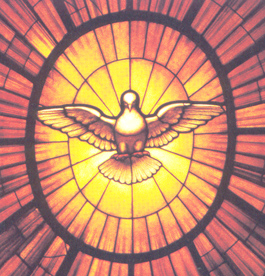
"... in a few days
You will be baptized
with the Holy Spirit."
Acts 1:5
©
Wim van den Dungen
Contents
the
shipwreck of philosophy
the
natural image in Hellenism & Judaism
individuality versus personhood
the
personal experience of God
theomonism instead of monotheism
the
Divine in Ancient Egypt, Greece & Rome
asking
for human persons
the
exodus of bondage
the
exodus of death
creation out of nothing
the
intelligible depth of beings
perpetual creation
the
Person of Jesus Christ
the
Jesus of history and the Christ of myth
the
sacramental Jesus Christ and the light of the world
major
sources of a theology of mysticism
the
schism in the universal church of Jesus Christ
the
imprisonment of Christian ethics
the redemption of Satan ?
the
shipwreck of philosophy
Philosophy is the fine
flower of the natural mind and its sciences, the excellence of the persuit of knowledge for
its own sake, the final step in the emancipation of reason
(rationality guided by itself), opening up understanding, inviting wisdom.
The best minds invoke an intellectual love of God. Here the echo of
the true call is transcendence. But the vehement devotee of God finds in this
intellectual theology,
the limitation of philosophy, whereas to the latter, this is precisely the
ultimate expression of its intent, namely the "ipsum Esse subsistens"
(Thomas Aquinas), the one sole existence of God.
Because thought and reason are its tools, philosophy is divided for the sake of an ever escaping horizon.
Being a particular mental activity pertaining to the order of the
languages of science, it exclusively works with a dual and finite logic. In the
latter, two entities are
always and irreversibly placed in opposition or contrary to each other,
and the third is excluded (the set "A and not-A" is empty).
As a
result, philosophical understanding enlightens, but exists in
darkness (cf. Hegel's the flight of the owl at night), whereas absolute
understanding is blind.
Mothering the principle of
duality, natural excellence of mind is unable to pierce through the
barrier of creation, the ring-pass-not.
Because of this, philosophy is not equipped to escape the dialogue of the
individuals (the intelligent animal and its objectivity posited
outside the subject of cogniton). Love of wisdom belongs to the order of
creation and its natural, rational laws. To be personally invited is a gift, not
an accomplishment, not even for its own sake (contemplative). For God is
not an abstract "esse", but a God-Person, a "Thou", not in any relational
sense, but in a personal sense.
The reign of the dyad is not intended to bring peace, for two numbers
always function in relational oppositions. Immanent metaphysics is devoid
of the order of grace given by the Living God and His revelation.
Understanding is without the spiritual
awakening necessary to receive an uncreated light higher than the intellect, so as to humanize the
human person. Hence, the darkness of the irreducible groundless ground
of the mind -perceived by the eyes of the night- is defined as the light of the
intellect posing as the sublime natural quality of the
"nous", as it were reflecting or imaging the "esse subsistens".
This posing is vain, for true greatness is not of creation.
Ergo, any
philosophy of religion explaining itself in terms of an intellectual
theology (of finitude) is meant to organize conflict (cf. the war of the
"enantia", the elements of creation). As a result, in all possible
intellectual theologies (natural or transcendent), concepts such as
"essence", "unity", "oneness", "subsistence" & "substance" are crucial.
They are indeed necessary to perpetuate the relational oppositions within
the dyad by returning them to the "essence". But who unmasks the
mask ?
"The wiser You are, the more worries You have ;
the more You know, the more it hurts."
Ecclesiastes, 1:18
the natural image in Hellenism & Judaism
Classical Greek philosophy discovered the dyad and the formal mode of
cognition, initiating decontextualized, conceptual rationality.
Because of this, in the Mediterranean area and beyond, the ways of thought
fundamentally changed.
In particular in Egypt's Late Period, Greek
conceptual rationality allowed intellectual Egyptians and (a minority of)
interested Greeks to finally summarize their traditional,
native
religion & philosophy in terms of a Pagan, Greco-Alexandrian
Gnosticism :
Hermetism.
Since Psammetichus I (664 - 595 BC), the Greeks had access to Egyptian sources, in particular to Memphite logoism (cf. the
Memphite theology of the "heart" and the "tongue" of Ptah, extant on
the
Shabaka Stone, inscribed ca. 710 BC). Also within their range was the perennial Heliopolitan
theology of the image ("tit", also : "form, shape, figure, design)
: precreation versus creation ("in the image of Atum") and the order of Maat, i.e. justice & truth, incarnated by the king
of Egypt, the "great house" ("pr-Aa") or Pharaoh, a god on Earth favoured
by the gods and maker of good floods, returning Maat to his father Re.
He was the "son of Atum", and only
he or his representatives faced his divine father face to face (the
cult-statue in the "naos" of the sanctuary). Pharaoh was the witness. The "image",
bearer of
"reality", even in
magical terms, belonged to the (ante-rational)
canon of art since the Old Kingdom (ca. 2670 - 2205 BC).
The hieroglyphs themselves were deemed sacred and vehicles of power,
assisting Pharaoh to ascend to the deities.
Is it accidental, that
after the complete destruction of the second Temple of Jerusalem, the
Jewish diaspora gave a Hellenistic expression to the word of
truth ? Today we know the Jewish qabalah has Platonic and
Pythagorean sources,
and is less Hebraic as some would like. The impact of Greek thought, its
rapid intensity, scope and juvenile power was tremendous, as had
been Alexander's armies for Darius.
The notion of the image returned in Plato, who claimed the aim of life is
the imitation of God, an ideal primarily conceived on moral lines.
"Ah Theodorus, evil cannot
dissapear. Indeed, there always has to be something opposing the good. And
to give it a place near the gods, is not possible either ! So it must
fatefully wander around mortal nature and this earthly abode. That is the
reason why we have to try to flee upwards from here as soon as possible.
That flight consists to become equal to God as much as possible, and this
equilization means : to become righteous and pious with rational insight."
Plato : Theaetetus,
176.
The Neoplatonist
Plotinus is clear : the "nous" or intellect is the natural "image" ("eikon", also
: "figure, representation, comparison") of the One. This image is created
out of a certain, natural necessity.
"The intellect stands as the
image of The One, firstly because there is a certain necessity that the
first should have its offspring, carrying onward much of its quality, ..."
Plotinus, Enneads, V,1.7.
This "certain necessity" associated with what may be called a "natural"
approach of the image, is the "deus ex machina" of Platonic, Platonizing
intellectual
mysticism. The image is deemed to be a perfect second, and hence a
direct participation in the Divine, a deification through individual
perfection. Man, the microcosm, is an image or reflection of the
macrocosm, God. This line of thought was also developed in Greek Paganism
(the
mysteries & Hermetism).
But is there a "natural" path to true salvation ? Shall all be
well "of necessity" (cf. Ennead 3.2) ? Can we levitate as Baron van
Münchhausen ? Although the highest levels of contemplation have reached a
purity which seems wholly transcendent to the clouded mind, it remains
impossible to know The One. Platonic heights are thus sterile. So it is
rather the "return to the cave" which has a "certain necessity", than the
mystery of the personal image of God, the "Imago Dei" hidden behind our
human natures and individualities, the person or someone we truly
are, not the something we possess (as our intelligence).
The Greek
tradition had no voluntaristic concept, invented a dualistic anthropology
(cf. Plato's "two horses" & "two worlds") and put into practice a linear interpretation
of relations and processes (cf. Aristotle's ethics regarding the
actualization of one's true nature and also his logic & categories).
So in Greek thought, the (active) intellect is the pure core, whereas the passions are
linked with the body, and both have to be disciplined ("apatheia").
Liberated from the constraints of the body and its passions, the "nous"
automatically returns to what it is and vanishes in The One, to be thrown
out of oblivion, back as an intellect chained to the miserable sublunar
condition. There is nothing personal in this conceptualization of man's
relationship with God. The fact it ends with annihilation proves its
unfruitfulness in matters spiritual. Is our return assured whatever the
action of the human mind ?
Hellenism also influenced Judaism. However, in the Old Testament,
there is almost a complete silence regarding God's image, except in Genesis.
"So God said, Let us make man in our image,
after our likeness : and let them have dominion over the fish of the sea,
and over the fowl of the air, and over the cattle, and over all the earth,
and over every creeping thing that creepeth upon the earth. So God created
man in his own image, in the image of God created he him ; male and female
created he them."
Genesis, 1:26-27.
Judaism (unlike Egyptian religion) introduced one living God (not a
henotheist multitude of deities headed by
Amun-Re,
the "king of the gods"), but refused to give Him an image in
human or animal form which could be worshipped. In Deuteronomy, we
read the Lord spoke at Horeb out of the midst of the fire, but He had
no form (similitude) and only a voice was heard (4:12). Throughout the
books of the Old Testament, God hides Himself, although
-paradoxically- He is called the Saviour (Isaiah 45:15) ! Adonai
does not show His nature by means of any image, but does not remain an
unknown God, for He speaks, reveals His Name and calls His chosen ones by
their names (Abraham, Isaac, Jacob), not often using angels. So Judaism reveals a personal God, a
"Thou" who nevertheless remains transcendent to every image which could make
Him known. The living, personal relationship between "YHVH ALHYM" is given
no icon, but unfolds in a sacred history, initiated with His choice or
election to liberate His people from their Egyptian masters.
This election shows, God commits Himself by entering into a personal
relationship with those whom He chooses. For the Jews, the One of Plotinus
was a natural, impersonal monad (as in Stoicism, Middle Platonism & Hermetism). But
sanctified nature was not the perfect image of the unimaginable Unbegotten
One. Of course, the One of Greek thought is not He of the Jewish
revelation, neither "another God", a stranger to the "dweller in thick
darkness" of the Hebrew kings. Greek philosophy approached God with the
"nous" and ended up with an abstraction, a "supreme" logos or
closed monad (engendering no dyad). Jewish revelation introduced the
absence of icons and a personal God who only made history sacred.
Judaic revelation struggled with the fundamental antinomy between "YHVH" and
"ALHYM". God (YHVH) is One, Alone and Unimaginable, but nevertheless
entered into history (the convenant) and manifested His Presence in various natural, mental,
social and
spiritual phenomena & their processes (cf. the "Shekinah" of the
manifold "Elohim"). The Hellenized, Jewish authors of
the Ptolemaic Septuagint blurred the obvious contradiction by
translating "ALHYM", plural & feminine, as "Theos", "Deus", singular &
masculine, while in Messianism, Qabalah and Rabbinism the division
reappeared.
"So the Elohim said : "Let us
make man in our image, after our likeness ..."
Genesis, 1:26.
The plural "us" in "Let us make man" refers to the "Presence of
God" in His creation, namely to the original plural Elohim, the
creators of creation by Divine speech. In the first chapter of Genesis,
the phrase : "The Elohim said ... "
is used 10 times (cf. the 10 Sephiroth of the Tree of Life), and with it, everything
was created in the first six "days" of creation. The last three
"elocutions of the Elohim" (on the sixth day) involved mankind.
Here his status is clear : in the human, God's image lives, prompting man
to become more and more like God. Fallen,
human nature lost contact with His "image", initiating the sacred
history of the chosen people, the personal God contacting Israel without
revealing His nature, but only His law. The sacred history of Israel was prophetic, royal,
legalistic
and messianic. Out of the latter shoot, Christianity emerged.
In Daniel and the Books of Enoch, the Messiah and His
Kingdom appear.
"I saw in the night visions, and, behold,
one like
the Son of man came with the clouds of heaven, and came to the Ancient of Days, and they
brought him near before him. And there was given him dominion, and glory, and a kingdom,
that all people, nations, and languages, should serve him : his dominion
is an
everlasting dominion, which shall not pass away, and
his kingdom that which shall not be destroyed."
Daniel 7:13-14.
"And at that hour that Son of
Man was named in the presence of the Lord of Spirits, and his name before
the Head of Days. (...) He shall be a staff to the righteous whereon to
stay themselves and not fall, and he shall be the light of the Gentiles,
and the hope of those who are troubled of heart. (...) And for this reason
hath he been chosen and hidden before Him, before the creation of the
world and for evermore."
Books of Enoch, XLVIII.
In Judaism, the Divine image was posited (in general) but only indirectly
thematized (in particular histories, eventually fulfilled by the Messiah). Besides being One (as in the Greek
"Theos"), God revealed Himself to Israel as a true living person,
someone who took the initiative to establish a direct, living & intimate
"I - Thou" relationship and perpetuate it. In the process, He remained
unimaginable, ineffable and in the most radical way absolutely
transcendent and aniconical (without tale, form or shape, for nobody met
the king of the good kingdom, cf. Baal Shem-Tov).
Even in the Qabalah,
where the "Shekinah" is indeed invoked, the highest ("Ain Soph Aur")
remains an impersonal, limitless vastness, an infinity of infinity lost to
any personal perspective. This supernatural void or "pleroma" has a lot in
common with the Egyptian "Nun", the limitless, undifferentiated primordial
ocean, to be identified with the Greek "chaos". Indeed, Judaism converted to Hellenism remained
mechanical. Is this not the fate of all theologies transforming the
supernatural into a "deus ex machina", a supernatural fysics of
abstractions regarding God ? If God were a Great Machine, His code could
be cracked. As God is not something, but Someone, another approach is
necessary. Only personalism will offer such good news, namely the
Incarnation of God's Son and His recuperation of human nature. All the
rest fails.
"God's Divine power has given us everything we need to live a truly
religious life through our knowledge of the one who called us to share in
his own glory and goodness. In this way he has given us the very great and
precious gifts he promised, so that by means of these gifts you may escape
from the destructive lust that is in the world, and may come to share the
Divine nature."
1 Peter 1:3-4
Christian anthropology departs from intellectual theologies and their
naturalism. God is unknowable by essence, but knowable in His existence.
God is One ineffable essence in Three existing Persons sharing God's
essence. The negative existence of the Qabalah is replaced by the living,
personal
existence of the Trinity revealed by Jesus Christ. Hence, in the
sphere of humankind, Hellenistic reflection, participation & kinship (the
methods of the natural image) are replaced by a personal relation, by the possibility of
participating in the life of the Divine by virtue of the Divine image
& the gifts of the Holy Spirit bestowed on the community of Christ (the
supernatural Image).
individuality versus personhood
Philosophies & rational systems underline the individual freedom of
the highest primate on this planet, the Homo sapiens sapiens. Much
is to be learned from these substantialist approaches. They utilize local standards to
solve universal problems and not vice versa. Nearly a century of logical,
epistemological & linguistic critique has
not changed the realist, materialist and objectivist bias which
characterizes
posthumous modernism, as well as its economical,
political & social institutional sedimentations & adjacent polluting technologies.
Individualizing, substantialist mentalities are contrary to the open, receptive, dynamical
& personal mindset.
Personhood is a free participation in the Divine life given to humanity by God.
It is possible
because each human being is made in the Divine image of God, i.e. in the
image of the "universal human" or human nature understood as a whole
(cf. the human genome). It is
man's spirit, the breath of God which imparts to humanity everything good, reflecting the plenitude of its prototype and flowering the
likeness of God. The single human nature common to all individual
expressions of this nature (the individual whatness of the body and
whoness of the psyche), is divided in a multitude of human persons, living in all possible
degrees of spiritual quickening (the being-there of someone). Insofar as humanity is fallen, this
someone is drawn down into the abyss of individual free-will, identifying
with the ever dividing something.
For Aristotle, the human soul contained in itself all the elements which
formed the world and the other animated beings. In Ancient Egypt, as well as
in Ancient Greek culture, the perfection of man lied in the restoration of
his microcosmic image, so as to reflect the macrocosm. Hermetism underlined this,
for the Heptarch of the firmaments had to be transcended in the Ogdoad of
blessedness, in close proximity to the Ennead of the autogenic, perfect
"nous", conceived as the manifestation of the Unbegotten One (the Decad).
"That which is Below corresponds to that which is Above, and that
which is Above corresponds to that which is Below, to accomplish the
miracles of the One Entity."
Tabula Smaragdina, line 2.
In
Heliopolitan theology as well as in
Alexandrian
Hermetism, the Ogdoad was reached by bracketing the seven dimensions of
creation, entering a mythological "first time" (in the beginning) and
jumping beyond the light of the circumpolar stars, settling the "nous" (or intellect) in the land of the blessed
spirits and blissful deities.
"(...) I was born in the Abyss before the sky
existed, before the earth existed, before that which was to be made firm
existed, before turmoil existed, before that fear which arose on account of the
Eye of Horus existed."
Pyramid Texts, utterance 486
(§ 1040).
In Hellenized Judaism, the "Shekinah" or presence of "YHVH Elohim",
prompted the rise of the Qabalah, introducing, at the apex of its
theological system, three negative veils, called "Ain" (what ?), "Ain
Soph" (limitless space) and "Ain Soph Aur" (limitless light). These recall
the negative existence as defined by Hermopolitan theology, namely : Amun
and
Amaunet (hiddenness), Heh and Heket or Huh and Hauhet (eternity), Kek and
Keket or Kuk and Kauket (darkness), Nun and Nunet or Nun and Naunet
(primordial chaos).
Although the Qabalah deals with One God only, the veils define a negative
existence declared inaccessible to man. The creature is confined to creation, and has to wait the Messiah to be able to lift the
burden of sin & matter.
In Christianity, the perfection of genomic human nature is not part of the finite order of
creation. But yearning after the unconditional, it is "natural" for the mind
to seek transcendence in nature. The finite brain is wired to
process infinity and in vain its co-relative mind tries to conquer the infinite, but
ends up with idols. To posit this perfection of human nature as an enlightened microcosm, is
to deify human nature by means of its own possessions, and not, as is the
case, by God's gifts. The perfection of human nature is not "already
there", but "bestowed". Hence, nobody possesses perfection, except God
Himself.
Individual human natures are ruled by laws. It
cannot escape these biological psychological and sociological parameters.
The mind and its intellect is part of this human nature, as is the
individual's sense of identity or ego, the seat of the free-will. The
reign of this free-will on the material plane is limited by the petty households they are bound to rule.
Individual economy is thus the freedom of an islander, a wanderer, a survivor
of the blasts of nature, of crisis, turbulence and panic numbers. If
destiny make the ego successful, centered and individualistic,
obscurantism ensues and the dawnfall of its tirany is guaranteed by time.
If individual human nature limits its personality open to all other
persons, God's
unlikeness is achieved, and with it the degeneration of life, law & love.
In extension, creation will not be redeemed because humanity relinquished
its humanizing vocation. In such a scenario, human individuality would
have betrayed its own, encompassing human personality. Instead of opening
up, the doors would have been be sealed by the pull of the fallenness of all
individual possession.
Understand that personality belongs to the order of the
Divine image, and is not just another part of man's constitution (just as the
Divine Persons are not parts of God) A crucial line must be drawn between
"nature" and "person". As an individual, man is only
one expression of the common human genome, but
as a person, he is all other persons as himself. More than a single
example of a common ground, each human person contains all others as
himself in himself and so exceeds his individual human nature.
Personhood is
irreducible to every human individual and can not be defined, only designated.
Hence, personhood is the source of the greatest possible freedom, rooted
in God. The personal uniqueness of someone, is what remains after all
natural, individual contexts and facts have been annihilated (nulled), situating
personhood in an absolute manner outside space & time. Each person is unique, and in its
uniqueness he or she objectifies and collects.
Only through reciprocity can
personhood be completely designated and so the "You" and the "I" form the
inner poles of the constantly renewing personality in which
God remains the One Absolute Witness. Hence, God is the common source of all
persons (human and angelic) and thanks to God they are able to participate with each other and
form the mystical body of persons of hope, faith and love.
In Greek philosophy, "ousia" and "hypostasis" were concepts used to denote
the individual being of an entity. "Ousia" was its essential, monadic nature,
"hypostasis" its singular particularities.
These categories define the
individual nature of each entity. This particularized,
biopsychological organism is part of a species. As a solitary element,
it divides its own nature, related to others by natural law,
not by personal connectivity & reciprocity. This happens in opposite &
repetitive ways, causing division without diversity, each fraction closed
to the other, the same nature constantly divided everywhere and all the
time. This individual is alone and has disconnected his or her mind from
the someone he or she is. Modern
science, philosophy and rational theology have sprouted from this "nature
morte", grasped without
the light of the intellect, its humanizing persuits and immortal
personhood.
Persons are united because the Divine is not possesses by them (as human nature
is possessed by each individual), because
they are open to other persons and able to share without restriction in the
Divine intrapersonal exchange, both between them (true humanism), as between each
person and God expressing Himself in a personal way (true spirituality).
Theology emancipates the person to the point of surpassing the individual.
Personhood is togetherness.
the personal experience of God
The fundamental
neurotheological fact is simple : man is wired to
experience God. To materialist science, this is nothing but an
evolutionary reaction to enable us to accept death. But to the monotheist religions, God created us to worship Him.
Although mediated by conceptual (prefrontal) structures, comparative
mysticism evidences the direct, unmixed, unmediated and highly emotional
(limbic) nature of the personal experience of God, touching the person
hidden behind
the individual, inviting the solitary wanderer (the Homo erectus)
to enter and settle down in communion and establishing a sense of the holy
& sacred (the amygdalic response of the Homo neanderthalensis), while
communicating the path towards the proper state of mind to realize this
(the neo-cortical formations of the Cro Magnon, the Homo sapiens
sapiens).
Mystical experience can only be designated (showed as examples) by science
& philosophy, not defined. Its limitation is found in the experience
itself, for the radical otherness implied can not get more personal.
Hence, without the maturity of this experience (evolving from state to
station), no mystical theology is possible. Conceptualizing one's personal life
with God, is the only true mirror of the soul, but one has to be looking away from it
(contemplating God). Personhood is this abandonment of individuality, to
discover what is truly unique, the someone who remains after the ultimate negation,
namely the loving "rapport" between the person and God through the Divine
image rooted in the soul of every human being. Not "eros", but "agape",
not "ego", but personality.
To move beyond the individual expression of a common human nature is not
achieved by any intellectual contemplation, for the mind is restricted to
the natural worlds of creation. The Alexandrian way only leads to the
deification of the individual by means of what is already possessed,
namely the intellect. In this mystical intellectualism, the perfect
natural image is an abstract entity, an idea reflecting God. This allows
His light to penetrate the intellect directly and enlighten this "nous",
considered to be the best, most excellent "part" of the whole human being.
The body, its emotions & feelings as well as the free-will, the organ of
responsibility, are not thematized (for in Greek thought a Socratic
determinism prevailed). Western science and its academia have inscribed
this attitude in the metaphysical research program, the background of the
current posthumous modernist paradigm, and its materialist, atheist,
mechanistic, reductionistic and solipsist features.
The personal revelation of the existence of One Living God, is the solid
corner-stone of dogmatic Jewish theology and legalistic Islamic theology
(both being "Abrahamic"). However to these, God hides in the profundities of His
nature. For the Jews, His name is unpronounceable. In Islam, He can not be
directly accessed. Theirs is the revelation of an inaccessible God,
denying man face to face encounters. Taken to the fundamentalistic
extremes of Farisee logic or "Left Eyed" jurists, this closed and terrifying Divine
monad bestows upon man the obscurity of obedience and scriptoral faith.
The contradiction between a personal God and the absence of true
reciprocity between God and man can hence not be solved. In this mindset,
mystical theology is a priori a forbidden knowledge, for there is no
common measure or mediation between Creator and creature. There is no
Pagan "natural reflection", but a bottomlessly deep abyss, making all
creatures, but man in particular, entities at the borderline, i.e.
isthmusses between absolute everything and (nonexistent)
nothingness. In this way, impossible knowledge (the One can not be
experienced) makes room for forbidden knowledge (qabalah
&
sufism).
Christianity is not burdened by this dilemma. The One Living God reveals at once
His essential nature ("ousia") and His Persons ("energeia"). Transcending
creation, the Christian God allows for reciprocity. In His own Divine
nature, He allows His essence to fully exist in Three Persons. In His
economies, He gives creation His only Son and deifies human persons in
the Holy Spirit.
Personhood is supernatural and not to be "mechanized" by the categories of
the mind. If God exists, natural theology (God as machine) is impossible,
for God is a Person, and hence exceeds His own nature by creating the
other than Himself. The human person also exceeds his natural
individuality, and is a someone precisely because of this. This surplus is
achieved by an crucial intent (or concentration of the free-will), namely
the greater freedom of the other human person.
Just as God considered a
freedom other than His own, a human person invites the other person
to relate, participate and share kinship with. Expecting the "parousia"
this instant, a ransomed person already lives in the Kingdom of God,
the "Mystery of the Eight Day". For recuperated by Christ, human nature
no longer pulls this person down. And thus resurrected from the "sleep" of
fallen nature, the Spirit of God may personally deify this someone in the
likeness of God. In these relational reciprocities, the essential unity of
God is not lost, exhausted or differentiated, for the Persons are
completely God by virtue of their common, (super)essential nature : sheer
unity.
theomonism instead of monotheism
Mystical theology, the conceptualization of the personal experience of
God coming
after ceaseless prayer with
the mind in the soul (or heart), embraces theomonism instead of
monotheism. This means Divine names, attributes, and revelations are
of One and the same God, rather than One God expressing Himself
exclusively in one exclusive way, for indeed, God revealed a variety of
ways.
Mystical spirituality is touched by transcendence. A perfect
Being transcends change and movement, as well as unity and plurality. If
God would be nothing more than the "pneuma" of the wheel of becoming (cf.
Stoic pantheism), transcendence could not be posited. So plurality does not
harm unity and totality is unthinkable without transcendence.
"He is nothing but the One / the Many - to the
like of this do all affairs give
witness."
Ibn al-'Arabî : al-Futûhât
al-makkiyya, III.458.6
Mystical theology embraces bi-polar pan-en-theism : God is both
transcendent & immanent, both essence & existence, both hiddenness &
revelation, both abstract & personal, both inaccessible & intimate,
revealed & unveiled.
This bi-polarity of Loinprès (cf. Porete) is crucial : on the one hand, unknowing & un-saying
({0} : all possibilities) and on the other hand, number 1, the foundation
or standard of formal thought.
The remote side of the polarity is absolutely
transcendent (the essence or "ousia" of God being unknown & unknoweable), while the
intimate, existential and personal side of God, His "energeia", is immanent in the
transcendent Trinity (Divine existence) as well as in creation (the
economies of the Son & the Holy Spirit).
God's ineffable essence, the apophatic side of the bi-polarity, does not negate His
Divine existence nor creation, the cataphatic side. God is One essence in
Three Persons, each with a distinct Divine personality fully participating
in the essence of God which they have in common.
Of course, by His (super)essential nature, God remains radically
transcendent, and this in the very immanence of His manifestations.
But never does this apophatism exclude His Presence, not to Himself (cf.
the Trinity) and not to creation (cf. the Providence of the two Divine
economies). Christian mystics from Dionysius to Ruusbroec confirm the
bewildering simplicity of the ultimate vision.
"For in this fathomless whirlpool of simplicity, all things are encompassed in enjoyable
blessedness, whereas the ground itself remains totally
uncomprehended, unless it be by
essential unity. The persons and everything that is living in God must yield before this,
for here there exists nothing but an eternal rest in an enjoyable embrace of loving
transport. That is, in the
wayless
existence that all inner spirits have preferred above
all things. This is the dark stillness in which all the loving are lost."
Ruusbroec :
Spiritual
Espousals, c248 - 252
the Divine in Ancient
Egypt, Greece & Rome
The Mediterranean religions of Antiquity conceived of a realm before
creation, a primordial being before space and time had come into
existence. But godhead shared preexistence with something
else : an infinite ocean like the Ancient Egyptian "Nun" or
the
yawning space of the Archaic Greek "chaos". In Greek thought, creation
was deemed the outcome of God's form imposed upon this inert, formless
primordial matter.
In Heliopolitan theology, before Atum created himself "in the first time" and
hatched out of his egg, subsequently (simultaneously)
fashioning creation, defined in terms of space, life & light (of the Sun and other
luminous stars), there was the Nun, the undifferentiated, primordial ocean.
Likewise, the Egyptian deities were remote and hidden away in the sacred
darkness of their "naos", faced by Pharaoh or his representatives alone.
The "king of the gods", Amun, was hidden although personalized
and hearing the prayers of the poor (compassionate, caring and loving).
The essence of these deities ("spirits" or "Akhu") was
never incarnate, except in the divine nature of the king. Because the
latter daily offered Maat (justice & truth), the deities dwelled in their
temples and statues as "souls" (Ba) or "doubles" (Ka).
In Neoplatonic philosophy, the One, beyond being and nonbeing, is only known
before and after, never during ecstasy, transcending the "nous". In these Platonisms, the
ultimate experience is not an experience, not a participation and
thus absolutely devoid of the I - Thou relationship of communication & communion, at once
absolute and personal.
Because the majority of Greek thinkers linked man's ultimate spiritual experience with
abstract intellectual contemplation and its adjacent sensoric and
affective reduction, they
rejected the living God Incarnating as a human being. God could not be a
human individual. In the Greek pantheon, the individualized deities behaved as individual kings under the
imperial dictatorship of Zeus, the super-individual (cf. the Alexandrian
model). In literature and
theatre, the gods interfered constantly and enjoyed themselves with
mankind. The latter had no defences against their whimsical nature &
astral fatalisms.
In Greek intellectual theology, ecstasy was seen as the outcome of
a natural process of "return" to the original "idea", considered
to be the essence or "natural image" of the individual. By means of the
initiated "nous", the purified, serene individual would contemplate his or
her "eidos", attributing the intelligent animal to a set of
categories. This process was more automatic and necessary than volitional
and contingent. This relational system involved the outstanding
characteristics of the species of which the individual was part (in a
closed, atomized, disconnected way), namely mankind. Each individual was a
microcosmic deity (a pure idea buried underneath layers of material
impurity).
At the end of the intellectual Odyssey, the individual
is
annihilated by the rapture (ecstatic delight) of the One. The individual desolves as a drop in the ocean. The
free-will played
no role whatsoever in this process or its outcome, for neither was this rapture an experience, but
rather the complete annihilation of individuality in the
impersonal One (a soteriology remarkably akin to Vedantic thought). A kind of natural
automatism seems to be at work, a "deus ex machina" summoned by the spirituality of
Antiquity as a whole (in Classical Yoga, liberation is the automatic
result of distinguishing matter and "purusa", the spiritual, witnessing
Self). Here, salvation as enlightenment is acquired, it in not the free
gift of a Living God.
asking for human persons
The intelligent animal is the organism of natural qualities ascribed to
the human individual. This individuality or "I-ness", is not the human
personality. The latter is rooted in the Divine image each human person has
to assume in order to attune his individual will to the Will of God. The
character of egology of the intelligent animal is the least personal part
of it. Neverthless, here the natural free-will is enthroned and able to decree
against the natural order of things. So, the individual with
his or her free will is not free from his or her own nature. In fact,
although free, the individual remains imprisoned by his or her poverty as
natural entity, an aggregate of material elements wandering in the cold
expanse of an extremely vast cosmos. The human individual is even quite
alone in the galaxy of the star providing him with life.
To reclaim the person, renunciation & repentance are needed. The
former is the acceptance of individual sin, the latter the change of mind
necessary to avoid its repetition and establish serene passions
("apatheia"). To fulfill the restoration of the Divine image, constant
prayer with the mind in the heart leads to inner stillness ("hesychia").
Then the last step is the realization of the fullness of
humanity in "the maximum man" (Nicolas of Cusa), Jesus Christ, the Son of
God or Word Incarnate, a Divine Person Incarnating in history and its
natural order to fullfull the vocation of human persons, betrayed by Adam.
He is a Divine Person, not a human person, who, in His Divine Person, assumes human nature in its
totality, with the exception of sin (depending on the
fallen use of individual freedom).
He is the Transcendent descending from paradise (at
the
Annunciation) into the low
hour of death (of
the
Passion), beyond the death of death in the infinite ocean
of light flowing from His Body of Resurrection and the achievement of this
final humanization of humanity in the Person of Christ,
no longer separated from God or in the hands of the enslavers of the
natural will (Ascension and Pentecost).
the exodus of bondage
Moses and his reception of "ego sum qui sum" is a clear break away
from the iconical approach of Antiquity. It heralds the advent of the first rational
monotheism, namely Judaism, profoundly characterized in every way by the
liberation of the Israelites from Egypt (probably under Ramesses II).
"YHAdonaiVH est l'Être unique, la matrice de toute vie, Celui
qui a été, qui est et qui sera. Les Elohîms en expriment les puissances
créatrices infinies. (...) N'oublions pas que si YHAdonaiVH est Unique, Elohîms est
pluriel. Les prophètes n'ont jamais aspiré à voir surgir un univers monolithique :
l'Unité qu'ils annoncent n'est pas faite d'uniformité, mais, nous y reviendrons, d'une
universelle
et vivante diversité, dans l'unité de l'Être qui la fonde, YHVH. Mieux que
monothéistes, ils sont théomonistes."
Chouraqui, A. : Moise, du Rocher - Paris, 1995, p.181-182, my italics.
Away are the images, pictures & statues of the Divine. The Name of God :
"Yahweh Elohim" suffices. "YHVH" represents the ineffable, unpronouceable,
unmixed, absolutely absolute, infinitely infinite and radically singular &
alone side of God, whereas
the "ALHYM", a plural word, exist in an inaccessible, uncreated light an ordinary man cannot see
without dying. They are His Presence.
By stretching his iconoclasm too far (namely in the realm of thought
itself), Moses closed the way of a face to face encounter between God and fallen man. Even Akhenaten had not
done away with direct spiritual experience ! On the contrary, daily the
Aten is visible to the naked eye. As a result, Judaic theology offered
no true reciprocity between God and man and no redemption, no salvation
and no liberation from death. Moses and his people worshipped a living God, but
did not have a
Divine life with God, a participation in His Divine nature, a becoming
(like) God
by His gift. Judaism is therefore the good promise, but not (yet) the true
closure, completion or fulfillment brought by the good news.
the exodus of death
"I am the living one ! I was dead, but
now I am alive for ever and ever. I have authority over death and the
world of the dead."
Revelation, 1:18
The Christ, the Son of God, a Divine Person Incarnating in human
nature, was absurdity to Athens &
folly to Jeruzalem. These theologians posit the standard
or "1", excluding relational oppositions, and hence division within the approach of
God (the mode of witnessing and affirming His essential unity).
"And YHVH
appeared to Abraham in the
plains of Mamrê as he sat in the tent door in the heat of the day ;
And he lifted up his eyes and looked, and, lo, three men stood by him : and when
he saw them, he ran to meet them from the tent door, and bowed himself toward the ground,
And said, Adonaï (...)"
Genesis, 18:1-2, my italics.
If, on the one hand, the monad is not duplicated to form the dyad, God has
no relations with Himself and creation is oblivion. This fixation on the
"standard" of unity is unable to think change,
process, history and evolution and downplays God's Glory as well as the
ultimate, escatological
restoration in freedom of all in All (the "Mystery of the Eight Day"). But,
on the other hand, Greek thought showed the dyad does not bring soteriology to
its final end, for two poles differentiate nature & confirm the relative,
conflictual (oppositional)
diversity of being.
In Christian mystical theology, God is identically monad (union) & triad
(distinctions). God is at once unitrinity and triunity. Why not more than
three ? The triad allows
for process to return to unity (from 3 to 1) and is an ouverture to
variety under unity or organical multiplicity (from 3 to infinity). It is
the last number retaining a direct and complete link with the standard
without returning to oppositional logics (4 returns to the dyad).
Hence,
these equations have to be posited :
-
{0} « » 1 : the monarchy
of the Father (1) maintains the perfect balance between the "ousia" of God
({0}) and the Trinity as a whole ;
-
1 = 3 : the Father
(1) bestows God's essence ({0}) compeletely to the Son (2) and the Holy
Spirit (3) ;
-
and 3 = 1. This double equation
is clear : when one of the three is communicated, the two others
immediately rise up. The Persons and their Trinitarian Divine perichoretic
dynamics, summarize all possible relational attributes of God ;
-
and 3 = ∞. The Three
Persons together, bring in an infinite sequence of change (cf. the rise of
irrational numbers in the theorem of Pythagoras, c = √2).
The Father and the Son
have a circumscribed relationship : the Son is generated by the Father
(the Holy Spirit proceeds from Him but is sent by the Son). The Son is the perfect image of the
Father, and "in the bosom" of the Father, He is His Logos or Verb (the
Father as it were "thinking" Himself). The Son is the reflective act of
the Father. He is the Father's verbalization of Himself in terms of a
dynamical opposition, for the Son is dual and actively relational
(energy being difference).
The "recapitulation" (cf. Irenaeus of Lyon) of human nature (all human
individuals as one
human nature, one flesh) by Christ as Jesus, opened to the people of
Jesus, i.e. humanizing humanity, a way out of the land of death, and
completed the economy of grace (not of necessity) of the Holy Trinity,
namely the deification of all human persons and, through them, the whole
of creation. Not in the afterlife, but right here in the Kingdom of God to
be realized by loving human persons anticipating the Day of the End, and
at the "eschaton" of the multiverse as a whole.
"If then
Elohim so clothes the grass that is in the field today and thrown into the
oven tomorrow, won't He put clothes on you, faint hearts ?
And you, seek not what you will eat or what you will drink, neither be disquieted.
For those of the world seek these things, and your Father knows that you need these
things.
But rather seek the Kingdom of
Elohim, and all these things will be yours as well.
Q1, 68 - 71.
Gregory of Nyssa (335 - 399) spoke of the Divine
ruse. Christ is the bait the Spirit attached on the hook of the Father.
Death threw itself on the prey, but the hook wounded death, which cannot
swallow God and died. This death of death is the judgement of judgements,
the final curtain on all attempts to separate humanity and God.
creation out of nothing
Creation sprung from the Will of God, as the gift of existence to the
other than God. By nature, creation is to be conceptualized as the "outside"
of God. This realm of created being, contains objective entities
standing before God, each with an irreducible
ontic density and a relative freedom of its own.
Before creation, there was only God. After creation, God and creation
stood in opposition : the absolute being of God versus the relative nothingness
of creation. Each created being is thus an isthmus between these extremes.
Creation started with God, not from something else. There is no prime
matter or original "chaos". Nothing exists in itself, except God.
Although prime matter has been called a nonbeing, a pure possibility of
being, it is never conceptualized as an absolute nothingness, but already
as a "something" with
which God shared precreation (as in the religions of Egypt, Greece & Rome). Creation has no
uncreated substratum, "pneuma" or "hidden variables", for it is by essence the
other than God. Neither had God to mysteriously fall and then strain to
become God again, as in the Platonist emanational model. The perpetual
taking-form of the Aristotelians is also rejected.
Without any necessity in God, creation is a gratuitous, free
act of God, born in the one Will of God, which is the expression of the
concerted Trinity. God in no way depends on the creature. As He is
infinitely good, His creative act of Will gives rise to positive,
liberated beings. Contingent of God, creation is only necessary for itself,
not for God. The
aim of creation is deification, in which the human person plays a
crucial role, as the Incarnation underlines.
Creativity is not a reflection of {0} in "1" to subsume all natural
numbers. It is taking the risk of novelty, the coming forth of something
new. The Divine creative act consists in reaching out and fashioning a new, independent and free
being other than God. The creativity of
the absolutely free God, is willing another freedom, another
created being endowed
with the uncreated Divine image. And to allow this ultimate creativity to occur, God had
to take the risk of being powerless precisely at the moment when created beings turned
against Him by abusing His ultimate gift (cf. Adam and the Fall) ...
Before creation, concepts such as the "outside" or "inside" of God have no
meaning. They are posited by the Will of God creating creation, separating
"before" and "after", "inside" and "outside". Nothingness has no existence
of its own. The "nihil" in "creatio ex nihilo" merely indicates
nothing but God's Will rose creation. God's creative Will is not bound by
any necessity, but lawless (not random) and absolutely indeterminate (but not
disorganized).
the intelligible depth of
beings
For Plato, ideas exist in the sphere of intelligible being, whereas the sensible
world had only verisimilitude, not verity. Real because participating in
the ideas, the flux of generation & corruption, of life & death did not
touch the superior level of being, an intelligible, uncreated world.
Plotinus took this structure a step further, and established the ineffable
One above the ideas, reducing them to Divine intelligence or "nous",
emanating from the One absolutely superior to being itself. In itself, the
abstract idea of the One is the ultimate achievement of Greek
intellectual theology, in casu developed in the context of a religious
philosophy. A return to
the One is then the natural path of an intellectual creature such as man,
but
no experience of this One is possible. Ecstacy is oblivion. There can
be no vision of the One, and no participation or kinship with It.
The
separation or "chorismos" is "natural" (between the
beings of the created
order) and "transcendent" (between the created and the uncreated). The immanent difference between the sensible &
the intelligible worlds is as crucial as the transcendence of the One
vis-à-vis the world of ideas. If unmediated, these Greek distinctions obscure the salvation of humanity and diminish
the splendour of God's creation. For why creation if God is not interested
?
There are no two worlds. God does not make a replica of Himself (a Divine
"nous") in order to create. If God, as transcendent Principle, Logos &
Spirit, would make an immanent copy of Himself (a Stoic "pneuma"), His
creation would not differ from Himself, it would not be the other
than God. A cosmos already born Divine would not
constitute the risk God intended with a free creation. The splendid, formidable
newness of creation is absolute : His creation rests only in God's
igniting omnipotent Will and in nothing else.
If ideas, which determine the essence of creatures or serve as exemplary
causes, exist, then these are not uncreated, for God, being radical
otherness, does not serve creation, neither facilitates (limits) the
necessities (the freedoms) of creation by reproducing His transcendence
explicitly in the laws of creation. Such an ideal world would already be
Divine and the gift of freedom (the risk of Divine unlikeness) impossible.
The dynamics of love demand freedom. God takes a risk by giving freedom,
and only by taking this risk is He creating the other than God, and with
this the possibility of a free return of all to All, the final goal of
creation. The deconstruction of both Augustinianism and Thomism is
irreversible. Both the intelligible "world" of ideas as well as immanent exemplarism
emerge as obsolete theologies. As such they are hinderances, not
gifts to cherish and keep ...
The ideas constituting the intelligible dimension of creation are the
very depth of created being. The Will of God creates order and reason,
allowing wisdom to position the "seven pillars of the mansion", the laws
of the multiverse. The ideas of wisdom are not a Platonic world beyond,
neither a replica of God. The "logoi sophon" (words of wisdom) or the
"logoi" of creation constitute the fundamental matrix of order
keeping the natural order in place (constants, laws, forces, particles or
waves). But this very depth of being is not uncreated. The "logoi" raise the
force of light in creation and the polarity of light & darkness. Rooted in
wisdom, they are God's first creatures.
The "logoi sophon" are the instruments of creation, and represent the invisible,
subtle & abstract laws determining the explicit
structure of and the forces at work in the cosmos, its order and compass. God thinks creation, in
the first place wisdom and its logoic archetypes. God gives freely, under no coercion,
so His creation may choose
for God and be partakers of the Divine nature, or not. Before anything else, God creates wisdom, at once
eternal and created, timeless, yet turned towards the other than God,
which must have a beginning. Wisdom abides "in the beginning", in
the immobile
eternity of the neverending "now" (time present), which is the ground or
"standard" of mobile time, the first moment of time which is not
yet in time.
Wisdom is to understand the beginning, to know how to found and build the
attitude of someone who loves to begin. She stands at the beginning of
time without being temporal. She is the beginning of everything without
being somewhere. She is the mechanism of the psyche, the stability of the
particles and waves. Because wisdom is the first being created, the crown
of the cosmos is good and the demiurge is an unveiled fountain of light
with nothing dark or reversed in any of its natural necessities.
perpetual creation
"In the beginning, God created the
heaven and the earth."
Genesis,
1.1
This "beginning" is the first moment of time which is not yet time, the
first step which is not yet a path. Eternity is not linear, neither an
indefinite line. It escapes the conditionality of repetition.
The finite
is not commensurable with the infinite, and so the latter is the limit (of
immanence) and/or absolute transcendence. In Ancient Egypt, the beginning
of "time" was not yet time, and so creation "happened" on the "first
occasion", a mythical "realm" between absence of creational intent (the
"Nun") and the emergence of the "primordial hill", the "first land".
In-between stood Atum-Re the creator, autogenes.
The first moment is unthinkable. It is not a point in time, for the future
becomes past without ceasing and the present is never grasped in time. The
first moment is the truth of the moment when it is realized the past is
all memory and the future only expectation. The
"first moment" is timeless. The timeless beginning of time, before the
beginning of creation as history, is the present, the "now" without
duration, revealed as an door to aeonic eternity, uncovering the
unchanging architecture governing creation.
In this first moment, "heaven and earth" appear, i.e. the entire
assemblage of creation elocuted by the "logoi sophon". Creation rises up in an instant. Not yet time, it
is created and eternal. Because of the wisdom of this timelessness, a
creative explosion takes place and temporality ensues. This first moment,
represents the timeless frontier of wisdom between the eternal God (beyond
time) and the transient cosmos. "After" this instant, time, itself a
creature, becomes fact and event until, at the "end of time", time is transformed
into the eternal newness of the New Day, which is the "Mystery of the
Eight Day".
God : One essence in three Persons :
transcendent Divine nature ;
Divine energies : uncreated radiations
shining forth from God ;
Wisdom : first creation of God, timeless,
existing in the beginning ;
Logoi : faces of the aeonic
eternity of wisdom ;
Creation : the forces, laws & entities of the
multiverse.
The wise beginning of creation is instantaneous and non-temporal. The
creative act initiates a relationship between the Divine energies (via
eternal, but created wisdom) and that which is not God. This was a limitation,
a determination of this infinite and eternal effulgence of God for the
sake of creation. God created all things by the uncreated energies so created being may accede freely to union with God in the
selfsame
energies.
Through "sophia", God's creative intent explodes in timelessness, to give
rise to time and history. "In the beginning", this world will always
exist, even if time is transformed at the eschatological end of time on
the Last Day, when all returns to
All. As the root of created time is timelessness, and
creation is the actualization or elocution of the timeless now, "in the beginning",
creation remains perpetual despite the temporality of its actualizations as
a historical otherness with a definite spiritual, timeless vocation.
the
Person
of Jesus Christ
When Christ, the Son of God,
Incarnated as Jesus of Nazareth, the
historical order was radically shattered. The hands of God (Logos &
Spirit) facilitated the Incarnation of the Verb as an Edenic human being
(a second Adam),
called to plunge into the depths of a human nature corrupted by
degeneration & hell, to assume sin without limitations, swallow it and let
it die. And this, while not a human person but a Divine Person, someone
who recuperated the single nature of humanity by becoming mortal flesh.
Christ is consubstantial ("homoousios") with the Father and the
Holy Spirit, i.e. these Persons fully share in God's essence. The Trinity
formed by the Three, is the joint operation of three
modes distinct of origin : the Father being unbegotten, the Son generated by the Father
and the Spirit
proceeding from the Father (but sent by the Son).
The Incarnation in Mary, made Christ
consubstantial with human beings by His humanity (as Jesus) and this without
Himself being a human person. His human nature is a human body and a human soul,
gifted with free-will. His humanity encompasses human nature, but without
the effects of sin. Indeed, because of the unsullied, Edenical, virginal
constitution of His humanity, this natural will always follows what is good, beautiful &
true, i.e. His Divine will. Hence, the human nature of Jesus Christ was at
all times always without the demons of
sin.
"My Father, if it be possible,
let this cup pass far from me. Yet, your will be done and not mine."
Matthew, 26:39.
Jesus Christ is more than a great example (against Nestorius), and really
a human being, in casu : a man (against the monophysites). His human nature is however not
personal, but universal & Edenic. Jesus Christ represents the Divine Verb
Incarnate, who shares with us the totality of our human nature (the sum of
individuals), who assumes -with His Passion- the objective (not subjective) conditions of sin
and submits to our fallen mortality ("kenosis"), while guarding His Divine nature.
"And there was in their synagogue a
man with an unclean spirit ; and he cried out, saying, 'What do you want
with us, Jesus of Nazareth ? Are you here to destroy us ? I know who your
are - you are the Holy One of God !' Jesus ordered the spirit : 'Be quiet,
and come out of the man !'"
Mark, 1:23-25.
" ... the
highpriest answered
and said to him : 'I adjure you by the living God, to tell us whether you
are the Christ, the Son of God ?' Jesus said : 'You have said it !
Nevertheless, I say to you : Hereafter shall you see the Son of Man
sitting on the right hand of power and coming in the clouds of heaven.'"
Matthew, 26:63-64.
Seven christological stages may be discerned :
1. Trinitarian :
The unitary essence of God is the
common ground of the three Persons, and thus insofar as their essence is
concerned, each of them is God. In this Trinitarian totality, Christ is
the unique, begotten, and Divine Son of the unbegotten Father. As the
second Person of the Holy Trinity, He represents the logoic operations,
relations or determinations of the Father, the monarch from whom the Son
is generated and the Holy Spirit proceeds.
Together, the
Persons radiate the eternal, infinite, uncreated Divine light, which flows
from the personal Trinity of the One God's infinite totality. Here, we
receive glimpses of Christ's Divine Personality, and apprehend (by being
given instead of possessing) the profound & sublime transcendence of His
creative command, which is the command of the One God, King, Lord and
Spirit of everything good, beautiful and true.
"In the beginning was the Word, and the Word was with God, and the Word
was God."
John, 1:1.
2. Annunciation :
The Will of God (the concert of the Persons) decreed the Incarnation of the Father's Son by means of
the Holy Spirit, who worked in Mary, a virgin.
"... the Holy Ghost shall come upon
you, and the power of the Highest shall overshadow you, therefore also
that the holy thing which shall be born of your shall be called the Son of
God."
Luke, 1:35.
The Incarnation is the Father's love for His creation, and His love for humans,
created in His image and towards His likeness. Thanks to the Incarnation, of which the Annunciation
by Gabriel of the name "Jesus" is the first, timeless instant,
the Father
(through the Spirit and His angels) and creation (by the presence of
Christ in the world) were joined for ever. The old abyss of Antiquity and
intellectual theology was irreversibly filled up and rendered obsolete. But
the impact of the Incarnation is only open to hope, faith and love, and
belongs to the invisible order of grace. Without the gates of these
cardinal virtues, the fallen kingdom of this world continues its closures,
dull repetitions of the same, as well as the mummification process of its willed
evil sedimentations.
This darkness has been dispelled. Only the grace of
the Holy Spirit is needed to enter this new order of creation, established
after Christ's Incarnation (God coming into the world directly, assuming
original, Edenic human nature in its universality). Grace is not
elsewhere, for as wisdom, she is everywhere.
"His disciples said to Him : "When will the Kingdom come ?" Jesus said :
"It does not come by expecting it. It will not be a matter of saying :
'See, it is here !' or : 'Look, it is there !'. Rather, the Kingdom of the
Father is spread over the earth and men do not see it."
The Gospel of
Thomas, logia 113.
3.
Baptism &
Transfiguration :
To His most beloved disciples, Jesus Christ evidences His Divine Person at
work
through His human nature : Baptism and Transfiguration. In both instances,
His Divine Person shone through His undefiled human nature, and His unity
with the Father (a voice) and the Spirit (a dove) was actualized. Each
time, the "form of God" and not the kenotic "form of the slave" was manifested.
These are exceptional moments, revealing the ineffable psychology of Jesus
Christ, in whom two distinct operations are conceived, but with one single
result. These two natures of Christ, His Divine Person (the Divine nature)
and His human nature, as Jesus, always cooperated in the single activity of Jesus
Christ, and this in a manner suitable to it (the human weeping before
Lazarus' tomb, the Divine raising him - cf. John of Damascus). There are two
wills in Christ, but His natural will is unsullied by evil and hence
always in accord with the Divine Will of the One Trinity and the absolute
goodness of the Three.
4. Passion :
Jesus the Christ accepted, totally and voluntarily, the (outer) effects of
sin, infirmities, and the humiliations of our fallen natural condition. He
did so, without
leaving His own Divine Person. The demonical passions depending on
the free will of egoism and egology were not included, for Christ's
natural will was perfect, His ego holy & saintly. Divine by nature (a
Person) and human (the perfect man) by Divine choice, Jesus Christ never
recapitulated in Himself (i.e. in His Divine Person) human aspirations
bogged down by sin and anti-natural inclinations. Jesus Christ did not die for the
perversions of our choice, neither for the stubborn continuation of the
fixation of the will in activities running against the natural order of
the cosmos, and its final end (deification). But he bore all the marks of
one who suffered the consequences of very bad choice. His descent into hell was not
a justification of the kingdom of Satan, but a debt payed to the king
of woe for those who remained in prison because they could not discharge
themselves, but nevertheless wanted to be free.
In Jesus Christ, the Divine (Person) hides behind the (human) slave to
redeem human nature as a whole. The humbling ("kenosis") is an universal
assumption of the objective, natural conditions of sin (i.e. the sum of all traits
of individual, human suffering part of the human genome). The slave humbles Himself to seek the
Glory of the Father who sent Him. The Passion of the Christ is the affirmation of the
extreme form of this unique recuperation of human nature as a whole, the
extreme abandonment of His transcendent Kingship by becoming the "man of sorrows",
forseen by Isaiah.
"Yet it pleased the Lord to bruise him
; he had put him to grief : when you shall make his soul an offering for
sin, he shall see his seed, he shall prolong his days, and the pleasure of
the Lord shall prosper in his hand."
Isaiah, 53:10.
His human nature was mortal in order to lead humanity into immortality. The
"community" (church) saved by the Passion of the Christ, is the group of human
beings "of good will", i.e. those who go for the reemergence of
the Divine image, the surpassing of the individual by the person, the
something by the someone. Let us never fool ourselves, as those who persist and
fixate their will in evil, are not invited at the banquet of Christ. The
Cross was not willed to save Satan, on the contrary, for thanks to the
Cross of Christ, death -in the order of grace- died. The Passion of the Christ
introduced a division in the sullied unity, namely between the visible order of the
world and the invisible order of "outer" grace (cf. the veil of the temple
rent in the midst). After the Passion, the order of grace was "internalized".
It remained in the world, but not of this world, rather next or adjacent to it.
5. Resurrection :
By calling, in the upper room, bread "His flesh" and wine (beer) "His
blood", Jesus Christ prepared His friends for what was coming : the Passion
& the
Resurrection. They had to understand the outer form of Jesus Christ,
his natural human shape, was accidental to His Person, Divine
and formless (transcendent, i.e. not of the created order). He had
fully assumed human nature since the Annunciation, but only to save
the single nature of humanity. Historically, the redemption of humanity would be initiated by
sleeping apostles betraying their master, by Judas betraying his best
friend, by Farisees betraying their own religion and by Romans betraying
the laws of Jupiter supposed to protect the truly innocent. But
what is worse than being betrayed by one's own intimate friend and brother ? The
kenosis had to be complete. The Divine sacrifice had to be effective on the
outer plane of individual, objective human nature. On the inner plane, it had
been since the Incarnation.
The empty tomb is suggestive of the extraordinary nature of Jesus'
physical body (as it were infused to the atom with Divine energy). The
miracle stories underline the ease with which He mastered the physical,
visible world. By nature, He was able to give life after death had done
its work. Transformation of substances, anti-gravitation, exorcisms,
spontaneous remissions and extraordinary healings were part of His
ministery. By Resurrecting in His Risen Body after His human vehicle had
died and vanished (the climax of the His kenosis), He eliminated death
from the order of grace (before only "outer" and ending with the death of its prophet).
His physical body had no other purpose than to allow Him to suffer as
humans suffer. Once its humiliation, mutilation and destruction had reached
its ultimate outburst (water & blood gulping out of its right side), it
was transfigurated and assimilated into the Divine Person of Christ as the
ocean of light of His Risen Body of Light.
The Resurrection is the full return to the foreground of
the Divine Person Christ, the exceptional and unique
manifestation of God in creation, who sanctified death
itself and restored humanity (as a whole) in Himself. The Risen Body is then
the background of this Person of Love, the shape of the human body being
an image of the whole of humanity. The Resurrection operated a change
in fallen nature, opening a prodigious possibility, namely participating in the
Divine nature thanks to Jesus Christ.
6. Ascension :
After the Resurrection, only one task is left over : return to the Father
and ask Him to bestow His Spirit, to seal the work of redemption, to
guarantee the eternity of the order of grace in creation and to comfort
the new humanizing humanity turned to deify creation. Christ's Ascension
underlined the Divine nature of His Person. Rising to heaven in His Risen
Body, with its
human form made luminous, Christ nevertheless promises to remain with His
people and to return to them (eucharistically and at the end of time). If His recuperation of our human
nature had not
been essential, i.e. completely assimilated by the Person of Christ, His
nostalgia for His people would be hardly explainable, and the Apocalyptic
solution too mechanical (for with the Resurrection, all has been done,
except for those of evil will).
7. Pentecost :
"Now we have received, not the spirit of the world, but the spirit which
is of God ; that we might know the things that are freely given to us of
God."
Paul : I Corinthians, 2:12.
The Holy Spirit descends upon the people of Jesus Christ as a free gift (a
new creation) of God. He lets us probe, discern & know the order of grace,
the things freely given to us of God. This seal is for all times, and
could only be placed because Christ deified human nature and we adhere to
God.
The Holy Spirit is an independent Divine Person. He is not the servant of
the economy of the Son and His redemption by recuperation of human nature. He proceeds
from the Father in a way to be distinguished from the generation of the
Son by the Father. The procession of the Spirit is a sequence, the
generation of the Son a coinciding. The Person of the Spirit hides behind
human persons, and works through them. At the Pentecost, a multitude
received this Spirit although it is One and the Same Spirit, namely the
One transcendent God insofar as His Divine economy of deification is
concerned.
the
Jesus of history and the Christ of myth
The scientific,
historical study
of Jesus of Nazareth shows the original teachings of
the Jesus of history (Q1)
contain no myth of Christ.
"... the brother of Jesus, the
so-called Christ, James was his name, ..."
Josephus, F. :
Antiquities, XX.200 (James was illegally brought to trial and executed
in 61/62 AD).
Compared with Jesus' wisdom-teachings,
so the story goes, "Christ" was a "myth", added by centrist Christians
to the Jewish tale of the original Jesus-people.
This myth was not new, but in line with Osiris - Dionysius - Attis -
Adonis & Mithras beliefs. These popular salvic deities were worshipped in the Roman
empire, and associated with the Greek mysteries (cf. the relatively early
Osiris - Dionysius link forged by
Pythagoras and his
initiatic philosophical religion).
These scholars underline the distinction between the wise Jesus of
Nazareth and the Divine Christ, cosmic Lord & unique Son of God. Does science put into danger the spiritual truth of
Christianity, i.e. the Incarnation of the unique Son of God ?
The mythical mode of cognition is the
first mode of
all possible cognition. If
our liberal scholars (humanists, agnostics, atheists) mean to say "myth" is to be equated with "nonsense" and
something "obsolete", then objection should be made. Without myth,
thought is impossible. Likewise, metaphysics can not be
eliminated from science. Myth can not be pulled out of the language games,
not even out of the game
of "objective" science. The question is : is the myth of Christ an
operational myth ? History indeed shows the myth of the Saviour had many
powerful & influencial
prefigurations (going back to prehistory as in the case of Osiris).
Those who wish to invalidate the historical work of Christ on scientific
grounds (using linguistics, history, sociology, economy, politics,
archeology etc.), point to the fact the narrative gospels were not
written by the hands giving them their name. Moreover, the earliest
gospel (Mark) defined the itinerary of the plot. Matthew and Luke (called,
together with Mark, the "synoptics") followed this scheme, adding bits and
pieces of their own. A variant chronological order is also brought into
evidence, stressing the redaction of the narrative gospels after the
destruction of the Temple of Jerusalem by the Romans (on the 29th of
August AD 70). Indeed, even in the gospel serving as the wisdom-source
of the narrative gospels, namely Q, three layers are evident,
shifting attention away from the spiritual wisdom-teacher or prophet of
Q1 to the Christ-figure in Q3.
AD 75 - 80 :
redaction of Mark (instead of 65 -70) ;
AD 85 - 90 :
redaction of Matthew (80 - 85) ;
AD 95 :
redaction of John (90 - 100) ;
AD 110 :
redaction of Luke & Acts (85 - 90).
The "Christic" element, so the liberals claim, came into focus with
John, written at least five decades,
if not more,
after the death of the historical Jesus. So, they gather the
"Christic" superstructure was erected long after Jesus and despite of the
latter. This myth was turned into an ideology by a centrist,
"catholic" tendency among the literate Christians of the time, in
particular the club of Rome (after 67 AD, with the martyrdom of Peter and
Paul). This centrist movement was largely justified & established for
sacramental reasons (the bones of Peter & Paul, the two most
universalizing, Christian apostles par excellence).
This fashionable historical viewpoint has one major problem : Paul. He
starts his three missionary journeys at the earliest around 49 AD, and
writes his Letters between AD 50 and 60. Ca. four years separate
the death of Jesus of Nazareth (AD 30) from Saul's conversion on the way
to Damascus, becoming "Paul" (ca. AD 34 - 36). It took Paul another 15
years to discover his task. Paul never knew Jesus of Nazareth and there
were no centrists around, except the Jewish apostles of Jeruzalem, with
whom he gathered around (49 AD) before initiating the announcement to the
gentiles for which
he became famous. Why ? These Jewish Christians still adhered to their
ancestral Temple practices and to circumcision. Paul, a gentile, refuted
these practices in the name of his vision of Christ Jesus. And he did so
decades before the first narrative gospel saw the light.
In the course of Christian history, Peter and the Roman centrists have
received major attention. Paul's church in Rome is not without reason
"beyond the walls". Paul, an apostle and a prophet, was the first major
Christian gnostic, proposing the universal concept of Christ. With
insistence, he pointed to the tremendous importance of both the
Incarnation and the Resurrection. Moreover, Paul's "kerygma" was from the
start spirito-communal, seeking to eliminate all differences between
humans in, through and with Christ Jesus.
Paul's source was his visionary, prophetic and mystical (spiritual)
experience of Christ, understood in a cosmic and Divine sense. Long before
John would finally convey his story to text and also before the
Gospel of Thomas, Paul underlined the spiritual meaning of Christ. He
focused beyond His historical, human nature, to which our sciences,
outside the order of grace, are necessarily bound.
Paul's texts shows little interest in the historical nature of the Verb of
God, for Christ Jesus had done His work on the Cross, had returned to His
Father and given us the Spirit of God to know the order of grace and exist
therein for ever. If Paul would have written his ideas long after or at
the same time as the narrative gospels, the myth of Christ would indeed
have been "invented" despite Jesus of Nazareth. But this is not so,
although the historical Jesus does not explicitly say He is the Son
of God (but only He is the son of man, as is to be expected). Christ
hid in His human nature, merged with it, and underwent the kenotic condition
to perfectly perform the task He was called to accomplish by the Father :
save humankind, fallen and separated from grace by recapitulating, by
means of His Divinity, human nature through His own humanity.
The work of Paul underlines Christ is Divine, Jesus of Nazareth human. The
latter did not take the trouble of writing, whereas the former allowed a
new order of grace to be experienced by those with hope, faith and love. The first narrative
gospels are textualized fourty years after the crucifixion. For Paul,
writing two decades after this event, Christian redemption emphasized the
economy of the Divine Son of the Father, manifested by the Holy Spirit. He
brought into perspective that the
historical nature of Christ Jesus
(His sinless human nature),
was necessary (for soteriological reasons), but insufficient (by nature), even somewhat peripheral
and "outer".
And this is precisely what historical studies confirm. About the historical Jesus, only very
little is known. Even in His own circle, His Divine Person became the core
of the Christian message. That He was a Jew, was only important insofar
the Messiah and the "Teacher of Righteousness" (cf. the Essenes
at Qumrân), fulfilled
the convenant of Israel, bringing their 613 precepts back to 2 : the love of
God above all and the love of the other human person as oneself.
Christianity is defined by what He accomplished for every member of the
human species, namely uniting human nature as a whole in His Divine Person
and making it possible for the Father to send us the Holy Spirit, who
permanently calls us to be human persons, i.e. so many expression of God's
unity at the "end of time", when the "Jubilee of Jubilees" is celebrated.
New humans called to be deified and to deify. Part of nature, but no
longer subjected to her whims. Still mortal in individual flesh, but
immortal in spiritual personhood. By becoming Christ's relatives, no
adverse power or sin can henceforth irreversibly separate man from grace :
truly repent and do penitence, and forgiveness is never kept aloof.
the
sacramental Jesus Christ and the light of the world
Human persons are called to work together. The individual, self-contained
system is doomed to fail. Only the order of grace, rooted in God Himself,
is able to satisfy the need for the unconditional so rooted in human
nature (in body as well as mind). Traditional solipsists are not of
Christ. No individual can contain the whole cosmos, for each individual is
the expression of a single, collective human nature.
The nature of personhood is participation and relation, openness to
each possible other, to see oneself in the other. Hence, the sense
of community ("ekklesia", church) is the natural result of Christ's
sending the Spirit of the Father. Each Christian is called to be a priest.
"Come to the Lord, the living stone
rejected by people as worthless but chosen by God as valuable. Come as
living stones, and let yourselves be used in building the spiritual
temple, where you will serve as holy priests to offer spiritual and
acceptable sacrifices to God through Jesus Christ."
1 Peter, 22:4-5
Peter also claims we are called to participate in the
Divine nature (1 Peter 1:3-4). This too points to a spirito-communal
Christianity. The question is, how to vision such a community ? For Paul,
it is a mystical body, with Christ as its head. Again, the spiritual
nature of the experience is stressed. In the narrative gospels, Peter received from
the latter the keys of the Kingdom of heaven.
"'What about you ?' He asked them.
'What do you say I am ?' Simon Peter answered : 'You are the Messiah, the
Son of the living God.' 'Good for you, Simon son of John !' answered
Jesus. 'For this truth did not come to you from any human being, but it
was given to you directly by my Father in heaven. And so I tell you, Peter
: you are a rock, and on this rock foundation I will build my church, and
not even death will ever be able to overcome it. I will give you the keys
of the Kingdom of heaven ; what you prohibit on earth will be prohibited
in heaven, and what you permit on earth will be permitted in heaven.'"
Matthew, 16:15-19.
In the liberal chronology, this statement was inserted after the
destruction of the Temple of Jerusalem. Peter himself did not mention it,
on the contrary. His community is a community of holy priests, not a new
religious imperial order in the style of the centrist church of Rome, the
later Roman Catholic Church.
Already in the first century, we see differences between Jewish Christians
(cf. the Didache),
the followers of Thomas, the twin brother of Jesus, the gnostic
community-builder Paul, the visionary John and the centrist movement in
Rome after 67 AD (from 69 AD onwards, Flavian emperors stopped persecuting
Christians, and destroyed the old Jerusalem a year later). In Paul's
Letters (ca. AD 50 - 60), we read of dissident churches and
communities unsatisfied with their (directly elected) bishops.
Some even dismissed their overseer ! To the apostles, the necessity of a
unified and universal canon (of rules) must have been self-evident. Jewish
Christians adhered to the itinerary of the Temple of Jerusalem and the
return of Christ. From the start, and because of its spirito-communial
character, Christianity faced the same problem incipient Egyptian
monasticism would face centuries later : How to organize these various
groups, especially in a multi-cultural setting ?
In the second century, heretics such as Montanus claimed the apostles
had misunderstood Jesus Christ. The centrist bishops of the "third
generation" (Clement I being their first Roman episcopal head), installed
a system of religion, a church of "dead stones". To back their authority,
the concept of "apostolic succession" was invented, warranted by the dead
bones of Peter and Paul.
In the early second century,
Christian Gnosticism became popular. Its
presence prompted the Catholics to define orthodoxy and stabilize the
canon of "sacred" texts (between AD 150 - 200, but universally accepted
in
367). With this standard, they fought those who had made other choices
(cf. Irenaeus of Lyon in Adversus haereses in 177). The Apologetics
are indeed so intense because of the stronghold of the opposition. This
process took more than a century to unfold, ending with the final
banishing of Gnosticism by episcopalism (cf. the Nag Hammadi cache).
In the late fourth century, monasticism saw the light in Upper Egypt, and its
inner vision of Christ contrasted with the urban priesthood ruled by the
local bishop and his pomp. Indeed, around the same time, the library of
Nag Hammadi was buried by local monks out of fear these books would
be burned. This library shows that besides the canon, monks read gnostic &
hermetical texts, invoking a Christ differing from the one of centrist
orthodoxy (episcopalism and curialism).
Orthodoxy had been defined by the
Greek and Latin
Fathers of the Church and the differences between Latin and Greek churches
was sealed by Roman rule (cf. Constantine and the Synod of Nicaenum of
325). But major differences, such as the Filioque, were never dissipated and continue until this day.
The visionary & gnostic John did not reject the authority of the
bishop of Rome. Indeed, the problem with the centrist movements and their Latin & Greek
offshoots, is their exclusive theology. From the start, a variety of movements around Jesus
Christ were at work, and the fact they gravitate around an
orthodox core, does not negate their variety. Even Latin Christianity has
had to deal with this, and the history of liturgy proves the point :
variety under unity is the seal of the Holy Spirit.
"I have said, You are gods ; and all
of you are children of the Most High."
Psalms, 82:6.
major sources of a theology of mysticism
Mystical theology is concerned with the immediate communion with God, communicated by the Father in the Holy Spirit.
It denies the vision of the Divine essence. The nature
of this communion is uncreated, and surpasses both the sensible and
intelligible light.
To understand how mystical theology involves a radical departure from Hellenism and its
rationality, we need to characterize the major components of its
cultural context insofar as they deal with the vision or experience of God :
-
the
Greek heritage : the systems of Plato and Aristotle were two outstanding
summings-up of Greek thought, stressing the intellectual (noetical) approach, stripping off all
accidental, worldly dross to get at the "eidos", "ousia" or
essence of something, in casu : the human soul. For Plato, the soul was of Divine
origin, whereas Aristotle rejected the immortality of the individual and
had no need for a contemplative "way back" to the luminous world of lights. In Late Hellenism, Plotinus' Enneads presented the pinnacle
of Platonic intellectual mysticism. For most if not all Christian
intellectuals of the first centuries, Greek philosophy, especially
Platonism, had to be surpassed, not rejected.
-
the
Alexandrian gnostics : in the Delta of Egypt, Greek thought forced those native, upper
class Egyptians who wished to be part of the Greek Alexandrian
establishment, as well as Ptolemaic Greeks interested in creating syncretic deities
& cults, to stage "Hermetism", an Egypto-Alexandrian
Pagan gnosis focused on Thoth, the Greek Hermes. Likewise, under the Ptolemies,
Egypt's Judaism was Hellenized (cf. Septuagint). This stimulated the
emergence of a Greek exegetical movement (cf. Philo of Alexandria),
purist counter-movements (cf. the Essenes) and (after the destruction
of the Temple of Jeruzalem), the emergence of a Jewish gnosis, a
monotheist "qabalah", which would incorporate the Pre-Socratic
(Pythagorean) number symbolism based on the Decad (cf. Sepher Yetzirah
& Sepher Bahir).
-
the
Christian school of Alexandria : for Clement of Alexandria (ca. 150 -
215), who read the Hermetica, we pass from Paganism into faith, and then from faith we rise to
gnosis, achieved by a life devoted to contemplation, for to see God is to
know God. A split between the Living God and the object of Platonic
contemplation is at work here. Salvation and contemplation of God are
separated. For Origen (ca. 185 - 254 or 255), the human soul maintains
a co-natural relationship with the Word, in so far as it keeps its
reasonable being. It is the latter which make it participate in the Verb
and renders it His image. The perfection of the image is the likeness and
the vision of God. Returning to the vision of God in the Logos (theologia)
restores the likeness and realizes the perfect union with God, who again
becomes "all in all" (as before creation). This restoration makes
the soul (psyche) become once again spirit (nous). Late Alexandrian
theology found its most orthodox expression in the thought of Cyril of
Alexandria (370 - 444). With him, the intellectual gnosis of Clement
and Origin is left behind, losing touch with Platonic contemplation.
Instead, deification belongs to the economy of the Holy Spirit, who makes
us likenesses of the Son, the perfect image of the Father. Even the
physical body partakes in this life in union with God, especially in the
Eucharist. Hence, the whole human being is addressed, and not only the
reasonable or intellectual part of man.
-
the
Cappadocians : the distinction (absent in Origen), between the
essence of God and the Father of the Trinity, is already apparent in his
pupil Didymus the Blind (313 - 393). The "ousia" of the Trinity is
unknowable. If the Logos is consubstantial with the Father, then the
latter is no longer a simple essence or God in Himself. Basil the Great (330 -
379) underlined there is not a single object which can be known in
its essence. The inaccessible "ousia" of the Trinity and its natural
processions or manifesting operations ("energeia") are separated.
Gregory of Nazianzus (328 - 390) contemplates we will discover God
when the Godlike image, our spirit, is elevated to its Logoic Archetype,
Jesus Christ, and jointed to its similar. This is the
celestial Kingdom, the vision face to face and knowledge of the Trinity in
the plenitude of His light. Gregory of Nyssa drew the line
between the created order and God. The former is the finite unity of the sensible
and intelligible order, and so true contemplation surpasses what is
visible to the senses as well as the light of the intellect. When "gnosis"
becomes "agape", our spirit has made the crucial difference between what is
created and its eternal, infinite image. It is this difference upon which all
depends.
With the emergence of the
dogma of the Trinity, the mystical intellectualism of the Greeks had been
overcome. There was no longer an intellectual spirituality of escape, but
a complete communion of the whole human person with the Trinity. The
doctrinal synthesis of the Cappadocians articulated the contrast between
the triune God and His bi-polar Son (Christocentrism). These teachings became part of the
canon of the early church (ideas adhered to by the community of Christians
ruled by the Holy Spirit).
Two major obstacles had been overwon :
1.
(external) the Pagan definitions of God : God is beyond the created
order, One essence in Three Persons and in no way in need of creation or
bound by necessity to create - creation is "ex nihilo", i.e. with the
absence of all necessity "ex parte Dei", in other words, the result of a
Divine contingency in the act of the creative Will of God - the whole of
creation exists by the grace of the Will of God - God is not a "deus ex
machina", nor an impersonal power of powers or principle of principles
(cf.
polytheism &
henotheism) ;
2. (internal) the Greek intellectual experience of
God : the experience of God is not restricted to the intellect
alone, but addresses the whole human being. The Holy Spirit blows were He
wants.
-
the school of Antioch :
the piety of this school is attracted by the concrete Jesus of Nazareth of
the narrative gospels. For John Chrystosom (344 - 407), the
compassionate nature of God is made evident by His revelatory descent, as
the work of the One Will of the Three, ending in the Incarnation of His
Son, the invisible image of the Father. Manifesting Himself in the flesh
as Jesus Christ, the Son revealed God while remaining hidden in His Divine
Person. This "hiding" of the Divine Person should not be emphasized
or viewed ontologically, for
this would imply rejecting any immediate communion with God (cf.
Nestorianism).
-
the ascetical literature :
the contemplative way is in no way superior to the way of action, and the
great ascetics of Egypt focused on the way of continual prayer and
vigilance, a life of virtues and a struggle for incorruptibility,
following the commandements of the gospels, in particular to love God and
one's neighbour. In the communal life, the bonds broken apart in the world
must be drawn together in a life in the image of the Trinity.
Contemplation of the Trinity is "pure prayer". In the gnosis of
intelligible beings (achieved when "apatheia" is realized), one is still
held back by multiplicity. At the end, the true gnostic is delivered from
simple thoughts. By pure prayer, the "nous" becomes simple and bare, filled
with the light of the Trinity. These ascetics make the Trinity
dwell in the soul not as He is in Himself, but according to man's
capacity to receive Him. Indeed, even an open window opens but to a small part of
the sky ! Christ paints, by means of the Holy Spirit, out of the substance
of the ineffable Divine light, in those who adhere to Him, and in harmony
with their spiritual capacity, a portrait, in His own image, of the
heavenly man ;
-
the Corpus dionysiacum
: in the state of union, we know God at a level higher than "nous",
the intellect, for we do not know Him at all, for knowledge is limited to
what belongs to the created order. God's super-essential nature
remains always inaccessible, and His energies are not diminishing
emanations from God, but God is fully present in them and beings
participate in them in the proportion or analogy proper to each one (the
water takes on the color of the glass). The
whole person, not just the mind, the spirit or the intellect, enters into communion with
God. But, in order to achieve, we must surpass the sensible and the
intelligible, enter total ignorance ("agnosis") & then encounter the Divine
delights (ecstatic ignorance). Maximus the Confessor (580 - 662)
added the spirit is perfect when it possesses in super-ignorance
the super-knowledge of the super-incomprehensible. The penetration of
created and uncreated in Christ finds its analogy in beings who are
striving to become (like) "God by grace".
In the ninth century,
when the iconoclasm was finally over, and the storm caused by the
differences over the Trinity (one essence in three Persons) and the
nature of Christ (one Divine Person with two wills) had calmed down, the pneumatological question of
the experience, vision, knowledge of God came to the fore.
-
John
Damascene
(675 - 749) : God can not be known ; what is said of God "ad
extra", does not indicate His nature (or essence) but His attributes
(personality). Communion with
these distinctions is possible, but the vision "face to face"
is deemed a communion
with the Person of Christ alone, leaving the communion of the whole person
with the triune God aside. Participation in the Divine is seeing
Christ eternally, and eternally being seen by Him, source of unending joy.
Deification is restricted to the Christological context ;
-
Gregory Palamas (1296 - 1359) : the core of his work is the
question of the possibility of an actual communion with God, i.e. the nature
of grace. Deifying grace is not the essence or "ousia" but the energy of God
("energeia"), a power
and universal operation of the Trinity. Insofar as God manifests Himself and makes Himself known in these energies,
i.e. in His dynamical attributes, He is Divine light. The perfect vision becomes perceptible as uncreated light,
fully revealed at the end of time as the
"Mystery of the Eight Day" (eschatology). It is imperceptible, yet contemplated by the
eyes of the body (cf. the Transfiguration). There is no co-naturality between the intellect and God
(cf. the Alexandrians). God (as a Trinity, not only as Christ) makes Himself known to the whole man, surpassing the limitations
of created being (against John Damascene). He who participates in this light, becomes light, living
in communion with the Trinity. This departure out of history and thus out
of time, is an
entrance into the eternal light of the "Eight Day", the eschatological
age to come, prefigurated "in the beginning", namely with the creation of
wisdom.
These essential inspirations
of the Byzantine tradition show two major areas had been transformed
into dogma
:
1. Trinitarism : God is one essence in three
Persons, and each Person is consubstantial with God, i.e. draws its
essence from the Divine unity, the nature of God as He is. Thus, in essence,
each of the Persons is God. As differentiations of unity, each Person has
specific attributes which are unique and not shared with the others,
although the Three always operate together and refer in their dynamism and
differentiations to each other as well as manifesting the theo-ontological
unity which is the fundamental characteristic of the One God and His
"perichoresis".
2. Christology : the second Person of the
Trinity, the Son of God, is God insofar as He is the perfect image of the
Father, reflected back to the Father by the Holy Spirit. The dynamism of
the Son of God (His process) defines three stages :
-
FIRST STAGE : the Son of God as the Divine Person of the Logos ;
this stage has two substages :
1. before creation : before the eternal act
of Will to create the universe emerged, the Son of God enjoyed the Divine
"perichoresis", the Divine dance of the Persons around their own essence.
The Divine Person of Christ is precreational and hence before time & space
ensued. The act of Will causing creation is shared by the three Persons :
the Father is the intent, the Son the grand architect and the Holy Spirit
the animator ;
2. after creation : with the creation of
historical time, the economies of construction (Son) and evolution
(Holy Spirit) were initiated. God created the human being in His image, pushing
His consciousness to emerge in matter (the likeness of God). Again two
substages prevail :
2.1 before the Fall : Edenical humanity had
no need for salvation, for physical necessity, sin and death were not part
of its will and communion with the presence of God was continuous, but
not "face to face" ;
2.2 after the Fall : humans on Earth are in
constant conflict with themselves and their environments and only
prefigurations of the right order are glimpsed and all of them perish.
Powerless, man is chained by the fallen angels to become the debased and
abused slave of Satan, the "prince of this world" ;
-
SECOND STAGE : the Incarnation of the unique Logos of God as Jesus
Christ, the God-man : "ex nihilo", the Father sent His Son "in the flesh"
to reclaim fallen human nature from the powers of evil & darkness. In Jesus
Christ, the communion between His Divine Person (as Logos) and His human
nature, unsullied but accepting the human condition insofar as evil is not
voluntarily willed, is complete : two natures and two wills act as
one, namely in terms of the economy of the Son of the Father. Christ
penetrated created nature, recuperated the human genome and opened the way
for the raised human person to see God "face to face", namely through the
perfect image of the Father and the deifying Holy Spirit who makes us
enter the order of grace ;
-
THIRD STAGE : the Ascension of Christ, the light of the world, to
His Father : the promise of the Father is fulfilled when the Resurrected
Christ "ascends" the created order and the Holy Spirit "descends" upon the
Christians.
3.
Pneumatology : the third Person of the Trinity, proceeding from the
Father (but sent by the Son), manifests the perfect image of the Father as the Son. The Spirit
manifest as Divine light to the sons of Christ when the Risen Christ
returns to the house of the Father. Hence, by the Son, they experience God
in the uncreated energies of the Holy Spirit and are deified, to become
"God by grace". Clearly, this happens "at the end", when the whole of
creation has been deified or this "eschaton" is vehemently anticipated.
the schism in the universal church of Jesus Christ
Ecclesiological problems increasingly determine the preoccupations of the
three dominant Christian institutions of today : the Catholic Church, the
Orthodox Church and the Anglican Church. And not without reason.
Anno 2004, in the secular, socio-liberal & democratic West, an alarmingly
decreasing number of Catholic priests celebrate in their quasi empty
churches, while in the South, the "spiritual" hierarchy of Rome refuses to
liberate the poor from the barbaric social, economical and political
injustices which chain them, smilingly using Jesuit trickery to maintain
the status quo, and this despite the evident wrongdoings of the owners of
the lands. Worldwide, Catholic bishops are asked to defend overtaken
positions on contraceptives, abortion, homosexuality, same sex marriages,
euthanasia, gay parenthood and married priests. Gross suffering is
tolerated and made to thrive for the sake of the principles of their
lukewarm & outdated "modern" Vatican II philosophies.
In the East, the fall of communism has allowed Russian Orthodoxy
to take its place (again) in the coulisse of power. The survival of faith
under the joke of the atheist Sovjets is a remarkable historical fact. Will,
after communism,
the Orthodox Church take care for all its people ? Is this
Christianity more than just the survival of the spiritual art of churches,
icons, prayers and rituals ? Will their pneumatological advantage be
finally implemented and the too prominent focus on sorrow be surpassed ?
Finally, the
Anglicans, the protestant church of Henry VIII, after wholeheartedly having accepted women priests (Why not
priestesses ?), are divided on gay bishops !
Let us concentrate on the sole and irreducible dogmatic ground for the
separation of the Eastern Orthodox and the Latin Roman Church : the procession
of the Holy Spirit, the true head of the true universal church of Jesus Christ.
Indeed,
with the end of the Christological phase ("Who is the Son ?"), the
pneumatological question : "Who is the Holy Spirit ?", caused a deepening
schism between the Greek and Latin churches. The experience of God (the
vision of God) was intimately linked with this issue, for who had
privileged access to God and thus the authority to rule the affairs of men
in His place ?
Each variant view on one of the Three Persons of the Trinity defines a different triadology
and
points to a fundamental, unbridgeable difference in outlook on God's
operations, energies, differences, attributes, in short : God's existence
(as opposed to God's essence, "ousia", "eidos" or "substantia").
If the Greek and Latin churches had been troubled concerning the Son
-the "consensus catholicus" being the ideal-, they never found unity
insofar as the Person of the Holy Spirit is concerned. This obstacle was and is
the
crucial divide, which can only be surpassed by the dogmatical refutation of
one of both positions.
Both Greek and Latin traditions affirm the Holy Spirit has no name of
His own, being anonymous. For both Father and Son are called "Holy" and
"Spirit". The Holy Spirit has no personal character or type, and His image
reveals His dynamism rather than His name. The Father has His image in His
Son and the Son in the Father, while the Holy Spirit has His image in none
but Himself. He conceals His invisible indefiniteness (as do Air and Fire), while Father
and Son underline their positive, strong, "hypostatic" character. Both
traditions also subscribe to the view the mode of origin of the Holy
Spirit is "procession", while the Son is "generated", an abstract
(not essential) distinction, indicative of diversity in the Trinity. But
both traditions fundamentally differ on how to conceptualize this
diversity, resulting in an overt, institutionalized schism.
The Catholic, Filioquist triadology, states the Holy Spirit proceeds
"a Patre Filioque tanquam ab uno principio", i.e. "from the Father and the
Son as from one principle". Hence, the Holy Spirit denotes a Person
related to the Father and the Son in respect to what they have in common
(cf. Augustine & Thomas Aquinas). The relation of the Father and the
Son together serves as the basis for the Third Person. The diversity
in the Trinity is deemed established by an "oppositio relationis", the
logic by which the Holy Spirit proceeds from two terms together as a unity
: Father and Son ("as from one principle of spiration").
Procession of the
Holy Spirit "ab utroque" (from both sides, i.e. from Father and Son)
presupposed relations to be the basis of the Persons. They define one
pair of oppositions : the Father to the Son and the two together to the
Spirit. So here, two Persons give rise to a further relation of opposition.
The conflictual tensions within this triadology force it to ground the
Persons in the "ousia" or essence of God, i.e. in impersonal unity.
Indeed, then, and only then, does this diversity by internal relations of
oppositions not divide the Trinity, reducing the triad to the dyad.
In fact, in the Latin theologies, the Trinity is surpassed
(escaped) by plunging into the undifferentiated & absolutely absolute, the
nature or "ousia" of God. Thus the personal character of God is made
impersonal, which is (ironically) a return to Greek intellectual theology. Nature ("ousia") is anterior to the Trinity, and so the latter
is the natural efflorescence of God's essential unity. By doing so, the
Latins missed the outstanding feature offered by Christ's Resurrection &
Ascension. They were still too fascinated by a Greek logic the Greek
Fathers had long surpassed ...
In the Orthodox tradition, the Holy Spirit proceeds "ek monou tou Patros",
i.e. "only from the Father". Relations are not the basis of the
Trinity, but the Father is. He is the plummet of the scales, maintaining
the perfect equilibrium between the "ousia" and the Trinity. He is the
principle of the common outgoing (as generation & procession) of the same one essence of God. The
Trinity has a common essence, and the unity of the Three Persons is part
of the monarchy of the Father. The Father, who is unbegotten and without
beginning, is not the Son or the Holy Spirit. The begotten Son is neither
the Holy Spirit or the Father, and the Holy Spirit is neither the Father
nor the Son. Apophatism (un-saying) befits mystical theology. For it is the
distinction between God's essence and His Trinity which allows for a
harmonious, graceful and serene triadology (one devoid of internal
conflicts).
The Father is the personal
principle of unity of the Trinity, the source of their common possession
of the same content, of the same one essence of God. But this "ousia" of
God is not subject to the Person of the Father. The Father is the basis of
the common possession of the same "ousia" by the Trinity. If the Father
were a logical monad, He would be identified with the essence or nature of God.
But He is a Divine Person who eternally begets the Son and eternally
causes the Holy Spirit to proceed, equal to Him in possession of the same
essential (or superessential) nature, so they are the same nature of God,
but unequal to Him regarding their mode of origin and energy (and
economy). He is the cause of their
equality within Himself, setting up irreversible relations of diversity.
Ergo, for mystical theology, the name "Father" is superior to the name
"God". The former opens the pneumatological factor, for the Father
proceeds the Holy Spirit who allows us to share in the Divine life of the
Trinity. The latter refers to the ever closed, incomprehensible,
unknowable and ineffable "ousia" or essence of God.
The Latin monadic view of God is philosophical, and reflects the limitations of
the intelligible domain. Because they are limited, mind, reason and
intellect do not move out of totality ({0}) into infinity (1 + 1 + ...), out of
the nameless
into numbers, out of timelessness into history. The spiritual capacity of
human beings -by virtue of the Divine image bestowed "in the beginning"-
transcends creation. Moreover, the first and last image of God is the
personal Trinity and the experience of God is the sole work of grace, i.e.
the direct & personal intervention, in casu of the Person of the Holy
Spirit.
These elements (transcendence, personhood and grace) mark a
decisive rupture with the Late Hellenistic heritage. By accepting the
Filioquist triadology of Augustine and Thomas Aquinas, the Latins
Hellenized Western Christianity and created a "pagan" Christian philosophy,
engendering (centuries later) the God of the philosophers, deism and
atheism. Typical in all
these systems is the essentialist approach of God, focusing on His
"ousia", i.e. His essential unity at the expense of His Persons.
By killing off the vision of God, they made the concept of God obsolete.
As Christianity has no meaning without the Son of God, manifested by the
Holy Spirit and manifesting the love of the Father to humanity, Christian
philosophy is impossible as long as the standards of an impersonal
essentialism are used, for God is one essence in three Persons as revealed
by Jesus Christ. The word "God" remains an abstract concept as long as
philosophy is identified with the Late Hellenistic frame of mind.
To avoid
modalism (Sabellius, ca. AD 220 saw the Persons of the Trinity as three
modi of the one, impersonal, essence), the Latins introduced relations of
opposition within the Trinity, but these underline God's essence
rather than maintaining the crucial and pivotal balance between God's
essence and His Persons, as revealed by the monarchy of the Father in the
Holy Spirit, without any procession of the latter out of the Son and His
economy. How can these postulated relations of opposition within the
Trinity be personal, if these oppositions call for the impersonal essence of God to
safeguard the unity of the Trinity (for the Persons are not three
individuals) ? In the light of the highly personal good new of Jesus
Christ, this difficulty must entail the shipwreck of (neo) Thomist
philosophy and the edifice of "modern" Catholic theology as a whole.
Orthodox theologians focus on the Father, for He is the source of the
Trinity without that the essence of God is subject to Him. He is not the essence,
because He is not the sole Person of the Godhead. The generation of the
Son is a definite, defined, singular, unique eternal act. The procession of the
Holy Spirit is an indefinite, undefined, multiple eternal act. Because of
the totality of these "duae processiones", each Person fully shares in
their common essential nature (are consubstantial), and so each Person is
"God". Hence, the Son and the Holy Spirit are not a degree lower than the
Father, but in essence identical. There is no subordinationism at work,
for the Son and the Holy Spirit are "God" in the same way and for the same
reasons as the Father is "God" (namely their common "ousia", or the Divine
essence of unity of God). The monarchy of the Father conditions the personal
diversity of the Three Persons and expresses their essential unity. He is
the principle of principle which no man can surpass.
For the (neo) Thomists, the Holy Spirit is relation of the essence,
differentiated by the logic of the dyad, submitted to the laws of numbers
and relations of oppositions, which serve as a basis for the diversity of
the Three Persons, confusing them with each other and/or with their common
nature (the "ousia" of God). What is most unwanted, besides this
conceptual confusion, is the reduction of the triad into a dynamical dyad
(the opposition between Father and Son and the opposition between both
together and the Holy Spirit) and the unbalance this brings into the
Divine Trinity, reducing the role of the Holy Spirit, diminishing His
Person. Indeed, the Latins imagine diversity as a relational conflict.
This notion is projected upon the Trinity, cut into two pieces : the
"fundamental" opposition between the Father and the Son and the "lesser"
opposition between both and the Spirit. The impact of this turbulent
"solution" is enormous ...
The Greek fathers iniate the theological discourses with the distinction
between "ousia" and "hypostasis", between the essence of God in the
Trinity, between what is unknowable (hidden) and what is knowable (present
to our senses and our mind). The Kantian idea that our cognitive apparatus
is limited and thus a priori unable to know the essence of anything
(the "Ding an sich" remaining ineffable), is to be found in the writings
of Basil the Great, the brother of Gregory of Nyssa. Apophatism was taken for granted ...
The second step, is the Byzantine focus on the Father, the source or
origin of the two other Persons. This is the monarchy of the Father, who
as principle of principle, differentiates (in operations) while uniting
(in essence). He is the plummet of the scale, the pivot between "ousia"
and "energeia". The Persons wholly penetrate each other (for the same
common nature is shared and thus all are consubstantial) but the Three
remain divided by virtue of their shared personal dynamism, mode of
operation, participation or relation. The unity of the latter is
guaranteed by the Father's gift of the Divine essence to the Son and the
Holy Spirit, however without making the essence subject to Himself. The
Father is thus the monarch of the Trinity, not of God as He Is.
The third step, is a genuine understanding of the personal dynamism of the
Trinity, defined by the distinction between "generation" and "procession".
Father and Son indeed share their perfect image. In a way, the Father is
the Son and the Son is the Father. The balance for this mutual
relationship is clear : the Holy Spirit, who only proceeds from the
Father, to compensate for the latter's intimate relation with the Son.
This third step is apophatic, for the essential characteristics of the
Three are unknown. The two scales of the balance : the Son and the Holy
Spirit are held in equilibrium by the Father, who eternally makes them
possess a common Divine essence.
Lastly, it should be remarked the procession of the Holy Spirit is an
infinite passage beyond the dyad, a moving away from singularity into
plurality and infinity. This is not into an infinite number of persons, but the
infinity of the procession of the Third Person, animating and sanctifying
the human persons.
The monad (1) opens out into the dyad (2) and from
there into infinity (3). There is no necessity of return to primordial unity
(3 = 1). The triad is more than just a return into the simplicity of the
essence, for this simplicity is found in the absolute diversity of the
Three, and not in any metaphysical need to retire in God's essence. The triad does
not represent unity but unity-in-variety (compare this with
the unity-in-conflict of the dyad). With the eternal procession of the Holy
Spirit, eternal creativity is launched, and Divine evolution is made
possible.
This procession can not be "ab utroque" because the dynamism of
the Trinity is not dualistic (Father/Son versus Holy Spirit) but triadic
(Father/Son, Father/Spirit & Spirit/Son). To downgrade the triad to the
dyad is conflictualize theology. This is precisely what the Latin West has
done, and on this crucial & confusing issue, no hotch-potch compromize is
possible. Ergo, the Orthodox and Romans commune in schism and try to
downplay the importance of this fact. And has Pope John Paul II not spoken
against this communion ?
the imprisonment of Christian ethics
The fallen angels play an important part in the New Testament. He
or they are mentioned 188 times, 62 times as "demon", 37 times as "beast",
36 times as "Satan", 33 times as "devil", 13 times as "dragon" and 7 times
as "chief of demons". Although the effects of demonical action are
described, we are not given any knowledge about their nature or fate, with
the exception of James & Jude. In
Q1, these
destructive spiritual entities are not mentioned. Paul identifies them
with the Pagan deities ... (1 Cor 10, 19- 21).
"Do you believe that
there is one God ? Good ! The demons also believe - and tremble with
fear."
James, 2:19
"As to the angels who did not
stay within the limits of their proper authority, but abandoned their own
dwelling place : they are bound with eternal chains in the darkness below,
where God is keeping them for that great Day on which they will be
condemned."
Jude 6
"God did not spare the angels who sinned, but threw them into hell, where
they are kept chained in darkness, waiting for the Day of Judgement."
2 Peter 2:4
The New Testament remains silent about the
nature of the demons, suggesting this issue was not a point of
Christ's revelation. The knowledge of the difference between good and evil is
approached from the side of goodness alone. The good God reveals
His
good news : the end of the reign of the fallen angels through the economy
of the Son of God. Repent and be saved !
This merged well with Greek emanationism. Evil was defined as "privatio", the absence of being (cf.
theodicy).
Matter, at the bottom, was nonbeing on the edge of complete nothingness.
Evil as privation "existed" only in the sense of exclusion, as
the "holes" in
the cheese. Evil is then unformed matter, the lowest degree separated from
the One : perfection, goodness and being.
"In a system such as that of Plotinus, the
status of the principle of evil is unclear. On the one hand it is the
lowest order of being or lacks being altogether. Ontologically it scarcely
exists. But when the moral element is introduced, it is possible to
conceive of a being of high ontological status making a choice for evil.
This idea, although an implicit possibility in Plotinus, was never an
explicit option for him, but it eventually became part of Christian
tradition."
Russell, J.B. : The Devil, Cornell University
Press - London, 1977, p.166.
The Latins incorporated evil as privation in their Christian
philosophy, as it were imprisoning Christian ethics by Hellenistic
thought (cf. "soma sema", the body as the "prison" of the soul) and Greek
ascetism (cf. Paul and Peter on the body and its passions). By denying
evil its proper place, the
fallen angels remained a priori outside their theological scope (except
eschatological), while the presence of evil in this world remains
undeniable (cf.
Chaostheory).
Demonology is an integral part of the narrative gospels. For example :
Christ's infernal descent to ransom His souls. In hell, He did not save
the demons (for His economy did not include them), but He liberated the
just but powerless human souls these fallen angels had chained (by means
of the unfulfilled economy of bloody offering) and which He, as the
fulfiller of the law, forgave. Demonology sheds light on the ways evil
works by nature to entrap heart, mind, passions and body. For the
demonologist, fallen angels are positive entities, not holes in the
cheese. They are a perverted positive nature.
In the West, the demonology has been largely ascetical
(monastic), not theological (catechetical), although the existence of
Satan and his demons was and is acknowledged. Because of this blatant
ignorance (the dogma of the "mysterium inequitatis"), even Divine angelology
seemed suspicious (cf. the fate of John Dee in 1555).
In the last century, Protestant theologians ousted the devil from the
exegetical plane, delegating the evil angel to psychopharmacology. Demons
were complexes and possession was a form of psychosis (schizofrenia &
manic-depressive disorder). Jesus Christ and His good saints had a
multiple personality disorder in common ! Christian historians concede the "prince of the world" was a personalizing projection of what we
dislike in ourselves, but especially in others. Depth-psychology reduced
Satan to a psychomorph phenomenon. His myth was nothing more than the
expression of one of the archetypes of the human collective unconscious,
the principle of evil itself (Jung). Away with the religious image of a
powerful, yet fallen angelical being, an anti-god who looks down from his
majestic material throne, horned with sin and death, enjoying to be
fixated in his own evil will, which is the sadistic cause of endless
suffering by inversion of what is good.
"All reservations
considered, however, I do believe in the existence of a personification
and principle of evil, call it what you will."
Russell, J.B. : The Devil, Cornell University
Press - London, 1977, p.260.
On the one hand, Orthodox theologians accept the notion of privation (evil
as the absence of being) and thus share in the problems. On the other
hand, they stress the personal character of the fallen angels. There is no
evil being, but only the evil will to bring about what is wrong. Hence,
evil only exists in the will (of demons and fallen humans). The evil of
demons is fixated, whereas the evil willed by humans exists when it is
done. Only through sedimentation can human evil endure.
Satan was the first of the fallen angels to turn away from God. He dragged
a third of heaven down in his fall. Being a person created by God, this
archdemon exists as human persons exist. So just as humans, Satan and his
gang belong to the created order of being (for absolute nonbeing is a
mental construction). Out of ill will, the devil creates evil effects
which he may call his own. Because in essence the dragon is an angelic,
spiritual
person, he is intelligent. And it is the darkness of his intelligence
which defies any attempt to negate the existence, the personality and the
economy of pain of "the Beast 666".
Today, the argument of evil (Why evil, if God is good ?) is considered to
be a strong
atheist reasoning. And it is. As philosophy can not accept demonology,
theodicy (or
the attempt to explain in rational terms why there is evil in God's creation)
is not able to explain the suffering of the innocent. Without the order of
grace, the savage laws of the natural order (of the demons) can not be
placed in a spiritual context of continuous emancipation and evolution.
This is the impotence of reason of which Hellenism was already the victim.
God, in His absolute freedom, created angels & humans as persons. This
implied the command of enduring goodness and the gift of free will. For as
God created the "other" than God, there had to come into being a goodness
excelling through freedom. Because creation has a Divine origin, the
deification of creation is its final end. Meanwhile, evolution calls
created beings to contribute to this deification of creation, the "Mystery
of the Eight Day".
the redemption of Satan ?
"How art thou fallen from
heaven, O Lucifer, son of the morning ! How art thou cast down to the
ground, which didst weaken the nations ! For thou hast said in thine
heart, I will ascend into heaven, I will exhalt my throne above the stars
of God ; I will sit also upon the mount of the congregation, in the sides
of the north : I will ascend above the heights of the clouds ; I will be
like the most High."
Isaiah,
14:12-14
For the Christian ascetics, monastics & apocalyptists, the bankrupting economy of the
demons is invoked to explain the massive presence of wickedness in this world. Indeed, besides the sedimentations of human
evil, which is the cause of enduring moral evil, demons sustain the
"natural" evils of this world and cause -to satisfy their sadistic
pleasure- the just & innocent to suffer. Through the five unprotected gates
offered by the frailty of human nature, they bestow the feeling of
spatiotemporal and geosentimental material (not spiritual) superiority to
their willing human slaves, to wit : unsavoury sexuality, a perverted lust
for power and the gratification of greed, assisted by causing, witnessing
and taking great pleasure in abject poverty, famine & infamous pain.
The body of man as well as his mind are the chosen targets of the devil
and his hords.
Materialism and individual indifference are the winning tickets to block
out the Divine image in the human person. The active cooperation of humans
with demons is the cause of the sedimentation of the
evil intent in stable forms, of which the ultimate frenzy is the
establishment of the kingdom of Satan on Earth (is this a ruthless global capitalism ?).
In all of this, the
Passion of Christ remains the outstanding example of the extent of the sardonic
principle : even the Lamb of God is denied, trampled upon, humiliated,
rediculed, tortured and slowly murdered. Because of the symbols of Christ
concerning Satan (the desert, exorcism, banishing, driving out, rebuking,
etc.) and the definition of evil as "privatio boni", an in-depth
theological approach of malice has not been possible in Christological
terms, and the complete
dispensation of the Trinity for humanity (both regarding his nature and
his person) not made part of theology. Indeed, the churches have focused
on their Christological foundation, the objective basis of revelation, and
disregarded personal multiplicity, their subjective root.
In line with the Latin tradition, the mystic Ruusbroec wrote that the unity of Satan
is eternally broken, while his archangelical beauty remained part of God's
thought (his despair defined his "vanquished" and eternally damned state).
Why assume Satan's ill will "broke" his being ? Can the joy of
vengeance upon the wicked be harmonized with the good news arrived with Jesus Christ
?
"But to you who hear, I say : love your enemies, bless those who curse
you, and pray for those who mistreat you."
Q1, 4.
Besides the eschatological problem (the nature of the
Last Day), "privatio boni" confuses the ontological order with a moral
(voluntaristic) choice. Even in the Essene Books of Enoch, the concept of the
Day of the End can not be reconciled with eternal, absolute division (with
the dyad instead of the monad or the triad), although the spirits of evil
were kept apart and finally destroyed.
"And in those days shall the
Earth also give back that which has been entrusted to it, and Sheol also
shall give back that which it has received, and Hell shall give back that
which it owes."
Books of Enoch, Second Parable,
LI,1.
Diabology conjures a diabolical psychology in which Satan's
ill will is opposed to his undeniable angelic origin (causing the devil to
be internally split or schizoid). And this opposition between the Divine
and the fixation in ill will lasts as long as this
ill will lasts. Hence, emancipation is possible ... Is therapy ? Can
the devil be psychoanalyzed and healed ?
"Que Satan existe, la question
est résolue de manière affirmative part la foi chrétienne. (...) Le
développement de l'esprit critique et l'avènement de la psychiatrie ont
provoqué une indulgence nécessaire. L'homme pervers est-il vraiment
coupable de son intensité maléfique ? Peut-on toujours se dépasser ? (...)
Après la présentation de la thérapeutique elle-même, une sorte de
psychoanalyse du diable à travers les formes sera pratiquée."
Satan, Études Carmélitaines,
Desclée de Brouwer, 1948, pp.9-10.
The order of grace shields, but grace is not a "deus ex machina", and so
can not be commanded or anticipated by a rational system alone. It exists
through hope, faith and love. Demonology enables us to understand
the mechanism of the evil one. Can a demonology lead to the restoration of
Satan ? Is Satan-saving possible ? Does his eternal lapidation benefit humanity and creation
more than the attempt to turn him around ? These questions can not be
answered on the basis of the objective dispensation of God, i.e. the
economy of the Son of God Incarnate, Jesus Christ.
"Well, then, pay to the Caesar
what belongs to the Caesar, and pay God what belongs to God."
Matthew, 22.
Only the Alexandrians have argued Satan must be able to change his
will. Clement of Alexandria admitted the devil had sinned in the beginning
and had persisted in his sin ever since. But the limitless nature of God's
mercy as well as the indelibility of free will suggested to him that Satan had retained the capability of repentance at
any time. Otherwise, Divine mercy would not be limitless. Moreover, his ontology forsaw the ultimate fulfillment of the
potential goodness on the part of every created thing, in accord with the
"all in all" formula. Finally, at the end of time (on the "Eight
Day"),
Christ would wish to extend his redemption to all. Clement was rather
unclear on these points, and it was Origen who developed the
notion of the ultimate return of all beings, Satan included (the so-called
"apocatastasis").
For Origen, the devil existed because he was made by God. Insofar
as he gives himself completely to the evil in which he (out of lust & pride) willingly fixates his iron will,
his demoniac nature exists as the outcome of the free-will choice to do the wrong thing
and celebrate it.
Satan's evil exists in this ill will. Now Origen
reasoned that however much we may sin, humans and demons alike, in the
course of time, God will grant us such desire for repentance ("metanoia"),
eventually letting us make the good choice. His contemporaries rejected his
theory, because Origen saw salvation as recurrent cycles. Later authors,
as well as the canons of the Latin Church, rejected Origen's mutability of
the demonical choice, proclaimed the eternity of Satan's separation from
God and therewith underlined the impossibility of a restoration or
deification of creation, not even on the Last Day (when heaven and hell
abide for all of eternity). In the same movement, the order of grace,
God's Glory, was deemed created ...
By which dispensation (or economy) may God give the demons this
desire for repentance ? For mystical theology, there is only one
dispensation, namely the economy of the Holy Trinity, which is accomplished by
two Divine Persons brought into the world by the Father, who is the source
giving these Two Himself as their common nature, the ineffable essence
("ousia") of God. The economy of the Son is of Redemption, the
pre-condition of the economy of the Holy Spirit, initiated with the
mystery of Pentecost, i.e. after the work of Redemption was finished.
"Jesus drank the wine and said,
'It is finished !' Then he bowed his head and died."
The Holy Spirit sent by
the Son has a double function : He manifests the Son and
sanctifies each person in a unique way.
As He who manifests the Son, the Holy Spirit participates in the economy
of the Son, establishing the objective head of the universal church of
Jesus Christ. Historically, the centrist churches have always stressed
this canonical, dogmatical, scriptoral & liturgical manifestation of the
economy of the Holy Spirit, His objective side. The "processio ab utroque"
of the Filioquists serves the same purpose, for the Holy Spirit
administers the relational oppositions of Father and Son.
To the Greeks,
the Holy Spirit, within His objective dispensation, is the Spirit of Jesus.
He proceeds from the Father alone (and is sent by the Son) and His dispensation is thus vaster. When one
adheres to the common Christocentric conception, there is (paradoxically)
a dogmatic disregard for the human person as a unique communicant with the
Holy Spirit and His gifts (cf. mystical experience & prophesy). The
constant reformation of theology has thus been made difficult by the
traditions. Because the redemptive economy of the Son is otherworldly, both
Greek and Latin soteriologies have incorporated a disregard for the
natural world. This led to a sacramental determinism, an Divine automaton
"de opere operato".
In the latter capacity, the Holy Spirit manages a larger dispensation,
namely the deification of all beings made after the image and towards the likeness of
God, i.e. persons. Who is a person ? In relation to individual nature,
personhood seems to be this sublime quality of the individual, namely his
perfection. But this is answering the question What is a person ? Such an
sensible and/or intelligible approach would put personalism on its head,
for persons are not individual gods (excellent individual qualities &
relations). Indeed, there is no element in individual nature (not even the
"nous" and its faculties of self-determination & liberty), which would be
able to root the full dignity of the person, for personhood is not
something, but someone. The someone of my person is called to commune with
the Person of the Holy Spirit distinct from but not in conflict with the
communion of the church(es) of Jesus Christ. A person is distinct from his
or hers individual, biopsychological nature, while still containing it.
The person constantly exceeds the nature of the individual and ecstacizes
it. It belongs to the subjective side of the dispensation of the Holy
Spirit to commune with all human persons at the same time. This is the
"mystical spirit" of the "mystical body" of the Christians living on
Earth.
The dispensation of the Trinity is one economical activity accomplished by
the Son and the Holy Spirit together. As both come forth from the Father,
the differences in these economies are independent insofar as their
operation is concerned, but effective and distinct. The Son Incarnates to
incorporate our single human nature dispersed in individuals into the
united humanity of Christ as
the Logos of God. Baptism is conformity to His economy, the objective sign
of adherence to the economy of the Son Incarnate. The Holy Spirit
manifests the Son and sanctifies our persons, so that we may become God by
Divine grace, not individual gods by our own right, but Divine persons by
the Holy Spirit.
In the East, the part of the Holy Spirit, the head
of the true universal church of Jesus Christ, is not reduced to that of an
auxiliary, deputy or assistant of the Son and His economy. Proceeding from
the Father alone (but sent by the Son), the Holy Spirit and His personal economy, although
manifesting the Son and sent into the world after the Son, is vaster than
the economy of the Son. His pneumatic dispensation, or the distribution of
God's eternal treasures by the Holy Spirit, is universal and has created
persons a such as its object, while the Son's economy -Incarnating as a
human being- involves a dispensation towards fallen human nature alone.
In this
universal economy of the Holy Spirit, created persons of all possible
states & stations are invited to realize deification freely. This in order
to fulfill the final cause of creation : that God may be "all in all"
(final and infinite nonduality).
This ultimate vision of redemption, which is eschatological,
is the "mystery of the eight day", the union with God of (a) the
individual human natural souls ransomed by Jesus Christ and (b) the created
persons that answered
the call of the Holy Spirit to share in the Divine nature of the Holy
Trinity.
|




