Theodicy : definitions & logical core Theodicy (from Greek theos, "god"; dike,
"justice") is the reasonable justification of the nature,
structure & goal of evil in an order of
things considered to be created by God, considered as the transcendent author of righteousness
and all good things (an eternal, absolute object or "Being" before all things).
The fundamental logic of a coherent theodicy comes down I. EXCLUSIVE goodness :
II. INCLUSIVE
wickedness :
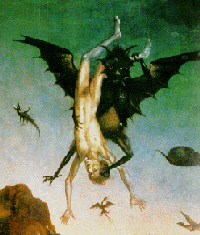
"I invite You to consider Satan as
a reflection of how we perceive ourselves and those we call 'others'. Satan has, after all, made a kind of profession out of being 'other'."
|
|||||||||||||||||||||||||||||||||||||||||||||||||||||||
| "YHVH" | ||
| Evil |
"ALHYM" the "Elohim" the "gods & goddesses" or the Divine Shekinah |
Good |
|
He creates the dark |
He forms the light |
|
|
Left Path Severity Tree of Death Damnation |
battle between good & evil tikkut by the Elect One Middle Path Tree of the Knowledge of the Difference between good & evil |
Right Path Compassion Tree of Life Salvation |
Clearly "YHVH" should always be situated above "good" and "evil",
for the essence of God is properly speaking "beyond Names". Nothing of the Divine Essence
is ever given, known, understood, prehended, revealed etc. Only the "ALHYM"
are associated with the problem of
"left" & "right", "chaos" &
"order", "night" & "day"... So God is good nor
evil.
The savage nature of pre-prophetic
Judaism reflects the wandering,
conquering Israelites. Moderation became necessary as soon as they got more
settled. Then God became more remote and absent, for He had his priests &
prophets. Mercy and the social responsibility of the individual came to the fore. The
savage "YHVH", the antinomy of opposites, became the "good"
Lord, who's Compassion (Chesed) is always stronger than His Severity (Geburah). Eventually, God became wholly good and evil was alien to His nature. The malignant aspect was
subtracted from "YHVH" and projected outward upon a negative spirit (cf.
the scape-goat and the
developments of this theme in apocalyptic literature - the Dead Sea Scrolls, the
Books of Enoch, Revelation). Of course, why the good God
would make deals with the Devil (a theme returning in the Koran) is
beyond rational grasp, leaving Abraham's religions in the darkness of
irrationality.
A fundamental and irreducible tension between explicit (masculine, paternal,
exoteric) monotheism and implicit (feminine, maternal, esoteric) semidualism
(between "light" & "dark") became a major feature of Judeo-Christian
spirituality. It is also prominent in
Sufism, the mystical
branch of Islam. For Ibn Al-'Arabi, the attributes of imperfection are part of
God's "Most Beautiful Names" mentioned in the
Koran.
Does this radical and consequent return to a concept of God resembling the
"YHVH" of pre-prophetic Judaism (and its adjacent determinism, predetermination
and fatalism) not invoke the confused and outdated persona of a terrible
and (?) compassionate God ? Had Judaism, under the pressures of
Hellenism, not abandoned this
ante-rational mindset
?
"There is only one God, but we
limited mortals seem to see him as a double figure, willing both good and evil. Since evil is, it must be the will of God. Yet God also wills the good against
the evil. Thus it can be said that God wills evil ; God wills good ; God does not will
evil ; God does not will good.
To our limited understanding, some things appear good and others evil, but
ultimately all evils are good, since all that God does is good."
Russell, J.B. : Mephistopheles,
Cornell University Press - London, 1986, p.36.
However, if all evils are ultimately good, then how is morality possible and why
should people refrain from loving (their) wickedness ?
Is this movement towards the exclusively "good God" fulfilled by
Christianity and the Messianic age of Jesus Christ ?
The Christian theology of evil
evil is non-being and God is ultimate goodness and being
Although, in a text probably
wrongly attributed to First Clement, we read he taught God rules the world with both hands, the right
hand being
Christ, the left Satan, later Christian theology (cf. Augustine) firmly adopted the
Neo-Platonic concept, which viewed evil as "privation boni", i.e. as
non-being devoid of goodness.
"We need not define God as absolute good and
absolute being and equate goodness with being. When we observe the cosmos we
intuit the immediate reality of evil just as much as we intuit the immediate
reality of good. Suffering is, just as joy is
; pain is, just as contentment is ;
ill will is, just as goodwill is. It
may be that God prefers joy and harmony and good will to suffering and ill will
; it may be that the former draw things closer to him, and that he has put
resistance to evil into his cosmos as well as evil itself. But none of these possibilities means that evils do not exist."
Russell, J.B. : The Devil,
Cornell University Press - London, 1977, pp.282.
Plato's own views on the "Idea of Ideas" were
completely focused on the goodness of the highest possible Idea, the limit of limits.
His was the ideal of a transcendent moral order. This led to a positive theology
("kataphatic") which affirms the most excellent qualities of God.
In the ontologies of Greek philosophy, evil had no real being at all, but consists in a lack of
perfection (privation). The world of ideas is perfect, wholly real and
exclusively good. Hence, as mere defect, as the holes of the Swiss cheese, evil does not exist.
"The absence of
food is a mere negation, but considered in relation to its surroundings, as an
empty stomach, it is hunger ; and hunger is a positive factor in this world of
ours. Sickness can be considered as a mere absence of health, but sickness is
caused either by a disorder in the system or the presence of injurious
influences, both of which are unquestionably positive."
Carus, P. : The
History of the Devil, Gramercy - New York, 1996, pp.454.
Plotinos conceived evil as privation.
In Ennead II 9, posthumous given the title "Against the Gnostics",
Plotinos links the essence of goodness (the Platonic "Idea of The Good") with
the Divine, called "the One". The idea of an "evil creator of the
world" is rejected. Although Plotinos is aware that to
"deny Evil a place among
realities is necessarily to do away the Good as well" (Enneads, I.8.15), he is unable
to define evil from within and initiates a negative interpretation of evil
exclusively based on what is known about the good, i.e. from without, ad
extra.
"If such be the Nature of Beings and of That which
transcends all the realm of Being, Evil cannot have place among Beings or in the
Beyond-Being ; these are good. There remains, only, if Evil exist at all, that it be
situate in the realm of the Non-Being ..."
Enneads, I.8.3.
According to Plotinos, absolute, primal evil is below all forms, shapes,
measurements, limits, "has no trace of good by any title of its own", a lawless
void, never at rest & ever-undefined. We can try to arrive at some conception of it by
"thinking of measurelessness as opposed to measure". Evil is the absence of good
("privatio boni"). This negative theory on evil became part of Christian
theology and was also adopted by Islamic philosophy.
"If evil is merely deprivation of good, why
should morally free agents choose it in preference to good ? If evil is the absence of good, whence comes malicious evil, deliberate
rebellion ?"
Young, F.M. : "Insight or Incoherence : The Greek
Fathers on Good and Evil.", Journal of Ecclesiastical History, 24,
1973, p.122.
The privation-theory of
evil was
adopted by Augustine & Thomas Aquinas and deeply affected the theodicy of most
Christian thinkers of the West. Plato's theology was inconsistent. If there is a God,
this God is
remote and hidden. The creator is a demiurge, a being inferior to God, not a
figure of worship but an abstract principle of goodness ("agathon") responsible for the creation
of an imperfect material world (contaminated by evil). This lack of perfection
is explained by the motion caused by chaos (existing before or with
cosmos - cf. the Ancient Egyptian
Nun), i.e. disorder and random, erratic movements. They exist but are not
created and so the good creator is not responsible for them. In Christian
theology, this argument did not work out, for God created the world "ex
nihilo".
Before creation, so Christian theology affirms, concepts such as the "outside" or "inside" of God have no
meaning. They are posited by the Will of God creating creation, separating
"before" and "after", "inside" and "outside". Nothingness has no existence
of its own. The "nihil" in "creatio ex nihilo" merely indicates
nothing but God's Will rose creation. God's creative Will is not bound by
any necessity, but lawless (not random) and absolutely indeterminate (but not
disorganized). Clearly incomprehensible.
The "Name of Names" in Christian theology is the Father of the Holy Trinity, Creator of all possible
goodness : love. In the Christian tradition, any incorporation of evil in the concept
of the Divine is refuted. The Divine Father explicitly does not create and
is not the cause of evil.
Christianity moralizes evil : it only exists in the will (of fallen angels and
wicked humans). In the early Judaic concept of the Divine, right (day, good) &
left (night, evil) were both created things. Theodicy was linked with cosmogony.
Chaos was an expression of the Divine. In the later Judeo-Christian concept, goodness belonged to the Divine (cf. Plato) and wickedness remains eternally
separated from the Divine in the "valley of death" (cf. Enoch). On the Day of the End, preluding the New Age, the corroded shell of evil is returned to the
pool and its contents neutralized. Satan is not restored but destroyed according
to the formula of Mordechai : (- 1) + (+ 1) = 0 !
Christians believe that during a "sacred night", the Incarnation of the
Saviour, the Son of God, was signaled by the hieratical rising of the conjunction of Jupiter & Saturn
in Pisces, ending the power of darkness. The redemption offered by the Son
of God terminated the association of darkness with the Divine (sustained by the "Old
Convenant"). Good & evil, day & night were for ever divided for the
sake of Divine goodness, redeeming all possible evil of those who accept to be
baptized and accept the Cross.
At the End of Time (when the Day of the End ends), the qabalah and apocalyptic
literature imagine a "Jubilee of Jubilees", the New Age of the New
Jerusalem,
integrating all possible aspects of the Divine both Transcendent and Immanent, both Left
& Right. However, in the Catholic and Orthodox version of the "Last Day", a duality is
left over (Paradise versus Hell) for Purgatory is emptied. This runs against the logic of
a final restoration, which has to end with a monad, not with a dyad. How can a
good God accept eternal torture in hell ? If He does, then clearly His
"goodness" is not "good" at all. If we escape by stating His goodness is
hyper-good, then how to understand the latter. It must include some "hyper-evil"
to explain eternal torture !
Alternative views,
like Origen's "apokatastasis" (or final restoration based on the idea of Paul
that "the Son shall at the last deliver up the Kingdom to the Father and God will be
all in all" (1 Corinthians, 15:28) were considered as heretical.
Satan cannot be saved. Why, if evil is rooted in the will, can Satan never
change his mind ? For the theologians of the Early Church,
bot Latin (Rome) and Greek (Byzantium), it was
clear that although God is good, the process of His Messianic redemption would not go on and on
untill the Divine had won back all souls, including the Devil, understood as a fallen
angel. They expected Christ back soon (cf. "the parousia" in
Jewish
Christianity), and things would be settled once and for all with the
Apocalypse and the Day of the End, leading to the New Jerusalem. The "prince of the world" (actually the ruler of those outside the
Christian convenant - "the others") is left behind or destroyed and can not be
repaired on the Last Day. The
projection is not retrieved and an unsatisfactory eschatological dualism ensues.
Satan is conceived as doomed for ever and ever.
"Leur péché est
sans retour, car les anges n'ont pas l'ambiguïté, la malléabilité, la
convertibilité qui caractérise l'animal raisonnable, ni ses capacités de
renouvellement à travers la condition temporelle et matérielle. Le péché de l'être purement spirituel est entier, tout d'une pièce. Il engage définitivement sa liberté et sa destinée entière."
Laurentin, R : Le
démon : mythe ou réalité ?, Fayard - Paris, 1995, pp.102.
If God created Satan as unable to return,
then obviously this cannot be the "fault" of the Devil, but of God as Creator,
inviting inclusive wickedness. An exclusive good God would not create creatures
able to do evil but unable to be morally restored. If He is good (or
hyper-good), then the Day of the End ends with unity (not duality). If the price
to pay for exclusive goodness is final duality, it seems as if the Devil has won
after all.
Origen, Pelagius, Augustine, Luther & Erasmus
Origen was correct when he considered a split "eschaton" to be a solution which imposed
a final
limitation on infinite goodness. If the Divine is Good, then nothing should escape God's
Mercy. For humanity, the Incarnation of the Son initiated the possibility of
complete
redemption and restoration (in the Holy Spirit). In order to defend God from the charge of injustice and arbitrariness, Origen
correctly defined the hierarchy of being as a diversity resulting from free choices.
However, like Clement of Alexandria before him, and in Neoplatonic style, he
muddled the ontology (how things are - descriptive) with morality (how things
should be - normative).
Also, insofar as the Devil (fallen because of lust or pride) is given
to evil (which is almost completely the case), he is almost wholly non-being.
Nevertheless, to fundamentalists, Satan is the most powerful force of evil in the cosmos
! So, how this
may be the case, without the Devil being out of control enough to hurt monism, is not explained (cf.
the "mysterium iniquitatis").
"Lucifer ne se
pense plus par rapport à Dieu ; il se pense par rapport à lui-même ... Il n'a
jamais vu Dieu et voilà qu'il se voit, lui. Et il s'éblouit ; et il se
complaît dans cet éblouissement mensonger et trompeur. Son coeur
s'enorgueillit de sa beauté."
Bernet, A. : Enquête
sur les Anges, Perrin - Paris, 1997, p.45.
Essentially linked with these issues is the problem of free will and the
question whether humans could help their "theosis" (deification).
Pelagians indeed stressed the fact that without free will, it becomes totally nonsensical to speak
of redemption. If creatures have no choice (everything being predestined), then
ontologically nobody is able to make a choice for the good. But, if we wish to exercise our
free will, then we have to be fully reponsible for the result of our actions.
God may help and assist, but He should not do the job.
Finally Augustine rejected the Palagians insistence on free will and left us
with another one of his inconsistent answers. The possibility of
free choice is the result of Divine grace, a meager result. Salvation is therefore a matter of
predestination and not of the free movement of the will, as ethics demands it
should be. His theodicy fails. For Augustine (the
Synod of Orange of 529 - article 23) we do good because we fulfill the will of
God. Rejecting His help makes us do evil. So without God, humans will inevitably
choose for evil. Free will is only necessary to reject evil. But although
Augustine insists on the accountability of the individual, ultimately God
distributes good and evil, and we do not know why some receive the one and
others the other ...
So we could end up as Job : good but nevertheless tortured by the Devil with
the consent of ... the good God !
An identical discussion took place between Luther & Erasmus. In his Heidelberg
Disputation (1518), Luther is clear : the free will exists in name only and
when "it does what it can it commits sin". Here Luther (cf. The
Bondage of the Will, 1525) stands in alignment with Augustine and the Synod
of Orange. This position has cast a dark shadow on Protestant theology. Without
the help of the Spirit of God, there is nothing
of the human in the human able to turn him or her toward the good, on the
contrary, left alone they all turn toward evil only. This solution reduces
reflects a poverty-mentality with regard to humanity.
In the mindset of Erasmus, the foreknowledge of God is not determining (for God does
not foreknow something so that it will occur but only because it
occurs) and so
free will is really possible. In his On the Freedom of the Will
(1524), Erasmus argues that Judas could have changed his will. The foreknowledge of God could not
have been compromised, for God would have foreknown even this and changed his
own Will accordingly to realize His goals, and this despite Judas potential turn
of mind ... Although Erasmus conceded the grace of God is the primary
factor while human free will remains a secondary cause, Luther moved towards
determinism.
the problems of traditional Christian theodicy
(1) The good Mercy of God is not fully acknowledged, for on the Day of the End, at the "End
of Time", the Devil is not restored, but allowed to
limit the grand finale of the Divine, namely God being all in All. One
should never pray for the
souls of the damned (for they are beyond help) and demons cannot be saved.
The most important quality of Divine goodness is
missed (cf. Origen).
(2) The evils of the world are not understood from within but derived
-through enantiomorphism- from the qualities of goodness ("Diabolus est Deus
inversus"). The rest is the "mysterium inequitatis". An
incomplete picture of evil is dangerous, for chaos is not suspected or
minimized. No creative & sustainable solution for the presence of evil in the
world is given. The unknown is inflated and demonized. If no clear model of evil
is available, we never know when we do good.
The mindset fostering ethical intent, namely to know in order to avoid, is
absent.
(3) By allowing the Devil (as Set, Mara, Satan, Iblis, Lucifer, Loki, Mephistopheles,
etc.) to play an important role in the understanding of
the massive presence of evil in the universe, traditional Christian theodicy
harvested the opposite of
what was intended (instead of glorifying God they cripple Him). For firstly, life
(which is never without some chaos - cf. postmodern chaostheory) is not grasped as
important (instead the return to the "house of our Father" is stressed and an
unworldly & anachronistic mentality is fostered) & secondly -far worse-
Satan is pictured as somehow out of control. Hence a manicheistic element creeps in
(Satan is eternally separated from the rest of creation) and so the omnipotence
of the Father comes under attack (He kicks Satan out & is unable -even at the end- to
change the rebel's heart). Christians prefer to invent a terrible monster outside the
Divine (able to challenge Him) rather than to accept
evil is the outcome of bad choice and hence repaired by a
change of mind ("metanoia"). When the Day of the End is past, there are no good,
merciful reasons to deny Satan his restoration and subsequent integration (as an
angel of light) in the New Jerusalem. This entails a change of mind of the
wicked one.
| Evil | Christian Trinity | Goodness |
| absolutely absent |
continuous battle between good & evil final restoration is an eternal division between heaven and hell purgatory is emptied |
absolutely present |
| hell of Satan eternally separated from God |
communion of Saints Paradise |
Catholic and Orthodox Christians prefer to maintain the
"mysterium
inequitatis" instead of accepting the logic of God's incomprehensible essence
and
the accompaning notion that in the end all turns out to be for the best
(cf. His
unlimited Goodness beyond good & evil, restoring evil). On the contrary, the proposed "final
end" is a state of eternal division between goodness & evil. This is a
very unsatisfactory solution from the point of view of the mystics (i.e. those who
experience Him). Also, evil not properly understood is bound to control us.
The original nakedness (cf.
Jan of Ruusbroec) of the soul has the
qualities of Eden : purity, freedom & nobility (cf.
Beatrice of
Nazareth). As freedom
of choice is illusionary without a real possibility of turning away from the good,
it must be acknowledged God tolerated the possibility of the rise of evil by
making in His Grand Plan potential anti-spiritual, immoral choices possible. This is not
the same as creating evil or sustaining it. To explain the Fall, both Philo of Alexandria
as Origen suggest the spiritual beings (angels) became sated with the adoration of
the Creator and fell by neglect, gradually cooling in their love. This is
unclear. How can a true God ever invite boredom ?
So the presence of evil is explained in terms of past choices & future expectations
of damned angels & wicked souls. Evil is always moral, not theo-ontological
: evil exists in the will.
Because in the Christian concept of the Divine, evil is completely exorcized, the Divine has no
shadow. The "Convenant" is "new and eternal". Righteous Christians
slain for Jesus Christ are called "martyrs" and "saints". The logic of
Christian sanctity is precisely this : when the good suffer and the wicked triumph, God is
asking the good to suffer for the sins of the wicked. Why would a good God ask
this if evil cannot be restored ?
moral evil = freedom without responsibility
Genuine freedom always implies responsibility
(cf.
Behaviours, 2006).
Although Christians may affirm God is our "Father", they should not expect
He is there "just to put things right for us". Because we are born to be
free & exert our will, we pay for all eventual factual damages (like
slowing down God's abstract Plan).
Although freedom through responsibility is a workable model to tackle the moral
issues concerning most cultural (moral) evils of this world, it can not explain
natural disasters, unexpected accidents, innocent death or the chaos in most
systems (except if demons are called in to explain the unexplainable or confuse
the confused).
| Evil |
ALLAH The God |
Goodness |
| absolute evil is nothing | nothing is like Him |
unlimited good (nobody is as good as Him) |
| loss, wrong, other than The God | His Self-disclosure : good, evil & beyond | benefit, right, The God alone |
|
Fiery Path of Iblis made a deal with The God Man & the Pharaonic Pretence |
the sublime harmony between all the Names in the Perfect Man | the "second command" or the revelation of the Koran and the tradition of Muhammad |
"Good" or "khayr"
is positive, useful, profitable,
beautiful. But, "there is no good but Allah". The opposite, "sharr",
is evil or lack of goodness. Hence it is nonexistence (cf. Ibn Al'Arabi). Good
only emerges from good. All what is good exists. Existence is goodness. Evil results when
creatures fail to share in existence, i.e. do not become what they were before
they became (cf. Junayd). Because evil is nothing, the proposition "there IS no evil
but Allah" is nonsense. Hence, "Allah" is unlimited Goodness, for no
creature is as good as Him, for there is nothing in creation like Him. His Essence is not
revealed, known or sensed.
"In reality, one does not say that the Real is 'free'. One says
that He is not a slave, since He can only be known through negative descriptions,
not through positive descriptions of self. However, the loci of manifestation exercise a
property upon Him in respect to the fact that He is the Manifest. Then all things
attributed to the locus of manifestation are attributed to Him, whether these be what are
commonly considered attributes of imperfection or attributes of perfection and
completion."
Ibn Al'Arabi : al-Futûhât al-Makkivva, II 502.21, translated by W.C.Chittick,
1989.
The disclosure of Allah is given with His 99 most beautiful Names. All of
these Names are "good", meaning they are the manifestation of The
God's unlimited goodness (but for each Name X the rule "there is no X but Allah"
still applies). Each Name deals with one of the 99 root-manifestations of
"Allah", and belong to His immanent order or revelation. The supreme (first)
engendering command which ignites these Names is : "Be" and
through them the Cosmos is created. Some of these Names deal with the essence of
"Allah". The Name "Allah" refers to the all-comprehensive
unity of all possible Divine Self-disclosures (through 99 Names).
From the point of view of "Allah" (as the totally other) the cosmos is evil & unreal. Inasmuch as He displays His signs in
the cosmos, the cosmos is good through His unlimited goodness. All creatures are a mixture
of evil & good. Only "Allah" is absolutely good and absolute evil does not
exist. The Real is never fully absent from the cosmos (His immanence) nor ever fully
present within it (His transcendence). The God's Essence however is His transcendence.
Good & evil are part of everything created by the engendering command :
"Be". All Divine Names demand loci of manifestation in the cosmos. All Divine
Names are good when conceived as essentially belonging to "Allah" alone. Because
they are the "formula" of creation itself, these Names also contain
"imperfection", in that they demand what we normally look upon as lacks and
deficiencies, like "the Avenger", "the Humiliator", "the
Dishonorer", "the Slayer", "the Punisher". But since
"Allah" is named by them, man to be perfect must also be named by them.
But, to the extent he does assume them (being part of his innate disposition) he must
take care to display them in the manner set down in the Law, i.e. the "second",
prescriptive command (given with the Koran). Otherwise, he risks to turn into
Pharaoh and say : "I AM THE GOD". This is why servitude is the
supreme "adornment" (or to become qualified by the Divine character traits).
The Law directs all traits into proper channels,
so "Allah" is satisfied. Although everything coming from
"Allah" is good (following the engendering command & by reason of His
unlimited Goodness), in the cosmos good & evil are relative factors, dependent of the
Law, agreeableness & individual desire. Moreover, in order to allow creation to
unfold, these "imperfections" are necessary. If they were not, there would be
nothing "other than Allah". Then there would be no cosmos. Hence, without
imperfection, the perfection of existence could never become. So evil is in essence good
(serves the purpose of The God's creation). Perfection however, is the essential attribute
of every creature, while imperfection is an accident whose essence is again perfection.
Three problems arise here :
(1) if all actual events are pre-determinated at the level of the Divine Names,
then there is no real free will and so no moral sense (no justice and true care) ;
(2) the danger of moral permissiveness is great (all evil being essentially a
higher good, we can always say : "Inshallah !") ;
(3) the return of a confused concept of God is clearly present : how can a
supremely good God allow Himself to be adorned with imperfect Names ? Is this
not a scandal ? Blasphemy ?
| Evil | Good |
| function of non-linear motion, randomness and formlessness | function of form, linearity & architecture |
| loss, destruction, entropy | gain, creation, negentropy |
|
process = from evil to good-in-evil to good |
process = from good to evil-in-good to evil |
natural chaos is a function of dynamical properties
Besides existing in the perverted free will, chaostheory puts into evidence disorder and unbalance are natural, dynamical properties of a system, i.e. chaos is restless, ever-changing and present as soon as three independent cycles are present. In the factual, natural realm of actual things, order & chaos cannot be separated. Order, goodness, sanity & balance are defined by a strong static architecture and its linear movements (symmetry). Especially complex living systems are characterized by order & chaos. Life itself can not be properly defined without the presence of non-linear, aperiodical, complex, irregular, not quite predictable, not completely erratic, more or less determinable movements (introducing symmetry-breaks). Often these movements are completely chaotic but can be characterized by a strange attractor in the phase-space depicting the route of the movement. This strange attractor is one of the gates to "new order" present within a chaotic system. Hence, chaos is ruled by a higher-order calculus. Natural chaos is a form of order (demons were fallen angels). Traditional theodicy remained too dependent of privation. Chaos is indeed a something, namely a positive type of movement expressing the rule of a higher-order, a meta-form. This is more than holes in a Swiss cheese.
in the natural realm of actual things
order & chaos work together
Chaostheory breaks away from a modern picture on being with its emphasis on a linear
approach. This is rooted in the scholastic notion of "chaos" as "privatio".
In such an approach, order-within-chaos and
chaos-within-order were unthinkable. A superdynamical interaction between order &
chaos was out of the question. As a result, no realistic interpretation of evil was
presented. The good resulting from complex systems learning to steer chaos well
was
not appreciated (the formula of Esther ignored). Non-linearity taboo.
In the traditional (modern) view on the process of change, chaos was situated between two
homeostatic levels : level 1 > chaos > level 2, etc ... Balance, equilibrium, stability,
immobilism & continuity were seen as fundamental. In the dissipative theory of Prigogine, this
equilibrium is rejected. The theory of non-equilibrium explains the processes of life,
whereas the traditional view applies to physical systems only. The equation
relevant for
highly intelligent systems is therefore :
non-equilibrium 1 > chaos > reequilibration 1 > non-equilibrium 2 >
etc ...
distinguishing between order & chaos
in the factual side of actual
things (manifest being)
The realm of (nominal) being (the world of facts or actual things) is a compound of order &
chaos. As
we know, life on Earth is not limited to constructive, stable & predictable
forces (cf. the normal stresses operational when various natural cycles confront
each other). Evolution
evidences the tenacity with which intelligent systems overcome massive
turbulence. The choices we make -as
free actors and co-creators of being- will define our ability to steer chaos well.
Excessive order & excessive disorder destroy the fabric of life.
Modern culture & conditioning is based on the dyad. So most choose for their little order and reject, repress or
discard chaos. They do not
implement a conscious attitude towards chaos (the "tertium comparationis"
needed) and make this grand chance of evolution-through-crisis unconscious, causing the
periodical emergence of unwanted, non-evolutionary chaos with its
turbulent, barbaric, horrific & terrific features. Because at this point the
strange attractors are unknown, nothing of the emerged chaos can be integrated
into
consciousness, stored into memory and used for later confrontations with this or other
types of unstable & unpredictable chaotic movements. So repression (the 'wrong' kind of silence) is never a creative
solution and will never allow a system to understand the chaos at hand and move
to an even higher level of conscious functioning, with better knowledge, better
understanding and more awareness.
distinguishing between factual actual things
& the abstract
interventions of God
"Divine actuality" (God's immanence or presence
in His creation) is the best part of
created being. It is as it were a
permanent trace of the purity, freedom & nobility of the Creator. As
nominal being is the actual, factual existence of the things objectified by our rational
mind and our senses, Divine existence & its hierarchy can metaphysically "be" nothing more than
a world of abstracts able to serve the
Creator at work in the actual world. These particular abstracts co-determine the flow of events which constitute nominal
existence and this by influencing the probable outcome through their respective form, code,
information (cf. God as the Lord of Possibilities - cf. Whitehead). So although seemingly separated from the factual actual world, the Creator (cf. the
"superforce" or ultimate abstract) weighs certain probabilities,
allowing them to manifest as a change of affairs in the state of actual things.
The presence of evil in the factual realm is to be expected. The natural kingdoms of Earth
(mineral, vegetal, animal, human) each have their own degree of liberty. Clashed between
independent evolutionary movements often occur. Those caught in the clash name
it "evil". The more evolved a system is, the more
capable it plays the game of survival. The cultures of humanity are proof of an excellent
degree of freedom. This means the human has to stand up by his own (cf.
Marcus Aurelius). Only
when a paternalistic concept of the Divine is maintained can the so-called
"silence" of God be interpreted as proof of His triviality. Modern atheism is based on
a pre-chaotic & outdated concept of Divinity and is primarily directed against
(and the reversal of) traditional Christian fundamental theology (denying evil
its existence, and hence excluding it a priori, even as a mere
possibility).
In fact, humanity is called to exercise its free will in concert. A confrontation with evil
(both natural & moral) is necessary to understand the conditions of life on
Earth. The
majority of scandalous evils are the direct result of human unwillingness to face
its own mismanagment and incompetence. Pride & lust indeed lie at the root of all
moral sins. The most vile criminal may exercise free will without personal
responsibility (cf. the dictators of the previous centuries). It is true accidental evil is very difficult to accept, but it too is
part of a factual realm characterized by the ungoing movement from order,
chaos-within-order, chaos, order-within-chaos to new order, etc. In the great majority of cases, humanity is called to realize it should blame
nobody else for its many problems. Atheists can not disprove God by discharging
humans.
In the philosophy of Albert North Whithead
(1861 - 1947) and Charles Hartshorne (1897 - 2000),
God's omnipotence is not coercive, but persuasive, meaning God does not exert
unilateral control. The universe is a wholeness of events experiential in
nature, with both a physical and a mental aspect. All events are important and
contribute to the ongoing, interrelated, creative process of reality. Hence, the
universe is characterized by process and change carried out by self-determined
agents. Everything in the universe, not just human beings, have this power of
self-expression & creativity (novelty). God cannot totally control events or any
human, but, as the "Lord of Possibilities", influences the exercise of this
universal free will by offering possibilities to every possible event. God has a
will or a say in everything, but not everything is God's will. God contains the
universe all-comprehensively (surrelativism), but is not identical with it
(pan-en-theism or theocosmocentrism, not pantheism or pandeism). Insofar as God
interacts with the universe, God is changeable and affected by these events.
However, the abstract elements of God (goodness, wisdom, etc.) remain eternally
the same and set apart from the universe. By his Divine "lure", God is the power
in the universe inviting a multiplicity of free, deciding actualities to work
together so goodness, beauty & truth may come about.
A real and mutual (in both directions) relation exists between God and the
world. He is not an impassible ruler or "Ceasar" of the world, but an
understanding Fellow-sufferer. In the realm of the finite actualities making up
this universe, God is related in two ways : a primordial (eternal) and a
consequent one (everlasting).
God's primordial nature is transcendent and does not touch the universe and
offers to all events the possibility to constitute themselves. If not, nothing
would happen. God does not decide, but lures. There is no efficient causality at
work here, but a teleological pull inviting creative advance. Given the
circumstances, a tender pressure is present to achieve the highest possible
harmony. God is the necessary condition, but not the sufficient condition for
events. God's purpose for each and every event is, given all conditions
determining it, that it may contribute to the realization of the purpose of the
whole universe, the harmony in diversity. God is the abstract actual entity making it possible for the multiplicity of events to end up in
harmony. This aspect of God is permanent, eternal and not linked to time &
space.
God's consequent nature is God's concrete presence in the universe, being near
all possible events and valorizing them to bring out harmony and the purpose of
the whole. God is a tenderness loosing nothing that can be saved, i.e. that
wants to be saved. Hence, God's experience of the world changes. It always grows
and can never be given as a whole. God is loyal and will never forsake any
event. God knows all actual events as actual and all possible (future) events as
possible. He does not know all future events as actual. This is a category
mistake.
And evil ? As actual entities in varying degree are free to decide for
themselves, there is no entity able to forsee, in concreto, what will happen. It
is a matter of probabilities. God wishes the best for the creatures, but not
without their own input. Evil happens at the intersection of numerous free
events & choices. All entities, except God, decide without witnessing the whole.
Probably the same causes eventuating the good make evil inevitable. God does not
want evil, but cannot interfere. God is vulnerable. Contrary to the other
entities, God has an absolute future and does not succumb under the pressure of
evil.
A change of perspective is necessary to allow the consequences of chaostheory to
have a positive influence on the traditional tenets of philosophy in general and
theodicy in particular.
The rational elaboration of the relationships between God and evil & the study of the
possible "good reasons" for evil in creation, cannot ignore the
factual presence of chaotic movements. Nor does their presence negate the good
God, as atheist would like. At best, they show the need of a positive definition
of chaos and evil. As most religions develop an
ethical system to socially organize their followers, insights into their theologies of
evil were more than needed. Comparative studies often reveal nothing more
than a variety of outdated discourses and ignorant piety.
The Platonic idea of evil has to be firmly rejected, for these notions contradict
the findings of our modern & contemporary sciences : chaos & order form a pair and
no workable definition of "life" is possible without both. Moreover, if
non-linearity & the non-Fregean approach (expressing some of the "logic" of
chaos) are exorcized, the result is sterility, dogmatism & fossilization. In a way,
both Christianity & Islam (both firmly adopting Plotinos' notion of evil as "privatio
boni") contradict themselves : for if evil is a nonexistent, then clearly no active
Satan or Iblis is thinkable. Nevertheless, in the legends of both religions, Satan is
accused of most of the terrors of creation ... This is inconsistent with the nonexistence
of evil.
Judaism, Christianity & Islam are unable to articulate a theology of evil which
satisfies the findings of chaostheory, namely :
it is necessary to deal with evil as an "existent thing" (always tending towards the greatest possible randomness) and
no living process is totally devoid of non-linearity.
In the scholastic interpretation, mathematical zero (nonbeing) is
equated with evil, whereas in
postmodern chaostheory, the chaotic function always finds -for
the time variable going
to infinity- its limit in zero. There is a subtle dynamical difference
between both. The first presupposes a static framework, suggesting evil
(as nonexistent) and good (as being) are for ever fixed in their respective stations. The
latter is devoid of such an idea, and understands isolated chaos (and order)
rather as exceptions, for
factual existence is continuous movement & transformation of
order into chaos and vice versa. Nonbeing is then the
limit-idea or mental construct of what really happens after an infinite time has elapsed. In actual
fact, good & evil are always intermixed, and, for the absolutely Absolute
good God, the mixture itself is evil.
To position this theodicy historically, let's distinguish between four theo-ontological models of
the Divine :
Semitic model : God is One and Alone. He is an unknown Divine Person responsible for good and evil alike (cf. Judaism & Islam). The advantage of this position is its universality, for natural evil and moral evil can both be understood as of Divine origin. God's will creates good and evil, although for us humans He wishes good only. We have to protect ourselves with God against God. The problem is God's remoteness, which contradicts His Presence in creation and in people, as well as His direct experience (mysticism) ;
Greek model : God is a Principle of principles, the best of the best (Plato), the unmoved mover (Aristotle), the One even ecstacy does not reveal (Plotinus), impersonal and in no way evil or tained by absence or privation of being (cf. intellectual theologies, humanism, agnosticism, atheism). The problem here (as in Christianity) is the "privatio boni", which contradicts natural inquiry and chaos theory. Furthermore, as the ultimate spiritual experience (ecstacy) has no subject, it is not really an experience (cf. Plotinus and the experience of the One) ;
Christian model : God is One essence in Three Persons, the Triune God revealed through Christ and completed by the Holy Spirit, never impersonal and cause of goodness (Christianity). Clearly, to the Greek disadvantage (evil cannot be an object of thought) another is added : the personal nature of God anthropomorphizes the Divine, albeit exclusively in the Person of Christ. Also its theodicy is defunct : if evil exists only in the will (cf. Orthodoxy), natural chaos cannot be explained (and hence Christianity does not favour natural enquiry and the scientific study of the world) ;
Oriental model : God is One impersonal essence at work in a complex manifold of personal & impersonal self-manifestations (theophanies), in which God reveals Himself (Herself, Itself), as in Ancient Egypt, Hermetism, Hinduism, Taoism and most mystical philosophies. God is the Author of good and evil, although moral evil falls within the responsibility of man. The moral law is part of creation ("Maat", "Dike", "karma", "dharma") and retribution is as sure as are cause and effect. The personal nature of God can be directly experienced. Although the impersonal nature of God does not interfere, all Divine self-manifestations are "powers" (natural laws) regulating nature. Buddism offers an exception : there is no God but only the Dharma. Good and evil are relative and belong to the conceptual mind. There is no evil which cannot be purified.
Consider the following
:
1. God transcends good and
evil alike. The Platonic "summum bonum" is not placed upside down
(Nietzsche), but the notion of God being outside natural chaos is rejected ;
2. Creation is always a mixture of order and chaos ;
3. As soon as three independent natural cycles emerge, natural chaos is a fact.
This is a positive entity, not the absence of being. Not unlike the sigils of
demons, chaos has formal characteristics, the "strange attractors". They seem to
be doorways to a higher dimensional order and because of them chaos has
properties ;
4. With the denial of the laws of order, moral evil enters creation because man's
consciousness settles in the omnipresent natural chaos and sedimentations of
moral evil ;
5. God keeps natural chaos and moral evil within a certain compass by
weighing probabilities. Temptations, perversion and
violence allow people to make a true, existential choice for what is the best
for each one of us ;
6. Creation is a freedom-engine. God created a being other-than-Himself
and gave it the possibility to trespass and transgress. If He had not done so,
no greater good could be realized, namely the sublimity of a free creature returning
by its own intent to God ; the greater good of a willed salvation and an even
greater liberation ;
7. True freedom, as true love, is always responsible, for only the fool sees his
bad choices return to him. The choice for the greater good knows the
transgression it rebukes ;
8. The closed system, linear as well as elliptic, is an exception, for the
transformation of differences (or energies) is crucial. Evil and chaos may be
transformed into goodness and order (and vice versa). Two evils may produce a
good ;
9. In order to be able to choose, like the surfer, for the natural chaos
suiting one's local purposes, a human being must learn to name, understand and
integrate his or her shadow (cf. Jung). Using the formula of Esther, people have
to neutralize their moral evils in the "black box", and they have to firmly
refuse to project or work out their own natural and moral wickedness upon others
;
10. Unitarism is the only solution of a rational theodicy : at the end of time,
only God is left. The hyper goodness of God is however beyond creation,
beyond good and evil.
|
SEMIDUALIST
To be consistent with Mediterranean spirituality since Ancient Egypt,
this
essay conjectures a pan-en-theism beyond tales. On the one hand, the
essence ("ousia") of God is one sheer transcendent being and
therefore ineffable and singular. On the other hand,
God's immanence, personality,
existence, energies, names or pluralities are every thing there is, except for the
sedimentation of evil choices and all natural turbulences and their
effects (contained by God). LIBERALIST This
semidualism (God and the Devil are two) is against determinism and
fatalism.
It defends human freedom. It is liberalist. Without free will, or a
choice slipping through uncertainty, ethics and thus responsibility
are impossible. Determinism and solipsism
avoid the confrontation with action, either by mechanizing it
(eliminating the random, stochastic factor, the uncertainty typical
for natural process, in this case : human choice), or
by non-action ending in quietism and a-morality ; the curse of
great civilizations, destroyed because they are unable to adapt to
constant change. UNITARIST
The unitarist envisions God's Mercy to return all to All, implying
unity in the beginning (before creation), unity in the permutations (during
creation) and unity at the end (after creation). Hence, eventually
all evil will somehow return to God who wants the happiness of every
creature (cf. Origen's "apokatastasis" or the Sufi "cooling of the
fire" - cf. Ibn Al'Arabi). |
This semidualist, liberal and unitarist position is more or
less logically sound,
but cannot eliminate the problem of all theodicies
accepting the (hyper-) goodness of God. Understanding the
truth of suffering excludes accepting vague explanations about why so
much evil is going on. Why does God not intervene ? Even a human
father would not allow his children to play with a smoking gun. So why would God ?
Perhaps Sartre was right : the presence of suffering is the best proof no "good"
or "hyper-good" God exists (cf.
Does
the Divine exist ?, 2005). This may leads into the obscurity of
inclusive wickedness and the acceptance of the Devil as the lowest degree of
God, making diabolical sadism like the Holocaust the expression of the
wickedness, cruelty and perversion of God Himself ! Clearly no clear concept of
Divinity is possible if this is allowed.
Being mindful of Ockham's Raizor, we may ask
whether natural causes, abuse of free will and its solidification not
suffice to explain evil ? Is the massive amount of evil just the
outcome of natural (including non-human agents of chaos) & cultural causes ? If
so, then theodicy is superfluous, for evil is nature-made and man-made. Natural
evil is the result of a wide range of determinations, and depends on material
conditions. Cultural evil increases entropy, triggering degeneration,
decomposition & destruction. Solidifying these acts of will in ego-systems and
their processes is "diabolical". But as they depend on conditions, they too can
be reversed.



|
LULU SPOTLIGHT |
initiated : 11 XI 1997 - last update : 20 III 2009 - version n°10
final version