Recently, new
information about the historical authenticity of the sacred text of
Islam have become available. They alter the analysis done here. Please
consult :
https://www.pfandercenter.org/
 Assalamu
Alaykum ! Portal to a plain
Recital
a critical approach to religion & mysticism
the reception, composition & redaction of the Koran &
a vertical approach of
spirituality
© Wim van den Dungen
"Our messengers came to Abraham with good
news. They said : 'Peace !'
'Peace !' he answered. And he waited not long before he brought a roasted calf."
Koran :
11:72
"The servants of
the All-Merciful are those who walk on the earth
with modesty and who, when the ignorant address them, say : 'Peace !'"
Koran
: 25:64
"Those who believe,
and do deeds of righteousness,
shall be admitted into gardens underneath which rivers flow,
therein dwelling forever, by the leave of ALLAH.
They shall be greeted there by this word : 'Peace !'"
Koran
: 14:28
Introduction
1
The critical approach
in religion & mystical experience.
1.1
The importance of critical philosophy.
1.2 Major differences between religion, religious experience and mysticism.
1.3 Religion & criticism : a few historical remarks ...
1.4 The challenge of comparative mysticism.
1.5 The ontological illusions of the religions.
1.6 Main areas of critical study of the religions.
1.7 The criticism of Islam ?
§ 1 the redactions of the Koran.
§ 2 The absence of a
redaction ordered by Muhammad.
§ 3 The originality of the contents of the Koran.
§ 4 And what after Muhammad
died ?
§ 5 The rise of orthodoxy
...
2 The authenticity of the Koran
:
intra- and extra-textual evidence.
2.1 The intra-textual evidence :
the guarded tablet, the transmission of sense, the abrogated and Satanic verses,
the limitations of the recipient, the variations and the Arabic
tongue.
§ 1 The guarded tablet versus the revealed copy.
§ 2 The guarded tablet and the celestial library.
§ 3 Transmission of the sense only.
§ 4 Abrogation of verses and the Satanic revelations.
§ 5
Muhammad's limitations, the lost texts and interpolation.
§ 6 The variations.
§ 7 A recitation in Arab.
2.2
The extra-textual evidence :
the verses, sûra's, pre-amble, mysterious letters, the
bismala.
§ 1 The verse : a set of revealed signs.
§ 2 The sûra : a chapter of revealed themes.
§ 3 The isolated letters : original divisions.
§ 4 The preamble : introducting a chapter.
§ 5 The "bismala".
CONCLUSION
3 The 12 hermeneutical levels of a
Koranic critique of Islam.
4 The vertical approach of the "fact of spirituality".
4.1 Some general considerations.
4.2 The case of Islam.
4.3 The spiritual message of the Koran.
5 A few characteristics of ritual, liturgical recitation.
6 Elements of the arabesque.
Final Remarks
TOWARDS A PLAIN RECITAL :
The Opening & the Cow |
Introduction
This essay serves to introduce an
English redaction of the Koran, of which the first two chapters (The
Opening & The Cow) are published on the internet.
The intention to move towards a
plain English redaction of the Koran (or Qur'ân), the
recital of Islam, came with the discovery of different
original Arab redactions of the Koran, as well as various
translations of the canonical Arab text. Sound translations in Dutch,
English & French evidenced various possible "approaches", whereas in
Sufism, the
great mystics of Islam made use of the "roots" of the Arab
words of the Koran to justify their theologies & mystical
philosophies (their champion in this being Ibn'Arabî). Moreover, for a number of "key
problems" there is -as usual- no other way left than to decide on
the basis of the original language of the text.
Everytime a problem was encountered which demanded the command of Arab (both linguistically & intuitively),
native speakers were called upon. A plain redaction on the basis of
different translations in English, French & Dutch could thus continue and be
completed. The outcome of this is therefore a redaction rather than a new
translation of the Koran. For is the Book translatable
?
Clear semantics, a fluent style, the identity of the author and a critical
reading were important
general hermeneutical guidelines.
-
clear
semantics : a lot of translations prefer complex sentences and a
complicated choice
of words, while maintaining the "Thee" and "Thy"-forms of
the biblical tradition. This obstacle had to be removed if a plain text had
to be the outcome ;
-
a fluent
style : when it was discovered that a plain English text could be arrived at,
no trouble was avoided to make sure that the overall style remained simple
and straightforward ;
-
identity
of the author : besides focusing on the meaning of the text we must
try,
by means of the text, to catch a glimps of the identity of the Author of the
Book.
It is inevitable that every book contains traces of the psychology &
philosophy of its author. This is also the case with the Koran,
a book in which ALLAH is speaking in 113 of the 114 chapters. To remember the
Author of the Koran is the most challenging, interesting &
rewarding feature of this work ;
-
critical
reading : let us distinguish between
three kinds of signs :
(a) in green : the essence of
the Recital, considered transhistorical, like all spiritual themes, stories and verses touching upon the unity of the Divine
as well as these elements which constitute the particular form of Islam
worship (like the direction of the Ka'ba, the food laws, the fast, the
pilgrimage, etc.)
(b) in orange : containing elements which need
to be reinterpreted in the light of historical circumstances, like the
laws for slaves and by extension all legal matters ;
(c) in red :
conflicting with the universal declaration on human rights and
possibly interpolated and/or purely historical & circumstancial, like
severing the limbs of thieves, whipping adultors, beating women, placing
woman a degree below men.
My study of Middle Egyptian enabled me to understand
the functional role of an unvoweled consonantal system, as well as appreciate
certain grammatical features which Egyptian has in common with
Arabic : the absence of the verb
"is", some of its verb & noun roots, its pronouns, two genders
with the feminine marked by the ending -t, the system of number and the endings
used to denote plural & dual, the presence of the stative as well as the
important aspectual distinction between "perfective" (state) and
"imperfective" (action) forms.
Egyptian verbforms recorded two aspects : the perfective singleness
(momentariness) of state or the imperfective continuity of action,
once considered to be fundamental (cf. the outdated verbal system of Sethe &
Gardiner). Particular forms
to indicate past and future time existed. However, as in Arabic, Dutch, German and
French, Middle Egyptian had a "static" verb form,
expressing a state of being and the result of a completed action. In
English, the past participle of most intransitive verbs can be used
instead, but this always expresses an action, never a state. Hence, English has
no stative. The French sentence : "Le soleil est paru." can
easily be translated into Dutch ("De zon is verschenen.") or
German ("Die Sonne ist erschienen."). In English, it has to be
rendered as "The sun has appeared.", for "The sun is
appeared." makes no sense.
Egyptian belongs to the Afro-Semitic languages such as Arabic, Ethiopic,
Hebrew & Hamitic -North African- languages such as Berber and Cushitic.
With the discovery of the bones of the free Egyptians who had built the Great
Pyramids (to erect, ca.2500 BCE, the pyramid of Khufu, ca.20.000 workers had been
placed in rotation for 20 years) and the comparison of its ancient DNA with that
of contemporary Egyptians, geneticians could prove a direct ancestral
relationship between the Ancient Egyptian builders and their Arab speaking
off-spring (although ca.4500 years stands between them).
In previous studies of Ancient Egyptian spirituality
(cf. the theology
of Memphis, the Aten of Akhenaten, the
constitution
of man and To Become a Magician) a distinction was
made between the mythical, pre-rational & proto-rational stages of cognition (Piaget) and
their co-relative presence in the genesis of Ancient Egyptian language and its
"magical" (power).
In her recent publication, Sagesse Sémitique : de l'Égypte ancienne à
l'Islam (1998), the French egyptologist Claire Lalouette tried to define the
broad "Semitical" horizon on which the images of the ancient
Middle-East dawned to enlighten the heart of both Ancient Egyptian, Judaic,
Christian & Islamic spirituality.
The re-assimilation of Ancient
Egyptian civilization also allows African civilization to be part of the total
picture of a possible multi- and meta-cultural model on human spirituality. This allows for a more refined understanding of the two major
historical events of Mediterranean Antiquity : Greek rationality and the birth of Jesus,
"the Christ" :
-
With Greek rationality, proto-rationality was superseded, i.e. the concrete
particularism and/or geo-sentimentalities and their patronizing influence on
cognition were eliminated by abstraction and stable concepts used in a formal
scheme. The Greek temples were finished constructions, whereas the Egyptian ones
were always open to allow context & concrete eventualities to demolish, add
or reconstruct structures. The Greeks liberated the mind by linearizing it.
-
The teachings of Jesus "Christ" introduced the principle of one's personal
conscience in the face of God. Everybody could be forgiven & saved.
Everybody could be damned. To each human his choice.
In Ancient Egypt, the theological realization of the Great One with many forms came
with
the New Kingdom, although the mythical and pre-rational forms of the "Great
One" were attested in the Old Kingdom and continue to play a role
throughout Egypt's long history. Ramesside theologians invented the idea of a
"divine trinity", which returned in its rational form in neo-Platonism
(or substance by itself, in relation & as returning).
The various forms of this "hidden"
"King of the gods" called
"Amun") were his outer manifestations or epiphanies and first among
these was the creator-god Re, visible to us as the sun (hence,
"Amun-Re"). They are the gods &
goddesses of creation. Only in Amarna theology (under the reign of the heretical
king Akhenaten), was Egypt briefly forced to accept that
the "Aten" (the physical light of the sun) was the sole god and
that Akhenaten was his only prophet. The experience was repressed but is,
thanks to the climate of Egypt, a fact of history (whereas Moses is completely
of memory).
In Genesis, the theology of Akhenaten was perfected with great success by
excluding all imagery of the Divine (cf. next to the inevitable pictorial
features of Ancient Egyptian culture, Akhenaten's theology had made ample use of
"light", "disk of the sun", "rays as live-giving
arms" etc to explain his concept of the One). The Hebrew "name" of the "Great One Alone"
was "YHVH ALHYM" (or : "Yahweh Elohîm"). "YHVH"
referred to the "hidden" Essence (or Face) of God, whereas
"Elohîm" was a plural to indicate the Divine Names or Existences of
God. In the Greek translation (the Alexandrian Septuagint),
"Elohîm" was replaced by "Theos" or "God" (i.e. a
plural by a singular), eclipsing the modi operandi of Divine Presence !
In Greek rationality, the Supreme Being was the object of philosophical
discourses. The ultimate idea in Platonism, the unmoved mover for Aristotle ...
This Ultimate Being or "first cause" was understood to be identical
with the material world (as in Stoicism, allowing for a "logos" of a
subtle material nature) or transcending the order of being (as in Platonism &
neo-Platonism). These philosophical conceptions did not offer redemption &
salvation. For Plotinus, liberation was understood as the outcome of a purification of the
soul, a return to its original state. The soul was able to do this unaided.
Although helped & guided, nobody could and should take away
that which prevented the soul from reuniting with the One. Contrary to the
Semitical theologies, Greek mysticism needed no salvic archetype (as was
Pharaoh in Ancient Egypt and the Messias in Israel). This intellectual
approach (cf. Plotinus), was clearly for an elite and did not attempt to understand
the devotional difficulties & barriers encountered by ordinary people who
trusted in the national deities of Greece or Rome.
In Ancient Egypt, Greece or Rome, the deities
were the occupation of only 10% of the population. Popular devotion existed, but
could not compete with state religion, on the contrary, it was at work at its
periphery. And so the rich and powerful could more easily win the favor of the
deities. In Q1 however, the historical Jesus only speaks of the
merciful "Father"
and teaches utter simplicity, renunciation of the world, charity &
unconditional trust in His love. He reduced the complex Hebrew law to a few
precepts : the love of God and the love of the other as your own self. In
Paulinian Christianity,
everybody was called to be baptized & reborn
"in Christ" (also uncircumcized males and criminals). Jesus "Christ" liberated the soul
irrespective of anything the bodily passions and the ruses of the mind might
have done or do. After the "Deus ex machina" of baptism, the old
world was eliminated, for the kingdom of Elohîm had come to light in one's most
inner chambers of intimate consciousness (that's why later Constantine was
baptized just before he died !) ...
Around the time Jesus
was born, the ancient gods and goddesses seemed to have become powerless and philosophical
discourses were unable to put the soul at ease (quite on the contrary). The
spiritual vacuum of the time being an indication that an epoch had ended. With the
rapid rise of an organized Christianity (late 3th century), the institutional phase
of Christianity (initiated by First Clement) was consolidated by Constantine as
Roman Catholicism (making the actual Catholic & Pontifical Church the last imperial
order on earth).
As Early Christianity indicates, Jesus was
a Jew who founded a Jewish sect (and there were many around). Among the Jews, Messianic expectations ran high, for Hellenized Judaism
under Roman occupation failed to satisfy the
Semitical vision of the "golden age". The first
followers of Jesus (the embryonic social formation of original folk witnessing
Jesus at work) were Jews interested in his teachings. They must have been much
impressed by his spiritual force and charisma, often forgotten by those
intellectuals who, two millenia later, never experience spiritual states and/or
never witness the charisma of mystics and those humans adept to be truly
themselves, called "saints", "guru's", or
"masters" etc. To them, Jesus was the Messiah. They composed Q and
the various stories told about Jesus. Paul, who never witnessed Jesus while he
was alive, universalized Jesus and transformed the adjectival use of the word
"Christ" (by the original Jewish Christians, as in "Jesus, the
Christ") into a nominal one : Christians are told that they are
"in" Christ, or belong to the mystical body "of" Christ. If Jesus "Christ" was the Messiah of Israel, then Judaism ended were
Christianity began.
Christianity had answered the call of late Hellenistic astral millenarianism (and Jewish Messianism)
and it had successfully superceded the boundaries of race, gender & nationality.
It was a "universal" religion of the One Supreme Being and would
subsequently try to use rational thought to justify its claims (early Christian
philosophy till Thomas of Aquinas). However, ironically, early Christian
churches were fundamentally divided regarding the nature of Christ, both
onto-theologically (Where does Christ stand in the salvic model ?) as well as anthropologically (What is the nature of Christ ?). Also Christ's miraculous
presence in the holy host remained a crucial matter of debate, for East
(Constantinopel) and West (Rome) differed regarding the precise moment this
miracle actually happened during Mass (and thus had conflicting liturgical
practices concerning an essential spiritual enactment, namely the true &
continuous Presence of Christ during Holy Mass !). These scandalous division of Christianity
fixated the dogmatic attitudes and many "consensual" Christ-models saw
the light (of which, in both churches, a lot were condemned as heresies).
How can the religion of the "One Being" remain justified, if inner
conflicts divide it ? It can not. Hence, around the time of Constantine,
Christianity became divided (in accord with its neo-Platonic schemes) in clergic
(active) and monastic (contemplative). Is it surprising that the Christian
monastic tradition was initiated in the South of Egypt ? Or that those who
started it, had enough of the administrative centrism of Rome and Constantinople
? Of course, monasticism had to follow the rules of the bishops, patriarchs
& popes. Hence, the early monastics (and later the mystical monastics) were
not trusted (for heresy and non-centrist "gnostic" -read : prophetic-
uprisings had to be avoided - cf. the 5the century Nag Hammadi hiding). The
"monastic rules" and the "walls of Pachomius" were indeed
invented to keep the monks within certain centrist parameters. But these
were apparently broad enough to allow genuine Christian spirituality to blossom and so
let us affirm that the purest expression
of Christianity is found in monasticism. For it is close to the true life of its founder, the laconical
wisdom-teacher who taught Q1.
The Christians who, in the 6th century, spoke with prophet Muhammad, peace be with him, were probably not
Roman Catholics. But it is likely that they spoke about them. Scholars found spurious data of so-called heretical sects, like
the Christian Gnostics
of Basilides and the Marcionites. We also know that Muhammad had a Coptic
handmaiden called Mary (Coptic was the last phase of Ancient Egyptian).
So it is also likely that the prophet of Islam was aware of the schisms and
conflicting views within the Jewish faith and had knowledge of Zoroastrism.
Marcion, who founded his own church,
was excommunicated by the church of Rome in 144 CE. He had reinterpreted
the gospels, did not accept the writings of the apostles and claimed that they
had misunderstood Jesus (apparently Marcion was right). In his
teachings, he eliminating the physical body of Jesus (early docetism).
Monophysite theories must also have circulated. In these teachings, Jesus had
another kind of physical body than ordinary people, i.e. he was primarily Divine
and not human as other humans. The Christian gnostic elaborated all kinds of
fantastic notions about Jesus and maintained that an evil deity had created the
universe, not the merciful Heavenly Father of Jesus "Christ".
These various schisms within early Christianity were answered by Muhammad's
fundamental teaching (in accordance with the Koran) that ALLAH has no second. The
Philonic "logos as second God"-model (rooted in Ancient Egyptian
filiation between Pharaoh and the creator-god Re and Jewish reverence for the
Messiah)
was radically rejected. The monophysite model (Jesus is only Divine) as well as
the Nicene "son of God"-model were discarded as the most serious
basphemies ever ! If a monophysite model was used, then in it, Jesus was a human
like us all.
For how could ALLAH have a second and be the One Being ? Either ALLAH is ALL or
He is not ALLAH. If there would be a place for the "son of God" to be
really this son, then the absolute would somehow be limited by this filial reality. As
ALLAH is absolute and unlimited there can really be no "son of God".
Ergo, to claim that there is a "son of God" is to deny the absolute
His Absoluteness. What can be worse ?
When Islam started to conquer foreign nations, it usually considered those who
adhered to any of the "false" ideas about Jesus "Christ" as
its enemies. For the Koran contains many signs dedicated to Jesus, a
prophet gifted with the spirit of holiness, and who is called "the
word" (i.e. "logos"). This adjectival use of "logos"
being in harmony with how first century
Jewish Christians had seen Jesus, namely
as "the Messiah". For them, the name "Jesus" was powerful
(in Hebrew, this name "splits" the secret Name of God : YHshinVH = Yeheshua, with the spiritual letter "shin" as copula).
"Christ" was the Greek version of "Messiah", or : "the
anointed one".
So in Islam, the
expression : "Jesus, the logos", is orthodox, if under "logos" is understood one of
the many revelations (albeit exceptional) of ALLAH through the spirit of holiness (and
not the "second God" of Philo of Alexandrian, one of the
teachers of Paul). The Paulinian contribution, a nominal use of
"Christ", is rejected by the Author of the Koran, who insists
upon a radical definition of the absolute.
What follows is divided into three parts :
-
a general outline of the use
of criticism in religion & mysticism ;
-
a critical study of the
authenticity of the Koran ;
-
a few major themes :
hermeneutical levels, vertical approach, etc.
At the end of this webpage,
there is a link to Towards a Plain Recital. This
publication contains an English edition
of the first two chapters of the Koran, based on several Dutch, French &
English sources and assisted, whenever necessary, by capable native speakers. The
publication of the complete text (although finished) was avoided in view of the
overall balance of this website.
1
The critical approach in religion & mystical experience.
1.1
The importance of critical philosophy.
The advent in Western Europe of critical philosophy has dramatically influenced
all subsequent scientific endeavours. The core of Kant's "Copernican
Revolution" and its impact on epistemology has been studied in
Kennis (1995).
This fundamental
reorientation has placed its stamp on nearly all scientific disciplines, and
altered our views on the possibility and the expansion of knowledge
fundamentally.
Especially in the last century, has the critical (anti-dogmatic &
anti-sceptic) perspective been assimilated by all major
disciplines like physics (Kopenhagen interpretation), psychology
(depth-psychology), sociology (Wertheimer) and biology (psychosomatism). In
philosophy (Wittgenstein), Kant triggered the "linguistic turn", rooted
in the transcendental method initiated with the Critique of Pure Reason
(and culminating in the work of Fregge & Husserl).
Before Kant, empiricism held the conviction that the conditions determining the processes of
thought (sense-data) are themselves part of the real world "out
there", and hence constitutive for our knowledge (realism). In Hume's scepticism,
only mathematical truths and direct observation are doors to knowledge. For him
there are no universal empirical statements. The so-called "law" of
causality is nothing more than a psychological habit. Kant's revolution attacks
and refutes exactly that, for he showed that what we usually call
"reality" is not the result of a perception of the real as if it were
an open book, but is undoubtedly co-determined by the normative, conditional structure of
cognition rooted in the subject of experience itself. So nature does not
condition us, but it is we who impose our categories upon nature ...
Kant
still hoped to radically escape scepticism by trying to universalize these conditions
themselves (reality would then be "our reality"), but this was of no
avail. For in the 20th century epistemology and the psychology of observation
clearly demonstrated that observation itself is never before or after subjective
theoretical connotations, but rather happens within the context of expectation
itself.
Insofar as the latter are standardized in a particular historical method
of investigation (set of rules for observation and dialogue conventionally
accepted by the majority of relevant sign-interpreters), a relative,
conventional "reality-for-us" may be arrived at when both observation (testing) and
dialogue (discussion) yield a common experience of reality (for-us and its a
posteriori criteria of knowledge-production). But
this is not the same as our personal, intimate "reality-for-me" (the
realities of my personal "Lebenswelt"), neither necessarily identical
with "reality-as-such", i.e. reality as it is for and by itself
without any subjective influence (also called "absolute reality").
In Rules for
the Game of True Knowing (1999), the rules
involved with this critical, normative theory on the possibilities knowledge
(theoretical epistemology) and the methodology of producing facts (practical
epistemology) are summarized. The latter are further elaborated and encompass both a
hermeneutical technique (to understand various "religious" texts) and
participant observation of actual communities in which particular ideas, beliefs
& myths circulate (to understand the major "religious"
communities).
1.2 The major difference between religion, religious experience and mysticism.
Religions experiences (re)connect the individual or a group with a
fascinating larger, totalized whole which is experienced as awesome and
mysteriously transcending the ordinary (cf. Otto's "mysterium tremendum et
fascinans"). This whole may be certain particularly intense
natural phenomena, nature as a whole, the state, the god-man, the deities or one
Supreme Being. All these components may have different relationships and
operational contexts. Let us call this larger whole "radical otherness".
Religious experience reveals this as a "Gegenstand", which opposes
one's everday
conscious identity (the realm of the "others").
In the case of mystical experience, "otherness" can in no way be compared with our
(socio) nominal
experience of the otherness of nature, our fellow human beings, the forces of
nature or the world, for here, the other is experienced as outstandingly exclusive
and this has a dramatical impact on its subject of experience. Hence, in
mysticism the "other" is
"radical" & "rhetorical".
Religion is always socially organized. A good reason for this is the fact that the
approach of radical otherness may affect the religious singleton so intensely,
that he or she may become physically ill, psychotic or in other ways unfunctional
(cf. the experience of the desert fathers). Hence, social formations become
necessary to embank this possibly dangerous flow towards transcendence and
soften the ill effects of too much loneliness on a social animal expressing its
humanity. Special
places to gather and express this religiosity as a spiritual community emerge (communal
caves or gathering places, loose spiritual groups, monasteries, temples, churches, synagogues,
mosks, lodges, etc.). Specific rules are found which allow the individual
to save him or herself (soteriology) within the context of the religion at
hand.
This salvation is generally preceded by adhering to a variety of rules touching
upon the physical, psychological and moral characteristics of the person
(virtues). This also implied purification, leading to or inviting salvation. In
most religious systems the latter can only be realized as long as the individual
accepts the rules of the game (each religion having its own set of rules and
rationally conflicting themes).
In the
20th century, comparative religion has shown that the source of most (if not
all) religions is the direct experience of radical otherness by a single or a
few individuals. Their experience is not limited by the need to reconnect the individual
in group with a
larger, numinous whole (as does religion). Exclusive theologies (only one
religion saves) were replaced by inclusive, pluralist models (each religion
saves in its own way). The speculative quest for the "nuggets of gold"
radiating a meta- & multi-cultural theology is just beginning.
The founders of the religions either
belong to myth (like Osiris in Ancient Egypt or Krishna in India), to history (Akhenaten
& Amarna, Jesus in
Christianity, Muhammad in
Islam) or to memory (like
Gautama in Buddhism, Lao Tzu in Taoism and Moses in
Judaism). Insofar as this
special individual has a more or less permanent experience of radical otherness
(= the mystical state), he or she is called a mystic.
Mystical
experiences are far more independent of the imaginations and conceptualizations
of a religious group than are religious experiences. The act of adhering to a
religion is impossible without assimilating a particular religious doctrine or
code. This indicates that religious experience calls for a group standard
(a totem, flag, waymarks). Mystical experiences move beyond a particular religious doctrine,
which does not mean that (a) the mystical individual has no theoretical superstructures (cf. Staal) or
(b) that he or she does not adhere to a religion (the latter condition is
however not necessary for the experience to happen). Inner ideas and (to
say the least) adherence to the philosophical longing satisfied by the
unconditional (absolute reality), often serve to prepare and to (afterwards) understand
the direct experience of radical otherness. But also : these
superstructures may (in the case of a social mystic who reveals Divine signs in
the different phases of a prophetic life) become the dogmatic
articulations characteristic of a particular religion, fideistically considered
holy and eternal ... wereas only the absolute can be named such.
So religious experiences are always mediated by a doctrine. The latter
is "invented" (in the constructive sense) by those who really witnessed the radical experiences of the founding
mystic(s) and collected the necessary information to save their insights for
posterity and to formulate a common picture for the group to imitate.
Nevertheless, the limitations of their religious experiences are such that they
are not really (only allegorically or metaphorically) entitled to say anything
about the contents of the mystical experience of any mystic (which is an
exclusive, vertical matter between this mystic and the absolute). Hence, religious
experiences are not radical because they are always more indirect than direct (i.e.
more determined by explicit or implicit religious dogma). They are a
door and an opening. At their best, they do offer a safe straight road when
one's house is left. But if the soul's love of absolute unity is answered,
can anything else than that absolute exist ? And what if the straight path is
left ? Peaceful religions indeed represent the aspiration of human groups, their
inner quest for the experience of the Divine. Only if they are in
"permanent revolution" are they able to cope with the "spiritual
lag" between the intentions of the mystical founder and the subsequent
generations of theologians ... This points to a religion which fosters
mysticism.
Let
us distinguish between, on the one hand, the extraordinary experiences
associated with orgasm, strong & intense emotions, awe, falling in love,
serendipity,
aha-experience, inventivity, synchronicity, intuition, etc. and, on the other
hand, the experience of radical otherness. The former are clearly
stations, i.e. intermediate, dynamical states of consciousness, prone to
change and determined by continuous (linear, cyclic, chaotic) processes (or
changes of events in their phase-space). These extraordinary
"everyday" experiences contain clear traces of the element of
transcendence and the co-relative tendency to break through barriers, which
seems inherent in the autostructuration which is operative (as the
unconditional) in intelligent beings. In the direct & radical experience of
the mystics, has the radical and completed form of this urge to move beyond
limitations become observable.
The waking consciousness of the individual who at least had one mystical
experience (a mystic) differs from
that of a non-mystic insofar as the past mystical state is always remembered.
The radical experience was so profound that it left a trace or deposit in consciousness (cf. the deposit
in classical yoga or the "reshimu" in qabalah). This deposit
influences the morality of the "one time" mystic, more focused now to
serve his fellow living beings (the criteria to decide between genuine and bogus
mysticism are to be found in ethics). Mystical states alone are powerful enough
to immediately and permanently influence the morality of the subject of experience, raising his or
her level of ethical engagement and charity (cf. Burcke).
Recurrent mystical experiences not only allow consciousness to encompass
the "process" of the transcendent experience, but they also make it
possible to observe the relationships between the color of the glass and the
water poured into it. At some point the mystical stations (always ending in
waking consciousness) rotate around one central mystical state, constantly enlightening the waking state (like an open door through which light
enters into the rather dark room of nominal consciousness). The
pendulum-movement characteristic of the stations is replaced by the integrated
state.
This
analysis raises the following points :
-
a gifted mystic has more or less
an immediate access to the direct experience of radical otherness,
triggering superstructures which may or may not be made explicit ;
-
the companions are guided by the
mystic and collect (after his
or her death) the stable components of what they think (or have been told) the
superstructure of the founder looked like, making it into a
religious dogma or a particular canonical discourse on radical otherness ;
-
those who adhere to the dogma -which usually calls for an imitation of some
of the practices of the founding mystic- may indirectly experience radical
otherness through the eye-glasses of the particular dogma, veiling &
limiting the real thing. This is then their religious
experience ;
-
a religion is born if the soteriological (salvic) power of the dogma
triggers the formation of a solid spirito-social structure (i.e. the companions
have followers). This can only mean that the eye-glass was strong enough to
allow for a succesfull albeit derived and indirect imitation of the founder's
mystical experience, transforming it into the religious experience of the
disciples who claim to walk the path of the master ... ;
-
the more time has elapsed between the mystical experiences of the
founder and
the religious experiences of the followers of the companions, the more likely it
is that the original superstructures (of the founder) become intermixed with
elements which are foreign to the original direct experiences of radical
otherness, moving the religion away from the message of its founder (as has been
the case in all world religions).
1.3 Religion & criticism : a few historical remarks ...
It took more than a century to fully understand how critical thought might play a
constructive role in the study of comparative religion and mysticism. In
fact, in the 19th century this was deemed impossible, for around 1850, religious
experiences were seen as an outdated mode of relating with the world (Compte), a
projection of humanity (Feuerbach), an epiphenomenon of the brain, an instrument
used by the upper classes to keep the masses sedated (Marx, Engels), a
psychopathology (Freud) etc.
In the
same way, mystical experiences were considered psychotic, i.e. involving
delusionary thinking, hallucinations and the construction of an illusionary
world (a theory unfortunately still popular in some conservative psychiatric circles
in Belgium today) ... At
the end of the 19th century, psychic research (later called parapsychology) was
born, and materialistic science was confronted with the inadequacies of its own
model of the world. Also from the inside did the Newtonian monolith show its
first cracks, namely as (a) the ultra-violet-catastroph, suggesting that nature jumped (cf. Planck's quantum), and (b)
the experiment of Michelson & Morley, proving the constancy of the speed of
light. In the last quater of the 20th century, chaostheory added the insight
that very small changes in the initial conditions could produce massive effects.
It took till the end of the previous century, to realize that no advancement of
science is possible if both object and subject of observation are not taken into
consideration, meaning the end of reductionistic approaches, i.e. exclusive
materialism (objectivism, positivism, realism, scientism) and spiritualism
(subjectivism, idealism). Pushed too far, this relativism became absolute
itself, giving way to "anything goes" (Feyerabend), radical scepticism
regarding "all-emcompassing stories" (Lyotard) and the denial of
absolute standards for reason (Rorty).
The postmodern approach allowed for
"double coding" (Jameson & Derrida's deconstruction) and a new
king of spectrology (the study of the invisible, the unseen, the absent).
Furthermore, contemporary parapsychological studies proved the existence of
extraodinary individuals able to read minds & objects at a distance (remove
viewing, psychometry), project themselves out of their physical body (astral
projection), cause small and large changes in objects inexplicable by the
current laws of physics (telekinesis), etc.
The moderate postmodern position of this
system*
implies that objectivity is only guaranteed if, on
the one hand, it
is understood that observational statements are impossible without some
extra-linguistic, absolute reality, which -so do we believe- makes itself known
to us through the letters of belief provided by the facts observed during
experiments and which correspond with our ideas & discussions about reality.
On the other
hand, no knowledge can be gained without subjective linguistic activity (the
articulation of theories, dialogue, discussion and consensus), for both the
organization and the assessment of an experiment are impossible without (a) a
particular theoretical background which, by mutual agreement, is considered
constant (cf. the "ceteris paribus"-clause) and (b) opportunistic
rules-of-thumb allowing one to measure (cf. the Kopenhagen interpretation of the
experimental context and the work of Knorr-Cetina).
Hence, science does not
produce eternalized knowledge (Kwant), but knowledge which we can consider as
true for the time being (Polyani). Moreover,
the discovery of the fallibility of knowledge (Popper), the dependence of
science on the relative, historical context of knowledge-production
(Knorr-Cetina) and the theory-ladenness of observation (Lakatos, Kuhn) have
paved the way for the notion that the language of science and the language of
religion are two separate language games (Wittgenstein) with their own set of
realities ... The two may thus exist next to each other, but should never
interact. In this view, science mainly deals with the objective, significant
state of affairs of the world, whereas religion is concerned with the
subjectively relevant conditions of life, like values, morals and personal
salvation (seen as subjective well-being). Science, finally awakened out of its
dogmatic slumber, no longer claimed to have access to absolute reality. But, the
language game of science was and is considered to be superior, for
inter-subjectively valid and dealing with a reality shared by all concerned
sign-interpreters (i.e. a "reality-for-us").
1.4 The challenge of comparative mysticism.
In the 20th century, comparative mysticism showed how this artificial dichotomy
between science and religion was not satisfactory and possibly flawed. Firstly,
because mystical experiences (independent of their different religious contexts)
share common characteristics, proving that some objective elements
are present
in the subjective process of enlightenment (as classical rationalists and
intuitionists had claimed - cf. the role of intellectual perception and
intuition). Especially the fact that (besides parapsychological and other
internal constants) the mystics of the world articulate a more or less common
cognitive model of reality (based on unity-in-differentiation or
bi-polarity,
the coincidence of the opposites & un-saying) suggested that mystical
experiences may be significant to understand the rather hidden and mysterious
layers of the real (constantly veiled by our inalienable subjectivities which
colour the water of life).
Secondly,
mystics claim to experience absolute reality, i.e. the experience is so radical
that most if not all subjective & objective conditions of the mystic are
temporarily cancelled and a paradoxical "station of no station"
(Ibn'Arabî) beyond subjectivity and objectivity is -ex hypothesi- attained. If this is truly
the case, then it would mean that mystical experience probe deeper into reality
than do scientific theories. Do mystics catch glimpses of the real as it is for and
by itself ? Science always remains dependent of the subjective conditions of
observation & dialogue (which always change) and hence a forteriori deals
with aspects of reality conditioned by subjectivity. Ironically, this is
exactely what was said about religion in the 19th century, when science was
still thought to be founded on the rock-bottom of the "absolutely
objective" sense-data and the various conflicts between the religions were
seen as sufficient proof of their fundamental subjective conditionings, deemed
incommensurable and ideosyncratic.
We had to wait for Bergson to understand that
the world religions all share the same core, namely the mystical experiences of
their respective founder.
-
Indian classical yoga was systematized by Patañjali
;
-
Buddhism goes back to prince Gautama ;
-
Judaism is unthinkable without Moses ;
-
Christianity would not be without the historical Jesus ;
-
Islam came with Muhammad.
|
The basic mysticological rule is :
a human subject < >> the Divine (!)
< or :
(1) in 4 nominal dimensions of space-time aspiring to transcend (cf. "ascendat
oratio")
(2) only an initiatoric procedure exists without an adjacent probable
>> or :
(1) more than 4 dimensions of space-time answering the call (cf. "descendat
gratia")
(2) the subjective answer has objective validity
< >> or :
(1) direct, immediate, individual experience
(2) paradoxical, in essence ineffable, totalizing
! : this rule is coherent
The theological set of rules added by the religions is :
(1) a human subject = founder < >> the Divine (!)
(2) the founder(s) = the sacred symbol (?)
(3) subjects < the sacred symbol >> the Divine (??)
? : this rule is questionable but acceptable
?? : this rule is questionable & unacceptable
Ideally, the authentic elocutions & actions of a founding mystic (1) become the sacred
symbols of the tradition initiated by the first direct witnesses or companions of the
founder (2). These symbols encompass a model of the world, a theory on man, ethics &
the afterlife and a salvic road, defined as the "right path". This
superstructuring is also and always political, i.e. meant to organize the mass
of believers.
Mostly
within a couple of centuries after the founder's death, a large number of texts see the
light, and a so-called "sacred" tradition ensues. A lot of this may be purely
legendary & mythical.
History shows that this traditional
testimony is always questionable because quickly after a founder's physical death
corruption occurs, redundancy & conflicts rise, schisms are proclaimed
& battles are unleached. This is the sad history of the glorification of human
inventions. In Hinduism, Buddhism, Judaism, Christianity & Islam differences operate
and continue to do so and hence the fundamental message of unity was and is -historically-
lost (each in its own way and with its own particular stories & intensities.)
|
1.5 The ontological illusions of the religions.
The
difficulties involving the confrontation of religion with critical
thought circumambulate the fact that most if not all religious authorities and
their traditions were and are deeply rooted in what Kant called the
"ontological illusion", namely the confusion of the conditions of
knowledge which are rooted in the subject of experience with objective states
exclusively belonging to the world (and hence independent of any subjective
condition). This
illusion is not surprising.
Firstly, because the superstructures developed by the
religions are all pre-critical. This means more precisely that they make use of
a conceptual realism which claimed a direct, one-to-one relationship between our
thoughts (assumptions, theories) and reality. Hence, what we think is a
reflection of what is. Plato and Aristotle were both conceptual realists,
although not in the same way (for Plato, ideas existed outside our minds in a
world of ideas and for Aristotle, ideas were abstractions produced by the active
intellect). Plato had a major influence on Hellenistic Judaism (Philo of
Alexandria) and Christian neo-Platonism, whereas Aristotle influenced the Arabs
(Ibn Sina, Ibn Roesjd) and Thomism. Proto-critical sounds, like Dionysian
negative theology in Christianity or Nagarjuna's views on vacuity in Buddhism
never became mainstream.
Secondly,
religions are meant to organize the masses ... they end up serving political
ends. So simple answers to complex
problems are necessary. Apologies based on critical thought are bad marketing
tools and so the religions prefer to accept the escape-route of the
"mysteries" than to attack the core : a continuous adaptation of the
dogma in the light of other mystical experiences (i.e. continuous reformation).
Thirdly,
religions tend to sanctify the founder in such a way that s/he becomes too far
removed from the disciples to stimulate them to imitate the mystical
experience of the founder. For this is considered as an exclusive matter
between radical otherness and the founder, and hence the dogmatic
superstructures developed by the religions themselves, become a system which barrs
one from the core of the matter : the experience of otherness, either directly
(mystical experience) or indirectly (through an everchanging and adaptive,
flexible religious model).
What happens is that dogma becomes fixed for ever. Without criticism it is thought that
religious concepts represent the absolute reality to which they refer (in
fact they are just one inter-subjective historical interpretation of this reality, not the
reality itself).
1.6 Main areas of critical study of the religions :
-
the investigation of the historical, psychological, sociological &
political influences on the formation of the religions ; and
-
a hermeneutical study of their major texts and traditions and the
participant observation of the practices of the living religions.
It
must be said that in the previous century, Judaism, Christianity, Islam, Hinduism &
Buddhism have been scrutinized using sound critical standards, thus allowing for
a clearer perspective on the original and even suggesting ways to perfect the
tradition.
For example. The
qabalah of Judaism refers to a universal model of existence (the Tree of Life)
which can be used outside the dogmatic formulations or rabbinical Judaism. It is
largely mathematical and hence open to adaptions and critical expansions.
The
mass of critical studies show that Christianity, being today an unsound amalgam
and unworkable hybrid, can not be recuperated without assimilating gnosticism
and the results of the seminars on Jesus. This however would make Christianity move away from the particularities
of the institutionalized aspects. But as so little is known, how to avoid that the
nugget of gold (Jesus) is again immersed in irrelevant myths
and metaphysics ? Moreover, the valid elements of the creed were mostly forms of
worship recuperated from Jewish debris and pagan cults and subsequently
"christified" ("in the name of Christ" or "through
Christ" added). In that respect, Christianity offers the best example of
the drama of the difference between the founding experience and its
superstructure (namely life & teachings of Jesus son of Mary) and the
resulting religion.
Hinduism
(if such a term may be used) is a complex phenomenon. Nevertheless, of the six
schools of philosophy, classical yoga proves to be a fairly independent, ortho-practical
and workable approach of the absolute. It focuses on practice, not on theory,
and although its classical form calls for a theistic component, Ishvara's
role is reduced to that of being the archetypal yogi. This shows that the
realization of the direct experience of the absolute is the only goal of yoga.
This makes yoga to be the oldest conceptualization of the methods leading the
individual to his or her own direct experience. I.e. instead of promoting an
ideology (orthodoxy) based on past direct experiences (of some extraordinary individual),
classical yoga promotes the direct experience of the absolute by every individual during
his or her lifetime (orthopraxis). Hence yoga is mystical and the most honest & practical
traditional path leading to enlightenment. Insofar
as Buddhism is limited to the realization of Buddha-nature, it has a lot
in common with yoga, except for the latter's theist component and the acceptance
of the material world as real and substantial.
1.7 The criticism of Islam ?
Let us now turn to the matter at hand : Islam or the complete and irreversible
submission to ALLAH, the Merciful, Compassionate Most High. The first thing to
be remarked is that a critical understanding of Islam by Muslim scholars is
still on its way. Studies by Western scholars on the other hand are available
since the 19th century. They focus on the reception of the Koran and the
trustworthiness of the historical information about Muhammad, the prophet of ALLAH.
Indeed, these are the two main sources necessary to approach Islam : the
revelation sent down to Muhammad (the Koran) and the traditions ("hadîth) ascribed to
the latter, believed to clarify the Koran ... One
of the reasons why a critical study by Muslim scientists of the Koran
poses difficulties (and this despite the fact that to increase knowledge is
explicitly mentioned in the Koran) is their devotional approach of the
book, described by Western critics a superstitious (like putting it on the
highest shelve in a library). For Muslims, the Koran, also called
"the book" is the most important text ever, while critical literary atheists
have described it as boring, nonsensical and of a very poor literary quality ...
and its author as a fraudulent man who devised revelations for convenience sake
...
It
goes without saying that a critical mind must remain open enough to understand
why believers understand the Koran as the highest form of literature, for
in its 114 sûra's or "series" there is only one in which ALLAH is not speaking (namely the
first one, called "al-Fatihah", the Opening). Hence, because of
this direct textual contact between the Divine and humanity offered through the book,
it must a forteriori be the excellence of excellences. This claim has to be
weighed against the historical authenticity of the text as we have it, which
brings us to the criticism of the reception of the Koran. Along with this
study is the question of originality.
Furthermore,
it is not because one adheres in the field of rational research to the methods
of criticism, that one has to reject theism or the existence of the Supreme
Being for that matter. So although critical minds may be atheists (making their
position easier), it is certainly not a necessary condition or a requirement. It
is not because one accepts the existence of the absolute (the Supreme Being
exists) that every revelation
is a priori accepted as genuine. In fact, how can an atheist develop enough
sensitivity to understand the deeper layers put into revealed texts ? Hence, critical "friends of God" are the best guarantee for an
honest and open study of the relevance of any revelation. These friends may even
adhere to none of the religions at all, and propose a rational concept of the
Absolute (cf. the "God of the philosopher") based on what the mystics
of all traditions claim and on the best of the religions.
Their honesty can only
be doubted if it has been proved that their critical study is a mask or apology
for a particular creed. So
two things have to be avoided here :
-
the critical atheist has to remain open and flexible enough to be able to change
his or her position. If the study of revelation is undertaken with a prejudice
(or hate) against the absolute, then clearly some points will be missed and
although the worse blunders (if any) will be put forward, it remains extremely
unlikely that a total picture will be attained. The critical atheist often
forgets that the existence of the absolute has not been disproved by science,
which deems itself unfit to answer that question (in the same way as scientific
language is inadequate to describe what happened before the Big Bang). This begs
the question whether atheists, and sceptics in general are valid investigators
of the religions, mysticism and the peripheral disciplines in particular. For
unlike critical minds, sceptics already have a proposition to prove (albeit a
negative one) and hence come nearer to dogmatism (as Kant so admirably
demonstrated) ;
-
the critical theist, deist, pantheist or pan-en-theist has to be rational
enough to be able to see the contextual and personal elements which may creep in
during the reception of the revelation. This can be guaranteed if the
investigator is not set in advance to "prove" this or that creed. In
fact, all historical creeds, being manmade, contain falsehoods ...
It is clear
that this type of scientist has to focus on the direct experience of radical
otherness itself, and hence will not throw the child away with the bathwater,
meaning that errors in superstructures not necessarily dismiss the experience of
the mystic or (in the case of Islam), the prophet Muhammad. As Staal suggested, the
true critical investigator of the religions in general and of mystical experience
in particular has him(her)self to experience (directly or indirectly) radical otherness in order to erect a
firm inner foundation, which then may be contrasted with the historical creeds (rooted
in the mystical experiences of their founder). The
author of the present text tries to belong to the second category and his experiences
and studies have turned him into a critical pan-en-theist disciplined enough to
daily perform a series of spiritual exercises (the one remembrance of the
absolute).
criticism of the historical authenticity of Islam
§ 1 the redactions of the Koran.
Several redactions have to be
distinguished :
-
the texts of the
"al-Qurra", a class of men in Medina, who lived near the prophet, and
had a fairly complete knowledge of the revelations and of the rules of life
(Caetani, 1915). It is possible that they memorized most of their knowledge but
also recorded parts of it. It is not unlikely that independent collections of
"al-Quarra" texts existed before the first redaction under Abu Bakr. -
the independent texts on
"pieces of papyrus, flat stones, palm leaves, shoulder blades and ribs of
animals, pieces of leather and wooden boards, as well as from the hearts of
men" mentioned by Zaid ibn Thabit. -
the private, first redaction of
Zaid ibn Thabit : a codex of what he had collected on sheets or leaves made
under Abu Bakr, caliph between 632 & 634, and given to
the second caliph 'Umar when Abu Bakr died in 634 and upon 'Umar's death to his
daughter Hafsa. -
the
second, "official" redaction of Zaid ibn Thabit under 'Uthman (650
- 656 CE).
In
1 - 3, all textual elements were in "scripta defectiva" meaning
that the consonantal text was unpointed, so that the distinction between letters
was blurred and several others indistinguishable. The 'Uthman collection was
meant to standardize the text, changing it into a "scripta plena" (a
fully voweled and pointed text).
"It must be emphasized
that far from there being a single text passed down inviolate from the time of
'Uthman's commission, literally thousands of variant readings of particular
verses were known in the first three (Muslim) centuries. These variants affected
even the 'Uthmanic codex, making it difficult to know what is true form may have
been."
Adams, C.J. : "Quran : The Text and Its History", in Eleade, M. (edit)
: Encyclopedia of Religion, Macmillan - New York, 1987, p.157-76, my
italics.
The
last redaction, official collection or
second reaction of Zaid ibn Thabit was completed between 650 and 'Uthman's death in
656. This collection was sent to Kufa, Basra & Damascus, and all other versions were ordered to be destroyed ! The collection
of Ibn Mas'ud of Kufa survived (he was indignant that the text was established
by someone like Zaid), as did many others. In fact, scholars like Jeffery (1937)
listed fifteen primary codices, and a large number of secondary ones. The
"official" text of modern Islam is based on Asim of Kufa
through Hafs (cf. Egyptian edition of 1924). The presence of an authentic
koranic tradition before the official redaction, the probability of
different collections in Arab before
the one made by Zaid under Abu Bakr, as well as testemonies of trustworthy
sources, make it clear that we do not possess the complete text of the Koran.
§ 2 The absence of a
redaction ordered by Muhammad.
If Muhammad had wished for a
collection of his independent revelations
he would have ordered its redaction himself. This does not mean that the
text we have is totally untrustworthy, but to consider it as complete and of
inviolate origin (as fundamentalists do) runs against its historical criticism
and, as we shall see, against what is written about it in the Koran
itself (cf. infra).
"... the Prophet, who was
more probably an unlettered man, had never thought of writing a book, or of
gathering together, in a complete code, the scattered verses which he had
recited to his friends, in some circumstances of his life ..."
Mingana, A. & Smith, A. : Leaves from Three Ancient Qurâns Possibly
Pre-'Othmânic with a List of their Variants, Cambridge, 1914, introduction,
pp.xi-xxxii.
§ 3 The originality of the contents of the Koran.
Critical studies of the Koran prove that many of its themes, as well as
the stories about the Hebrew prophets largely came from the Jews of Arabia (cf.
the Bani Quraiza, Qainunqa'a, Nadhir near Medina), whereas parts of the sections
on Jesus & Mary were influenced by certain Christian opinions circulating at
the time of Muhammad (spurious data of so-called heretical sects like Gnostics
of Basilides and Marcionites or of plain domestical origin - cf. his Coptic
handmaiden Mary). Muhammad himself confused Miriam, the sister of Moses, with
Mary, the mother of Jesus and he makes the fertility of Egypt depend on rain
instead of the inundations of the Nile (12:49). Furthermore, the content of
certain passages is at times purely for the sake of rhyme. Instead of the usual
seven angels around the Throne, sometimes eight are introduced in order to
assure that "thamaniyah" happens to fall in with the rhyme (69:17). This
shows its underlying poetical (recitatoric) intention.
The Book claims that Christ announced to his followers to expect a prophet named
Ahmed ("the praised one"), because they fancied that the word
"Paraklete" meant "Periclete" (praised, celebrated) etc.
Apparently, the Christians around Muhammad did not know the book of Revelations,
nor the role of the Holy Spirit in Christian theology. The tales of Christ's
childhood were taken from the non-canonical (i.e. heretical & fabulous)
literature of early Christianity (with its variety of non-centrist, gnostical
sects depending heavily on the gift of prophesy).
Moreover, some koranic verses have without doubt been taken from poems anterior
to Muhammad. Passages from the Sabaa Mu'allaqat of Imra'ul Qays appear in
the Recital. The story goes that it was the custom of the time for poets to hang
up their compositions upon the Ka'aba and it is known that the seven Mu'allaqat
were exposed. Fatima (the daughter of the prophet) was repeating a verse and was
overheard by the daughter of Imra'ul Qays, who said : "O that's what your
father has taken from one of my father's poems, and calls it something that has
come down to him out of heaven.", a story told amongst Arabs until today.
Moreover, before the time of Muhammad, at Mecca, Medina & Tayif, the
Hanefites had stressed the unity of The God and abandoned their idols. Their
influence upon the prophet is beyond doubt (especially Zaid ibn Amr).
Arabian and Greek historians tell us that previous and during his life, many
parts of the peninsula were ruled by Persian kings. Undoubtedly, many of the
Eastern descriptions of the garden of paradise were overheard and known by the
prophet, as well as the "balance" of judgment (of Ancient Egyptian
origin via the so-called The Testament of Abraham, originally written in
Egypt). Traditions tells us how often Muhammad conversed with people of every
nation in their own tongue.
The principle of theology of the Book is a radical dogmatic articulation of
monotheism hand in hand with the idea that The God sent many messengers with His
messages (or clear communications) before Muhammad.
The first part of the "declaration of unity" can also be found in the Torah
and even in the Amarna religion. Was the idea of the
multiplicity of communications (sealed by Muhammad) developed properly ? Indeed,
nothing is said about the scriptures of the Hindus (Vedas), Buddhists (Tripitaka),
Ancient Egyptians (Pyramid Texts) or Assyrians (to name but a few of the
great & pre-Arabic religions). If one concludes that these religions were
unknown to Muhammad, then he too had his limitations and reflected what he knew
through the forms of his own mind & senses (cf. the Sûfî dictum : "water
takes the color of the glass"). He never got in touch with the Ancient Egyptian
quest for the Great One Alone, nor with the monotheistic monuments of
enlightened Brahmanism or the teachings of the historical Buddha.
Some scholars conclude that the Koran was filtered by the mind of its
prophet (cf. the koranic distinction between the prophet as a human being and
Gabriel as "rasul karim ALLAH") ...
These and other examples (like the verse on beating women) have been thoroughly
criticized by contemporary scholarship. Changes very probably occured as soon as
the text was canonized.
§ 4 And what after Muhammad
died ?
As soon as Muhammad died in 632 A.D., important
organizational problems rose. It was unclear who the rightful successor
("khalîfa") of the prophet was ("khalifah rasul Allâh" or
"successor of the Messenger of God"). Would the emergent Arab
culture relapse into its former ancestral tribal consciousness ? A central focal
point seemed necessary.
"Canonization and
stabilization of the text of the Koran go hand in hand with the formation
of the community, according to Wansbrough. A final fixed text of the scripture
was not required, nor was it totally feasible, before political power was firmly
controlled ; thus the end of the second/eighth century becomes a likely
historical moment for the gathering together of oral tradition and liturgical
elements leading to the emergence of the fixed canon of scripture and the
emergence of the actual concept 'Islam'."
Rippin, A. : "Literary analysis of Koran, Tafsir, and Sira :
The Methodologies of John Wansbrough", in Martin, R.C. (edit) : Approaches
to Islam in Religious Studies, University of Arizona Press - Tucson, 1985,
p.155.
Those who's interests had been
purely political, argued that the death of Muhammad meant the end of their
allegiance with the community of ALLAH. This shows that the historical
community was not the unity of ALLAH Muhammad had projected it to be (the
rejection of hypocrisy is often repeated in the Koran). But most of the
Muslims gathered around Abu Bakr, the first calyph, or successor of Muhammad as
spiritual leader of the Islam. He was very clear about his authority, claiming
no Divine status, nor human excellence (cf. Ibn Ishaak's account in 1017). But
only two years later he died and was succeeded by 'Umar & 'Uthman. In 656 (only 24 years later)
'Ali became the last of the founding calyphs of Islam after Muhammad.
'Ali,
Muhammad's son-in-law who married Fatima, Muhammad's only daughter, had stressed
that the leader should in all cases care for his people. But 'Ali never quite
received the allegiance of all the Muslims. He had to wage increasingly unsuccessful wars to maintain himself
in power. He was murdered in 661, and Mu'awiyah, his chief opponent, became
caliph. After Ali's murder, Mu'awiyah
-the governor of Syria during the early Arab conquests, a kinsman of 'Uthman,
and a member of the Quraysh lineage of the prophet- proclaimed himself caliph
and established his capital in Damascus.
From there he conquered Muslim enemies
to the east, south, and west and fought the Byzantines to the north ! He is
considered by some as the architect of the Islamic empire and a political genius
(the Constantine of Islam). Under his governorship, Syria became the most prosperous province of the
caliphate. Mu'awiyah created a professional army and won the undying loyalty of
his troops (like Alexander the Great, he paid them their generous salaries on
time). Heir to Syrian shipyards built by the Byzantines, he established the
caliphate's first navy. He also conceived and established an efficient
government.
'Ali's second son, Al-Husain,
refused to recognize the legitimacy of Mu'awiyah's son and successor as caliph,
Yazid. This led to the schism between Sunnites and Shiites (the later party of
'Ali). The community of the direct followers of the prophet had considered
themselves to be the guardians of the orthodox core or spiritual
"sunna" (the habitual practices) of the prophet. These Sunnites were
in the majority. This unity was breached when the dynasty of the Omayyads
(initiated by Mu'awiyah) ruling the Empire of the Caliphate (CE 661 - 750) was rejected by the Shiites. The followers of 'Ali claimed
that only the direct relatives of 'Ali could inherit the caliphate. The Shiites
stressed (not unlike the Zoroastrians) inspired leadership ("imam")
and actually venerated Husain, the second son of 'Ali.
As a result a fundamental
division rose between the orthodox majority (following the "sunna" of
the prophet) and the growing opposition, condemned for heresy. At present 60 to
80 million people (or 10% of Islam) are Shiites. The first four calyphs,
so-called rightly guided, had more or less assured the unity of the community which had also been very important to the prophet. With the rise of the Shiites this unity was broken and would never
be restored again ...
The prophet's direct
successors, the "perfect caliphate" and later Mu'awiyah
effected the expansion of the Islamic state beyond Arabia into Iraq, Syria,
Palestine, Egypt, Iran, and Armenia and, with it, the development of an elite
class of Arab soldiers. They were also responsible for the adoption of an
authoritative reading of the official Koran, which strengthened the
Sunnite Muslim community and encouraged religious scholarship. By 732, the dynasty founded by
Mu'awiyah had conquered Spain and Tours in France and stretched in the east to
Samarkand and Kabul. It
exceeded the
greatest boundaries of the Roman Empire.
The Omayyads followed the
traditions set by the Hellenistic monarchs and the Romans. The conqueror's
(Muslim) law applied only to those of the same faith or nationality as the
conquerors. During the 89 years of Umayyad rule, most Syrians became Muslims,
and the Arabic language replaced Aramaic. The Omayyads minted coins, built
hospitals, and constructed underground canals to bring water to the towns.
Foreign trade expanded, and educated Jews and Christians, many of them Greek,
found employment in the caliphal courts, where they studied and practiced
medicine, alchemy, and philosophy.
However, during their
expansion the Muslims encountered Zoroastrism in Persia, monophysite
Christianity in Syria & Asia Minor (especially in Anatolia), Nestorian
Christianity in the Euphrate region, Buddhism & Hinduism in Nordwest India,
fertility cults in North Africa and Roman Catholicism in Spain.
All these religions influenced Islam, especially its mystical current (Sufism).
§ 5 The rise of orthodoxy
...
A century after Muhammad's
death, Islam was not considered to be a religion for all of humanity. Only Arabs
could convert. But, the other religions "of the book" ("ahl
al-kitâb") received freedom to practice and were protected minorities
("dzimmî"). Moreover, especially after the period of the
"ar-râsjidun" (the first four so-called rightly guided successors), when all of Muhammad's
companions had died, one argued that the text of the official Koran could
not be understood properly without the oral tradition or "hadîth's" (the stories
about the "sunna" of the prophet).
So the "Sharî'ah",
or sacred codex of Islamic practices was written down (9th - 10th century).
It
was based on :
-
the Koran ;
-
the "Sunna" (the way) of the
prophet as recorded in the
Tradition (the "hadîth") ;
-
the "Ijma'", or universal agreement, which probably has been the
most important factor in defining what the Koran and the straight path
imply but which itself has remained the least clearly formulated religious
institution of Islam. Its full nature and implications have never been really
analyzed neither in Medieval Islam nor by modern scholarship. Far from working as
unique standard, "Ijma'" came to operate as a principle of toleration
of different traditions within Islam ;
-
"Qiyas", or analogical reasoning, is the genuine basis of
interpretation and thought ("ijtihad") in Islam. It is this which
makes progressive "Ijma'" possible. Its earlier form was personal
thought and opinion, criticized by traditional authorities as
"arbitrary."
Four new sciences, known as the
"sciences of the Sharî'ah", saw the light : the prophetic tradition
("hadîth'), koranic exegesis ("tafsir"), theology
("kalam"), and law ("fiqh"). As a result of increased
exposure to other religious systems, a cleavage occurred between the law and the
doctrine, and the former, which ideally presupposed the latter as its base, came
not only to be an independent discipline but to claim for itself the title of
the science of the Shari'ah par excellence and was even identified with the
Shari'ah itself. Thus "fiqh", which originally meant an understanding
of the entire range of the faith, came to be applied to law alone.
Later, several new disciplines
focused one the more philosophical aspects of these scriptures and these
fractions often disagreed. Heresy became in effect in Islam. Although Islam stresses the importance of a political organization in accord with the
laws of ALLAH, i.e. unity, it lacks the necessary tools to realize this : no
canon, no centralized authority and many fractions and sects fighting each other
for supremacy. Even today in our secularized societies this remains a problem. In France, Muslims were till
recently not represented in the national council for religions because it
remained unclear who represented the
community as a whole. The same happened in Belgium, were till 1999 the
Muslims could not benefit from the official support offered to Judaism,
Catholicism, Protestantism & Orthdox faith. Moreover, often after these
councils have been established, they do not receive the support of everybody,
diminishing their executive power.
"According to general
belief, ahâdîth were orally transmitted at least for one hundred years. (...)
On the authenticity of this statement, there are differences of opinion among
orientalists. Muir accepts it with the remark that there are no authentic
remains of any such compilation of an earlier date than the middle of the 2nd
century of the Hijrah. While Guillaume
in referring to this statement says, 'The hâdîth must be regarded as an
invention', Ruth also refers to Guillaume and some other scholars who doubt the
trustworthiness of the report."
Azami, M.M. : Studies in Early Hadîth Literature, American Trust
Publications - Washington, 1992, chapter II, pp.18-19.
Moreover, the famous imam
Malik Ibn Anas (born in Medina in the 8th century A.D.) never stopped saying
that he did not record any of the Hadith
they recounted, because he saw that they were dealing in matters for which
they were
not qualified.
"After having tried to
set straight the historical record - the line of transmitters and witnesses who
gave their account of a troubled historical epoch - I can only advise redoubled
vigilance when, taking the sacred as an argument, someone hurls at the believer
as basic truth a political axiom so terrible and which such grave historical
consequences as the one we have been investigating. Nevertheless, we will see
that this 'misogynistic' Hadith, although it is exemplary, is not a unique
case."
Mernissi, F. : The Veil and the Male Elite, Perseus - Massachusetts,
1991, p.61. (She is talking about the Hadith that states : "Those who
entrust their affairs to a woman will never know prosperity !"
Is it strange that political matters like succession, power & territory
played such an important role after the prophet of ALLAH died ? Anyway, these
considerations make Western scholars prudent enough not to blundly accept as
genuine all (oral) stories in circulation after 632. Furthermore, it discredits
any attempt to sanctify them.
The Recitation ended when Muhammad died and the
Muslims did not regress by reconstituting the tribal mosaic and its worship of
the 360 gods, although polytheist practices prevail (cf. the kissing of the
Ka'aba). During his lifetime they believed that Muhammad was a very
evolved human, perhaps the archetype of the emerging Arab spiritual state of
mind able to confront & transcend all former revelations. Apparently the
language Muhammad used guaranteed the survival of a pan-Arabic cultural form. In the light of this achievement, all
conflicts between the political fractions seem irrelevant. But they
continue to exist till today.
2
The Koran's authenticity : intra- and extra-textual evidence.
2.1 The intra-textual evidence : guarded tablet, transmission of sence,
abrogated and Satanic verses, Muhammad's limitations, variations and the Arabic
tongue.
§ 1 The guarded tablet versus the revealed copy.
To most traditionalists, asking questions about the authenticity of the Koran is considered
as blasphemy. The same incredible attitude is found in Christian fundamentalists. It is part of the complex of fossilizing effects which
install themselves after the process of canonization of the superstructure
erected by the followers
of a founding mystic is over. In
the case of the Koran, this is surprising, for the Koran itself contains a
lot of information concerning its own authenticity. Is it not strange then that
the learned doctors of Islam did not develop their theories on the basis of
these data ? Why ? Instead of answering this question, let us focus on what the Koran
teaches.
In it is made the fundamental distinction between the revealed text (a recitation
or "qur'ân") and its original guarded by ALLAH :
"Yes
! This glorious Koran is written on a tablet guarded with great
care."
(85:21-22)
This
is confirmed :
"Recite
what has been revealed to you of the book of ALLAH. Nobody can change His words.
Apart from Him, you will find no refuge."
(18:26)
The
"book" of ALLAH or "kitâb" is a written piece, not the
historical text
to be recited (or a "qur'ân"). Nobody can change these words or
decrees ("kalimât"). Hence, there are two entities : an original,
celestial writing which never changes and which is guarded by ALLAH and its
copy
revealed to Muhammad through Gabriel. This original is given a special name :
"Ha
Mim By the clear book. We have made it an Arabic Koran so that you would
understand it. The mother of the book is with Us. It is indeed sublime and
wise."
(43:1-3)
The
word "mother" implies center, source, origin. The mother of the book
is hence the matrix from which the copy is made. This distinction is
suggestive of the genetical relationship between an unchanging original and a
copy exposed to all kinds of risks ... Although the copy may be in peril, its
mother remains the same all the time. The
relationship between both is expressed by the verb "saddaqa", i.e. to
be loyal to the celestial original. But this conformity is not a literal
reproduction, for the same verb is used to indicate that the scripture of the
Jews and those of the Christians are conform ("musaddiq"). Hence, the
copy revealed to Muhammad is far from being a literal reproduction of the book
written on the guarded tablet, although the copy conserves the general sense of
the guarded tablet ...
§ 2 The guarded tablet and the celestial library.
When Pharaoh asks Moses about the past generations and their teachings :
"Moses answered : 'The
knowledge of them is with my Lord, in the book. My Lord goes not astray, nor
forgets."
(20:54)
That
ALLAH possesses and guards the scriptures of the ancient peoples of 'Âd, Thamûd,
etc. is thereby confirmed. The "book" mentioned is nothing less than a
complete celestial library containing all the spiritual knowledge of humanity.
The guarded tablet is the most revered book in it, but it does not stand
alone. Nevertheless, the original tablet is the object of special care :
"No
! I swear by the falling stars, (And this is indeed a mighty oath, did you but
know !) that the noble Koran, the prototype of which is in a hidden book,
should be touched by none except the purified. Its a revelation from the Lord of
all being."
(56:74-79)
Nowhere
is it said that the purified angels occupy themselves to guard the revealed copy of the
hidden tablet. Hence, alterations during its transmission are not excluded.
§ 3 Transmission of the sense only.
The notion of conformity is used in the Koran to indicate the
relationship between the revelations of the ancients, namely those that became
before the revelation to Muhammad. Also : the Gospel is said to be
conform ("musaddiq") with the Koran. This
potential non-conformity between the original and the copy (the written book and
the revealed recital) has been confirmed by Muslim theologians.
Suyûtî (who
died in 1505 CE) put forward three possibilities : (1) there is a literal
conformity ; (2) Gabriel received the sense which Muhammad put down in Arab and
(3) Gabriel received the sense and expressed it in Arab (the inhabitants of
heaven read the book in Arab) ... The latter two options imply that
the sense of the book is unlike the words of Muhammad ... Al-Juwaynî proposed
to settle the argument, by conjecturing that part of the Koran is literal
and another was transmitted in accordance with the sense of the revelation only
...
§ 4 Abrogation of verses and the Satanic revelations.
Two other important intra-textual problems prevail : (1) the Koran itself
mentions the fact that ALLAH abrogates and confirms certain verses and (2) some
revelations were caused by Satan with the accord of ALLAH.
"Before you, We sent
messengers, and We assigned to them wives and a lineage. None of them brought
signs, except by ALLAH's leave. Every period has had its sacred book. ALLAH
blots out or maintains whatever He will. In His hands rests the essence of the
book."
(13:38-39)
If
every period has its sacred book, then clearly the distinction between the
guarded, unaltered tablet and a revelation which adapts to historical
circumstances (the law of periods - "ajal") becomes acute. Without
solving his dilemma, the Koran merely points out that those who are of bad faith see in this the proof of prophetic imposture.
"And
when We exchange in this Koran a verse for another verse (ALLAH knows
very well what He is sending down), they say : 'You are a mere forger !' No !
Most of them have no knowledge.
Tell them that the spirit of holiness sent it down from your Lord in truth
to confirm those who believe, to guide them and to bring good tidings to those
who surrender.'"
(16:104-105)
To propose that it is necessary to adapt the revelation to a changing
situation and to new problems may lead to another, more fundamental question,
namely how to maintain the validity of the revelation in the light of the
authenticity of the unchanged Divine text ? Apparently,
according to the Koran, only the spirit of holiness is able to bridge this gap
by inspiring the friends of ALLAH. Hence, the whole matter is made dependent of
the depth of the faith of the believers and their ability of submit to ALLAH, to
affirm Him even if reason is confronted with superficial inconsistencies which
can only be resolved in and by ALLAH Himself.
Moreover,
it seems that with His revelation, ALLAH did more than just bring the final law
for humanity. The recital itself is testing those who are confronted with it ...
"So We have appointed to
every prophet an enemy ; among Satans
of men and jinn, they reveal tawdry speech to each other, all as a delusion.
Yet, had your Lord willed, they would never have done it."
(6:112)
The Koran
explains how ALLAH's messengers are tested and also test. The Old Testament
introduced prophets who were called by the Lord to utter falsehood (1 Kings
22:21-22). They have to be distinguished from false prophets, i.e. crooks who
"reveal" something without the backing of the Lord (Ezechiel, 13:3 &
6). In
the Koran, a distinction is made between confirmed signs and allegorical
ones.
The latter were revealed to test the believers and to distinguish between
them :
"It
is He who sent down to you the book. Among its verses, some are firmly
established and contain the essence of the book, and others are allegorical.
Those whose hearts swerve follow the ambiguous part, desiring dissension,
and desiring its interpretation. But none save ALLAH knows its interpretation.
Those firmly rooted in knowledge will say : 'We believe in the book, all it
contains is from our Lord.' Nobody remembers, but men possessed of minds."
(3:5)
Those
who fall in the trap see their sins increased. The others witness how the
demonical words are eliminated. Hence, the firmly establised verses are the
essence of the recital, whereas the allegorical ones are secundary and marginal,
intended to test the believers. The Satanical revelations are a temptation too
but eventually they are eliminated.
"Not once did We sent a
messenger or prophet before you or Satan suggested errors to him in the
recitation of a divine book. But ALLAH annuls what Satan casts and then He
confirms His signs. Surely ALLAH is All-knowing, All-wise.
But ALLAH permits this so that what Satan casts may be a trial for those whose
hearts are sick and hard. The evildoers are plunged into a wide schism. This
so that they who have been given the science may know that it is the truth
from your Lord and believe in it, so that their hearts be humble unto Him. ALLAH
ever guides those who believe towards the straight path."
(22:51-53)
§ 5
Muhammad's limitations, the lost texts and interpolation.
The Koran tells the story of the pressures felt by Muhammad. His enemies
tried to change his mind or claim to have had revelations too. Muhammad hesitated
to reveal certain verses, was taught by ALLAH how to speak, forgot verses and/or
was made to forget them (by ALLAH) and, according to tradition, was asked by Zaid
ibn Thâbit (one of his secretaries) to add verses. Some of them just changed his
words around ...
The Koran also makes clear that Muhammad is a mortal
human who therefore is bound to make mistakes. Hence, ALLAH admonitions his
prophet when the latter does a mistake (like talking to a rich man while leaving
a blind one outside). The
distinction between all the words of ALLAH and the words revealed in the Koran
is maintained :
"Say
: 'If the sea were ink to write the words of ALLAH, the sea would be spent
before they are spent, even though We brought another sea the like of it.'"
(18:109)
"If
all the trees on earth were pens, and the seven seas ink, yet the words ALLAH
would not be spent. ALLAH is All-Mighty, All-Wise."
(31:26)
The Koran
is just a divine drop of water facing the oceans of Divine Words. So who is able
to maintain that the Koran contains the science of the universe ? Moreover,
tradition itself teaches that a lot of texts were lost. Muhammad's wife Aisha
said that sûra 33 had 200 verses instead of the 71 today. The same is true for
sûra's 2, 9, 15 & 24 ... In the corpus of Ubayy, two sûra's more are
present than in the canon of Uthmân. Both resemble the first sûra and could
have been omitted for that reason. In the recension of Ibn Mas'ûd, both are
rejected, together with sûra's 1, 113 and 114 ! Finally,
there is the question of interpolation.
Tradition has never hid the fact that
interpolations happened. These were seen as authentic passages of the Koran
by virtue of the fact that Gabriel is said to have dictated to Muhammad the
places were they had to be inserted. This scenario clearly points to corrections
a posteriori. Hence, the majority of sûra's of the koranic canon were formed by
aggregates of revelations, making them into heterogeneous compositions ...
§ 6 The variations.
Ergo, the unity of koranic revelation is broken up by the
fundamental distinction between a literal revelation and one of sense only.
Moreover, purely literal differentiations prevail in the copy because of a variety of literal
expressions, causing the literal meaning to be multiple. This is the theory
advanced by traditionalists as "the seven letters" or "the seven
readings", based on a hadîth told by Utmân and attributed to Muhammad :
"The Koran came down according to seven letters."
Suyûtî
explains that this has been interpreted in fourty ways ! Among these, Ibn
Qutayba explains the seven letters as seven "modes of variation" in :
-
the declination without changing the sense ;
-
the tenses of the verbs ;
-
the diacritical signs on identical graphisms ;
-
the letters which are near in graphism ;
-
the place of groups of words in a sentence ;
-
the text itself because of addition or suppression of words ;
-
the words according to their synonyms.
Other
traditionalists advanced other differentiations, like the one between gender,
number and pronunciation (Al-Râzî). Ibn Hanbal conjectured that every word in
the Koran may be replaced by seven synonyms ... Ubayy, one of the most
important scribes of Muhammad, established the legitimacy of an infinite freedom
of variations, except if this led to contradictions and counter-sense (like
changing chastisement for pardon - cf. Umar).
The
story goes that one evening, after diner had been offered to him by Abû Bakr,
Muhammad was walking with Umar. He heard a man, called Ibn Umm Abd, reciting the
Koran in a very particular, personal manner. "Who has said,"
Muhammad asked Umar, "to read the Koran in its original form
('ratb'), as it descended ? That they read it as Ibn Umm Abd reads it !" This
anecdote clearly shows that Muhammad himself distinguished between an original
state of the text and a worked state. The original form is associated with
"ratb", or fresh dates, called to be modified and corrected.
§ 7 A recitation in Arab.
The Koran confirms that the copy of the guarded tablet was meant to be in
Arab because the Arabs had not yet received a
revelation in their own language. Moreover, nobody would have believed Muhammad
if his revelation would have come down in another language altogether.
"We
have sent it down from heaven as an Arabic Koran so that you may
understand it."
(12:2)
"If
We had made this Koran a book written in a foreign language, they would
have said : 'If, at least, its signs had been distinguished ! But what ? It is a
book in a foreign language and the one who teaches it speaks Arabic ?' Answer
them : 'It is a guidance and a healing to those who believe. But in the ears of
those who do not believe is a heaviness, and they do not see it. They are like
those called from far away.'"
(41:44)
2.2 Extra-textual evidence : the verses, sûra's, preamble, mysterious letters, the
bismala.
Without going into the scholarly details of the matter, it should be mentioned
that the Koran as we know it today is the result of the work of
redactors. The division of the text in verses had liturgical purposes and does
not correspond with the original situation. The same goes for the chapters ...
Let us try to summarize this process.
§ 1 The verse : a set of revealed signs.
The word "âya" (used 382 times in the Koran), meaning
"Divine sign", may indicate a miraculous event, a decree or any other
manifestation of the Divine will. It points to the essence of the revealed text,
for the Koran itself is a Divine sign, commanding respect, obedience and
bringing faith. In
that sense, every word of the revealed text is a sign.
If these words are put
together to form a textual division or set, the notion of verse emerges. Indeed,
before the Koran came into existence as one text of more than 6000 verses
long, it existed as individual carriers which showed no organic relationships and
contained no perspective on their unity as one Koran. Hence, the
revelation was multiple ... The idea of bringing these elements together met
with resistance. "How would I dare to do a thing the prophet himself did
not do ?" asked Abû Bakr when Umar proposed him the project. Even Zayd ibn
Thâbit was at first scandalized, but he eventually accepted the task. The
order of the verses has been fixed only late, namely during the Omayyad dynasty.
§ 2 The sûra : a chapter of revealed themes.
In the Koran itself, the word "sûra" (mentioned 9 times) is
used not to indicate a textual division or chapter, but a revealed text. This
implies that the real standard of koranic revelation is a particular theme
or subject (i.e. a set of verses). Most chapters however contain a multitude of
revelations covering different subjects. Each of these, in its original koranic sense, is
a unity of revelation, or a "sûra".
Only after Muhammad died did the
word "âya" designate a subdivision of the sûra's. The varying length
of the latter can be explained by the change in style between the beginning of
the revelation (with its verses of one word only) and its end (with verses of a
page). It is
likely that in the first phase of the redaction, sections of revealed text (i.e.
"sûra" in the koranic sense) were not provided with isolated letters
and preambles. These "floating" chapters were inserted in the
collections of the second phase, which were fractionated (in 29 fractions headed
by the isolated letters ?).
In the third phase, that of the constitution of the
actual "vulgate", they remained part of existing chapters (and were
grouped together) or constituted new individual chapters. The
redactors can be felt at work in the choice of the titles and in the order of
the chapters. The scribes of the first century AH (the Hegira of 622 CE) used the formula "end
of sûra x". Then it became : "end of sûra X and beginning of sûra
y". Eventually, only the last part was retained, stabilizing as : "sûra
x". The titles of the chapters were added later than the isolated letters.
Their order, from the longest to the shortest, was introduced by the canonical
"vulgate" of Uthmân.
§ 3 The isolated letters : original divisions.
Only 29 of the 114 chapters begin with groups of letters which are isolated.
Different hypothesis have been put forward, giving them numerological,
historical or geographical meaning. Some have associated them with the Divine
Names, whereas others understand them as being part of the title of the chapter.
The
study of these letters suggested to scholars like Welch, Loth, Nöldeke,
Schwally, Bell and Jones that they are an integral part of the revealed text.
Others doubt this. For Sfar they played an important role in the elaboration of
the chapters, i.e. they are criteria to classify the chapters. Welch showed that
the letters used were selected because of the graphism of the Arabic letters in
the time of Muhammad. Hence, the isolated letters are the earliest
witnesses of the organizational concerns which sprang into life as soon as the
revelation had to be written down. Hence,
the chapters are the result of dividing the first collections into smaller
fractions, a process which was assisted by the letters.
For the vulgate, the process can be summarized as follows :
The unity of revelation is a sign ("âya") or theme. Each sign
or theme is a set of verses. Each "sûra" (chapters or series)
is a set of signs or themes.
§ 4 The preamble : introducting a chapter.
The preambles of the Koran belong to an ancient Oriental literary
tradition of which we also find proof in the literature of Ancient Egypt. They are placed at the beginning of a chapter and introduce the theme
which immediately follows it. However, the preamble is concerned with this theme
alone, suggesting that new themes were added to the chapters a posteriori.
It is unknown whether these additions happened during the lifetime of Muhammad or
afterwards. Hence,
the proof that the individual revelations were divided into chapters is given by
the preamble, announcing the nature of the revelation or the theme at hand. It
is probable that these introductory formulæ were put there after the
collection of all the units of revelation (or signs) into chapters had been completed. The abence
of the bismala in chapter 9 in the redaction of Uthmân was for example caused
by the resemblance between this chapter and chapter 8 : "That is the reason
why I did not separate these two chapters by the formula of the bismala." The
fact that preambles sometimes also occur in the middle of a chapter evidences
that the sign at hand once was an individual chapter which got
integrated in another chapter when new collections ensued. All of this points to
a loose compositional structure based on the individual signs.
§ 5 The "bismala".
All chapters, except one (namely chapter 9), are headed by : "In the Name
of ALLAH, the Merciful, the Compassionate." This formula was probably also
introduced after the collection of signs into chapters had been finalized. Tradition
explains that Muhammad did not recite the "bismala" in-between the
chapters. Neither did Hamza (one of the seven canonical reciters) and this
because (according to Qaysî) he did not consider it to be a verse. The isolated
letters and the bismala show that they belong to a later phase, when the
necessity was felt to incorporate into the canonical text elements which had not
belonged to the revelation in the first place, but which were part of the tools
used by the first redactors to organize the multiple units of revealed text into
units needed in the liturgy.
CONCLUSION
The Koran as we know it today is a composition of signs or sets of verses revealed to Muhammad in the course of his prophetic life, work
& teaching as separate units of revelation in time. Each sign containing
verses which deal with the same theme and
which vary in length (from one word to one page). It is probable that during
Muhmmad's lifetime, small units with identical themes were put together. Proto-chapters of a book
emerged which still had to be collected to form a physical
unity.
During
his lifetime, some bits and pieces were probably written down on various media
(not to fashion a book, but to help those with weak memories). No book or Koran
as we know it today ensued. Why ? The prophet himself was the best example the
believers had and moreover he was their living point of reference, a person to
whom all questions could be addressed to. He did not order such a
collection ...
However,
to organize this growing Muslim community after his death, a new focus became
necessary : the revealed texts themselves. Thus, the unity of this revelation
became the most important concern. Several
critical studies identified the compositional phases at work before the actual
canon of Uthmân emerged. These stages explain the presence of compositional
tools like the chapters, the isolated letters, the titles and the bismala.
Moreover, collections which differed from each other ensued and these variations
were also related to contents. Texts were omitted and others were interpolated.
The result was the presence of several authoritative collections (used in the
major cities of the emerging Islam).
It is clear that although no other book
than the canonical collection had to survive (cf. Uthmân's order to burn all
others except his), several alternative collections saw the light and continued to be used
... So we
may conclude that the Recital is not a literal copy of the celestial one.
Neither is the canonical copy a literal transcription of the spoken words
revealed to Muhammad as "fresh dates".
Hence, besides the differences
between the Recital and the celestial book announced by the Koran itself
(together with the other intra-textual evidence), extra-textual evidence makes
it very likely that differences between the original collections and the
canonical one continued to exist after the latter was sanctified by the Sunnite
community.
These
critical remarks however do not eliminate the fact that :
-
those in charge with
the original collections knew or had known the prophet personally ;
-
they
started collecting the revelations shortly after Muhammad had died ;
-
they
did not had to choose between texts which contained themes which radically
contradicted themselves (like changing "pardon" for
"retribution") &
-
they were motivated by no other reason than
to establish a reliable text which could function as a guideline for a Muslim
nation in state of chock and dismay (they could not believe that Muhammad had
disappeared).
Compare
this with what happened when the
narrative gospels were formed (invented ?). Only
Matthew and John knew Jesus personally, but both of their gospels were probably
written by somebody else. The four narrative gospels were written decades after
Jesus died (ca. 30 A.D.). The Gospel of Mark, which was the first, was
written between 75 & 80 A.D. (dated by Catholicism : 64 A.D.), whereas that
of John (the latest) was composed more than half a century after the facts. It
contained enough gnostic material to be rejected by second century
centrist (i.e. Roman catholic) theologians. Moreover, the Christ-myth developed
in these gospels is not confirmed by the
Q-source they used and
incorporated.The original teachings of Jesus stand next to inventions and
mythological constructions which were derived from a variety of sources,
foremost Jewish (like Philo of Alexandria) but also pagan of origin (Greek
philosophy, mystery-cults and Persian religions).
The Didache
(the first catechesis probably written in Galilea at the turn of the first
century) proves that the Jewish Christians of the first century held different
views than those expressed in the narrative gospels. Both the Greco-Romans as
well as the Hellenized Jews were far more civilized than the Arab Muslims of the
first hour and could therefore easily turn for inspiration to the cultures
around them to elaborate their own fancy superstructures. In fact, some Jewish
Christians doubted whether Christ had come to save the gentiles (as Paul
claimed). They were all circumcised, continued this practice among them and went
to the temple of Jeruzalem to offer and pray ...
Moreover,
in the Didache, prophecy played an important role. It directly influenced
the making of Christian theology as well as its first liturgy (the practice of
the eucharist). These Christians believed that Jesus would return in their
lifetimes (the "parousia"). Hence, their theology was not the same as
that developed by those second century Christians who were confronted with a
variety of Christianities & sects. False prophets are mentioned in the Didache,
but the notion of heresy emerged only mid-second century (to reject gnosticism,
Montanism and other forms of Christianity besides the Roman catholic centrists). However,
as early as the first century, gnostic currents were active (cf.
Gospel of
Thomas). And these elaborated a different metaphysical outlook on Christ.
These differences increased. In the middle of the second century, various Christian sects propagated non-centrist views, each proposing a
different Christ ... (in some sects, the function of the spiritual leader of the
community, the over-seer or bishop changed in every service and was determined
by chance). Hence,
at the end of the second century an enormous contradictory Christian literature had been
composed.
When these different views are compared, we can only conclude that the
teaching of the historical Jesus (as expressed in the earliest layer of the
Q-source, called Q1) had been largely replaced by the conflicting
theologies of the believers. Only after the canonical view was implemented in
the West "de manu militari" and motivated by the politics of Constantine,
did Europe become catholic ... and the conflicting texts were burned and/or
forced to go underground (cf. the Nag Hammadi library).
It is
true that shortly after Muhammad had died, different fractions rose (they had
already been present before, but had been kept at peace by virtue of the
charisma of the living prophet). But their differences were largely
theo-political and did not touch the core of koranic theology, namely the unity
of ALLAH. Nobody doubted that ALLAH was One and that there was no deity next to
him (the question whether Jesus was God or not continued to trouble Christianity
for many centuries after Jesus physically disappeared). None of these Muslim
fractions re-introduced the "daughters of ALLAH".
Indeed,
the conflict between Sunnites and Shiites had everything to do with the status
of the leader of the community, not with the major theological issues (unity of
ALLAH, angels, last day, heaven & hell, prayer, alms, pilgrimage, fast,
etc.). Indirectly, however, the status of the leader did influence the
interpretation of the Koran. For the Shiites, the inspired leader had the
last word in everything, whereas the Sunnites stressed the importance of the
Sunna of the prophet and the consensus arrived at by the Muslims.
Consider
the differences of opinion regarding Christ between for example the Gospel of
Mark and the works of the Christian gnostic Valentianus. They are huge
compared with the variations evidenced by the different collections and the
canonical text of the Koran. Hence,
the revelations given to Muhammad have come to us without that their existing
variations substantially clouded their original koranic meaning. But
this original meaning is not a priori the celestial one !
3. The 12 hermeneutical levels of a koranic critique of Islam.
|
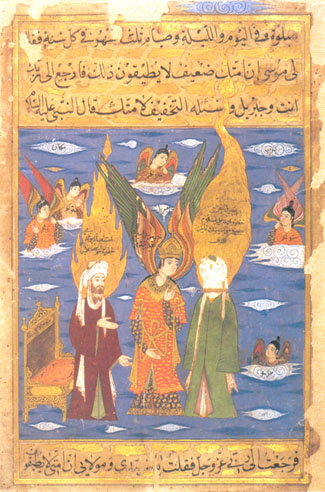
The prophets Moses and Muhammad with
archangel Gabriel (Museum für Islamitische Kunst - Berlin).
|
A revelation is a Divine sign which is sent down by ALLAH from heaven to earth.
This does not arrive here directly from ALLAH, for nobody witnesses the Face of ALLAH.
ALLAH
created the worlds by writing with His Pen on the Table. Hence, the origin of
everything created is found in the Divine Names of ALLAH.
The scope of the
metaphysics involved is suggested by the following hermeneutical table.
It has a celestial (yellow), an angelico-revelatoric
(white) and a man-made (grey) register : |
|
LEVELS
|
MEANINGS
|
| 1 |
the celestial Pen & Table |
ALLAH
creates all through His Names |
| 2 |
the celestial library of ALLAH |
ALLAH
is the Author of all the scriptures explaining His Wish to all peoples |
| 3 |
the celestial guarded tablet |
origin of
the Muhammadan revelation |
| 4 |
the archangelical sense of the celestial tablet |
the
angelic understanding of Gabriel of the celestial original |
| 5 |
prophet Muhammad's angelical sense of Gabriel's
words |
Muhammad's
recital of the Arab words brought down upon his heart by Gabriel |
| 6 |
the essence of the book |
the unchanging
essence of these signs revealed to Muhammad |
| 7 |
the allegorical verses |
the changing
contents of the signs revealed to Muhammad |
| 8 |
the abrogated & Iblis verses |
the pitfalls
& difficulties related to human understanding of parts of these
signs |
| 9 |
the original redaction of the signs |
the
Koran : original collections of these signs under Abu Bakr |
| 10 |
the
canon and the
alternative versions |
Uthmân
and the variety of collections of these signs in Islamic tradition |
| 11 |
the Arab recitation of the text |
the
art & science of the liturgical recitation of one of these major
collections |
| 12 |
the daily recitation of each believer |
the
sense of the Koran to each believer |
The three registers (Divine,
angelical, human) incorporate the fact that the interpretation of the Koran
belongs to ALLAH alone. The first major step being the assimilation of the sense
of the guarded tablet by Gabriel. Even he did not know its absolute
interpretation (i.e. its sense in the light of all possible revelations and
their co-relative books, to be attributed to ALLAH alone). He did grasp the
sense of the guarded tablet and transmitted this as such to Muhammad.
This extraordinary ability being Gabriel's Divine side, especially related to
the fact of revelation as such. As Muhammad was a human, as were all prophets,
his revelatoric propensities were angelical (not archangelical). So in the Koran,
Muhammad is called the "messenger", but Gabriel "rasul
karim" or perfect messenger (suggestive of the major -arch- role
played by Gabriel in the transmission of the sense of ALLAH's guarded tablet and
probably of other spiritual texts out of the Divine library as well). The
extraordinary fact of Muhammad's capacity to read the Arabic words revealed to
him by Gabriel and the subsequent maturation of this capacity (between 610 and
632 CE) , being the distinguishing factor here.
During the 22 years of Muhammad's prophetic life, the dynamical features of the
contents of the recital brought by Muhammad became apparent. The later Koran
evidences this in many places. The distinctions between guarded tablet and
recital, essence and allegory, in effect and abrogated mark the extend of this
movement and the complexity of the matter. Ancient Egyptian, Judaic,
neo-Platonic & Christian streaks are present, distinguishing it from the
inspired (read : jinn-possessed) poetry of pre-Islamic Arabia. An extraordinary
austere & radical monotheism is developed. This being the backbone around
which all the various movements of the revelation revolve. Austere, because all
positions eventually have to bring us back to the Oneness of the Absolute, in
which the Face (or essence) of ALLAH is only for ALLAH. Radical, because no
other divinities are accepted next to ALLAH. The Koran often allows the
deities to exist story-wise, so that they may end up saying to their worshippers
: "We never told you to worship us. For we submit to ALLAH. But you did not
listen." The same figure of speech is used regarding Iblis and his demons.
At the end of the day (i.e. on the day of doom) they laugh with those who
revered them, for only ALLAH is worthy of worship (as they know). So they only
fooled themselves.
The signs brought by Muhammad to his people were not collected and gathered
together in one book. Muhammad never ordered his secretaries to write down and
collect his many revelations in one book. Such an act would in a way
"close" the revelation, which was apparently ongoing as long as
Muhammad was alive. Muhammad
himself was the "unity" around which the Muslim community was erected.
When he died, his word inevitably became that "unity", which prompted
the redaction of the many signs. If we may believe tradition on this, some signs were inscribed on various
materials (original texts) but also in the "hearts of men" (memory).
The legendary redaction of Zaid under Abu Bakr was meant to be a collection of
the original writings, for to find experts to recite the Koran was not as
difficult as "removing a mountain". However, to collect all the
original texts (written in the presence of Muhammad but never collected into one
book) was not an easy task. The idea however that a complete text existed
"in memory" and not in writing (so that all the compositional
structures such as the sûras, their titles and contents are original) is left
by critical scholarship. The basic koranic unit of revelation is therefore the
"sign" or thematic set of "verses".
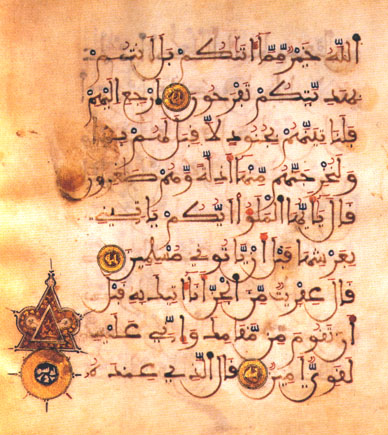
Koran : sûra 27, the Ant, verses 36-39
North African text in Maghrebi-script, 12th CE - Spink College -
London.
Perhaps the redactions made after
Muhammad
died, did bear his "nihil obstat" seal. The fact that fifteen primary codices
exist, indicates the contrary. The schisms in Islam did also not improve the situation,
nor do the actual divisions. One of the solutions out of this, being each
believer's honest experience of the Koran and its Author. In the latter
case, one must be aware of the possibility of interpolation, especially when the
issue is not repeated in different chapters and other contexts. Indeed, the fact
that Muhammad had 22 years to recite, his "original" (of memory)
contained the essence over and over again intermixed with issues which were
important at hand. Hence, if extremely important matters are only mentioned once
(or conflict with other signs or general themes), chances are high that they do
not belong to the arabesque structure of the "original" recitation and
might be put there either as a safeguard or trap, or perhaps later for political reasons,
such as the consolidation of horizontal power.
4. The vertical approach of the "fact of spirituality".
4.1 Some general considerations.
All human beings are, at some point in their existence, confronted with the
unconditional and the unbounded. This need to transcend limitations has been
understood since Plato as one of the major characteristic of the human race. It
is true that we share this with other living beings, who -under the pressures of
evolution- are forced to battle with the boundaries imposed to them by nature.
Moving beyond borders is essential to life as a whole to win this war with
evolution and erect strong architectures in the process.
However, only the human is able to transcend in a way which defies
the possibilities of the other creatures on this planet. In fact, highly
intelligent systems only survive as the result of growth-through-conflict, and
the ability to autoregulate their internal structures and operators in the light
of changed environmental circumstances. The
human forms of transcendence, i.e. the different roads taken by humanity (as a
whole or in part) to arrive beyond the treshold of crisis, turbulence and
catastrophe and attain relative stability are multiple, the two
fundamental ones being language (the ability to communicate knowledge) and
culture. But they are many. To study these forms is one way to understand the
many civilizations this planet has carried.
Since
the French Revolution, the organs of power of the Western world have been
radically secularized in order to free Europe from the chains of Christian
fundamentalism. The so-called "religious forms of transcendence" have
been distinguished from other modes, ways or means to be in touch with the
"beyond", like science, art, humanism, erotism and the short trills
offered by consumerism. Atheist forms of religiosity were also developed. These
secular forms are contrasted with religious forms precisely because their
fulfillment does not reach beyond physical death but instead stress the
importance of individual freedom and expression within the framework of
democracy and human rights & obligations right here on Earth and possibly
today. Because of this secularization, the intolerable forms of religious
oppression and coercion have dwindled in the West. As a result every individual
has received his or her religious freedom and nobody can be discriminated on the
basis of their adherence to any of the numerous faiths.
The
traditional & systematic forms of transcendence proposed by many religions,
however, never limit their scope to a good life lived on Earth only, but instead
connect the post-mortem state of a human consciousness with his or her
activities during life here. This means that eternity is considered to be more
important than temporality, although our life here is truly transient. This also
implies that human responsibility is transferred from today to the Last Day ... Those who
have sowed good deeds will reap good fortune, while those who do evil will see the little
that they have being taken away from them, perhaps in this life, but
certainly in the next. Poverty and a denial of this world are considered
essential to transcend the conditions of our life on Earth. Realizing the
spiritual truths of heaven & hell is seen as essential to be able to
transcend the world and find salvation "for ever and ever".
In the
same line of thinking, the life of an individual is considered to be less
important than the community of believers. The traditional religious forms of
transcendence promote the collective, which shows their political rather than
their spiritual origin. In Judaism, Christianity and Islam these kind of
considerations are often heard. As
explained above, most collective religious forms of transcendence are
superstructures which elaborate the revelations of their founding mystic. As
such, they are limited by the same conditions & limitations which pertain to
superstructures in general. But, as mystical experiences have degrees of
maturity, it is very likely that some religious forms of transcendence are less
a genuine expression of the Will of the Absolute than others. Instead, they
reflect the ideosyncratic features of this incomplete, imperfect experience of
the Divine. Hence, any superstructure raised upon these immature forms, will
undoubtedly show identical weaknesses and thus at times draw spiritually
irrelevant conclusions. This is of course unacceptable.
No human soul is the
plaything of another human soul, especially not when its salvation in the light
of eternity is at stake. At
this point, let me distinguish between individual and collective forms of
spirituality. The religions "of the book" are clear examples of forms
of transcendence which a priori involve
a collectivity. The Jews exhalt their race, the Christians revere the
"mystical body of Christ" and the Muslims live according to the
"sunna" of their prophet, considered to be a model for all of humanity
to follow and dream of the "umma" or unity of all Muslims. In these forms, the individual is submerged in an existing tradition,
and supposed to find his or her place in the community by adhering to the tenets
of its theology, soteriology, ethics and the like. Alternative mystical
revelations are of course shunned and if they occur, they are marginalized or
persecuted. Individual spirituality can never outlaw the established pathways,
and if it does, it is considered as heretical and should if possible be
destroyed.
Is
individualized spirituality an alternative ? In
Hindu yoga, the yogin/pupil relationship is essential. The
interactions taking place there, may serve to discover the spiritual imperative. In some immature cases, unconditional surrender is expected
from the disciple (cf. "bhakti" yoga), leading to other forms of
abuse, but this is not a conditio sine qua non, quite on the contrary. For in
the so-called all-comprehensive "royal" yoga of Patañjali, surrender
is but one aspect of the spiritual technology of enlightenment (or mystical
experience) and when it occurs, it is directed towards the Supreme Being only.
The worse that may happen (if he or she is not able to comply) is to be expelled
from the "ashram" or spiritual community. But as there are many
teachers around, one may always try again ...
The
yogi/pupil relationship is emancipatoric (the pupil is called to become a
teacher). What we know about classical yoga is a historical reference for a
postmodern approach and reconstruction of the early stages of spiritual
technology or orthopraxis on the basis of a universal spiritual imperative
assuring that each human being should be protected against spiritual abuse.
Furthermore, because of the dangers involved, large yogic communities are out of
the question. The genuine yogin has but a few pupils, the true
"ashram" is not unlike a small family, a spiritual cell in the
mystical body of spiritual humanity (humans seeking the direct experience of
God) ...
This
brings us to the core of the message of this paragraph : genuine XXIth century
spirituality does not emerge from collectivities and their fossilized
traditions, but is the sole responsibility of the individual. In other words,
the horizontal, intersubjective dimension is only important in the earliest
stages of spiritual awakening. Its structures should be emancipatoric only (a
kind of universal spiritual growth technology) and organized in a decentralized
way. Hence, the horizon of initiative and initiation is put in place to
stimulate and help to open up the vertical inner dialogue between the Absolute
and every individual. In
other words : explain to people the importance of having mystical experiences
and assist them in such a way that they may reach, elaborate & sustain their
vertical experiences to attain genuine spiritual maturity and -as a reflection
of this- live a life in a permanent (horizontal) state of compassion and
charity.
Only after this vertical contact has been realized (cf. "ascendat
oratio, descendat gratia"), will one's individual horizon be filled with
the hidden treasures received as a result of this exclusively individual
experience (which may or may not have been prepared in small spiritual cells,
providing shelter to the individual's mystic intent). Hence, the spirito-social
dimension is given shape on the basis of individual spiritual merits. The
fossilized remains of earlier builders of superstructures are left behind and
understood as collective forms of religiosity which do not necessarily please
God.
Hence, it is
clear that the combination of a collective religious form with a soteriology
projecting the ultimate goal of human existence beyond physical death (or in
abstractions like a chosen people, a mystical body of Christ or a Muslim
"umma"), is likely to demonize other
expressions of human civilization and hence, at times, find pseudo-reasons to
destroy the lives of innocent human beings. The history of Jewish, Christian and
Muslim fanatics have proved this point with great clarity and this
was and remains unacceptable. These collective forms of ignorance are the
negative example par excellence which has made the return of a horizontal,
political organization of religious communities (as theocracies) impossible in
genuine democracies. They confirmed the importance of consequent secularization.
4.2 The case of Islam.
Each of the three religions "of the book" developed different
theo-political perspectives : Judaism teaches that the people of Israel are
chosen by God to lead the world in the future Messianic age. They are the best
of the best, a kind of spiritual master race ... This fraudulent notion has been
the cause of most of their suffering and this kind of arrogant fundamentalism
continues to thrive even today. The
Christian is called to give to Caesar what belongs to Caesar, for the ultimate
is not found in this world but in the next. The rejection of this world together
with its "prince of darkness" and the dogma of primordial sin, make of
any work in this world a forteriori a confrontation with the adversary. Charity
is based on the love for Jesus Christ, believed to have given his life for the
children of Israel (to complete the revelations) and for the whole world (in
Paulinian theology). What is given to the smallest, is given to Christ himself
...
The
establisment of a just society is an integral part of Islamic theology. The Koran
is very clear regarding this and it repeats the importance of the just
redistribution of wealth over and over again. The presence of poverty and the
fact that weak and needy people are forced to suffer because of the cruel
neglect of the rich, is deemed unacceptable and an insult of ALLAH, who is
Master on the Day of Justice and who gives to everybody their just wages. His main
distributive principle being the righteous equilibrium between strong and weak,
between rich and poor ... Commerce,
trade and the adjacent notion of profit are not rejected as such, except if they
lead to criminal disparities in the world and to a forgetfulness of ALLAH. And
-as the Koran teaches- this neglect of ALLAH is more likely to befall
wealthy people than poor. For wealth is a distraction given by ALLAH to test the
soul, and most are unthankful and hence fail. The rich are called to eliminate
suffering, not to cause it ... But most of them corrupt the world, make others
suffer and are unable to manage their own souls, leading to their eventual
downfall.
Let
us, to help this critical investigation, distinguish between, on the one hand,
the koranic message and, on the other hand, the Islamic traditions which saw the
light after the prophet died. This distinction is warranted by the fact
that shortly after this death, the conflicts between the many fractions rose.
These differences had as object the different collections of the Recital, the
fundamental question of leadership and the ways to regulate and organize the
rapidly expanding community (in the first decades of the 8th century, Islam had
already crossed the French Pyrenees).
The Koran
contains both general and specific judical regulations. One of these general
laws prescribes that Muslims should give alms. No beggar should be refused.
Giving alms became one of the so-called "five pillars of Islam",
together with the declaration of unity, the daily prayers, the fast during the
holy month and the pilgrimage to Mecca. The specific regulations involve laws
organizing marriage, inheritances, position of women, rules for retaliation and
the like. It may well be that these specific laws are largely historical and
thus valid for the original Muslim community only (although traditionalists will
argue otherwise). But surely this is not the case for the general
law, repeated often in the Koran and regulating the righteous distribution of
wealth in the community and eventually in the world.
Indeed,
poverty and social injustice have to be taken out. The natural egoism of people
and their need to dominate their fellow human beings lead to injustice and the
differences between rich and poor. Although this distinction is unavoidable, due
to the natural differences between people, each Muslim is called to help the
poor and the needy and to eliminate the excesses caused by the unthankful. Trade
and commerce (the major origin of wealth) have to be submitted to extensive
controls and regulations which make sure that the gap between rich and poor does
not become outrageous (as it is for example today). The "free" market,
the principle par excellence of neo-capitalism, is therefore in conflict with
the Koran ...
For
the traditionalists, this noble goal can only be achieved if all koranic laws
are used to give form to the Islamic state. This implies democracy and a free
market, but not without the controls in the hand of religious authorities able
to veto any rule which is in conflict with the Koran. As
democrats, we can not limit the wish of a community to organize their lives
according to religious laws, except if these are in conflict with the universal
declaration on human rights (like the Taliban interpretation of Islam were women
were humiliated and forbidden to study). Like Tibetan Buddhists or Zionists,
Muslims have the right to form a community and live according to laws derived
from the Koran. But if people choose for this, then clearly the endeavor
has to be (locally) in accord with the majority (everybody being able to make a
free choice in favor of an Islamic state) and (globally) with the dignity of
human beings. Unfortunately, at least four koranic laws do not satisfy these
conditions, namely the punishment for adultery (100 lashes of the wip in
public), theft (severing of hands), the beating of women and the explicit
acceptance of slavery. In a more general way, the ontological differences
proposed between men and women should also be criticized ...
"Men
are the managers of the affairs of women for reason of the qualities with which
ALLAH has elevated the one over the other, and because men expend of their
property to them. Righteous women are therefore obedient, guarding, when their
husbands are absent, that what ALLAH ordered to conserve intact. And those you
fear may be rebellious admonish, banish them to their own couches, and beat
them. If as soon as they obey you, look not for any way against them. ALLAH is
All-high, All-great."
(2:38)
Does the
conflict between these verses and the universal declaration on human rights not
show that these specific rules do not belong to the essence of the Koran
? Is it possible that certain regulations (like those occuring only once) were
actually added after Muhammad died ? How to be absolutely sure that this did not
happen ? Surely ALLAH does not want us to erect a society on analogical and
circumstancial teachings ? Were they put in there to test the believers after
their point of reference vanished ? Or are they inventions sanctified by the
Ommayads (the role played by the founder of this first Islamic dynasty,
Mu'awiyah, can be compared with that of Constantine in Europe) ?
Critical
investigations evidence that the history of the emergence of the Recital does
not eliminate the possibility of later additions, quite on the contrary. And as
the book itself does not provide us with the keys to decide which verses are
essential and which are allegorical, no unambigeous moral system applicable to a
collective can be safely rooted in them. This explains the need to introduce
scholarly interpretations to "solve" this problem (the consensus of
the learned Sunnites) or to deify the (Shiite) leader. This
strategy was followed several times in the course of 15 centuries of Islam. The
result being that even today terrorists are able to justify their vile actions
through uncritical, fideist Medieval interpretations of the Recital.
These groups represent
the laws of the fractions, cutting the Recital into pieces to sell it or to make
their own sacred text out of it to justify their own petty politics ... In the Koran,
the
consensus of the learned is not mentioned (neither is the circumcision which the
Sunnites consider essential). And nowhere is Muhammad, the proto-type of all
possible Muslim leadership, deified or considered as infallible. Quite on the
contrary ! Nobody except ALLAH knows the interpretation of the Koran. No
consensual view is therefore a priori the view of ALLAH (as is the case in
Catholicism were the decisions of the body of bishops is automatically
considered to be "sealed" by the Holy Spirit). In fact, one may ask
whether the Recital did not descent to make an end to this practice of people to
decide for God ! If
this is the case, then surely many followers of Muhammad fell into the same trap
as did Buddhists and Christians.
Superstructures became more important than the
actual mystical experience upon which they are erected. The horizontal
structures put in place to organize the community of believers became more
important than the vertical relationship between ALLAH and the individual
believer, which should be the prime focus. Polytheism, which indeed vanished
from Arabia, was thus replaced by a variety of collections, readings, traditions
and interpretations. These distinctions continued to exist till today. Hence,
the relative and historical opinions of Muslim scholars or Muslim leaders are
always situational and tained by their own limitations. No universally valid
system of governement can thus be erected upon their consensual views. Unlike
the Christianity of Paul, the Koran does not teach that the elect may
"seal" their personal opinions with the Holy Spirit. The spirit of
holiness may
inspire, but nobody can bear the load of another soul and each one of us will be
individually addressed on the Last Day, the Day of Doom ...
4.3 The personal spiritual message of the Koran.
It goes without saying that the emergence of a genuine spiritual community was
part of the koranic message. Togetherness characterized the believers, and
together they tried to establish the world ALLAH wants, if necessary with the
sword. But as the Koran alone did not suffice to organize everything,
analogical thinking was called in to invent laws considered koranic. One is
forced to conclude that the horizontal dimension of Islam did not receive form
as a reflection of the vertical one. Instead, extra-koranic elements were
introduced (like the Hadîth). They were deemed prescribed because reputed to be done or
said by Muhammad. The Koran
indeed stipulates that the prophet is to be listened to, but the problem is not
Muhammad's authority in this, but the genuineness of the reports and the stories
told.
For example, the fact that, when Muhammad's life had arrived in
its final stage, a lot of believers could not accept that he would really die,
proves the point : the prophet (although mortal) was considered by a lot of
people around him to be a kind of superman. It is this unkoranic projection
which makes most superstructures introduced by the companions and the
followers doubtful. Is it not dangerous to accept these stories if historical
truth is sought ? Personal preferences creep in and the historical situation is
distorted to the point of mythogenesis.
The
narrative gospels of the centrist Christians are another good example : the
Roman traditionalists claims that they represent four perspectives on Christ but
in truth these different stories contain flagrant contradictions and lead to a
fundamentally irrational view on Jesus the Christ. In fact, this plurality of
Christian gospels proves the principle : most people color the colorless water
of mysticism with the color of the glass of their own vessel. This brings us
back to the importance of the original elocutions ... Hence,
one may understand why some scholars reject the hadîth's and stories attributed
to Muhammad.
And
what about the "consensus catholicus" ? "Ijma'", or
universal agreement, probably the most important factor in defining what the Koran
and the straight path imply, has itself remained the least clearly formulated
religious institution of Islam. Modern criteria for communicative actions (cf.
Habermas) show that a symmetrical discourse implies that nobody is coerced or
limited (to say or not to say something). Democratic principles add to this that
universal agreement reflects the will of the majority, so that in
representational systems it has to be proved that those making the decisions
really represent the community of believers. The Taliban conclave called
together to decide whether Bin Laden would be given over or not is a good
example. This conclave has not been assembled using democratic means and so
nobody knew what the majority really wanted. The decision was made
"top/down". Clearly, this is in conflict with the notion of a
universal agreement, except if "universal" is only put in for
rhetorical justication, and actually stands for the majority of those who detain
political power, i.e. able to enforce their ideas "de manu militari".
In
Roman Catholicism, the same happened. Although Vaticanum II stressed the
importance of common believers to participate in the leadership of their church,
the latter have no direct influence on who is their leader (this was not the
case in early Christianity, appointing their overseers
democratically). However, the Roman Church never introduced universal
agreement as a way to erect the Christian empire. It was totally dogmatic from
the start and remains the only imperial order in existence today ...
So,
instead of thinking that the first Muslims (after Muhammad died) were better
informed regarding how to organize their community than later believers (cf. the
"isnads" of each "hadîth"), politicians had better focused on the
direct contact between ALLAH and each individual believer. This would have
resulted in a permanent reformation of the
horizontal dimension as a function of the vertical one. Believers today
would have the Koran and their personal spiritual experience of the signs
of ALLAH instead of thousands of pages of laws considered holy (the Islamic
"deposit of faith"), the dictates of Islamic authorities and the
danger implied by fundamentalism and islamized terrorism.
Only
in Sufism is direct spiritual experience considered as essential. But Sufism
was regarded by traditionalists as the cradle of heretical anti-islamic ideas
& rituals. Furthermore, it was elitist, for common mystical experiences were
excluded. The advanced mystic was a superior being, one who stood at the top of
the pyramid of society ... This superiority-complex of some Islamic mystics (cf.
Ibn'Arabî claiming to be the "seal of the saints") has sidetracked
the original goal of Sufism : to serve ALLAH as perfectly as possible. So,
as had been the case in Buddhism, Judaism and Christianity, the Islamic
spirito-communal horizon determined the ways and modalities put at the disposal
of the believers. This explains also why in Islam heresy saw the light and why
some mystics were persecuted and even executed for having said or done things
which were in conflict with the tenets developed by jurists and theologians. The
latter rejected the self-manifestation of the Divine Names and hence transformed
the "no second" theology into a fanatical, unkoranic view, acting even
against those who annihilated themselves in ALLAH !
A
good example of a doubtful superstructure is circumcision. Although nowhere
mentioned in the Koran, no uncircumcized person is allowed to enter Mecca
and perform the duties asked for by ALLAH in His Recital. This means that laws
which are not part of the Recital were made to condition the performance of
essential koranic prescriptions ! If ALLAH considers circumcision a condition sine qua non
to enter Mecca and to walk the circumambulations, would the Recital not have
mentioned this ? How can the general association of circumcision with the
convenant of Abraham lawfully block the uncircumcized believer from going
to Mecca and visit the Ka'aba? Does this not show that these post-koranic teachings were actually
aiming at politically consolidating the emergent sense of community in the
Arabic consciousness ?
The history of Islam proves that its "deposit of
faith" (traditions, laws, specifics of liturgy, philosophy, etc.) became
nearly as important -if not more important- than the genuine adherence to the
message of the Koran by each individual Muslim ... The
same problem rose in early Christianity, but Paul was able to convince the
pillar apostles of the church of Jeruzalem that gentile Christianity and
circumcision were incompatible (did the fact that the gentile churches would pay the church of
Jeruzalem help to convince the latter ?). In its first centuries, Islam too
did not consider itself to be the religion of humanity. Just as it was claimed
that Jesus only came for "the lost children of Israel", Muhammad was
said to be the prophet of the Arabs, and not, as the Koran teaches, of
the whole of humanity !
The
most important prescription given in the Koran is to remember ALLAH. He
or she who does this will be remembered by Him and this will radically change
one's life. This remembrance is not a collective event, but part of one's
individual piety. To pray daily is the prescribed koranic standard for this
remembrance. But besides these prayers, (which are obligatory) the believer may
remember ALLAH as much as he or she likes or is able to. Hence, the daily
prayers (the number of which is not mentioned in the Koran) are a minimum
minimorum. In fact, the five pillars of Islam are not defined in terms of the
spirito-communal but as the activity of the individual (who may be assisted in
this by others but this is optional).
The declaration of unity, the
prayer, alms, pilgrimage and the fast testify that the aim of ALLAH is to
transform every individual (vertical) automatically resulting in a more just
communal sense (horizontal). So the house of Muslim faith is built on individual
spirituality. The biblical notion of a church (cf. the New Testament on
the "mystical body of Christ") is hence absent in the Koran,
stressing that each person will receive his or her wage, for ALLAH knows what is
in the hearts of His believers and He will always recompense humans for what
they have done ... That this spiritual activity may incite believers to come
together is not rejected, quite on the contrary. The Koran teaches one
to communicate, assist each other and work to establish a peaceful community,
living in harmony with its neighbours.
5 A few characteristics of ritual, liturgic recitation.
The history of liturgic recitation starts in Ancient Egypt and was further
developed in Judaism. It contrasts with the Summerian and Greek approach of the
Divine. The latter was based on conjuration (words -mostly the name of a god or
goddess- forcing the deities to act in accord with the will of the magus) and
not on recitation (words re-enacting the original, mythical time of creation so
that this original power may merge with and be helpful in the situation of man here and
now). For example, as late as the
4th century A.D., Greek magicians (the "magoi") would invoke the Moon
goddess and command her as follows :
"Tu feras quelque chose, que
tu le veuilles ou non,
parce que je connais ta lumière dans ses détails infimes
et que de tes actions belles je suis le célébrant, le serviteur et le témoin,
ô vierge.
Ce qui doit être, il n'est pas possible de la fuir.
Cette chose, tu la feras, que tu le veuilles ou non, je te conjure ..."
Prière
adressée à la Lune sur son déclin - Greek Papyrus IV (2241 - 2358), National Library, Paris, my italics.
In the religion of the
Egyptians, rituals did not mediate between humanity and the gods, for the latter
abided in the sky. Ritual action only took place between the gods themselves. As
Pharaoh was the sole god living on Earth, he was the only one able to
"face" the deities directly. Hence, all rituals were performed in his
name. Pharaoh allowed the ritualists to assume the form of the local deity and
recited certain words of power enabling this god or goddess to send its double
("ka") and/or soul ("ba") to dwell in the ritualists, the
statues of the deities prepared beforehand and the place of worship.
These words
of power brought all ritual action back to the "first time", the
mythical time of the creation of the world. The importance of intelligent
(Sia) creative speech (Hu) able to produce extraordinary, magical (Heka) effects
which fashion justice & truth (Maât) is clearly attested in the Pyramid
Texts and in the
Memphis Theology. The former evidence that both Re
and Pharaoh possessed the Great Word. After insightful planning (Sia, taking
place in the heart, i.e. the mind) they uttered this word of command (Hu) which
is inherently protected against all resistances because of its supernatural,
magical power (Heka) able to break all resistances and annul them.
Without answering the question
whether Judaism has been influenced by Ancient Egyptian thought (in particular
New Kingdom theology), it should be noted that the notion that certain
spiritual words give (eternal) life
was not uncommon in Jewish spirituality. When a Jew blessed, he did so unlike a
neo-Platonist or a (Persian) magician. For the "berakah" -the Jewish
prayer-, unlike the magical prayers of Babylon or Greece, has a particular
intentional structure. The Old Testament
claims that the Divine revealed Its being to Moses by speaking Its Name in a Holy Fire. Hence, Israel "knows" (cf.
"Daath") the Divine (YHVH the Elohîm), for He made a covenant -the Torah-
with His chosen people, the Israelites. Because of this link forged between the
Divine and His chosen ones (in the mythical time of the new beginning of the
Israelites after its liberation), we may understand the "berakoth" as
an expression of their mutual relationship sui
generis. Hence, ideally Jewish prayers
do not liberate "divine energy" trapped in the form of a sacrificial
animal, nor command the "gods" by knowing their name, but form a
continuous reply to the original Divine speech, using the Words of the original
speech, and thus re-enacting the experience initiating the Mosaic covenant.
Another characteristic of the "Great Word" in Judaism is its immediacy. Not
only is this Word action (as it was in Ancient Egypt), personal intervention
(the Divine letting Himself known), and Divine Presence, but, being the Word of
Elohîm, it produced by its own virtues
that which it announced. By uttering the Divine Word its meaning is
realized. This characteristic is akin to "Heka", also automatically
realizing the authoritative command based on insightful planning. So the "berakoth" answer
YHVH Elohîm, directly manifesting the Divine intent of what has been said. They
are more than supplications, invocations or magical commands, but immediate,
direct & eternal Divine actions (theurgy) realizing the Plan of the
Divine within the physical realm (containing Kether in Malkuth).
So these prayers
are theurgical acts. They constitute a deifying
elocution of the abstract order of the Divine Word by those wise enough to
answer their personal experience of the Divine by means of the Words given by
the Divine.
So the following stages are noted
:
-
the Divine reveals Himself
in original Words ;
-
the Presence of the Divine is experienced by the individual (or the
collective) ;
-
prayers answer the Divine Presence using these
original Divine Words ;
-
the elocution of these Words immediately create what they intent :
spiritualization.
The Koran is called
"a Recital" because it is not to be read as an ordinary text. To
recite this Book, is, at best, a return to the original moment when a sign was brought to
Muhammad by Gabriel. Tradition recorded the extraordinary state of mind he was
brought in everytime a revelation was sent to him. Identical stories are told
about the prophets of Israel. Comparative cultural anthropology too attested the
trance-like states of Shamans and wizards. However, the Koran itself
makes a clear distinction between pre-Islamic poets (inspired by jinns) and the
revelations of Muhammad.
"Shall I tell you who the
Satans inspire ? They inspire the liar, he who
is plunged into sin.
Those who teach what they have
heared : but most of them are liars. It is the poets that the
perverse follow. Have you not seen how the
poets like madman wander in every valley ? How they say what they do not
do ? Save those who believe, who do
righteous deeds, and who repeat the name of ALLAH without cease. The Koran
has not been
brought down by the Satans."
(28:210).
This distinction defines the major difference
between Divine revelation and inspirations coming from other sources. These
"poets" were the authors of pre-Islamic literature, and they too went
into trance to utter their extraordinary words. However, they were not
necessarily Muslims, i.e. believers in the unity and uniqueness of ALLAH. Their
inspirations could therefore stem from evil jinns or Satans. Then
they are like madmen, uttering words which are not backed by their own way of
life. The same criterion can be found in the Didache, the first Christian
catechesis, were the distinction between a false and genuine prophet is
established on the basis of the correspondence between his words and his deeds.
In the Koran however, this is not considered to be a sufficient reason
... Genuine
poets repeat the Name of ALLAH constantly and by doing so they repell the Satans
able to give pseudo-revelations. Hence, not the state of trance or for that matter any
other extraordinary state of consciousness or paranormal feat is sufficient
proof of the genuineness of spiritual inspirations. Only the spiritual intent of
the poet, the fact that he or she refers everything to ALLAH, is a sufficient
reason to guarantee its Divine source. And because trance-states are an open
invitation to the Satans, they are mostly considered as rejectable ... In
that line of reasoning, we find the rejection of alchohol or, for that matter,
any substance altering the normal waking state.
Muhammad
himself was considered mad by those adhering to the pre-Islamic polytheism of
the "daughters of ALLAH". For them, he was another crazy poet,
bringing a dangerous revelation, one rejecting the existence of divinities next
to ALLAH. In
Sufism, these states are common, but as Al-Junayd so eloquently explained, he
who is his own teacher in these matters has taken Satan as his guide. And this
will eventually lead to perdition (not for Satan, for he will reject this
affiliation on the Last Day) ... The highest state is
"trance-in-sobriety" ... In
this sense, liturgical recitation stands between reading genuine spiritual
poetry and having a direct revelation of the Divine.
When a genuine revelation is
recited, no insane poetical elements can creep in. And if, after a lot of
practice, this recitation is well performed, another liturgically induced state
of consciousness may emerge. During as well as after this ritual recitation,
actual themes, situations and problems can be approached in this particular
state of mind and solutions may be revealed ...
Finally,
let us distinguish between recitation in spirit and truth versus recitation with
sacrifice. In
Ancient Egypt, the recitation of ritual texts was always accompanied by
sacrifice, going from the libation of fresh water and incense to the sacrifice
of hundreds of animals during the major festivities. This because the deities
were supposed to exist in the sky. Their doubles (ka's) and souls (ba's) could
dwell on Earth but this only if they were fed. Hence, liturgy without sacrifice
was deemed totally useless, for no god or goddess would accept the requests if
its subtle bodies had not received nourishment.
In
pre-synagogal Judaism, the holocaust of animals was part of the bloody temple
service held in Jeruzalem. It was not enough to recite the Torah, for
YHadonaiVH was pleased with these sacrifices. The notion of feeding the deity
was absent. The reason for sacrifice was the fact that by slaughtering and
offering his animals, the Jew proved his ability to relinquish his precious
earthly goods for Adonai (cf. the story of Abraham and his son). In this
way it became obvious that He and only He was the Lord. The roasted meat was eaten
by the
priests and the participants. After
the destruction of the second temple, this sacrificial ritualism was abandoned
because it was considered too sacred an act to be performed outside the
temple.
In synagogal liturgy, the service of the word stands alone and a recitation in
spirit and truth prevails. Occasional sacrifices still occur, but not in the
synagogal context. Suppose
that Israel would be able to rebuild its temple (a very unlikely event). Would
the ancient practice of the bloody holocaust of animals be reestablished ?
Informed sources confirm that this would be the case. Hence, synagogal Judaism is not
the next stage of Jewish spiritual practice, but only one which awaits the
return of the Messiah who will reaffirm the ancient ways ... When asked why this
kind of sacrifice is necessary, the pious Jew responds that it was commanded by
the Creator, i.e. a justification based on a literal, uncritical reading of the Torah
and other so-called "sacred" texts ...
However, it is
beyond doubt that parts of the texts which were organized, edited and rewritten
after the Israelites returned from their Babylonian captivity (Jeruzalem was
looted in 587 BCE) and came under Persian rule (587 - 331 BCE) were of an
earlier date (parts of Exodus and Deuteronomium were probably
composed ca.1250 BCE). But how to know for sure which texts go back to the
original (oral) composition ? What part of this oral original was already lost
after the Babylonian capitivity ? Also, which contemporary influences were
allowed to play a role in the redaction which took place at the time of Ezra
? What about the absence of punctuation ? Clearly Mozes could not have written
about his own death & funeral ? Scholars
agree that we do not know which sources were used. The fact that several editors
were responsible is also very likely. Moreover, traces of the myths recited at
Ur can be found in Genesis (cf. the parallel with the Babylonian poem of
creation, the Enuma Elisj). And the influence of the literature of the
New Kingdom of Ancient Egypt on some of these writings can also be established
(cf. Genesis, Psalms, Proverbs).
Under Persian rule, the Old Testament as we know it did not exist. In the Septuagint
(the Alexandrian translation into Greek), the Name of God (YHadonaiVH Elohim)
was badly translated and hence in the Greek Old Testament, a crucial
theological nuance was lost (the plural "ALHYM" became the singular
"Theos", and "YHVH" became "Kyrios", eclipsing the
ineffable bi-polar
nature of the Divine).
Although Philo of Alexandria (a contempory of Jesus) thought that this
translation was divinely inspired, it nevertheless shows the corrosive influence
of Hellenism on original Judaism, forcing traditional Jews outside the walls of
Jeruzalem and triggering more than one rebellious, desert fraction or
fundamentalists avant la lettre.
The presence of the Qumrân Scrolls
(Dead Sea) shows that textual inventivity continued to grow (the first Qumrân
text is dated ca.150 BCE) and that different opposing fractions (with their
texts) existed. After
the destruction of the second Temple (29th of August, 70 CE) all important
elements of Jewish faith were recorded and after Rabbi Akiba (who was ca. twenty
when Jeruzalem fell) the "final" redaction (incorporating different
spelling and ornamentation of certain letters) became a sacred Temple of its
own, treated with a reverence as if the Supreme had been personally at work
here. Unfortunately, after the execution of Akiba by the Romans, only thousands
of little pieces of paper found in a synagogue in Caïro was all that what was
left of the Hebrew Bible as it existed in the centuries after Akiba's death ...
In
Catholic Christianity, the notion of sacrifice has been transformed in a very
special way. It was believed that Christ, as the sole son of God, sacrificed
himself for those who adhere to him (Paulinian thesis). During the eucharist,
the officiating priest acts "in persona Christi" and repeats the
original sacrifice in a bloodless way. Hence the priest (as Christ)
sacrificed Himself again during each eucharist. Transsubstantiation added a
realistic element to this, for by uttering the words spoken by Christ at the
last supper (before being killed) over the bread and the cup, the priest
(as Christ) changes the offerings of bread and wine into the body and blood of
Christ ... After this epiclesis (the exact moment of which remained a matter of
dispute between the Western and Eastern churches), the fact that Christ died but
was resuccitated is affirmed.
Although
during Mass, the role of the "service of the word" is an important
preliminary, it can not be said that the ritual recitations of the "Great
Prayer" (after the Offertory) are devoid of sacrificial connotations. Quite
on the contrary. Take away the sacrifice of Christ and Paulinian theology
collapses. Later Protestant interpretations show that it is possible to remove
the sacrificial component. The result being a "service of the word"
which resembles synagogal practices, except for the verbal affimation of
Christ's sacrifice & resurrection, which remained unaltered and can be seen
as the heart of Christian faith.
The Koran
prescribes occasional sacrifices, but the activities in the Mosk have always
been devoid of it. Not unlike synagogal Judaism, Islamic liturgy is wholly
verbal. The believers come together to perform their prayers and to listen to
the liturgical recitation of some koranic verses by the imam, the person who
leads the prayers. After this, the imam pronounces his sermon, intended to
explain and actualize the meaning of the recited texts. No sacrificial elements
creep in. Although the Koran prescribes certain occasional sacrifices,
they do not belong to the "pillars" of Islam. On a grand scale they
were introduced for a stated term only, namely for the Jews of the "ancient
house" (22:34). Unlike
Judaism, Islam never indulged in elaborated sacrificial practices. The most
important obligation for the Muslim is to remember ALLAH and this through the
repetition of His Name.
"Be pure of faith. Do not
associate anything with Him. For those who associate anything with ALLAH are
like him who has fallen from heaven and the birds snatch him away, or the wind sweeps him headlong into a far
away place. It shall be like this. He who
venerates ALLAH's waymarks does a deed that belongs to the piety of the heart. In the sacrificial animals are
many things which are profitable to you for a stated term. Thereafter their
lawful place of sacrifice is by the ancient house. We have appointed for every
nation a holy rite, so that they may mention ALLAH's name over such beasts of
the flocks as provided by Him. Your ALLAH is the unique ALLAH. So to Him
surrender. And you, Muhammad, give good tidings to the humble."
(22:32-35)
Is this good tiding the fact
that mentioning ALLAH's Name is all that matters ? If the slaughter of
animals is considered essential to please ALLAH, then surely the Lord would be
limited by the fire of the holocaust. This would be in contradiction with His
oneness and uniqueness ... Sacrificial activity indeed only serves the purpose
of being an important object (to the believer) over which His Name may be
mentioned. It is also part of the obligation to feed the poor, for instead of
burning everything, the sacrificed animal should be used to aleviate the
situation of the needy.
For
the true believers, an external sacrificial object is not really necessary, for
all that matters is the remembrance of ALLAH. Of course, the Koran does
not deny that for some people such an object of sacrifice may been important,
but is it surely not considered essential in the same way as the sacrificial
activity of the Ancient Egyptians, the pre-synagogal Jews or the Christians ...
6 Elements of the arabesque.
In the Koran we read :
"It is He who let the two
seas come near, the one with sweet water which is grateful to taste, and the
other with salt water, which is bitter to the tongue. Between them He set an
insurmountable barrier."
(25:55)
"The two seas are not equal. The one is sweet, grateful to taste, delicious
to drink, and the other is salt, bitter to the tongue. Yet of both you eat fresh
flesh, and bring forth out of them ornaments to wear. You may see ships cleaving
through it, so that you may seek of His
bounty. Perhaps you will be thankful. He makes the night to enter
the day and the day to enter the night. He has subjected the sun and the moon,
each of them running a stated term. That is ALLAH, your Lord. To Him belongs the
kingdom and those you call upon, apart from Him, possess not so much as the skin of a
date-stone."
(35:13-14)
"He separated the two seas that touch each other. Between
them is a barrier so that they do not overpass."
(55:19-20)
The
logic of the arabesque is an example of the "coincidentio oppositorum"
discovered in mystical discourses all around the world. In Muslim
thought however, it became the core of their superstructure. All divisions,
also those between the Divine and creation, are ruled by this arabesque logic, or the
symbolization of the fundamental dialectic apparent everywhere in creation and
even beyond. Indeed,
in Sufism, the Divine itself is a dual-unity of the essence of ALLAH (His Face)
and His most beautiful Names. Ibn'Arabî distinguished between the "most
holy emanation" (the Essence revealed as Divine Names) and the "holy
emanation" (the Divine Names creating the worlds). The Divine Names (the
"hidden treasure") themselves form an arabesque between the noble and
the base Names. In creation too the same dialectic is witnessed, for all created
objects are a mixture of light and darkness, good and evil, truth and falsehood.
In Muslim theology, only the Face of ALLAH is free from all possible duality,
and represents the ineffable, unsaying transcendence beyond all possible
affirmations and denials (cf. the "hypertheos" of ps.-Dionysius the
Areopagite). Hence, only ALLAH is the truth and the real. He is the absolute
neutral in which all equations, positive as well as negative, are rooted. Besides
this syntax, the arabeque has definitely semantical intentions. Although
everything except ALLAH's Face is organized as a dialectic, its
"arabesque" nature is exemplified by the fact that both sides of the
spectrum are put there by ALLAH and kept there by Him too. He divides the
spectrum by means of an unsurmountable barrier.
The fact that this barrier is
there, shows that both sides need to be distinguished. But the fact that He
makes it unsurmountable evidences the fact the He alone rules all divisions in a
way no creature is able to supercede. The
interplay of the two sides of the arabesque is only possible because ALLAH is
the Lord of all divisions. The caleidoscopic dynamics unfolding when the
divisions are maintained but put into motion allows every Name to find its locus
of Self-expression. Everything tasteful and tasteless has its function and role
to play. There is no division or ALLAH controls it. We have to accept that some
of the water can not be drunk, although it is only tasteless from our
perspective.
The
arabesque of the two commands springs into mind. Firstly, ALLAH creates
everything by His command "Be !". Chaos and order alike depend on this
generative command, which is the expression of His Will. This is suggestive of
the two seas, the sweet and the bitter. Both are under His command. Nothing
happens in creation or ALLAH wills it to happen. Even what we would call the
greatest misery is part of His Will. Secondly,
ALLAH sends His messagers to inform humanity about the specific task ALLAH has
prescribed for them, which is the expression of His Wish. Many revelations came
down, a holy rite for every nation. This is the prescriptive command : "Be
yourself !", implying for the human that he or she has to realize the
Divine Names which make them exist so as to realize the perfection ALLAH has
intended for them.
The prescriptive command is the sweet sea, and suggests that
humanity should leave part of creation untouched (the salt sea). Only ALLAH is
able to divide both and so He alone is the arbiter that decides which evil
befalls man. The Koran
teaches that if a human decides to leave the bitter untouched, s/he will be
given the sweet and protected from the bitter by the barrier of ALLAH. The
division is therefore a test, a way to observe whether a creature endowed with
the freedom to choose for those aspects of ALLAH's Will (like unjustified
violence, corrupting the land, lack of respect for others, gross &
rejectable attitudes, etc.) which are not His Wish (for that creature) will
stick to what ALLAH knows (of that creature), for indeed ALLAH only does what He
knows.
If somebody goes against the Divine Wish, then the taste of the salt sea
will make the person go astray and leave it unprotected. Surely the forces of
darkness will encompass it and the final outcome of the process is destruction
& damnation.
Once the crooked path has been entered, the freedom to choose is hampered and no
return is possible (except if ALLAH decides otherwise). But, as some people are
the expressions of the Base Names, their infernal terminus is in accord with what
they are, namely expressions of the Divine Wish to put upon the face of the Earth humans
which are evil and corrupted (like Hitler, Stalin,
Pol Pot etc.) ... For them, the tortures of hell are as natural as the
bliss of the inhabitants of the heavens ...
Religious experience, mystical experience & religion are three different
answers to the call of the unconditional, i.e. the absolute in all its possible
forms of absoluteness (as in number : infinity ; length : limitlessness,
time : eternity, knowledge : omniscience & will : omnipotence).
Some never notice the call or try in vain to construct an "absolutely"
relative model of being. They are either atheists or agnostics. The former fight
against any notion of "divinity" (they say : "nothing is
absolute" or "there is no Supreme Being"). The latter confess no
to know and so leave the matter open (they say : "it is possible that the
absolute exists but even so that it does not exist").
We must try to understand that universals may act as the deities of old. In this
perspective, atheism is impossible, for it entails the worship of univeral ideas
proposed by a limited group of people. If the absolute is negated because of
some universal, then clearly this idea is actually the
"absolute" used to deny the absolute. Hence, atheist logic contains a
"contradictio in actu exercito" (a contradiction in the act). How to
deny the absolute with the absolute (How to maintain democracy if everything
is decided by the majority, also majority-ruling ? What if the majority decides
to kill the minority ?). In its humanistic form, atheism is thus forced to
wrongly elevate the human to the status of God.
It goes
without saying that arabesque logic is highly effective in mystical &
poetical discourses intended to arouse religious feelings and point to the
basic tenets of mysticism, namely the fundamental unity of the Divine veiled
by the infinite multiplicity of Divine Names emanating from the infinite
source. As the context of the arabesque is an absolute consensus and never a
majority rule alone, it is dangerous to use this kind of logic to organize
groups of people (politics & law). Hence, to mirror its vertical features
socially (creating a spiritual elite) runs against mystical principle that
nobody is or is able to claim to be or represent God (for the finite never
grasps the infinite).
Final
Remarks :
Allow
me to articulate a few final remarks :
1. Muhammad, peace with him, was a genuine mystic. His mysticism being that of
the "unity of being", in particular, the unity & oneness of ALLAH,
The God, or the One Absolute Divine Being. To affirm the fundamental unity of
ALLAH is the hallmark of Muhammadan mysticism. This
"declaration of unity"
(or "tawhîd") is the actual affirmation (performance) of two distinct adhesions, each in two parts :
As
a mystic, he was very "noetic" (cf. "say :"), implying that
the aforesaid unity unveiled itself in a cognitive structure, a book with
the truth sent by ALLAH to humanity. Muhammadan mysticism shares this feature
with other mystics before him, such as Akhenaten, Moses & Jesus. But in the
case of Muhammad, this revelatoric form ("word" or elocution) is an
answer to the command of Gabriel, the perfect messenger : "Read !"
Tradition describes the extraordinary state he was in when a Divine sign
"came down" in his heart. And there were many witnesses, believers as
well as unbelievers. Some of the latter compared his state with that of the mad
poets of old. Nevertheless, the Koran makes a clear distinction between
poetry and Divine revelation.
Muhammad never claimed divinity for himself as had done Akhenaten and the
Christians with Jesus, son of Mary. He did not see ALLAH face to face, for His
Face is essentially His Alone (i.e. apophatism & radical un-saying). The
"noetic" and "revelatoric" nature of Muhammad's mysticism
may eclipse the fact that he was truly a mystic of un-knowing (apophasis), for
ALLAH knows and we do not. To return everything to ALLAH, is the golden
treat enabling the reader to read through the complete text of the Koran
several times.
2. Muhammad was a prophet. Not all mystics are prophets, but all prophets are
mystics. The revelation brought to Muhammad came to radically reaffirm Divine
unity and the fact that the Absolute is all-comprehensive and all-inclusive,
excluding all possible associated things next to it. It also claimed to be the
final word, because it was the first to include all other possible
revelations, which are all from ALLAH. Indeed, the Koran states that
no distinction is made between any messenger of ALLAH ! If with Christianity
salvic access had become generalized (Judaic circumcision abrogated), with Islam
revelation itself was universalized (through the Muhammadan form).
3. The Koran states that its interpretation is known to ALLAH alone. It
distinguishes between a guarded tablet and a book to be recited sent by ALLAH.
If during Muhammad's lifetime, collections of the revelations existed, then it
is probable that he himself had his own set of chapters in which he arranged the
verses which descended in his heart or spiritual recipient. Was this original
also 114 chapters long ? Was their order (according to subject-matter and not
chronology) also fixed ? Critical scholarship doubts this. In their minds,
Muhammad did not order a single book and the work of subsequent redactors was
considerable. As no original texts seem to subsist, the argument is undecided.
But where are the fragments used by Zaid ? It is probable that Muhammad had his
"memory" copy of the "recitation", with its own original
arrangement. It is also likely that the later redactions of Zaid are
"worked" copies. The rather large number of original codices proves
the point. On the other hand, it is also likely that these copies somehow used
the original form (scattered around in texts and living memory), of which a part
was lost (for the original recitation was larger). By itself, this editorial
history is remarkable. Compared with what had happened in Judaism, Buddhism
& Christianity, the difficulties are smaller and the final reliable text
larger.
4. In which way the historical redactions "worked" the original is
hard to tell.
Three layers or registers have been introduced :
-
green
text : wisdom-teachings involving Divine Unity, spiritual life
on earth, in the hereafter and the fundamental principles of Islam ;
-
orange
text : legal matters pertaining to the early historical
circumstances of Islam ;
-
red
text : matters which are in direct conflict with the universal
declaration on human rights.
It
is possible to create subregisters in the (dominant) green
text by highlighting verses which are based on or make use of Jewish
& Christian themes (black text).
Towards
a plain Recital
The Opening & the Cow



initiated : 23 I 2002 - last update : 15 I 2015 - version n°2
final version
|

