Intelligent Wisdom
reflections on the cognitive continuum
from myth to nondual thought
©
Wim van den Dungen
Antwerp, 2015.
"As a man
thinketh in his heart, so is he !"
"Wisdom resteth in the
heart of him that hath understanding ..."
Proverbs, 23:7 -
14:33
TABLE OF
CONTENTS
I
: The Heart of Wisdom in Ancient Egypt :
01.
Visualizing the physical heart as the mind.
02.
The heart in the Old Kingdom.
03.
Conscience and the weighing of the heart.
04.
Thoth, the first to write.
05.
Intelligence-of-the-heart or the heart of wisdom.
II
: Conceptualization in Western ontological thought :
06.
Myth : simplifying "the beginning".
07. Proto-rationality in
Parmenides and Democritus.
08.
Conceptual rationality : the Sophists and Socrates.
09.
Concept-realism : Plato and Aristotle.
10.
Fideism or the onto-theological ground.
11.
Real and rational science in scholasticism.
12. Rationalism and empirism of nature.
13.
Kant, the shipwreck of foundationalism.
14.
Criticism and the Münchhausen-trilemma.
III
: Intelligent Wisdom after Critical Philosophy :
15.
The spirit and way of life of the philosopher.
16.
The own-Self and the heart of creative thought.
17.
Beyond the concept : reflective & reflexive nonduality.
Epilogue : Guidelines
Bibliography
|
The Architecture of Thought |
7 MODES OF THOUGHT
3 STAGES OF COGNITION |
|
I
pre-
nominal |
ante-
rationality |
1 |
Mythical
libidinal ego |
the
irrational |
|
2 |
Pre-rational
tribal ego |
INSTINCT
(imaginal) |
|
3 |
Proto-rational
imitative ego |
|
barrier between
instinct and reason |
|
II
nominal |
rationality |
4 |
Rational
formal ego |
REASON
(rational) |
|
5 |
Critical
formal Self |
|
barrier between rationality and intuition |
|
III
meta-nominal |
meta-
rationality |
6
|
Creative
own Self |
INTUITION
(intuitional) |
|
7 |
nondual
awareness |
I : The Heart of Wisdom in
Ancient Egypt.
The use of capitals in words
like "Absolute", "God" or "Divine", points to "theory" and reason. Hence, in the
context of Ancient Egyptian thought, words such as "god", "the god", "gods", "goddesses", "pantheon" or
"divine" are not capitalized.
"Osiris, the
scribe Ani, said : 'O my heart which I had from my mother ! O my heart which I
had from mother ! O my heart of my different ages ! May there be nothing to
resist me at the judgment. May there be no opposition to me from the assessors.
May there be no parting of You from me in the presence of him who keeps the
scales ! You are my Ka within my body, which formed and strengthened my limbs.
May You come forth to the place of happiness whereto I advance. May the
entourage not cause my name to stink, and may no lies be spoken against me in
the presence of the god ! It is indeed well that You should hear !'"
Papyrus of Ani, Plate 3 - ca. 1250 BCE - XIXth
Dynasty - British Museum
01. Visualizing the
physical heart as the mind.
In Ancient Egyptian, the word for "heart" was written in three possible ways.
(1) Heart as "ib" -Eeb- (F34) was written as ,
a single hieroglyph, representing a (mammal) heart + the determinative for "one"
(a stroke). ,
a single hieroglyph, representing a (mammal) heart + the determinative for "one"
(a stroke).
(2) Heart as "HAt" -Hat- (F4) was written as
 , the forepart
of a lion ("HAt"), a bread ("t" - X1, phonetical complement) + , the forepart
of a lion ("HAt"), a bread ("t" - X1, phonetical complement) +
 ("ib" - F34),
used as determinative for everything related to "heart". The first two signs
("HA" and "t") + stroke determinative meant "forehead", "forepart", "beginning",
"the best of", etc. ("ib" - F34),
used as determinative for everything related to "heart". The first two signs
("HA" and "t") + stroke determinative meant "forehead", "forepart", "beginning",
"the best of", etc.
(3) Finally, heart was also written as "HAtii", with two strokes added, or
 , whereas
"Hatiiw" indicated "thoughts" ... , whereas
"Hatiiw" indicated "thoughts" ...
The semantic field associated with this visual sign, or icon of a mammalian
heart, was very rich, highly complex and encompassed all physical, emotional,
mental and spiritual states of the human. The heart represented the physical
heart, but also denoted the seat of thoughts and emotions, the mind, its
intelligence and understanding, as well as will, desire, mood, wish,
interiority, attentions, intentions, disposition, conscience and middle. In the
sapiental discourses (cf.
Amenemapt), it was the sacred shrine (devotion,
spirituality). In
funerary theology, the heart was the ultimate motor of the spiritual
transformation ("Xpr" -Kheper-) of the "bA" -Ba- or "soul" into "Ax" -Akh- or
"spirit" (in the horizon or "Axt" -Akhet-). The physical heart
was not removed from the body during mummification, and often covered with an
image of the dung-beetle -L1- "Kheper" ("Xpr") or "become", deemed helpful
during judgment.
The hieroglyph of the heart marked off the subjective state, quality or
"mental" condition which the Egyptians associated with the physical heart,
considered as the master receptor & coordinator and motor organ of the
organic, functional unity at work in the physical body. Likewise, the heart
was the "other" (read "inner") side of this coordination of movements using
conscious intent, causing speech (cf. the role of the tongue in the
Memphis theology). The heart explicitly refers
to the mind, as in : "thought of the heart", the "kAt" ( )
meaning thought or meditation (cf. to think, to think out, to say). )
meaning thought or meditation (cf. to think, to think out, to say).
The notion of the "shrine" of the heart as the sacred place of the "inner god"
was a concept developed in the Late New Kingdom (ca. 1200 BCE), when personal
piety became fully part of the Egyptian cultural form (cf.
Hymns to Amun). By entering its "shrine", the heart (mind, desire,
will) is brought before the god, enabling the latter to dwell in the person.
Deriving their concrete (not abstract)
concepts from
natural differentials, the intellectual elite
of Ancient Egypt (scholars associated with the local House of Life) visualized
their thoughts in "sacred signs" (or "hieroglyphs"). Mythical, pre-rational and
proto-rational layers of cognition were superimposed and partly integrated into
concrete conceptualizations. This pragmatical, deep thinking of the Ancient
Egyptians was indeed unstable, but evidenced the first, unfinished "closure" of
the cognitive apparatus. Proto-rationality integrated both myth and pre-rationality. Tensions remained and turbulence was unpredictable and possibly
annual (cf. too much or too little Nile flood), but because of this
"hieroglyphic thinking from the heart" (allowing for a "multiplicity of
approaches" - cf.
Frankfort, 1961), a dynamical equilibrium was
achieved (and maintained for over thirty dynasties, covering 3000 years of
history).
Hieroglyphs (as Byzantine Icons) refer to a wider experience of reality, to an
understanding of the heart. Then, by using sacred symbols in particular
cognitive contexts, the surrounding macrocosm is visualized as one complex whole
of architectures, momenta & rhythms, which are also at work in human body,
conceived as a microcosm.
Note that contrary to (a) the physical body or "Xt" -Khat-, (b) the
"double" or "kA" -Ka-, (c) the ritual (noble) body or "zaH" -Sah- and (d) the
celestial body or "xA-bA.s" -Khabas-, the heart represented a state of
consciousness rather than a vehicle or executive, functional component
of man's soteriology. Its conservation was necessary because the general mastery
of life was projected in it. The heart was deemed responsible for the direction
of the rudder, the navigation on the river of this life and for the initiation
of spiritual transformation in the next (cf. the judgment scenes of deities, the
divine king and common mortals).
|
Chronology
approximative, all dates BCE
Predynastic Period
- earliest communities
: - 5000
- Badarian : - 4000
- Naqada I : - 4000 -
3600
- Naqada II : - 3600 -
3300
- Terminal Predynastic
Period : 3300 - 3000
Dynastic Period
- Early Dynastic
Period : 3000 - 2600
- Old Kingdom : 2600 -
2200
- First Intermediate
Period : 2200 - 1940
- Middle Kingdom 1940
- 1760
- Second Intermediate
Period : 1760 - 1500
- New Kingdom : 1500 -
1000
- Third Intermediate
Period : 1000 - 650
- Late Period : 650 -
343
|
02. The heart in the Old Kingdom.
In the Old Kingdom, both psychological and funerary identifications are attested
:
"I have come and I bring You the Eye of Horus, that your
heart may be refreshed possessing it. I bring it to You under your sandals. Take
the efflux which comes out of You. Your heart will not be inert, possessing it."
Pyramid Texts, Unas:32.
"There is no seed of a god which passes away
at his <word>, and You shall not pass away at his <word>. Atum will not give You
to Osiris, and he shall not claim your heart, nor have power over your heart.
Atum will not give You to Horus, and he shall not claim your heart nor have
power over your heart."
Pyramid Texts, Unas:215.
In the
Maxims of Ptahhotep (ca. 2200 BCE) and other
sapiental discourses, the word "heart" is always used to indicate
and/or express subjective, internal, intimate, "states" or "conditions" of
consciousness. In the context of the teachings, insofar as Maat is concerned and
is used as a good example, Ptahhotep summarized the
phenomenology of the subjective. The awareness of each human of him or herself,
of volitions, affections and cogitations, and the complex functions, organs,
subdivisions and strata of the psyche and her implicate processes are part of
the connotative semantic field of the word "heart" and its use.
The fact so many states of mind are mentioned, is suggestive of the
freedom enjoyed by the "heart" to turn to any side it desired. With the "heart", we touch upon Ancient Egypt's concept of "will" and "freedom".
Ante-rational thought did conceptualize the freedom to go wrong. Moreover, to
the ancients, a harmony, called "Maat" existed which was established with the act of creation
itself.
The Egyptian language of the Maxims captures the essence of the "state
of heart" in a pictorial, metaphorical and poetical way, leaving room for many
readings and an alternative "coupure" of the text. Indeed, to understand an
Egyptian concept one is advised to seek context before content. The
latter may be isolated within a given set of connotative meanings, but is never
defined beforehand as in the "geometrical" method developed by the Greeks (cf.
Euclid).
|
The
"heart" in the Maxims of Ptahhotep
every clause ends with det.
("ib" - F34)
heart is weary : to be tired in body and mind
;
the heart, ended :
the cognitive faculties being absent, finished ;
the exactness of
(every) heart : the correct, precise information given ;
heart get big/great : an inflated sense of personhood ;
directs the heart :
to be able to conduct & control oneself, a powerful man ;
seize your heart
(against) : to act aggressively against someone ;
control of heart :
self-control, restraint of one's personal drives ;
aggressive of heart :
the attitude of attacking another person ;
relieve your heart :
to undo oneself of a psychological burden ;
wash the heart :
to relieve oneself of feelings, whether they be anger or joy ;
little heart
: a man of weak cognitive abilities, an incompetent person ;
your heart desires : what you like or wish ;
the heart that robs :
the greedy person, the thief ;
evil on his heart :
evil intentions, negative feelings and/or thoughts ;
please the heart :
to satisfy oneself or another person ;
follow your heart :
enjoy your life, be happy, make a good life for yourself ;
the time of 'follow-the-heart' :
sum of all happy, joyful, unmixed moments of life ;
withdraw the heart :
to separate oneself from a situation or a person ;
reaches the heart : to enter consciousness, to become aware ;
heart
obeys his belly : the mind follows the instincts and the lower affects ;
heart is denuded :
sorrowful state of mind, degeneration of the sense of ego ;
great of heart :
great-hearted person ;
swallowing the heart :
to loose sight of reality, to falter, to forget ;
calms the heart :
to eliminate the harsh, unpolished sides of one's character ;
the heart rejects it :
a person does not accept a thought, feeling or action ;
greed of the heart :
the vice of always wanting more material things ;
gladden the heart :
to make a person happy, joyful and serene ;
whole heart together : to concentrate exclusively on something ;
a
high heart : to be haughty ;
the hot of heart :
a hot-heart or a hot-tempered, uncontrolled person ;
sad of heart :
a depressed, sorrowful person ;
frivilous of heart :
to be constantly light-hearted, gay and without concerns ;
obeys his heart :
to follow the rules one made one's own ;
vex the heart :
to make somebody furious ;
the trust of your heart :
the faculty of trusting something or someone ;
lacks in heart :
to be mindless, unconsiderate, disrespectful towards others ;
water upon the heart :
effeminate, unmanly thoughts, feelings & actions ;
test his heart :
to probe the authenticity of oneself or another ;
unbound of heart :
to be gay and joyful as a result of being without obligations ;
joyful of heart :
a positive, constructive attitude and a good sense of humour ;
the
heart twines his tongue : thought and speech match, are equal ;
heart ... a listener
or a non-listener : a person decides to listen or not ;
life ... are a man's heart : the core of a person is alive, healthy &
prospering ;
valued by the heart :
taken into consideration, given attention, be aware of ;
immerge your heart :
to be discreet, to hide one's thoughts, to keep to oneself ;
be
patient of heart : to be deliberate, to take
the time to collect one's thoughts ;
his heart matches his steps :
he lives & acts as he thinks and says, is straight ;
|
03.
Conscience and the weighing of the heart.
"O my heart !
Raise yourself on your base (so) that You may recall what is in You."
Coffin
Texts, spell 657.
In the Coffin Text, references to the netherworldly Judgment Hall
abound. Brought before this tribunal, the deceased had to recall his or her
life. To do so, the heart was crucial. If it abandoned the deceased, the cause
was lost. The Coffin Texts were written during the Middle Kingdom, but,
contrary to the New Kingdom Book of the Dead and its weighing scene, have
no vignettes (explanatory, cartoon-like drawings explaining the actions
surrounding the text).
The collapse of the Old Kingdom brought about a provincialism in which the nomes
(or 42 provinces) themselves and not exclusively the royal residence defined
Egyptian culture (as Memphis had between ca. 3000 & 2200 BCE). This triggered an
interiorization and the emergence of a personal accountability based on the
moral condition of the individual, i.e. on the nature of his or her heart. After
the Old Kingdom, a person's place in society no longer determined what would
eventuate in the afterlife (as had been the case in the Old Kingdom, where all
depended on being near the divine king). Whether one had acquired moral
rectitude was enough to be saved (i.e. dwell in the dark kingdom of
Osiris and, for the very few, ascend to Re's
heaven - cf. the
Pyramid texts of Unas).
From ca. 1940 BCE onwards, every Egyptian was deemed to have a "soul" or Ba. No
longer a Pharaonic privilege, the soul of commoners could now spiritually evolve
and also become a spirit or Akh. Although the elite of the elite (the divine
king and his family) would experience ascension to Re, commoners, if vindicated
by the independent tribunal of 42 Osirian assessors, could be regenerated to
dwell in the latter's netherworld, which had its own kind of heaven
(accommodating the spirits bound to the realm of Osiris). In fact, the kingdom
of Osiris reflected the kingdom of the Horus-king on Earth. A Solar (royal) and
Lunar (common) soteriology emerged.
"... my heart is
not ignorant of its place, and it is firm on its base. I know my name. I am not
ignorant of it. I will be among those that follow after Osiris ..."
Coffin
Texts, spell 572.
During mummification, the mortuary priest would pull out the internal organs
except the heart, which played an essential role in the mortuary rituals
performed throughout Pharaonic history. If moved or damaged, it would be
stitched together with great care. To assist a good outcome of its weighing, the
amulet of the Kheper Beetle ("xpr") was usually placed on top of it during the
wrapping of the mummy in linen.
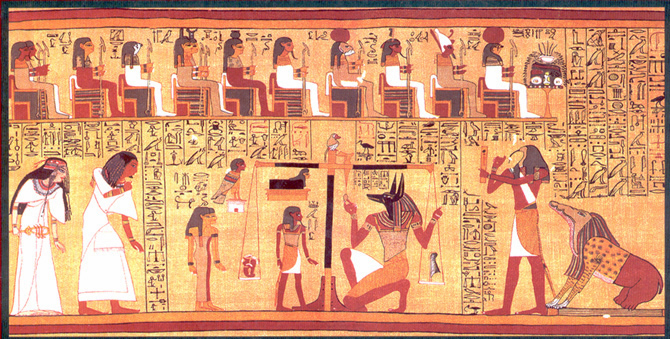
The Weighing of the Heart
Papyrus of Ani, Plate 3 - ca. 1250 BCE - XIXth Dynasty - British Museum
In the Book of the Dead, the heart appears in the context
of being without blame (i.e. in harmony with Maat). The deceased did not wish to
loose his or her heart after judgment, for the heart was the seat of the Ba
(before it entered its ritual, noble body). Judgment came after the mummy had
been reactivated, so it could speak and adapt to its new,
postmortem environment.
But to enter the heaven of Osiris, it was decisive to have
passed the trial of the balance. A heart found to be heavier than a plume, the
symbol of Maat's justice, was devoured and with it the prospect of eternal life. Such a
heavy heart (burdened by sin), only invited the remainder to be eaten by the
monstrous "great devouress", the goddess Anmut
...
In the Book of the Dead, the process of deification of
everyman implied a series of initiatoric events, starting with purification,
then judgment and finally admission as a deity, or Akh of Osiris. Hence,
the heart was also a major "moral" center (cf. "conscience" or "super-ego" in
depth-psychology).
During life, the heart was closely related with the Ka and
(also) represented the cognitive aspect of personalized existence (i.e. the
mind). Hence, the importance of the words one had spoken during one's earthly
life.
The heart had to be restituted so the deceased received his
memory and personal identity back, for perpetual existence also implied personal
continuity. This notion is amply present in the
Book of the Dead, elaborating on the restoration of the
heart known in the Coffin Texts (and earlier, in the Pyramid Texts
of the Old Kingdom ).
In the famous scene from the
Papyrus of Ani, Ani and his wife enter the Hall of the Double Law or Double
Truth (divine versus human - good versus evil - eternal life versus second
death, etc.) to have Ani's heart, emblematic of conscience, weighed against the
Feather of Maat, emblematic of truth & justice. Ani's heart is thus the
epicenter of the whole scene, symbolizing Ani's thoughts, intentions and
conscience during his lifetime on Earth.
The central emblem is Maat's Feather. It represents the standard of truth &
justice immanent in creation, but also the truth of the declaration of innocence
made by the deceased (Plate 31) before the tribunal of assessors (the hieroglyph
for "not" is in red). By virtue of the rule of "reversal",
this declaration involved a "purging"
of possible past crimes. Three offences are repeated in the Judgment Scene :
-
never to diminish the
offerings made to the temples (against the pantheon & the people) ;
-
never to destroy what had
been made (against the memorial of the ancestors) ;
-
never to speak
deceitfully (against truth & righteousness).
What does the text give us ?
It starts with Ani invoking his own conscience but also his mother, from whom
he received his heart (cf. the major role of woman in nurture, but also as
representing the sacred "matrix" of life). We also learn his heart was
linked with the Ka "within the body", the vital power making and sustaining
one's stride. Next, Anubis weighs Ani's heart against the divine standard (the
Feather) and Thoth confirms no sin is found and the equilibrium of
the Great Balance is established. Finally, the Ogdoad of Hermopolis (headed by
Thoth), confirms the sentence spoken and recorded by Thoth and it is they -the
chaos-gods- who lift the curse of the Monster or Ani's "second death". Instead
of being annihilated, Ani will be allowed to enter the kingdom of Osiris
because he is "maa-cheru" ("mAa - xrw"), i.e. vindicated, justified,
triumphant !
What was the meaning of this afterlife scene to those still alive ? The
importance given to the heart could not be missed : it is a person's
conscience, determined by what he said (wrote) and did (how he lived), which
was deemed crucial. As Ptahhotep taught, just speech is the heart of a wise
transference of the best of the past to the best of today for the sake of the
future (so the memorial of the ancestors remains), as well as of the
continuous progress made over the generations. If we study Egypt's sapiental
literature, we do not encounter the notion a person may be
vindicated during his or her lifetime on Earth. On the contrary, in the Old
Kingdom, a non-royal could only hope to endure without being immortalized. The
sage was always in the process of attaining the state of veneration,
except when his vital force left his physical vehicle. Then and only then
could veneration be a final station (a terminus). Although since the
Middle Kingdom, deceased commoners could be immortalized and deified as
"Osiris-NN", nobody attained this state during his or her lifetime. Only
Pharaoh was a living god on Earth. Hence, even during his lifetime, Pharaoh
was "justified", for he "lived in Maat".
The concept of the weighing procedure invoked in this scene, is not restricted
to the afterlife (were it appears as the final "balance-sheet" of the
deceased). The sapiental discourses make it clear that in every situation, the
Egyptian wise seeks to do Maat, and does it by "measuring" the scale of
the imbalance in order to restore the Left Eye of Horus and bring it to
the forehead (i.e. realize a "tertium comparationis"). This to
harmonize life and end strife in Pharaoh's name, he who guaranteed the unity
of the Two Lands by returning Maat as voice-offering to his father Re.
First comes a careful, concrete investigation of what is at hand, in order to
discover its "balance", i.e. the two factors allowing the "Ka" to
flow (from high to low) and animate the given context. Next there is the
restoration by striking the "nil", the true balancing-point of the beam,
arrived at when the difference between the two weights is naught. Indeed, the
sinuous waters go up and down and when this flood equilibrates (not too much
and not too little), the inundation is perfect and the surplus large. The wise
has always enough reserves to compensate for any imbalance ... At the
balancing-point, Maat is brought to the nose of Atum ...
The wise of Ancient Egypt made the poise of the balance of truth & justice
rest upon the vastness of the non-equilibrium (chaos) constantly
threatening the survival of the cosmos. He knew this reclaiming of life by
death is of no avail if at every movement of the rudder, the boatman knows
how to balance the bark and master the waters, whether he be traveling on
Earth or on the Nile of the netherworld. His commanding excellence made his
bark float upon the chaotic ocean. His just word was the primordial hill, or
the emergence of order out of chaos, the making of the beam of the
balance, keeping the two scales together and separated, allowing one to
"walk upon the waters", using the surface-tensions of their chaos.
04.
Thoth, the first to write.
Thoth's name, written as G26, the hieroglyph of
the Ibis :

appeared perched on a standard on slate palettes of the Late Predynastic
Period. The sacred Ibis (Ibis religiosa) had a long curved beak,
suggestive of the crescent New Moon, and black & white feathering reminiscent
of the Lunar phases of waxing & waning. In the Old Kingdom, the association
between the Ibis and Thoth had already been made, for in the afterlife, the
wings of Thoth carried Pharaoh over the celestial river (cf. Pyramid Texts,
§ 1176 & § 1254).
Hopfner
(1914) thought "DHw" could have been the oldest
name of the Ibis, implying that Thoth ("DHwT" or "Djehuti") would mean : "he
who has the nature of the Ibis". Others, like
Wessetzky (1958), conjecture it proceeds from
"HwwT" or "messenger" with prefix I10, "D".
Another, less common, pictogram for Thoth was the squatting baboon, who
greeted the dawning Sun with agitated, chattering sounds. These baboons are
also represented on their hind legs with front paws raised in praise and
greeting of Re (cf. the First Hour of the
Amduat). They faced the rising Sun (cf. above
the statues of Ramesses II at Abu Simbel). In both instances, Thoth wears a
crown representing the crescent Moon supporting the disk of the Full Moon. In
the Middle Kingdom, he was worshipped in all of Egypt. In all major temples,
the cult of Thoth was present. Why ?
An exceptional deity, not part of the royal
Heliopolitan Ennead, but with an Ogdoad of his
own, he was the secretary of Re, and so the "scribe of the gods". He was Re's
messenger, who promulgated the laws of "the Lord of All" or sole creator-god,
Atum-Kheper-Re. He was a traveler and an international deity, for his name
can be found in many ancient languages : neo-Babylonian, Coptic, Aramean,
Greek & Latin. Thoth represented the embodiment of all knowledge and
literature. He had invented writing and wrote himself. His most important
record was the outcome of the mythical battle between Upper Egyptian Seth and
Lower Egyptian Horus, the son of Osiris and Isis. Thoth was at the command of
all the divine books in the House of Life. The wisdom of Thoth was revered and
considered too secret for profane eyes.
In the Middle Kingdom story of the magician Djedi, a man of a hundred and ten,
we read that Djedi knew the number of the secret chambers of the
sanctuary of Thoth. The latter was "mdw nTr" "medu netjer", the "word of the
god", namely Re. He is called the "son of Re" and "Lord of the Eight gods" (of
Hermopolis, Thoth's cult centre). In the funerary rituals, Thoth acted the
part of the recorder, and his decision was accepted by all deities. Thoth
observed whether the heart (mind) of the deceased was light enough to balance
the feather of truth & justice. This by "weighing the words", for the
heaviness of heart was the result of unwholesome speech (cf. the
insistence on silence serving magical purposes). Thoth was also the ultimate
teacher of magic, ritualism & the words of power which opened the secret
pylons of the underworld. As healer of the Left Eye of Horus (cf.
wedjat), Thoth is the deity of medicine.
His original home was Khemenu, or "eight-town", referring to the four pairs of
mythical chaos-gods existing before creation (cf.
Nun), of which Thoth became the leader and head. The Greeks called
it Hermopolis. In myth, it was famous for the "high ground" on which Re rested
when he rose for the first time. This "risen land" was a central metaphor, an
example of the emergence of creation out of the undifferentiated waters,
in which inert chaos lay dormant.
This chaos of pre-existence was personified by the Ogdoad of Hermopolis,
showing this theology was intimately linked with the "mind of Re"
speaking its Great Word transforming the pre-creational, chaotic Ogdoad
Egg (cf. the "Eight of Hermopolis", four female snake-goddesses & four male
frog-gods with Predynastic roots) into the created Ennead of Hermopolis,
headed by the "First of the Eight", the
Great Word of Re, Thoth. The Hermopolitan scheme is
magical, for the true magician (like Pharaoh) finds his origin not in the
pantheon, but before the Ennead and Ogdoad.
In Isis and the other great goddesses (personifications of the Great Sorceress),
the balance tilted towards Lunar sacrality, in Osiris- Pharaoh, Follower of
Horus, son of Re, towards Solar divinity, but in both cases not exclusively.
Isis knew the "true name" of Re without which Osiris would not have
resurrected. The divinity of Pharaoh was not without the sacred, for he was
the son of Her who bore Atum !
The peace of Thoth was a neutrality which was also the objective guarantee of
objectivity, truth and justice. This middle path had chaotic polarities of
equal force (four females, four males) surrounding it. Slight movements away from
the straight path could imply going astray and be assimilated by either
polarity of the Ogdoad. Disease was the outcome of this loss of equilibrium
between and control over the forces of chaos. Through the power of the Great
Word, the greatest evil could be conquered (cf. the overthrowing of Apophis,
the giant snake trying to swallow Re before
dawn). The creative verb is dropped by the sacred Ibis, and order is restored.
The mind of Re brings clarity, distinction and operational control in all
contexts.
Thoth is known as the divine witness, mediator & messenger who recorded
things as they were. He was also the arbiter, and his duty was to prevent Set
or Horus from destroying the other. He was able to keep these hostile forces
in exact equilibrium. Darkness & light, night & day, evil & good were balanced
by Thoth, the heart and tongue of Re. It is Thoth who spoke the Great Word, resulting in the wishes of Re being carried into effect, and once he had
given an authorative command ("Hu") and had put it into writing, it could not fail to realize
itself ("Heka").
The androgynous nature of Thoth can be derived from his being a male deity.
Just as the great magic of mother Isis (female) was derived from her knowing
the true name of the creator Re (male), so was the writer Thoth (male) a great
magician because he (as the mind of Re) knew how to practice the sacred Lunar
traditions (female) to invent writing, science & literature. Pharaoh (male),
Lord of the Two Lands, was the greatest of magicians, because as a living
god on Earth he had assimilated the power of the sacred Great Sorceress
Herself (being Her son) and hence Pharaoh stood before the Enneads abiding in
the sky. Pharaoh's Great Word was spoken by a living god-with-us, and
hence Pharaoh's "heka"
was outstandingly sublime and greater than the greatest deities.
To acclimatize to Egypt, the Greeks identified their gods with native divinities. In the Late
Period, Thoth was probably the most popular and diverse deity of the Egyptian
pantheon. Indeed, in the Late New Kingdom, Third Intermediate and Late Period,
individual destiny and fate had become increasingly important. Both lay in the
hand of the gods and this fate could be derived by studying the rhythms of
planets & stars (astrology, entering Egypt from Babylon).
Although a national deity, Thoth had local associations and particularities
and was regarded as a Moon-god, determining the rhythms of Egyptian national
life (festivals & calendars). As "Lord of Time", Thoth, the mysterious, ruled
individual destinies too, and was thus very popular. By extension he was lord
of knowledge, language, all science, magic, writing and understanding. He was
the creator who called things into being merely by the sound of his voice. As
guide and judge of the dead, Thoth owed much popularity with common people,
and the "power of the Moon" was invoked in the
wisdom teachings.
The Greek settlers identified their god Hermes with Thoth. Like Thoth, he
was Lunar, and associated with medicine and the realm of the dead. Both were
tricksters and messengers. Hermes was the "logos", the interpreter of Divine
Will to humanity. In Stoic philosophy, Hermes is both "logos" and "demiurge",
which probably owed something to the Hermopolitans. In Alexandrian Egypt, the
Greek Hermes (identified with Thoth), became cosmopolitan and Hellenistic, but
Egyptianized and known throughout the Roman world as "the Egyptian".
Interestingly, by intermingling native Egyptian (Thoth) and Greek theology
(Hermes) with Hellenistic philosophy, a syncretic sum was produced, a major
and crucial archetypal idea, which encompassed the function of the cognitive
in the Mediterranean cultures of before Christianity :
Hermes
Trismegistus,
or Hermes the "Thrice Greatest". Indeed, during their
rituals, the Egyptians used to call Thoth "Great ! Great ! Great !".
However, by people of Greek culture, Trismegistus was not envisaged in the
same way as the Egyptians saw him. The Greeks produced fictional stories to
explain the emergence of Hermes Trismegistus (cf. the
Tabula Smaragdina).
For example, it was widely circulated Homer was an Egyptian and a son of
Hermes ! The learned Greeks invented a "human" Trismegistus.
The "philosophical" Hermetica (the Corpus Hermeticum) presented Hermes
as a teacher of wisdom. However, in the "technical" Hermetica (the Greek
magical papyri which readapt Egyptian magic), Thoth appeared, for there
Trismegistus was seen as a cosmic deity, able to dwell in the heart of his
devotees and object of identification for the magician. This ambiguity of
Hermes Trismegistus, the dual-union between the Divine and the human, must
have struck many. It may explain why Hermes is mentioned in early Christian
literature (cf. the two natures of Christ). Hermetical principles were
imported in Europe in the XI - XIIth century by the monastic movement (as part
of the "Orientale Lumen" - cf. Bernard of Clairvaux, Willem of St.Thierry).
Hermes Trismegistus the wisdom-teacher influenced both
Christianity and
Islam. Besides its dogmatic canon,
Early Christianity
was influenced by neo-Platonism and Stoicism, both linked with
Alexandrian Hermetism,
and the Pagan notions of "Divine Mind", "World Soul", "Demiurge" and "Pure
Act" (developed in the New Kingdom and returning in Classical Greek
philosophy).
Through Harran, Hermes established his place in Islamic sciences, which in
turn would help initiate the European Renaissance in XIVth century Italy. It
is at this point a new mixture was brewed, one which called into being a
re-Platonized egyptomanic Hermeticism conquering Europe and finally
the New World. It is still with us in Egyptian Masonic Orders and the various
branches of Californian New Age religion.
Three fundamental phases appear :
-
native
Hermopolitan theology : the perennial worship of the native
Egyptian Thoth, "Thrice Greatest", centered in Hermopolis
("Hermoupolis Magna") ;
-
historical
Hermetism : the identification of Thoth with Hermes Trismegistus,
who, in his Graeco-Alexandrian, philosophical teachings (between ca.
150 BCE and 250 CE) is
Greek
and human (although Egyptian elements persist), but who assumed, in
the technical Hermetica, the cosmicity of the Egyptian Thoth ;
-
literary
Hermeticism : the Renaissance produced a fictional European
Trismegistus, based on
the Alexandrian Hermes Trismegistus
and a misunderstood Ancient Egyptian language. Trismegistus became the
patron of alchemy, magic, mystery orders, freemasonry, astrology, the
New Age, the Western tradition
... and all matters occult.
Thoth was the first to write. The hieroglyphic system
reflects his mentality, for it aims at a fluent communication of the pictorial,
non-cerebral, parallel, non-linear "intelligence of the heart", integrating
(although ante-rationally) the early layers of cognition, namely its mythical,
pre-rational and proto-rational sedimentations.
Our knowledge of the Ancient Egyptian language is
the result of modern scholarship, for since the Renaissance, a symbolical and
allegorical interpretation was favored, which proved to be wrong (but based on
the practice of allegorical mystifications of Egyptian priests working under the
Ptolemies). Egyptian belongs to the Afro-Asiatic language family, and is related
to Arabic, Ethiopic and Hebrew, but also to North African (Hamitic) languages
such as Berber and Cushitic. Being the longest continually attested language in
the world, it appeared ca. 3000 BCE and remained in use until the XIth century
CE.
The learned Jesuit antiquarian Athanasius Kircher (1602 - 1680) proposed
nonsensical allegorical translations (Lingua Aegyptical restituta, 1643).
Thomas Young (1773 -1829), the author of the undulatory theory of light, who had
assigned the correct
phonetical values to five hieroglyphic signs, still maintained these
alphabetical signs were written together with allegorical signs, which,
according to him, formed the bulk. The final decipherment, starting as late as
1822, was the work of the Frenchman Jean-François Champollion, 1790 - 1832, cf.
Précis du système hiéroglyphique des anciens égyptiens par M.Champollion le
jeune, 1824.
Champollion, who had a very good knowledge of Coptic (the last stage of
Egyptian), proved the assumption of the allegorists wrong. He showed, especially
aided by the presence of the Rosetta Stone, Egyptian (as any other
language) assigned phonetical values to signs. These formed consonantal
structures as in Hebrew and Arabic. He also discovered that some were pictures
indicating the category of the preceding words, the so-called "determinatives".
After Champollion's death in 1832, the lead in Egyptology passed to Germany
(Richard Lepsius, 1810 - 1884). This Berlin school shaped Egyptian philology for
the nineteenth and twentieth centuries, in particular scholars such as Adolf
Erman (1854 - 1937), Kurt Sethe (1869 - 1934), who, together with Francis
Griffith (1862 - 1934), Battiscombe Gunn (1883 - 1950) and Alan Gardiner (1879 -
1963) in England, laid the systematic basis for the study of Egyptian. Later,
Jacob Polotsky (1905 - 1991) established the "standard theory" of Egyptian
grammar. These efforts finally made the historical record available to scholars
of other disciplines. Hence, by interdisciplinary work, the impact of
Pharaonic Egypt on all Mediterranean cultures of antiquity can be put into
evidence. The result being, that Ancient Egypt can no longer neglected in the
history of the formation of the European intellectual movements (cf. Egypt's
impact on Greek philosophy, in particular
Memphite thought).
The first hieroglyphs were written down towards the end of the Terminal
Predynastic period (end of the fourth millennium BCE), often attached as labels
on commodities. There is a continuous recorded until the eleventh century CE,
when Coptic (the last stage of the language) expired as a spoken tongue and was
superseded by Arabic.
The Egyptian language knew six stages :
* Archaic Egyptian (first two Dynasties)
* Old Egyptian (Old Kingdom)
* Middle Egyptian (First Intermediate Period & Middle Kingdom)
* Late Egyptian (New Kingdom & Third Intermediate Period)
* Demotic Egyptian (Late Period)
* Coptic (Roman Period).
In the last two stages, new scripts emerged and only in Coptic is the
vocalic structure known, with distinct dialects. Archaic Egyptian consists
of brief inscriptions. Old Egyptian has the first continuous texts. Middle
Egyptian is the "classical form" of the language. Late Egyptian is very
different from Old and Middle Egyptian (cf. the verbal structure). Although over
6000 hieroglyphs have been documented, only about 700 are attested for Middle
Egyptian (the majority of other hieroglyphs are found in Graeco-Roman temples
only).
modes
of thought |
examples
in Egyptian literature |
major stages of
growth in the formation of Middle Egyptian |
mythical
sensori-motoric |
Gerzean ware design schemata,
early palettes |
individual hieroglyphs, labels,
no texts, no grammar, cartoon-like style - Predynastic
|
pre-rational
pre-operatoric |
Relief of Snefru, Biography of
Methen, Sinai Inscriptions, Testamentary Enactment
Pyramid Texts |
individual words with archaic
sentences, a rudimentary grammar to simple sentences in the
"record" style of the Old Kingdom
|
proto-rational
concrete operations |
Maxims of Ptahhotep,
Coffin Texts,
Sapiental literature, ...
Great Hymn to the Aten
...
Memphis Theology |
from simple sentences to the
classical form of a fine literary language capable of more further
changes
|
Egyptian hieroglyphs is a system of writing which, fully
developed, had 2 classes of signs : logograms & phonograms. The phonograms refer
to the actual sounds of the language. Each letter is a phoneme. The consonantal
phonograms, representing either one, two or three phonemes are without
vocalization, and so lack pronunciation.
Hieroglyphic Egyptian gives a pale reflection of the spoken tongue, and was used
as a ceremonial, sacred language. At best, we may derive guides to pronunciation
based on Coptic. The "e" of Egyptology is only a convention.
Mainly found in temples & tombs, the sacred script bring
into visual evidence the excellence of Egyptian civilization and hence mirrors
Egyptian life as an idealized, a-historical (timeless) "golden" form. Precisely
this strong desire of most Ancient Egyptians to visualize the afterlife after
this-life, and to give an account of the heaven of their desires (in particular
in tombs of kings, royals and high officials), makes us recover, through
hieroglyphs, parts of the overall typology of their ante-rational mindset, which
is lost. These artworks, or archetypes of Ancient soteriology, try to eternalize
what was the most creative and efficient, namely the luminous & self-created
Re-spirit of eternity-in-everlastingness (Atum-afloat-in-the-Nun,
the boundless ocean of darkness).
Contrary to other languages (except perhaps Linear A, Maya script and Chinese), Egyptian
introduced visual glyphs (pictorial materializations, actualizations or
sedimentations of meaningful shared states of consciousness). These various
visual and artistic representations of crucial typologies brought in
effect (in its classical form) a variety of categories, namely : man and his
occupations, woman and her occupations, anthropomorphic deities, parts of the
human body, mammals, parts of mammals, birds, parts of birds, amphibious
animals, reptiles, etc., fishes and parts of fishes, invertebrates and lesser
animals, trees and plants, sky, Earth, water, buildings, parts of buildings,
etc., ships and parts of ships, domestic and funerary furniture, temple
furniture and sacred emblems, crowns, dress, staves, etc., warfare, hunting,
butchery, agriculture, crafts and professions, robe, fibre, baskets, bags, etc.,
vessels of stone and earthenware, loaves and cakes, writings, games, music,
strokes & geometrical figures (cf. the sign list of
Gardiner, 1982, pp.544-547).
Each visual glyph is a work of art. Because these glyphs (as cultural
sedimentations), represent an important part of the iconography of the Egyptian
mindset, they form a complex image-language with a sense of nuance broad enough
to encompass
ancient wisdom and its
teachings of the heart, and this for more than 3000 years. To put
into evidence the "sacredness" of hieroglyphs, we may try to visualize -with the
icons as windows to Egypt's wisdom- how the practical closure offered by this
proto-rational cognition created literature, religion and wisdom teachings.
Mature ante-rational thinking enables a first closure of mind, allowing concepts
to form concrete "blocks" or mental aggregates. These refer to concrete,
specific situations, local contingencies and geosentimental conceptualizations.
When the context is changed, the blocks no longer support each other and the
concept is undermined. So bound to changing contexts, the concrete concept is
unstable. This contrary to the second, stable closure of formal rationality,
which operates in the abstract and the decontextualized. Ante-rational thought
has no universal operator. Only existential contexts are denoted.
If communication is always based on signs, and the latter are signals (reptile
cortex), icons (limbic system) and symbols (neo-cortex - cf.
neurophilosophy), then hieroglyphs bring out the best of "emotional
intelligence", or the "intelligence-of-the-heart". Its icons bring the synthetic
function of symbols to the fore, and appeal -in the right-handed- to the right
hemisphere of the neo-cortex, processing spatiality and synthesis.
"Let us remember that prior being a device of physical
weighing, the pair of scales is the symbol for the act of exchanging physical
and intangible things. In other words, exchanging and not weighing is the main
thing."
Mancini,
2004, p.53.
An image is not a sequential symbol, but always a whole. It does not need to be
analyzed (like letters in a word), but grasped as a totality. Hence, besides
artistic aptitudes, the ability to visualize is trained as well as
thinking in images. Small visual details define important distinctions (for
example, the difference between G36, the swallow, & G37, the sparrow, is defined
by a tiny change in the tails). Subtlety and nuance are possible by adding
pictures with determinative meaning to the phonograms (together forming a
consonantal system of sounds).
logogram (word writing)
A logogram is the representation of a complete word (not individual
letters or phonemes) directly by a picture of the object actually denoted.
As such, it does not take the phonemes into consideration, but only the direct
objects & notions connected therewith. To compose a complete vocabulary with
logograms would however be cumbersome. As there were about 500 hieroglyphs in
common use, only the same number of words could have been written this way. The
rest of the ca. 17.000 known words had to be written with phonograms.
For example :
 , depicting
the Sun, signifies : "Sun", is a logogram, for this sign alone denotes the Sun. , depicting
the Sun, signifies : "Sun", is a logogram, for this sign alone denotes the Sun.
 ,
depicting a mouth, signifies : "mouth", is also a logogram. ,
depicting a mouth, signifies : "mouth", is also a logogram.
Indeed, a writing system exclusively based on logography would have
thousands of signs to encompass the complete semantics of any spoken language.
Such a large vocabulary would be unpractical. Moreover, which pictures to use
for things that can not be easily pictured, like wisdom, understanding,
authoritative speech, love, justice and the like ? How to address grammar
(and simple categories as gender and number) ?
The theory according to which Ancient Egyptian was a complex allegorical
logography was refuted by Champollion in 1822. Most hieroglyphs represent
phonograms, not logograms (or ideograms, in the case of allegorical denotation).
As until recently sufficient insight into Egyptian was lacking, trustworthy
translations were slow to emerge and their assimilation by historians,
philosophers and philologists even slower. The impact of Ancient Egypt on
Judaism, Greece and Christianity (curtailing Hellenocentrism) has been put into
evidence only a few decades ago (cf.
Hermes the Egyptian, 2002 &
The Instruction of Amen-em-apt, son of Kanakht,
2003). Via
Alexandria, Egypt's
wisdom influenced the Hellenistic world and, much later, the
Renaissance (cf. the Orientale Lumen and the rise of Hermeticism). This did not bring about a
historical Egypt, but an egyptomania turning romantic in the XIXth century.
phonogram (sound writing)
Egyptian phonography (a word represented by a series of sound-glyphs or
phonemes -letters- of the
spoken sounds) was derived through phonetic borrowing. Logograms are
used to write other words or parts of words semantically unrelated to the
phonogram, but with which they phonetically share the same consonantal
structure.
For example :
The logogram
, signifies
"mouth". It is used as a
phonogram with the phonemic value "r" to write words as "r", meaning
"toward" or to represent the phonemic element "r" in a word like "rn" or "name".
 "rn" or "name" : the logograms of mouth and water
This pictorial phonography is based on the principle of the rebus : show
one thing to mean another. If, for example, we would write English with the
Egyptian signary and apply the rebus principle, then the word "belief" would be
written with the logograms of a "bee" and a "leaf" ...
The shared consonantal structure allows one to develop a large number of
phonograms with limited number of hieroglyphs. These, and not the logograms, as
in any other language, are the solid architecture of Egyptian.
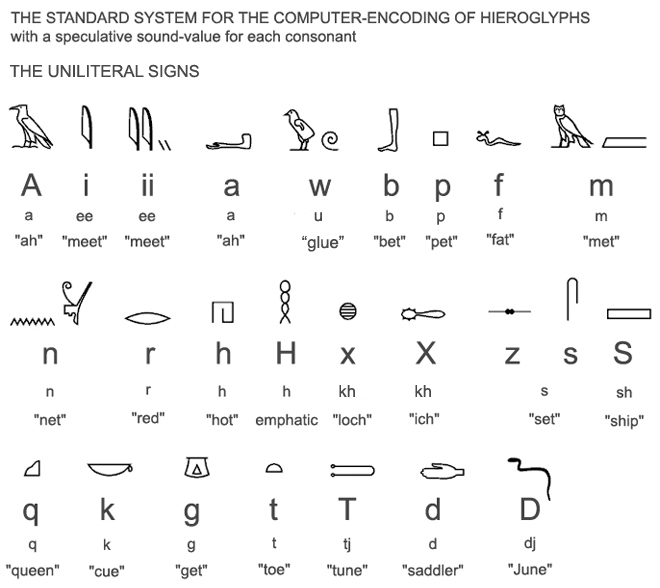
The consonantal system was present from the beginning. Three main categories of
phonograms prevail :
-
uniconsonantal hieroglyphs
(one sign for one sound) : 26 (including variants) - they represent
a single consonant and are the most important and frequent group
of phonograms ;
-
biconsonantal hieroglyphs (one
sign for two sounds) :
a pair of successive consonants (ca. 100) ;
-
triconsonantal hieroglyphs :
(one sign for three sounds) :
a trio of successive consonants (ca. 50).
Duplets and triplets are often
accompanied by uniconsonantal hieroglyphs which partly or completely
repeat their phonemic value. This phonetic complementation is to
make sure the complemented hieroglyph was indeed a phonogram and not
a logogram and/or to have some extra calligraphic freedom in case a gap
needed to be filled ...
This phonography allowed a word of more than one consonant to be written
in different ways. But in Egyptian, economy was exercised and spellings
were relatively standardized, allowing for variant forms for certain words
only.
ideogram or semogram (idea writing)
Logograms are ideograms, concerned with direct meaning and sense,
not with sound. A pictorial ideography (a variety of hieroglyphs
-representing idea's, notions, contexts, categories, modalities, nuance
etc.-) adds meaning. Ideograms are semantic (and so semograms).
Egyptian has a particular type of ideogram, the determinative, derived
from logograms, and placed at the end of words to assist in
specifying their meaning when uncertainty existed. To the objective
sound-glyph (the phonetics, in this case, being the consonantal structures
with no vocalizations), an ideogram is added indicating the general
idea of the word.
A stroke for example was the determinative indicating the function of
the hieroglyph was logographic. The determinative specified the
intended meaning. Some were specific in application (closely connected
to one word), while others identified a word as belonging to a certain
class or category (the generic determinatives or taxograms).
Determinatives of a word would be changed or varied to introduce nuance.
The same hieroglyph can thus function as a logogram, a phonogram and a
determinative (O1, "pr" or "house", was regularly used in all three
functions) !
For example :
The logogram
, depicting
the Sun, signifies : "Sun" (in continuous texts, a stroke would be put
underneath the hieroglyph to indicate a purely logographic sense). Placed
at the end of words, it is related to the actions of the Sun (as in
"rise", "day", "yesterday", "spend all day", "hour", "period") and so
then the hieroglyph is a determinative. In the context of dates
however, it is a phonogram with as phonetic value the duplet "sw".
Besides these purely semantical functions, the determinatives also marked
the ends of words and hence assist reading. They help to identify the
"word-images" in a text, and point out the preceding signs are meant
as phonograms. Once established, these were slow to change, causing -as
early as the Middle Kingdom- great divergences between the written script,
becoming increasingly "historical", and the spoken, contemporary
pronunciations of the words.
In the New Kingdom and later, when Middle Egyptian became the ceremonial or
"sacred" language of the rituals, its hieroglyphs had lost touch with the
actual spoken tongue, although the magical, effective power of these
visual symbols abided, spurring the analogical frenzy of the native
Ptolemaic priesthood (bringing to number of hieroglyphs to more than 6000).
Until its demise (the last datable hieroglyph is a temple inscription on
the island of Philae, carved as late as ca. 394 CE), hieroglyphic writing
remained a consonantal, pictorial system, allowing for both phonograms &
determinatives to convey meaning. The latter, because of the specific
iconography, is symbolic in both the analytic and synthetic mode of
recording cognitive states in material glyphs.
05.
Intelligence-of-the-heart or the heart of wisdom.
The reptile brain emits signals to identify territory, aggression and food.
It has no emotions and is primarily occupied with immediate survival.
The mammalian brain concocts affects to color sensoric and motoric
stimuli. It contains the cranial endocrinal glands governing sexual
development, passions, sleep, dreams, pleasure and pain. Emotional
patterns gives rise to icons, or signs allowing consciousness to move from
an outer representation to an inner sensation (of light, sound, smell,
touch & taste), and this based on personal phantasmd, dream & wish. The
latter are computed and memorized by a limbic cortex constantly balancing
between lust and unlust, allowing gratification or triggering woe, and
more often the latter ... This system empowers the early mental function
of visual retention.
On the level of the neocortex, consciousness, identity, conceptual
cognition & willful action are processed and sedimented into symbols,
intended to compute information about inner states and outer phenomena.
The left hemisphere of the neocortex processes information sequentially,
the right hemisphere simultaneously (or parallel, accessing several inputs
at once). The digital mode of the left hemisphere deals with the
analytical mode, reducing variety to a defined abstractions. The right
hemisphere allows for the analogical mode, denoting quanta, making the
unity of the standard principle, rule or abstraction into a variety of
facts.
Symbols are semantic fields of meaningful patterns, associations,
connotations, etc. Analytic symbols are quantitative and measure our inner
& outer environment. Synthetic (or analogical) symbols are qualitative.
They constitute a network of connected & interdependent meaningful
associations around a semantic core which they constantly circumambulate,
bringing variety under unity. Synthetic symbols join different
associations to each other and bring this diversity in the cognitive act
of apprehending one sign.
"Thus a symbol is a material representation of
immaterial qualities and functions. It is an objectification of things
subjective in us and subliminal in nature, awakening us to a perception of
the world which may make us aware of a knowledge contained in our soul."
Schwaller de Lubicz,
1978, p.17.
The evocative power of an analogical symbol rallies a complete emotional
pattern, as it were triggering the whole network at once (cf. the role of
mandala in Buddhist Vajrayâna). Insofar symbols are introduced to evoke
subjective, vital responses, they are esoteric.
Hieroglyphs are sacred because -next to their utilitarian, arbitrary and
singular meaning or analytical function-, they also act as analogical
links between the reptilo-limbic systems & the right hemisphere of the
neo-cortex. In this mode, they play out their synthetic function.
"In this sense, the symbol is thus the object,
exterior to us, which awakens innate knowledge through the senses. This
creates our intuitive knowledge of the simultaneous, a continuity in which
a discontinuity is located."
Schwaller de Lubicz,
1978, p.62.
Complementarity rules the synthetic mode. A relationship between two
elements always prevails. If the active pole is forward activity,
then the passive pole moves by inverse activity.
"Earth's rightness lies in justice !
Speak not falsely - You are great.
Act not lightly - You are weighty.
Speak not falsely - You are the balance.
Do not swerve - You are the norm !
You are one with the balance,
if it tilts, You may tilt."
The Eloquent Peasant -
third petition, Middle Kingdom (Lichtheim,
1975, I.176).
In Ancient Egypt, the heart (mind) of mind "is the balance" and realizes
the constant exchange between divine and mundane levels of existence. The
"intelligence-of-the-heart" evoked by the Egyptian sages works
analogically. Its "practice" is elucidated by a symbol :
|
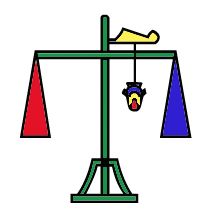
U38 "mxAt", balance, justice |
(Anubis checks the plummet and watches this small text-line) :
"Said he-who-is-in-the-tomb : 'Pay attention to the decision of
truth and the plummet of the balance, according to its stance.'"
Papyrus of Ani - XIXth Dynasty
Weighing Scene (cf. supra)
Chapter 30B - plate 3 |
This exhortation summarizes the practice of wisdom
found in Ancient Egypt, as well as their philosophy of well-being and art of
living happily & light-heartedly (for the outcome of the weighing is determined
by the weight of the heart). In this short sentence, the "practical method" of
the Ancient Egyptians springs to the fore : concentration, observation,
quantification (analysis, spatiotemporal flow, measurements) & recording
(fixating) with the sole purpose of rebalancing, reequilibrating & correcting
concrete states of affairs, using the plumb-line of the various equilibria in
which these actual aggregates of events are dynamically -scale-wise- involved,
causing Maat "to be done for them" and their environments and the proper Ka, at
peace with itself, to flow between all vital parts of creation.
So the "logic"
behind the operation of the balance involves 4 rules :
-
inversion : when a concept is introduced, its opposite is also
invoked (the two scale of the balance) ;
-
asymmetry : flow and energy are the outcome of inequality (the
feather-scale of the balance is a priori correct) ;
-
reciprocity : the two sides of everything interact and are
interdependent (the beam of the balance) ;
-
multiplicity-in-oneness : the possibilities between every pair are
measured by one standard (the plummet).
Wisdom ("sAA"), understanding ("siA"),
authoritative speech ("Hw") and effective power ("HkA") are the mental functions
developed by this ancient proto-rational civilization. As the theoretical,
formal, purely analytic mode is lacking (as are decontextualization and
universals), hieroglyphic thinking is close to the "instinctive" or
ante-rational approach of the "intelligence-of-the-heart".
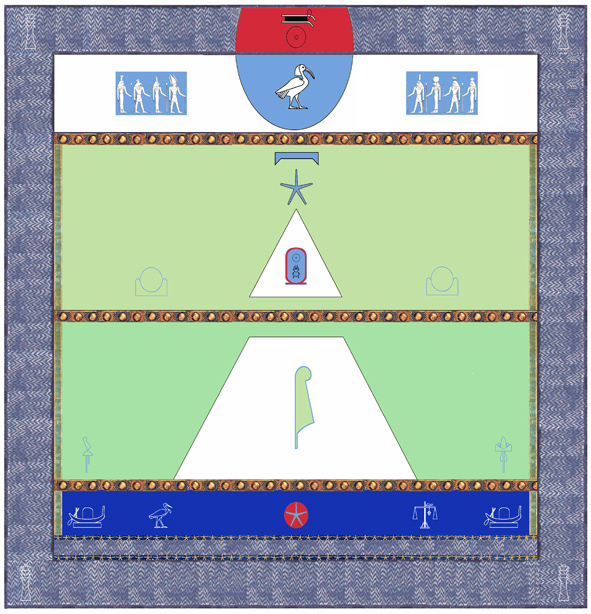
In three millennia, this synthetic, analogical mode was able to develop a
range of ante-rational theologies, rituals and wisdom teachings. Heliopolitan,
Hermopolitan, Theban & Memphite
henotheist thought represented so many
answers to the same set of philosophical questions : How did creation come about
? What is man's place in the order of the universe ? How to speak and act justly
?
-
Memphite unity (body) :
Ptah is one & all-comprehensive (he is
Nun, Atum & Re). With mind he speaks the Great Word and creates
everything therewith. Pre-creation, first time & creation are all put
into one category, an exemplaric summation. Ptah was before creation,
during the first time, at the moment of creation and in every created
god & goddess, in all Kas & Bas, in all temples and on every altar ...
Just as Pharaoh alone faced the deities (everybody else had to face
him), so was every member of the Enneads (or constellations of deities
around a godhead), a manifestation of Ptah.
-
Heliopolitan ritual (appearance) : Atum-Re, afloat in
Nun, creates himself in the first time
and with himself his Ennead or company of gods & goddesses. Pre-creation
is left behind and hostile. Self-creative Re-Atum-Kheprer has
understanding (sia), wisdom (saa), authoritative utterance (hu, the
Great Word), magic (heka) and justice-truth (maat). His eternal
rejuvenation is based on his being all-light forever, life eternal &
mutating perpetually in his Bark. At night, Re navigates on the Nile of
the Duat, the underworld, the depth of which touches the primordial
chaos of pre-creation (or Nun, represented by
Osiris). His eternal cycle represents
"neheh", the perpetuity of eternity-in-everlastingness (or Atum in Nun).
The origin of creation was Atum, but the moment he autogenerates he
splits into a pair (Shu and Tefnut). Unity and differentiation walk hand
in hand. The first two "generations of gods" are natural principles :
Shu, Tefnut, Geb and Nut and the hypostases of physical phenomena : Air,
Moist, Earth & Sky. Only with the third generation of deities, did human
drama enter the picture. As is to be expected, they are represented by
anthropomorphic deities. Osiris, Isis, Seth and Nephthys are the prime
actors in the mystery play of the mythical "golden age", the grand story
of
Osiris ;
-
Hermopolitan magic (names) : Thoth is the head of the
pre-creational Ogdoad, composed of four frog-gods and their consorts.
When Thoth, as the sacred Ibis, drops the creative
Great Word from his beak, everything is
created. The mythical origin (before time and before the intermediate,
transient, fugal first time) is placed under the command of the divine
mind, the word of Re and the
god of magic ;
-
Theban
monarchy (power) :
Amun is one & all-comprehensive (he is
Nun, Atum & Re). Amun is the "king of the gods" and Pharaoh. Amun was
before creation, during the first time, at the moment of creation and in
every created god & goddess. Moreover, he is not only "before"
everything, but also "beyond" everything. Amun is one and millions.
Nevertheless, Amun hears the prayers of the poor and is near to the
devotees.
II : Conceptualization in
Western ontological thought.
06. Myth : simplifying "the beginning".
To situate, within the framework of Ancient
Greek history, "the Greek miracle" in general and the advent of philosophy in
particular, the following division is helpful :
-
Neolithic Age (7000 - 2600 BCE) : settlements of farmers in Crete and
mainland Greece ;
-
Bronze Age (2600 - 1100 BCE) : the Bronze Age, starting with the
arrival of peaceful immigrants on Crete, can be divided in two periods :
Minoan : This culture was palace-based.
Between ca. 2600 and 1600 BCE, no Greek influence was present on the island.
The Minoans reached their zenith between ca. 1730 and 1500 (the "Pax
Minoica"). Two scripts are attested : hieroglyphic (not yet deciphered)
& Linear A. The latter is nearly always used for administrative purposes
(the count of peoples & objects). The last phase of the Minoan neopalatial
civilization was characterized by Mycenæan influence (i.e. after ca.1600
BCE).
Mycenæan : Initiated ca. 1600 BCE, the
culture of these Greek speaking people spread over mainland Greece and
reached Crete. It was strongly influenced by Minoan protopalatial (ending
with the destruction of ca. 1730 BCE) & neopalatial culture, but remained
loyal to its own Greek character. Eventually they conquered Crete (ca. 1450
BCE) and caused the elaboration of Greek Linear B based on Cretan Linear A,
which is not a Greek language as evidenced by the few tablets found in
Linear A (for example, the word for "total" -often used in administrative
texts- cannot be understood as the archaic matrix of a Greek word).
So Minoan and Mycenæan cultures interpenetrated : before 1600 BCE, Crete had
directly influenced the formation of Early Helladic Greece but was itself
non-Greek (Linear A) - after 1450 BCE, Mycenæan Greece took over Minoan
culture on Crete and Greek Linear B was used by the Minoan treasury of Crete
in the postpalatial.
-
Dark
Age (1100 - 750 BCE) : "Dorian" Greece, pushing Greek culture a step
back ;
-
Archaic Age (750 - 478 BCE) : Greek culture reemerges ;
-
Classical Age (478 - 323 BCE) : the "polis" and the emergence of
classical, concept-rationalism.
Although the scattered Mycenæan
refugees probably kept parts of their linguistic tradition alive, the cultural
network which had existed beforehand had been destroyed by the Dorians and with
it a unified cultural form in Greece based on a shared language. Moreover,
Dorian culture was very likely oral.
During these obscure centuries, Greek culture, as a form shared by all the
inhabitants of Greece, was nonexistent. The marauding barbarians, who had
destroyed the fortified towns of the pre-Helladics, and had developed (thanks to
Crete) into the grand Mycenæan culture, were themselves destroyed by horned
plundering hordes from the North, identified by some as belonging to the Doric
branch of the Greek family ...
The second half of the tenth century BCE brought a distinct easing off in
depopulation, isolation, metal-shortages, architectural and artistic
impoverishment & regional disparities. Because important centers of Greek
civilization were still wrapped in obscurity, one can however not claim the
"Greek Renaissance" had already begun ... Moreover, these changes were confined
to the Aegean and its coasts.
In the memory of these few scattered groups, settling in the South of Greece and
able to safeguard the "original" Mycenæan form, Mycenæ became legendary &
heroic. In a sense, the Mycenæans represented the "mythical" past of the Ancient
Greeks ...
The length of the Dark Age (300 years) threw a devastating shadow on the
survival of Mycenæan culture. Note the name of this period refers to how
little is known about it and also points to the remarkable contrast between
Doric Greece & Mycenæan culture. The Dorians had no written language of their
own and did not use Linear B. Isolation and loss of skills characterized the
period.
The archaic mentality emerging in Ionia around 750 BCE and prefigurated in the
rigid Mycenæan "megaron" as well as in the complex geometrical design of Dorian
pottery, was stern, courageous, young, linear and geometrizing. But just like
the rigid Mycenæans had been fascinated by Minoan Crete and its "African"
elliptic and chaotic natural scenery, these Archaic Greeks were awestricken by
the formidable grandeur of (Afro-Egyptian culture. Their own insistence upon
this should be taken serious. There was more than intellectual opportunism at
work here.
Of course, as Indo-Europeans, the Ionians had a couple of typical features of
their own :
-
individuality / authority : at the beginning of the Archaic
Age, there was a "crisis of sovereignty" (Vernant,
1962). It implied a new political problem : Who should rule and by virtue of
what authority ? The collapse of the Mycenæan palace civilization was
followed by a return to the small tribal organization (cf. the "ethnos").
This tension between individuality and social unity is fundamental to
understand Greek philosophy (culminating in the judgment of Socrates). The
view an individual had the right to rule by virtue of divine lineage
was undermined. Heroic individualism was slowly replaced by an egalitarian
ideal, in which archaic aristocratic authority was challenged. The building
of temples was an "argument" for the appropriation of civic authority and
helpful to keep control of the foundation of the economic power of the
landowners, the aristocrats (Hahn,
2001, p.237). They secured their claim by drawing a particular connection
between themselves together with a given deity and so integrated the
divergent fractions of the community through the regularity of worship ...
This swing of the pendulum between the particularism of the aristocrats and
the egalitarism of the democrats, remained a fundamental ingredient of Greek
culture & animated the Classical Greek "polis" ;
-
exploring mentality : at the beginning of the Archaic Age, the
population quadrupled and citizenship was increasingly connected with land
ownership, triggering a competition for land which motivated the
colonization. But besides these external causes, the Greeks were a curious
people, always eager to learn more by approving new ideas and linearizing
them in accord with their own abstract (generalizing, universalizing) frame
of mind. The dynamic nature of the Greek cultural form assisted a
decontextualized approach (while in Egypt, a sedentary mentality reigned and the
concrete concept never emerged without context) ;
-
unique dynamical script : the importance of their new system of
writing should not be underestimated : by fixating the vowels, the Greeks
were able to describe an state of affairs with a precision no other script
of antiquity possessed. This referential, objective linguistic capacity
enabled them to communicate through writing with more ease, precision &
objective validity. The Egyptian intellectual elite read and wrote
hieroglyphs, also used a short-script (hieratic) and mastered a common
script (Demotic, Coptic). The absence of vowels in hieroglyphic script
eternalized it and made it ill-equipped to cover both the immediate
situation as well as be precise. By adding vowels, the Greeks made writing
referential, dynamical and objectifying ;
-
linearizing, geometrizing mentality : proportion, measurement,
number, spatial organization, cyclical processes etc. "reveal" the
structure, form, order, organization of the cosmos. Numbers are more than
practical tools to categorize, for they reflect the genuine, authentic,
essential features of any object. A number never stands alone, for it
entertains numerous fixed mathematical relationships with other numbers and
spatial characteristics. These are described in general, universal, abstract
terms ("theoria"), to be distinguished from their particular, local,
concrete applications in architecture, sculpture, poetry etc. ("techné") ;
-
anthropomorphic theology : deities had a human face and in the
Mycenæan age, they were at times combined in one cult. At the beginning of
the Archaic Age, the pantheon was systematized by Homer and Hesiod, and each
deity received its task (as in human society). However, Greek religion was
undogmatic, for no sacred text existed. Xenophanes was
critical about Greek anthropo-morphic (and anthropocentric) polytheism,
proposing One Supreme God who was unlike anything human. Typical for Greek
soteriology (salvic theory), is insisting the human soul had to liberate
itself from the physical body through purification (cf. "ascesis" in
Orphism) or somehow trigger its release (cf. "katharsis" & "ekstasis" in the
Dionysian cult). Most major Greek emancipatoric theories will return to this
and understand the body as the prison of the soul (cf. Plato & Plotinus).
This would become the cornerstone of the Greek idea of "mystery", as opposed
to the
Egyptian view on the mysteries, in which
transformation and ascension are taught.
"Perhaps the greatest contribution of the Bronze Age to
Classical Greece was something less tangible, but quite possibly inherited :
an attitude of mind which could borrow the formal and hieratic arts of the
East and transform them into something spontaneous and cheerful ; a divine
discontent which led the Greek ever to develop and improve their
inheritance."
Higgings, 1997, p.190
(my italics).
So from the middle and late eight century BCE, profuse changes came about in the
outlook of Greek civilization. This "Greek Renaissance" was an Age of
Revolution. Exploration and codification (through settlement) were its
leitmotivs. This revival took place between ca. 750 and 650 BCE.
The Corinthian expansion probably took place at the end of the ninth century
BCE, while the establishment of a Greek settlement in the Levant is slightly
earlier. These colonizations did not leave a strong impact, while the eighth
century Greek colonies in southern Italy and Sicily shaped the history of
these regions for the next centuries. The early colonizations consisted of
forerunners of probably voluntary and spontaneous venturers, whereas those of
the eight century were the work of organized bodies of Greeks, possibly led by
an individual aristocrat and his retinue, stimulated by the growth of population
in the Greek homeland.
Greeks may have been marauding the Egyptian Delta perhaps as early as ca. 800
BCE, if not earlier. Because Ionian mercenaries had successfully assisted
Pharaoh Psammetichus I (664 - 610 BCE) in his battle against the Assyrians, the
Greeks were welcomed in Egypt, enabling Miletus to found Neukratis and the
Greeks to settle in the Delta of Lower Egypt. Pharaoh Amasis (570 - 526 BCE)
allowed them to settle upstream (Heliopolis, Thebes). Of a direct influence of
Ancient Egyptian thought on these early visitors is more than likely (cf.
Hermes the Egyptian, part I, 2002).
Greek philosophy, the intellectual side of the "Greek miracle", was initiated in
Asia Minor, starting in Ionia ca. 600 BCE. Initiated
by Thales of Milete (ca. 652 - 545 BCE), it
commenced with a pre-rational approach of nature (the material pole), and,
thanks to Pythagoras of Samos (ca. 580 BCE - 500), who coined the term
"philosophy", added a study of proportion and number (the mathematical pole).
These early philosophers tried to do away with mythological
explanations, whereas the symbolism of Pythagoras coupled their naturalism with a
mysticism of numbers, allowing natural phenomena to be related to each other in
abstract, theoretical terms.
Identifying the myths of
Mycenæan heroism, the pantheon (Hesiod) and
the works of Homer as representing the mythical and pre-rational phases of
Greek cognition, we see the Ionians gather the central themes of Greek thought
in proto-rational terms. A closure is realized by justifying the world by its
origin & the role of man by symbolization. Each pre-Eleatic posits a pivot, an
ontological foundation for what exists. The
multiplicity of mythical views is challenged by the unification around a single
principle. This proto-rationality exceeds itself, and paves the road for the
conceptual rationality of the Eleatics, the sophists and Classical Philosophy.
With the introduction of conceptual
rationality by Parmenides of Elea (ca. 515 - 440
BCE) &
Democritus of Abdera (ca. 460 - 380/370 BCE), the stage is set for the
ontological tradition of the West long before the Platonic and Peripatetic
systems.
Thales of Miletus
There is a consensus, dating back at
least to the 4th century BCE and continuing to our present academical history of
Greek philosophy, of Thales of Miletus being the first Greek philosopher.
According to the Greek thinker Apollodorus, he was born in 624 BCE. The Greek
historian Diogenes Laërtius (ca. 3th century CE) placed his death in the 58th
Olympiad (548 - 545 BCE), at the age of 78. He also affirms Thales traveled to
Egypt, while Iamblichius explains how he advised other intellectual Greeks to go
to Egypt in order to learn :
"Thales advised Pythagoras to go to Egypt and to
entertain himself as much as possible with the priests of Memphis and Diospolis
: it was from them that he had drawn all the knowledge which made him a sage
and a scientist in the eyes of the masses."
Iamblichius : Life
of Pythagoras, 12, my italics.
During his lifetime, the word "philosopher" (or "lover of wisdom") had not yet
been coined. Thales was counted, however, among the so-called "Seven Wise Men"
(the "sophoi"), whose name derives from a term designating inventiveness and
practical wisdom rather than speculative insight (consistent with the
Ancient Egyptians'
notion of wisdom). In fact, today we reckon Thales to be the only
"philosopher" on that list !
Thales tried to transmit to the Greeks the mathematical knowledge he had derived
from the Babylonians (who, when conquering Egypt in the Third Intermediate
Period, had influenced its astronomy profoundly). Thales sought to give it a
more exact foundation and used it for the solution of practical problems, such
as the determination of the distance of a ship as seen from the shore or of the
height of the Gizza pyramids. Though he was also credited with predicting an
eclipse of the Sun, it is likely he merely gave a natural explanation of
one on the basis of Babylonian astronomical knowledge (cf. the Saros-period
between eclipses).
Thales' significance for Greek philosophy, lies less in his choice of water as
the essential substance, than in his attempt to explain nature by the
simplification of phenomena. Indeed, Thales searched for causes within nature
itself rather than in the caprices of the anthropomorphic gods. He was
deemed the first Greek to give a purely natural explanation of the origin of the
world, free from all mythological ingredients and unnecessary complexities
(linearization and homogeneity). The claim Thales was the founder of Greek
philosophy rests primarily on Aristotle, who wrote he was the first (Greek) to
suggest a single material substratum for the universe, namely, water, or
moisture ...
Even though Thales renounced mythology, his choice of water as the fundamental
building block of matter had its precedent in the Egyptian tradition (cf. "Nun",
the undifferentiated primordial waters before time and space and its "Ba" or
"soul", the autogenitor Atum). To Thales, the entire universe is a living
organism, nourished by exhalations from water (cf. Egypt's organic, hylozoistic
view on creation).
It is true Thales made a fresh start on the basis of what a person could
observe and figure out by looking at the world as it presented itself. This
procedure naturally resulted in a tendency to make sweeping generalizations on
the basis of rather restricted but carefully checked observations. Milesian
thought prompted philosophy to move beyond the localized, contextualized &
traditional thought of the cultures surrounding it.
In geometry, Thales has been credited with the discovery of five theorems :
(1) a circle is bisected by its diameter ;
(2) angles at the base of a triangle having two sides of equal length are equal
;
(3) opposite angles of intersecting straight lines are equal ;
(4) the angle inscribed in a semicircle is a right angle ;
(5) a triangle is determined if its base and the angles relative to the base are
given.
The mathematical achievements of Thales are difficult to assess. The ancients
credited particular discoveries to men with a general reputation for wisdom.
However, their logic evidences the linear and geometric spirit of the Greeks.
Surely, before Thales, Egyptians and Mesopotamians had arrived at the truths
represented by these theorems. But the way the Greeks recorded and fixated
knowledge in more abstract, discursive, denotative and context-independent
terms, was highly original. It is these linearizing & symbolical activities
which foremost characterize the "Greek miracle", not observation, recording and
comparison. The latter can be done with proto-rational concepts too. But formal
reason is precisely this : a reduction of a variety (a manifold) to a limited
number of categories. This in order to seek a universal proposition (a
conclusion) on the basis of a universal major and an empirical minor. The latter
was provided by the storehouse of practical knowledge cherished in all important
Egyptians temples (cf. Memphis, Heliopolis, Hermopolis, Abydos & Thebes).
Anaximander of Miletus
Thales' friend, disciple and successor, Anaximander of Miletus (ca. 611 - 547
BCE), is said to have given a more elaborate account of the origin and
development of the ordered world (the cosmos). However, his writings are lost,
and although still available to Apollodorus of Athens (cf. Chronica, ca.
140 BCE), they are not known to have been used by any other writer later than
Aristotle and his successor Theophrastus of Eresus (ca. 370 - 285 BCE). The
latter's Phusikos Doxai is also lost, but repeated by Simplicius (6th
century CE). All ancient doxographers depend on the latter's Physics
(Diels).
Doxography evidences Anaximander wrote treatises on geography, astronomy, and
cosmology surviving for several centuries. He made a map of the known world,
prized symmetry and introduced geometry and mathematical proportions into his
efforts to map the heavens. Thus, his theories departed from earlier, more
cosmogonic conceptions of the universe and prefigured the achievements of
later astronomers.
Unfortunately, we only possess one sentence of Anaximander's writings. In this
sentence, Anaximander explains a "need" or "necessity" (a moral imperative at
work in creation) operating between the elements (as well as in human society)
:

"But where
things have their origin, there too they must pass away, as it should ; for
indeed, they give one another justice and penalty for their injustice, in accord
with the ordinance of time."
Simplicius : Commentary
on the Physics, 24.13v, my translation.
According to him, the cosmos developed out of the "apeiron", the boundless,
infinite and indefinite (without distinguishable qualities). Aristotle would add
: immortal, Divine and imperishable.
Within this "apeiron" something arose to produce the opposites of hot and cold.
These at once began to struggle with each other and produced the cosmos. The
cold (and wet) partly dried up (becoming solid Earth), partly remained (as
water), and -by means of the hot- partly evaporated (becoming air and mist), its
evaporating part (by expansion), splitting up the hot into fiery rings, which
surround the whole cosmos. Because these rings are enveloped by mist, however,
there remain only certain breathing holes visible to men, appearing to
them as Sun, Moon, and stars.
"The Greeks seem to have received from Egypt their old
celestial architecture, as well as that of their temples. It is only when
conceived in this way, as a roof, that the 'ouranos' can be described as
'brazen' or (in the Odyssey) as made of iron. The reference is no doubt
to the great solidity of the edifice. Hesiod has much the same thing in mind
when he calls it, 'a seat set firm'."
Kahn, 1994, p.139.
Anaximander realized upward and downward are not absolute. Downward means toward
the middle of the Earth and upward away from it, so the Earth has no need to be
supported by anything (as Thales had believed). Instead, he asserted the Earth
remained in its unsupported position at the centre of the universe because it
had no reason to move in any direction and therefore was at rest.
Starting from Thales' observations, Anaximander tried to reconstruct the
development of life in more detail. Life, being closely bound up with moisture,
originated in the sea. All land animals, he held, are descendants of sea
animals. Gradually, however, the moisture will be partly evaporated, until in
the end all things will have returned into the undifferentiated "apeiron", in
order to pay the "penalty for their injustice", i.e. of having struggled against
one another.
Anaximander subscribed to the philosophical view unity could definitely be
found behind all multiplicity.
Anaximenes of Miletus
Anaximander's successor, Anaximenes of Miletus (ca. 585 - 525 BCE), taught Air
was the origin of all things. Neither Thales nor Anaximander appear to have
specified the way in which "the other things" arose out of the water or the
"apeiron". Anaximenes, however, declared the other types of matter arose out of
Air by condensation and rarefaction. In this way, what to Thales had been merely
a beginning, became a fundamental principle remaining essentially the same
through all of its transmutations.
Thus, the term "arche", which originally simply meant "beginning," acquired the
new meaning of "principle," a term henceforth playing an enormous role in
philosophy. This concept of a principle remaining the same through many
transmutations is, furthermore, the presupposition of the idea nothing can
come out of nothing. All of the comings to be and passing away we observe, are
nothing but transmutations of something remaining essentially the same for ever
(the law of conservation).
Pythagoras of Samos
The Ionian naturalists (materialists)
were individuals, and although Anaximander had Thales as a teacher, no "school"
emerged after their death. With Pythagoras
(ca. 580 BCE, island of Samos, Ionia -
ca. 500, Metapontum, Lucania), this son of an engraver of gems, we encounter the
first Greek "school" of thought, a teaching in which religion, mysticism,
mathematics and philosophy were allowed to interpenetrate each other and
orchestrate a totally new symphonic whole, which will have a decisive
influence on Greek thought as well as on Greek architecture. This was so unique,
that Pythagorism may well be called the second major orientation in pre-Socratic
philosophy next to Milesian materialism as a whole.
According to tradition, the very word "philosophy" was coined by Pythagoras,
who described himself as a "philo-sophos", a "lover" of wisdom. With his school,
the scope of the Milesian "sophoi" was dramatically enlarged by the introduction
of metaphysics, mystical experience and the philosophy of mathematics (including
Pythagorean numerology). These speculative considerations took place "next to"
physical inquires into the nature of all possible beings. With his emphasis on
numbers and the theology of arithmetic (cf. Nicomachus of Gesara's The
Theology of Arithmetic, ca. 100 CE), Pythagoras completed mathematics, for a
complete study of geometry was taken for granted (for part of the "know-how" of
the Milesian "sophoi").
The combination of geometry and arithmetic, was called the "tetraktys" (from
"tetra", "four"), after the form of a four-tiered triangular patters of ten
dots, the sacred symbol upon which Pythagorean Oats were sworn, and which
probably had its origin in the arrangements of pebbles used to study
mathematics. It is "holy", because of its summarizing manifestation of
completion. It is "sacred", because it contains a secret which is kept out of
sight of the inept ...
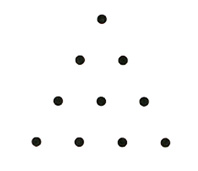
TETRAKTYS - ultimate sacred number
"delta" shaped form
(cf. "deka", ten) in four ("tetra") rows
directly influenced Hebrew qabalah and its 10 "Sephiroth"
as well as the structure of the 4 qabalistic worlds
Unfortunately, none of the writings of Pythagoras have survived, and
Pythagoreans invariably supported their doctrines by indiscriminately
citing their master's authority. It is difficult to distinguish his
teachings from those of his disciples, neither legends from historical
fact. However, he is credited with the theory of the functional
significance of
sacred numbers in the objective world and in music (obtained by
stopping a lyre string at various points along its length - the octave (2:
1), the fifth (3: 2) and the fourth (4: 3)). Other discoveries often
attributed to him, like the incommensurability of the side and diagonal of
a square, and the Pythagorean theorem stating the square of the
hypotenuse of a right-angled triangle equals in area to the sum of the
squares of the other two sides (well-known in Egypt and Mesopotamia), were
probably developed only later by the Pythagorean school.
Diogenius Laërtius also tells us Pythagoras entered the Egyptian
temples and learned the secrets of their gods. This is a remarkable
testimony. The Egyptian gods were hidden from sight. Nobody, except
Pharaoh and his appointed priests, could enter the "holy of holies" and
face the deity. There was no communication between the deities and humans,
for gods communicate only with gods. In the Late New Kingdom, common
people took Amun "in their heart" and the Hidden Supreme heard their
prayers & supplications ... Does the fact Pythagoras entered parts of
the inner spaces of the temple (decorated with the grand story of the
pantheon), not make it likely he had learned how to read hieroglyphs
and had satisfied the discipline of an Egyptian priesthood in decline ?
Not to say he had become an Egyptian priest, but a wide variety of
functions were in existence in Egyptian temples and some of them allowed
access to areas which revealed much to those able to read the sacred
writing, the "words of the gods" (cf. "lector" priest of the "House of
Life" - in the Late Period Memphis, Sais and Bubastis had major
libraries).
Iamblichus writes Pythagoras buried Thales and knew Anaximander before he
stayed 22 years in Egypt and was initiated in the teachings of the priests
of Thebes (plurality & unity of the Divine) and the doctrine of the
resurrection of Osiris (the immortality of the soul). He would have
received the sign of the winged disk in gold on his thigh, so that he was
called "chrysomeros", or "he of the golden thigh". When the Persian
Cambyses conquered Egypt in 525 BCE, he was made captive and brought to
Chaldea. There he studied with the "magoi" for 12 years and learned about
numbers and music. Other authors claimed he encountered Zarathoustra
(being baptized in the Euphrate) and traveled to India were he met
Gautama the Buddha (& was taught the
doctrine of the "transmigration", i.e. rebirth ?). The teachings
drew a large following in the Greek colony of Croton in southern Italy,
were he went to live. A kind of Freemasonry "avant la lettre" rose among
the aristocracy. It was a fraternity with Pythagoras as its "master". Its
members had a lot of political power (based on "areté" and "ponós",
excellence and effort), but were eventually massacred in a riot long after
Pythagoras had died. The followers spread the principles and caused
Pythagorism (or "Pythagoreanism") to become part of the Greek world.
Iamblichus quotes his master, who had said : "number
is the rule of forms and ideas, and the cause of gods and demons".
In all, the various accounts draw a cosmopolitan picture of Pythagoras. He
was the first Greek philosopher in the universal sense of the word, for
all beings were part of his reflection. His interests go further than the
physical doctrines of the Milesians and for the first time in Greek
history, philosophy, mathematics & religion were put in one system of
thought.
The problem of describing Pythagorism is complicated by the fact the
surviving picture is far from complete, being based chiefly on a small
number of fragments from the time before Plato and on various discussions
in authors who wrote much later - most of whom were either Aristotelians
or Neo-Platonists. In spite of these historical uncertainties, the
contribution of Pythagorism to Western culture has been significant and
therefore justifies the effort, however inadequate, to depict what its
teachings may have been.
Three levels may be discerned :
-
original teachings of
Pythagoras ;
-
Pythagoras in Plato and
Aristotle ;
-
teachings & influence
of the Pythagorean school.
The character of original Pythagorism is controversial, and the
conglomeration of disparate features it displayed is intrinsically
confusing. Its fame rests, however, on some very influential ideas, and
likely most of these prevailed in the school of Croton :
-
the metaphysics of number
and the conception reality, including music and astronomy, is, at its
deepest level, mathematical in nature : Pythagoras' sufficient ground is not
a cosmic substance but an inner organization or structure coupled with a
liberating, salvic intentions, albeit ascetical & philosophical ;
-
the use of philosophy as a
means of spiritual purification : a lover of wisdom is more than an
intelligent person aware of problems and their solutions, for his pursuit of
wisdom must be a window to the immortal soul, the light of which draws him
near to the original and fundamental level of reality : the mathematical
order of being which whispers a hidden, mysterious language of silence, with
a code available to the initiate only ;
-
the heavenly destiny of
the soul and the possibility of its rising to union with the Divine :
Pythagoras is not satisfied with the mundane, immanent perspective, for the
Pythagorean philosopher is before all the rest a lover of unity and its
experience, which implies transcendence, trance, osmosis etc. ;
-
the appeal to certain
symbols, sometimes mystical, such as the "tetraktys",
the golden section, and the harmony of the spheres : symbols are the residue
of spiritual experiences and contain a code to trigger co-relative
experiences later ;
-
the Pythagorean theorem :
mathematics and the solution of particular problems are the "purest" way to
encounter the immortal soul, for its language is that of sacred number ;
-
the demand members of the
order shall observe a strict loyalty and secrecy : the order is a private
affair and has no "outer order".
What could Pythagoras have learned from the priest of Memphis and Thebes ?
-
the unity of the Divine : the absolute is One and Millions,
invisible by nature and manifest in nature's forms ;
-
the rule of truth and justice : all actions have to be weighed on
the balance of truth to measure their order ;
-
the order of creation : the cosmos unfolded as a series of
numbers : 0 > 1 > 2 & 3 > 4 & 5 > 6, 7, 8, 9 ;
-
the sacrality of "10" : Pharaoh, "son of Re", completes the
Ennead + 1 = "10" order ;
-
the creativity of thought and speech : the cosmos as conceived in
the "mind" of the absolute ;
-
geometrical solutions to practical problems : mathematical papyri
testify Egypt's elementary abilities ;
-
the magic of symbols : sacred script and ritual speech have
powers beyond their physical form ;
-
the rule of silence : the Egyptian gods and their priests were
out of sight and hidden - silence was gold ;
-
the harmony of opposites : all fundamental oppositions are
bridged by a harmonic "third" ;
-
the symbolism of numbers : each natural number (0 - 10) has
"inner" meanings, purposes and relations.
There probably never
existed a strictly uniform system of Pythagorean philosophy and religious
beliefs, even if the school did have a certain internal organization.
Pythagoras appears to have taught by pregnant, cryptic "akousmata"
("something heard") or "symbola". His pupils handed these on, formed
them partly into Hieroi Logoi ("Sacred Discourses"), of which
different versions were current from the 4th century BCE on, and they
interpreted them according to their convictions.
Plato mentions Pythagoras only once (Republic, X.600). No details are
given about the "Pythagorean way of life", which he compares with Homer. The
Pythagorean teachings were obviously popular enough for Plato not to bother
to discuss them. Not so for his pupil Aristotle, who wrote :
"Pythagoreans applied themselves to mathematics, and were the first to
develop this science ; and through studying it they came to believe that its
principles are the principles of everything. And since numbers are by first
nature among these principles, and they fancied that they could detect in
number, to a greater extent than in fire and Earth and water, many analogues
of what is and comes into being-such and such a property of number being
justice,. and such and such soul or mind, another opportunity, and
similarly, more or less, with all the rest - and since they saw further that
the properties and ratios of the musical scales are based on numbers, and
since it seemed clear that all other things have their whole nature modeled
upon numbers, and that numbers are the ultimate things in the whole physical
universe, they assumed the elements of numbers to be the elements of
everything, and the whole universe to be a proportion or number."
Aristotle,
Metaphysics, I, v. 1-3, 985b.
In the 4th century BCE, Plato's inclination toward Pythagorism created a
tendency -manifest already in the middle of the century in the works of his
pupils- to interpret Platonic concepts as originally Pythagorean. Most of
the literary sources ultimately hark back to the environment of Plato and
Aristotle. Later, neo-Platonism, which developed in the third century CE,
reworked Pythagorism. Although they claimed to reassert a true understanding
of Plato, they took a syncretic approach and drew from other sources, such
as Pythagorean number mysticism and the
Hermetica.
By laying stress on certain inner experiences and intuitive truths
revealed only to the initiated, Pythagorism seems to have represented a
soul-directed, salvic idealism alien to the mainstream of pre-Socratic Greek
thought, preoccupied with determining what the basic cosmic substance
("phusis") was. In contrast with Ionian naturalism, Pythagorism was akin
to trends seen in mystery religions and mystical movements, such as Orphism,
which often claimed to achieve a spiritual insight into the Divine origin
and nature of the soul through intoxication. Yet, there are also aspects of
it appearing to have owed much to the more sober, "Homeric" philosophy of
the Ionians, especially regarding ascetics and the importance of
mathematics.
Indeed, the Pythagoreans displayed an interest in metaphysics (the nature of
being), as did their naturalistic predecessors, though they claimed to find
its key in mathematical form rather than in any cosmic substance.
They accepted the essentially Ionian doctrines saying the world is composed
of opposites and generated from something unlimited, but they added the idea
of the imposition of limit (number) upon the unlimited and the sense
of a musical harmony in the universe (a "music of the spheres", sounding to
human ears as silence - cf. Aristotle, De Caelo, II.9). Again, like
the Ionians, they devoted themselves to astronomical and geometrical
speculations. Combining, as it does, a theory of number with a numerology
and a speculative cosmology with a theory of the deeper, more spiritual
reaches of the soul, Pythagorism interweaves religion and philosophy more
inseparably than does any other movement in pre-Socratic thought.
The occult blend of proportion & number with numerology, as well as
speculative philosophy masked with the pursuits of religion, point to an
emerging conceptual rationality still clinging to the proto-rational mode of
thought, dependent of context & myth. Pythagorism achieves a grand
synthesis, liberated from the necessities of local myth, multi-cultural and
grasping an intrinsic "Homeric" tendency towards linearization. Pythagoras
and his school were also the first to develop a system of thought influenced
by many disparate sources (Ionian, Egyptian, Persian, Indian). These various
elements were brought together, equilibrated and made to function as part of
a larger whole. Just as the Ionian "sophoi" before him, this system of
thought incorporated foreign sources, transcending them using a Greek mode
of thought. But if we analyze the object - subject relationships at work, we
cannot say of Pythagorism it has completely emancipated both sides. A
symbolical adualism is still implied. Numbers are more than just mental
conventions, but are an expression of the ontological structure of nature,
and so refer to an extra-mental "ground", "foundation" or "hypokeimenon"
(underlying thing,
substratum). A "magical" sympathy exists between things. Wandering
Pythagoras heralds urban Plato, who may be read as a direct student of the
former.
Pythagorism differentiates between subject & object, and so is the earliest
manifestation of conceptual rationality in Greece. Not yet a clear
demarcation (as in Plato's "two worlds"), Pythagoras steps outside the
continuum of ante-rationality.
Summary what ante-rationality accomplished.
Ante-rationality encompasses the three first, earliest layers of cognition,
namely mythical, pre-rational and proto-rational thought, developing
libidinal notions, tribal pre-concepts & imitative concrete concepts
respectively. Concrete concepts are never decontextualized. These early
Piagetian stages (cf.
Stuurkunde, 1993,
Cognition, 2003,
Clearings, 2006) are characterized as follows :
Myth :
the notion
First substage :
-
non-reflective adualism and
only a virtual consciousness of identity ;
-
primitive action testifying
a quasi complete indifferentiation between the subjective and the objective
side of cognition ;
-
actions are quasi
uncoordinated, i.e. random movements are frequent.
Second substage :
-
first decentration of
actions with regard to their material origin (i.e. the physical body) ;
-
first objectification by a
subject experiencing itself for the first time as the source of actions ;
-
objectification of actions and the experience of spatiality ;
-
objects are linked because
of the growing coordination of actual actions ;
-
links between actions in
means/goals schemes, allowing the subject to experience itself as the source
of action (initiative), moving beyond the dependence between the external
object and the acting body ;
-
spatial & temporal
permanency and causal relationships are observed ;
-
differentiation (between object and subject) leads to logico-mathematical
structures, whereas the distinction between actions related to the subject
and those related to the external objects becomes the startingpoint of
causal relationships ;
-
the putting together of
schematics derived from external objects or from the forms of actions which
have been applied to external objects.
Pre-rationality
: the pre-concept
-
because of the introduction of
semiotical factors (symbolical play, language, and the formation of mental
images), the coordination of movements is no longer exclusively triggered by
their practical and material actualizations without any knowledge of their
existence as forms, i.e. the first layer of thought occurs : the difference
between subject & object is a signal which gives rise to
the symbol ;
-
upon the simple action, a new type
of interiorized action is erected which is not conceptual because the
interiorization itself is nothing more than a copy of the development
of the actions using signs and imagination ;
-
no object of thought is realized but
only an internal structure of the actions in a pre-concept
formed by imagination & language ;
-
pre-verbal intelligence &
interiorization of imitation in imaginal representations ;
-
psychomorph view on causality : no
distinction between objects and the actions of the subjects ;
-
objects are living beings with
qualities attributed to them as a result of interactions ;
-
at first, no logical distinction is
made between "all" and "few" and comparisons are comprehended in an absolute
way, i.e. A < B is possible, but A < B < C is not ;
-
finally, the difference between
class and individual is grasped, but transitivity and reversibility are not
mastered ;
-
the pre-concepts & pre-relations are
dependent on the variations existing between the relational characteristics
of objects & can not be reversed, making them rather impermanent and
difficult to maintain. They stand between action-schema and concept.
Proto-rationality : the concrete concept
-
for the first time stable concepts
and relations emerge and the interiorized actions receive the status of
"operations", allowing for transformations. The latter make it possible to
change the variable factors while keeping others invariant ;
-
the increase of coordinations forms
coordinating systems & structures which are capable of becoming closed
systems by virtue of a play of anticipative and retrospective constructions
of thought (imaginal thought-forms) ;
-
these mental operations, instead of
introducing corrections when the actions are finished, exist by the
pre-correction of errors and this thanks to the double play of anticipation
and retroaction or "perfect regulation" ;
-
transitivity is mastered which
causes the enclosedness of the formal system ;
-
necessity is grasped ;
-
constructive abstraction, new,
unifying coordinations which allow for the emergence of a total system and
auto-regulation (or the equilibration caused by perfect regulation) ;
-
transitivity, conservation and reversibility are given ;
-
the mental operations are
"concrete", not "formal", implying that they (a) exclusively appear in
immediate contexts and (b) deal with objects only (i.e. are not reflexive) ;
-
the concrete operatoric structures
are not established through a system of combinations, but one step at a time
;
-
this stage is paradoxal : a balanced
development of logico-mathematical operations versus the limitations imposed
upon the concrete operations. This conflict triggers the next, final stage,
which covers the formal operations.
07.
Conceptual rationality in Parmenides and Democritus.
The evolution from "mythos" to "logos", viewed as a reflective process
of the understanding of thought by itself, went through stages characterized
by a variety of object/subject-relationships.
In myth, non-reflective adualism pertains. This differentiates to bring about
the pre-concept, allowing for a distinction between object and subject, but
not without a psychomorph recuperation of the former by the latter.
Pre-conceptual thinking seeks a hypostatic grounding of this subjective
objectivity of pre-rationality. In Ancient Egypt, in particular in the Old
Kingdom, this was realized by the introduction of the pre-concept of divine
kingship, expressing a unique feature :
the equilibrium of opposites. The dual nature of the monarchy was
all-comprehensive and reflected in the regalia, in the royal titulary, in
the royal rituals and festivals.
Frankfort (1948) called the presence of
the divine king and his institution of
"transcendent significance". It was a unique
phenomenon in the region, if not in the world. In the pre-Eleatics, the
"arché" of nature ("physis") played the same cognitive role of "explaining"
the constant intermixture of the objective & subjective poles of thought. It
did so, by moving beyond the scarcely established demarcation, positing a
"root-cause", borrowing its descriptive terms from the language of myth and
the ongoing battle of the "enantia" or elements of nature (cf. water, air,
fire and pre-existence).
The step from non-reflective adualism (myth) to pre-rationality is nothing less
than a revolution. For the first time, the coordinations of a physical body
are experienced by a subject as "its own", enabling this subject to
distinguish between object and subject, albeit in psychomorph form. Cognition
begins with notional myth, but the first pre-rational thought (or
auto-reflection) is of pre-rationality. Likewise, the step from
pre-rationality to proto-rationality, from pre-concept to concept, is
crucial, for the ability to generate mental operations is added to the range
of the cognitive differentiation between object and subject.
By integrating transitivity, proto-rationality offers a closure. Various
classes of concrete concepts constitute practical "systems" operating
logico-mathematical procedures within given contexts. Theoretical insights
are absent, and no formal procedure is ever outlined. Practical inductivity
(by entertaining the psychological connectedness between events), not formal
causality, yields a vast storehouse of practical notions, pre-concepts and
concrete concepts.
The formal operations of rational thought have
no contextual entanglements, and give a universal, a-temporal embedding to
the cognitive process through abstraction, categorization & linearization.
Here the formal concept is introduced and theories see the light. Cognition
is liberated from the immediate events and able to conceptualize logical &
mathematical truths (deduction) as well as physical causalities in abstract
terms, without any consideration for their actual occurrence, if any (cf.
the inner thought-experiment). Thought is able to combine propositions into
abstract systems and paradigms.
Parmenides of Elea
Parmenides of Elea (ca. 515 - 440 BCE), inspired by
Pythagoras, who introduced the concept a priori, and pupil of
Xenophanes (ca. 580/577 - 485/480 BCE), was the first Greek to develop, in
poetical form, his philosophical insights about truth ("aletheia"). Thanks
to the neo-Platonist Simplicius (490 - 560), 111 lines about the Way of
Truth are extant. In it, the conviction dominates human beings can attain
knowledge of reality or understanding ("noos"). But to know the truth, only
two ways are open : the Way of Truth and the Way of Opinion. These are
defined in terms of the expressions "is" and "is not".
The first is the authentic way, leading to the unity and uniqueness of
"being". When using the copula "is", Parmenides points to the perfect
identity of substantial "being", ascribed in a single sense. Hence, what is
other than "being" itself has no being at all ... This is the second way,
that of mere opinion ("doxa").
In his argument, Parmenides makes use of a three-tiered disjunction and
a reductio ad absurdum. To answer the question : "Is a thing or is it
not ?", three answers are deemed possible : (a) it is or (b) it is not or
(c) it is and it is not.
By using the necessities of this logic, the formal conditions of
knowledge become apparent. Two ways of inquiry are alone conceivable. The
first, the journey of persuasion, attends on reality, on the fact a thing
is, while the second, is without report and deals with that a thing is not
and must not be. As one can neither know what is not (deemed absurd), nor
tell of it, the second way is pointless. Only one way is thus left over :
"being" is ungenerated, imperishable, entire, unique, unmoved and perfect.
It never was nor will be, since it is now all together, one, indivisible. It
has no parentage.
Let us consider the three answers. If a thing is and is not, then this
either means that there is a difference due to circumstance or that "being"
and "nonbeing" are different and identical at the same time. This answer is
relative (circumstantial) or contradictory. If a thing is not, then it
cannot be an object of a proposition. If this would not be the case,
not-being would exists ! But this answer is pointless. As the last two
answers are clearly false, and only three answers are possible, the first
answer must, by this reductio ad absurdum, be true, namely : the
object of thought "is" and equal to itself and being itself from every point
of view.
Parmenides clearly accommodates formal rationality, the fourth stage in the
self-reflective differentiation of cognition. Before the Eleatics, with
Pythagoras as the exception to the rule, the difference between object and
subject of thought remained psychomorph. The formal laws of logic were not
yet brought forward in this way and used as tools to back an argument. The
strong necessity implied by the laws of thought had not yet become clear.
Ontologically, the proto-rational concept of change of Heraclitus (540 – 475
BCE) -with whom he is often paired- is indeed opposed to the static, single
being of Parmenides, but epistemologically, the latter was the first to
underline the importance of the formal characteristics a priori of
all thought and the use of a chain of arguments. The mediating role of the
metaphor is replaced by an emphasis on the distinction between the thinking
subject (and its thoughts) and the reality of what is known. What is this
"Being" ? What sense attaches to the verb "to be" in asserting and thinking
?
"... remaining the same and in the same state, it
lies by itself and remains thus where it is perpetually, for strong
necessity holds it in the bondage of a limit, which keeps it apart, because
it is not lawful that Being should be incomplete, for it is not defective,
whereas Not-being would lack everything. The same thing is for conceiving as
is cause of the thought conceived ; for not without Being, when one thing
has been said of another, will You find conceiving. And time is not nor will
be another thing alongside Being, since this was bound fast by fate to be
entire and changeless."
Parmenides, fragment 8, 29-35.I
Ironically (or by force of apory ?), the idealism of Parmenides,
thinking the necessity of the object of thought, confuses between a
substantialist and a predicative use of the verb "to be" or the copula "is".
That something "is" (or "Dasein") is not identical with what something "is"
(or "Sosein"). Properties (accidents) do exist apart from the "being" of the
substances they describe. Absence of certain accidents can be expressed.
From the substantialist point of view, not-being is pointless. Only an
all-comprehensive "Being" can be posited. Parmenides asserted further
predicates of the verb "to be", namely by introducing the noun-expression
"Being", conceived as ungenerated, imperishable, complete, unique, unvarying
and non-physical ...
He did not grasp the absence of certain properties as not-being, nor
could he attribute different forms of "being" to objects. What Parmenides
calls "Being", is an all-comprehensive being-there standing as
being qua being, as "Dasein" in all the entities of the natural world
(trapped in their "Sosein").
Democritus of Abdera
"All thinkers then agree in making the contraries
principles, both those who describe the All as one and unmoved (for even
Parmenides treats hot and cold as principles under the names of Fire and
Earth) and those too who use the rare and the dense. The same is true of
Democritus also, with his plenum and void, both of which exist, he
says, the one as being, the other as not-being. Again he speaks of
differences in position, shape, and order, and these are genera of
which the species are contraries, namely, of position, above and
below, before and behind ; of shape, angular and angleless, straight and
round."
Aristotle : Physics, book 1, part
5. Democritus of Abdera
(ca. 460 - 380/370 BCE), geometer and known for his atomic theory, developed the
first mechanistic model and introduced conceptual empiricism. His system
represents, in a way more fitting than the aphorisms of Heraclitus, a current of
thought radically opposing Eleatic thought, drawing its inspiration from the
object of thought as posited by the senses.
The evidence of sensation cannot be denied. The Eleatics are obviously
wrong. Instead of relying on the formal conditions of thought only, the origin
of knowledge is given with the undeniable evidence put forward by the senses.
Becoming, movement and change are fundamental. Hence, not-being exists. It is
empty space, a void. If so, then being is occupied space, a plenum. The
latter is not a closed unity or continuum, a Being, but an infinite variety of
indivisible particles called "atoms".
The atoms are all composed of the same kind of matter and only differ
from each other in terms of their quantitative properties, like extension,
weight, form and order. They never change and cannot be divided. For all of
eternity, they cross empty space in straight lines. Because these atoms collided
by deviating ("clinamen") from their paths, the world of objects came into
existence (why they moved away from their linear trajectories remains
unexplained). Hence, the universe is composed of a multiplicity of atoms moving
and colliding in empty space ... Each time this occurs, they form a vortex
separated from the rest of the universe, thus forming a world on its own. Hence,
an infinite number of simultaneous and successive worlds are in existence.
Objects emerge by the random aggregation of atoms. Things do not have an
"inner" coherence or "substance" (essence). Everything is impermanent and will
eventually fall apart under the pressure of new collisions. Atoms are
characterized by quantitative features only. Thus, all spiritual, psychological
and mental processes can be reduced to conglomerates of atoms moving without
inner principle of unity. Thoughts, feelings, volitions and the like, are
nothing more than mechanical activities between atoms. Qualities are subjective
interpretations of quantities. Hence, the universe is material, quantitative,
deterministic and without finality.
Regarding knowledge, Democritus conjectures that the senses are all
derived from the sense of touch. The atoms bombard the senses and give a picture
of the object emitting them. As a function of their speed, form etc. we can
speak of sweet, blue etc. These names are only conventional and do not convey
any real characteristic of the object in question.
This whole analysis does not lead to skepticism and pure relativism. Human
beings are able to discover the true, real features of a thing behind the dark
veil of the senses. This is rational knowledge. Indeed, without the latter, it
would not be possible to develop the mechanistic model !
The logical difficulty is obvious : if all things are atoms, then how
can rational knowledge be more reliable than sensation ? Moreover, how can
atomism describe atoms without in some way transcending them ? In
epistemological terms : how can the subject of knowledge be eclipsed hand in
hand with a description of this "fact" ? There is a contradictio in actu
exercito : although refusing the subject of knowledge any independence from
the object of knowledge, the former is implied in the refusal. By the
necessities of the architecture of conceptual thought, every observation implies
a subject of observation.
The problems facing Democritus are those of realism (materialism) in
general. They mirror those of Eleatic idealism (spiritualism). Both represent
the two poles of the essential tension characterizing thought in pre-Socratic
philosophy (cf.
Clearings, 2006).
The pendulum-swing between realism and idealism, or, in other words, the
exorcism of respectively either subject or object of knowledge, can be
identified in pre-Socratic thought as the apory between Parmenides & Democritus.
Both exemplify a movement of thought allowing it to exceed and thus reduce
(repress) its natural anti-pode. Idealism rejects the object of sensation,
realism the constructive activity of the subject of thought. Instead of
harmonizing both, by introducing a principle of complementarity, thought is
crippled by a contradiction. In each case, the necessities lay bare by this
forced monism (either of mind or of matter), bring the structure of both poles
to the fore : Parmenides thinks the logical conditions a priori, leading
to oneness, universality and qualitative uniqueness, Democritus observes the
empirical conditions a posteriori, bringing in an infinite series of
singular atoms and quantitative multiplicity.
08.
Conceptual rationality in the Sophists and Socrates.
"Nothing exists. If anything existed, it could not
be known. If anything did exit, and could be known, it could not be
communicated."
Gorgias of Leontini : On What is Not,
or On Nature, 66 - 86.
With the start of the Vth century BCE, Greek philosophers showed less interest
in cosmological issues, but instead turned to practical questions of education,
economy & politics. On the one hand, international awareness made some question
the natural foundation of morality and justice, which seemed more a matter of
habit & convention ("nomos") than being the expression of the unchanging natural
law ("physis"). On the other hand, the rise of powerful city-states ("polis")
accommodated the study of good citizenship.
After the Persian Wars, the rich wanted "areté", virtue, merit and social
esteem. And to be successful, especially in Athens, one had to be able to
convince by using words. The sophists were wandering teachers paid to
teach how to use words and arguments to win a cause. They were not concerned
with the contents, nor with the truth-value of their mental strategies, but only
with the result of convincing an audience hic et nunc.
Inventing rhetoric (cf. Gorgias), the sophists posited the relativity of
thought, making the human the measure of all things in the process of escaping
the wilderness (cf. Protagoras) or rejecting culture and embracing the right of
the strong to express their natural instincts, i.e. enslaving the weak and
glorifying egoism (cf. Callicles). Because of their blunt rejection of
objective, extra-mental truth, both Socrates (470 - 399 BCE) & Plato tried hard
to refute the relativism & skepticism of the Sophist they rejected.
By introducing the relativity of thought (skepticism and humanism), the sophists
prompted a new quest for a comprehensive system. In it, the various facets
developed since Thales would have to be brought together so
true knowledge would remain certain and eternal (and not
circumstantial and probable).
Socrates, as Plato, Xenophon & Aristophanes depict him, wanted to know the
"eidos" or "essence" of words, not just their rhetoric, opportunistic
applications. He was convinced there was an object, extra-mental reality which
could be known by way of dialogue, conversation, induction and apory. View and
method of Socrates influenced Plato.
09.
Concept-realism : Plato and Aristotle.
The abstract concept is the core of formal rationality, maintaining a clear-cut
demarcation between subject & object of experience. The object is felt to have
substance & independence, while the subject is deemed active, interactive and
symbolizing. Parmenides and Democritus were the first to explore the
possibilities of the poles of conceptual thought, but a system of philosophy is
absent. To combat the sophists thoroughly, Socrates & Plato launched a
comprehensive philosophical inquiry, advancing Platonic concept-realism.
Greek concept-realism, gratifying the tendency of conceptual thought to
fossilize & substantialize its inherent duality, developed two radical answers
and two major epistemologies. These were foremost intended to serve ontology, or
the study of "real" beings, as does the logic underpinning them. Indeed, neither
Plato or Aristotle developed the quantitative view of the world as proposed by
Democritus. Their comprehensive systems contain no mathematical physics.
In concept-realism, concepts must refer to something "real", either in
the mind or extra-mental. Our thoughts (even imaginations) are always about some
thing. In concept-realism, this "real" is a sufficient ground guaranteeing the
identity of every thing. For the Greeks, the "real" had to be universal ("ta
katholou", or applicable everywhere and all the time). Given the duality of
conceptual reason (formal rationality), two positions emerged : either these
universals exist by themselves outside the sensoric world (the real is ideal -
cf. Plato) or they only exist as the form of things in each individual thing
(the ideal is real - cf. Aristotle). In the former, a cleavage occurs and
dualism emerges (between being and becoming), in the latter, a quasi-Divine "intellectus
agens" has to be posited. Again two reductions of the ongoing, crucial
tension of thought, i.e. the continuous, shocking confrontations between object
and subject of knowledge : the concordia discors characterizing formal,
conceptual, discursive rationality.
Plato
For Plato (428 - 347 BCE), strongly influenced by Pythagoras and the
Eleatics, there is a real, Divine world of ideas "out there" or, as in
neo-Platonism, "in here", a transcendent realm of Being, in which the things of
this fluctuating world participate. Ideas are those aspects of a thing which do
not change.
Obviously then, truth is the remembrance ("anamnesis") of (or return to)
this eternally good state of affairs, conceived as the limit of limits of Being
or even beyond that. These Platonic ideas, like particularia of a higher
order, are no longer the truth of this world of becoming but of
another, better world of Being, leaving us with the cleaving impasse of
idealism : Where is the object ?
The Platonic ideas exist objectively in a reality outside the thinker.
Hence, the empirical has a derivative status. The world of forms is outside the
permanent flux characteristic of the former, and also external to the thinking
mind and its passing whims. A trans-empirical, Platonic idea is a paradigm for
the singular things which participate in it ("methexis"). Becoming participates
in Being, and only Being, as Parmenides taught, has reality. The physical world
is not substantial (without sufficient ground) and posited as a mere reflection.
If so, it has no true existence of its own (for its essence is trans-empirical).
Plato projects the world of ideas outside the human mind and represents the
transcendent pole of Greek concept-realism, for the "real" moves beyond our
senses as well as our minds. To eternalize truth, nothing less will do.
Aristotle
Aristotle (384 - 322 BCE) rejects the separate, Platonic world of real
proto-types, but not the "ta katholou", the generalities ("les généralités",
"die Allgemeinen"), conceived, as conceptual realism demands, in terms of the
"real", essential and sufficient ground of knowledge, the foundation of thought.
So general, universal ideas do exist, but they are always immanent in the
singular things of this world. There is no world of ideas "out there". There is
no cleavage in what "is" and there is only one world, namely the actual world
present here and now. The indwelling formal and final causes of things are known
by abstracting what is gathered by the passive intellect, fed by the senses,
witnessing material and efficient causes. The actual process of abstraction is
performed by the
intellectus agens, a kind of Peripatetic "Deus ex machina",
reminding us of the impasse of realism : Where is the subject ?
"The faculty of thinking then thinks the forms in
the images, and as what is to be pursued or avoided is already marked out for it
in these forms, the faculty can, by being engaged upon the images, be moved, and
this also in a way independent from sensation."
Aristotle : De Anima, III.7.
How is this first intellect able to derive by abstraction the universal
on the basis of the particular ? How does it recognize the forms in the images
without (Platonic) proto-types ? Even a very large number of particulars does
not logically justify a universal proposition, as Aristotle knew. Induction has
no final clause, for all past causes can never be known. How does this active
intellect then recognize the similarities between properties offered by the
passive intellect, if not by virtue of a measure which is independent from
sensation (and so again introducing a world of ideas) ?
Aristotle posits the objective forms in the actual world. In the latter,
both being and becoming operate. This was a major step forward, for ontological
dualism is explicitly avoided, although implicitly reintroduced within
psychology. The forms are realized in singulars, but known by accident of a
universal intellect he does not study. For him, the "real" is known through the
senses and the curious abstracting abilities of the mind. The workings of the
intellectus agens remain dark. This concept-realism is immanent. All things
are explained in terms of four causes : causa materialis, causa efficiens,
causa formalis and causa finalis. Experience of the first two causes,
triggers the process of cognition and knowledge of material bodies. Abstracting
the last two causes, allows one to understand the "form" or essence of things.
In Platonic concept-realism, one cannot avoid asking the question : How
can another world be the truth of this world ? The ontological cleavage seems
totally unacceptable. Peripatetic thought summons a psychological critique, for
how can the human soul possibly know anything if not by virtue of this
remarkable active intellect ? Both reductions are problematic. Because they try
to escape, in vain, the
Factum Rationis, and so represent the two extreme poles of the
concordia discors of thought, they form an apory. Plato, being an
idealist, lost grip on reality. Aristotle, the realist, did not fully probe his
own mind. Composite forms of both systems do not avoid the conflict, although
they may conceal it better. The crucial tension of thought was not solved by
Greek concept-realism. How to evolve formal rationality beyond this dilemma ?
The two major philosophical systems of Greek philosophy are examples of
foundational thinking. Truth is eternalized and static. Concept-realism will
always ground our concepts in a reality outside knowledge. Plato cuts
reality in two qualitatively different worlds. True knowledge is remembering the
world of ideas. Aristotle divides the mind in two functionally different
intellects. To draw out and abstract the common element, an
intellectus agens is needed. But, both positions reveal new
insights : knowledge is impossible without innate forms (Plato) versus knowledge
starts with sensation (Aristotle). Greek thought is unable to reconcile the
extremes and so no armed truce ensued. One tried to avoid the concordia
discors by eliminating the other side of the equation. These tensions, like
open wires, short-circuited Medieval logic, preparing thought for its
emancipation from fideism and fundamental theology.
10.
Fideism or the onto-theological ground.
Although the Romans established a vast political unity (cf. the Pax
Romana), focusing on monumental, lasting social, administrative and judicial
order backed by a strong military, their intellectual influence on the Middle
Ages was not as profound as the Greek legacy. The following components were
decisive :
-
the
quality and variety of Greek philosophy : pre-Socratics,
Plato-Aristotle, Hedonists, Epicurists, Cynics, neo-Platonists, Stoics, etc.
;
-
Greek art and science : mathematics, geometry, cosmology,
architecture, grammar, linguistics, drama, sculpture, etc.
-
anthropocentrism : the human and his emancipation were of central
concern ;
-
ideal of the
abstract : study devoid of practical consequences, aiming at absolute
knowledge coupled with tolerance, dialogue, contradiction and argumentation
;
-
impact of
reason on action : the search for harmony, measure and balance.
The Christian Empire of
Constantine the Great (ca.274/288 - 337) heralded the beginning of the
end of "Pagan" philosophy and the indoctrination "de manu militari"
of Catholic dogma (cf. Council of Nicea of 325 CE). Both in Rome,
Alexandria and Constantinople, revealed knowledge was deemed superior
than independent, rational thinking and philosophy was made to serve
fundamental theology. The latter was based on an exegesis of the canon
of the New Testament (a name invented ca. 190 CE). These 27 books
were accepted by the majority of the Roman Church as late as 382 CE (Concilium
Romanum).
In 415 CE, the Hellenized Egyptian scientist & Platonic philosopher
Hypathia of Alexandria (ca. 370 - 415), the inventor of the astrolabe
and the hydrometer, was brutally murdered by a raging Christian mob
tolerated by the Patriarch Cyril of Alexandria (ca. 375 - 444). They
tore off her clothing and dragged her through the streets of the city
till she died ! In 529 CE, under the Christian emperor Justinianus, who
commissioned the Hagia Sophia, the Platonic Academy at Athens was
closed. To fight those who made a different choice (or "heretics"),
institutionalized Christianity was all but loving & kind. In those days,
and for many more centuries to come, violence, repression, blacklisting,
the suppression & burning of manuscripts, the rewriting of history etc.
would remain common practices in both
Western Catholicism and
Eastern Orthodoxy
alike.
Revealed knowledge was eternal and absolute, for unveiling the
"Creator-God" of all possible things, i.e. God as the ground of grounds
and focal point of a theology rooted in the axiom of the existence of
this transcendent God (onto-theology). Educated by Late Hellenism, early
Christian thinkers allowed Greek concepts to infiltrate the emerging
Christian theology and its apology, in particular those of Plato and
neo-Platonism, as evidenced by the first "sum" of Christian philosophy
(or philosophy of the revealed texts), the work of Augustine of Hippo
(354 - 430). For him, three "imperial" principles of faith stood firm :
the Incarnation of the Son of God, the God-Man Jesus Christ and the
Representative of Christ on Earth (the Pope of Rome).
The major difference between ancient philosophy (rooted in the maxim
"know thyself") and the end of Late Hellenism, is the beginning of a
purely theoretical and abstract pursuit, divorced from the oral
tradition of the art of living. If ancient philosophy had been a
way of life (in the "polis"), implying the total person (including
affects and volition besides cognition), the Middle Ages would develop a
purely intellectual, exegetic scholastic approach, still with us in
philosophy today. Spiritual exercises were no longer deemed part of
philosophy, but were integrated in Christian spirituality. Religion
realized the transformation of one's personality and oriented one's
whole way of being, not philosophy. Of course, the conceptions of
Christocentric & Trinitarian monotheism, as well as the sense of
hierarchy and liturgy, serving Roman & Byzantine Christianity, sum up,
albeit "Christianized", the essence of Paganism.
Fideism holds faith above reason, or worse, denies reason its place.
However, as soon as faith needs to be explained to convert the infidel
or to refute the arguments of critical non-believers, reason is needed
(cf. the Apologetics). Then, as the servants of dogma, logic and
philosophy accommodate theology, and adapt to the necessities of sacred,
miraculous texts ...
When Imperial Rome's upper classes turned Christian, they were driven by
Late Hellenistic fears (the collapse of a weakened empire) and spiritual
pessimism (cf. the astral fatalism of Pagan religions). The intellectual
elite sought refuge in the salvic simplicity advocated by the Roman
centrist, based on an act of will, a leap of faith, but not in the
elaborate trappings of the mysteries, nor in the Gnostics. Thus,
Christian intellectuals (starting with Augustine and ending with Thomas
Aquinas) slowly "Christianized" Pagan philosophy, "explaining" the
religion of Jesus Christ in a logic borrowed from Late Hellenism. Even
Trinitarian theology could benefit from the elaborated triadic
speculations of neo-Platonism.
In the 9th century, thanks to the Carolingian Renaissance, and the
organization of the Palatine School, a remote ancestor of the
Renaissance "university" ("turned towards unity") was created. Europe,
under the political will of Charlemagne, was awakened to its "rational"
inheritance and embraced the importance of education and learning (for
the upper classes). Although short-lived, its influence would not
completely vanish.
Usually depicted as a transitional figure between fideist & scholastic
theology, the Benedictine Anselm of Canterbury (1033 - 1109) was a
protagonist of the Augustinian tradition. Philosophy is only
dialectica (logic, rhetoric, linguistic) and part of theology.
Nevertheless, his position within this fideist movement is
rationalistic, for he seeks the "rationes necessariae" (necessary
reasons) for the existence of God, but also for revelations as the Holy
Trinity and the Incarnation of Christ. However, his rationalism is
provisional, for Anselm believes so he may understand ("credo
ut intelligam"), but does not seek to understand in order to
believe.
The context in which he operated, the vows he took, deny Anselm to
openly profess the distinction between philosophy and theology, and so,
even if he had not been able to find the necessary reasons for
Divine existence, he would not, therefore, have rejected the existence
of God. Perhaps is it fair to say Anselm is the most dialectical pole
within the Augustinian movement and its blatant fideism, overturned by
Thomas Aquinas
(1225 - 1274).
11.
Real and rational science in scholasticism.
In his Isagoge, a work translated by Boethius, Porphyry (232/3 -
ca. 305) had written :
"I
shall not say anything about whether genera and species
exist as substances, or are confined to mere conceptions ; and if they
are substances, whether they are material or immaterial ; and whether
they exist separately from sensible objects, or in them immanently."
Porphyry : Isagoge, 1,
introduction.
For Boethius, considering these matters to be "very deep", the answer is
Aristotelian : the universals have an objective existence in particular
physical things only, but the mind is able to conceive genera and
species independent of these bodies.
For Isidore of Sevilla, who died in 636 CE, etymology was the crucial
science, for to know the name ("nomen") of an object gave insight
into its essential nature. Hence, he posits an implicate adualism
between the name (or word) and its reality or "res". This
symbolic adualism or natural sympathy (correspondence) differentiates
not between an "inner" subjective state of consciousness and an "outer"
objective reality (cf. ante-rationality and its psychomorphism). This
view was a blunt return to Plato and the Eleatic cleavage between "is" &
"is not". Indeed, the core of the Augustinian interpretation of
Christianity is neo-Platonic. Here, symbolical adualism (between "nomen"
and "res") walks hand in hand with ontological dualism, for the
true name of a thing reveals its unchanging, transcendent essence or
substance by way of a direct, transcendent intuition, precisely because
there is a radical division between the perfect, true world of Being and
the incomplete, false world of becoming, only bridged by the Holy Spirit
and His intuitive gifts. So, true knowledge, necessary and eternal, is
not derived from the senses, nor from the workings of the human mind,
but is placed in the soul by God, who sheds light upon our mind
(illuminism).
Clearly the problem of universals touched the foundation of fideist
thinking, which tried to identify general names (like "God") in the mind
with universal objects in extra-mental reality.
On the one hand, there was the ultra-realistic position, or "exaggerated
realism", found in the
De Divisione Naturae of John Scotus Eriugena (ca. 810 - 877) and the
work of Remigius of Auxerre (ca. 841 - 908), who taught that the
species is a "partitio substantialis" of the genus.
The species is also the substantial unity of many individuals.
Thus, individuals only differ accidentally from one another. All beings
are thus modifications of one Being. A new child is not a new substance,
not a new "soul", but a new property of the already existing substance
called "humanity" (a kind of monopsychism avant la lettre may be
noted).
On the other hand, very soon heretics in dialectic rose. For Eric
(Heiricus) of Auxerre (841 - 876), general names had no universal
objects corresponding to them. Universals concepts arise because the
mind gathers together ("coarctatio") the multitude of individuals
and forms the idea of species. This variety is again gathered
together to form the genus. Only individuals exist. By the
process of "coarctatio", many genera form the extensive
concept of "ousia" ("substantia"). In the same line, Roscelin
(ca. 1050 - 1120) held that a universal is only a word ("flatus vocis")
and so "nihil esse praeter individua" ...
Peter Abelard
In the Middle Ages, this apory between exaggerated realists ("reales")
and nominalists ("nominales"), itself a logico-linguistic
transposition of the ontological apory between Plato and Aristotle (cf.
concept-realism), is best illustrated by the clash between William of
Champeaux (1070 - 1120), and Abelard (1079 - 1142). The latter was a
rigorist dialectic arguing against the "antiqua doctrina", and,
according to the famous Bernard of Clairvaux (1090 - 1153), an agent of
Satan !
Abelard argued, that according to William of Champeaux, only ten
different substances or "essences" exist (namely the 10 categories of
Aristotle). Hence, all living beings, subsumed under "substance", are
substantially identical, and so Socrates and the donkey Brunellus are
the same. In his early days, William of Champeaux taught, against his
teacher Roscelin, that the individual members of a species only
differ accidentally from one another. But this identity-theory came
under severe attack and so he changed it. Some say as a subterfuge,
William later replied to Abelard with his indifference thesis, according
to which two members of the same
species are the same thing, not "essentialiter" but "indifferenter".
Peter and Paul are "indifferently" men (they thus possess humanity "secundum
indifferentiam"), because as Peter is rational, so is Paul, whereas
their humanity is not the same, i.e. their nature is not numerically the
same, but like ("similis"). In fact, agreeing with one of
Abelard's polemical interpretations, he is saying the universal
substances of both are alike, applying indifferently to both or
any other man.
Abelard's "nominalism" is a denial of ultra-realism in epistemology,
i.e. against the adualism between "vox" and "res". He does
not refute Platonic "ideae" preexisting in the mind of God, but
understands these as the metaphysical foundation of the real
similarities in status between objects of the same species, and
not of the particular objects (as Platonism insists). So the ideas
explain how two things may be alike, but objects do not participate in
ideas, nor are these ideas the "ousia" or "substantia" of
objects.
Abelard's analysis states the distinction between the logical and the
real orders, but without the denial of the objective foundation of the
universals. This early nominalism is a moderate realism. He demonstrated
how one could deny exaggerated realism without being obliged to reject
the objectivity of genera and species.
For Abelard, universals were by nature inclined to be ascribed to
several objects. They are only words, not things (against the "reales").
When identified with words, universals are not reduced to mere "sound"
(which is also a "res"), but to the signifying power of words
(against the "nominales"). This "significatio" of words is
not a concept accompanying the word (a mere contents of mind, i.e.
exclusively subjective), but gives expression or meaning to the
objective status of the word (semantics). This status is a human
convention based on real similarities between the particulars,
but these real "convenientia" are not a "res", not "nihil"
but a "quasi res", for example, it is not the substance "homo"
that makes human beings similar, but the "esse hominem".
For Abelard, objectivity, found in universal propositions, is a human
convention based on real similarities between particulars. The latter
exist on their own. Ideas are the metaphysical foundation of the
similarities between objects. They are not the "ousia", "eidos", essence
or substance of things. These conventions have a special status, for
they stand between being and nothing.
The extraordinary contribution of Abelard to scholastic epistemology is
that he was able to avoid the apory of the concordia discors by
introducing a third option :
-
universale ante rem : the universals exist before the realities they
subsume : Platonism ;
-
universale in re : the universals only exist in the realities ("quidditas
rei") of which they are abstractions : Aristotelism ;
-
universale post rem : universals are words, abstact universal
concepts with a meaning, given to them by human convention, in which
real similarities between particulars are expressed. These are not "essentia"
and not "nihil", but "quasi res".
This juggling may conceal the larger issue at hand
: if extra-mental objects are particulars and mental concepts
universals, then how to think their relationship ? Does an extra-mental
foundation of universals exist ? The Greeks as well as the
Scholastics answered affirmatively. The idea of a foundation of
knowledge was still present.
For the Scholastics, given their preoccupation with God, the problem was
to know whether an objective, extra-mental reality corresponded to the
universals in the mind ? If so, then the mere concept of "God" might
entail Divine existence, as the a priori proof tries to argue. If
not, rational knowledge resulted in skepticism and Divine existence
might be argued a posteriori only. Greek rationalism was
concept-realism & ontological, whereas Medieval dialectics was
foundational and logico-linguistic (psychological).
Abelard's solution involves a crucial distinction : universals are not
real, but they are words (real sounds) with a significance referring to
real similarities between real particulars. Because of their meaning,
they are more than "nothing". The foundation of his nominalism is "the
real" as evidenced by similarities between objects, whereas the "reales"
supposed an ante-rational symbiosis between "verbum" and "res",
between Platonic ideas and material objects ("methexis").
William of Ockham
"Although it is clear to many that a universal is
not a substance existing outside the mind in individuals and really
distinct from them, still some are of the opinion that a universal does
in some manner exist outside the mind in individuals, although not
really but only formally distinct from them. (...) However, this opinion
appears to me wholly untenable."
Ockham : Summa totius logicae, I,
c.xvi.
With the Franciscan monk William of Ockham (1290 - 1350), theologian &
philosopher, the "via moderna" received its most logical of
defenders. Thomists, Scotists and Augustinians formed the "via
antiqua". It is their realism, Platonic (the essence is
transcendent) as well as Aristotelic (the essence is immanent), which
was firmly rejected. Instead, nominalism was promoted, but one
without objective universals. It was hence more radical than Abelard's.
No reality ("quid rei") is ever attained, but only a nominal
representation ("quid nominis").
For Ockham, the metaphysics of essences was introduced into Christian
theology and philosophy from Greek sources. So, contrary to Abelard's
moderate nominalism, his strict nominalism did not incorporate
them. There are no universal subsistent forms, for otherwise God would
be limited in His creative act by these eternal ideas. Indeed, every
idea is limited by its own individuality. This non-Christian invention
has no place in Christian thought. Universals are only "termini
concepti", final terms signifying individual things which stand for
them in propositions.
It was Peter of Spain (thirteenth century), who's exact identity is
unknown, who had distinguished between probable reasoning
(dialectic), demonstrative science & sophistical
reasoning. Ockham was influenced by this emphasis placed on syllogistic
reasoning leading to probable conclusions. Hence, arguments in
philosophy (as distinct from logic) are probable (terministic) rather
than demonstrative. Formal logic is demonstrative, whereas terministic
logic is probable.
For Ockham, who took the equipment to develop this terminist logic from
his predecessors, empirical data were primordial and exclusive to
establish the existence of a thing. The validity of inferring from the
existence of one thing to the existence of another things was
questioned. He distinguished between the spoken word ("terminus
prolatus"), the written word ("terminus scriptus") and the
concept ("terminus conceptus" or "intentio animæ"). The
latter is a natural sign, the natural reaction to the stimuli of a
direct empirical apprehension. Only individual things exist. By the fact
a thing exists, it is individual. There cannot be existent universals,
for if a universal exists, it must be an individual, which is a
contradictio in terminis (for universals are supposed to subsume
individuals).
This focus on the objects which are immediately known, goes hand in hand
with the principle of economy to get rid of the abstracting "species
intelligibiles". What is known as "Ockham's Razor" was a common
principle in Medieval philosophy. Because of his frequent usage of the
principle (cf. the Franciscan vow of poverty), his name has become
indelibly attached to it. In Ockham's version it reads : "Pluralitas
non est ponenda sine neccesitate." (plurality should not be posited
without necessity). In general terms, this principle of simplicity or
parsimony is to always prefer the least complicated explanation for
an observation.
Radical nominalists, like Nicolas of Autrecourt (ca. 1300 - ca. 1350),
who belonged to the Faculty of Arts, would say no inference from the
existence of one thing to the existence of another thing could be
demonstrative or cogent, but only probable. Hence, necessity and
certainty, idolized by the foregoing metaphysical systems, were gone. No
demonstration of God's existence was possible. Such matters have to be
relegated to the order of adherence to revealed knowledge or faith. At
this point, theology and philosophy separate and the latter becomes a
"lay" activity. This is not yet apparent in Ockham, who remains a
theologian seeking to find a way to rethink the "proof" of God's
existence in merely a posteriori
terms.
Against his predecessors, Ockham accepts "being" as one concept common
to creatures and God, meaning "being" is predicable in a univocal sense
of all existent things. Without such a concept of being, the existence
of God could not be conceived. But, this does not mean that this concept
acts as a bridge between empirical observation of creatures and the
existence of God. The concept of being is univocal in the sense that
this concept is common to a plurality of things, neither accidentally or
substantially alike (thus avoiding pantheism).
These thought bring the distinction between "scientia realis" and
"scientia rationalis" to the fore. The former is concerned with
real, individual things. He agrees with Aristotle that only individuals
exist, but rejects the doctrine that science is of the universal. The
latter are not forms realized in individuals (realities existing
extramentally). Real science is only concerned with universal
propositions, i.e. with their truth or falsity (for example : "Man
is capable of laughter."). To say a universal proposition in science is
"true", is to say that it is verified in all individual things of which
the "terms" of the proposition are the natural signs. The terms known by
real science stand for individual things, whereas the terms of the
propositions of rational science (like logic) stand for other terms.
With Ockham, concept-realism is finally relinquished. The universals are
limit-concepts. The foundational approach is also left behind. The
nominal representations arrived at in real science are terministic, i.e.
probable, not certain. They concern individuals, never extra-mental
"universals". Real science deals with true or false propositions
referring to individual things. These empirical data are primordial and
exclusive to establish the existence of a thing. The concept ("terminus
conceptus" or "intentio animæ") is a natural sign, the
natural reaction to the stimuli of a direct empirical apprehension.
Rational science is possible, but it does not concern natural signs but
other terms.
For Ockham, the long scholastic dealings with concept-realism were
futile. Universals are not before, not in and not after particulars.
They are simply abrogated. Given the religious context at hand, only
faith remains. Science is given a limited extension only. Nevertheless,
by positing empirical data as primordial, Ockham comes close to realism,
grounding knowledge (subreptively ?) in direct empirical apprehension,
as would Thomas Aquinas before him. The latter had returned to
concept-realism and backed Aristotle. Intellectual knowledge (science)
derived from the senses and from abstraction (cf. the intellectus
agens). The influence of Thomism was so vast that Ockham's message
passed unnoticed.
12.
Rationalism and empirism of nature.
"The scholastic university, dominated by theology,
would continue to function up to the end of the eighteenth century, but
from the sixteenth to the eighteenth centuries, genuinely creative
philosophical activity would develop outside the university, in
the persons of Descartes, Spinoza, Malebranche and Leibniz."
Hadot, 1995, p.270.
Between the 16th and 18th centuries, Europe developed a new vision of
the human. Differing radically from anything before, it became an
example for non-Europeans to follow. Eventually, this new ideal
conquered the civilized world. Its essential components were :
-
focus on the empirical : the transcendent realities of myth and
religion are replaced by what the senses bring ;
-
humanism : the human is put in the center and given an ultimate value
to which everything else had to be subdued. Egocentrism & the subjugation of
nature to the will of the human prevailed ;
-
openness : commerce brings the unknown into focus and exploration is
of the order of the day, everything is possible & there are no sacred
grounds ;
-
pluralism &
tolerance : slowly the realization dawned that other people, groups,
nations etc. have the right to take their own development at heart ;
-
rationalism &
utility : science & technology are deemed crucial to eliminate the
difficulties encountered : anticipation, prediction, self-control,
efficiency, argumentation etc. become more important ;
-
pretence :
the rational, calculating, planning and self-controlling Westerner becomes
highly optimistic and develops pride in his enormous achievements,
anticipating to become God himself, i.e. achieve immortality on Earth ;-
democracy : with the French
Revolution (1789), a new political consciousness dawned. Divine kingship
could no longer be accepted and with its demise the world was again
transformed.
René Descartes
"Il y a déjà quelque temps
que je me suis aperçu que, dès mes premières années, j'ai reçu quantité
de fausses opinions pour véritables, et que ce que j'ai depuis fondé sur
des principes si mal assurés ne saurait être que fort douteux et
incertain ; et dès lors j'ai bien jugé qu'il me fallait entreprendre
sérieusement une fois dans ma vie de me défaire de toutes les opinions
que j'avais reçues auparavant en ma créance, et commencer tout de
nouveau dès les fondements, si je voulais établir quelque chose de ferme
et de constant dans les sciences."
Descartes, R. : Meditations, 1, §
1a.
To seek indubitable truth, René Descartes (1596 - 1650) turned to
methodological doubt. He left the Jesuit college of La Flèche and was
ashamed of the amalgam of doubts and errors he had learned there.
Traditional philosophy consisted of various contradicting opinions,
grosso modo Platonic or Peripatetic. History was a series of moral
lessons (cf. Livius) and philosophy was still restricted to logic. The
experimental method was absent, and various authorities ("auctoritates")
were studied (Galenus, Aristotle, Avicenna, etc.). Aim was to harmonize
the magisterial contradictions (cf. the "sic et non" method). In
the interpretation of these sources, a certain creativity was at work.
However, in the mind of Cartesius, the only constructive point of his
education, so the Discourse on Method (1637) tells us, was the
discovery of his own ignorance.
This discovery prompted Descartes to reject all prejudices and seek out
certain knowledge. Nine years he raises doubts about various
conjectures and opinions covering the whole range of human activities.
Eventually, doubt is raised regarding three sources of knowledge :
-
authority : as contradictions
always arise between authorities a higher criterion is needed ;
-
senses : maybe waking experience
is just a "dream" or a "hallucination" ? Can this be or not ? Also : the
senses give confused information, so a still higher criterion is needed
;
-
reason : how can we be certain
some "malin génie" has not created us such, that we accept
self-evident reasoning although we are in reality mislead and in fatal
error ?
However far doubt is systematically applied, it
does not extend to my own existence. Doubt reveals my existence. If, as
maintained in the Principles of Philosophy, the word "thought" is
defined as all which we are conscious of as operating in us, then
understanding, willing, imagining and feeling are included. I can doubt
all objects of these activities of consciousness, but that such an
activity of consciousness exists, is beyond doubt.
Thus, the "res cogitans", "ego cogitans" or "l'être
conscient"
is the crucial factor in Cartesian philosophy. Its indubitable,
intuitively grasped truth ? Cogito ergo sum : I think, therefore
I am. That I doubt certain things may be the case, but the fact that I
doubt them, i.e. am engaged in a certain conscious activity, is certain.
To say : "I doubt whether I exist." is a contradictio in actu
exercito, or a statement refuted by the mere act of stating it.
The certainty of
Cogito ergo sum is not inferred but immediate and intuitive. It is
not a conclusion, but a certain premiss, an axiom. It is not first &
most certain in the "ordo essendi", but as far as regards the "ordo
cognoscendi". It is true each time I think, and when I stop thinking
there is no reason for me to think that I ever existed. I intuit in a
concrete case the impossibility of thinking without existing. In the
second Meditation, Cogito ergo sum is true each time I
pronounce or mentally conceive it ...
Having intuited a true and certain proposition, Descartes seeks the
general criterion of certainty implied. Cogito ergo sum is true
and certain, because he clearly and distinctly sees what is affirmed. As
a general rule, all things which I conceive clearly and distinctly are
true. In the Principles of Philosophy, we are told "clear" means
that which is present and apparent to an attentive mind and "distinct"
that which contains within itself nothing but what is clear.
Although he has arrived at a certain and clear proposition, he does not
start to work with it without more ado. Indeed, suppose God gave me a
nature which causes me to err even in matters which seem self-evident ?
To eliminate this "very slight" doubt, Descartes needs to prove the
existence of a God who is not a deceiver. Without this proof, it might
be so that what I conceive as clear and distinct, is in reality not so
(cf.
Does the Divine exist ?, 2005).
Both in the Meditations and the Principles of Philosophy,
substance is demonstrated after proving the existence of God. However,
the "I" in Cogito ergo sum, is not a transcendental ego (a mere
formal condition of knowledge), but "me thinking". Despite various
contents of thought, the thing that cannot be doubted is not "a
thinking" or "a thought", but a thinking ego
conceived as a substance. This ego is not formal, nor the "I" of
ordinary discourse, but a concrete existing "I". Descartes uncritically
assumes the Scholastic notion of substance, while this doctrine is open
to doubt, as Kant will show. Thinking does not necessarily require a
thinker, and the ego cogitans must not be a thing which thinks,
but a mere transcendental ego accompanying every cogitation (cf. Kant).
At this point, the apory resulting from a mismanagement of the
concordia discors or armed truce between object and subject of
thought, animating all possible thought, reappeared and entered
modernism.
Transcendental logic makes both terms of the formal equation offered by
the Factum Rationis necessary and not reducible. In terms of
acquiring knowledge, this implies object and subject of knowledge have
to be used simultaneously. But like Plato and the "reales" after him,
Descartes eclipses the object of knowledge by inflating an ego
cogitans in terms of a substantial ego, solely reflecting on
itself, and as Leibnizean monad, without windows on the world and the
alter ego. The Spinozist definition of God and freedom being the
mature example of the substantializing (ontologizing) effect of this
idealistic reduction of the discordant concord or armed truce of
thought.
"By God, I mean the absolutely infinite Being -
that is, a substance consisting in infinite attributes, of which each
expresses for itself an eternal and infinite essentiality."
Spinoza : Ethics, Part I,
definition VI.
"That thing is called 'free', which exists solely
by the necessity of its own nature, and of which the action is
determined by itself alone. That thing is inevitable, compelled,
necessary, or rather constrained, which is determined by something
external to itself to a fixed and definite method of existence or
action."
Spinoza : Ethics, Part I,
definition VII.
Because he did not rely on the object of knowledge (deemed doubtful),
Descartes rooted his whole enterprise in an ideal ego constituting the
possibility and expansion of knowledge. All idealists after him would do
the same. The end result of this reduction is a Platonizing theory of
knowledge grounded by ontological idealism.
David Hume
In his Treatise of Human Nature (1739) and
Enquiry concerning human Understanding (1748), David Hume (1711 -
1776) seeks to develop a science of man. As Locke (1632 - 1704), he
envisages a critical and experimental foundation.
"Nature is always too strong for principle."
Hume, D. : Enquiry concerning the
Principles of Morals, 12, 2, 128.
"Perceptions" represent the general contents of mind, and are divided in
impressions and ideas. The former strike the mind with vividness, force
and liveliness, whereas the latter are faint images of these in
thinking. Impressions are either of sensation or of reflection. The
latter are in great measure derived from ideas.
Like Ockham, Hume is a nominalist. Real or ideal universals are not the
foundation to erect the science of man. Unlike Descartes, he is an
empirist : the senses are the foundation of knowledge, not the intuition
of the existence of the cogito. Two kinds of propositions are
possible :
-
analytic :
the predicate is part of the subject - these tautologies are universal
and necessary, but restricted to geometry and arithmetic. All
a priori propositions are analytic and have nothing to say about
the world of fact, but only add structural meaning by connecting
identical propositions ;
-
synthetic
: the predicate is not part of the subject and an extramental
reality is implied. All synthetic propositions are a posteriori
and have always something to say about the world.
The extra-mental reality sought can be no other
than the one offered by direct or indirect empirical experience.
-
direct
synthetic propositions : the predicate is attached to the subject
because of what is immediately empirically perceived here and now ;
-
indirect
synthetic propositions : the predicate is attached to the subject
because we move from what be know to be a direct, given fact to a state
of affairs which is not (yet) empirically given. These propositions are
problematic because a necessary and objective connection between our
idea of causality and real events cannot be demonstrated. Moreover,
logically the move from a finite series of particular observations to an
infinite, necessary law can never be warranted (cf. the problem of
induction in naive realism).
Suppose the observed psychological connection
between fact A and fact B is continuous. Is it necessary ? My (or our)
witnessing the connection more than once, does not imply that it will
work tomorrow. As we do not know whether this psychological continuity
is valid and based on the reality of causality, i.e. a law working
independently from the mind, skepticism results. The universal value of
scientific laws cannot be demonstrated, neither can the reality of the
world (within and without). Science is restricted to statements of
probability.
The Achilles Heel of this position is the status of the sense-data and
the formation of concepts. It is unclear how sense-data can be
identified without conceptual connotation, which is not a sense
datum. Moreover, sensation is introduced as a sufficient ground. "Adequatio
intellectus ad rem" is presupposed (as in all forms of empirical
realism). Finally, how can similarities between sense-data be observed ?
Empiricism identifies truth with the naive correspondence between
concept and fact.
The ontologisms a priori & a posteriori (of Greek
concept-realism and the Medieval scholastics of universals) gave way to
the crucial distinction between analytic and synthetic propositions. On
the one hand, Descartes, by introducing a substantial ego cogitans
and its intuitive cogito ergo sum, reintroduced a kind of
Platonism by (a) positing innate ideas and (b) backing his criterion of
truth with a proof of God (making use of the criterion). On the other
hand, Hume, by rejecting all but direct synthetic propositions, was
unable to explain how we could draw out the common element without
innate cognitive structures. Remember how Aristotle was forced to call
in his intellectus agens to make abstractions possible ! Is
rationalism not a return to the symbolical adualism (inneism) and its "leges
cogitandi sunt leges essendi" (the laws of thinking are the laws of
reality) ? Is empirism not the modern equivalent of the system of
Democritus and the subsequent "veritas est adequatio rei et
intellectus" ("truth is the correspondence between the intellect and
reality) ? These constant pendulum-movements between subject and object
of knowledge were identified by Kant and deemed a "scandal" ... How, in
the light of these major apories, is knowledge possible ?
13. Kant,
the shipwreck of foundationalism & criticism.
Immanuel Kant
"We thus see that all the wrangling about the
nature of a thinking being, and its association with the material world,
arises simply from our filling the gap, due to our ignorance, with
paralogisms of reason, and by changing thoughts into things and
hypostatizing them."
Kant, I. : Critique of Pure Reason,
A394-398.
With his "Copernican Revolution", Kant (1724 - 1804) completes
the self-reflective movement initiated by Descartes, focusing on the
subject of experience. The scholastic substantialism of Descartes,
identifying thought itself with his own existence as a substantial
ego cogitans, is no longer presupposed. Kant probes into the
pre-conditions of thought insofar as the human thinks. The idealist move
from the empirical fact of thought to a thinking substance is not made.
Incorporating rationalism and empirism, he avoids the battle-field of
the endless (metaphysical and ontological) controversies by (a) finding
and (b) applying the conditions of possible knowledge. The latter are
discovered in the cognitive act and the cognitive system of which it is
an application. An armed truce between object and subject had to be
realized. Inspired by Newton (1642 - 1727) and turning against Hume,
Kant deems synthetic propositions a priori possible (Hume only
accepted direct synthetic propositions a posteriori). Why ?
Because the system of categories produces scientific statements of fact
which, contrary to Hume's skepticism, are always valid and necessary.
This system stipulates the conditions of valid knowledge
a priori and is therefore intended as the transcendental
foundation of all possible knowledge, found rooted in the transcendental
subject of cognition, not as an empirical ego, but as a universal
condition of application in all possible thinking.
So Kant's aim was to find the conditions enabling statements of fact to
be universal & necessary, i.e. as binding as the analytics of
mathematics. Then, and only then, a universal and necessary science is
possible. Without apory, philosophy explains how the universal physical
laws of Newton are what they are. The scandal is over ... ?
With Kant, rational thought matured. Unlike concept-realism (Plato or
Aristotle) and nominalism (Ockham or Hume), critical thought, inspired
by Descartes, is rooted in the "I think", the transcendental condition
of empirical (ego) self-consciousness without which nothing can be
properly called "experience". This "I", the apex of the system of
transcendental concepts, is "of all times" and represents the idea of
the connected of experiences a priori. This is not a Cartesian
substantial ego cogitans, nor an empirical datum, but the formal
condition accompanying every experience of the empirical ego. It is the
transcendental (conditional) unity of all possible experience (or
apperception) a priori. Like the transcendental system of which
it is the formal head, it is, by necessity, shared by all those who
know.
"What can I know ?" is the first question asked by Kant. Which
conditions make knowledge possible ? This special reflective activity
was given a new word, namely "transcendental", not to be confused with
"transcendent". This meta-knowledge is not occupied with outer objects,
but with our manner of knowing these objects, so far as this is meant to
be possible a priori (A11), i.e. always, everywhere and
necessarily so. Kant's aim is to prepare for a true, immanent
metaphysics, different from the transcendent, dogmatic ontologisms of
the past, turning thoughts into things.
Modern, self-reflective thought, initiated by Descartes, implies the
meditative capacity of mentally reflecting thoughts, as if the mind
where a reflective surface. Cleaning it by eliminating the stains of
authority, ideas and sense-input, Descartes continued to witness his own
image and to identify it with his actual, physical, empirical
ego-experience. Cogito ergo sum is not a conclusion, nor an
inference. It seems a direct experience (intuition) of reality through
ideality, in the case of Cartesius : irrespective of contents -what I
think-, but only of form -that I think-. The free thinking initiated by
Descartes and his self-reflective move away from scholastic
substantialism is depersonalized & formalized by Kant. Transcendental
inquiries involve a special meta-knowledge, produced by a particular
reflective activity aiming at referring thought back to itself. In other
words, critical thought introduces reflexivity or a relation holding
between an element and itself (like in the case of co-referentially).
The transcendental system of the conditions of possible knowledge (or
transcendental logic) is a hierarchy of concepts defining the objective
ground of all possible knowledge, both in terms of the synthetic
propositions a priori of object-knowledge (transcendental
analytic covering understanding), as well as regarding the greatest
possible expansion under the unity of understanding. These
transcendental concepts are not empirical, but surface thanks to the
reflexive transcendental method, bringing to consciousness principles
which cannot be denied because they are part of every denial. They are
"pure" because they are empty of empirical data and stand on their own,
while rooted in (or suspended on) the transcendental "I think" and its
Factum Rationis, the fact of reason. For Kant, reason, the higher
faculty of knowledge, is only occupied with understanding, while the
latter is only processing the input from the senses. Reason has no
intellect to inform it. There is no faculty higher than reason.
"All our knowledge begins with the senses,
proceeds thence to the understanding, and ends with reason. There is
nothing higher than reason for working up the material of intuition &
comprehending it under the highest unity of thought."
Kant, I. : Critique of Pure Reason,
B355.
For Kant, the process of acquiring knowledge runs as follows :
-
transcendental aesthetic :
empirical knowledge : a variety of direct, multiple, unordered,
nameless impressions (Hume), called "Empfindungen" (or sensations) are
synthesized by the forms of representation "space" (related to geometry)
and "time" (related to arithmetics) and turned into "Erscheinungen" (or
phenomena). These representations reflect the structure of our receptive
apparatus. They are meant to structure sensations into phenomena ;
-
transcendental analytic : scientific knowledge : phenomena are
only objectified by thought, but do not constitute an object of
knowledge, for this is realized in propositions. The phenomena need to
be structured by the 12 categories of understanding, corresponding to 12
different types of propositions (quantity, quality, relation and
modality, each viewed from three angels). This categorization of
phenomena leads to object-knowledge (synthetic propositions a priori).
The categories are meant to structure phenomena into object-knowledge ;
-
transcendental dialectic : metaphysical knowledge : the variety
of objects known is brought to a higher unity. A last, sufficient ground
is sought and found in the ideas of reason : "ego", "world" and "God"
(derived from the category of relation). These ideas are not things and
only serve understanding, nothing more. While stimulating the mind's
continuous expansion, they regulate understanding and bring it to a more
comprehensive, reasonable unity. They are meant to structure
understanding into an immanent metaphysics.
The 2 forms of representation, 12 categories
(brought to unity by 3 ideas) make the object possible, rather than
vice versa. The human mind is the active originator of experience,
rather than just a passive recipient of perception, as Hume thought. The
mind can not be a
tabula rasa, a "blank tablet", so Descartes is right. The whole
transcendental system is innate. Even on the level of the transcendental
aesthetics, sensations, the only source of knowledge acknowledged, as
Locke claimed, must always be processed to be recognized,
or they would just be "less even than a dream" or "nothing to us". Both
sensations, representation and categorization are necessary to
constitute an object of knowledge.
Kant aimed to do for philosophy what Newton had done for physics : a
universal system allowing one to explain the movements of planets as
well as that of falling apples. He could not accept skepticism and the
relativism it engenders. Not finding this firm ground in the objective,
outward reality (as a transcendent world of Platonic ideas or universal
forms immanent in matter), his transcendental method cleared the
foundations of the subjective apparatus of thought, deemed universal. By
thus making the subject of experience active after the reception of the
sensation (analytic object-knowledge after the aesthetic synthesis of
phenomena), all possible knowledge was about the "thing-for-us" and
never about the absolute "thing-as-such".
Where did Kant miss out on his own Copernican revolution ?
The first to point to the major flaw was F.H.Jacobi (1743 - 1819), who
-in 1787- asked : Were does the "matter" of the sensation ("Empfindung")
turned into phenomena ("Erscheinung") come from ? Kant supposed our
sensations were somehow caused by reality-as-such, the famous
"Ding-an-sich". But how can this be ? Causality cannot be invoked, for
the nameless sensations are pre-categorial. Neither can the
world-as-such be thought as temporally first and the sensations last,
for the former is outside time. Hence, the way our senses receive
information is obscured, compromising Kant's epistemology. If Kant needs
the "noumenon" to start up the engine of the categories, then he
clearly does not use the "thing-as-such" as a negative, formal and empty
limit-concept, and the Copernican Revolution is incomplete. And if this
is the case, and it is, then his attempt at justifying knowledge a
priori fails. So far the idealists were correct : knowledge cannot
find a sufficient ground in the transcendental apparatus, for the latter
depends on the very thing it tries to avoid : a direct, unmediated
contact with reality !
Kant's system, although transcendental, and thus devoid of any attempt
to explain the possibility of knowledge by ontology, retains the
postulate of foundation, by which true knowledge is certain, universal
and necessary. Hence, he still needed an Archimedic point outside
knowledge. Scientific knowledge is considered to be a system of
synthetic propositions a priori, and so indirect synthetic
statements may pass the critical test (while for Hume only direct
propositions were certain). Kant's philosophy is Newtonian, and so
absolute principles are acknowledged both in sensation (time, space),
understanding (forms, categories) as well as in reason (the ideas). At
the same time, clear demarcations avoid their abuse and potential
corruptive effect on thought.
14.
Criticism and the Münchhausen-trilemma.
For good reasons, the history of philosophy is divided in pre- and
post-Kantian. For with the crucial Copernican Revolution, the activity
of the subject of knowledge was finally fully acknowledged. The
categorial scheme is deemed to yield object-knowledge in the form of
synthetical propositions a priori. So a Newtonian science of
absolute certainties is possible. The skepticism of Hume (also at work
in Ockham) is overturned. Causality can be thought and so the
connectivity of our knowledge guaranteed. The catch ? By pursuing his
foundational course, Kant had to introduce a pseudo-causality before
causality in order to explain (describe) how the motor of the categories
is fuelled. Moreover, the cleavage between becoming and being was
reintroduced as the abyss between "noumena" and
"phenomena". To avoid these problems, parts of the
transcendental exercise of Die Kritik der Reinen Vernunft had to
be redone.
With Kant, a totally new perspective unfolds : criticism highlights the
limitations, demarcations, frontiers and borders of thought. It is not
possible to step outside ourselves and witness the world from
some real external or ideal internal vantage point. The subjective
structure cannot be removed and so what we call "objective" cannot be
identified as observation without interpretation. Conceptually, the
latter is impossible. There is no point of intersection between the
lines created by our thoughts and reality-as-such, i.e. absolute,
noumenal reality. The lines bounce on the mirror-surface of phenomena
and do not allow concepts to probe into noumenal reality itself.
Contrary to ante-rationality, formal rationality is able to operate
without immediate context. Abstract concepts in various systems of signs
emerge. The technological advances this type of thinking initiates, in
particular by identifying an imperative chain of abstract commands to
solve problems, were already obvious in Alexandria, but more so in
modern times. In philosophy, formal rationality has not objectified the
conditions of its own operation. It lacks reflexivity. In most systems
of thought, ontology is placed before epistemology. This means a certain
state of affairs is implicitly or explicitly presupposed before
explaining the possibility of knowledge. Either the kickable qualities
(cf. Popper) of reality are idolized, and turned into an underlying
thing, a solid brickwork of stubbornly unyielding particles and forces,
or the laws of thought are deemed sufficient to say what "is" and what
"is not", and so constitute a "hypokeimenon" (cf. the tradition from
Parmenides to Habermas).
To begin with ontology, is like starting with the fruit of philosophy.
It also betrays the need to secure knowledge in an absolute sense. The
foundation is a given (not a fruit) and is called in to subreptively
ground knowledge by "explaining" it. Empiricism appeals to the senses.
Rationality calls in the universality of signs.
Platonic and Peripatetic concept-realism was replaced by Medieval
scholasticism. Modern empirism & rationalism reframed the theories of
the reales & nominales, backing their position with
realism or idealism respectively. Reflective, discursive, formal
reasoning lacks reflexivity, and presupposes a sufficient ground
before knowledge in which the latter is made to root. Either a real
world "out there" is considered to be given, or an ideal subject and its
truth-bearing structures pre-determine the act of knowledge. Thought has
to make its surface reflective (capable of reflecting light) and investigate itself. With this
realization, the critical layer of cognition becomes operational. Formal
thought has to be integrated in the critical operation.
Critical thought uncovers the limits of conceptual thinking.
Empirico-formal systems only know reality as it appears to them,
not as it is by itself, as such (cf. the Copernican Revolution in
epistemology). Hence, the world is epistemologically divided between
"phenomena" and "noumena", between what is processed by our
understanding (by virtue of the categorial schemes of out thinking
capacity) and the intellectual intuition of things as they are as such.
In the 20th century, neo-Kantianism reconstructed parts of Kant's
system. What can I know ? is answered without presupposing synthetic
proposition a priori are possible. The science of certainties is
replaced by the science of probabilities and approximations.
Demonstrative intentions are replaced by a terminist logic. This means
modernism, as the via moderna had before, took the next step by
abolishing foundational thinking. To show this radical move does not
automatically lead to relativism or skepticism, is one of the underlying
motifs of the present exercise in critical thought.
According to Sextus Empiricus, it was the skeptic Pyrrho of Elis (ca.
365 - 275 BCE) who taught conflicts between two (or more) criteria of
truth automatically lead to an apory or an antinomy, i.e. a
contradiction posed by a group of individually plausible but
collectively inconsistent propositions. The truth of a given criterion
can only be argued using true propositions. But, whenever a given
criterion is justified, a petitio principii or circular argument
is involved. Discussions about the criterion of truth are therefore
unending and without solution.
Much later, the problems of foundational thinking were summarized by
the Münchhausen-trilemma (Albert,
1976). Its logic proves how every possible kind of foundational strategy
is necessarily flawed. The trilemma was named after the Baron von
Münchhausen, who tried to pull himself out of a swamp by his own hair !
Every time a theory of knowledge accommodates the postulate of
foundation, three equally unacceptable situations occur. A justification
of proposition P implies a deductive chain A of arguments A', A", etc.
with P as conclusion. How extended must A be in order to justify P ?
-
regressus ad infinitum :
there is no end to the justification, and so no foundation is found
(A', A", etc. does not lead to P) ;
-
petitio
principii :
the end P is implied by the beginning, for P is part of the
deductive chain A. Circularity is a valid deduction but no justification
of P, hence no foundation is found ;
-
abrogation
ad hoc :
justification is ended ad hoc, the postulate of
justification is abrogated, and the unjustified sufficient ground (A' or
A" or ...) is accepted as certain because, seeming certain, it needs no
more justification.
The Münchhausen-trilemma is avoided by stopping to
seek an absolute, sufficient ground for science. This happens when one
accepts genuine science is terministic. In mathematics and physics,
major changes have happened since Newton, and who is able to disprove
the revolutions of tomorrow ? Hence, the categorial system cannot be
absolute, although some of its general features are necessary in a
normative way (for we use them when we think).
On the level of transcendental logic and the theory of knowledge, object
and subject of thought are fundamental critical concepts. On the level
of the practice of knowledge, experiment & argumentation are crucial.
Realism and idealism are the proposed transcendental ideas of reason
(instead of ego, world & God, crucial for psychology, cosmology &
religious philosophy).
The end result of the proper regulative use of the ideas of the Real and
the Ideal (leading to experimentation and argumentation respectively),
is not a synthetic proposition a priori, but object-knowledge
which is considered, for the time being, as very likely true by
the community of sign-interpreters. These empirico-formal propositions
are always a posteriori, and may be direct (reality-for-me) or
indirect (reality-for-us). Critical epistemology is there to remind us
of the natural tendency of reason to hypostatize its ideas.
If the idea of the real is turned into an object (like extra-mental,
kickable and kicking things out there), then true knowledge is "adequatio
intellectus ad rem". But, we do not know whether knowledge is made
possible by a real world. Suppose the latter is the case, then how to
reconcile this with the facts that (a) observation co-depends on
theoretical connotation and (b) observation unfolds in a conceptual
pattern which develops in the act of observing ?
If the idea of the ideal is turned into an object, then true knowledge
is given by the "consensus omnium" and "leges cogitandi sunt
leges essendi" persists. But, knowledge is not made possible by an
ideal theory or ideology. For if so, then we blind ourselves from the
fact that synthetic propositions are also statements about some thing
extra-mental, escaping (inter) subjectivities. These two criteria of
truth, although discordant, operate simultaneously, and regulate the
development of thought. Correspondence and consensus are integrated in a
coherence theory of truth.
In accord with Ockham's terministic probabilism and the view of all
knowledge as "approximative", contemporary criticism finds comfort that
only probable, not certain empirico-formal knowledge is possible, and
that no sufficient ground for the possibility of knowledge needs to be
found. This position is open and so free to investigate all possible
expansions of knowledge. Dogmatic and ontological fossilizations are
excluded from this secure but narrow point of view.
Facts are not monolithical, but hybrids.
On the one hand, they are theory-dependent and as such determined by
intersubjective languages, theories and their arguments. Of this a
descriptive analysis is possible, for we can test ourselves to
realize how extended the influence of subjective connotations is on
direct and indirect observation. In quantum mechanics, the total
experimental set-up, observer included, co-determines the outcome of the
experiment.
On the other hand, so must we think, facts are
theory-independent. If not, then there is no genuine object of
knowledge, whereas the proposition in which this is affirmed ("There is
no object of knowledge.") has as object the absence of the object of
knowledge. Universal illusion would pertain. The conviction (or belief)
in the theory-independent face of facts is
not descriptive for it cannot be observed (every observer has a
unique set of space-time coordinates and cannot step out him or herself
to observe). Ergo, the theory-independence of facts is
normative and belongs to what we must think in order to think
properly. And this is precisely what thinkers thinking properly have
been doing all the time. Suppose we accept all conceptual thinkers
have been deluded, then the argument of illusion holds, and skepticism
is irreversible.
Also in science, the problems posed by skepticism had to be
addressed. Especially since Kant, the question "What can I know ?" has
been crucial. The apory between "realism" and "idealism" is also without
final result. The foundational approach favored since Plato and
Aristotle has caused a pendulum movement between two criteria of truth
(consensus versus correspondence). To move beyond this, the antinomic
problems of justificationism (i.e. the foundational, fundamentalist
thinking within science) must be clear : if, on the one hand, real
"sense data" are the only building-blocks of "true" knowing, as realism
maintains, then why is the definition of the word "sense datum" not
a sense datum ? Also : how can a "naked" or "raw" sense datum be
observed if our mental framework co-constitutes our observation ? If, on
the other hand, ideal linguistic symbols and speech-situations are the
exclusive arena of truth, as idealism maintains, then how can knowledge
be knowledge if it is in no way knowledge of something (i.e. a "res"
and not only "flatus voci") ?
A focus of truth "behind the mirror" (as Kant put it) comes within reach
if and only if both perspectives, experiment (correspondence,
objectivity) and argumentation (consensus, intersubjectivity) are
used together, and this in a regulative, non-constitutive
(unfoundational) way. The criterion of truth is not justified by a
sufficient ground outside knowledge, but by discovering the
normative principles governing all possible knowledge. The latter are
bi-polar but interactive and never exclusive, as 19th century, Newtonian
scientific thinking claimed. Insofar as either realism or idealism are
accepted, the logical merits of the truth claim of science do not exceed
the religious criterion of truth. It cannot escape the apory as long as
it identifies with objectivity at the expense of subjectivity and
intersubjective symbolization (as in logical positivism, materialism,
scientism, instrumentalism, reductionism and epiphenomenalism) or with
subjectivity and intersubjective symbolic activities with disregard for
entities independent of the human sphere (as in spiritualism, idealism
and humanism).
Facts are not only experimental and not only theoretical. They are
hybrids, composed of what we know (our theories) and, so must be think,
the realities outside our minds. The latter cannot be isolated from the
former, for the subjective conditions of knowledge cannot be removed
without causing the perversity of reason. Empirico-formal
object-knowledge is always the product of two vectors at work
simultaneously. Not because of some ulterior reason, but because
it must be so and has always been so. Epistemology is hence not
descriptive, but normative.
Although the Copernican Revolution posits the subject and its
constructivist activities, Kant's epistemology is a attempt to still
adhere to the postulate of foundation, for synthetic judgments a
priori are rooted in the cognitive, categorial apparatus of the
subject of experience, without which no thinking is possible. In other
worlds, the constructions of my mind are per definition those of other
minds. These categories hold true for the object of experience insofar
as this object is constituted in observation by our capacity of
observation and knowledge. For Kant, scientific knowledge
(empirico-formal propositions) does not deal with reality-as-such, but
with reality-for-us. However, as contemporary mathematics, relativity &
quantum mechanics disagree with the principles of Newtonian physics Kant
thought to be anchored in our minds for ever, it becomes clear that
these categories are not absolutely certain and not a priori.
Kant's attempt to anchor science failed, although his unearthing the
active subject became a fundamental and irreversible asset of modern
epistemology.
Science has no anchor and is for ever set adrift on the limitless ocean.
We may throw out our nets, but will only catch those fish unable to slip
through the mazes, and there are only a few nets on board. Scientists
erect buildings on the edge of or in the swamp. Such flooded bottomland,
saturated with water, is constantly shifting. Yet, despite its
instability, science tries to build a platform above it that will hold
out for a while. How long nobody knows. But not forever, that much we do
know ... Then we need another net, another set of poles driven into the
swamp. In view of the vastness of the material universe, this procedure
is practically unending. Likewise for the expansion of knowledge.
Scientists cannot play for God. They are sailors on a leaking ship lost
in the vastness, finding no harbor to accost. To them to repair their
vessel while aboard ...
It took more than two centuries before the antinomy between realism and
idealism was critically superseded by a normative theory on the
possibility and the production of knowledge (cf.
Clearings, 2006). In contemporary
scientific practice, scientific facts are the outcome of two
simultaneous vectors : on the one hand, objective experiments and their
repetition, and, on the other hand, intersubjective communication
between the community of sign-interpreters. Logic provides a few a
priori conditions, related to the form, clarity and elegance of the
symbols of a theory. Epistemology adds a few objective and
intersubjective criteria and the local research-unit will foster a
series of a posteriori rules of thumb. Nevertheless, despite all
possible care, scientific knowledge cannot be absolutist or radical, but
instead delicate, prudent & provisional. Indeed, divorced from the
metaphysical aim to anchor knowledge, genuine science cannot be a new
dogmatic religion, but a method to acquire fallible knowledge.
Indeed, empirico-formal knowledge, or knowledge of facts, is
conditional, relative, hypothetical and historical, although a clear
theory explaining a lot of phenomena will (provisionally) always be
called "true", meaning "very probable", not "certain". A set of such
theories will constitute a tenacious scientific paradigm, covering
entities which "kick" and "kick back". But things may change, and
usually they do ...
"It is an hypothesis that the sun will rise
tomorrow : and this means that we do not know whether it will rise."
Wittgenstein, L. : Tractatus
Logico-Philosophicus, 6.36311.
Regarding the justification of its truth claim, formal and critical
rationality developed their argument in three stages :
-
uncritical
& foundational : true knowledge corresponds with real, repeatably
observable objects (naive realism under the guise of materialism) or
true knowledge is the object of an ideal theory (naive idealism under
the guise of spiritualism or ideology). Greek conceptual realism
developed both variants. In both strategies, the error consists in the
implicate use of the contra-thesis. Real objects are also co-determined
by the theoretical connotations of their observers. Ideal objects are
always also referring to a "something" outside the grasp of a
theoretical discourse. The foundation of science is objectified : the
"real" world "out there" or the "ideal" theory of reason. For Kant, the
apory empiricism versus rationalism was a scandal ;
-
critical &
foundational : asking for the limitations of human knowledge,
Kant rooted cognition in the cognitive apparatus (cf. the Copernican
Revolution). In this way, the foundation sought was interiorized and its
a priori categorized. By making the ego cogito (the "I
Think" of the Factum Rationis) the foundation of knowledge, Kant
succeeded in making reality-as-such fall outside science ! Likewise, for
Kant, meta-rational knowledge (intellectual perception) was denied to
man, who's capacity to know, divorced from any direct contact with "das
Ding an sich", seems trivial. The foundation of science is subjectified
(not in an idealism but in a transcendentalism) ;
-
critical &
normative : in the previous century, the foundational approach
was relinquished and in this way, the aporia threatening
justification was avoided. Science produces terministic empirico-formal
propositions. These are treated "as if" they represent a high
probability, but never a certain truth. This likelihood is posited by
repeatable tests and the intersubjective dialogues and argumentations of
all involved sign-interpreters. The end result is fallible knowledge,
although, for the time being, highly probable.
With the end of foundational thinking, the
confrontation between incompatible foundations is over. Scientific
knowledge is probable, historical and relative. Facts may change over
time, and nobody is able to predict for certain what the future holds.
The future is open. Moreover, scientific investigations are always
conducted against the background of untestable information. Insofar as
the latter is arguable, metaphysics is possible. But the latter is never
testable, only arguable. Finally, who decides who the "involved
sign-interpreters" are and/or when a certain threshold is "critical" ?
In order to define these and other matters, science evokes a series of
a posteriori
conditions representing the idiosyncrasies of the local research-unity,
the "opportunistic logic" of their fact-factory and the style of their
pursuit of scientific, factual knowledge. These conditions determine the
practice of knowledge.
Philosophy and science should remain open and postpone their final
judgments. Both must be totally recuperated from the hang-over of their
shameful foundational history over the last two millennia. The only role
of science is to confirm or deny probable fact. The task of
philosophy is to uncover the laws ruling epistemology, esthetics &
ethics as well as develop a theoretical picture of the whole
(speculation or metaphysics).
Ontology no longer roots object and subject in a self-sufficient ground
or eternal, certain foundation. The possibility of knowledge is grounded
in knowledge itself. Critical thought raises the reflective to the
reflexive. Epistemology is a normative discipline, bringing out the
principles, norms and maxims of true knowledge. These must be used in
every correct cogitation producing valid knowledge.
The principles of thought are given by transcendental logic, the norms
by the theory of knowledge (and truth) and the maxims by the
knowledge-factory or applied epistemology. Science deals with
propositions arrived at by the joint efforts of experimentation and
argumentation. The discordant concord of both object and subject is
necessary and their defenses should never be put down, nor should their
truce, which is essential to produce knowledge that works, be broken.
Both object and subject constitute knowledge, and each aim differently.
Testing requires the monologue of nature, whereas argumentation is
dialogal. Scientific knowledge is in the form of empirico-formal
propositions which are terministic (probable) and fallible. They are
formulated against the implicit or explicit background of untestable
metaphysical speculations and always imply a "ceteris paribus"
clause.
III : Intelligent Wisdom
after Critical Philosophy :
15.
The spirit and way of life of the philosopher.
Egyptian ante-rational sapience
Prince Hordedef, son of king Khufu (ca. 2571 - 2548 BCE), vizier Kagemni,
serving under kings Huni & Snefru, ca. 2600 BCE, and vizier
Ptahhotep (ca. 2200 BCE) were the first men on
record to have lived their "wisdom". Their "sAt, "sAA" or "sArt", and the rule
of Maat (justice & truth) it represented, animated more than 2000 years of
Egyptian sapiental literature :
-
The Instruction of Hordedef
(Old Kingdom, Vth Dynasty, ca. 2487 - 2348 BCE, fragment) ;
-
The Instructions of Kagemni
(OK, late VIth Dynasty, ca. 2348 - 2205 BCE, fragment) ;
-
The Maxims of Good Discourse of Ptahhotep
;
(OK, late VIth Dynasty, ca. 2200 BCE, complete)
-
The Instruction to Merikare
(IX Dynasty,
ca. 2160 - ?, incomplete) ;
-
The Instruction of Pharaoh Amenemhat
(Middle Kingdom, early
XIIth Dynasty, ca. 1919 - 1875 BCE, nearly complete) ;
-
The Instruction of Amen-em-apt
(New Kingdom, XIX /
XXth Dynasty, ca. 1292 - 1075 BCE, complete).
Both in Egypt and in Greece, the wise fostered an
integrated approach of wisdom. They knew how to apply wise knowledge
(sapience) in everyday, common life (practical philosophy, "praxis"). In wise
living, cognition, affect, volition and sensation are addressed in special
spiritual exercises. These allow the student to "orient
themselves in thought, in the life of the city, or in the world" (Hadot,
1995, p.21.). In Egypt,
ritual and
devotion were always part of these sapiental
discourses, for the wise was loved by the deities, the million faces of the
Great One Alone (cf. the New Kingdom theologies of
Ptah &
Amun).
Greek spiritual exercises
"The Socratic maxim 'know thyself' requires a relation of
the self to itself that 'constitutes the basis of all spiritual exercises'.
Every spiritual exercise is dialogical insofar as it is an 'exercise of
authentic presence' of the self to itself, and of the self to others."
Hadot, 1995, p.20.
The particulars of the Greek style involved more than youth, keen interest,
opportunism, individualism and anthropocentrism. With the introduction of formal
thought and its application to the major problems of philosophy (truth,
goodness, beauty & the origin of the world, life and the human), a completely
new kind of sapiental thinking was set afoot. Theory, linearization and
abstraction were discovered and applied to the new Greek mentality. The
immediate was objectified in discursive terms, and this in a script symbolizing
vowels.
Starting with the Ionians, in particular Pythagoras, philosophy was a way of
life summoning the person as a whole. Although in Greece cognition
was privileged, philosophy also implied the training of affects, volitions &
sensations (cf. the four elements of creation). Moreover, to effectively master
these, a lot of effort was required. Together with cognitive tasks, imagination,
music, ritual, meditation, martial arts, dance, singing, role-playing etc. were
also practiced, addressing the entire spirit and
"one's whole way of being" (Hadot,
1995, p.21.).
Greek philosophy was first to think the supremacy of reason & the subsequent
liberation of thought from immediate context & geosentimentalities.
Ante-rationality is bound to its milieu. Formal rationality is abstract and able
to overstep the limits of old. The "young" Greeks emerged out of their Dark Age
as curious individualists. Moreover, most pre-Socratics were also travelers &
wanderers, eager to investigate other cultures. The emergence of the city-state
and colonization walked hand in hand.
The emerging Greek mysteries, contrary to
the Egyptian, aim at the illumination of
thought through the bridling of emotions & uncontrolled volitions, and this
while the body remained passive. The legend of Pythagoras meeting Gautama the
Buddha springs to mind, for Buddhism has an "analytical meditation"
("vipashyanâ") intended to generate penetrating & critical insights. Greek
spiritual practices indeed point to the transformation of one's vision of the
world, only possible after a radical subjective change. Nearly always, reason is
placed above passion and volition.
For Plato, the way of life of the philosopher is given with Socrates, a kind of
"prophet" of the Greeks. He sought universal, eternal truths by means of
dialogue, criticizing established views and inviting his listeners to discover the
truth by using their own mind. Although Socrates is Plato's great example, his
own philosophy had two aims : the transcendent and the political. Not only did
the wise participate in the world of ideas, but he does so to return to the
world to liberate and remind people of their original, transcendent origin (cf.
the allegory of the cave in book VII of
The Republic).
Plato, an Athenian aristocrat, depicts the philosopher as a liberator, a king
who guides his own out of the cave of shadows & illusions. As such, the physical
world of becoming is rejected. For those gone astray, the philosopher is a
wandering light ... He participates in a higher world and so for those
caught in illusions, his wisdom is salvation. Hence, the human needs to "build"
himself in the light of who he truly was, is and always will be. The Platonic
school tries to help people remember their Divine, transcendent essence.
The process of institutionalization, starting with the Eleatics, had run its
course. With Plato, the first comprehensive "system-school" emerged ; a graded,
gradual approach scattered in a corpus of dialogues. In it, formal
thought had duly linearized "the life of a philosopher", and in effect reduced
"practical philosophy" to teaching, writing & politics. After Plato, Greek
philosophy remained school-bound and in tune with power. Although we remember
Plato for his "spiritualism" (or idealism), it should be clear his interests lay
in the organization of the "perfect" city-state, one which would allow its
citizens to "escape" the shadows and turn towards the light of their own
substantial and eternal "idea" or substance.
Christ as wisdom ?
Although the thinkers of the Late Hellenistic schools (neo-Platonism, Stoicism,
Skepticism and Epicurism) had already considerably lost the freedom of spirit
characterizing the philosophers of the city-states, they continued to seek
personal transformation, but more and more failed to find it in terms of Pagan
philosophy and its religious practices. Indeed, the intellectual climate of Late
Hellenism was characterized by a feeling of disquietude and fatalism, and from
the beginning of the 4th century, a release of talent and creativity is
witnessed. The empire was in a deep crisis and the reforms of Diocletianus (284
- 305) tried to "solve" the issues by transforming the Roman civil state into a
despotic empire (he professionalized the army, introduced a hierarchical
bureaucracy, raised the taxes and put into place a repressive legal system and a
secret state police, the "agentes in rebus", as Augustine would call
them). These changes were consolidated by Constantine the Great (306 - 337), who
adopted Christianity as the ideology of the state, turning the monarchy, by
introducing hereditary succession, into a system ruled by the grace of the God
of Christ (he himself was baptized on his dead bed). After Theodosius I (346 -
395), the "imperator Christianissimus", the empire was divided and the
Western part was invaded by the "barbarians" ... In the East, the Byzantines
recovered from the Gothic inroad and, throwing back the Persians and the Arabs,
they would hold out until 1453.
In Late Hellenism,
Christianity represents the new view on the world, man
& salvation, advancing
parallels to Paganism, but outstripping the latter in ultimate rejection of the
classical concepts.
"Messianism or millenarianism is the belief in the
imminent arrival of a new order or millennium of harmony and justice when the
Messiah and the saints 'go marching in'. It is a frequent response to distress
of all sorts, but especially to military conquest and economic and cultural
dominations by foreigners. Indeed, the idea that some outside force will sweep
down and overthrow the present illegitimate rulers so that 'the first shall be
last and the last shall be first' has been fundamental to Judaism, at least
since the captivity in Babylon in the 6th century BC. It is clear, however, that
this feeling intensified after about 50 BC and was very prominent for the next
200 years ; furthermore, the sense of apocalypse was not restricted to Jews. The
crisis can be partially explained by a number of political and economic changes.
There were the unprecedented success of the Romans in uniting the Mediterranean,
the savage civil wars between the Roman warlords ; and finally, in 31 BC, the
establishment of the Roman Empire -often portrayed as a new age- under
Augustus."
Bernal,
1987, pp.124-125.
Four major novelties were adopted :
-
the idea of a World Savior:
there was a human, a God-man, called "Jesus Christ", who lived, died
and rose again within historical times as the savior in the new cult ;
-
the theology of the person
:
humans are persons endowed with a free will and so able to make a
positive choice. Hence, despondent men of the empire could come one by
one to find salvation ;
-
the spiritual equality of all
humans :
although the social system distinguished ever more sharply
between aristocrats and commoners, the new religion offered salvation to
all human beings only because they were human ;
-
the emperor as the protector of
the new order :
already at the end of the first century, Clement I had stressed the
centrist approach and placed himself at the head of the Church of Christ
(for Rome "had the bones" of Peter & Paul). Constantine would finalize
this move, and declare himself as the protector of the Universal
(Catholic) Church, while manipulating the outcome of crucial
Christocentric & Trinitarian issues (cf. the Council of Nicea in 325,
deciding in favour of co-substantialism and the two natures of Christ,
effectively splitting Christianity irreversibly in two, each positing
its own theological system).
In a Christian perspective, "spiritual exercises" no longer
involved the person as an individual, but only as a member of the
community or church. Without the church, there is no salvation ! Despite the
theology of the person (in fact intended to allow people to make the life-saving
choice for Christ and the Catholic Church), individualism was lost and even the
monastic reaction (in 4th century Upper Egypt), would eventually also become
regulated by the centrist bishops (cf. the rise of monastic rules) and emerge in
the 9th as a completely regulated "spiritual" life (cf. Cluny). Also, even if
monks and nuns were seeking transformation, this was no longer to find a new
wholeness within themselves as themselves, but only insofar as they
became, through baptism, the adoptive children of Christ Himself ! Realizing the
"imago Dei" was the goal, and without the grace of the Holy Spirit this
was deemed impossible.
Indeed, in Greek philosophy in general, and in neo-Platonism in particular,
individual efforts were considered to be sufficient to realize wholeness and
experience "the One" directly. In Christianity, only Jesus Christ is deemed to
save. Indeed, persons make a "free choice" to find themselves integrated into
the "mystical body of Christ" ! What a difference ! Without Divine grace,
nothing could be achieved and man was an easy prey for the devil and his own
(cf. Augustine, who's life coincided with the transition from Late
Antiquity to the Christian Middle Ages).
With the rise of Christianity and its fundamentalism, philosophy and its pagan
way of life were deemed heretical and so excommunicated. Also Hermetism and
Gnosticism, still steeped in Paganism, were condemned. A mentality which would
persist for more than 13 centuries, reducing free thought to nothing !
Officially, individual spiritual exercises were over and philosophy became the
appendix of Christian theology, used for apology & exegesis only, i.e. reduced
to logic & linguistics. Only as late as 2000 CE did the Roman Church acknowledge
these "sins against truth" by asking God to forgive her.
Montaigne and Descartes : introspection &
meditation
With his motto "Que sais-je ?", Montaigne (1533 - 1592) revitalized skepticism
and posited cultural relativism. In his Essays (or "Attempts"), he
eloquently employed so many references and quotes from classical, non-Christian
Greek & Roman authors, in particular Lucretius, that his work may be read as an
argument to disregard religious dogma. More importantly, Montaigne was the first
to use introspection to analyze his own thoughts, feelings and actions. This
"psychological turn" implied the return of self-discovery and the experience of
oneself "as it is", which is the first step in any attempt to address the
totality of faculties. This reinvention of the individual was one of the crucial
characteristics of the Renaissance.
The move from humanism to rationalism (cf. Descartes' Discourse of Method)
was interpreted by Toulmin as rationalism's answer to the initiating force of
humanism (cf. Cosmopolis : The Hidden Agenda of Modernity, 1990), for in
his Apology, Montaigne wrote that we can not be sure of anything unless
we find the one thing which is absolutely certain. Of course, this is only
possible if we place the human center stage.
To integrate systematic doubt into philosophical method, Descartes, relying on
the natural light of reason to attain certain knowledge, introduced the style of
the meditation. Self-reflective activity is made independent of revealed
knowledge, and the thinker is deemed able to find absolute truth independent of
the scholastic tradition. Although this cannot be called a return to a
spiritual practice aiming at the integration of the whole (the
transformation of parts -thoughts, affects, actions- into a larger whole),
Cartesian meditation does imply a systematic use of introspection at the service
of a given philosophical aim : finding the absolutely certain. He thereby
initiated the French approach "from within", which returns in Bergson (1859 -
1941), as well as in Sartre (1905 - 1980) or Foucault (1926 - 1984). In German
philosophy, Husserl (1859 - 1939) is a good example, as was the late
Wittgenstein (1889 - 1951).
academic philosophy lacking the practice of wisdom
In the virulent dialectic between, on the one hand, the will to restore &
maintain the old order of foundational thought (a nostalgia for pre-critical
feudalism) as in Hegelianism, Marxism, scientism, Fregean logicism, logical
positivism, historical materialism, Husserlian and Heideggerian phenomenology
etc. and, on the other hand, an irrationalism rejecting the supreme role of the
cognitive phenomenon, as in the protest philosophies of Schopenhauer (1788 -
1860), Nietzsche (1844 - 1900) and Bergson (1859 - 1941), irrationalism proved
prophetical for the 20th century, ending with
postmodern thought.
Contemporary academic philosophy, concocting a beautiful, but
still incomplete neo-scholastic system, does not give the philosopher the tools
to actually practice sapiental teachings "on the market", i.e. in the world
outside school and the academic system. The curriculum has no
practicum. These academia are presently unequipped to give its "Master
Degree in Philosophy" any economic value. This petrifies the veins and causes
arrest. The philosophy of the practice of philosophy is the necessary
complement of the "pure" work of writing out theory intended to teach philosophy
in the best possible way. Thanks to philosophy as praxis, the psychology,
sociology, economics, etc. of acquiring wisdom are integrated to fructify
philosophy as theoria. Thanks to the latter, the former increases
efficiency.
With the reintroduction of the practice of philosophy, things radically changed.
The philosopher could again move as a Socratic operator "on the market", a sage
able to make a living as an independent teacher and advisor. Being a way of
life, defined by (1) a free spirit of rational inquiry, (2) regulated by the
idea of the unconditional, (3) aiming to be more "a living
voice than writing and more a life than a voice" (Hadot,
1995, p.23.), philosophy is more than a logistics of ideas and
their history.
The acquisition of absolute, purely abstract, theoretical knowledge should not
be divorced again, this time by realist materialism instead of idealist dogmatic
theology, from the transformation of one's complete personality through the
exercise of wisdom. Moreover, the latter implies much more than relative,
contextual virtues and maxims, mere "applications" outside the confines of the
"academic approach". The fact exercising wisdom constitutes the actual spirit of
philosophy, rooted in practice, should not be misunderstood for irrationalism.
Quite on the contrary, it triggers a deeper realization of the own-Self of the
philosopher, actualizing creative thought. Academic philosophy still circumvents
a confrontation with the challenge posed by the actual life of philosophers
through the well-known tactic of intentional silence.
16.
The own-Self and the heart of creative thought.
Kant and the transcendental Self
Another great accomplishment of Kantianism, is to evidence certain
necessary conditions of the possibility of self-consciousness, understood
as "an original and transcendental condition"
(A106), a state of consciousness preceding all data of perception,
and without reference to which no representations of objects are possible
(A107). This "pure", original & necessary Self-consciousness produces a
synthetic unity of all phenomena in concept only (A108). Indeed, reason
cannot perceive and the senses cannot think (A51, A68).
Transcending the empirical ego & its various, ever-changing states, this
fundamental transcendental consciousness of myself cannot be
rejected if the word "experience" is more than an unconscious,
non-reflective stream of events (in which case "theory" & "science"
would be
impossible). For Kant, this "Self" of transcendental inquiry is not a
substantial, permanent state of consciousness open to experience, but the necessary apex point of the whole
cognitive apparatus.
Experience is always the experience of a subject
of experience. But in critical epistemology, and this necessarily so, the
state of consciousness of the transcendental Self can never be a clear, precise or definite
conceptualization, as demanded by science, for conceptuality always
defines existence in relation to given (outer) objects (B72).
In terms of our mental concepts, the transcendental Self is the mere
"representation I", always confused, and so, from the point of view of formal &
critical thought, this Self-consciousness lies outside the empirical
consciousness and is hardly a genuine "awareness" at all
(for Kant, like Descartes, finds authenticity only in thought). If this
Self-presentation in Self-ideas & Self-knowledge
were as clear an impression of an object as in experience via the
outer senses, it would constitute object-knowledge, which is not the case.
Science is only constituted by the interplay of experimentation &
argumentation. Hence, the Self is never the object constituted by our
outer, physical senses. If this were not the case, then the intellect
would perceive this Self directly.
Our consciousness assumes the color of our representations (experiences),
and virtually nothing is left to Self-consciousness. The consciousness of
a permanent subjective element in all our variegates experiences is not
rejected, and necessarily so, but, according to Kant, we are only
conscious of ourselves "with respect to the manifold
of the representations which are only given in a perception"
(B135). We know ourselves only as we appear to ourselves, not as we are in
ourselves (B152, B153). We only know the transcendental "I" through our
thoughts, not through direct experience. For Kant, sensation ("die
sinnliche Anschauung" - A31) is the only form of perception which "must
fall to everybody's share" (A42). He accepts an "intellectual perception"
in which, though its own activity, without any intervention of the senses,
all possible objects would be given to the subject :
"The consciousness of self (apperception) is the
simple representation of the ego, and if by it alone all the manifold
(representations) in the subject were given spontaneously, the inner
intuition would be intellectual."
Kant, I. : Critique of Pure Reason, B68.
However, for the human this is not possible. It can only belong to the "primal
Being" ("Urwesen").
Indeed, if the experience of the transcendental Self would be an
articulate conceptualization transcending the categories, it would be an
intuition of absolute reality (ideality), which would run against the
conditions of possible knowledge (as defined by the categorial scheme fed
by the outer senses). Hence, Self-consciousness demands perception of
objects (B68), and on this Kant concurs with Descartes and Hume. "I" exist
necessarily with and through my thought and experiences. Consciousness is
always consciousness of something and the latter is an outer object.
Without the senses no objects are given and without reason no object would
be thought. Thoughts without contents are empty, perceptions without
concepts are blind (A51). Although Kant has a intuition of sorts of the
existence of the "I", he has no perception ("Anshauung") of it. The "I" is
always connected with an "act", but is itself never an "act" or an
"action" (B108). He affirms the existence of a transcendental Self of all
thinking, but considers it to be inaccessible to direct experience and so
not open to verification. Of course, the question is whether the "I" is
always a "thinking I". In terms of "empirico-formal rationality" this is
necessarily the case, but the possibilities of human consciousness are
perhaps not as limited as the sort of consciousness voiced by Kant ...
In critical thought, strictly remaining within the realm of conceptual
thinking, the transcendental Self of apperception points to an
aspect of consciousness which does not refer to an empirical ego (or
subject of experience), and so cannot be an object of any outer sense.
All it does is guaranteeing
the continuity of cognitive experience. Indeed, the connectedness of
experience cannot be rejected. The latter is "a
minimal condition of the occurrence of anything that can properly be called
experience." (Strawson,
1982, p.167).
Conceptual thought has no direct, immediate access to the Real-Ideal. We
must accept the transcendental Self to accompany every empirical
experience, but we have no conceptual knowledge of this. Allowing
intuition to constitute object-knowledge (in whatever way) would again
open the door to an ontology in the heart of epistemology and blur the
crucial barriers between the stages of cognition, particularly between
rationality and intuition. Rationality, as the buffer-zone between
instinct and intuition must guard its borders. These two "rings-pass-not",
one between instinct and reason and another between reason and intuition,
are necessary for reason to remain independent, free, flexible, open,
communicative, dialogal and, eventually, sapient.
If no isolated consciousness of the "I", independent of its thoughts,
experience and activities is possible (as Descartes, Kant and Husserl
think), then for empiricists like Hume, James (1842 - 1910), Russell (1872
- 1970) & Ayer (1910 - 1989), this is sufficient to characterize the
formal Self as nothing at all. A return to skeptic realism ?
"Indeed, by what would one know the knower
?"
Brihadaranyake Upanishad - 4.5.15
For Kant, the "intellektuelle Anschauung" was a perception producing outer
objects, a bringing into existence contents of empirical experience
without the use of the senses. Only a "primal being" or "Urwesen"
could be entitled to such a capacity. It is not at all "everybody's
share", as is sensation. In the Critique of Judgment, the Divine
intellect evacuates the difference between possible & real, for in such a
super-mind everything thought is also real. The mind of God is an "intellectus
archetypus" or "intuitus originarius". But our sensations are
not original, but derived ("sensuous"). Human cognition is an "intellectus
ectypus", a derived, discursive intellect, i.e. one dependent on the
material of the outer senses.
Although necessary in the theory of knowledge, this "Protestant" reduction of the
substantial Self is
too radical in other areas of philosophy. Even
Kant knew this, reintroducing the substantial Self, the world as well as God as postulates
of practical reason.
The preface to the second edition of his Critique of Pure Reason is
the only place Kant writes about a fixed point required for our
time-determined existence to be thinkable, implying an intellectual
perception of the "I am" as the perception of a fixed inner point.
For Kant, also our inner sensation is limited and bound by
spatio-temporality. Schelling (1775 - 1854), trying to open another way for
idealism and an ontology of the Self, accepts this latter type of
intellectual perception as belonging to our cognitive abilities &
distinguishes it from an intellectual perception producing objects by
thinking. For Kant, inner sensation has nothing constant, while Schelling
will criticize him concerning this limited view on possible human
experience and accept "inner" experiences as real and empirical as those
derived from the "outer" senses. Moreover, from 1801 onward, Schelling
identifies the "Ichheit" as the highest principle of finitude, a
subjective, relative and empirical unity. Against Kant and Husserl, for
whom the "pure consciousness-life", the "I" and its pure experiences
precedes all "worldly objectivity", Schelling said the Self is
object-related and definable as object. The Self is a finite existence
("Seiendes"), to be left behind in order to attain to being (cf. nondual
thought). So Schelling digs two strata below Kant, for besides the
reduction of the pure ego to an "ego sum", this subjective,
individual consciousness has to be reduced to an absolute consciousness,
eclipsing all distinction between the two, in reality one, or the identify
of the Real-Ideal ("Real-Idealismus").
The direct perception of a fixed inner point, of "I am" instead of "I
think", is an existential, inner datum constituting the First Person
Perspective (FPP). When the empirical ego retreats, the Self
experiences itself as a distinct, individual entity. The own-Self pretends
substantiality while, conceptually, it is never found isolated. Hence, the
cogitations of the own-Self are not conceptual but hyper-conceptual. It
mirrors to itself a unique "own object" which is, in terms of
conceptuality, apart from its relations, empty, although, for itself,
originator of individual, unique Self-ideas. In that sense, from the point
of view of critical thought, the own-Self is the imagination of complete
I-ness beyond egology. It is a true fiction, a real Ideal.
In critical thought, the own-Self is an active fiction, potent icon, or
imagination, a point or "focus imaginarius" beyond the surface of
the mirror. In creative thought, consciousness projects itself into the
mirror of the mind and beyond, and so the own-Self is directly,
intimately but decisively experienced as a part of history, in casu, "my"
individual,
fundamental, unique ontic history, destiny of soul. In that sense, the
own-Self is not only part of the world, but reflects my individual path or
cosmodesic within the world-system. The own-Self is the logical
precondition of transmigration, or (a) an existence in store-consciousness unsupported by the physical body and (b) the constant factor
in a variety of consecutive physical supports for consciousness. Although
the empirical ego dies with the body, the own-Self does not, and the "summum"
(in terms of the unique Self-ideas) of thought, affects & actions done by
the ego in its short life "on Earth" are transcribed at the moment of
physical death in pure consciousness and retained there, adding to the
maturity of the own-Self (cf. the "age of the soul"). Each consecutive
incarnation is an opportunity to work out the agenda of the own-Self,
fulfilling its purpose of ultimate principle of finitude, the subjective
pole of the creative pull towards totalization characterizing immanent
metaphysics. Hence, without the own-Self, immanent metaphysics cannot be
thought.
Is the own-Self a metaphor of the "heart" of my consciousness, selecting
out the positive evolutionary effects of the sensations (sensuous
contact), the actions (volition), the affections (emotion) & the
cogitations (thought) of the empirical ego ? This abstract "idea of
ideas" is then the "real" Ideality of an own-Self, an abstract
hyper-concept "of my pure I-ness", leading to a clear, inner, imaginal awareness
of who "I am", a "Gestalt" or "mandala" of a someone rather than a
something. Real in creative thought, this mandala is a fiction in
critical thought. This demarcation between an empirical ego and a imaginal
point remains pertinent as long as cognition works in accord with the
principles of reason. Although the own-Self does not constitute reason
(but regulates it), it does constitute the reality of my ideality-as-such.
As in the psycho-philosophical methods of surrealism, this "own-Self" is
not a substantial, essential, ontological stratum "out there", but an
epistemo-ontological interpretation of intuition "in here". This means it
does not exceed the limitations given by immanent metaphysics, providing
the heuristics for physics, biology and the human sciences.
This new province of creative thought redefines the First Person
Perspective (FPP), giving shape to a mature "reality-for-me", the
subjective knowledge of inner, intimate, private, secret, hidden mode of
creative cognition through inner experience, reduced by critical thought
to imagination,
fiction & virtuality. This is not, as in critical thought, a "reality-for-us", for the moment
anything private is shared by way of the outer senses, it a priori
stops being private & inner. It may be a shared imagination, but never as
clear and precise as in a trained imagination, able to hold
thousands of individual items as one icon, image or visual matrix in each
"moment" of thought of the ongoing mindstream.
Before reason, "reality-for-me" is geo-sentimental, firmly rooted in
libidinal, tribal & imitative behaviours, realizing a context-bound &
concrete closure. Formal & critical rationality are dual, operating the
concordia discors of subject & object and advocating, along as things
work out well, a relative, consensual paradigm. With reason,
"reality-for-us" effectuates. Beyond reason, entering the mode of
the
creativity of the intellect, a mature & refined intimacy (without psychomorphism)
re-emerges.
From the side of critical thought, interiority (via meditative introspection & absorption)
initiates the "open space" of visualized options. In creative
thought, the direct experience of
an ideal Self effectuates. It is "real", but only for "me", i.e. as in true fiction, or like
dreams come true in ways patterned with causality & meaningful
coincidence.
How to experience the own-Self ?
The direct experience of this own-Self is possible, but not by way of the
outer senses. Which introspective meditation introduces this "higher"
Self-consciousness ? Can it be done by way of the inner organ of imagination ? In the
Renaissance, memory theatres were common to organize the mind and enable
its incredible mnemonic capacities, keeping track of all outer inputs & results
from inner computing (Yates,
1965). Today, mental laziness and absence of spiritual exercises decrease
the store of information available at any time.
For the brain, visualizing an image is as "real" as computing one using
sensoric information (cf.
From the Living Mindbrain to the Imaginal Brainmind,
2003). Imagination is therefore a powerful tool, enabling the inner
transformation of parts into a larger whole, a visual interplay of
different levels of meaning, composed out of numerous parts, etc.
Conceptual cognition evolves from
the psychomorph pre-concepts of pre-rationality to the psychocreative
hyper-concepts of creative thought. The latter observes an "inner world" (comparable
to, but not the same as dreams, visions, fictions, hallucinations, mirages, etc.) in ways
transcending the normal capacities of the ego. Self-realization
begins with the internalization (introjections) of a particular
Self-knowledge (or gnosis), which is not the direct, nondual
discovery of absolute reality (Real-Ideal), as in nondual thought, but rather
sets off with the
imagination-reality of one's original leitmotif, the calling of one's
ontic
own-Self, offering (giving) vocation, i.e. the gift to subjective
reality (or ego-consciousness) of an objective sense, I-ness or "I am" within subjectivity and
the FPP. Although not "substantial", the own-Self is "existential" in
inner monologues as well as in every intersubjective dialogue. In all
creative thinking, "being-there" (Dasein) rather than "being-what ?" or
"being-who ?" (Sosein) is invoked. To know, realize and
experience the
own-Self directly is like living on the "razor's
edge" invoked by Maugham in his famous 1944 novel, citing the Upanishads
(understanding the edge of the razor as the unique vantage point of
creative thought to address nondual thought) :
"Arise ! Awake !
Having attained your gifts, understand them.
Sharp as the edge of a razor and hard to cross,
difficult is this path, say the sages.
What has no sound nor touch nor form nor decay,
likewise is tasteless, eternal, odorless,
without beginning or end, beyond the great, stable,
by discerning that, one is liberated from the mouth of death."
Katha Upanishad, Beck 1996.
Creative thought implies a continuously recurrent, sustained &
concentrated cogitation of a new, more complete, enthusiastic inner vision
of the individual person one experiences oneself to be. Insofar as this is
introduced by an internal, iconic visualization of this imagination of "who I
am", the condition of wholeness is satisfied & consciousness may expand
and deepen its inner experience along those lines. At each moment of the
mindstream, the creative operators cause changes in the overall conscious synthesis,
transforming cognitive, affective & volitional events into the actualizing
mandala (cf. infra), increasing compassion & love for all sentient beings
(cf. goodness regulating the practice of philosophy). So the Socratic
"know thyself", the primacy of cognition, can also be read in metaphysical
terms, namely as a precept to acquire Self-knowledge, insight into who one
truly is, i.e. a unique own-Self, allowing a second focus to operate in
the functional field of consciousness. The circular movement of the
empirical ego is replaced by a recurrent pendulum-swing between
"katnut" and "gatlut", as Qabalah calls it.
"I still cannot, in accordance with the maxim at
Delphi, know myself. I therefore think it ridiculous, as long as I don't
know that, to devote my attention to something that is foreign to me."
Plato : Phaidos, 230a
(Socrates is talking).
Bi-focality or a consciousness of both the empirical ego and the own-Self, represents a
higher panorama in which the empirical ego is
completely integrated, giving less afflictive emotions, goodness and a
deep, clear, open & strong mind. The own-Self is thus a "higher" Self. By the way, the
major difference between the psychosis of bipolar disorder and creative thought is not
vision and its contents, but moral engagement (cf.
Bucke, 1901). Sublime artists
and sages shape their own "spiritual biotope". Crazy people have no place.
Touching upon the whole range of meaningful (semantic) presences by the
clear, serene, dependent synthesis of cognitive, affective & actional
experiences from an inner, panoramic perspective of the "I am" or ontic
Self, creative thought
transforms, through inner vision, the dual tension of rationality into the
direct experience of life as a meaningful conscious event, stimulating one
to practice its precepts (enthusiasm). Creative thought is thus the
optimalization of :
-
self-reflection, or
the dimension of the own-Self ;
-
free thought, acting on the
human right to exhaust potential ;
encompassing finitude (completing immanent metaphysics).
How, given observers a priori never share the
same spatio-temporal parameters, can "reality-for-us" not be a transient &
conventional construction ? But is this "reality-for-me" of every other
sign-interpreter, being untestable, not the immanent metaphysical root of our
shared "reality-for-us" ? In tune with social logic, humans
make-believe, pretend & act as if "reality-for-us" is substantial,
permanent, "for all times", etc. But this is clearly never the case, for
things are subject to causes, changes & connections, acting against
pet ideas triggering
solidification, petrification, mummification, fossilization,
sedimentation, etc.
-
1 - 4 :
nominal senses : three-dimensional matter (particles & forces) &
two-dimensional information on an uni-directional time-line : a
physical body constituted by the operators
matter and
information ;
-
dim =
5 : nominal consciousness : the presence of an observer of the
nominal world, not-coinciding with it, and able to exercise free choice :
the empirical ego at the centre of a circular consciousness ;
-
dim = 6 : consciousness of the
own-Self : direct, inner observation from the perspective of a unique
spiritual vantage point : the ontic "I-ness" as the second focus of an
elliptical consciousness ;
-
dim = 7 - 10 : the dimension of
no-dimension : direct discovery of the natural state of the mind and
its clear, natural, absolute light of presence-of-no-presence, the
station-of-no-station.
Although the own-Self is untestable but arguable, its presence in
consciousness is undeniable in an existential sense and effectuates the creative operator,
producing series of totalizing, unconditional thoughts or hyper-concepts.
These emanate from the own-Self and its ongoing "making of the mandala"
and are sublime, imaginal, artistic (very beautiful) constructions of the
mind, which, like pure diamonds, seem limitless, substantial & permanent
(which is not the case - cf. nondual thought). They occupy the end of
finitude, and define the borders of the ontic subjectivity at work in
immanent metaphysics.
Immanent metaphysics still retains the division between object and
subject. The former being a totalized picture of the outer world and the
latter an inner mandala having the own-Self in its centre (or, an
elliptical consciousness with two foci of I-ness, one empirical &
conventional, another trans-empirical & ontic).
Five stages introduce the own-Self :
-
building :
on the basis of the super-ego, the "summum bonum" of empirical
consciousness, or a totalized icon or mandala of the best of cognition,
affection and action is made. This mandala is a vibrant total picture, a
summary of what the ego is able to perceive as its ultimate
self-representation. This stage is purely empirical and does not escape the
confines of critical thought. It demands renunciation and being conscious of
the impermanence (interconnectedness) of all objects of empirical
consciousness (ego as well as of all possible outer objects) ;
-
concentrating :
once the mandala made, prolonged concentration on it decenters the ego, and
"purifies" all which does not belong to the mandala, allowing the ego to
take on the form of its own ideal, and distinguish itself clearly from its
negative, the Shadow (cf. Jung). This form is not the own-Self, but a
ladder to the plane of creative thought ;
-
becoming
: insofar as the mandala indeed represents the best the ego is
capable of, its representation is internalized and perceived "from within".
Instead of visualizing the mandala "before" the ego (as any other outer
object would), it is observed with "the eye of the mind" and realized as an
inner object encompassing consciousness.
When this happens, the mandala, or visualized correct Self-knowledge, is
seen from within, with the direct
experience of I-ness, of "my" soul or own-Self placed at the
center ;
-
actualizing :
Self-realization initiates the production of Self-ideas, which are more than
a projection of the super-ego, but the living experience of an individual,
historical being experiencing itself directly as a Self witnessing
(integrating) all empirical states of consciousness ;
-
annihilating : the last
stage of the own-Self is the end of the own-Self, namely when its own root
is directly discovered as the nondual light of consciousness, the natural
state of the mind.
A final remark.
In this philosophical & cognitive approach of the Self, the individual,
personal nature of our creative thought is emphasized. The own-Self is not
a collective "Self", a so-called "mystical body" or "community" (church)
of "our Lord", as in the organized theistic religions & faiths. Neither is
it a universal Self "of all times" or a depersonalized, solipsistic
"complex mind", as so-called quantum-spirituality holds. If recuperated in
a universalizing doctrine, especially a religious one, the direct
experience of the Self is never direct or immediate, but a replacement of
"my Lord" by "our Lord" (cf. Ibn-al'Arabî), a mere indirect, "collective
ego".
Does monotheism not subjugate the most personal and intimate focus of consciousness
to rules invented by a (usually male) elite and this in order to dominate
the collectivity and satisfy their mammalian sex-, money- & power-drives
?
This would be the very opposite of the true intent of creativity, implying
novelty (progressivism), but also genuine individuality, the celebration
of a someone rather than a something, of a "soul" rather than an ego.
Because traditional Western philosophy focused on formal and critical thinking, erroneously
accepting the latter as the final stage of cognition, it opened the way
for a dogmatic recuperation of creative thought, assisting (by means of an
exclusive logic of finitude) the false, evil,
ugly, dangerous, abusive and dehumanizing formats at work today. It is easy to hide someone behind
something, but difficult to truly know oneself & live
accordingly.
17.
Beyond the concept : reflective & reflexive nonduality.
Hegel (1770 - 1831), rejecting the transcendental
necessities of critical thought, confused his own-Self with the "absolute
I" and attributed, with foundational eloquence, a transcendent, Divine
consciousness to man :
"Consciousness,
then, in its majestic sublimity above any specific law and every
content of duty, puts whatever content it pleases into its knowledge and willing. It is
moral genius and originality, which knows the inner voice of its immediate knowledge to be
a voice Divine ; and since in such knowledge it directly knows experience as well,
it is Divine creative power, which contains living force in its very conception. It is in
itself, too, Divine worship, 'service of God', for its action is the contemplation of this
its own proper Divinity."
Hegel, G.W.F. : The Phenomenology of Mind, 1807, chapter 8, my
italics.
The "katapathic" (positive, constructive) recuperation of ontology
in Hegel's epistemology, uniting the ontological, more extended
(objectifying) definition of "intellectual perception" with the idea of
the "absolute I" as the Self having itself as object (cf. Schelling),
results in an invalid confusion (Hegelianism) and, a few decades later, in
an even more regrettable reversal (Marxism). Both moves must be rejected as
uncritical (invalid), but also confounding the higher modes of cognition
(confounding the valid demarcation between immanent & transcendent
metaphysics). Hegel makes clear the benefits of critical thought
are not "dead bones". In the name of historical materialism, Marx (1818 -
1883) evacuates the higher modes altogether.
Absolute reality (ideality) is beyond the own-Self and its creative
thoughts. It can no longer be called "an experience" although its
introduction is experiential. The natural light of the mind cannot be
observed, for it is the very thing observing, perceiving only the suchness
of the actual event(s) without interpretation. This light is a virtual
light-point, a potential, a single clarity (as of a single mass less
photon) in the single, open space of "all possibilities". It cannot be
affirmed this singularity exists, for it can not be objectified, being the
objectifier of objectifiers. It cannot be denied to exists, for there must
be an absolute I (only witnessing itself) to support the own-Self & the
ego, if the FPP & "reality-for-me" are to have meaning. It cannot at the
same time be affirmed & denied (non-contradiction). It cannot be anything
outside everything affirmed & denied (excluded middle). This is the nature
of the mind as it is by itself, its witnessing clarity.
Nondual thought via the
catuskoti ?
"Everything is such as it is, not such as it is,
both such as it is and not such as it is, and neither such as it is nor
such as it is not. That is the Buddha's teaching."
Nâgârjuna :
Mâdhyamaka Kârikâ,
18.8.
The knowledge, experience and realization of the own-Self is a
necessary precondition for nondual thought (much like formal thought was
for critical thought). The burning-away of
attributes (of both ego & own-Self), leads to the discovery of and an
introduction to the nonmanifest, natural foundation of the
mind. The "veil of Self" is what keeps the creative mind and its
immanent metaphysics wandering
aimlessly, glorifying the limitations of only one infinite string, a
unique individual among an infinity of individual strings. If nondual "knowledge"
operates without notions, pre-concepts, concrete
concepts, formal concepts, transcendental concepts or creative concepts, it can hardly be called "knowledge"
in the conventional sense at all.
"What words can express comes to a stop when the
domain of the mind comes to a stop."
Nâgârjuna :
Mâdhyamaka Kârikâ,
18.7a.
Nondual thought is not discursive, nor conceptual. In other words, the
apex of thought is non-verbal. Myth, the beginning of cognition, is also
non-verbal, but opaque & non-reflective (and, mutatis mutandis,
non-reflexive). Nondual thought, the end of cognition, on the contrary, is
highly reflective (dynamical, differential, energetic) and sublimely
reflexive, with no other object than the "I", turning it into an "absolute
I" à la Schelling. But this is no longer "inner" knowledge, not even
arguable (immanent) metaphysics, for it lacks all forms of duality and
cannot be expressed in teachings, although teachings mime it poetically.
As a direct self-liberating, self-transforming, wordless, instantaneous
awareness in presence of the unlimited wholeness of which one's nature of
mind is part.
If this highest, nondual awareness is called "wisdom", then wisdom
transcends the world of the concept (i.e. concrete, formal, critical &
creative).
Formally, nondual thought may be approached with the logic of the
tetralemma, known in Indian philosophy as the "catuskoti", worked out in a
Buddhist context by Nâgârjuna (ca. 200 CE) in his Mâdhyamaka Kârikâ,
and used by countless practicing Buddhists, especially in Theravâda &
Sûtrayâna, as the supreme device, mental tool or efficient instrument to
liberate consciousness from all possible conceptualization, namely by
negating all views, discovering they are without inherent existence,
eternal substance, absolute identity or immortal essence, in short :
impermanent. In the Pâli Canon, the principle emerges in the
context of what Buddha Shakyamuni left "undeclared" (cf. Majjhima
Nikâya, sutta 63).
"Yoga is the restriction of the fluctuations of
consciousness.
Then the seer stands in his own form.
At other times there is conformity with this flux."
Patañjali :
Yoga-sûtra, 1.2 - 1.4
In logic, the particle "not" has no other function than to exclude a given
affirmation. The tetralemma excludes everything by exhaustively analyzing
what it is not :
-
as it is (identity) : things
are always connected with other things and if causality & change are
accepted, then all identity is impermanent and devoid of inherent existence
or substance ;
-
as it is not (negation) :
likewise, the negation of anything cannot be done without negating other
things, making what is being negated interconnected and thus impermanent ;
-
as it is and as it is not (mixture)
: to say this clause has meaning is to utter a meaningless "flatus
voci", except if differences in time, space & persons are introduced. In
the latter case, the mixture is a new identity, and (1) applies ;
-
beyond as it is and as it is not
(included middle) : only if (1) & (2) cannot be clearly defined may
this clause apply, but it is rejected as invalid. However, denying the
included middle implies the excluded middle if we accept the principle of
double negation, equivalent to the excluded middle.
"For the repelling of unwholesome thoughts,
cultivate the opposite."
Patañjali :
Yoga-sûtra, 2.33.
The tetralemma negates the four options given by logic (using the "reductio
at absurdum", the "prasanga"). Accepting the first two is "nominal",
and no valid path to liberation, for suffering is what is common to
everything. Identity has to be renounced and its emptiness realized, i.e.
conceptualizing the impermanence of everything (due to interconnectedness,
interrelation and causality at work in the nominal consciousness) leads to
the end of conceptualization. Accepting the last two is "irrational", for
in classical logic, non-contradiction & the principle of the excluded
middle are necessary (although many-value logics do not accept the
principle of the excluded middle).
By restriction ("nirodha"), each clause removes, dissolves, evacuates &
drives calm the final obstructions of knowledge (cf. "jñeyâ-varana"), and,
ultimately, the concordia discors itself. The result being what is
ultimately possible to get closer to the nondual state using
conceptual thought. The tetralemma expresses the inapplicability of
ordinary, nominal conceptual language to the absolute Real-Ideal. The idea
behind the tetralemma is to establish a view beyond concepts, i.e. employ
logic to reach beyond logic. Indeed, the "wisdom" of meditative equipoise
cognizing emptiness is induced by an inferential consciousness segueing
into emptiness. The "operation" of the tetralemma is therefore not
self-settled, but a process by which conceptual thought is transformed
into the highest possible wisdom. Is such an "operation" possible ?
The
Lumen naturale.
"... for what the natural light shows to be true can
be in no degree doubtful, as, for example, that I am because I doubt, and
other truths of the like kind ; inasmuch as I possess no other faculty
whereby to distinguish truth from error, which can teach me the falsity of
what the natural light declares to be true ..."
Descartes : Meditations, III.9.
In La Fléche, Descartes was introduced to the light-metaphysics of
the philosophers of the Renaissance, for whom the "lumen naturale"
was still a direct way to know the Divine and its absolute truth.
Augustinian symbolic adualism or Peripatetic empirism both invoke a
sufficient ground outside knowledge. But strict nominalists like Ockham,
rejected any form of natural, primordial, given link between the order of
thought and the order of the extra-mental.
"... commencer tout de nouveau dès les fondements
..."
Descartes : Meditations, 1.1
Descartes wants to escape the nominalism of Duns Scotus (ca. 1266 -
1308). The "Deus absconditus", the eclipsing of God and
Being, are caused by nominalism and its conventionalism. To escape
eternalism (the presence a natural connection or innate bridge between
thought and extra-mental reality) and nominalism (all thinking happens in
conventional symbols, there is no "sacred" language, theory, insight,
understanding, wisdom, etc.), Descartes posits the natural light as
before any (conventional) meaning, before any possible word.
This "lightning" of direct insight happens in the interiority of the human
"spirit", an innate, given, direct, immediate, spontaneous, luminous space
or field of endless possibilities. As in Thomism, light is
conceived as an "actus".
With his view on the natural light as a "habitus", as a gift of
nature to our human spirit, to this sublimity beyond object & subject (as
thus beyond consciousness), enabling it to illuminate the imaginary space
of our intellect, Descartes distances himself from the Divine
interpretation (steeped in concept-realism and its authorities), positing
the nondual "beginning" or zero-point of the Cartesian grid. This direct,
nondual intuition of the point of singularity implied by the notion of
absolute beginning is a point of light, clarity & luminosity (ironically,
the photon has no mass and travels at the highest speed). Cartesius
aimed at a secular sapience, rooted in the natural light of cognition,
divorced from revealed, Divine wisdom. This natural light is ineffable and
before consciousness itself.
Descartes uses the metaphor of a blind man with a stick to convey the
direct, invisible activity of the natural light in every cogitation. Only
the stick connects the intellect with the extra-mental. Only in an
instantaneous cognition (implying instant presence), can intellect know
the absolute, as Buddhist logicians like Dignâga (480 - 540) and
Dharmakîrti (ca. 7th century) also pointed out.
The stick is pivotal. It represents the immediate, instantaneous
cogitation (direct experience), or "moment of truth", preceding every
meaning of every sign. The ultimate foundation of thought is not found in
the object (for then the natural light is also the Divine light), nor in
the subject (for then the natural light is produced by languages, which
are traditional). Only in each individual instance of cogitation, beyond
object & subject, is certainty found, and this because the foundation of
the mind found is "natural", i.e. the stick is trustworthy and represents
the "straight path" followed in science as wisdom. The space illuminated
by clarity is before any thought.
The nondual foundation of the mind is the only possible foundation for
certain (but nondual) knowledge (cf. Spinoza's "verum index sui").
The natural light is the nature of mind or nondual thought. This is a
direct, immediate, spontaneous, nondual intuition of the mind of itself
one-fold, before any concepts and words. The latter should be stressed.
The activity of the natural light has no bearing on concepts, but
only on clarity, the presence of clear transparency integrated with every
cogitation.
In Cartesian thought, the innate activity of the natural light of the mind
is unmistaken, outspoken & crucial. Invisible and inner, this light
illuminates our interiority in very act of cognition, opening new,
ever-receding intellectual horizons for thought. The rationalist is an
intellectual affirming nondual thought.
The nature of mind.
Even the creative concepts of the intellect, still circumambulating a
fixed inner point (namely the own-Self), do not convey the nature or
foundation of the mind itself. Without direct, contemplative experiences,
i.e. distinguishing between the use of a logical system and the direct
method of discovering and dwelling in the nature of mind, the
foundation of the mind itself remains covered by conceptualizations, like
the Sun behind massive clouds (cf. mythical notions, pre-concepts &
concrete concepts, formal concepts, critical concepts & creative
concepts).
To introduce nondual thought, logic & contemplative experience have to be
distinguished. A direct introduction to and discovery of the natural
light, does not create something, rather, as a mirror, reflects, when
secondary causes manifest, the movements of energy appearing in it.
The nature of mind is ultimate reflectivity & reflexivity (the absolute I
knowing the absolute I). The nature of mind is thus (a) self-clarity, like a
Sun allowing itself to be seen or as a lamp in a dark room lighting up the
room but also itself, (b) primordial purity, or the absence of
conceptualization, (c) spontaneous perfection, self-liberating all flux within
consciousness, (d) unobscured self-reflexion, as in a polished mirror,
transparency in variety, like a rainbow or as water taking on the color
of the glass and, as space accepting all objects in it, (e) impartiality.
The fundamental nature of the moving mind, its foundation, is a
primordial, pervading awareness, a non-conceptual, instantaneous
self-understanding & presence, an open, clear, luminous space of
possibilities. This nature is not consciousness, and so some form of
awareness functions outside its limits. Indeed, once there is
consciousness, there must be an object and thus a dualism. The open, clear
awareness present in nondual thought is a type of direct perception not
found among sensate or mental objects. Hence, it is
not an "intellectual perception", restricted to creative thought. The
latter does not observe its own natural state, but the own-Self and its
complex creative hyper-thoughts. Nondual awareness is not induced by any immediate
prior condition. It is a self-settled, wordless, open awareness, without a
place ("epi") on which a subject might stand ("histâmi") and so
pre-epistemological. It is simply present to, aware of, its own state of
absolute absoluteness (as the absolute I only aware of the absolute I).
Although without object, this subjectivity is "aware". It is "awareness of
awareness", reached by a pathless path. It is clarity, but without
differentiating anything. Liberation is discovering it and integrating all
with it. And as the essence of all enlightened ones is the same, their
form of manifestation is separate, distinct from one another. Indeed, in
the sky many Suns may arise, but the sky always remains the sky. Likewise,
the nature of mind of every individual is unique & distinct, but the base
or essence of every individual is universal, and common to all sentient
beings.
"Because reflexive open awareness lacks holding to
any focus, its nature is clear light. Because its essential nature is
untouched by extremes of permanence or annihilation, its nature is
nondual. Because it is uncontaminated by an attraction to either excluding
or including, its nature is blissful. (...) untouched by either the
extreme of permanence or annihilation, it is the Lord that dwells just as
it is, aware of everything."
Lishu Daring : Authenticity
of Open Awareness (8th century), commentary 526.6ff (Klein
& Wangyal, 2006, p.84).
The essence & its display : energy & the
nature of mind.
"There was neither non-existence not existence then.
There was neither the realm of space nor the sky which is beyond.
What stirred ? Where ? In whose protection ?
Was there water, bottomlessly deep ?"
Rig Veda :
Creation Hymn, 1.
"Through the paradox of rite, every consecrated space
coincides with the center of the world, just as the time of any ritual coincides
with the mythical time of the 'beginning'. Through repetition of the cosmogonic
act, concrete time, in which the construction takes place, is projected into
mythical time, in illo tempore when the foundation of the world occurred."
Eliade, M. : The Myth
of the Eternal Return, 1965, p.21.
In Ancient Egypt, precreation (Nun)
was the founding concept of all extant systems of
theology (Heliopolitan, Memphite, Hermopolitan, Osirian & Theban
branches). This founding concept, for which a special virtual adverb clause
existed, was, like many others, also a transposition -in ante-rational,
pictorial thought- of an important
natural process, in this case, water
surging up as the result of the specifics of the water table of the alluvial plain of the Nile
(another image was provided by water falling from the sky).
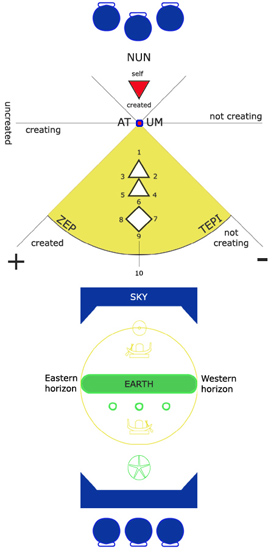
Nun, Atum and creation
As early as the Old Kingdom (ca. 2670 - 2198 BCE), the virtual clause "n SDmt.f", i.e. "before he has
(had) ..." or "he has (had) not yet ..." (Gardiner,
§ 402), denoted pre-states, namely
a potential state before the actual state happens.
Because this state was not yet actual, it
indicated mere possibility, virtuality or potentiality, but related to
(preexisting in) the effect. Anterior to
creation, it was imagined as limitless waters (or ocean), called by various
names : "nw", "nww", "nnw", "nnww", "nnnww" and "niw", vocalized in Coptic
as "Noun", from which the English "Nun" has been derived.
Nun represented a principle
of limitless wholeness before oneness rather than an individuality
(beginning with oneness). It represents dark, primordial undifferentiated
wholeness,
preceding the creation of sky and Earth, i.e. before any movement or display
from the base. It represents the everlasting dark
pre-condition of creation, but also the unchanging vastness which abides
simultaneous with all possible light-creation or display. This
nondual state is :
"... before the sky existed, before the Earth existed,
before that which was to be made form existed, before turmoil existed, before
that fear which arose on account of the Eye of Horus existed."
Pyramid Texts, utterance 486, § 1040.
In the ontology sketched in the
Pyramid Texts, precreation is an
undifferentiated mass of water. The Egyptians gave descriptive rather than
denominative qualifications. Nun is conceived as an inchoate, dark, inert,
nonexistent state-of-no-state.
A large, inert mass of water higher than the sky and deeper than the netherworld
is the image conveyed. This virtual realm of the nonexistent is beyond the
subtle, invisible strata of creation, beyond the sky and underneath the
netherworld. It is nondual, everywhere and nowhere.
This precreation,
or nonexistence, is not a nothingness. There
is movement from this base, there is display, for to be nonexistent
potential is obviously to preclude actuality, but in
Egyptian thought this
never precludes the potentiality to come into existence, to become,
transform or transmute. The latter is indicated by the verb "kpr",
"Kheper", meaning "come into being, become, change, occur,
happen, grow up, come to pass, take place, be effective, etc". Hence, besides chaotic Nun, precreation also effectuates the
capacity of autogenous creation or self-creation.
The first display from the base is this autogenous activity. Limitless
wholeness is before oneness, or the beginning of order. Light and life are spontaneous
manifestations happening in the base, in Nun. Precreation is the conjunction
(unity) of Nun & the
sheer possibility of something preexisting as a nonexistent, virtual,
clear,
singular, one, primordial awareness causa sui. Precreation is
viewed as the dual-union of Nun and Re-Atum, of the
infinite, dark sea and the primordial light-spark of luminous
self-awareness and self-creation (Atum-Kheprer). The image of Atum, in his
Egg, afloat in Nun.
Creation (order, display, effective result) emerges from a singular, atomic monad, floating
"very weary"
(CT, utterance 80) in the dark, gloomy, lifeless infinity of
Nun. Within the omnipresent substance of Nun, the possibility of order, light and life subsists : a
nonexistent object capable of self-creation ex nihilo. Hence,
although Nun is nowhere and everywhere, never and always, it is the
primordial, irreversible and everlasting milieu in which the eternal
potential of light auto-creates. Although order is not ex
nihilo (for there is "something" before "anything"), self-clarity is
spontaneous & without precedent. Precreation is thus not the zero of nothingness, but
the unity of a limitless wholeness (Nun) and the virtual oneness of a
singular, autogenous genetic potential within it (Atum).
"Les Égyptiens ne rencontrent l'unicité absolue de
dieu qu'en dehors du monde et de la création, durant la transition fugace entre
la non-existence et l'existence. Par ses travaux créatifs, le premier - et à
l'origine le seul dieu, disperse l'unicité primordiale en une multiplicité et
une diversité de manifestations : ainsi, en dépit de multiples
caractéristiques communes, chaque dieu est unique et incomparable."
Hornung,
1986, p.169, my
italics.
Atum "created what exists" and is
the "Lord of all things" (CT,
utterance 306), "Lord of All" (CT,
utterance 167), "Lord of Everything" and
"Lord of Life" (CT, utterance 534).
He/She is
"the origin of all the forces and elements of
nature" (Allen,
1988, p.9). His/Her name is a form of the verb "tm", probably a noun of
action, meaning both "complete, finish" and "not be". Indeed, Atum,
a bi-sexual supreme deity,
makes display/creation emerge and completes it without belonging to the created order.
Coptic scholars like
Crum (1939) translate "noyn" as "abyss of
hell, depth of Earth, sea" etc.

Coptic "Noun", or "abyss of hell" ...
"In the beginning Elohîm created the heaven and the
Earth. And the Earth was without form and void ; and darkness was upon the
face of the deep. And the Spirit of God moved upon the face of the
waters."
Genesis,
1:1-2.
Precreation is more than a dark, everlasting and limitless sea of
undifferentiated space.
It is more than a formless mass, inert, dark and inimical to the
light-order & its life. In other words,
precreation is not identical with Nun. Atum, the "Ba",
"soul" or transformational principle of Nun, is
the co-relative factor of Nun in preexistent nonexistence. Re-Atum-Kheper
represents singularity, order, light and life resulting from
self-creation, in essence self-clarity.
On the first moment of display, or "zep tepi" ("zp tpi"),
on this "first occurrence" or "First Time", Atum is Atum-Kheprer. Before
that moment, no order, light or life preexisted. While Atum "floated" in
the inert ocean, this potential was as it were diffused in Nun. But on the
creative instance, the patterns of existence
were
established and enacted by focus, contraction and pressure (or
singularity). Creation was thus initiated by the distinction
between the surrounding waters (Nun) and the active primordial seed or
monad.
Atum-Kheprer creates
ex nihilo. The beginning of display and energy (differentiation) is not
the transformation of a previous state.
Diffused in Nun, and thus inactive, Atum as Kheprer autocreates his own
change of mode, and recollects out of darkness and dispersal,
reversing the genetic potential, beginning the genesis of light and
clarity.
Nun is not changed because of Atum-Kheprer. Although the Egyptians could well see
Atum-Kheprer as the "Ba of Nun", this mythical notion is rather confusing.
Let us go over this notion again.
Before the monad Atum self-creates as Atum-Kheprer (changing from diffused and passive to
contracted and active),
lifeless, inert, dark nonexistence prevailed (Nun). With this monad bringing
itself into existence, nonexistence is divided
into, on the one hand, the chaotic waters (the Abyss) and, on the other
hand, the seed of order, light and life (the Ennead). Atum
represents the spontaneous, genetic potential of precreation to manifest creation,
and because Atum-Kheprer self-creates, there is nothing anterior to this monad,
except the liquid space of disorder and darkness in which Atum passively floats ...
Before becoming singular, Atum (the
genetic potential) is diffused in Nun, and thus incapable of
concentration, focus and hence creativity or display of energy.
This difficult notion is touched upon in this remarkable text :
"It is me (who came out of) Nun, the sole one, without equal.
If I (Atum) have transformed, it is on the
great occasion of my
floating (after) I came into being ! I am he who flew up, who's {form is
that of he who encircles}, who is in his egg. I am the one who began in the Nun.
See : the chaos-gods came out of me ! See : I have come ! If (I) brought my
body
into being, it is through my Akh, (for) I am the one who made myself and I
formed myself at my will according to my desire."
Coffin Texts, utterance 714, lines 343-344 : the second first person refers to
Atum, not Nun as the rest of the passage makes clear (nowhere is the name
"Atum" mentioned).
In the "zep tepi", Atum creates and completes the world for his own pleasure and according to
his own heart (or divine mind - cf.
Memphite theology).
The reason why something came out of Nun is
explained as Atum pleasing himself (the image of masturbation), not
parenthood. Other images convey the meaning of strong and powerful
ejection (as in expectoration or ejaculation). Atum is both male and
female and does not need a consort. The "zep tepi" emerges as the
dreamed genesis (of the pantheon and its "golden" proportions) of an
autarchic, masturbating bi-sexual African Solar deity, who at the moment
of ejaculation brings actual creation into being (a "giving birth" of
actualized "nature" of the godhead).
The first occurrence (display) unfolds at the moment creation starts with the
spontaneous emergence of Atum-Kheprer contracting to a luminous point (Re) ex nihilo.
Atum is alone insofar as he has no consort. He is causa sui (cause
of itself) and sui generis (the only example of its kind and
so constituting a class of its own, unique).
Atum autogenerates and
necessarily splits into a divine diversity. The first "stable"
form in (or first generation of) this "divine comedy" is the fertile trinity
"Atum - Shu - Tefnut". His oneness is "fugal" (running away) and his being
alone only serves his autogeneration, which does not impend an instantaneous
differentiation into life and order, on the contrary. Atum is
aloneness-in-transformation, a point of alternation between the diffused
genetic potential and the beginning of light-genesis, the reversal of this
diffusion by contraction or drawing together.
Atum, autogenerating for his own pleasure, immediately &
simultaneously splits and, in the "zep tepi", gives birth to Shu & Tefnut, the start of a chain of
ordered structures, the Ennead or divine sequence : {1, 2, 3} U {4, 5} U
{6, 7, 8, 9}. This eternal happening, the proto-type (matrix) of order, is the imaginal continuum
or "Golden Age" of natural
parameters, preparing creation before it happens, and sustaining it when
it actually happens. This is the divine mind
and "Golden Age"
with its infinite number of names, attributes and functions.
With Atum-Kheprer and the (eternal) first
occurrence, no actual thing is positioned, but only the structure
necessary to manifest light. This is the "Ennead" of Atum : Atum,
Shu, Tefnut, Geb, Nut, Osiris, Isis, Seth, Nephthys. Only the formal conditions of
the divine display are given (i.e. an outline of its elements and forces).
The world is in the image of Atum ("iti tem").
As every thing, except the absolute base or essence (Nun), is a dynamic
light-display of the latter, even clarity and open awareness (Re-Atum)
differ not from the ongoing movement from the base or "energy"
(difference) or "Khepri". Instability (Set) is therefore part of this
dynamic display, and "sub specie temporis", the base itself is
impermanent (Atum is fugal). But from the perspective of its own essence,
the base is changeless and ceaseless (every thing floats in Nun).
The essence of everything : the absolute
Real-Ideal.
"The Tao that
can be trodden, is not the enduring & unchanging Tao. The name that can be
named, is not the enduring & unchanging name."
Lao-Tze : Tao Teh King, 1.1.
"There is no speaking of it, nor name nor knowledge
of it. Darkness and light, error and truth - it is none of these. It is
beyond assertion and denial. We make assertions and denials of what is
next to it, but never of it, for it is both beyond every assertion, being
the perfect and unique cause of all things, and, by virtue of its
preeminently simple and absolute nature, free of every limitation, beyond
every limitation ; it is also beyond every denial."
ps.-Dionysius the Areopagite : The Mystical Theology, chapter 5.
In Ancient Egypt, before any light, a dark, undifferentiated,
indefinite vastness abided enduringly & everlastingly ("djedet"). This
limitless darkness was always present, did not change and was without
singularities. Nevertheless in this ocean, an inert & diffused potential
for oneness was afloat. Out of itself, this potential hatched as the One
to immediately differentiate, giving form to the natural
energy-differentials ruling the order of light (the "gods & goddesses").
The display of Atum is spontaneous and ongoing, for the creation of the
Ennead is an eternal and unending repetition.
In Dzogpa Chenpo (cf. Bön, Vajrayâna and Iranian light-mysticism), the
essence or base of everything is discovered to be vast, boundless,
everlasting, omnipervasive, limitless expansiveness, immeasurable,
uncontracted & immutable. It is neither oneness or twoness, but
indefinite. It is what Mâdhyamika cannot posit by way of inferential
logic : emptiness beyond "affirmation & denial" (cf. negative theology).
This base is real and displays itself as energy (lights, sounds, rays), of
which the nature of every mind is part.
Western Abrahamic theology largely affirms the "Names of God" and their
underlying symbolic adualism in terms of dogmatic fideism (escaping
nominalism through faith alone). On the fringes, negative theology
identified the essence of God with absolute, nameless, signless
transcendence, only to be approached by nondual, ineffable and un-saying
thought in the contemplation "of the mind".
So, as in Vedânta, with its important, Sanskrit-inspired distinction
between "Nirguna-Brahman" & "Saguna-Brahman", Western onto-theology of the
Divine Names and their "sacred" language (Hebrew, Latin, Arabic),
distinguished between the interior "essence" of God and the exterior
"existence" of God, between an impersonal absolute and a personal, more
approachable God.
In Qabalah, "YHVH" being ineffable, is pronounced as "Adonai" (or YHAdonaiVH).
"ALHYM" (or "Elohîms), a masculine plural ("Eloah"
is the singular form, "Allah" in Arabic) of a feminine noun, indicating neutral
plurality & receptivity to the creative impulse, is the "Divine presence"
within the created order (cf. the "shekinah"). "Elohîm" is
creational as shown by the first three words of Genesis : "B'RASHITh BaRA
ALoHIM ...", "In the Beginning the "Elohîm" Created ..."
"Elohîm said" (343) occurs 10 times (cf. the 10 Emanations or
"Sephiroth"). "Elohîm" is repeated 32 times in the first chapter of
the account (cf. the aleph-beth (22) + 10 Sephiroth or the 32 Paths of Wisdom of the Tree of Life).
"Elohîm" is related to the majestic revelatory plurality of the
singular hidden "YHVH" and is translated as "the holy Gods" or
"Gods & Goddesses". It expresses the totality of Divine attributes (or
exterior) and underlines the variety with which the Divine manifests in creation
(God-in-Nature). The "Elohîm" are not idols for no "Eloah" (singular)
can constitute Divine existence without reference to "YHVH", the uncreated
silence.
The translators of the Septuagint
(starting in the middle of the 3th century BCE) identified the Hebrew Name
of the Divine "YHVH (the) Elohîm" with the Greek "Kyrios ho Theos",
"Kyrios Kyrios" or "Despotes Kyrios", the gods of Hellenism. So "YHVH" was
translated as "the Lord", and "Elohîm" as "God" ("Theos", "Deus"). Thus
the plural "ALHYM" became the singular "God" !
Orthodox Christianity keeps the
neo-Platonic division between the inner essence & the outer face of God.
Indeed, the only place in creation where God is constantly Present (after
the ministry of Jesus Christ), is in the Eucharistic Host & Cup. God is
therefore "Loin-près" (or far-near).
In the tradition of
Sufism, the essence of the Divine is
unknown (nobody known Allah's Face but He). Divine existence is the
Self-disclosure of Sheer Being in an infinite number of Divine Names,
origin of all of creation (cf. Ibn al-'Arabî). Here "Allah" ("The God") is
both Essence (His Face) & Existence (99 most beautiful Names).
These "positive" (dogmatic) theologies "of the book", pertain, as written
testimonies, to the domain of creative thought, invalid when God's essence
is at hand. As nominalism is correct, no symbolic adualism can be invoked
to explain the "exclusive" status of any written text, of whatever nature
or whatever its author. There is no God-given bridge from "text" to "God".
Words do not suffice, on the contrary, as mere conventionalities, they
obscure the natural light acting in the mind of each. Hence, as negative
theology makes clear, positive theology becomes uncritical, unworldly &
delusional if it does not regularly purge itself by way of negation,
denial and renunciation.
For Plotinus (ca. 205 - 270), multiplicity is a fragmentation of the
original unity of the One. Hence, each stage of emanation is a descent
into greater multiplicity, which means greater restriction, more needs,
and the dispersion and weakening of the power of previous stages. The One
is the negation of duality, formless, unmeasured, and infinite. "Soul"
(psyche - cf. empirical ego) and "spirit" (nous - cf. own-Self), are
insufficient to know the One, because both operate by positing object &
subject. Contemplation brings us so far as the ideas (of the own-Self),
but only ecstasy allows for glimpses of the One.
"With the absolute I, which can never become object,
the principium essendi and cogniscendi coincide."
Schelling
:
On the Self, 1.236.
For Schelling, the absolute subject is the knower of itself. It is
"den Urstand", which can never become "Gegenstand" or object. To be known
as subject and object is only possible in "ecstasy". Hence, absolute
idealism is also absolute realism, for absolute I = Being pertains.
Besides the reduction of thinking to the ego sum, the latter needs
also to be reduced to an absolute I. So the empirical ego opens up for the
state of its own individuality (or own-Self) and then annihilates this to
discover the natural state of mind, which is one with the absolute I. This
identity is then called "real-idealism". In the absolute I, the fight
finally ends, the concordia discors is put to rest. Mind is no
longer before nature, nor is nature before mind. Both are originally
united, and the distinction between two is gone, for the are in reality
one ("realiter Eins"). It is possible for a "completed spirit" to unite
with the absolute, to bring on-itself ("an Sich") and for-itself
("für-sich") together. This is not to have the absolute in thinking
(as in Hegelianism), for the spirit being "with itself" ("der 'bei sich'
seinde Geist") has thinking in the absolute. Indeed, the thought of
the absolute is not the state of the absolute !
Mystical experience : contemplation &
union.
"'There is no target behind God'
- that is the Real, that cannot be coveted. This is the station of the
Real. Do not transgress ! In this station, no station is permitted. When
You arrive, my brothers, return !"
Ibn al-'Arabî :
The Meccan Openings, chapter 410 (Chittick,
1998, p.225).
In Classical Yoga ("râja"), three "inner" limbs characterize the path of
increasing distinction between nature ("prakrti") & spirit ("purusha") :
concentration ("dhâranâ"), contemplation ("dhyâna") and union ("samâdhi").
Nature includes matter, the world of appearances and mind, or "that which
knows". "Purusha" ("man", "person") is the eternal, absolute I or
"own-form" of "citta", consciousness. It observes the changes in matter as
a witness, and, as Sâmkhya philosophy explains, the world comes into being
by a union of both. In Vedânta, "purusha" is identified with "âtman", and
hence also with "Brahman".
For Patañjali, the three "inner" limbs form a whole, called "restraint" or
"self-control" ("samyama"). Contemplation is an incomplete union (cf. the
presence of the own-Self as "samskâra" and/or the "union with nature").
Only when nature & pure consciousness are absolutely divorced, will all
fluctuations of consciousness be restricted. This is not described as a
"standing-outside-oneself" or "ecstasy", but as the realization of the
true core of consciousness, "purusha". To realize the "own-form" of
consciousness is restricting all of its fluctuations, bringing its
luminous nature to the surface.
"And when fluctuations have dwindled consciousness
is like a precious jewel ; there results with reference to the 'grasper',
the 'grasping' and the 'grasped' a coincidence with that on which
consciousness abides & by which it is 'anointed'."
Patañjali :
Yoga-sûtra, 1.41.
In Zen, belonging to the Mahâyâna, "satori" is the beyond of knower &
known. In Vajrayâna Buddhism, "union" is not called "samâdhi", but
"contemplation" ("dhyâna"). This is a state of emptiness, or absence
of inherent existence and substance, united with clarity. This highest
meditative state is present in the inseparability of clarity & emptiness,
which is liberation or "nirvâna".
In Dzogchen Buddhism, mindnature generates an ultimate, primordial wisdom
beyond thought.
"One is introduced directly to one's own state.
One definitively decides upon this unique state.
One continues directly with confidence in liberation."
Garab Dorje : The Three
Statements That Strike the Essential Points, (Reynolds,
1996, p.39).
The "gradual", "staircase" methods of Sûtrayâna & Tantrayâna use a "scala
perfectionis" based on renunciation, compassion & emptiness,
involving transforming
impure into pure, slowly accommodating the advent of the highest
state of awareness. Sûtra teachings accept the absolute view may be
realized using conventional logic. Dzogchen, accepting no conceptual
authentication of the absolute, directly introduces the nature of mind &
its light (clarity) by pointing to its immediate, instantaneous and
constant presence hic et nun.
Once properly introduced, only two practices pertain : (1) constantly
cutting through the conceptualizations created by the mind, and so each
time being re-enlightened ("tregchöd") and (2) integrating every display
from the base (pure & impure) with mindnature ("thödgal"). These ongoing,
primary practices no longer rest on meditational sittings & pûjâs (both
Sûtrayâna & Tantrayâna are "secondary" practices). Cutting through and
integration bring the mind to itself and so allow it to be convinced of
the genuine reality of its own light-nature, which is a display from the
essence of everything. They enables the mind to better integrate every
thought, affect & action in mindnature through self-liberation : as
everything is as what it is, nothing must be done (i.e. rejected or
affirmed). Without effort, every thought, affect and action is seen to
"liberate" itself spontaneously. Being impermanent, it vanishes. To
release all conceptualization is the precondition to gain confidence in
the "even plains" of nondual thought.
"The nature of phenomena is nondual,
but each one, in its own state, is beyond
the limits of the mind.
There is no concept that can define
the condition of 'what is',
but vision nevertheless manifests :
all is good !
Everything has already been accomplished,
and so, having overcome the sickness of effort,
one finds oneself in the self-perfected state :
this is contemplation."
Garab Dorje : The Six
Vajra Verses (Norbu,
1996, p.81).
In Qabalah, "katlut" denotes the lower, "nominal", material kind of
consciousness of the fallen Adam. The "Fallen Daughter" ("Assiah",
manifestation), bound by the four elements of the physical
four-dimensional world of the body ("Malkuth", the kingdoms of
thought, volition, affects & sensation), is conscious of herself in a
confused, dreamlike Lunar way ("Yetzirah", formation). In this world of
mind & imagination, consciousness, operating in a fifth dimension,
does not exceed its own egological deeds, affects and cogitations (limited
to the formal and the critical).
The higher state ("gatlut") is two-tiered. In Tiphareth, the
Solar adept experiences, knows & communicates with his or her Higher Self,
the incarnating own-Self or "ego sum". This is a glorious spiritual
experience. Transformation, freedom & compassion are necessary to cross
the "abyss" separating the world of soul ("Briah", creation) from
the world of spirit ("Atziluth", Divine presence). The latter is
nondual & ineffable, involving a direct special, unworldly
knowledge ("Daath") of the three factors of Divinity : Understanding
("Binah"), Wisdom ("Chockmah") & Crown ("Kether"), in other words, the
triad of material forms, natural lights & ALHYM or "Gods & Goddesses"
respectively, "YHVH" or "God" being posited beyond the Crown (as "Ain Soph
Aur").
Christian mysticism, dominated by theological Christocentrism, introduced
two paths to experience God : contemplation "of the heart" and
contemplation "of the mind". In both cases, the essence of God is never
known, but only how He shows Himself to the mystic. The mystic knows God
only thanks to Divine Grace, as a gift of the Holy Spirit and never as the
result of any effort or special technique (virtue prepares but does not
produce). The contemplation of the heart or
love-mysticism, involves a direct contact with the absolute
through the dynamics of "holy" love, described by Beatrice of Nazareth
(1200 - 1268), in her
Seven Ways of Holy Love (1237), as a
process unfolding in seven steps. The highest way brings the soul
"into the insusceptible wisdom and the silent
highness, into the deep abyss of the Deity, who is everything in
everything that exists, insusceptible, elevated above everything,
imperishable, almighty, all-embracing, and who acts all-ruling in
everything that exists" (Seventh Way, § 1). On this highest level,
her Divine love has objects as Christ and the Holy Trinity, but not
God-as-He-is.
Contemplation "of the mind" brings the mystic close to God by way of the "imago
Dei" hidden in the depth of the soul. In this type of experience, the
absolute dawns. In the Spiritual Espousals (1335) of Jan van
Ruusbroec (1293 - 1381), the path of the Christian mystic has
three parts : the "via pugativa" (the "active life"), the "via
illuminativa" (the "yearning life") & the "via unitiva" (or the
"contemplative life"). The last is also called "the
third life" and deals with the supreme mystical experience. The
core of the mystical teachings of Jan van Ruusbroec is the "summit of the
inner life" and was considered by major French theologians like Jean
Gerson (1363 - 1429) as heretical (because -in his reading- it was
pantheistic) and hence a good candidate for rejection & critical scrutiny.
For although Ruusbroec does stress the ontological difference between God
and the contemplative, he nevertheless is unable to stop this overt proof
of orthodoxy of being blurred by his definition of contemplation as
"seeing God with God". The conflict between
orthodox mystical theology and Ruusbroec's ultimate mystical experience is
prominent in the text and often one has the impression that he invokes
orthodoxy just to avoid condemnation each time his experience transcends
important ontological boundaries. Did Ruusbroec think it possible to
trespass the "natural" God-given limitations of created beings ? By
stressing the core of our being is nothing less that God Himself, he comes
very near the Vedânta and its identification of the soul ("âtman") with
absolute being ("Brahman"), and seems to underpin the claim of some
Islamic mystics, like Mansur Al-Hallaj (ca. 858 - 922), that they actually
are "Allah" !
In
Sufism, the sea can not be separated from
the waves, nor can the waves exist without the sea. All these waves of
light have names and create worlds, but there is nothing but the sea and
its water. The water of the sea is always the selfsame water. Only the
color of the cup determines its color. The Islamic mystic who plunges into
this ocean of light annihilates everything he or she is (cf. "fanâ" or
"annihilation"). What is left is utter darkness because of the nearness to
the Absolute light. In that darkness is hidden the "Water
of Life". To drink this water (a metaphor of "baqâ" or
"survival") is to recover from total oblivion and survive as the
perpetual witness of the Absolute. One is reborn as a totally renewed
& perfected human being in the imperishable light which is the Face of the
Absolute, but not the Absolute-as-such. The mystic cannot become God
Himself !
Indeed, Sufi ontology of "wahdat al wujûd" (the unity of being),
distinguishes between being-as-being (One & Necessary) and
being-as-existence (multiple & possible), between being indeterminate and
determinate. The mystic witnesses multiplicity as an expression, a
modality of the absolute being-as-being. But the latter is irreversibly
ineffable, incomprehensible & incomparable (i.e. the One Alone without a
second). Indeed, in the Koran we read :
"Allah warns you about His Self."
Koran,
3:28.
The task of philosophy ?
"He who sees the
Infinite in all things sees God.
He who sees the Ratio only sees himself only.
Therefore God becomes as we are, that we may be as he is."
Blake, There is No Natural Religion,
ca.1788.
It is not possible to express with words what is before and after words,
forcing the infinite into the finite categories of concepts. But although
ineffable, wordless, non-conceptual & non-verbal, nondual thought
nevertheless exist. The religions "of the book" (Judaism, Christianity,
Islam) reject any direct experience of God-as-God on onto-fideist
grounds, and if contemplatives do touch the level of nondual thought and
dare to express it, they are condemned, marginalized as insane,
excommunicated and/or killed.
A direct experience of mindnature is the sole remedy here, not
dubious poetry like "an awareness of awareness no longer consciousness",
etc. Nevertheless, when their direct experience can no longer be kept a
secret, mystics only have ambiguous poetical language and flamboyant
prophetic speech as their final refuge ! Then, spurred by their
enthusiasm, they evoke the deepest mystery, but this hidden, implicate
layer of theirs, effective no doubt, is always at work without words &
concepts, as the wisdom of silence.
How can philosophy assist in the discovery of the nondual ?
Theoretically, even creative thought is untestable, only arguable. The
sublime constructions of the own-Self are immanent metaphysical
speculations, transcending the limitations imposed by formal & critical
thought. Here, philosophy has logic, argumentation & the rules of the
ars inveniendi left as methods to discern between valid & invalid
creativity, between strong, doubtful & weak arguments in the quest for
totalizing answers regarding being, life & the human. This is important,
for some speculative thinkers (like Hegel - cf. supra), posit the
"Divine" within conceptual thought. Their systems block the direct
discovery of the non-verbal pyramidion crowning the obelisk of
consciousness with un-saying. One cannot discover the non-conceptual by
applying inferential logic to concrete, formal, critical or metaphysical
(hyper) concepts.
Insofar as the complete unfoldment of the cognitive continuum from myth
to the nondual is deemed necessary, metaphysics may develop ways to
annihilate the own-Self, as it were prepare cognition for its last & final
step : nondual thought. Acting as a preliminary, the philosophy of
emancipation gathers the mental conditions necessary to develop the best
possible mindset to discover mindnature. It has no other focus, and
mindnature (not the Real-Ideal) lies at the heart of such a
"therapeutic" philosophy, as an act of caring for growth-potential
and full realization.
Practically, the wise is constantly working to make things fit in a less
limited & narrowed "space". Clutching to pet ideas is renounced. The
annihilation of the own-Self, as well as its rebirth, resuscitation &
resurrection, are ongoing in each
"invention" (cf. the alchemical "solve et coagula"). The own-Self,
as a cup,
is (re)created for the sake of compassion and out of love for all beings of
light. The own-Self is a "phantasm" (a fiction) at work (i.e.
genuinely operational)
to help other beings to be less & less engrossed, anticipating & unable to
"fit in" all others in their "Lebenswelt".
The practice of philosophy is
helpful to lay bare mindnature. Open dialogue with a "spiritual friend"
lies at the core of all spiritual transmissions, empowerments &
initiations. However, this is but preliminary play, for if nondual thought
can be pointed at (introduced ostentatiously as in : "There it is !"), it
cannot be developed, produced, generated, invited, transmitted,
anticipated, taught etc., completely & irreversibly baffling & perplexing
conceptual thought ... even wondrously annihilating the own-Self (again).
As the blanks in-between thoughts, it occurs and
that is what is.
|
Epilogue : Guidelines
neither is reason instinct (ante-rational thought) ;
or intuition instinct ;
or instinct intuition ;
confirm the heuristic contribution of an immanent
metaphysics of finitude to science ;
to move beyond critical thought, is to transcend the
"nominal" empirical ego, the fugal "I" ;
beyond critical thought,
always maintain a non-ontological
definition of "intellectual perception" or intuitional knowledge, affirming
intellect does not create outer objects without the outer senses (which
are
everybody's share) ;
conceive the own-Self or "ego sum" as the heart of
an existential, meaningful, inner, positive, creative experience, like an
imaginal, intellectual, meta-physical space, set ablaze by the Cartesian "lumen
naturale" ;
creativity guards the limitations set by the immanent
metaphysics of the own-Self ;
always remind the ineffable, nonverbal, non-discursive,
non-conceptual nature of nondual thought, shaping the "apex" of thought as
an open area of endless possibilities, a direct experience of the nature of
mind ;
transcendent metaphysics poetically extols mind-nature &
the absolute Real-Ideal ;
who knows whether the clear light of mindnature is united with
the base of everything ?
who knows whether mindnature is a
luminous energy-singularity of the absolute Real-Ideal ?
philosophy may seek preliminaries for the nondual but
without causality between preparation & fruit ;
the practice of philosophy is the open space in "a forest
dark", bringing to awareness a change of mind is possible and so indirectly
pointing to the transparant openness of the natural light of mind.
|
Bibliography
General Bibliography
(2005 - 2007)
Bibliography on Egyptology (2004
- 2007)
Bibliography on
Neurotheology (2003)
|




