|
On Henotheism
beyond polytheism & monotheism
an invitation to gnosis
epistemological,
neurotheological & depth-psychological remarks
©
Wim van den Dungen
Table of Contents
Abstract
Introduction
Definitions
1.
Epistemological arguments.
1.1 Two
logical systems and three branches of logic.
1.2 The
limitations of formal syntax.
1.3 The
plurality of semantics.
1.4
Pragmatism or the variety in action.
1.5
Non-Fregean representations.
1.6 Truth and
epistemological pluralism.
1.7 The
problems of polytheism.
1.8 The
problems of monotheism.
2.
Neurotheological arguments.
2.1 Three
types of brain software.
2.2 Archaic
software and the polytheist representation.
2.3 Limbic
software and ante-rational henotheism.
2.4 Frontal
software and the monotheist representation.
2.5 Towards a
rational henotheist representation.
3.
Depth-psychological remarks.
3.1
General remarks on the law of the psyche.
3.2
Polytheism and the collective unconscious.
3.3
Monotheism and conscious rationality.
3.4 Henotheism and psychic equilibration.
Epilogue
Bibliography
Abstract
Monotheism defends the numerical singularity of
the Divine, or God = {1}. This statement implies there can be no "second"
next to God, reducing Divine infinity (expressed as the full-empty set
of "all possibilities") to firstness, or : {Ø} = {1}. On the other
end, polytheism worships a finite or infinite variety of independent Divine
beings, or God = {{A}, {B}, {C}, ..}. Mostly, if not always, this goes hand in hand with an
ante-rational
approach to life. Indeed, the logical problems invoked by
polytheism can not be accommodated by rational thought.
In-between and beyond both, henotheism maintains the essential unity of
God, hand in hand with a variety
of theophanies, S elf-manifestations or cogitations of God, giving rise
to and sustaining creation and
humanity. However, all Divine realities are permutations of firstness.
Everything and everyone is in The All and The All is in all.
Henotheist theology has historical roots in
Ancient Egyptian
religion, Pagan
Hermetism and Hermeticism. Today, it is at work in
the East in Brahmanism (Hinduism)
or in Taoism and is part of the Western Mystery Tradition.
In this essay, and with various arguments, the case of rational henotheism is defended,
i.e. Divinity as an essential unity with & in existential diversity. The Divine is a
singular unity manifesting in plural diversity.
God The All is One in the Beginning, One in the Permutations and One at
the End.
The firstness of the Divine is
not in conflict with this diversity. The sole God is not against the
other Deities, but Self-manifests as Divine Names, Attributes,
Presences, Hierarchies, Gods & Goddesses, etc. Such a bi-polar concept of the
Divine does not eliminate the notion of firstness, for in the hierarchy
of Divine Names, "1" or "I AM" remains the "summum bonum"
(cf. the Decad of the
Pythagoreans, or 'Kether", the "Crown" in
Qabalah).
The radical departure called for, is the end of the numerical dogma of monotheism,
i.e. The All above and against Its own Images. The existentials of God (the Names, Attributes, Deities)
offer various ways to worship God, although in essence always the same
God is worshipped (cf. the
Sufism of Ibn'Arabi). Henotheism is not monotheistic, but theomonistic.
Orthodox Christian Trinitarism comes closer to henotheism than expected.
Contemporary Paganism (Hermeticism, Theosophy, Western Tradition,
Occultism, New Age, Wicca, Kemetism etc.) is
henotheist.
Introduction
Although exceptional, the direct experience of the Divine is an intrinsic part of humanity's
wide array of possible experiences. This "visio Dei experimentalis"
(Thomas Aquinas) is however non-casual, and usually occurs when a
complex set of conditions are fulfilled (giving rise to altered states
of consciousness). Because of this complexity, religious experiences and
mystic states are very rare.
Even yogi's & monks exercise daily. As the impact of these spiritual
limit-experiences is often tremendous, leaving lasting effects, the
procedure is best channeled. Preparations are necessary but never
sufficient : the most diligent of devotees may have to wait for years
before his or her consciousness truly alters. Even after many unions,
sudden periods of "dryness" may still ensue. Only the few realize a
mature spirituality, able to profoundly
invest in God. Too strong and too weak emotional attachments (positive or
negative) make such a study unrewarding. Especially in the beginning,
worldly activities often block further spiritual growth. Loinprès
emerges in the serene and clear sobriety of dawn or in the utter
stillness and concentration of the night (cf. the "midnight
mystery").
"And again I say to You : 'It is easier for a
camel to go through the eye of the needle, than for a rich man to enter
the kingdom of God.'"
Matthew, 19:24.
Only divested of all superfluous stuff can sparks of the true meaning of
God's Being be discerned. Our incapacity to experience God, brought upon
ourselves by constructing walls around the soul, encapsulating its
intellect and organ of inner, intellectual, intuitive perception and
prehension, does not prove that God does not exists. Although today it
is fashionable to understand God as the exclusive datum of faith, we are
equipped to directly experience God's existence(s) (or gnosis).
The proof of the pudding is in the eating. This is what most, if not all
mystics teach (irrespective of their religious affiliation).
A typical example. Beginning spirituality is often characterized by Divine
nearness (producing exclusive states of joy, euphoria and
enthusiasm). However, after this profound initial elation, long periods
of "dryness" follow, triggering frustration and the felt remoteness or
non-existence of God. These are illusions we bring about on ourselves.
We need to find rationalizations not to change our bad habits and ill
character, like our lack of trust, sincerity and true love. Suppose our spiritual efforts
are deeply entrenched
and regular (despite being lukewarm), then is it possible, when the time is ripe,
that a
new "jubilatio" ("mentis" or "cordis")
lights up. This mature spirituality praises God for being there and for
nothing else.
Indeed, most
beginners throw the baby out with the bath water. In this
early stage of our spiritual itinerary, we "trust" God
conditionally
(Does God really exist ?),
need swift "results" and so relinquish our spiritual exercises too
quickly, resulting in immature experiences of God that haunt our memory
until our
bodies die. The dryness is a test most students fail. These
crucial early spiritual manifestations, covered up with later mundane
experiences, are done away (repressed) as childish
auto-suggestions, hallucinations or hypnotic effects ...
We fail to realize how difficult it is for a human being to open up
enough and create the necessary conditions for God to manifest. The
"easy way", so does it seem, is to keep the filters and reject God ...
Indeed, as Kierkegaard affirms, religion is a "jump" in the absurd, for
the "infinite" is to be caught by the "finite" ...
Very early in history, these difficulties led to specialization, at
first organized around a "special" individual (like the Upper
Paleolithic and Neolithic) "shaman", and later by a regulated
priesthood, worshipping one of the many possible Self-manifestations of
the Divine. It is this spirito-communal organization which gave rise to
the religions.
The registers are divided : the substructure of the direct experience of
God (gnosis, mystical union, samâdhi, satori) is super structured
by a theological framework, a set of concepts regulating the semantics
of the interpretation of the experience. As the direct experience has an
intimate, dominant core-meaning of its own (namely the confrontation
with a unique object, the "totaliter aliter"), such
superstructures tend to encapsulate each person's right to experience
"his" ("her") God to the advantage of "our" God, the object of worship
of the various religions in terms of a specific, common religious
language. Hence, mystical experiences (of solitary mystics), religious
experiences (as in popular piety) and spirito-communal experiences (in
fixed groups like churches, lodges, monasteries & religious schools)
represent various intensities of the same experience of God, ranging
from esoteric to exoteric. Despite the fact of their exclusivist
soteriology, no religion holds a monopoly on God. Indeed, religious
diversity annuls this.
Historically, distinction is made between four theo-ontological models of
the Divine :
-
Semitic
model : God is One and Alone. He,
the sole God, is an
unknown and unknowable Divine Person, Who Wills good and evil alike (cf.
Judaism &
Islam) ;
-
Greek
model : God is a Principle of
principles, the best of the best (Plato), the unmoved mover (Aristotle),
the One even ecstasy does not reveal, impersonal and in no way evil or
tainted by
absence or privation of being (Plotinus), the First Intellect (Ibn
Sina), a "God of the philosophers" (Whitehead). This abstract God
figures in intellectual theologies, humanism & atheism. In the latter,
by the "alpha privativum" of the Divine, as in a-theism,
an absolute term is produced, but this time by negation instead of by
affirmation. God is reduced to an abstract & absolute "no-absolute" - in
popular Greek religion, the deities are anthropomorphic ;
-
Christian
model : God is One essence in Three Persons
: God the Father revealed by God's incarnated Son, Jesus Christ,
because, in and with God the deifying
Holy
Spirit. A God of Love, never impersonal, always without evil (pure of
heart) and sole cause of goodness
(Christianity) ;
-
Oriental
model : God, The All, is One sheer
Being present in every part of creation in terms of a manifold of impersonal
& personal Divine Self-manifestations (theophanies), as we see in
Ancient Egypt,
Alexandrian
Hermetism
(gnosis), Paganism,
Hinduism
(Vedanta), Jainism,
Buddhism, Taoism, Hermeticism.
These
approaches underline the multiplicity of the available superstructures or
ideologies built on religious life. These meta-languages transform direct
experience into indirect or encoded information (traditions), while immediate
awareness remains the true touchstone of spirituality.
The outstanding conflict in the theologies of humanity is between those who
maintain God's unity is only numerical (i.e. quantitative) and
those who understand God to be qualitatively One in All Possible
Self-Manifestations of the selfsame God (in Divine Names, Attributes, Gods and Goddesses, the "God of
Gods" included). The latter are
polytheists only if God's unity is lost, which need not be the case, as
history shows and this essay tries to point out. Monotheism thinks God
solitary. Henotheism thinks God relational.
Max Müller (1906 -1994) coined the term "henotheism" to explain the tendency in the Vedas
to make the Deities perfectly interchangeable. He wrongly believed
henotheism to be a historical stage subsequent to polytheistic
syncretism, which identifies the Deities with each other. He also
underestimated the theological sophistication of the Vedic seers. A
unitary truth, underlying the many paths, gives different Names and
Personifications to the same One.
"There is one Truth, but the wise call it by
different names ..."
Rig-Veda,
I.164.46
In later Hinduism, the
One is simultaneously Many and vice versa. The same type of theology was
at work in
Ancient Egypt. Even the Christian
Triune God retains certain
characteristics of this approach (cf. Epilogue), the
Qabalah as well (cf. the 10
Sephiroth).
Monotheism and polytheism are polar extremes and cannot be reconciled.
Monotheism becomes radical in the light of the obvious problems caused
by polytheism. But most monotheistic theologies fail to distinguish
between polytheism and henotheism, and hence misunderstand this other
path to the selfsame God.
All extremes are to be avoided. Both monotheism and polytheism lead to a
series of problems, and express both ends of a spectrum, in which
henotheism occupies the middle ground and also moves beyond it.
Three theo-cosmogenic models of the Divine return :
-
Immanentism : God
and creation are the same, and so there is no Divine essence outside
creation, for Divine essence equals Divine existence. God maybe the subtle "pneuma" of
the universe (cf. Stoic Pantheism) ;
-
Transcendentism : God and creation
radically differ, and so only God is real, ideal and creator (cf.
radical
theism). At best, creation
is God's Image. In any case absolute essence (The All) remains a degree "higher" than
relative existence (creation) ;
-
Creationism :
God includes creation, and so although there is a distinction between
essence and existence, the latter is the Self-manifestation of God's
ineffable essence (the latter encircles creation in all possible
directions - cf. pan-en-theism). The All is in everything and everyone
(immanent) and all is in The All (transcendent).
The first two are classical models
and define a
spectrum : God is either identical with the universe or absolutely different and
thus
alienated from
creation.
If God is one with nature, it becomes unclear how God's essence can
be defined. Where can this subtle "logos" be found ? In matter
and its entropy ? The concept itself becomes obsolete (is replaced by mathematical &
physical ideas) as soon as the description of nature is enough to define God
(naturalism).
If God does not touch creation, it is difficult to maintain the
independent nature of existence, or to attribute, next to God, a
positive meaning to nature, or even to understand the universe as
created. As God is the only Real, all the rest is -per definition-
unreal (cf. neo-Platonism & Vedanta).
Creationism ascribes a positive value to creation. Nature (material as
well as psychological) is real. Nature may be sacralized as
the many theophanies of God, the Great Architect or Intelligent Designer
(First Intellect, the Pen, etc). Essence (transcendent, ineffable and
absolute) and existence (immanent, verbal and relative) are held apart,
but existence is not devoid of creative Divine Presences, for all
happens in God.
The
world as a cogitation of The All (cf.
Memphis theology), does not alienate
The All (the One Thing - cf.
Tabula Smaragdina) from Its creation.
The balanced approach of Loinprès (Porete) is the hallmark of genuine
mystical theologies. In Platonism, both
ends of the Divine spectrum were divorced. Aristotle too projected the
perfect movement "outside" the sub lunar sphere of becoming. Although the
unmoved mover is the final goal of all of creation ("telos") and a pure act, this
Principle of principles remains remote and abstract (not a living
Divinity, a Person as in the religions).
Exclusive transcendentism sees God as absent and remote (cf. the "Deus
absconditus"), and thus denies the world any substantiality. Exclusive
immanentism or pantheism sees God as devoid of hidden interiority,
promoting presence and nearness to the expense of the history of the
world itself (namely its finitude, entropy and singular origination).
God The
All Farnear encompasses both views. As essence, The All is unknowable.
As existence, The All is in everything & everybody, while we all are in
The All. Viewed from The Absolute All, nothing is Real except The All.
Viewed from the relative world, all things are real, because of The All
in which they were, are and become.
DEFINITIONS
Divine - God - Religion -
Religions - Mysticism - Theism - Polytheism - Monotheism - Pantheism -
Pan-en-theism - Monolatry - Henotheism - Deism - Atheism - Agnosticism
DIVINE : what is a supernatural
phenomenon
This term denotes all things belonging to God (viewed
as numerically one, monotheism, qualitatively one, henotheism, or
numerically plural, polytheism). The only qualification being a
meta-nominal, "supernatural", meta-nominal phenomenon (either part of nature,
pantheism, or transcending nature, theism).
GOD : the One Greatness excelled by
nothing
GODS & GODDESSES : the Great Ones for whom nothing greater exists
A definition of God is
impossible. "Infinite, eternal, absolute, etc." are limit-concepts, like
"the One Greatness". God is "that than which none greater can be
conceived" ("aliquid quod majus nihil cogitari potest"), Anselm
of Canterbury (1033 - 1109) said. Because such an all-comprehensive concept, were its
referent not to exist, would not be all-comprehensive, God exists. Only
the concept of the Being of God implies existence or instantiation.
Although Kant showed the fundamental flaw when this kind of reasoning is
applied to beings other than the Supreme Being (or Beings), it still
detains an intuitive core : the perfection of a concept like "God" is
harmed by attributing it anything negative or imperfect, such as
inexistence, ineptness, inertia etc. Because this is only the case for
"God", the argument is tautological and hence a failed ontological proof
of the existence of God.
When focusing on the logic behind Anselm's argument, we realize he did
not find a way of inferring God’s actuality from His mere possibility,
but a way of inferring God’s existence from His sheer Being. The latter
is not distinct from His existence. The direct experience of this Being
moves beyond the tautology, introducing
mysticism. Here were read God as the
only Being worthy of worship. The Divine is then praised for being there.
RELIGION : to
unite
From the
Latin verb "religare", religion.
In sensu lato, religion is the joining of the part with the
larger whole. The latter may be nature viewed as a totality, or a
comprehensive perception as in orgasm or religious experience (cf. "yoga" from
the Sanskrit root "yug", meaning "yoke").
In sensu stricto, the word points to the
"totaliter aliter", i.e. a radical otherness called
"Divine".
This
involves a Supreme Being or Beings, either transcending nature or representing,
for example, a subtle, fiery, logoic "pneuma" at the head of the natural order
(as the Stoics assumed). For thematical distinctions between
religious & mystical experiences, consult my
Introduction to a Colorful Recital
(2002).
RELIGIONS : the social organization of religious
experience
Organized worship according to a "canon" established by a founder
(plus a founding message and/or text) and/or
his or her followers (plus a tradition). As soon as a spiritual group is formed, a rule of
order is called for (cf.
the rise of Christianity or
monasticism). At a certain point, this group-form becomes
quasi independent and a goal on its own. Religions are therefore
defined by two pillars : the original teachings + the traditions (the
so-called "magister fidei"). To
evidence the authentic core besides the dross, both need
deconstruction.
MYSTICISM : direct, immediate experience of God
From the
Greek "mustikos", hidden, secret.
The "visio Dei experimentalis" is the authentic core of all
religious experience and hence of all religions. It is the "secret" in
the heart of faith and the living soul of all
human spirituality. Without it,
religion is a dry and unrewarding experience. With it, a direct
experience of God becomes possible ...
THEISM : God, Gods and/or Goddesses
exist !
From the
Greek "theos", God.
The existence and continuity of creation is owed to only a single
Supreme Being (monotheism), a single unity of Supreme Beings
(henotheism) or a plurality of Supreme
Beings (polytheism), distinct from creation (but not necessarily transcending it).
The Divine order is both omnipotent & omniscient. In this definition,
theism exceeds monotheism to encompass polytheism and henotheism.
POLYTHEISM :
many Supreme Beings
There are many Supreme Beings. This manifold causes the created order to come into being,
sustains it and
participates in its creativity and enfoldment. These Beings, transcending and/or coinciding
with the natural order, are not interconnected, do not spring from a common
source, are co-eternal from the beginning, form an atomized Divine order, are
mutually exclusive, while each has its own specific, irreducible domain or field
of activity.
Insofar as
these Divine beings are headed by an absent "Most High" Deity (a "Deus
absconditus"), a mild form of polytheism is defined. Insofar the role
of this "Most High" can be assumed by various Deities, monolatry is
defined. Insofar as such a
Supreme
of the supreme is absent, archaic or primitive polytheism is indicated. This
construction works well in mythical and pre-rational modes of cognition.
It is already difficult to maintain its stability in proto-rational conceptualizations
and it is in direct conflict with the principles of reason.
MONOTHEISM :
only "1" Supreme Being
There is only
a single Supreme Being, the sole God. This God is alone and causes the created order to come into being,
sustains it and
participates in its creativity and enfoldment. This solitary Being, transcending the natural
order, does not share its Divine nature with anything else, has no "second" and
so is Absolutely Alone. All other beings to whom Divine status may be attributed
are essentially powerless and derive their illusionary status from the sole One.
Insofar as this sole God dictates only one way of worship (of that One), we speak of
strict monotheism. Insofar as the One may be worshipped in multiple ways,
theomonism is defined.
Monotheism proclaims a dualistic relation between God and the world,
wherein God is a Being who controls events from outside of the human
world. Emphasis is put on the numerical "firstness" of God, or (God = {1}).
PANTHEISM :
only One supreme natural being
From the
Greek "pan" and "theos", the universe = God.
There is only One
Supreme Being, the One, sole God, a "logos" who does not
transcend the natural order ; the One and the world coincide. Everything
part of the natural order is therefore in essence Divine and sub
summated
by the One, the supreme God "of nature". There is no transcendent
essence outside nature, and therefore creation is not caused by anything
outside the natural order. Naturalistic auto creation (auto generation) is
effectuated with nothing except nature or the universe is conceived as
uncreated and eternal.
PAN-EN-THEISM : all in The All and The All in all
From the Greek "pan en theos",
all in God.
God (singular or plural) is truly different from the natural order, but
existentially Present in every element of creation as a manifold of
Self-manifestations of Divine Names, Attributes, Gods & Goddesses, the
abstract differentials of nature, of the world in action (creationism). There is nothing outside
God, who is both transcendent (theism) and immanent (pantheism). Creation
happens in, by and for The All. God encompasses creation in all
directions, but transcends it. All in The All and The All in all.
MONOLATRY : One
Supreme Being exists, but reversibly so.
From the Greek "monos" and
"latreia", service.
A "Most High" is acknowledged, but not universally
or irreversibly. In Ancient Egypt, especially in the Old Kingdom,
various Supreme Beings were called "the Great" ("wr" or "aA"), and worshipped as such :
Atum-Re and Osiris are strong examples (but any "god of the city" was
also "the Great"). Only in the New Kingdom is a New Solar Theology
at work, focusing, in the Late Ramesside Era, on the Greatest God before and
within all beings (Amun).
Then the provisional nature of oneness and greatness looses ground
(although, to the affects, it was never lost).
Monolatry is consistent with mythical & pre-rational
thought.
HENOTHEISM :
One in all Divine Beings & all Divine Beings as One
From the Greek "hen" and
"theos", The One God.
Divine Beings or Powers cause the created order to come into being. They
are expressions, Self-manifestations or theophanies of one and the same
great God. These
Supreme Beings, transcending and/or
coinciding with the natural order, are interconnected, spring from a common
source (before or simultaneous with creation), are not co-eternal from the beginning, do form a concerted
Divine order, are not necessarily mutually exclusive. Although each has its
own specific, irreducible domain, cooperation, interchanges and adjustments between these
remains possible, although not necessary.
Insofar as some of these Beings
transcend the natural order, pan-en-theist henotheism is defined. Insofar as all
of these Beings coincide with the natural order (the source of Them is
simultaneous with creation), pantheist henotheism is being
defined.
DEISM : a Divine reality exists but
is absent !
The existence and continuance of creation is owed to
One Supreme Being.
Transcending creation, God does not interfere with the natural order of
creation. The natural laws are defined from the beginning and God does
not alter them (miracles are impossible). There is no "revealed"
religion. God is absent, except in the laws of nature. The experience of
God is only possible within these laws.
ATHEISM : a Divine reality does not exist !
There is no
Divine Being or Divine Beings. There is nothing Divine in ontology (no
theo-ontology). There is nothing transcendent, supernatural nor
"pneumatic" in the natural order. The latter is the only existing
order. There may be a natural hierarchy, but not to accommodate a
Supreme One, omnipotent, omniscient Being, nor an indifferent deist God
(atheism = a deism).
AGNOSTICISM : maybe a Divine reality
exists or maybe not ...
There may be
a Divine Being or Divine Beings. There may be a transcendent, supernatural or
"pneumatic" natural stratum. The latter may be the only existing
order. If a natural hierarchy exist, it may imply a supreme, omnipotent,
omniscient being. But, these propositions may also all be untrue.
Insofar as it
can never be decided whether these propositions are true or not, radical
agnosticism is defined. If a decision about them is postponed to the future,
prospective agnosticism sees the light.
The
superstructure conjectured here is a possible pan-en-theist henotheism.
The transcendent essence of God is One but never single and manifests in
"millions" of immanent Self-manifestations.
1. Epistemological arguments.
These
arguments are draw from the nature of human knowledge, in
particular the limitations and possibility of the cognitive system. As
the rules
of "true knowing", and a
comprehensive epistemology have been developed
elsewhere, only those arguments which are specific to the present text will be
presented.
As no
epistemology is possible without the rules of logic, we shall deal with these
first.
The arguments
of this section may be summarized as follows : both logic and epistemology show
the limitations of a formal, imperative, closed and complete system of rules.
Rooted in the Greek miracle, these represent exceptional expert-systems.
Non-linear (chaotic),
suggestive, non-formal, open and incomplete calculi serve to understand the
limitations and possibilities of human knowledge and existence better (cf. my
Chaos, 1996). The less this is
understood, the more thought is imprisoned by a series of linear, closed and
formal propositions, which do not reflect the ways of the natural order
and its elliptic evolution. Any exclusively formal thinking is entrapped by an ideal system (of thought) bound to be in
conflict with the evolving reality of the facts.
Applied to our main theme, the defense of henotheism, the
conclusion will be that monotheism represents the theological counterpoint of
formal, Fregean logics and all types of idealistic epistemologies. To
posit a single God Alone, a Supreme Being above, beyond and also against
all other Deities, is to introduce an exclusivist, monolithic,
brontosauric mindset of the Divine, eliminating variety and complexity.
Such a model of God favors the elimination of all other mindsets. Its
adherents will receive the right to develop a conflictual ethical system
("we" versus "they") and dismiss the core of the religious attitude, to
wit : universal peace profound.
1.1 Two
logical systems and three branches of logic.
Let us distinguish between Fregean and non-Fregean logics. This
fundamental division is recent, for traditional, classical and
non-classical logic is Fregean
throughout.
It was Aristotle who initiated Fregean deductive reasoning by eliminating
the contents of the propositions and judging their validity exclusively on the basis of the truth-value of the
logical operators : not, and, or and if-then. The importance of this kind of approach is unmistaken
and has eventually developed into the imperative algorithms used by most of
our computers. Every step of the argument can be checked using formal rules,
devoid of semantics. Given the initial positions (the axioms), a series of
hypothesis may be inferred which, when proven correct, turn into theorems. This formal
calculus does not allow or has difficulty with stochastic variations (the element of
probability & chance) or
non-linear attractors (the element of chaos). This could be seen as the logic of
formal representation, the way of the linear straight line (instead of the
non-linear curve). Formal logic tries to
develop
closed, complete & consistent representations, in which no "bugs" or randomness occur. Moreover,
although impossible, it also invokes completeness, i.e. the calculus foresees all
possible logical situations beforehand.
Non-Fregean
logics are non-formal representations in mini-worlds by analogy. Problems are
isolated and transferred to such a representation or register. In this "small"
world, the problem is solved and then reintroduced into the main frame of the
argument. In this elliptic way, the argument do not follow an imperative course,
but as the river, adapts to the ever changing circumstances. There is no attempt to represent the
whole or to seek complete solutions. Para-consistency (the fact paradoxes
always remain present within the system) is not fought (but efficiently handled)
and there is no absolute, but relative predictability.
Dialogal, ethical and
political logics are good examples of non-Fregean calculi. Aristotle would call these rhetorical, but
there is more to them than a bag of tricks to convince an audience. In fact, chaos-theory has shown
that most, if not all, living systems are non-linear and function according to
the tenets of non-Fregean calculi. Recently, the study of Artificial Intelligence has shown
the importance of non-imperative algorithms, able to process novelty and
randomness, as well as multiple userware inputs. Non-Fregean systems are therefore the way of the curve, not the
line.
These two
broad and general systems have three branches : syntax, semantics and
pragmatics. The first rules the rules, the second contents and the third
application.
Fregean
systems tend to reduce contents to syntax, and symbols to signs. They inflate
structure, and attribute truth exclusively to the form of the argument. Indeed, semantics
is more than just the identification of certain signs with certain meanings.
In non-Fregean approaches, symbols "throw together" a wide array of meanings and fuse these together, so as
to form a dense semantic core around which a variety of meanings
circumambulate, defining a particular and unique semantic field.
In living
systems, the use of natural symbols is common. Natural languages are able to convey
a complex network of meanings with a relatively small number of symbols, as art
and non-verbal communication shows. In this synthetic, connotative area, formal logic is unable to
penetrate and its analytics is completely off the mark. This shows both systems
have to work complementary, but in "real life" formal logic proves to be the exception (the
architecture or backbone), whereas elliptic
systems are the rule (the evolution, the symmetry-breaks). To implement imperative commands,
architecture is necessary, but
to organize the suggestive, representational, analogical and symbolical reality
of cognition, the bare structures of formal logic are too frigid.
1.2 The
limitations of formal syntax.
Syntax is a
way to organize the flow of thought. Structure allows a body of data to stand
erect and without it only an amorphous mass results. Non-Fregean logic has
syntax, but it is not exclusively formal (although formal elements persist).
Non-formal organization works with the analogical principle which is open and
comparative (whereas formal syntax is defined by its internal axioms and allows
for distinctions relative to the elements of the system only).
The limitations
of formal logic become obvious as soon as the fluid arena of evolutionary
processes and human communication is entered. Here, strict laws are not
abrogated, but they only catch the stringent parts of the organization
and these are unable to allow for an understanding of the complete
picture (consisting of
architecture plus momentum), especially not subtle and diverse semantic fields.
1.3 The plurality of semantics.
Semantics is
the science of meaning, and various strands may be detected.
In artificial
systems, meaning is subservient to the formal outline, as in imperative
algorithms unable to process any meaningful datum outside the
framework or definition of the software. Meaningful variations are only possible
if the complete
array of potential meaning shifts has been preprogrammed, otherwise the system blocks or
produces nonsense. Multiple approaches are difficult and linearity optimized. Semantic
fields are unilateral, and keep within the borders
determined by the software, with no possibility of auto-adaptation (or
autopoiesis).
In natural systems, as in evolution
or the formation of the natural languages of the world, a completely different approach
may be witnessed.
Here, meaning is in constant interaction with its internal and external
environments and adapts. Instead of stable architecture (sameness),
disequilibrium & reequilibration are at work. The latter are foremost
dynamical and create novelty. Intelligent adaptations imply the
emergence of semantic changes and
novelty. The latter introduces meaningful data which were not present
before, nor are they necessary deductions flowing out of the
axiomatic basis and derived theorems. They result from
intelligent auto-regulation. This characteristic gives rise to a wide variety of
possible meanings and calls for a plurality of semantics.
If a natural system is
unable to call for such intelligent behavior, either because it does not
possess the means to do so, or worse, because it sticks to the formal approach and its
non-linear perspective, then deterioration and finally the collapse of the
adequate functioning of the system eventuates. In all natural systems we see the
opposite : formal rules are provisional and reversible. In this way, survival, complexification and
adaptation, become possible and this in accord with the rules of open, non-equilibrium standards, truly elliptic and non-Fregean.
This line of argument is not exclusivist. Both architecture and momentum
are necessary. Exclusivism is excluded. A description without
architecture (momentum) is incomplete. Both vectors (or differentials)
are to be isolated and kept together in an adequate description of any
living, natural system of differential equations.
1.4
Pragmatism or the variety in action.
Observing the
natural order, a variety of evolutionary processes developed
over aeons unfold before our eyes, prompting us to conclude nature prefers variety over
standardization.
Although the core architecture of nature does work with formal,
discursive, denotative standards and the linear rule of unity (these
architectonic rules are already at work in the atom, as the
Pauli-exclusion principle testifies, but also direct DNA-based protein
production), its momentum defies such rigid symbolizations.
However, this core is surrounded by adaptive mechanisms which follow the rules of
the pragmatic approach, implying utilitarism. Sensitive to small changes, these
processes work to satisfy immediate conditions, and find an
"intelligent" path from crisis to crisis (equilibrium being the
exception). Over long periods of time, new architectures are discovered
(and implemented). However, the process itself was never
without architecture (or without momentum). So when external or internal
pressures throw the intelligent system out of order into
crisis, turbulence and catastrophe, and by doing so raise the
probability of spontaneous, autogeneous auto regulation, the texture adapts by implementing changes which allow
its survival and continuous complexification in the light of these new
circumstances. This explains why nature is a system inviting creativity,
multiplicity, heterogeneity, variation and ongoing differentiation. In
all these cases, the logic behind the process avoids a formal, linear
and Fregean description. The latter tool is more of an exception raised
to the throne of exclusivity by
modernist science. In a postmodern context, both architecture
and momentum are taken into account, and the underpinning model is based
on irreversibility and non-equilibrium.
If a system does not know how to adapt to the ever changing
environments, if it is not truly chaotic, then it cannot be called
intelligent and will eventually stop evolving and meet certain death
(cf. chaos-theory). It is necessary to be able to develop a wide spectrum of actional
patterns causing conflicts with the environment, for
homogeneity has no outstanding characteristics and so no potential
conflicts. Without conflicts, as in the outdated equilibrium model, no
evolution is possible, for architecture is the strong and tenacious
sculpture of sameness, of structures resisting increasing entropy. These
are homogeneous and isotropic : every point of the form sustains every
other point of its morphology. The Newtonian world view promoted the
"closed box" model, a Carnot-cycle and the identification of "energy"
with "heat" (although "energy" is a differential product and heat the
result of movement, i.e. differences). Closed systems are artificial exceptions. Their
study favored our knowledge of the enduring, perennial semantic fields
at work in the language of natural evolution. However, every thing is
continuously in interaction with everything else. The momentum of the
universe itself makes us aware of the dynamical properties of existence and
the non-equilibrium of complex trajectories, i.e. the "open box" model
(as in string-theory).
Conflicts throw the system out of balance, and this deregulation calls
for a reequilibration promoting higher levels of complexity and
increased
energy-expenditures. Without conflict, only slow changes are possible
and the overall evolutionary tendencies of nature are aborted in favor
for inertia and conservatism. The latter are constructive insofar as the
core architecture of a system is concerned, but detrimental to its
growth if applied to its actional spectrum.
Growth-through-conflict goes hand in hand with a paradigm of action
seeing
equilibrium as the stable zone between non-equilibrium, the latter being more
fundamental. This implies intelligent, constructive conflict is in accord
with the logic of nature, moving along non-linear avenues. Creative conflict means
the outstanding features of systems confront each other. Such a
confrontation brings out the adaptive and intelligent features of these systems
and invite them to grow by becoming more complex, using a more refined
energy-pattern to avoid catastrophe. In this way, living systems move towards greater and greater
complexity (negentropy), as it were evolving from amorphous matter to rarified consciousness.
Systems trying to stop this flow, are detrimental to the stable core
architecture necessary to facilitate evolution, and therefore dangerous.
They move
against the pragmatics of nature itself.
1.5
Non-Fregean representations.
Classical deductive interference is not the only knowledge manipulation
tool available. In general, representation of knowledge in a symbol
operating system is a way to predict, prepare, control and guide
behavior, to invent new solutions for problems and a new style of
activities, etc. Natural and artificial intelligent systems do not have
an optimal universal knowledge representation, nor a technique useful
for all purposes. Intelligence is more related to adaptations to new
situations, without loss of identity, than the expression of an absolute
plan or "grand story". Because of this important realization, our
intellectual orientation towards unity ("universitas") has to be
redefined, allowing analogical approaches and the cross-reference
between deductive and non-Fregean calculi. Instead of the conservative "status quo"
of the paradigmatic core, scientists should invest time to study the
periphery of their disciplines and cross-reference their investigations.
Reality is more than a "nature morte".
The limited use of deductive inference in natural intelligent
systems is explained in terms of certain restrictions, namely the
operations of formal logic and its "dry bones" (Hegel). The
strong architecture of these abstract rules is eroded by the by-passing
momentum of real life. Reduced are : the creative abilities and swift
adaptations of intelligent systems, i.e. their capacity to take action
based on incomplete, partially incorrect, maybe inconsistent
information, articulated in a symbolic system composed of confused
concepts and ill defined terms. This is done by defining mini-worlds, an
non-Fregean calculus which does not replace but supplement closed and
complete logical worlds.
In classical, Fregean, analytical reasoning, underpinning the rational
mode of thought, the structure of the symbols used as knowledge
representations by natural and artificial intelligent systems bear no
relations to the structure of what is denoted, although the Fregean
approach represents a structure of a procedure identifying the denoted.
In contrast, in the non-Fregean, synthetical (intuitive) calculus, a
mini-world representation or depiction is a structure giving information
about the structure of the thing denoted.
Hieroglyphic script exemplifies this
approach.
In Fregean logic, syntactically well-formed expressions often denote
nothing, even though they adequately express procedures for attempting
to identify a referent (which is their strong point). Failure of
reference is hence a commonplace. In an analogical representation, small
syntactic changes (in how a thing is represented) very likely
corresponds to small semantic changes (in what is represented). In formal
logic, the smallest change blocks the imperial line of command of the
algorithm.
In non-Fregean logics, constraints in a problem situation
(represented in a mini-world or register), can be expressed by
constraints on the kinds of syntactic transformations which may be
applied to the representation. Only a finite number of possibilities
have to be generated. Likewise, a great many facts about a single object
may be stored in a relatively economical way (cf. the use of
determinatives or meaning-signs in Middle Egyptian). Important changes
in the world can be represented by small and simple changes in the
representation. On a map, for example, changes in the world are expressed by moving
buttons or markers on the map.
Algorithmic, classical and non-classical logics require closed,
consistent and complete systems. In Western culture, these logics have
been given a dominant role to play, although they are not the hallmark
of intelligence, but only the formal architecture of past learning and
expertise. They are conservative, monolithic and uncreative as any solid
architecture would be. Once a great number of expert systems (closed
software) have been assimilated, the question remains : How to adapt to
novel situations and, worse, to fraud, deception, entrapment and formal
nonsense ?
Given the axiom of consistent closure and completeness, no
formal calculus can tackle these, for the smallest change in a
representation stops the progress of linear construction and
edification. It is good to know a lot, but better to process the data.
Because formal systems always need all possible expressions, no
absolutely adequate referent can ever be found (except in abstract
worlds). The best referent fits the model, but never completely, and the
difference eventually "bugs" the system and its capacity to continue to
solve problems. As imperative systems are taught to define objects
absolutely, they can only be made operational (effective) by allowing
them to dismiss certain observable data or facts, which runs against the
logic of natural intelligence and its empirical-formal reasoning.
The open, efficient and incomplete calculi of analogical thought are
better adapted to natural and artificial intelligence and its progress. Human survival
depends on tool making. We need to develop more and better tools,
especially in the area of non-Fregean, non-linear modes of cognition.
The latter has been fired by the fact machines (computers & robots) are
able to execute most of our imperative operations, making a certain
historical type of human labor obsolete.
Because human beings are
intelligent symbol manipulation systems, they need to develop analogical
techniques, projection rules for interpreting fuzzy data, learning
strategies for auto-adaptation, autopoiesis, and a variety of
non-monotonic logics. Man has to prove his intelligence, and the new
area of discovery is non-Fregean, non-linear and truly chaotic (cf.
Chaos, 1996).
1.6 Truth and
epistemological pluralism.
In
pre-Kantian epistemologies, truth was identified with an ideal state of affairs (idealism
: "consensus omnium")
or the real, hard core entities given by the senses (realism : "correspondentio"
- cf.
Rules). Both perspectives
are radical developments and move beyond the frontiers necessary to make
knowledge and the growth of knowledge possible (cf.
Prolegomena).
It is important to stress truth is only arrived at when the regulative (not
constitutive) ideas of reason (the real and the ideal) allow for a focal
point "behind the mirror", as Kant puts it. Reason is not equipped to
arrive at absolute truth, and when we intuit it, our mind is not capable
of identifying with it (as Plotinian ecstasy shows). Because every
observation done, is made
possible by virtue of the theory or mindset in which it appears (in fact,
observation and mindset are simultaneous), and because
every mindset or theory refers to an externality which we cannot grasp without
it, and which cannot be eliminated from it, both ontological idealism and realism are
superseded as uncritical theories of knowledge. This leads to an epistemological
pluralism, i.e. theories cannot be eternalized and the variety of approaches of
reality or ideality (of nature and man) cannot be reduced to a singular,
monolithical view of things or method able to grasp it in a rational fashion
(intellect or transrational methods may be possible but, in the scientific
language-game, do not constitute knowledge, but only metaphysics, a theoretical
activity exceeding physical restrictions).
Neo-critical epistemology is a powerful tool in moderate, modular
postmodern thinking. It cannot be called "modern", for there
is no ground for reason (it is autogeneous).
Hence, there is not
one reality, but a plurality of realities. There is not one language, but a
variety of tongues. Among these, there is an "objective language" (in casu
our
scientific language). Although
science developed methods leading up to empirical-formal statements, objective
knowledge is but one tool to understand the world, as non-verbal cognition, art,
intellectual perception and
mysticism amply show. Nevertheless, science remains the most reasonable tool to understand reality and
ourselves.
1.7 The
problems of polytheism.
In theology, the above epistemological arguments make it possible to
criticize two positions : the explosion of the Divine at the expense of unity or
polytheism,
and the reduction or implosion of Divine variation (Gods & Goddesses) to the advantage
of the single, sole God alone, as in monotheism. Arguments aim to
evidence
a "tertium comparationis", namely henotheism.
This is the
declaration of unity embracing Divine variety (Divine names, attributes,
theophanies, manifestations and personifications). This option is taken by most mystics of most religions & spiritualities (cf.
qabalah in Judaism,
Cistercian mysticism in Christianity,
Sufism in Islam, Vedanta in Hinduism, etc.).
Let us first focus on polytheism.
The divine variety introduced by polytheism does not allow for any
overarching unity, i.e. a standard or rule beyond a potentially endless series
of deities. The divine beings are absolutely or relatively disconnected from
each other, although loose family-relationships and specific interactive
patterns may characterize the mythical patterns existing between them. Ontologically,
each deity is "cause sui", i.e. the cause of itself and hence a
divine atom next
to the myriad of other atoms constituting the divine.
Hence, the word
"divine" has no other meaning than one referring to a collection or set of
entities capable of creating the universe and/or events occurring in it. The
question how the universe may be created by different deities and be the same
universe cannot be solved. At times, creation itself is as atomized as the
divine order, each deity creating this or that part of it.
In Early Egyptian polytheism (Predynastic, Early Dynastic and Old
Kingdom), the
activities of the deities are mutually exclusive and notwithstanding their
localized and geosentimental activities, each is called "great" ("wr") and deemed
responsible for the origin of the universe.
Polytheism
belongs to the early stages of human cognition, i.e. its mythical and
pre-rational strands (cf. my studies on the layers of our
cognitive texture). Hence, in the
present description of polytheism (and for that matter the henotheism of the
civilizations of Antiquity), the words describing the Divine order (the various
entities) are not capitalized ("gods" and "deities" instead of "Gods" and
"Deities"). For either the distinction between object and subject is not made
(myth) or is
without fixation (pre-rational). The stage of conceptuality is only reached by means of
unstable notions or pseudo-concepts.
The latter have no real identity outside their subjective use and
embedding
and the variations in the semantic fields are so multiple, that meaning-shifts occur which do not
yield a
clear discourse on the mode of activity of the entities. Alterations, variations
and permutations happen, caused by local, idiosyncratic, specific,
individual and contextualized events, escaping historical scrutiny (cf.
"reality-for-me" -
Rules).
No comparisons are
operative. Because of these features, polytheism leads to endless conflicts,
the constant war between the "enantia", the elements of creation. These conflicts
cannot be mediated or terminated and continue as long as the universe is deemed
to exist, which may be perpetually. As a result, polytheism leads to an unstable
and unworkable theology, to be characterized as idiosyncratic. This may only
work in isolated societies, capable of mediating this state of war between the gods
& goddesses by
means of standardized rituals and the localization of the domains of these
deities. Such "totemizing" reduces the negative effects of the
theological approach and permits the survival of the polytheism in
question.
Logically,
polytheism is non-Fregean throughout. This exclusivity eliminates the
architecture of thought, which needs Fregean, i.e. formal standards too.
No speech, discourse, communication or language dealing with the Divine
can be devoid of this core architecture. If so, nothing is said and the
utterances are irrational. If God is not One, there is no God.
In polytheism, creation survives by thinking the perpetual conflict or state of war between the
elements. This state postpones the dreaded relapse into the primordial
inertia. In fact, any organization of the
deified differentials of nature points away from polytheism, for
any association between the deities implies a standard.
Epistemologically, polytheism and radical skepticism (as in Hume's
epistemology) are akin.
Indeed, if synthetic judgments (inferring from a given state to an absent one)
are deemed illusionary and only analytic statements of the factual "here and now"
are possible (whereas mathematical truths are called "empty"), then no genuine
comparisons can be made and objective knowledge is atomized and exclusively
relative to spatio-temporality. This was the catastrophe which gave Kant his
sleepless nights. Had Newton not shown that the course of an apple and the movements
of the planets were ruled by the same law of universal gravity ? So how could
human cognition be nothing more than direct observation ? If the Deities are
called "Divine", then surely a common denominator exists, namely the
"standard" of Divinity.
The latter logic is sound, must be accepted by henotheism, but has been
inflated by monotheism, turning the notion of affinity and relational
correspondence, into the quantitative, naked statement : there is only "1"
God.
1.8 The
problems of monotheism.
Religion is
a living phenomenon. It supersedes discursive logic.
In monotheism, sole God
defines the Divine Order and the latter is conceived as a monolith in which no
variation or Divine dialectics are at work. In fact, monotheism belongs to the
other side of the spectrum we have been discussing.
By eliminating variation within the Divine order, one out of two positions becomes
inevitable : either only the sole God truly exists (and creation is an illusion) or
the all is the single One (and creation is Divine). The latter solution seems
to throw ethics out of joint, for have we to accept suffering and all
symmetry-breaks as Divine (as the Oriental model calls for) ? The former solution
turns ontology into theo-ontology, for
it becomes impossible to understand anything as absolutely real besides
the single One God.
This "argument of illusion" is the option taken by the three monotheisms "of the book", i.e.
Judaism, Christianity and Islam. They "reveal" God, but do not "manifest" the
Absolute, nor ultimate origination (even Christ is but the Son of God
and not the Father Himself). They adhere to the superessential Goodness
of God, beyond created good and evil. The latter is placed in the will
(of free creatures) and divorced from theo-ontology (they adopted from
the Greek model the notion of "privatio boni", evil as the
absence of goodness). Taken to its extreme, this position leads to the
conception of creation as a universal illusion in the light of God's
absolute, ideal reality.
Illusionism negates the real or ideal value of creatures, reducing them to
borderline phenomena, strips of existence ("ex-histanai") between absolute being and
relative nonbeing, between
light and darkness.
Historically,
monotheism is a violent reaction against the overall polytheisms of
Antiquity
: Judaism against Egyptian and Canaanite religion, Christianity against Greco-Roman
polytheism and gnostic multiplicities and Islam against the "ignorance" of Arab
desert polytheism. To overcome the problems of the multiplicity of Divine beings
in permanent conflict, either with each other or with the created order,
often with both, these new theologies assimilated Greek logic.
Judaism got Hellenized (the Second Temple), Christianity shaped a
Trinitarian dogma, a personalized variation on neo-Platonic themes
(Alexandria) and early Islam developed a theological system by
integrating Greek philosophy (especially Platonism).
In comparison
with polytheism, these monotheisms concentrate the religious efforts of its
adherents toward one point, one standard, one origin. This quantitative
oversimplification (or Greek linearization) assisted the manipulation of the masses
by an "orthodox" minority (priests, rabbi's, bishops or caliphs).
The monotheist religions introduce a singular God. Creation
(ontology) and the moral order (the activities of humanity) are no
longer explained in terms of a variety of theophanies or
Self-manifestations of the One, for the One God is viewed as a
solitary. The declaration of unity runs against other Divine Beings :
there is no god (or goddess), only The God ! Is the solitude of the
monotheistic God tragi-comical ?
To think the Absolute Being alienated from (Divine) relatedness and
companionship is not being serious. The Absolute must include the relative or the
Absolute makes itself ridiculously redundant. The king must accept the
servant to be king. Lordship implies servitude. By stressing the
remoteness of God (a function of the imagined quantitative singularity),
the experience of God itself is made problematic and made impossible.
This is tragic. Monotheism thus ejects the core of the religious
attitude, replacing it with blind, pious devotion and fundamentalist
faith in "revealed truths and traditions". The results are catastrophic
and run counter the peaceful intentions of God.
Because of its
quantitative imperative, monotheism turns a God of Peace and Love upside
down into an Idol of War and Hate. And the Devil (the anti-God) is
worshipped and projected upon others. Because monotheism has never been
singular, the same God is monopolized by different faiths. A
remarkable situation, indeed. In fact, the reversal of advanced polytheism : as
private languages are impossible, the disconnected variety tends to monolatry : the contextualized perception of unity,
the standard or common ground of things "Divine" attributed to a
variety of deities.
Monotheistic
logic is limited by formalities and dogma. A strong example. The three major
monotheist religions defined the single God in their own way, but had to subreptively
introduce the counter-thesis, namely Divine multiplicity. One extreme invokes
its alternative. Just as polytheism, when verbalized, spoke of an
absent "great spirit" (like the later "Deus absconditus"),
so
monotheism negated its own premise by calling for God's nearness and
presence in creation, and this
despite a fanatical identification with the concept of a remote,
unworldly Divine
singleton.
In Judaism,
the One God is essentially hidden, ineffable and withdrawn ("YHVH", Jahweh,
Adonai), although in Qabalah, His
Presences in creation ("ALHYM", Elohim) are acknowledged (cf. the "shekinah" and the Messiah).
In
Christianity, God is one essence with three Persons, one of them
incarnating in the world and allowing for the redemption of humanity as a whole
(i.e. bridging the logical gap between God and His creation through a "leap into
the absurd" (Kierkegaard), to wit : Jesus Christ as the unique "Son of God",
who died for our sins and paid the price for our salvation).
Christianity is Christocentric. The objective work of the Holy Spirit is
identified with the Church, while the subjective activity (mysticism) is
marginalized. Because of its Trinitarism, Christianity comes closer to
henotheism than it realizes. There is no reason, except revealed dogma, why only three Divine
Persons are reckoned with.
In Islam, the
most radical form of monotheism, theology runs into considerable logical
problems, for by negating God's nearness, as only Allah is real, creation is
reduced to a Vedantic illusion. Were it not for
Sufism and the Koranic notion of the "most beautiful Names" of Allah, this radical monotheism
would destroy its own existence.
In these monotheist theological systems,
the antinomic proposition is also articulated, for the sole God accompanies
Israel (as the "shekinah"), incarnates as a perfect human being (as
Jesus Christ) or
Self-manifests as the "most beautiful Names" (or loci of the Self-manifestation
of Allah - cf. Ibn'Arabi). This antinomic counter-thesis is necessary to save ontology.
Epistemologically, monotheism and fideist thought is naive and
uncritical. Realism, i.e. the
correspondence of a true proposition with reality, and idealism
(identifying a true proposition with the operations of a transcendental
subject and its idea of consensus) are taken for granted. By eliminating the role of the active subject of experience
(co-constituting knowledge), realism deems true knowledge to be the mirror-image
of facts. As all observation is co-determined by the theoretical connotations of
the observer, such an openness of reality cannot be possible, and only a
reality-for-us seems available. By eliminating the role of the object of
experience (co-constituting knowledge), idealism deems true knowledge to be what
happens in a perfect language (or discourses). Both eliminate variety, either by
reducing the multiplicity of mindsets or the variety of nature. Both remain
dependent of what they try to negate (realism subreptively thinks the active
subject, idealism the factual nature of reality).
Likewise,
monotheism tries to eliminate the multiplicity of the Divine. God is deemed
single and alone, dictating the death or powerlessness of all "lesser" Deities. This
tyrannical radicalization is incomplete, for if it were not, nothing would exist
at all or all existing things would be God. As both conclusions, because of
their absurdity, fail to meet logical, epistemological and practical standards,
these theological constructs are to be rejected.
Monotheism (& polytheism) cannot be coherently verbalized. Logically,
formal completeness and consistency are impossible, for certain propositions
always escape such a description. Non-Fregean, analogical representations (in a
cloud, a fire, the Messiah, the Son of God, the final prophet, the seal of
saints or 99 Divine Names) are
necessary to solve the issues of ontology and ethics, as well as allow
for the organization (manipulation) of the masses by the given religious
mindset.
The logical argument is simplicity itself. By claiming God = {1}, the
infinite set of natural numbers N is reduced to its first number,
leaving zero out of the picture. However, compared with henotheism, an
infinity series of numbers is "cut off" the concept of the Divine, or
formally : {1} Π {0, 1, 2, 3, ... ∞} = {1}. Why reduce the infinite
Absolutely Absolute (God) to finite firstness ? In the mystical currents
running through the monotheisms, infinity is recuperated by stating that
in the case of God {Ø} = {1} holds. In doing so, the mysterious is only
made more mysterious ...
2.
Neurotheological arguments.
Let us consider the nature of the
human central
nervous system, the operational,
material &
informational input/output tool with which
consciousness
interacts with the world, in particular its
neurotheological features. As the
structure of this complex system, its relationships with
human cognition and the
emancipation of the brain have been
touched upon elsewhere, only arguments
specific to the present discussion are presented here.
Neuroscientist
MacLean (1970,
1978, 1990) advanced the fertile concept of the triune
brain. In the brain as a whole, he identified a three-tiered structure, called
"reptilian", "mammalian" and "neocortical". This
division has been used by neurotheologians to explore the meeting between
religion and neuroscience (Albright & Ashbrook, 2001).
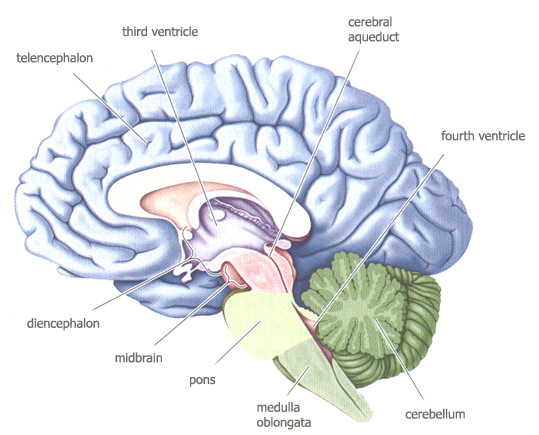
adapted from
Bear, Connors & Paradis (2001)
MacLean and other
researchers have observed animals whose activities depend on each of these
"brains". In this way, various functions have been attributed to each
of these three parts of the brain, characterized by a different structure and
chemistry, yet extensively interconnected.
-
the
reptilian brain : brain stem (medulla, pons), midbrain, (large part
of the) hypothalamus ;
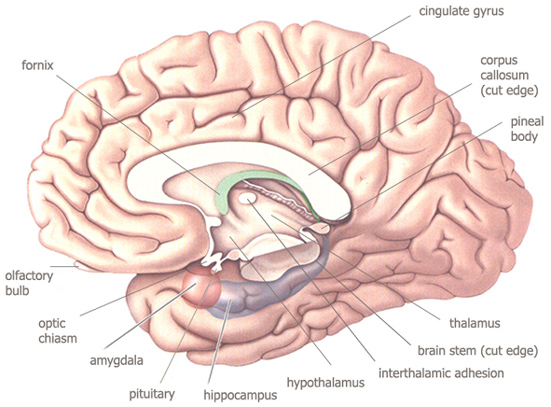
-
the
mammalian brain : thalamus, amygdala, hippocampus ;
-
the
human brain : neocortex or the two cerebral hemispheres of the cerebrum,
with its crucial angular gyrus, both bridged by the corpus callosum.
2.1 Three
types of brain software.
Neurology
puts into evidence the complexity and layeredness of the brain of the
Homo sapiens sapiens. Three
neuronal strands, modules or quasi independent software define a
series of co-relative operations, evolved in processing specific
neuronal tasks. These activities are computed by neuronal circuits featuring
differences in evolutionary age, goals, plasticity and function.
The concept of the triune brain calls for three distinct layers
of encoded neuronal software in the brain. The correct overall functioning
of the brain is then determined by the adequate processing of data by each of these three
subcomputers, as well as by their modes of possible interaction or networking.
The brain is a network of systems or modules. Each system features a
relative plasticity, in that some functions at times may be
interchanged. The older the brain, the less likely this happens without
loss of computation capacity and hence impaired physical performance.
Throughout
the triune brain, a division in two is observed (it is there from the start to
form the nervous system).
The embryo starts as a flat disks with three layers of cells : endoderm
(the internal organs), mesoderm (the skeleton and the muscles) and
ectoderm (the nervous system and the skin). Changes in the ectoderm give
rise to the neural plate, a flat sheet of cells. In the neural plate a
groove is formed, running from anterior (rostral) to posterior (caudal).
The two walls of the groove (the neural folds), move together and fuse
dorsally forming the neural tube. Out of these walls the whole nervous
system develops. When folding, some neural ectoderm is pinched off
lateral to the neural tube. From this neural crest derive all neurons
with cell bodies in the peripheral nervous system. The process from
neural plate to neural tube or neurulation occurs about 22 days after
conception.
The bridged dichotomy of the brain is the prime
characteristic of the three quasi independent neuronal modules : the neocortex
(or human brain), the
limbic system (or mammalian brain) and the nuclei at work in the brainstem (or
reptilian brain).
THE HUMAN BRAIN
The neocortex
is divided in two hemispheres. This "human brain" is capable of processing
complex abstract thoughts, feelings and actions. In right-handed people, the left
hemisphere is verbal and serial, whereas the right hemisphere is non-verbal and
parallel. Because of the stress on language, the left hemisphere has become
dominant (cf. lateralization) and this despite the fact of the presence of a higher
connectivity between the right hemisphere and the mammalian brain.
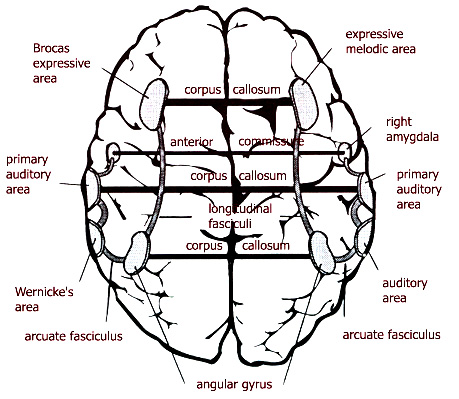
after
Joseph, 1993, p.44
|
Linguistic
Hemisphere
(left) |
Iconic
Hemisphere
(right) |
| linguistic |
kinesthetic |
| propositional |
visual |
| discrete |
diffuse |
| analytical |
synthetical |
| verbal |
visuospatial |
discursive
(logical) |
presentational
(melodic) |
| digital |
analogical |
| specific
features |
broad features |
| deliberate |
analogical |
Our sense
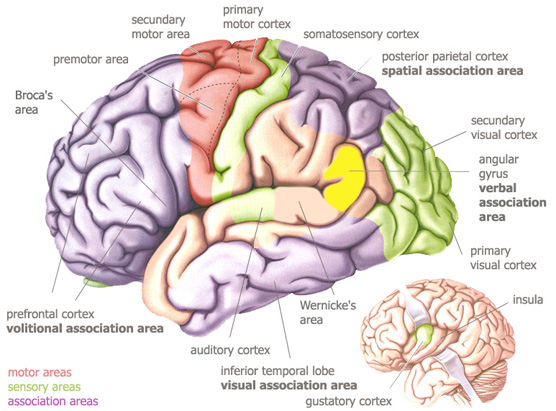
of personality, or I-ness, is computed in the prefrontal cortex of the neocortex, just behind our
forehead (cf. the frontal lobe). Before anything else, the human brain is linguistic
and verbal (cf. the areas of Broca & Wernicke and the angular gyrus). It is able to invent
new tools, think abstract thoughts, organize complex spatio-temporal features
and develop complicated social structures. It emerged in Homo sapiens sapiens
(cf. the Cro-Magnon people).
THE MAMMALIAN BRAIN
In 1878, the French neurologist Broca
conjectures that mammals possess a
group of cortical areas distinctly different from their surrounding.
This collection of neurons formed a ring or border ("limbus") around
the brain stem. In his definition, the limbic cortex (or area of functionally
co-relative neuronal networks)- consists of the cortical
cortex
around the corpus callosum (especially the cingulate gyrus) and on the medial
surface of the temporal lobe (including the hippocampus). By the 1930s, it
became clear that a number of these "limbic" structures were involved in
emotion.
James
Papez proposed an "emotion system"
linking the
neocortex with the hypothalamus (forming the Papez circuit), each element
being connected to another by a major fiber tract (like the fornix,
"arch", a major
bundle of axons leaving the hippocampus).
To physically experience emotion, the neocortex is critical, but to express it, the
hypothalamus is imperative. The cingulate cortex projects down to the
hippocampus and the latter down to the hypothalamus by way of the fornix (cf.
figures supra).
Upward hypothalamic effects (reptilian brain) reach the neocortex (human brain) via a relay in the nuclei of
the anterior thalamus (mammalian brain). The Papez circuit is bi-directional :
Because of the similarity
between the elements composing both the Papez circuit and Broca's limbic lobe,
this group of structures is referred to as "the lymbic system" (although Broca's
notion did not focus on emotion).
The "mammalian brain" and the "limbic system" are used as
synonyms, although minor differences occur, the larger part of the hypothalamus being part of the
reptilian brain. The middle computer is also lateralized (cf. the left and right
amygdala), and computes, among other functions, emotions (ranging from intense
happiness to violent rage), emotional coloration, sexuality, long-term memory
and the felt "presence" of the Divine (namely in the right amygdala, the so-called
"God-spot"). We shared it with the Homo Neanderthalensis, who's funerary
practices suggest the earliest form of spiritual awareness (cf. the possibility
of life after death and the supernatural, both absent in the animal world).
Before the rise of the neocortex, the brain was ruled by the hypothalamus. This
area successfully consolidated its role as "master controller" of the limbic
system as well as that of top security agent of the reptilian brain.
THE REPTILIAN BRAIN
Indeed, deep down the brain, above and in the brainstem, the so-called
"reptilian brain" processes primitive functions, such as the overall
level of wakefulness (waking, dream and dreamless sleep - cf. the
Ascending Reticular Activitating System operating the level of
wakefulness
of the brain as a whole, i.e. the intensity of
conscious experience), territorial instincts, basic reflexes, habits and
addictions. This neuronal circuit
is very connected with the limbic system. The relationships
between primitive instincts and emotions is therefore very pronounced,
and the network running between both computers is an ancient neuronal architecture.
In the reptilian brain of non-reptiles, the territorial imperative
(cause of war) is still at work, in geosentimentality, life support and
self-protection. In reptiles, the latter is often realized through deception,
imitation & secrecy (cf. the treacherous serpent, the violent crocodile, the
cowardly chameleon, the slow tortoise). The responsive (not reactive) nature of
this brain, makes it suitable for guarding, patrolling and vigilance, which are
bound to routine, precedent and ritual. The conservatism of this brain is
stabilizing, and routines save energy. However, failure to adapt is one of
its prime characteristics. In the brain stem, addiction & deep memory storage
through dreams are processed.
The reptilian brain also houses the more violent, aggressive -even murderous-
expressions of impersonal sexuality, like in vertical, hierarchical,
dominant/submissive signal communication. This earliest brain and its "automatic
pilot", anchor in embodied, concrete objects, events and circumstances, and are
driven by the moment (exist "in the now"). They compute no emotions and process
no language, except signals.
Mens sana in corpore sano ...
Although
these three systems work on their own, in a healthy brain, they also
work together. Their evolutionary architecture reveals two major stress-points,
namely, on the one hand, a lack of networking between the older two brains (reptilian and
mammalian) and the neocortex, and, on the other hand, another reduced
capacity between the
two hemispheres of the human brain (left versus right hemisphere). As the connections between the neocortex and
the older brains (in particular the limbic system) runs via the dominated
hemisphere (usually the right), the first issue entails eliminating hemispheral lateralization.
So besides intellectual intelligence, we need to develop emotional intelligence to
bridge the dangerous gap between the rational thinking processed by the neocortex and the
ante-rationality (in extremis : irrationality) computed by the two older brains. This
cannot be done if non-verbal, emotional intelligence is deemed less important than
verbalized, discursive thought. Before anything else, the dominating tendencies
of the linguistic hemisphere have to be eliminated. Likewise, mindsets
based on the deafferentiation (or neuronal isolation) of the linguistic brain are
incomplete.
Neurotheologically, the issue at hand is the nature, function and goal of
spiritual experiences. The brain as a whole is able to process spirituality, and
so (although triggered by the temporal limbic God-spot), mature spirituality is,
ex hypothesi, computed by a neuronal circuit running simultaneously on the three
levels of the brain, to wit : acute reptilian wakefulness, strong limbic
emotivity and broad neocortical intelligence.
|
mode of
thought |
cortical
evolution |
stages of
psyche |
model
of God |
|
mythical |
reptilian |
libidinal |
primitive
polytheism |
|
pre-rational |
mammalian |
imitative |
primitive
monolatry |
|
proto-rational |
human |
tribal |
ante-rational
henotheism |
| rational |
linguistic |
formal |
rational
monotheism |
|
meta-rational |
integrative |
intuitive |
rational
henotheism |
Immature spiritualities limit spiritual experience (a
category covering religious experience, trance, ecstasy, mystical experience,
etc.) to the exclusive (deafferented) output of neocortical, limbic or reptilian
computations. In this way,
intellectual spirituality, emotional spirituality and reptilian spirituality are distinguished. In each, the dominant neuronal computer rules the
others by deafferentiation (temporal elimination of the operations of the
dominated circuits).
What about polytheism, monotheism and henotheism in terms of these
neurotheological considerations ?
2.2 Archaic
software and the polytheist representation.
Reptilian
and limbic systems are unable to represent conceptual structures, and hence the
influence of the
immediate context cannot be cancelled. The reptilian computations add to this a
localized expression of environmental interests based on the law of power (the
strongest force wins) and a state of constant vigilance and wakefulness.
Territorial claims are not made on the basis of geosentimentality, for no
emotions are computed. Indeed, all is based on immediate survival-interests, the
"here and now" of the moment at hand and the balance of the needs to be
satisfied.
These trigger immediate changes in attention, but the latter quickly dissipate if the
object of arousal is gone. Territory is important because it allows the organism
to find food and shelter. These provisions allow for an identification with the
locus of activity, left as soon as the provisions are taken away or moved.
In primitive forms of polytheism, the Totem represents the past, present and
future of the tribe. As an idol of the achievements of the ancestors, the Totem
summarizes the past acquisitions of the community and defines the particular
environmental features essential for the survival of the group in that locale, to wit : sacred animals,
plants, rocks, stellar phenomena (Moon, Sun, rising stars) and the achievements of the holy
men or shamans, able to control their trance and assist the community in a
supernatural way.
The Totem is the present, for it brings together the forces
enabling the tribe to maintain the borders of its niche (point of reference) and
it feeds the community (with divine power).
The hunters refer to it when they leave the village, evoking the power of their ancestors
before they take the road of death (either of themselves and/or the animals they
hunt). The Totem is the future because it magically assures the presence of the animals hunted near the sacred
ground of the tribe. The herders carve their domesticated and fabulous animals in the wood or
stone of the Totem, and so call upon their protection and fertility. Projected into the future,
the Totem is the power of continuity par excellence, representing the
continuity of the tribe in time.
In more
elaborated forms, polytheism introduces a single deity. The latter is part of a family-constellation
of "great"
deities (monolatry). The cult-statues or cult-representations of the god or goddess are
shielded from the rest of the world (deep down in dark caves, high up in rock, in
the "most holy" area of
temples, etc). The deity has a particular area of power, beyond which it can no
longer exert its influence. Another power takes over. In the same area, ruled by
one "great god", various lesser gods may be active and they represent a
specialization of the magical effectiveness of the area. Conflicts between these
lesser deities may occur, but usually a family story links them together and
assures the peace of the constellation.
To all the relevant natural
powers (archetypal representations of collective experiences), the Totem-deity in particular, offerings are presented. The principle is
reptilian : give and receive, tit for tat. Power and control are determined by
the food-stuffs present in the nome, province or region of the chief god or
goddess. Hence, when a deity is fed with the wrong kind of offering, or if the
requisite rituals are not performed as they should, the favors could be
withdrawn, and the divine may no longer bless its sacred theatre of operations.
Cold,
emotionless cruelty as well as bestial sexuality are reptilian. Likewise, some forms of
polytheism demand human or animal sacrifices, ritual abuse, the spilling of "sacred blood" and
other unethical offerings. Violent, sexually defined power rituals are also common.
Just as a crocodile snaps its prey and devours it, the cult-deity may only be satisfied
by destruction, killing and "savage" mortifications and torture. Blood
may be its food. To draw its attention and blessings (to feed and be fed),
the deity demands the loss of what is important to the community, like
children, women, animals and the first fruits. Only by giving the best
is one likely to receive the best. Refuse the deity its sacrifice, and
the community will perish from lack of sustaining means ...
The deity
cannot be moved, except in religious ceremonies tied up with its
semantic field. It is bound to a particular place and defines itself completely in
terms of it. Export the Totem and its power is gone. Import another more
powerful deity, and the Totem is replaced by another. The confusion between
Totem-deities is left intact, for the constellation itself is considered sacred
and conflicts are included in the tale. Contradictions, paradoxes, fuzzy
thinking, hallucinatory babble, etc. form an intrinsic part of any mythical
language and illiterate practice. Specialization is often the practical way out, allowing
deities to exist side by side.
The reptilian
nature is best exemplified by the locality of the power of the Totem. Outside a
given perimeter, defined geographically or functionally, no blessings are to be
expected. It is nonsensical to ask a fertility god protection in war, nor will
the god of the mountain be useful in the savannah.
Polytheism
does not blend with a developed, literate civilization. It is a niche spirituality. Its
operational principles are not affectional or conceptual. No emotional
plea or mental argument will help. The only way polytheism is overcome is by a
"more powerful" deity. The strongest force wins.
Is radical
polytheism historical ? Written sources are often lacking. Records mostly (if
not always) reveal the
presence, albeit hidden, of an originator, a "great god" before
everything, or they accept some deities may pull rank on. Insofar as no function is given to this "god of gods", polytheism is
a fact, but if various deities are identified as this "supreme one", monolatry
ensues. If and only if petitions, sacrifices and the like are made to
one truly
unprovisional "great god" together with (and not against) the
other deities, the fringes of henotheism are reached (cf. the theologies
of Ptah and Amun-Re in the New Kingdom allow us to conclude Ptah and
Amun-Re are one and the same God).
2.3 Limbic
software and ante-rational henotheism.
In primitive polytheism, various entities, without relational or
emotional ties between them, exist
next to each other. The first step away
from this, is to accept one "great" deity along with a variety
of other "lesser" divine beings. This primordial god or goddess is reckoned as the source
of all other deities and a family-relationship or "constellation" is
established. However, as various deities assume the role of "great one", in this
stage the title remains provisional (monolatry). The next step is a
single deity, viewed as hidden (a "deus absconditus"), and without
worship (as the Egyptian "Nun", the primordial waters).
Only when remoteness & nearness are both attributed to the same, single deity,
is proto-rational henotheism the case. The ante-rationality of the solution is
brought to the fore by the contextual emotionality and belongingness connecting
unstable pre-concepts. Memory is at work, and stories are told. But in
these, the dynamical relationships between the divine entities are as important
as their individual field of activity. Geographical fixation is replaced by
geosentimentality. The deities form a pantheon, a family. This type is absent in
polytheism, were the forces are not interconnected, but rather atomized, not parallel but rather
serial.
The
emotionality and belongingness involved makes these deities more accessible. Polytheistic shamanism
makes way for personal devotion. Specialized states of trance are supplemented
by prayer, ritual action, meditation and festive participation (dance, music,
acting). The gods and goddesses are no longer remote and
unavailable, but may manifest in one's home and be
worshipped directly. Totem variety may continue to exist, but the overall unity
of the deities is underlined, either by a divine king or a series of "national"
gods, encompassing most geosentimentalities (cf. Egypt in the Old Kingdom).
The
experience of the divine is made possible by the felt presence of the
supernatural. Fear and awe (reptilian) are transformed into bliss and mystery
(limbic). Reflex and
vigilance replaced by amygdalic presence and feeling (the "holy" as "mysterium
fascinans et tremendum" - cf. Otto). The impersonal is
personalized, either by sacralizing animals or by
anthropomorphic deities. The emotionality of spirituality is primordial and each
family, clan or tribe identifies with one or a series of deities. Because of the
story-line of each, no god or goddess is isolated from the rest and the
distinction between the local deity and the "great one" is explicit or
suggested. The latter is the "grandparent", the ancestral deity, often nameless,
hidden and cosmic (cf. the difference in Ancient Egypt between the nome deities
and cosmic deities like Atum-Re, Ptah, Thoth & Khnum).
Ante-rational
henotheism too, rooted in mythical notions and pre-rational pre-concepts, leaves the contradictions between the deities and the inconsistencies
of the story-lines intact. There is no effort to elaborate an overarching
theology, for the great questions of life are answered from multiple
perspectives. The latter are not exclusive, but inclusive and complementary. The
"great truth" is a mosaic of different answers, to be called in relative to the
geosentimentality of the seeker and his or her point of view.
A notion of "one divine reality" is present,
but not operationalized as such (cf.
Hornung, 1986, 1999). It is difficult to
distinguish ante-rational henotheism
from monolatry. Each deity with its story is one representation of
the whole by a part. Insofar as the answers given exceed the constituents of
this part, other representations are called in. But various "great gods"
continue to exist. There is no need to articulate one "grand story", a single
tale answering all questions. The need for completeness is not processed by the
limbic brain, but in the pre-frontal lobe. Once the provisional nature of the
"great god" is eliminated, a mature form of henotheism is possible.
In Ancient Egypt, only the sacerdotal elite, reacting against the ousted
Amarna theology (cf. the "damnatio memoriae"),
arrived at the fringes of such a rational henotheist perspective, namely in the
Late Ramesside Period, when Theban priests viewed
Amun-Re, the "King of the Gods", as "hidden, one and millions" (Assmann,
1991, 1995).
"Secret of manifestations and sparkling of shape.
Marvellous God, rich in forms.
All Gods boast of Him,
to magnify themselves in His beauty,
to the extent of His Divinity."
Hymns to Amun,
Leiden 350 I, chapter 200 - ca.1213 BCE.
2.4 Frontal
software and the monotheist representation.
On the other
side of the spectrum, monotheism proposes a single God. No Divine intermediate entities
are possible, in fact, their Divine features are rejected and completely
transferred to the single, solitary Deity. Historically, this option was
formulated in an ante-rational format by
Atenism, and in its most radical,
rational form by Islam. The distinguishing feature is the quantitative
singularity. There is "1" God, and hence no Gods and Goddesses.
In the
theology of Pharaoh Akhenaten (ca. 1353 - 1336 BCE), only the Aten is worshipped, for
the actual Solar Disk is the
sole deity. Moreover, as only Akhenaten understands the Aten, the rule "only the
Aten and his prophet Akhenaten" is valid. Conceptually, Atenism refuted the
other deities, but in practice the contrary was the case. The people as well as
the nobles surrounding Pharaoh continued to worship the "old" pantheon. As
Atenism had no priesthood or holy book, it was bound to go extinct with the
death of its prophet, a fate shared by all revealed religions (Moses is not of
history but of memory, Jesus of Nazareth wrote nothing, Muhammad likewise).
In early
Judaism, the worship of Divine images was rejected. Not only is God one and
singular, but no
icon is available (no sacred image, no window with a view on this remote
solitary Deity).
Although God is not directly accessible, He nevertheless revealed His law. The latter is an
abstract written word, valid in all circumstances. The exclusive mediator is not a
Divine human person (like a shaman, a priest or a Divine king), but a holy book,
revealing the sacred history of God and His people, underlining the covenant
made between them. This focus on a single, imageless God (Abrahamic faith),
named "I am that am",
revealing the Mosaic law, makes Judaism the first rational system of theology.
Incipient before Hellenism, this theology developed thanks to Greek rationality
and by the time of Philo Judaeus, turned into a full-blown rational monotheism,
i.e. a system of religious thought using the rational mode of cognition. This
should not be confused with "rationalism", which is one of the phases of
rational thought. Early Judaism is not rationalistic ("cogito ergo sum" is not
accepted), although to articulate its tenets, it made use of the rational mode
and later embraced Greek conceptual rationality (as Christianity and Islam would
also do).
The reason
for introducing such a monolithic concept, is in tune with how the pre-frontal
lobes
process data, aiming at logical completeness, consistency and the use of
the linguistic abilities of the dominant hemisphere (cf. the importance of
prayer, lectio and recitation). Indeed, if a variety of Deities are
acknowledged, each will (to underline its Divinity) claim to have created
"heaven and Earth" and a competition will ensue. By
decontextualizing God, the prefrontal turn invalidates such limbic
geosentimentalities. The
experience of God is mediated by the "holy operation" of the pre-frontal cortex, to
wit : sacred words and traditional constructs. The direct limbic experience of the
Divine is often made suspect and rejected by the "doctors of faith", exception
made for the founding mystic, Son of God or prophet (as well as their direct
companions and eye-witnesses).
Because only few interconnections between the limbic system and the pre-frontal hardware
exist, the
experience of God is has to be processed via the artistic hemisphere and thus subjugated by
the linguistic functions (Broca and Wernicke) of the dominant side of the
neo-cortex (the left hemisphere in right-handed people). Music and art may assist
the experience of the Divine, but to the monotheist, God is before everything
else
interested in sacred words (and fundamentalists shun music altogether). Prayer is thus the repetition of the sacred
discourse between God and man, a return of the actuality of the founding words of
the tradition, kept secret in God's holy books ...
Logical
completeness and the authority of the final clause, are the prerogatives of the
dominant pre-frontal lobes in particular, and the neo-cortex as a whole in
specific. With the strong verbalization of religion, conceptualizing man's quest
to unite with radical otherness ("totaliter aliter"), the direct experience of
God is invested with constructions processed by the linguistic cortex (the
dominant hemisphere of the neocortex). These circumambulate
holy texts, used to develop a dogmatic theology, exclusively based on what has
been revealed (to the few).
Discursive
thought forces God to express Himself exclusively through words. Are these "old
wine bags" ? The poetical, analogical and historical value of monotheist writings
is made clear by studying the three holy books of the "people of the book".
These monotheist religions, aiming to control the masses and reacting against polytheism,
have fallen in identical but opposed traps than polytheism. In protecting
their rationalistic heritage, they developed the most rejectable fundamentalisms
and fostered exclusivist theologies. On the one hand, they reject the direct
experience of God, but on the other hand, they feel themselves forced to reintroduce it subreptively (cf.
the Qabalah, Christian mysticism and Sufism). This shows their efforts were
primarily
sociological, not theological.
2.5 Towards a
rational henotheist representation.
Polytheism
does not escape the power of the "locus naturalis" of the deities. Monotheism,
being universalistic, eliminates the individual approach of the Divine, and
forces religion into a spirituality of the remote and the afterlife (when a
"face to face" contact is deemed possible). It thus
denies a this-life experience of God, as well as the reformation of theology by new revelations,
which are deemed
impossible (for Judaism, the Torah is complete, for Christianity the New
Testament is complete and for Islam the Koran is complete). In-between, ante-rational henotheism
entertains the geosentimental appeal of polytheism, but falls into the trap of
monolatry (a provisional, reversible "great god").
Polytheism cannot be harmonized with a conceptual approach, for it is
fundamentally non-verbal, rooted in myth and psychomorph pre-rationality. Monotheism cannot be
made less radical, for it cannot think God as plural (which is not the same as
positing a "second" next to God). Can ante-rational
henotheism be reformed ?
Rational
henotheism accepts the three levels of our neuro-cognitive make-up : the reptilian,
the limbic and the human brain, and takes into account lateralization, as well
as the isolation of the limbic system by a dominant neocortex.
the reptilian factor
The reptilian
need to localize Divine action is acknowledged by a non-idolatrous worship of
idols, to wit : the recognition of the same One God in all Divine manifestations. The
henotheist idol is not a "second", but a complete, holographic and localized representation of
the One God (a theophany, not an unstable monolatry). If we equate Descartes' "grand formula"
(of everything) with the One God, then
a particular physical law or Deity is one of the differentials in this super-equation, an
application of it to a particular set of events, a specific manifestation of
totality (a "pars pro toto"). From the perspective of this
differential, the law it represents is absolute, but from the view-point of the
One, it is only one out of many absolute differentials part of the equation. Each Deity is like a transfinite number (an "Aleph"), while God
is Cantor's "Omega", the ultimate, absolute "number" beyond numbers.
In this sense, all things able to
represent a symbol (a particular object, symbol, concept, person, collective or
group) may be worshipped if it transcends the immediate and links the part
with a larger whole. The latter is not necessarily the radical other (God as
God), but a spatiotemporal
Self-manifestation of God (a Divine Name, attribute, Self-manifestation, etc.). As such, the idol is a Deity. Only if this idol is
worshipped with pre-frontal values to be ascribed to the One God alone, a relapse into
polytheism has occurred and God has received a "second". In other words, if the
idol is seen as the manifestation of God's essence and totality (and not as one
of its differentials), then (and only then) the "hidden treasure" (the
Self-manifestations of God) is
confused with the "sheer Being" of God as God (the essence of the Divine even
unknown to the Deities, the Nameless Name of God known to God alone). Such a confusion is
true blasphemy (cf. "shirk" in Islam), for the whole may be represented by the part but the part is
not, in essence, the whole (in every temple of Ancient Egypt, Pharaoh was
represented by the high priest, but not one of these many representatives was
confused with the king himself).
the limbic factor
The limbic
need to ascribe family-relationships and belongingness to the Deities is the
potent, outstanding feature of henotheism. The Pantheon is an organized set of Deities. As
each Deity is a Self-manifestation of God, there is no radical ontic
difference between them, only functional and operational distinctions prevail. Insofar
as the greatness of a particular Deity is described in emotional terms only,
expressing a genuine sentiment rather than a conceptual description, no conflict between
worshippers arises. These emotional differences are not abstracts but affects.
Each image is a window with an emotional view on the One God, albeit through the
framework of the Deity in question. These emotions allow one to cry out to a
Deity : "Great, Great, Great !", but this is not a theological statement, for
only the One God, of which these Deities are but differentiations, is truly the Greatest.
the pre-frontal factor
The
pre-frontal need to totalize all possibilities in one abstract thought is made
possible by rational henotheism by accepting the rule that all Deities are epiphanies of
the One God. I.e. the variety of Deities is not maintained ontologically, but
only in terms of (a) emotional attachment to particular images, story-lines,
family-constellations and ritual activities and (b) the operational effects of
valid differentiations of the One God.
Fundamentally, rational henotheism differs with monotheism in terms of the
mathematical definition of God. The Divine is not a singleton or finite set with
only one number (the Divine = {"1"} = God), but the union of all possibilities
(the empty set) and an organized (hierarchical) infinite set (the Divine = {Ø} U
{1, 2, 3, 4, .... ∞} = God). In this infinite set of natural numbers, the first
number still retains hierarchical firstness, and so the Divine still has
"firstness" or "all-encompassing" features, namely insofar as "1" and the
presence of "1" in all natural numbers is concerned (all natural numbers being
additions of "1"). God is not only "1" (monotheism), but en plus all possible extensions of
firstness (henotheism).
The Deities are the case-laws of
the statute-law of the One. If we think the Pantheon, we only conceptualize God,
but if we approach the One, we only experience the Pantheon. The One God is
therefore not experienced directly, and His essence remains ineffable,
unknowable and remote (the retained core of truth of monotheism). The
apophatic rule of monotheism is maintained, but the catapathic features are
transferred to so many expressions of the One. Insofar as the overall
architectonic plan goes, God is the Author. But as soon as a particular item or
force within that plan is addressed, the Deities spring to the fore. God is the
hidden eye, the Deities the visible eye. Henotheism does not foster consistency
but coherence. Paradox is not avoided but made efficient, if possible ...
Polytheism and monotheism are extremes. These theologies are not in tune
with the workings of the triune brain. Polytheism denies conceptuality and
atomizes the deities, whereas monotheism is unable to imagine the functional
differences animating God (who is considered to be Alone). Each subreptively
introduce clauses to by-pass the problems arising from their exclusivism : polytheism
may have a silent, hidden, provisional "great spirit" devoid of worship, and monotheism may
accept the power of God's Presence, His "most beautiful Names", a Perfect Man,
or introduce new types of semi-Divine mediators (like the deified Mary and the community of the
saints in Christianity). Henotheism holds the middle ground between the concept
of a solitary God and the non-verbal myth of a plurality of disconnected deities.
Henotheism accepts the qualitative Oneness of God, but rejects His quantitative
aloneness. It accepts the
plurality of the Divine, but rejects the atomization of the Deities. Because it
stays within the limitations imposed by reason, it capitalizes the words
"Deity", "Deities" and "Pantheon". The Gods and
Goddesses are Self-manifestations of the One God, not Divine Beings posited
outside God, manifesting as a "second" next to God.
Prefrontal
activity is based on control. The values of the conceptual system are imperative.
The logic of completeness and the rule of the unconditional are primordial. In
religious terms, the denial of variety and multiplicity for the sake of unity and
uniformity is translates as orthodoxy. As a result, heresy (alternative choices) sees the light.
Reasons are invoked to combat opposite views, and coercion is the dominant mode
of communication. There are no rules to change the superstructure, fixated for
all of eternity. This fear of change becomes part of the mode of thought. It is
dogmatically insensitive to novelty, and intellectually incapacitated to assimilate
other cultures and systems of belief (the other Deities are rejected as idols). The unbelievers are lesser human beings,
with other rights and duties than the brethren of the faith.
In some cases,
discrimination between the believers themselves is introduced, such as male
supremacy (the man being a degree higher than the women). Such pre-frontal
religious exclusivism denies the possibility of other conceptual superstructures, and often the latter are demonized. This is the last phase
before violence, active hatred and the strategies of destruction and death
(typical for a neocortex overstressing the limbic and allowing the repressed,
violent and mad tensions to manifest "to serve God"). Religious fascism and
terrorism are the outcome ...
Limbic
spirituality, and its adjacent reptilian reflexes, focuses on the sacred
image of the teacher, prophet or guru who is deemed to mediate the experience of
spiritual bliss, liberation or enlightenment. Emotional attachments run deep and cause a sentimental mode
devoid of conceptual clarity and decontextualized behavior. Although direct
experience is central, which is positive, there are few superstructures to
connect this with logical, scientific and ethical considerations. If human
sacrifice is part of the sacred image, no questions are asked. Another type of
violence may thus ensue. The death-wish may be directed to others or even to
oneself, and this in the emotional conviction a better state will be theirs
(either in this world or in the afterlife). Terrorism, the abuse of women and
children and many other imaginable horrors are done without remorse, but in a
state of extreme emotional arousal and irritability.
Negative expressions
of limbic spirituality are often connected with reptilian reflexes and sense of
power and territory (in fact, the limbic system often acts as the control-center
of the reptilian brain). In many ways, the pre-frontal superstructures are shaped
to counter these violent emotions. But by doing so, another type of violence is
created. In this case, not emotions steer the dogmatic, but a series of Divine laws deemed
absolute, universal and eternal. Hence, violence is rationalized. The
consequences of this may exceed the emotional outburst, for the latter is
limited by geosentimentality and the temporality of arousal. Rational
calculations are not driven out as quickly and may transcend the borders (for,
in principle, they have none).
The
conclusion of this paragraph is simple. Spirituality is a phenomenon processed
by the whole brain. All software modules have to be taken into account, and a
balanced approach is necessary. The direct experience of the limbic system (in
the niche of our reptilian securities) has to go hand in hand with hemispheral
checks and balances. The latter have to incorporate both the linguistic and the
iconical approach, but in such a way as not to block the experiential mode of the
limbic system.
Theologically, the brain is equipped to process a complex view on God, both One
and Many, both hidden and manifest, both remote and near. The "visio Dei
experimentalis" is possible, but demanding. A complete change in called for,
and next to the natural states of consciousness (co-relative with a level of
arousal of the reptilian brain) a
"fourth state" has to be implemented in the
ARAS-system. To do so, years of training are necessary and an overall neuronal
balance has to be achieved. If not, a reduced, incomplete and immature spiritual
sense may ensue. Then, primitive power-games, violent emotional states or
fanatical thought-forms rule supreme and bring the human effort to link up with
God below the threshold of likelihood.
3.
Depth-psychological remarks.
3.1 General remarks on the law
of the psyche.
These
considerations are drawn from our knowledge of the deep, unconscious structures
& drives of the human
psyche, in particular the emancipation of the ego, the "I" of consciousness
interacting with its inner & outer environment.
Freud, the "grandmaster" of the psychoanalytical movement, introduced the famous
distinctions between the unconscious "Es" or "Id" (the instincts or libido based
on the pleasure-principle), the conscious "Ich" (the ego based on reality),
and the (partly unconscious and partly conscious) "Über-Ich" (the superego
based on morality), mediating between instinct and society.
The inner
world of the psyche was divided by Freud in two layers : the conscious and the
unconscious. It was possible to discover the existence of the latter by studying
the causation of failures in conscious functioning. The model arrived at is
therefore not derived by stepping outside consciousness and observing the
unconscious directly (which is per definition impossible, except in so-called
"superconsciousness"), but was developed in the retinue of clinical psychopathology.
In the process of unwrapping the unconscious causes of the problems of
consciousness, depth-psychology was able to delineate the deep structures of the
psyche and understand their ways.
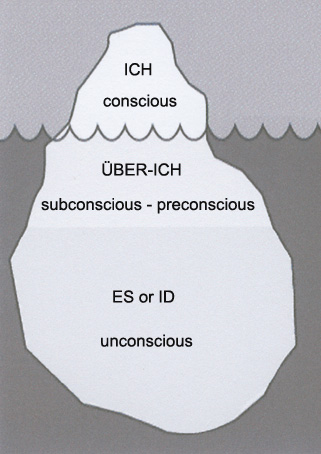
FREUD's
Closed iceberg model of the Psyche
According to Freud, we are born with the "Id". It allows
us to get our basic needs met. The "Id" wants whatever feels good at the
time, with no consideration for the reality of the situation. It does
not care about the needs of anyone else, only
its own satisfaction counts.
When the "Id" wants something, nothing else is important. The
fundamental, mythical principle of the "Id" is summarized by Freud as
"Eros" (lust) and "Thanatos" (death).
The ego is based on the reality principle. It understands that other
people have needs and desires. It is
the job of the ego to meet the needs of the "Id", while taking into
consideration the reality of the situation. The superego stands
in-between lust and reality. Socialization means people introject the
norms & values of society. The unwanted manifestations of the "Id" are
thus repressed (censored) and/or sublimated by the superego, the moral
principle. Unreleased repression causes complexes (neurosis) or the
collapse of the psyche (the breakdown of the reality-barrier of the
superego, and is ability to tax the real, as in psychosis).
The "Id" causes very powerful
erotical and morbid drives, lodged in the unconscious, to emerge in consciousness
(cf. Eros and Thanatos). This process revolutionized our modern
perception of the psyche, rooting it in our unconscious biological
constitution, in particular its mammalian and reptilian past. Although
valid in 19th century Vienna and its surrounding culture, Freudian
thought was correctly deemed by Jungians and others to be a reduction of the vast
possibilities of the unconscious psyche to a small set of variables, to
wit the erotical, vital and morbid.
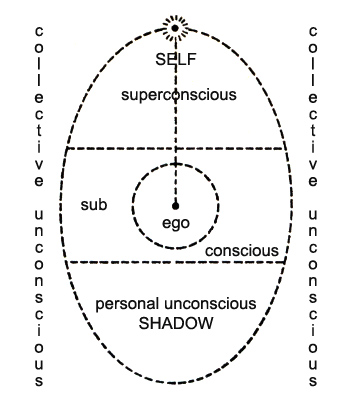
ASSAGIOLI's
Open model of the Psyche
The eclectical map of the psyche used here, has been
largely derived from the depth-psychological
models developed by Jung and Assagioli. These last two studied the
psychological relevance of religion and mystical experience (cf. the Self) and their approach is therefore appropriate
and most welcome.
The pivotal psychological law discovered by Jung, stipulates that the aim of
the psyche is to equilibrate and constantly compensate to achieve this.
Too little conscious interest in the unconscious automatically triggers
such compensations, disrupting conscious functioning (strong emotions
such as fear or love are typical, but also lingering feelings of
discomfort and anxiety). Too much involvement with the unconscious,
blurs the borders of consciousness and triggers an unsustainable
inflation.
Also in Jung's
analytical psychology, the inner world of the psyche is divided
into conscious and unconscious. But the last stratum is given two layers : on the one hand, there is a subliminal and personal layer,
called "the personal
unconscious". This contains subliminal memories one is able to
retrieve at will, as well as repressed "Freudian" material (the shadow). On the other hand,
there is the collective unconscious, shared by all Homo sapiens
sapiens alike and bedrock of the psyche. It is this deep, universal
layer which deals with the Self. The latter is the terminus of
the process of individuation, i.e. the realization of psychic wholeness.
The repressed
psychic stuff of the personal unconscious animates the deepest part of this
personal layer, on top of which preconscious -subconscious- contents
floats. It represents everything rejected by the ego on the basis of a system of values
and norms kept strong and vital by its superego, a censor aimed at maintaining a
balance between all possible psychic urges and the outer environment of the
psyche, the social world of intersubjective experiences.
The totality of personal
unconscious elements forms the "shadow" of "normal" (read : "nominal" or
unawakened) conscious activity. In this state, the shadow is projected on outer
events, situations & peoples. This tendency to witness evil in others
blocks the spiritual maturation of the psyche. The shadow has to be
named, accepted & integrated. Deeper, unconscious needs emerge in
consciousness to maintain the dynamic equilibrium of the psyche. If
these vital archetypes are not allowed to surface in consciousness as
this-or-that representation, then repression is the outcome. Repeated
repression leads to complexes and their adjacent neuroses. In extreme
cases, when these unconscious centers of psychic activity are left to
rot, the psyche may split, causing psychosis. Suppose the unconscious
drives are rationalized and so used to underline the
strongholds of the superego. Then sublimation prevails.
But our deepest
psychic urges, the bedrock of the psyche, are not personal, although, when
going upward to surface in consciousness (pre-frontal cortex), they as it were move
through the personal unconscious (limbic system) and are colored by it. This so-called
"collective unconscious" contains the universal forms of survival
developed by the human race in the course of its evolution, and was linked by Jung with
the brainstem.
The contents of the collective unconscious cannot be directly
approached, for they are universal "forms", "patterns" or "archetypes". They
surface as archetypal representations in dreams, myths, symbolical cultural
forms, religious experience, spirituality and all endeavors to emancipate the
ego, and turn it into a mature, individuated centre of conscious activity (an
ego in constant alignment with the Self). The
latter goal implies a movement in two stages : first the work of the shadow (of
death), to allow, in a second stage, the
confrontation of consciousness with the fundamental archetypes of humanity,
addressing the two basic urges of the psyche : relationality (anima/animus) and
spirituality (Self).
The
relational archetypes (the "anima" for a male and the "animus" for the
female) organize the human need to be together with fellow humans, animating the
soul-like qualities encountered in art, sexuality, eroticism, friendship and love. The spiritual
archetypes (summarized as the "Self") bring order in man's urge to return to the
source of existence and directly experience God.
Before we confront this model with what we know about the theological
features of polytheism, monotheism and henotheism, in particular
regarding Jung's compensatory law on psychic energy, we should be aware
of how the psyche strives for its own dynamical equilibrium.
The process of individuation is unending. Like the experience of God, it
represents a horizon, pushing the extent of the field of consciousness
further and further (cf. Gregory of Nyssa's definition of enlightenment
as an endless growth towards God). Self-experience is possible, but the
human psyche is never without an ego (after annihilation comes
recollection). Hence, a "return" to nominal consciousness is always
happening, although each time the Self has been experienced, the borders
of consciousness have become more and more translucent and the overall
frequency of consciousness has increased (making it more subtle, deep,
creative and wise). This bi-modality of spirituality is fundamental to
an understanding of higher states of awareness.
Psychic energy is caused by the differential tension existing between
the ego and the unconscious (in last instance, the Self). The ego is
aware of its own field of action and confronts reality directly (through
the senses). Its focus, sense of I-ness and personal memory
make it unique. The huge difference between the ego and the
unconscious, gives psychic energy its momentum, and because the
rock-bottom of the psyche cannot be made conscious, a gigantic energy
potential exists between both psychic instances (for the field of
consciousness is finite whereas the deepest unconscious has no clear
boundaries).
The law of psychic equilibrium implies a free flow or exchange between
the conscious ego (the ship) and the unconscious (the sea), and every
stop in this flow is cause of psychological disorders and eventually
mental breakdown. In general, such hindrances results from the
inability of the superego to process freely emerging unconscious
contents. The moral principle defines a series of adequate activities
(yielding no conflicts with reality) and tries to preserve these (either
by repression or by sublimation). As long as the superego has not been
reshaped by the ego, the occurrence of psychological problems has been
automatized (as a function of socialization and the immediate
environmental situation).
3.2
Polytheism and the collective unconscious.
In all cultures throughout history, an endless
variation on the archetypal themes offered by the collective unconscious is evident. Even today, when technological consciousness
has tried to close the gates of a symbolical perception of reality, and offers a
materialistic and mathematico-physical approach, certain archetypes persist,
even in business (the growth-illusion) and science (God as truth).
Besides the strong images available of our erotical and social needs, God (although
as a revealed entity largely absent
in the secular scientific discourse) and all associates spiritual teachings and
practices persist, even among the most technological of nations (cf.
presidents blessing in the Name of God).
Although often
only rhetorical, the recourse to the supernatural seems a cultural constant. The
atheist argument stating the end of spirituality as a result of modernity, does
not match the evidence of history. Even the communist drama and subsequent
repression of religion has not eradicated
Orthodox Christianity. Materialism,
scientism, epiphenomenalism and the like have not stopped the growth of
alternative sciences and the emergence of syncretic and eclectical social
currents (cf. the "New Age-movement" based on a mixture of
theosophy, the Western mystery tradition and Oriental spiritualities).
This variety
of expressions is in tune with the richness of the collective unconscious. A
limited number of archetypes are able to animate a wide variety of archetypal
representations, a kaleidoscope of colors based on a few standard rotations and
transformations. Hence, the deities of polytheism may be interpreted as
archetypal transformations, and although they cover a wide array of functions,
they can be reduced to a limited number, in tune with the major archetypes
entrenched in the collective unconscious. The "millions" of gods and goddesses
(both in Hinduism and in Ancient Egypt) can be understood as so many
variations on a small number of themes.
In mythical
forms of polytheism, the deities are disconnected. The fuzzy field of
consciousness in which these representations emerge, annuls discursive
denotation. The deities are mere notions, not concepts. They are
invoked to solve immediate problems and give meaning to an actual reality. They
are pre-conceptual.
The infestation of consciousness with these representations is also possible and
leads to archetypal possession, as evidenced in primitive and immature forms of
shamanism (whereby the inept shaman is no longer in control of his trance) and
insanity. The
representations are charged with emotions and are not mediated by a conceptual
framework.
In pre-rational
polytheism, pre-conceptual schemes come into being, allowing for a functional
differentiation. As soon as these structures come into play, the (prefrontal)
rule of unconditionality is called in, the representations are
organized by category, and an overseeing entity is posited, a "great spirit",
although only provisionally (monolatry). Hence,
conscious organization is necessary to escape the endless variations caused by a
limited number of representations transformed in a variety of ways.
Regarding the distribution of psychic energy, polytheism has the
disadvantage of maintaining, except for mythical notions, no mental
structures. No stable mentality can be recognized and put into place,
and this fluidity harms the development of cognition. The archetypes are easily
represented.
Individuation cannot take place, for there is not enough ego-structure
present to act as counter-force and delimit the field of consciousness.
Hence, reality is not distinguished from myth and physical objects are
not even dealt with as if they were psychic realities (psychomorphism is
pre-rational) : instead, the difference between object and subject has
no cognitive meaning (not even a projective one). Insofar this mental
state is shared with society, it is not possible to define it as
psychosis, but rather as a collective archaism, as in preliterate
societies characterized by an oral transmission of the outstanding
features of the cultural form. In contemporary society, this kind of
infestation of reality by psychic elements is typical for severe mental
disorders and/or for the mindset of immoral, idiosyncratic and marginal subcultures.
In illiterate societies, the low energy potential of polytheism (the
absence of any clear division or standard) is compensates by the role of
the shaman. Apparently these "sacred and wise fools" were able to master
the state of trance. In it, they entertained a direct, controlled access
to the hypnotic, hallucinatory and visionary functions of the emotional
circuits of the mammalian brain. In this altered, non-linguistic state
of consciousness, these "seers" interpreted the "messages of the gods"
received as visions & voices, seen and communicated with in mythical
declarations and barbaric speeches. Prehistorical shamanism predates the
specialization of religion and the rise of the sacerdotal class (the
priesthood). It represents the earliest layer of human spirituality.
This exceptional discipline (returning in all organized religions),
aims at a specific "psychic mechanism" (cf. surrealism and the role of
automatic writing in the work of Dali), namely the "form of no-form" of
direct spiritual experience. Once "at hand", it is used and
specialized : divination, a higher, ancestral protection, the control
over natural forces like sickness and death, esoteric teaching, multiple
parapsychological phenomena such as telepathy & telekinesis, etc. These
eccentric individuals, always small in number, escape the nominal
societal tasks holding semi-nomadic Neolithic societies together :
herding, farming & hunting. Because they are integrated in society and
transmit their knowledge, these natural born paragnosts are not
psychotic (although their discourse may well sound just like that).
Indeed, their behaviors may be weird, exclusive and marginal (even to
those around them). A clear definition of their theology is not to be
expected, for the limbic nature of their work limits the scope of their
cognitive reflection and subsequently also binds thought to oral
transmissions (from "mouth" to "ear"). However, because the
"God-spot" (the trigger of the software
computing the felt presence of the Divine) is limbic, the operational
psychological impact of a genuine shaman on weak and gullible people may be considerable (cf. the
dangers of hypnosis and the charisma of certain religious and/or
political leaders).
3.3
Monotheism and conscious rationality.
By a swing to the other
side of the pendulum, consciousness may turn away from the unconscious, and
fix its spiritual eye on a series of revealed dogmas. The manifesting
God-spot of the limbic system (processed by the temporal lobe, in
particular the right amygdala) is then replaced by the revealing God
computed by the prefrontal lobe and its dominant linguistic
expert-systems. Limbic spirituality is encapsulated by sacred words.
The limited & indirect features of the neuronal pathways between the
neocortex and the mammalian brain, is a hardware restriction on the
natural modes of communication between, on the one hand, the visionary,
illiterate shamanistic spirituality of the limbic system (cf. the Neanderthals)
and, on the other hand, the linguistic (language, science), instrumental (tools) &
symbolic (art & spirituality) explosion brought about by the Homo
sapiens sapiens, initiated by the Cro-Magnon and his exceptionally
large brain and frontal lobes. As a result of the decisive cognitive step forward
made by the Cro-Magnon, the direct
experience of the Divine was, by symbolization, easily kept "on the other side" of
the psyche (that part of the neocortex and the limbic system got
deafferented). Parallel with this, a specialization of spirituality
occurred
and the first forms of "organized" religion appeared (a priesthood).
The theology of quantitative pre-frontal oversimplification was finalized by
the three "peoples of the book". From heaven the "true law" descended. It animated the mind of a
crucial prophet (Moses, Muhammad) or incarnated as the unique "Son of God"
(Jesus Christ). This revealed "Word" rejects further revelations
after it, affirming both its finality and completeness (as is believed in
Judaism,
Christianity and
Islam).
The closed loop thus introduced calls for strong compensations (as history confirms).
The "other side" is also "the other god" and "holy war" seems justified,
although it never can be.
The original text is canonized and always distorted. The
gates of perception receive a filter and unconscious forces can no longer
influence consciousness. A religious superego is installed and takes over (a
high priest, a prophet, a super rabbi, a pope, a caliph, a madi, a pole of the age,
etc). If unconscious urges
emerge to equilibrate the psyche, the censor represses them and shadow-projection ensues. Indeed,
the history of monotheism is one of blood and sorrow. The same God is
called in to justify slaughter and war, and unjust social relationships
(such as slavery and the subjugation of women). This is not because, for
our neocortical computer, God
is to hard a concept to grasp, but because
the word "God" does not represents a concept,
but a direct spiritual experience. Monotheism encapsulates this in rational
constructs, "holy" books and texts (superstructures) at the expense of the
experience itself (substructure). However, the latter, so may we expect, is a manifestation of the
Divine, which should be of primordial importance to any religious
organization. On the contrary, the religions tend to focus on revealed truths, not on
the repetition of God's manifestation (except in rituals).
Rational theology has a dogmatic foundation, a past revelation which
cannot be altered. Rationality proceeds from the past to the present. At
best, reason keeps the future open, but in all cases it makes ample use
of its memories of past events, making it traditional and conservative
sui generis. Reason and the reality-principle walk hand in hand,
as Freud underlined. This turning away from the unconscious allows
consciousness to gain in structure, in form and in differentials
(architecture). The way psychic energy is distributed, i.e.
the momentum of the psyche (determining its frequency or pitch), is also
influenced (conscious focus on word and icon increases its potential).
By focusing on both spoken and written language, monotheism tried to
simplify, categorize & universalize the via Regia to God, i.e.
monopolize the various ways of access to the direct experience of the
Divine. In these monolithical revelations, all ways had to lead to
Jerusalem, Rome or Mecca respectively. The pyramidal streak of
linearization was pushed to its extreme, and spiritual emancipation
became the exclusive affair of the religions. What happened in terms of
psychic momentum ?
The neglect of the Self by the ego, brought about by the monotheist
focus on revealed texts, causes a considerable difference between
conscious and unconscious and hence a high energy potential with a lot
of momentum. The problem is not tied in with this high frequency (which
underlines the constructive sides of rational thought), but with its
negative cause : indifference. If we understand the ego as an instance
called to differentiate and expand, then we may understand how the
neglect of the psyche's spiritual emancipation may cause severe
compensations to be brought in effect.
As the difference between ego and Self is maintained by avoiding direct
spiritual manifestations (and not by a bi-polar pendulum movement
between both), the psyche is forced to compensate by stimulating
projection (outer conflict) and/or mental disorder (inner conflict).
Both strategies force the ego to stop functioning in an indifferent way
towards its own necessary wholeness and completion. Further neglect may
lead to psychosomatic disorders. In religious terms, projection implies
a war with "the other god". Inner conflict may fossilize the system and
trigger the atrophy of one's spiritual functions or the insanity of the
exclusive ownership of "the sole way to heaven".
Another problem is the inter-hemispheral conflict caused by the dominant
language & speech functions. In the neocortex, featuring two
hemispheres, the linguistic cortex (in right-handed people this is the
left hemisphere), tends to overpower the human brain as a whole. This
lateralization should be counter-balanced by emotional intelligence,
meditation and creative visualization, which stimulate the spatial
neocortex. Only via the dominated hemisphere may a conscious route
be found to (re)establish a direct contact between, on the one hand, the
dominant prefrontal lobes and their rational thought and, on the other
hand, the limbic system and the hippocampus, together processing
mammalian emotivity and its belongingness and relatedness.
Yoga experience testifies of the need of
discipline, detachment and the awareness of one's psychological uniqueness (cf.
the
emancipation of the brainmind).
Replacing a highly personal mechanism with the gross and generalizing
salvic tools of a community (a series of canonized, formalized rituals,
like meditation, prayer, recitation, liturgy and ceremonial workings) is replacing
"my" God with "our" God. It is impossible to
entertain an intersubjective experience of the
Divine ("our" God), without living in the
Presence(s) of God (for "me"). Without a mystical, sacral,
spiritual "reality-for-me", no religious, spirito-communal
"reality-for-us" is possible. Hence, without
personal piety (and "my" way to Rome),
only a residual, intersubjective experience of the Divine is
made possible. This is a tradition of beliefs and shared rituals, often
dry, conservative and emptied of the vibrating, constantly reforming and
creating Spirit of God. These facts invalidate the proposals of monotheism
and invites organized religions to focus on the manifestation of God and
less on past revelations in words canonized in texts.
By declaring The infinite All numerically one and so by reducing the
empty set {Ø} of all virtual possibilities and potentialities, i.e. the
ineffable Divine essence or sheer Being, to
a revealed unity ({Ø} = {1}), Divine variety is cast out. Tragically one-eyed,
monotheist rationality is fated to be unable to experience God's Presence(s),
subreptively reintroducing it (them) in terms of accepted dogmatic
constructions.
In rabbinical Judaism, the Torah represents God's Presence par
excellence. In the light of Temple nostalgia, the old city of
Jerusalem may be next. In Christianity, the Presence of the Person of
Christ in the consecrated host during Eucharist is the sole daily
repeated "miracle". In Islam,
Sufism has introduced nearness and
God's Self-manifestation through the recitation of the "most beautiful
Names of Allah".
In all cases however, mystical
theology excelled as "the other side" of theology, wholly
negative & apophatic, as in
Qabalah,
mystical theology and
Sufism. Mystics were marginalized (if not persecuted), except
in terms of propaganda and ideological recuperation (mystics as good &
holy examples).
The "God" of monotheism is deconstructed as a closed concept, a standard
({1}), true, but one allowing for no developments, measurements or
process (i.e. as the tautology : {1} = {1}, unworkable). In this
case, blinding faith in the revelation, the traditions and "our"
canonical interpretation is the only possible
construction-tool left.
3.4
Henotheism and psychic equilibration.
Religious consciousness open to the possibilities of Divine
Self-manifestations, unhindered by dogmatic superstructures that
invalidate Divine Presence(s),
welcomes archetypal representations and their impact on individuation,
i.e.
the realization of a bi-polarity stretched between ego and Self, between
reality and ideality, between outer and inner world. A consciousness
with two foci (ego and Self) instead of one (ego). An ellipse instead of
a circle.
In a henotheist theology, religious and mystical experiences are seen as
part of the nominal momentum of the psyche and hence not repressed to
(a) feed the shadow and its destructive effect on mental well-being and
spiritual development (manifesting as soon as its presence is no longer
acknowledged) or (b) underline the ideology of the superego. The monotheist God of Goodness and Light always calls for
its opposite, in accord with the formula "Diabolus est Deus Inversus".
The reversal of the Platonic God is bound to the flaws it opposes (cf.
Nietzsche).
Henotheism does not coerce the psyche to project its shadow on events,
people and objects to compensate for lack of conscious consideration for
the unconsciousness and its biological, mental, social and spiritual
needs (cf. Maslow). These emerge as representations of archetypes :
shadow, anima/animus, Self.
The collective unconscious contains vital ancestral information on the survival of
the Homo sapiens on Earth. Call it a memory of inherited
"forms of knowledge", representing the product of shared human
interaction
with a variety of natural differentials.
Neurotheology explains how the experience of God is processed in the amygdala,
which are part of the
mammalian brain. As the number of connections between the neocortex
and the limbic system is relatively small, we understand why henotheism
and its colorful, emotive variety stimulates an encounter with the
unconscious. Indeed, by moving against the deafferentiation of the
linguistic hemisphere and its dogmatic revelation of the abstract "Word
of God", henotheism invites the emotional intelligence of the
visuospatial, non-propositional, iconical hemisphere.
Unlike monotheism, henotheism is
not aniconic. It does not reject the imaginal representation of the
Divine, but allows for material representations of the One God and His
Deities, each being a theophany of this One. The diffuse, analogical and
kinesthetic features of the visual hemisphere are utilized by henotheism
to process its model of God. This superstructure makes way for the
increase of connectivity between the two most dislocated neuronal
circuits, namely the human and the mammalian brain. By way of the
connections between the iconic hemisphere and the limbic system, the
logical, linguistic verbalizations of consciousness are associated with
the iconical and synthetic representations. The unity of word and image
presents the mental forms into which the activity of the God-spot may be
poured and interpreted (as "voice and vision").
Although in Judaism the role of music and dance are important, they are
celebrative and commemorative, not constitutive for the model of God.
Jahweh does not dance or make music. He is a remote Deity, revealed by
the letters of
the Torah. Indeed, the mature vision & voice of the mystic is computed by
an
inter-hemispheral communication fed by constant limbic activity.
What influence does a henotheist superstructure have on the energy
potential of the psyche ? Because of its lack of differentiation between
reality and ideality, between conscious experience and unconscious
activity, polytheism reduces the potential. Monotheism inflates it,
because unconscious issues are a drag. Both extremes trigger
compensations : in the first case, the gods fight each other, in the
other case, the followers of the same God make war. Both extremes need
to be avoided.
By balancing between both in accord with the Golden Rule of the balance
and the continuous equilibration of its scales, henotheism favors an
energy-flow avoiding the extremes to bundle a strong, continuous,
non-catastrophic
momentum towards natural evolution. As the process of individuation
itself, unity is preserved in variety.
Epilogue
Today, formal rational theology is either monotheist or henotheist.
Henotheism superstructures
Hinduism as well as Taoism. In the past, Egyptian
Amenite theology and Graeco-Alexandrian
Hermetism were excellent examples.
The henotheist position has an Oriental subtlety. It acknowledges the
One God, but not numerically. All Deities are theophanies,
Self-manifestations of the One God, who as such (in essence) remains
hidden, nameless and unknowable (even to the Deities, as the Late
Ramesside
priests of Amun would add). Nobody
knows His Name, for the One God is The All and no thing can move outside
creation.
To approach the position in steps, start with the broad division between
transcendent and immanent henotheism :
-
transcendent henotheism : God is The All ! The hidden essence of
The All ({Ø} = all possibilities) and the Self-manifestation of the
Divine ({1, 2, 3 ... ∞}) are to be distinguished (the Divine = {Ø} U {1,
2, 3, 4, .... ∞}). How the empty set is treated defines the
subconstructions : it may be a "negative reality" as in the qabalah of
"Ain Soph Aur", a creative "primordial flood" as in Egyptian
Nun-theology, a pre-creational Ogdoad as in Hermopolitan theology, a
yawning space (chaos) as in Greek theology or a sleeping ("nirguna")
Brahman as in Hinduism. This option is hence in accord with
pan-en-theism (all things in God) ;
-
immanent
henotheism : Divine essence and existence
coincide (the Divine = {0, 1, 2, 3, 4, .... ∞}). The Gods and Goddesses
have never "not been" and shall never stop to "be". Creation "ex
nihilo" is rejected. Every thing was there all the time. Pantheism
(all things are God).
To refine transcendent
henotheism, the position conjectured, posit :
-
the
hidden, essential oneness : the essence of The All (or God) is
the oneness of The All ({Ø} = all possibilities or The All). Every
Self-manifestation of God, and the whole of created are rooted in this
essential hidden oneness, or Divine quality of all-comprehensive unity,
both in essence as in existence. This hidden oneness of God always
exceeds any Divine Self-manifestation, even that of firstness ({Ø} ≠
{1}) ;
-
the
manifested, hidden firstness : God starts existence as firstness
(= {1}),
the Crown of Creation, the Heavenly Father, the standard of the Great
Architect, the First Cause of the cube of manifestation, the First
Intellect, the Divine Nous, the original
singularity (or Big Bang) out of which the universe emerged, etc. ;
-
the
manifested, present permutations : the extensions of firstness
within creation towards infinity (the existence of the Divine = {1} U
{2, 3, 4, .... ∞}), or the multiple Self-manifestations of God in
natural differentials (the energy-potentials created by the architecture
-structure of natural laws & constants- and momentum -particles &
forces- of the universe itself) ;
-
the
manifested, hidden lastness : the spiritualization of the
created universe through the interplay of human consciousness and all possible
natural differentials (poetically referred to as "Gods & Goddesses"),
leading up to its reabsorption (Big Crunch), either in the original pool or on a
higher level on the Divine scale of the cosmoi.
We see henotheism share the
first two position with monotheism. The declaration of unity is however
qualitative, not quantitative. It does not start with a negation ("there
is no god"), but with an affirmation : "there is but The All".
God, The All is The One Thing. There cannot be any thing outside The
All. The set of any thing outside The All is empty in an absolute,
non-virtual and impotent way. This is "absolute" zero, as opposed to
"virtual" zero. The latter, because of the idea of a "set" still points
to the possibility of elements, and thus tends towards firstness ({Ø} »
{1, 2, 3 ... ∞}). Absolute zero ({0}) has lost the very possibility of
defining an element, and hence refers to the impossibility a priori
of anything outside The All. Virtual zero is the set of all
possibilities tending towards firstness ({Ø}). It is this set which is equated with
concepts such as "Divine" and "The All".
Most importantly, this tendency towards the standard and hence the
singularity out of which creation emerged, does not away with the permutations of the canon,
nor makes each of them in a lesser way
Divine. All possible Divine Self-manifestations are "God", for by the monarchy of
the standard {1}, they share in the Divine essence of the "first time" outside
creation (before and after creation), the sheer Being of The All ({Ø} » {1} U {1 + 1
= 2, 2 + 1 = 3, 3 + 1 = 4 ... ∞}).
Two historical examples :
Hermetism and
Christianity.
In Pharaonic Egypt (ca. 3000 - 30 BCE), polytheism, monolatry,
monotheism and henotheism have each been called to superstructure the
experience of the Divine. These forms often existed side by side.
-
polytheism
: Predynastic Egypt, Early Dynastic Egypt, popular as well as
local devotions throughout the Pharaonic Period evidence a belief in many
deities, although they were never disconnected and appeared in pairs and
constellations ;
-
monolatry :
in the Old Kingdom, we see the rise of the first theological systems, of
which the Heliopolitan is the most developed. Although Atum is the sole
creator, every deity arising in the "first time" is called "the great
one". Atum-Re, Ptah and Thoth are all considered to be the top of the
hierarchy of divinity and hence their status of "the great"
("wr") is provisional
and interchangeable ;
-
monotheism :
in Amarna spirituality, the Aten is above and against all other deities.
He is numerically one, and hence the first sole god in Egyptian history.
Monotheism served as an intermediate phase allowing for the precise
articulation of ante-rational, pan-en-theist henotheism ;
-
henotheism :
after the Amarna crisis,
in the hearts of scribes and theologians of Amun-Re and Ptah,
henotheism matured. In the Late
Ramesside Period, Theban theology affirms : there is One Amun and as a "hidden" and
"one" God, He Self-manifests in "the millions" of
Gods and Goddesses.
The
Greeks acclimatized to Egypt by identifying their gods with native
divinities. At the time, Thoth was probably the most popular and diverse
deity of the Egyptian pantheon. Indeed, by the end of the New Kingdom
(ca. 1075 BCE), in the Third
Intermediate Period (ca. 1075 - 664 BCE) and in the Late Period (664 -
305 BCE), individual destiny and fate had become
increasingly important. Both lay in the hand of the gods. When, under
the influence of Assyrian and Persian influences, "Chaldean"
astrology became popular in Egypt, Thoth (the "Lord of Time") also
became the supreme diviner, magician and alchemist.
The meaning of Thoth's name ("DHwtii" or "Djehuti"), represented by the
hieroglyph of the Ibis, is unknown. Egyptologists propose "he of
Djehout" (an unknown location), "he of the castle of speech", "he who
speaks in the temple", "messenger", "he who selects", "he who chooses".
Hopfner (1914) thinks "DHw" could have
been the oldest name of the Ibis. So "Thoth" means : "he who has the
nature of the Ibis". But nothing is certain. He seems an accumulation of
cognitive deities.
The Ibis bird appears perched on a standard on slate palettes of the
Terminal Predynastic Period. The sacred Ibis had a long curved beak,
suggestive of the crescent New Moon, and black & white feathering
reminiscent of the Lunar phases of waxing & waning.
In the Early Dynastic Period (and perhaps earlier), Thoth, together with
Horus and Set, acted as psychopomp for the divine king, heading towards
his celestial (starry) abode (the Imperishable Stars). In the Old
Kingdom, the association between the Ibis and Thoth had already been
made, for in the afterlife, the wings of Thoth carried Pharaoh over the
celestial river.
Although a national deity, Thoth had local associations and
particularities. He was regarded as a Moon-god, determining the rhythms
of Egyptian national life (festivals & calendars). As "Lord of Time",
Thoth, the mysterious, ruled individual destinies. By extension, he ruled knowledge, language, all science, magic,
writing and understanding. He was the creator who called things into
being merely by the sound of his voice. As guide and judge of the dead,
Thoth owed much popularity with common people, and the "power of the
Moon" was invoked in the wisdom teachings.
The Greek settlers (enrolled in the army under Pharaoh Psammetichus I,
664 - 610 BCE, and invited to stay in Egypt by Pharaoh Ahmose II or
Amasis, 570 - 526 BCE) identified their god Hermes with Thoth. Like
Thoth, he was Lunar, and associated with medicine and the realm of the
dead. Both were tricksters and messengers. Hermes was the "logos",
the interpreter of "divine will" to humanity, the scribe of the gods. In
Stoic philosophy, he is both "logos" and "demiurge", which
probably owed something to
the Hermopolitans.
In Alexandrian Egypt, the Greek
Hermes (identified with Thoth), became
cosmopolitan and Hellenistic, but Egyptianized and known throughout the
Roman world as "the Egyptian". Interestingly, by intermingling native
Egyptian (Thoth) and Greek theology (Hermes) with Hellenistic
philosophy, a syncretic sum was produced, a major and crucial archetypal
idea, which encompassed the function of the cognitive in the
Mediterranean cultures of before Christianity : Hermes Trismegistus, or
Hermes the "Thrice Greatest", as during their rituals, the Egyptians
used to call Thoth : "Great ! Great ! Great !".
Throughout history, three fundamental phases appear :
-
native
Hermopolitan theology : the perennial worship of the native
Egyptian Thoth, "Thrice Greatest", centered in Hermopolis
("Hermoupolis Magna") ;
-
historical
Hermetism : the identification of Thoth with Hermes Trismegistus,
who, in his Graeco-Alexandrian, philosophical teachings (between
ca.150 BCE and 250 CE) is
Greek
and human (although Egyptian elements persist), but
who assumed, in the technical Hermetica, the cosmicity of
Thoth ;
-
literary
Hermeticism : the Renaissance produced a fictional European
Trismegistus, based on
the historical Egyptian Hermes and a misunderstood
Ancient Egypt. Trismegistus became the patron of alchemy, magic,
mystery orders, freemasonry, astrology, the New Age, the Western Tradition ... and all matters occult.
In pre-Christian,
Graeco-Alexandrian Hermetism, fusing Greek categories
of thought with native Egyptian and Jewish spiritual traditions, God is the Unbegotten One (being-for-itself).
This is the Pythagorean Decad, anchored in the Monad : The All.
This Monad contemplates (thinks) and these thoughts make up
the One Mind of the Logos (cf. Plato's
"world of ideas"). This Divine "Nous" is the "Ennead" or the Self-Begotten One,
the "First
Intellect"). It created the universe by means of its
"holy word". The latter "is the son of God coming from
his Intellect" (Poimandres), i.e. the Begotten One, identified
with the Ogdoad and at the same ontological level as the Gods and
Goddesses of the Pantheon.
So in Hermetism, the triad reads as :
-
God, the Unbegotten
One, the essence of being, the Decad ;
-
the First Intellect,
the Self-Begotten One, the Mind of God, the Ennead, the "Ninth" ;
-
the Holy Word or "son of God"
from the First Intellect, the Begotten One above the Seven Governors
or Powers of creation,
the Ogdoad, the "Eighth".
The One Entity is known to Its creation as the One Mind, which contains
the "noetic" root of every individual existing thing (cf. Plato, Spinoza). This Divine Mind
(the attributes of the One Entity) allows all things to
be transformations (adaptations, modi) of the One Entity :
-
the
Unbegotten One : the One Thing, or the
totality of all things (Deities, creation, world, universe) plus the essence of
being, the One Thing as It Truly Is, which is ineffable (the principle
of being) ;
the
Self-begotten One : the One Mind, or the
Oneness of the Divine Names which Self-express in many particular
forms (the relationality of being) ;
the
Begotten Son of God : the many expressions of Divine existence, locus of the continuous
theophany under the ægis of the holy Begotten One, the Son of God (the return of all
actual things to their root in the Self-Begotten One Mind of the
Unbegotten).
In neo-Platonism, this would also
trigger the ontological ternary animating emanationism : being-for-itself
("monos"), being-in-relation ("proodos") and being-in-return
("epistrophe"). This structure influenced the IVth century articulation of
the Nicene dogma of the Trinity of Father, Son (Jesus Christ) and the Holy
Spirit.
The Nicene Trinitarian concept of the "One God" is still
the cornerstone of the Catholic concept of God today :
-
the Father : the good,
heavenly and unique principle of absoluteness and transcendence, the
monarchy rooted in the essence of God ;
the Son : the unique Divine and human son of the heavenly Father (Christ), who, as "logos", creates the
universe and, as Savior, mediates between humanity & the
Father ;
the Holy Spirit : proceeding from the Father and
the Son, the Spirit is the love between the Father & the Son, comforts
and is a spiritual guide for Christians to return to the "house of the
Father" (Roman Church) or : the Holy Spirit proceeds from the Father
alone, shows the Son and deifies all those saved by the Son (Orthodox
Church).
So although Christianity is
catalogued as a monotheism, radical monotheism is avoided by the dogma
of the Trinity (one essence with three Persons) and the nature of the
Person of Christ (two natures and two wills). The precise formulation of this nature and His role in the Trinity has always caused a lot of
problems and heresies. This helps to explain the popular devotion for his
mother, who remains entirely human, although deified (by the Holy
Spirit).
As the Three Persons are God by virtue of the monarchy of the
Father rooted in Divine essence, a weak form of henotheism has not been
avoided (but radical monotheism has).
General conclusion.
Polytheism = God = {{Ø}, {1}, {2}, {3} ...
}
Monotheism = God = {Ø} = {1}
Henotheism = God = {Ø} U {1} U {2, 3, 4 ... }
Intelligent adaptation requires an open system of symbols, not a closed
one. Monotheism reduces all possible Divine variety to the standard of
God = {Ø} = {1} and erects its edifice by way of a dogmatic, unchanging
textual revelation. A large section of the Divine is eclipsed, namely :
God ≠ {2, 3 ... ∞}. By introducing the sole God, a monolith is created,
a standard of unity without variation, an expert-system without the
adaptivity of intelligence.
The other extreme, polytheism, has the
advantage of mini-world representations, but lacks a unifying standard
or comparative rule. As a result, symbols are closed islands. Both
models of the Divine, representing the extremes, are to be left behind.
Henotheism affirm God's essence, firstness and Divine Self-manifestations.
God = {Ø} U {1} U {2, 3, 4, .... ∞}
It keeps the "doors of perception" (Huxley) open, giving rise to
registers and local representations in verbal and nonverbal, discursive
and analogical, abstract and iconical systems of symbols. These mediate
the experience of the Divine and allow the infinite to manifest in the
finite in "millions" of ways ...
Psychological emancipation is impossible without a dynamical and
balanced approach of the unconscious. Because of its exclusive focus on
a mathematical & linguistic standards, monotheism throws the psyche out
of balance. Its aniconical streak works against the analogical approach
of the mind (processed by the iconic hemisphere) and blocks a sane
relationship with people who experience Divine Presence(s) (and entertain
an open circuit between the three brains).
Henotheism encompasses The All ({Ø}), the standard ({1}) as well as the
natural permutations of firstness ({2, 3, ... ∞}). A most fertile
encounter with the unconscious is followed by ratio-intuitive
intellectual perceptions and identifications. Lower, nominal and higher
consciousness work together. A Deity is a "pars pro toto", one
out of many possible holographic representations of the infinite in a
finite form of Self-manifestation. The Pantheon is then a map of a
number of successful (repetitive) encounters with archetypes and their
paradox, for indeed these psychoid forms are, on the one hand, unconscious realities
(inner) and, on the other hand, the collective structures holding the
universe together (outer). Rituals, ceremonies & liturgies serve to
praise the One God and all possible Divine Self-manifestations. Because
of the latter, these forms of worship may be altered in accordance with circumstances and
locality. Ritual accommodates the direct, subjective experience of
the Divine and not the other way round (as the commemoration of a revealed, dogmatic,
objective sense).
In the human brain, hemispheral lateralization (or more permanent deafferentiation)
may be caused by stern standardization, rigid canonization & formal
universalization. Such outspoken inter-hemispheral indifference flattens
emotional intelligence. In the monotheist mindset, the system of revealed
symbols is exclusively textual and recitative. Absence of imagery underlines these
restrictions. Such neuronal isolations compute the loss of contact or
split between, on the one hand, the unconscious, largely processed by
the dominated hemisphere, the mammalian brain (limbic system) and the
reptilian brain, and, on the other hand, the conscious ego, processed by
the prefrontal lobes. Violent compensations are called in, especially
when there is a lot of momentum. In the case of monotheism and
its tendency to polarize both areas of the psyche, the
energy-potential of the psyche is increased in a negative, stressful way. Religious projections
or fundamentalist sublimations are the common outcome. Both bring the
psyche in degenerating conditions, halting individuation.
Leading up to spiritual quickening, liberation and enlightenment,
henotheism welcomes dance, music, art, poetry, eroticism, every possible
stimulation of the senses, altered states of consciousness, etc. The
material realm is never diabolized, rejected or reduced (for the
feminine, the limbic, is made part of the equation). The iconical
hemisphere works hand in hand with the linguistic cortex. The role of
multiple transfers between both hemispheres is crucial and computes an
open attitude of mind. The latter guarantees a flow of energy between
all strata of the psyche (processed by the three software-modules
constituting the brain).
For all these reasons,
henotheism is to be preferred above monotheism and polytheism.
Bibliography
Egyptology :
Bibliography (2004)
Neurotheology :
Bibliography (2003)
Epistemology :
Kennis (Noten, 1995 - Dutch)
Natural philosophy :
Chaos (Noten, 1996 - Dutch)
Mysticology :
Kennis en Minne-Mystiek (Noten
Preludium, 1994 - Dutch)
|




